
5) If a firm’s credit period is decreased, the sales volume, the investment in accounts receivable,
and the bad debt expenses can be expected to increase.
6) When a firm initiates or increases a cash discount, the net effect on the accounts receivable
investment is difficult to determine because the nondiscount takers paying earlier will reduce the
accounts receivable investment, while the new customer accounts will increase this investment.
7) The net effect of changes in a cash discount period is quite difficult to analyze because they
are directly attributable to the three forces affecting a firm’s investment in accounts receivable.
8) An increase in accounts receivable turnover due to an increase in collection efforts will
decrease a firm’s marginal investment in accounts receivable.
9) A decrease in collection efforts will result in an increase in sales volume, an increase in the
investment in accounts receivable, an increase in bad debt expenses, and a decrease in collection
expenditures.
10) Increased collection expenditures should reduce the investment in accounts receivable and
bad debt expenses, increasing profits.
11) An aging schedule breaks down accounts receivable into groups on the basis of the first letter
of the name of the company that owes on the account.
12) A firm’s credit terms cover ________.
A) credit standards
B) lines of credit
C) cash discount period
D) credit scoring

13) The most stringent step in the collection process is ________.
A) letters
B) personal visits
C) collection agencies
D) legal action
14) The first step in the collection of overdue accounts is ________.
A) a letter
B) contacting a collection agency
C) legal actions
D) a personal visit
15) 2/15 net 45 translates as ________.
A) 15 percent cash discount if paid in 2 days, net 45-day credit period
B) 45 percent of account due in 15 days, payment prior to day 15 receives a 2 percent discount
C) 2 percent cash discount if paid prior to 15 days, if customer does not take a cash discount, the
balance is due in 45 days
D) 2 percent of the balance is due in 15 days, the remaining balance is due in 45 days
16) A technique that provides an analyst with the information concerning the proportion of each
type of account that has been outstanding for a specified period of time is called ________.
A) credit analysis
B) credit scoring
C) aging of receivables
D) the economic order quantity model
17) Which of the following is true of cash discount?
A) It increases bad debts because after availing discounts all customers may not pay.
B) It decreases the investment in accounts receivable and increases the per unit profit.
C) It helps to speed up collections without putting pressure on customers.
D) It reduces sales because the customers feel that the products are of inferior quality.
18) When a firm initiates or increases a cash discount, sales are expected to ________, the
investment in accounts receivable is expected to ________, the bad debt expense is expected to
________, and the profit per unit is expected to ________.
A) decrease; increase; increase; increase
B) decrease; decrease; increase; increase
C) increase; increase; decrease; decrease
D) increase; decrease; decrease; decrease
19) When a firm decreases or cancels a cash discount, sales are expected to ________, the
investment in accounts receivable is expected to ________, the bad debt expense is expected to
________, and the profit per unit is expected to ________.
A) decrease; increase; increase; increase
B) decrease; decrease; increase; increase
C) increase; increase; decrease; decrease
D) increase; decrease; decrease; decrease
20) If the cash discount period is increased, a firm’s investment in accounts receivable is
expected to ________.
A) increase because existing customers attracted by the new policy will buy more products
B) decrease because of non–discount takers paying earlier to avail the cash discount
C) decrease because discount takers will pay more in order to get more discount
D) decrease because new customers will doubt the quality of product due to increase in discount
21) If the cash discount period is increased, a firm’s investment in accounts receivable is
expected to ________.
A) increase because new customers attracted by the new policy will result in new accounts
receivable
B) decrease because new customers will doubt the quality of product due to increase in discount
C) increase because existing discount takers will pay more to get more discount
D) decrease because of existing discount takers will now pay earlier to avail the cash discount

22) Which of the following is true of changes in cash discount period?
A) If a firm increases its cash discount period, the sales are expected to decrease, the bad debts
are expected to decrease, and the profit per unit is expected to increase.
B) If a firm decreases its cash discount period, the sales are expected to decrease, the bad debts
are expected to decrease, and the profit per unit is expected to increase.
C) If a firm increases its cash discount period, the sales are expected to increase, the bad debts
are expected to decrease, and the profit per unit is expected to decrease.
D) If a firm decreases its cash discount period, the sales are expected to decrease, the bad debts
are expected to increase, and the profit per unit is expected to decrease.
23) Which of the following is true of changes in cash discount period?
A) If a firm decreases its cash discount period, the sales are expected to decrease, the bad debts
are
expected to increase, and the profit per unit is expected to increase.
B) If a firm decreases its cash discount period, the sales are expected to increase, the bad debts
are
expected to increase, and the profit per unit is expected to decrease.
C) If a firm increases its cash discount period, the sales are expected to decrease, the bad debts
are expected to decrease, and the profit per unit is expected to increase.
D) If a firm increases its cash discount period, the sales are expected to increase, the bad debts
are expected to decrease, and the profit per unit is expected to increase.

24) If a firm’s credit period is increased, the sales volume can be expected to ________, the
investment in accounts receivable can be expected to ________, and the bad debt expenses can
be expected to ________.
A) increase; decrease; decrease
B) increase; increase; decrease
C) increase; increase; increase
D) decrease; decrease; decrease
25) If a firm’s credit period is decreased, the sales volume can be expected to ________, the
investment in accounts receivable can be expected to ________, and the bad debt expenses can
be expected to ________.
A) increase; decrease; decrease
B) increase; increase; decrease
C) increase; increase; increase
D) decrease; decrease; decrease
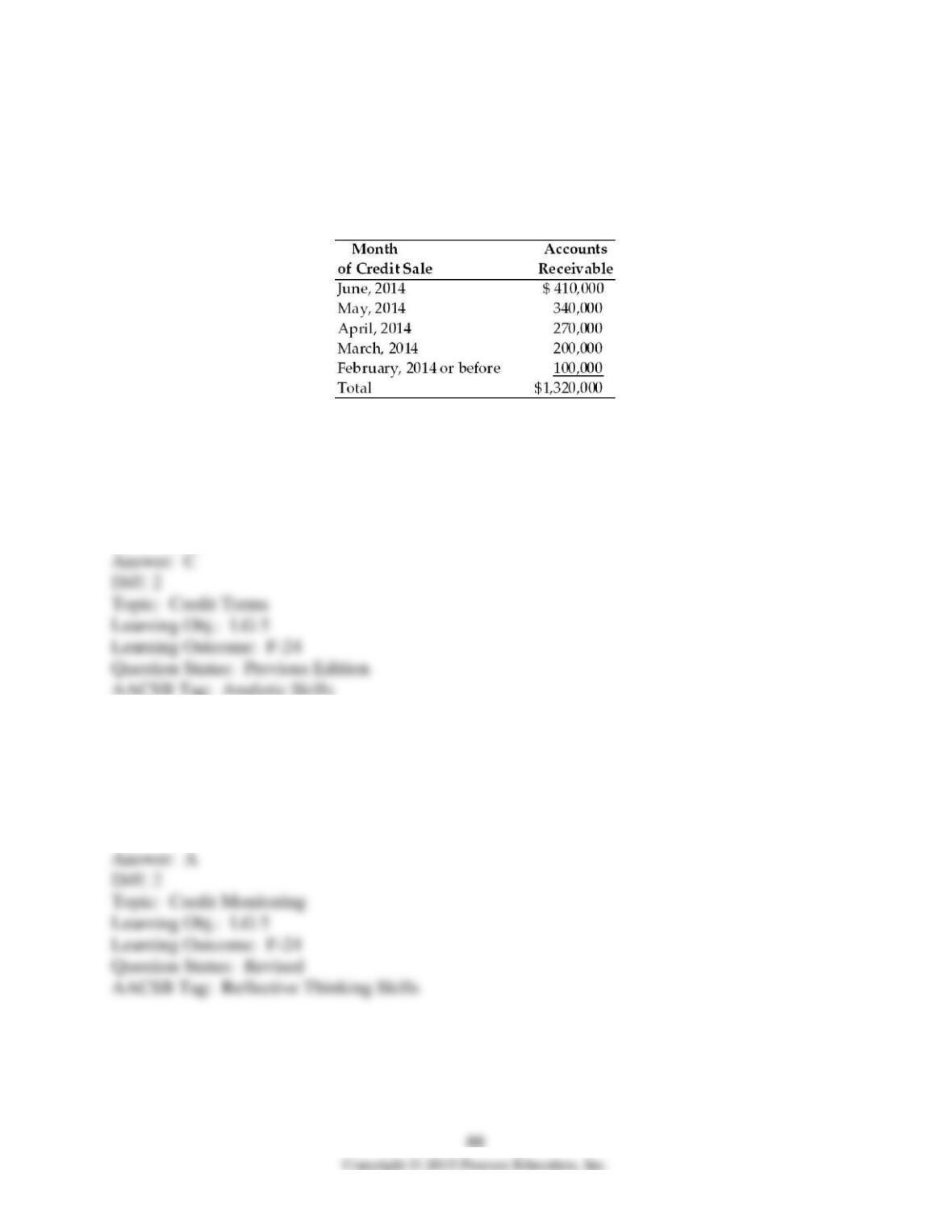
Table 14.6
A breakdown of Teffan, Inc.’s outstanding accounts receivable dated June 30, 2014 on the basis
of the month in which the credit sale was initially made follows. The firm extends 30-day credit
terms.
26) Accounts receivable due over 90 days total ________. (See Table 14.6)
A) $200,000
B) $470,000
C) $300,000
D) $100,000
27) An evaluation of the firm’s collection efforts based on the aging schedule would suggest
________. (See Table 14.6)
A) poor credit management
B) satisfactory credit management
C) superior credit management
D) overzealous collection efforts

28) An increase in collection efforts by a firm will result in ________ in sales volume, ________
in the investment in accounts receivable, ________ in bad debt expenses, and ________ in
collection expenditures.
A) an increase; a decrease; an increase; a decrease
B) an increase; a decrease; a decrease; an increase
C) an increase; a decrease; an increase; an increase
D) a decrease; a decrease; a decrease; an increase
29) A decrease in collection efforts by a firm will result in ________ in sales volume, ________
in the investment in accounts receivable, ________ in bad debt expenses, and ________ in
collection expenditures.
A) an increase; an increase; an increase; a decrease
B) an increase; a decrease; an increase; an increase
C) an increase; a decrease; an increase; a decrease
D) a decrease; a decrease; a decrease; an increase
30) An increase in accounts receivable turnover for a firm due to an increase in collection efforts
will ________.
A) decrease the firm’s marginal investments in accounts receivable
B) increase the firm’s marginal investments in accounts receivable
C) decrease the firm’s collection expense
D) increase the firm’s bad debt expense

Table 14.7
Fizzy Animators, Inc. currently makes all sales on credit and offers no cash discount. The firm is
considering a 3 percent cash discount for payment within 10 days. The firm’s current average
collection period is 90 days, sales are 400 films per year, selling price is $25,000 per film,
variable cost per film is $18,750, and the average cost per film is $21,000. The firm expects that
the change in credit terms will result in a minor increase in sales of 10 films per year, that 75
percent of the sales will take the discount, and the average collection period will drop to 30 days.
The firm’s bad debt expense is expected to become negligible under the proposed plan. The bad
debt expense is currently 0.5 percent of sales. The firm’s required return on equal-risk
investments is 20 percent. (Assume a 360-day year.)
31) What is the firm’s marginal profit contribution from sales under the proposed plan of
initiating the cash discount? (See Table 14.7)
A) $22,500
B) $40,000
C) $62,500
D) $100,000
32) What is the marginal investment in accounts receivable under the proposed plan? (See Table
14.7)
A) $1,234,375
B) $1,382,500
C) $1,567,300
D) $1,841,570
33) What is the cost of marginal investment in accounts receivable under the proposed plan?
(See Table 14.7)
A) $313,460
B) $276,500
C) $246,875
D) $368,314
34) What are the savings of marginal bad debts under the proposed plan? (See Table 14.7)
A) $500,000
B) $50,000
C) $10,000
D) $5,000
35) What is the cost of the marginal cash discount? (See Table 14.7)
A) $768,750
B) $300,000
C) $307,500
D) $230,625
36) What is the net result of increasing the cash discount? (See Table 14.7)
A) +$33,750
B) -$33,750
C) +$128,750
D) -$58,750
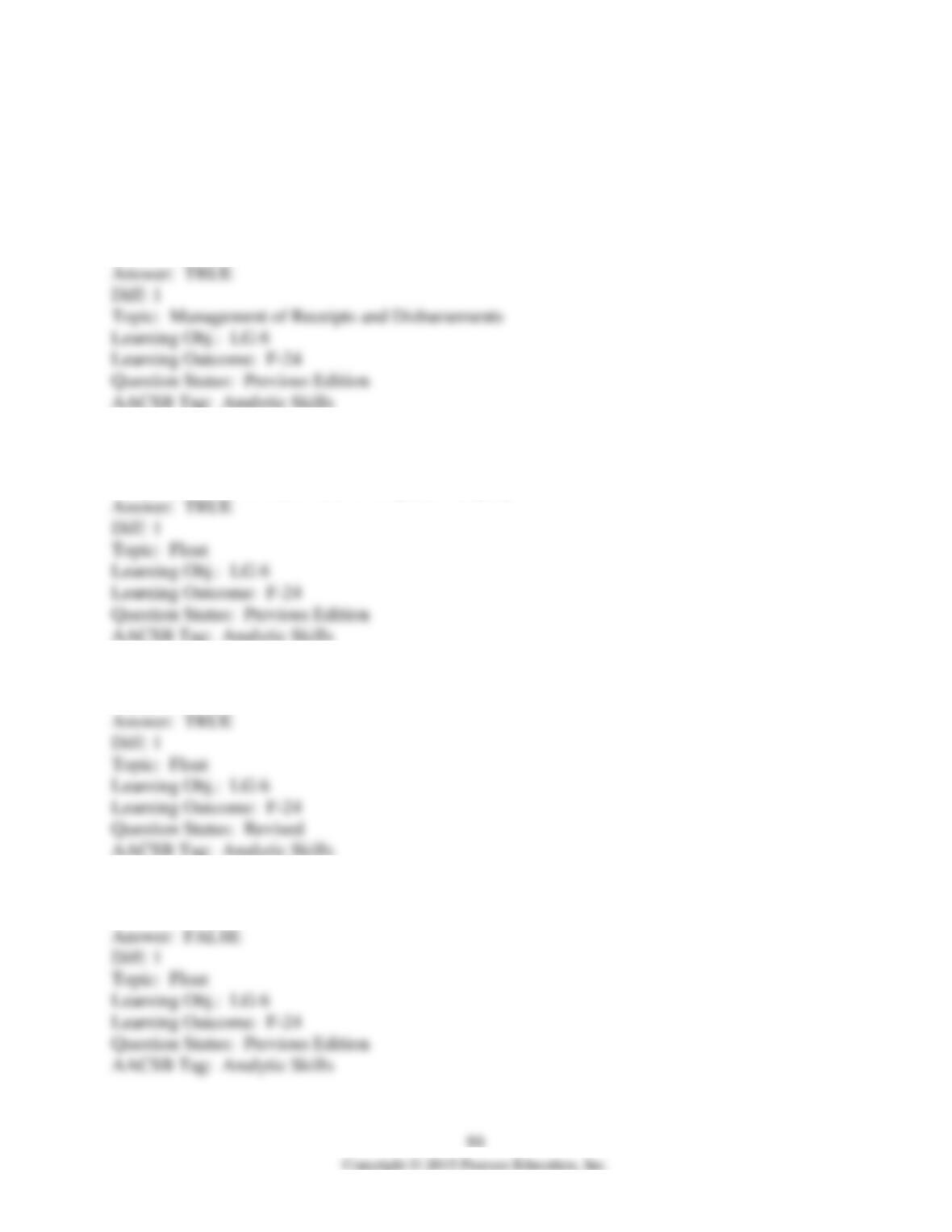
37) Ashley’s Ad Agency’s accounts receivable totaled $451,000 on January 30, 2015. An aging
summary of receivables at this date follows:
The firm extends 30-day credit terms to all its credit customers.
(a) Prepare an aging schedule for Ashley’s Ad Agency.
(b) Evaluate the firm’s collection performance.
14.6 Understand the management of receipts and disbursements, including float, speeding up
collections, slowing down payments, cash concentration, zero-balance accounts, and investing in
marketable securities.
1) Receipts and disbursements management techniques are aimed at minimizing a firm’s
financing requirements by taking advantage of certain imperfections in the collection and
payment system.
2) The entire process resulting from a check issue and mail by a payer company to a payee
company (i.e., mail float, processing float, and clearing float) is disbursement float to the payer
company and is collection float to the payee company.
3) Processing float is the delay between the receipt of a check by a payee and its deposit in firm’s
account.
4) Mail float is the delay between the deposit of a check by a payee and the actual availability of
the funds.

5) Assuming that a firm has done all it can to stimulate customers to pay promptly and to select
vendors offering the most attractive and flexible credit terms, it can further speed collections and
slow disbursements by taking advantage of the “float” existing in the collection and payment
systems.
6) Float exists when a payee has received funds in a spendable form but these funds have not
been withdrawn from the account of the payer.
7) Collection float is experienced by a payer and is a delay in the receipt of funds.
8) Disbursement float is experienced by a payee and is a delay in the actual withdrawal of funds.

9) Collection float results from the lapse between the time that a firm deducts a payment from its
checking account ledger and the time that funds are actually withdrawn from its accounts.
10) Disbursement float results from the delay between the time that a payer or customer deducts
a payment from its checking account ledger (disburses it) and the time that a payee or vendor
actually receives these funds in a spendable form.
11) A lockbox system is used to reduce collection float by shortening all three basic float
components (i.e., mail, processing, and clearing).
12) Controlled disbursing involves the strategic use of mailing points and bank accounts to
lengthen mail float and clearing float, respectively.

13) Controlled disbursing is a method of consciously anticipating the mail, processing, and
clearing time involved with the payment process.
14) Playing the float involves the strategic use of mailing points and bank accounts to lengthen
mail float and clearing float, respectively.
15) With the ACH (automated clearing house) credits, disbursement float is sacrificed because
ACH transactions immediately draw down a company’s payroll account on pay day.
16) The ACH (automated clearing house) debits are preauthorized electronic withdrawals from a
payer’s account.

17) Zero-balance accounts are checking accounts in which a zero balance is maintained and the
bank automatically covers all checks presented against the accounts.
18) Federal agency issues are low-risk securities issued by government agencies but not
guaranteed by the U.S. Treasury.
19) Eurodollar deposits are deposits of currency that are not native to the country in which the
bank is located.
20) To be truly marketable, a security must have three basic characteristics: a ready market, risk-
free, and safety of principal.

21) Marketable securities are short-term, interest-earning, money market instruments that can
easily be converted into cash.
22) Since Treasury bills are issued in bearer form, they are considered to be virtually risk-free.
23) The yields on Treasury bills are generally higher than those on any other marketable
securities due to their virtually risk-free nature.
24) Federal agency issues are obligations of the U.S. Treasury and are readily accepted as low-
risk securities.

25) Commercial paper is a short-term loan issued by commercial banks that have variable yields
based on size, maturity, and prevailing money market conditions.
26) A major decision confronting a business firm when purchasing marketable securities
involves a trade-off between the opportunity to earn a return on idle funds during the holding
period and the brokerage costs associated with the purchase and sale of marketable securities.
27) Treasury notes generate lower returns than U.S. Treasury bills.
28) Most federal agency issues have short maturities and offer slightly higher yields than U.S.
Treasury issues having similar maturities.