
40) Taizhou Products uses 800 units of a product per year on a continuous basis. The product has
carrying costs of $50 per unit per year and order costs of $300 per order. It takes 30 days to
receive a shipment after an order is placed and the firm requires a safety stock of 5 days usage in
inventory.
(a) Calculate the economic order quantity (EOQ).
(b) Determine the reorder point. (Assume a 360-day year.)
41) Jia’s Apple Farm uses 12,600 baskets a year for apple shipment. Determine the optimum
order quantity of baskets assuming the order costs per order is $600 and it costs $2 to carry a unit
of basket in inventory per period.
42) Jia’s Apple Farm uses 35 baskets each day to pack apples for shipping. It takes 5 days to
receive a shipment of baskets after an order is placed and she would like a safety stock of 3 days
in inventory. At what level of inventory should Jia’s place an order for baskets?

43) Joe Manufacturing uses 2,400 units of a product per year on a continuous basis. The product
carrying costs are $60 per year and ordering costs are $250 per order. It takes 20 days to receive
a shipment after an order is placed and the firm requires a safety stock of 8 days of usage in
inventory.
(a) Calculate the economic order quantity (round up to the nearest whole unit.)
(b) Calculate the total cost per year to order and carry this item.
(c) Its supplier has notified Joe that if Joe increases its order quantity by 58 units they will give it
a discount. Calculate the dollar discount that the suppliers will have to give Joe Manufacturing to
result in a net benefit to the company.
14.4 Explain the credit selection process and the quantitative procedure for evaluating changes
in credit standards.
1) One of the components of a cash conversion cycle is the average collection period.
2) A firm’s credit selection is the process of determining the minimum requirements for
extending credit to a customer.

3) Credit analysts usually analyze an applicant’s creditworthiness by using the dimensions of
credit such as character, capacity, capital, collateral, and conditions.
4) Credit selection involves application of techniques for determining which customers should
receive credit.
5) A firm’s credit standards are the minimum requirements for extending credit to a customer.
6) By increasing collection expenditures, a firm can decrease bad debt losses up to a point,
beyond which bad debts cannot be economically reduced.

7) The average investment of a firm in accounts receivable is equal to the firm’s total variable
cost of annual sales divided by its average collection period.
8) The objective for managing accounts receivable is to avoid credit sales as much as possible.
9) In analyzing an applicant’s creditworthiness, a credit manager typically gives primary
attention to two of the five C’s of credit—collateral and condition—since they represent the most
basic requirements for extending credit to an applicant.
10) One of the key inputs to the final credit decision is a credit analyst’s subjective judgment of a
firm’s creditworthiness since it can provide a better feel of a firm’s operation than any
quantitative figures.

11) A firm’s credit selection procedures must be established on a sound economic basis that
considers the costs of investigating the creditworthiness of a customer and the expected size of
its credit purchases.
12) A firm’s credit standard is a procedure for ranking an applicant’s overall credit strength,
derived as a weighted average of scores on key financial and credit characteristics.
13) As credit standards are relaxed, sales are expected to increase and the investment in accounts
receivable is expected to decrease.
14) The turnover of accounts receivable can be calculated by dividing 365 days by average
collection period.

15) Increasing the length of the credit period can increase sales, but both the investment in
accounts receivable and bad debt expenses are likely to increase as well.
16) If a firm relaxes its credit standards, the volume of accounts receivable increases and so does
the firm’s carrying cost.
17) A relaxation of credit standards is expected to affect profits positively due to lower carrying
costs, whereas tightening credit standards would affect profits negatively as a result of higher
carrying costs.
18) The increase in bad debts associated with tightening credit standards raises bad debt
expenses and has a negative impact on profits.

19) The cost of marginal investment in accounts receivable can be calculated by finding the
difference between the average investment in accounts receivable before and after the
introduction of the changes in credit standards.
20) The cost of marginal bad debts is found by multiplying a firm’s opportunity cost by the
difference between the level of bad debts before and after the relaxation of credit standards.
21) The key dimension of credit selection which analyzes an applicant’s record of meeting past
obligations is ________.
A) collateral
B) capacity
C) character
D) capital

22) ________ is a procedure resulting in a number reflecting an applicant’s credit strength,
derived as a weighted average of the scores obtained on a variety of key financial and credit
characteristics.
A) Credit scoring
B) Aging of receivables
C) CAPM
D) The economic order quantity model
23) The key dimension of credit selection which analyzes an applicant’s ability to repay the
requested credit focused on cash flows available is ________.
A) collateral
B) capital
C) conditions
D) capacity
24) ________ are established to evaluate a customer’s creditworthiness and to determine the
minimum requirements for extending credit to a customer.
A) Lines of credit
B) Credit limits
C) Collection agencies
D) Credit standards

25) Which of the following is true of credit scoring?
A) It audits the amount of assets the applicant has available for use in securing the credit.
B) It specifies the terms of sale for customers who have been extended credit by a firm.
C) It is an ongoing review of a firm’s accounts receivable to determine whether customers are
paying according to the stated credit terms.
D) It applies statistically derived weights to an applicant’s scores on key financial and credit
characteristics.
26) The key dimension of credit selection which analyzes the amount of assets an applicant has
available for use in securing the credit is ________.
A) capital
B) collateral
C) capacity
D) conditions
27) Which of the following is one of the five C’s of credit?
A) coordination
B) cost
C) character
D) control

28) A credit applicant’s ________ reflects its ability to repay the requested credit.
A) character
B) capacity
C) capital
D) collateral
29) A credit applicant’s ________ is his or her financial strength as reflected by his or her
ownership position.
A) character
B) capacity
C) capital
D) collateral
30) A credit applicant’s ________ reflects his or her record of meeting past obligations.
A) condition
B) capacity
C) control
D) character

31) Which of the following is a major external source of credit information?
A) suppliers
B) bank checking
C) customers
D) distributors
32) Which of the following is true of credit scoring of suppliers?
A) It is frequently used in business because the scoring information is easy to obtain.
B) It is frequently used in business because scoring standards are too flexible.
C) It is frequently not used in business because most business transactions involve mercantile
credit which cannot be scored.
D) It is frequently used in business because mercantile credit decisions are easily quantifiable.
33) Which of the following is true of a credit applicant’s character?
A) It reflects a credit applicant’s ability to repay his debt obligation.
B) It reflects a credit applicant’s past payment history.
C) It reflects the level of liquid assets available with a credit applicant.
D) It reflects any unique conditions surrounding a credit applicant’s transaction.

34) As credit standards are relaxed, sales are expected to ________ and the investment in
accounts receivable is expected to ________.
A) increase; increase
B) increase; decrease
C) decrease; decrease
D) decrease; increase
35) As credit standards are tightened, sales are expected to ________ and the investment in
accounts receivable is expected to ________.
A) increase; increase
B) increase; decrease
C) decrease; decrease
D) decrease; increase
36) Which of the following major variables should be considered when evaluating proposed
changes in credit standards?
A) level of inventories
B) accounts payable
C) level of liquid assets
D) bad debt expenses

37) An applicant’s capacity to repay its requested credit can be found by ________.
A) analyzing financial statements
B) checking bank account balances
C) analyzing tax payment history
D) checking the covenants
38) A firm is analyzing a relaxation of credit standards that is expected to increase sales 10
percent. The firm is currently selling 400 units at an average sale price per unit of $575, and the
variable cost per unit is $400 at the current sales volume. The average cost per unit is $425. What
is the additional profit contribution from sales if credit standards are relaxed?
A) $23,000
B) $16,000
C) $6,000
D) $7,000
39) When a firm’s credit standards is relaxed ________.
A) its sales is expected to decrease with corresponding increase in costs
B) its costs is expected to decrease with corresponding decrease in sales
C) its costs is expected to increase faster than sales if the standards are not relaxed
D) its profit contribution from sales will be greater than the cost contribution

Table 14.5
Caren’s Canoes is considering relaxing its credit standards to encourage more sales. As a result,
sales are expected to increase 15 percent from 300 canoes per year to 345 canoes per year. The
average collection period is expected to increase to 40 days from 30 days and bad debts are
expected to double the current 1 percent level. The price per canoe is $850, the variable cost per
canoe is $650 and the average cost per unit at the 300 unit level is $700. The firm’s required
return on investment is 20 percent. (Assume a 360-day year)
40) What is the firm’s additional profit contribution from sales under the proposed relaxation of
credit standards? (See Table 14.5)
A) $2,250
B) $6,750
C) $9,000
D) $69,000
41) What is the cost of marginal investments in accounts receivable under the proposed plan?
(See Table 14.5)
A) $1,817
B) $1,867
C) $1,733
D) $1,617

42) What is the cost of marginal bad debts under the proposed plan? (See Table 14.5)
A) $383
B) $765
C) $3,315
D) $5,100
43) What is the net result of implementing the proposed plan? (See Table 14.5)
A) $3,952
B) $3,869
C) $2,084
D) -$2,084
44) A firm is considering relaxing credit standards, which will result in annual sales increasing
from $1.5 million to $1.75 million, the cost of annual sales increasing from $1,000,000 to
$1,125,000, and the average collection period increasing from 40 to 55 days. The bad debt loss is
expected to increase from 1 percent of sales to 1.5 percent of sales. The firm’s required return on
investments is 20 percent. The firm’s cost of marginal investment in accounts receivable is
________. (Assume a 360-day year.)
A) $5,556
B) $9,944
C) $12,153
D) $152,778

45) A firm is considering relaxing credit standards which will result in an increase in annual
sales from $3 million to $3.75 million, a decrease in the cost of annual sales from $2,225,000 to
$2,000,000, an increase in additional profit contribution from sales of $10,000, and an increase
in the average collection period of 15 days, from 20 to 35 days. The bad debt loss is expected to
increase from 1 percent to 1.5 percent of sales. The firm’s required return on investments is 15
percent. The net result of the firm relaxing its credit standards is ________. (Assume a 360-day
year.)
A) $10,000
B) -$16,250
C) -$26,875
D) -$16,875
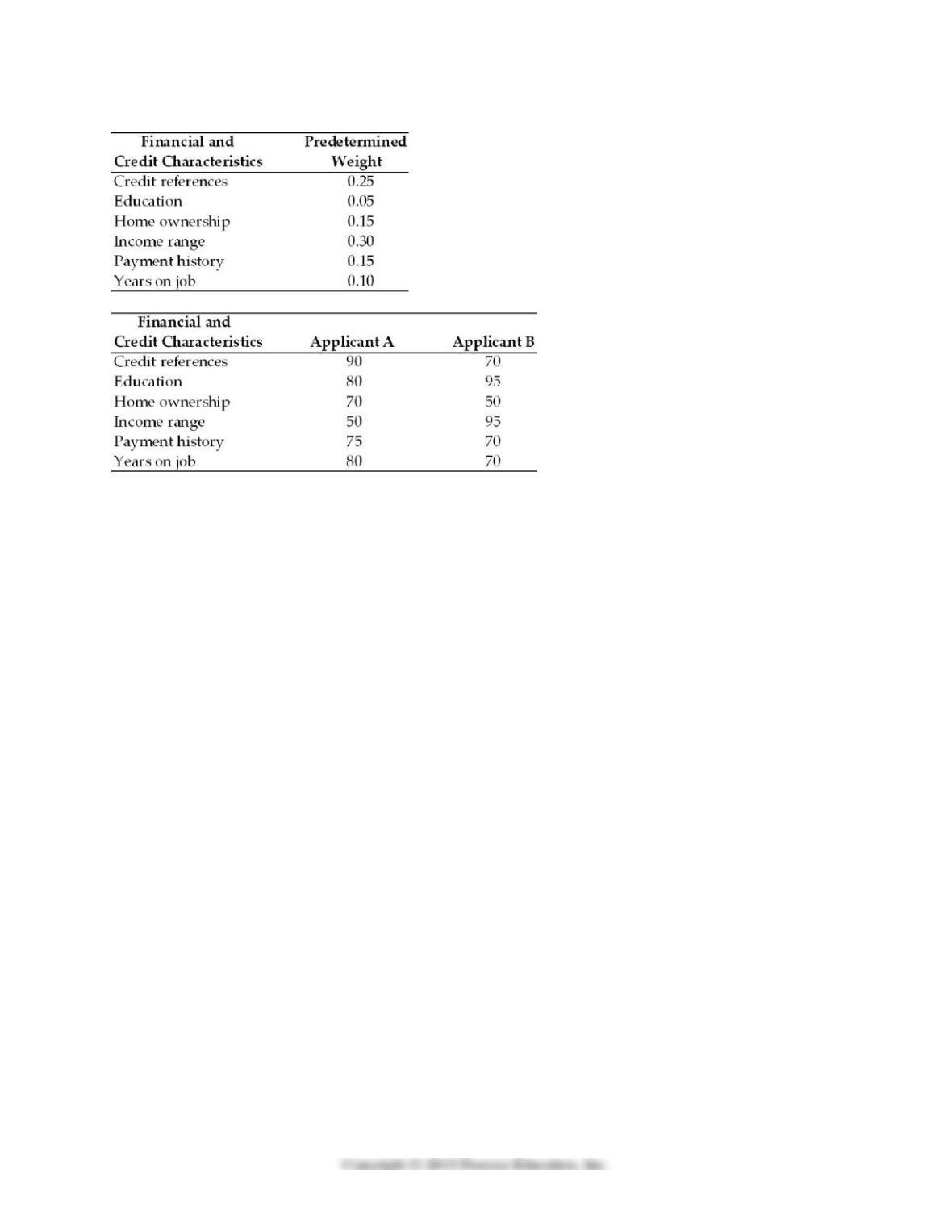
77
46) Credit Scoring Policy
Jia’s Jewelry uses the credit scoring technique to evaluate retail applications. The financial and
credit characteristics considered and weights indicating their relative importance in the credit
decision are shown above. The firm’s credit standards are to accept all applicants with credit
scores of 85 or more, to extend limited credit to applicants with scores ranging from 75 to 84,
and to reject all applicants below 75. The firm is currently processing two applicants. The scores
of each applicant on each of the financial and credit characteristics are summarized above.
Would you recommend either of these applicants for credit extension?


47) Maggie’s Gold Coins, Inc. is considering shortening its credit period from 30 days to 20 days
and believes, as a result of this change, its average collection period will decrease from 36 days
to 30 days. Bad debt expenses are also expected to decrease from 1.2 percent to 0.8 percent of
sales. The firm is currently selling 300,000 units but believes as a result of the change, sales will
decline to 275,000 units. On 300,000 units, sales revenue is $4,200,000, variable costs total
$3,300,000, and fixed costs are $300,000. The firm has a required return on similar-risk
investments of 15 percent. Evaluate this proposed change and make a recommendation to the
firm.

14.5 Review the procedures for quantitatively considering cash discount changes, other aspects
of credit terms, and credit monitoring.
1) If the level of bad debt attributable to credit policy is relatively constant, increasing collection
expenditures can be expected to reduce bad debts.
2) 2/15 net 45 translates as 2 percent of the balance is due in 15 days; the remaining balance is
due in 45 days.
3) If a firm increases its cash discount period, the firm’s investment in accounts receivable due to
non-discount takers now paying earlier is expected to decrease.
4) If a firm increases its cash discount period the firm’s investment in accounts receivable, due to
discount takers still getting cash discounts but paying later, is expected to increase.