54
22) The equilibrium constant, Kp, equals 3.40 for the isomerization reaction:
cis-2-butene ⇌ trans-2-butene.
If a flask initially contains 0.250 atm of cis-2-butene and 0.205 atm of trans-2-butene, what is the
equilibrium pressure of each gas?
A) P(cis-2-butene) = 0.0603 atm and P(trans-2-butene) = 0.205 atm
B) P(cis-2-butene) = 0.0431 atm and P(trans-2-butene) = 0.147 atm
C) P(cis-2-butene) = 0.0735 atm and P(trans-2-butene) = 0.250 atm
D) P(cis-2-butene) = 0.103 atm and P(trans-2-butene) = 0.352 atm
23) Phosphorus pentachloride decomposes to phosphorus trichloride at high temperatures according to
the equation:
PCl5(g) ⇌ PCl3(g) + Cl2(g)
At 250° 0.250 M PCl5 is added to the flask. If Kc = 1.80, what are the equilibrium concentrations of each
gas?
A) [PCl5] = 0.0280 M, [PCl3] = 0.222 M, and [Cl2] = 0.222 M
B) [PCl5] = 0.125 M, [PCl3] = 0.474 M, and [Cl2] = 0.474 M
C) [PCl5] = 1.80 M, [PCl3] = 1.80 M, and [Cl2] = 1.80 M
D) [PCl5] = 2.27 M, [PCl3] = 2.02 M, and [Cl2] = 2.02 M
24) For the reaction, A(g) + 2 B(g) ⇌ 2 C(g), Kc = 5.00 × 10⁻¹⁰ at 25°C. Which of the following statements is
true?
A) Δn = +1
B) The concentration of the products is greater than the concentration of the reactants.
C) The reaction is favored in the reverse direction.
D) The value of Kp will be larger than the value for Kc.
25) Which statement is true for a reaction with Kc equal to 8.90 × 10⁻¹²?
A) Increasing the temperature will not change the value of Kc.
B) There are appreciable concentrations of both reactants and products.
C) The reaction proceeds hardly at all towards completion.
D) The reaction proceeds nearly all the way to completion.
26) For the reaction: 4 HCl(g) + O2(g) ⇌ 2 Cl2(g) + 2 H2O(l), the equilibrium constant is 0.063 at 400 K. If
the reaction quotient is 0.100, which of the following statements is not correct?
A) [HCl] will increase.
B) [O2] will increase.
C) [H2O] will decrease.
D) [O2 ] will decrease.
27) “If a stress is applied to a reaction mixture at equilibrium, the reaction occurs in the direction that will
relieve the stress.” This statement is called
A) the Third Law of Thermodynamics.
B) the Law of Combining Volumes.
C) the Law of Mass Action.
D) Le Châtelier’s principle.
28) Which of the following changes in reaction conditions will alter the composition of an equilibrium
mixture of gases for a reaction having unequal moles of gaseous products and gaseous reactants?
A) adding of products
B) decreasing the volume
C) increasing the temperature
D) All of these will alter the equilibrium concentrations.
29) For a homogeneous equilibrium of gases, which of the following changes in reaction conditions will
not alter the equilibrium concentrations?
A) addition of an inert gas to the reaction mixture
B) addition of products
C) increasing the volumee
D) increasing the temperature
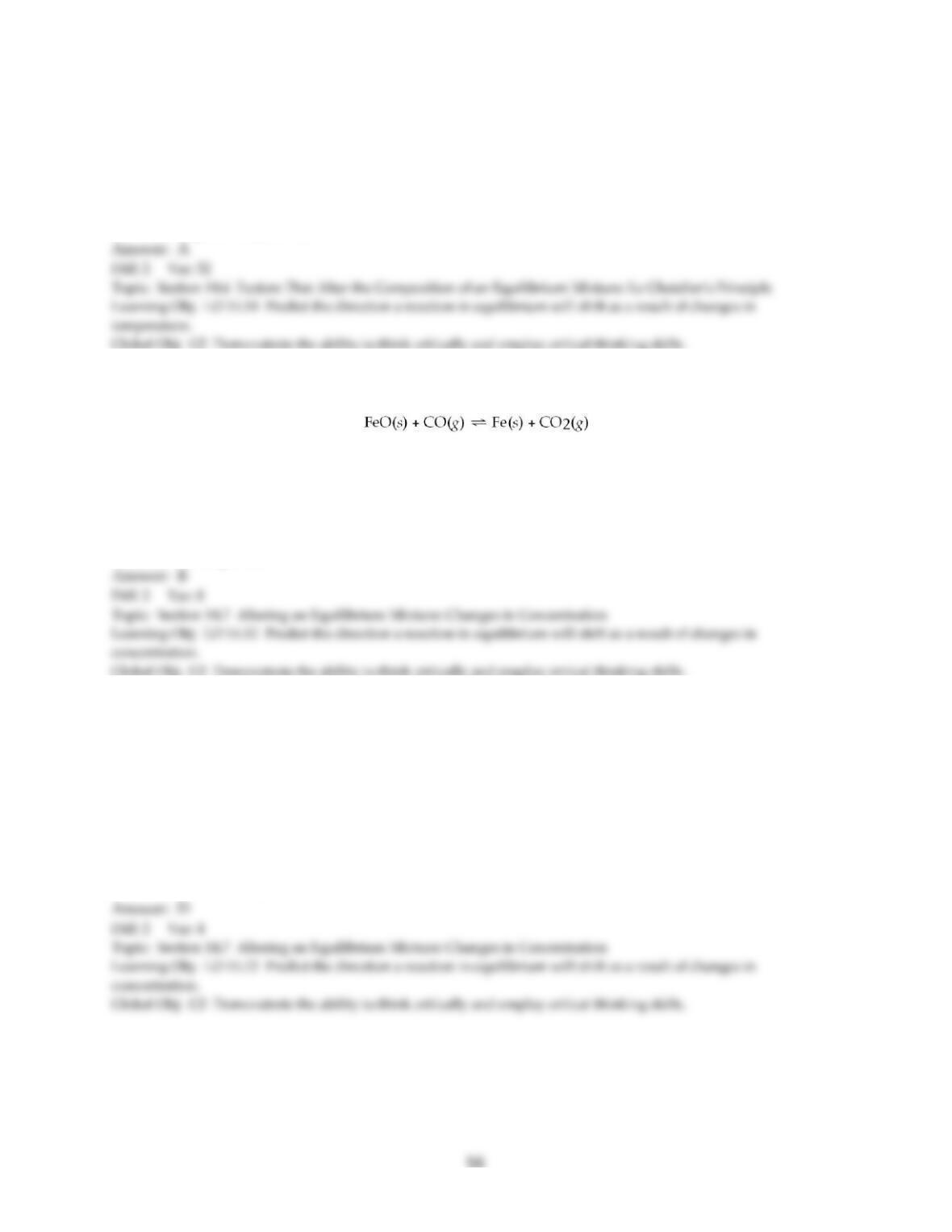
30) Iron oxide ores are reduced to iron metal by exothermic reaction with carbon monoxide:
Which of the following changes in condition will cause the equilibrium to shift to the right?
A) remove FeO
B) add CO
C) add CO2
D) raise the temperature
31) The enthalpy for the following reaction is 136 kJ. If the reaction takes place in a closed container,
which one of the following reaction conditions will not decrease the concentration of water vapor?
2 NaHCO3(s) ⇌ Na2CO3(s) + CO2(g) + H2O(g)
A) remove CO2
B) cool the container
C) decrease the volume of the container
D) add some NaHCO3
32) For the reaction shown below, which change in conditions made to the system at equilibrium will
result in a net reaction to the right to form more product?
C(s) + 2 H2(g) ⇌ CH4(g) ΔH° = – 74.8 kJ
A) adding Ar
B) adding C
C) increasing the pressure
D) increasing the volume
33) Which change in the system will drive equilibrium to the left in the reaction below?
N2O5(g) ⇌ NO2(g) + NO3(g)
A) decrease the amount of NO3
B) increase the amount of N2O5
C) decrease the volume
D) increase the volume
34) Ammonium bromide is a crystalline solid that decomposes endothermically when heated:
NH4Br(s) ⇌ NH3(g) + HBr(g). When solid NH4Br is added to an evacuated flask at 300°C, which change
in reaction conditions below will cause the equilibrium to shift to the right?
A) add more HBr
B) add more NH4Br
C) decrease the temperature
D) decrease the pressure
35) For the reaction shown below, which change in conditions made to the system at equilibrium will
result in a net reaction to the right to form more product?
C(s) + 2 H2(g) ⇌ CH4(g) ΔH° = -74.8 kJ
A) removing C
B) increasing the volume
C) increasing the pressure
D) removing H2
36) The overall reaction for photosynthesis can be represented by the following equation:
6 CO2(g) + 6 H2O(l) ⇌ C6H12O6(s) + 6 O2(g)
The enthalpy change for this reaction is 2802 kJ. Which of the following changes in condition will shift the
equilibrium to the right?
A) increase the pressure of O2
B) increase the temperature
C) add water
D) add C6H12O6(s)
37) For the reaction shown below, which change in conditions made to the system at equilibrium will
result in a net reaction to the right to form more product?
C(s) + 2 H2(g) ⇌ CH4(g) ΔH° = -74.8 kJ
A) adding more C
B) removing C
C) increasing the concentration of H2
D) decreasing the concentration of H2
59
38) The decomposition of nitrosyl bromide is exothermic: 2 NOBr(g) ⇌ 2 NO(g) + Br2(g). Which of the
following changes in reaction condition will shift the reaction to the left?
A) remove NO
B) decrease the temperature
C) decrease the pressure
D) None of these
39) Which will alter the composition of an equilibrium mixture?
A) increase the volume
B) increase the temperature
C) increase the pressure
D) all of the above
40) Which of the following changes in reaction conditions will not alter the composition of a
homogeneous equilibrium mixture of gases in a reaction having unequal moles of gaseous products and
reactants?
A) addition of a catalyst
B) addition of reactants
C) decreasing the temperature
D) increasing the volume
41) Which of the following statements about a catalyst is true?
A) A catalyst decreases the position of the equilibrium in a reaction.
B) A catalyst increases the pressure of a reaction.
C) A catalyst is consumed in a chemical reaction.
D) A catalyst provides a lower energy pathway for a reaction.
14.3 Short Answer Questions
60
1) A reaction in which reactants form products in the forward reaction and products simultaneously form
reactants in the reverse reaction is said to be ________.
2) In a reversible reaction, when the rate of the forward reaction equals the rate of the reverse reaction, the
reaction is at ________.
3) For the reaction H2(g) + S(s) ⇌ H2S(g), if the rate constant for the forward reaction is greater than the
rate constant for the reverse reaction, the value of Kc must be ________ (equal to, greater than, less than)
1.
4) For the reaction shown below, N2O4 and NO2 have equilibrium concentrations, [N2O4]eq = 2.160 ×
10-4 and [NO2]eq = 1.001 × 10⁻³, respectively. The equilibrium constant, Kc, for this reaction equals
________.
N2O4(g) ⇌ 2 NO2(g)
5) For the reaction CaCO3(s) ⇌ CaO(s) + O2(g) the equilibrium expression is Kp = ________.
61
6) For the reaction shown below the value of Kp is ________ than the value of Kc, because Δn = ________.
N2O4(g) ⇌ 2 NO2(g)
7) At 298 K, Kp = 2.1 × 10⁴ for the reaction CO(g) + 2 H2(g) ⇌ CH3OH(g). What is the value of Kc at this
temperature?
8) At 298 K, Kc = 1.7 × 10–56 for the reaction 3 O2(g) ⇌ 2 O3(g). What is the value of Kp at this
temperature?
9) At 1000 K, Kp = 19.9 for the reaction Fe2O3(s) + 3 CO(g) ⇌ 2 Fe(s) + 3 CO2(g). What is the value of Kp
for the reaction 2 Fe2O3(s) + 6 CO(g) ⇌ 4 Fe(s) + 6 CO2(g)?
10) At 1000 K, Kp = 19.9 for the reaction Fe2O3(s) + 3 CO(g) ⇌ 2 Fe(s) + 3 CO2(g). What is the value of Kp
for the reaction 8 Fe(s) + 12 CO2(g) ⇌ 4 Fe2O3(s) + 12 CO(g)?
62
11) For the reaction shown below the equilibrium constant expression for Kc = ________.
HF(aq) + H2O(l) ⇌ H3O+(aq) + F–(aq)
12) Kc = 57.0 at 700 K for the reaction shown below.
H2(g) + I2(g) ⇌ 2 HI(g)
If [H2(g)] = [I2(g)] = 0.200 M at equilibrium, the molar concentration [HI((g)] = ________ at equilibrium.
13) Kc = 1.2 × 10–42 at 500 K for the reaction shown below.
H2(g) ⇌ 2 H(g)
If [H2] = 1 × 10⁻² M and [H] = 1.2 × 10⁻²² M, in order to achieve equilibrium a net reaction must occur
from ________ to ________ until Qc = ________.
14) At an elevated temperature, Kp = 0.19 for the reaction 2 NOCl(g) ⇌ 2 NO(g) + Cl2(g). If the initial
partial pressures of NOCl, NO, and Cl2 are 0.50 atm, 0.25 atm, and 0.45 atm, respectively, a net ________
(forward, reverse) reaction must occur in order to achieve equilibrium.
63
15) At an elevated temperature, Kp = 4.2 × 10⁻⁹ for the reaction 2 HBr(g) ⇌ H2(g) + Br2(g). If the initial
partial pressures of HBr, H2, and Br2 are 1.0 × 10⁻² atm, 2.0 × 10⁻⁴ atm, and 2.0 × 10⁻⁴ atm, respectively,
what is the equilibrium partial pressure of H2?
16) For the reaction 2 A + B2 ⇌ 2 AB, the rate of the forward reaction is 0.75 M/s and the rate of the
reverse reaction is 0.25 M/s. The reaction is not at equilibrium. In order to attain equilibrium the reaction
must proceed in the ________ (forward, reverse) direction in order to achieve equilibrium.
17) For the reaction A2 + 2 B3 ⇌ 2 AB3, the rate of the forward reaction is 0.25 M/s and the rate of the
reverse reaction is 0.75 M/s. The reaction is not at equilibrium. In order to attain equilibrium the reaction
must proceed in the ________ (forward, reverse) direction in order to achieve equilibrium.
18) If additional SCN– is added to the equilibrium system shown below, Le Châtelier’s principle predicts
a net reaction from ________ to ________, causing the red color to become ________.
Fe3+(aq) + SCN–(aq) ⇌ FeSCN2+(aq)
yellow colorless red
19) The reaction CaCO3(s) ⇌ CaO(s) + O2(g) is endothermic 298 K. The effect of adding CaO to the
system at equilibrium will ________ (decrease, increase, have no effect on) the total quantity of CaO once
equilibrium is reestablished.
20) According to Le Châtelier’s principle, if the volume of the vessel containing the equilibrium system
shown below is decreased, there will be an increase in the concentration of ________ and a decrease in the
concentration of ________.
H2(g) ⇌ 2 H(g)
21) The reaction CaCO3(s) ⇌ CaO(s) + O2(g) is endothermic 298 K. The effect of increasing the partial
pressure of O2 in the system at equilibrium will ________ (decrease, increase, have no effect on) the total
quantity of CaCO3 once equilibrium is reestablished.
22) The reaction CaCO3(s) ⇌ CaO(s) + O2(g) is endothermic 298 K. The effect of increasing the total
volume of the system at equilibrium will ________ (decrease, increase, have no effect on) the total
quantity of CaCO3 once equilibrium is reestablished.
23) The reaction below is heated from 20°C to 91°C, according to Le Châtelier’s principle, there will be a
net reaction from ________ to ________, and the brown color will become ________.
N2O4(g) ⇌ 2 NO2(g) ΔH°= + 57.2 kJ
colorless brown
65
24) The reaction CaCO3(s) ⇌ CaO(s) + O2(g) is endothermic at 298 K. The effect of increasing the
temperature of the system at equilibrium will ________ (decrease, increase, have no effect on) the total
quantity of CaCO3 once equilibrium is reestablished.
25) The reaction CaCO3(s) ⇌ CaO(s) + O2(g) is endothermic 298 K. The effect of adding a catalyst to the
system at equilibrium will ________ (decrease, increase, have no effect on) the total quantity of CaCO3
once equilibrium is reestablished.