18) Refer to Figure 14.2. A movement from point d to point b could be caused by a(n)
A) increase in government spending.
B) increase in the price of oil.
C) increase in taxes.
D) decrease in short-run aggregate supply.
19) Refer to Figure 14.2. A movement from point b to point d could be caused by a(n)
A) decrease in government spending.
B) increase in the price of oil.
C) decrease in taxes.
D) increase in short-run aggregate supply.
20) Refer to Figure 14.2. A movement from point d to point c could be caused by a(n)
A) increase in government spending.
B) increase in the price of oil.
C) increase in taxes.
D) increase in short-run aggregate supply.
21) Refer to Figure 14.2. A movement from point a to point b could be caused by a(n)
A) increase in government spending.
B) decrease in the price of oil.
C) decrease in taxes.
D) decrease in short-run aggregate supply.
22) Refer to Figure 14.2. A movement from point b to point a could be caused by a(n)
A) increase in government spending.
B) decrease in the price of oil.
C) increase in taxes.
D) a massive crop failure.
Recall the Application about the factors involved in causing recessions, and the causes of
recessions in the United States from 1893 to 1990 to answer the following question(s).
23) Recall the Application. Recessions can occur either when there is a(n) ________ in
aggregate demand or a(n) ________ in aggregate supply.
A) increase; increase
B) increase; decrease
C) decrease; decrease
D) decrease; increase
24) Recall the application. The recession of 1929 was primarily due to
A) a decrease in aggregate demand caused by the private sector.
B) a decrease in aggregate demand resulting from decreases in government spending.
C) a decrease in aggregate supply due to rising gold prices.
D) an increase in aggregate supply resulting from European bank collapses.
25) Recall the application. The recessions in 1973 and 1979 were caused by
A) supply shocks.
B) deflation.
C) foreign monetary developments.
D) arbitrage losses in the foreign exchange market.
26) Recall the application. The recession in 1991 was caused by
A) increasing oil prices which resulted in a decrease in aggregate supply.
B) the government cutting back on aggregate demand to reduce inflation.
C) an decrease in aggregate supply resulting from U.S. bank collapses.
D) massive immigration from Europe to the United States.
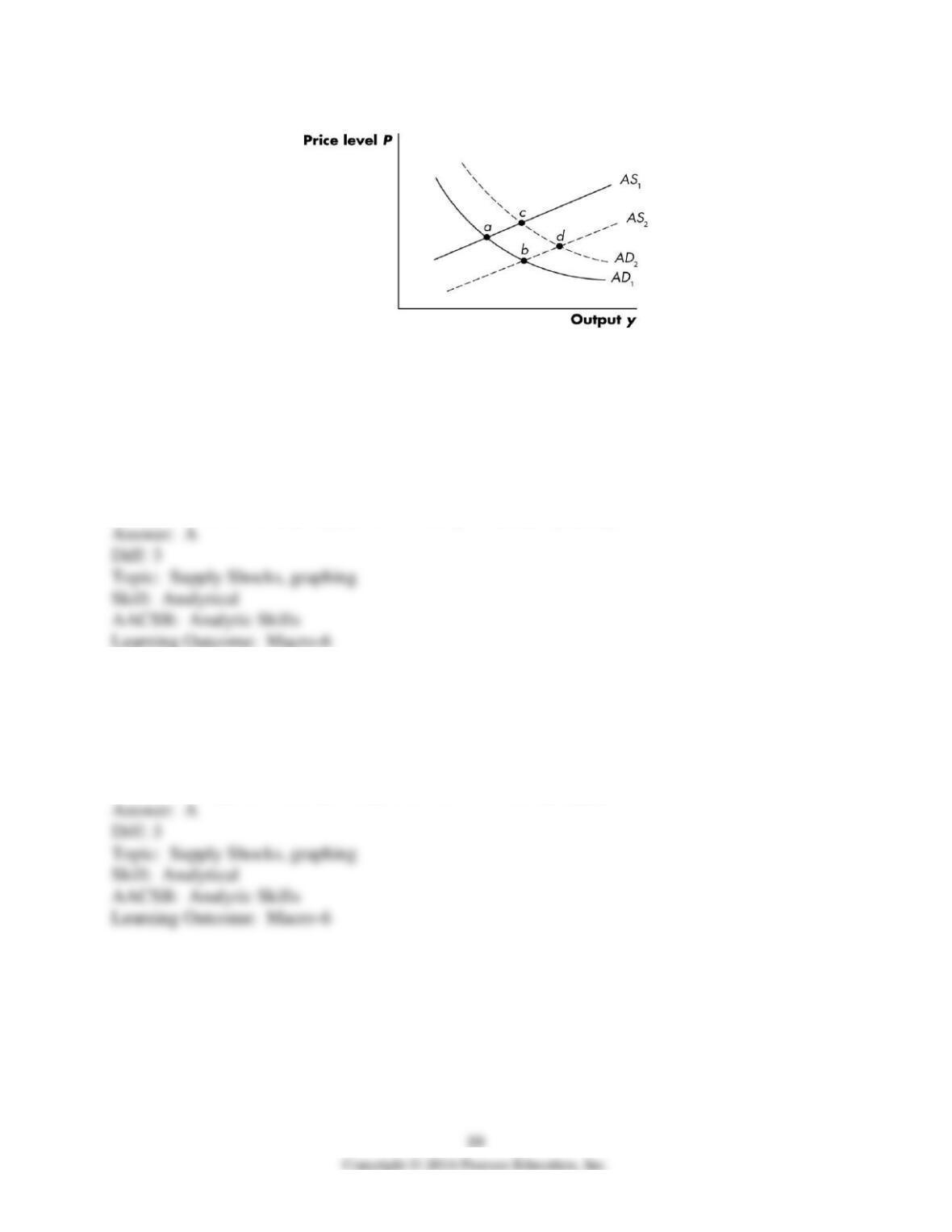
Figure 14.2
27) Refer to Figure 14.2. A movement from point a to point d could be caused by a simultaneous
________ and ________.
A) increase in government spending; decrease in the price of oil
B) increase in taxes; increase in the price of oil
C) decrease in taxes; massive crop failure
D) decrease in the money supply; decrease in government spending
28) Refer to Figure 14.2. A movement from point c to point b could be caused by a simultaneous
________ and ________.
A) decrease in government spending; decrease in the price of oil
B) decrease in taxes; increase in the price of oil
C) increase in taxes; decrease in government spending
D) increase in government spending; increase in the money supply
29) Refer to Figure 14.2. A movement from point d to point a could be caused by a simultaneous
________ and ________.
A) decrease in the money supply; increase in the price of oil
B) increase in the money supply; massive crop failure
C) decrease in taxes; decrease in the money supply
D) decrease in government spending; decrease in the price of oil
30) Refer to Figure 14.2. A movement from point b to point c could be caused by a simultaneous
________ and ________.
A) increase in the money supply; increase in the price of oil
B) decrease in taxes; decrease in the price of oil
C) increase in taxes; decrease in government spending
D) increase in the price of oil; massive crop failure
31) Which of the following is an example of a supply shock?
A) a surprise increase of the money supply
B) an increase in government spending
C) a sharp increase in the price of oil
D) an increase in the price level
32) Which one of the following statements is true?
A) In the short run, the level of output is determined by demand.
B) In the long run, the level of output is determined by demand.
C) In the long run, the aggregate supply curve is horizontal.
D) Where aggregate demand and aggregate supply intersect is always the full-employment level
of output.
33) When there is a shift the aggregate supply curve caused by factors external to a nation’s
economy, it is called
A) trade imbalance.
B) government control.
C) supply shock.
D) economic anomaly.
34) A supply shock is an ________ event that shifts the aggregate ________ curve.
A) internal; supply
B) external; supply
C) internal; demand
D) external; demand
35) When there is a recession (a fall in output) and prices are increasing, and this situation is
caused by adverse supply shocks, the term economists use to describe it is
A) aggregate shifts.
B) stagnation.
C) inflation.
D) stagflation.
Recall the Application about the causes of oil price increases to answer the following
question(s). Economist Lutz Kilian examined the importance of supply disruptions to the
U.S. oil market by constructing measures of supply disruptions in oil producing countries
based on a detailed examination of prior trends in demand and specifications in oil
contracts.
36) Recall the application. If speculators believe oil prices are going to rise in the future, they
will ________ oil now, which will tend to ________ the current price of oil.
A) buy; decrease
B) buy; increase
C) sell; decrease
D) sell; increase
37) Recall the application. Oil price increases may be caused by
A) decreases in world demand.
B) increases in world supply.
C) speculation in oil markets.
D) price ceilings in oil markets.
38) Recall the application. Oil price increases may be caused by
A) increases in world demand.
B) increases in world supply.
C) increase in the U.S. supply of money.
D) beneficial supply shocks for the U.S. consumer.
39) Recall the application. Oil supply disruptions explain ________ of the variability of oil
prices.
A) about 50%
B) more than 90%
C) only a small fraction
D) absolutely none
40) The long-run aggregate supply curve is horizontal.
41) Aggregate demand determines output in the short run if prices are flexible.
42) If the supply of money increases, the long-run aggregate supply curve suggests that output
will not change but price level will.
43) Aggregate demand and aggregate supply must be combined to determine the price level and
the “real” GDP.
44) In the long run, output is determined solely by the supply of capital and the supply of labor,
not the price level.
45) In the long run, the level of output depends on the price level.
46) In the short run, the price level is determined primarily by the supply of goods.
47) Adverse supply shocks can cause a recession with increasing price level.
48) The term “stagflation” is used to define an economic situation where there are adverse supply
shocks which cause a fall in output but with increasing price level.
49) Explain why the long-run aggregate supply curve is vertical.
50) Explain why the short-run aggregate supply curve is a relatively flat, horizontal line.
51) What are supply shocks? Explain what effect adverse and favorable supply shocks have on
the supply curve.
52) Name a supply shock that has affected the U.S. economy on more than one occasion.
14.4 From the Short Run to the Long Run
1) During an economic boom
A) actual output exceeds potential output.
B) potential output exceeds quantity demanded.
C) potential output exceeds actual output.
D) aggregate demand exceeds aggregate supply.
2) During an economic boom
A) the level of unemployment tends to be high.
B) it is difficult for firms to recruit and retain workers.
C) firms have an easier time purchasing raw materials.
D) prices tend to decrease over time.
3) Adjustments in ________ take the economy from the short-run equilibrium to the long-run
equilibrium.
A) imports and exports
B) interest rates
C) wages and prices
D) the multiplier
4) If actual output exceeds potential output, ________ shifts upward over time.
A) the short-run AS curve
B) the short-run AD curve
C) the long-run AS curve
D) the long-run AD curve
5) If potential output exceeds actual output, ________ shifts downward over time.
A) the short-run AS curve
B) the short-run AD curve
C) the long-run AS curve
D) the long-run AD curve
6) During an economic boom, output exceeds potential output.
7) If potential output exceeds actual output, the aggregate demand curve shifts downward over
time.
8) If actual output exceeds potential output, the short-run aggregate supply curve shifts
downward over time.
9) Describe how adjustments in wages and prices take the economy from the short-run
equilibrium to the long-run equilibrium.
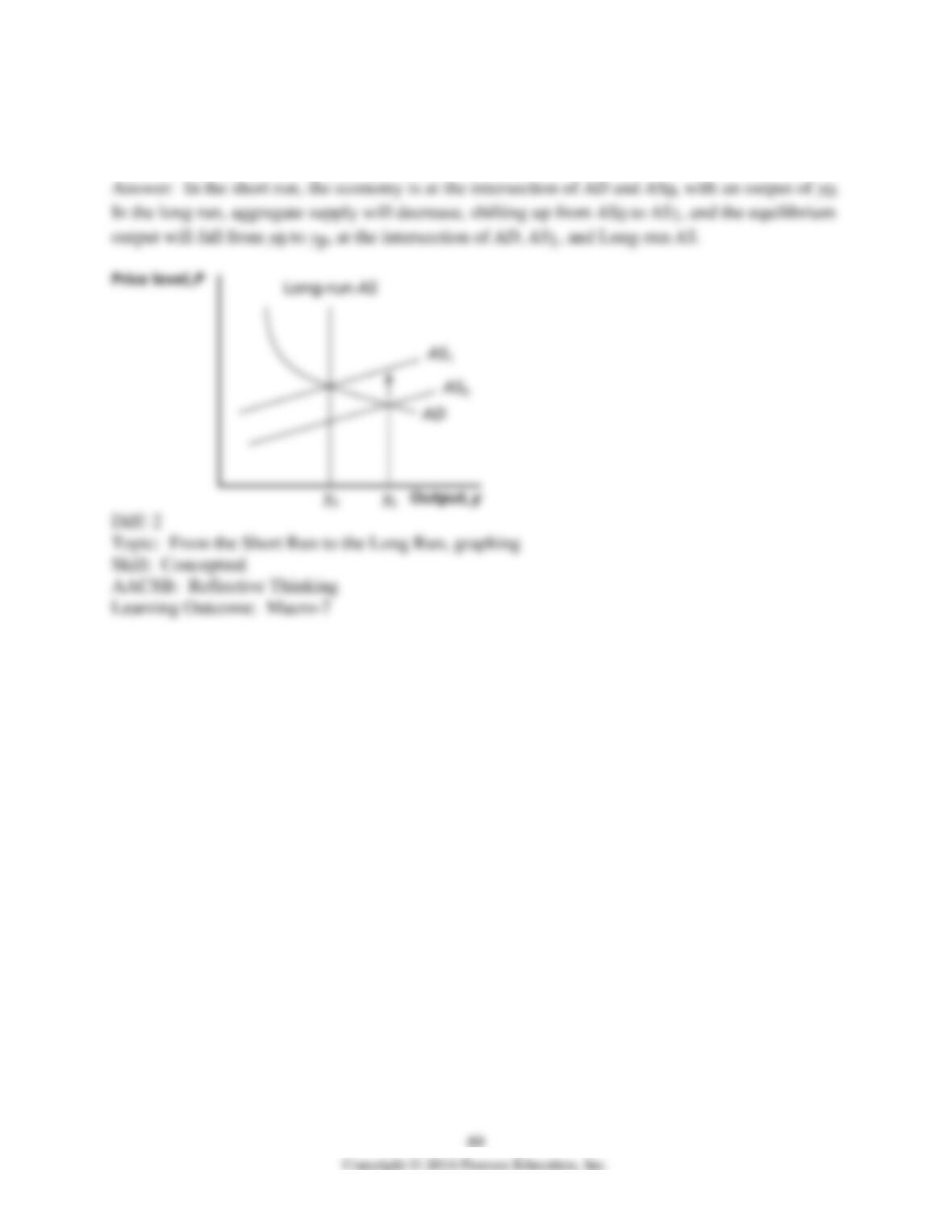
10) Draw an aggregate supply and aggregate demand graph which shows the economy producing
an output which exceeds potential output in the short run, and the adjustment that will occur as
the economy adjusts to long-run equilibrium.