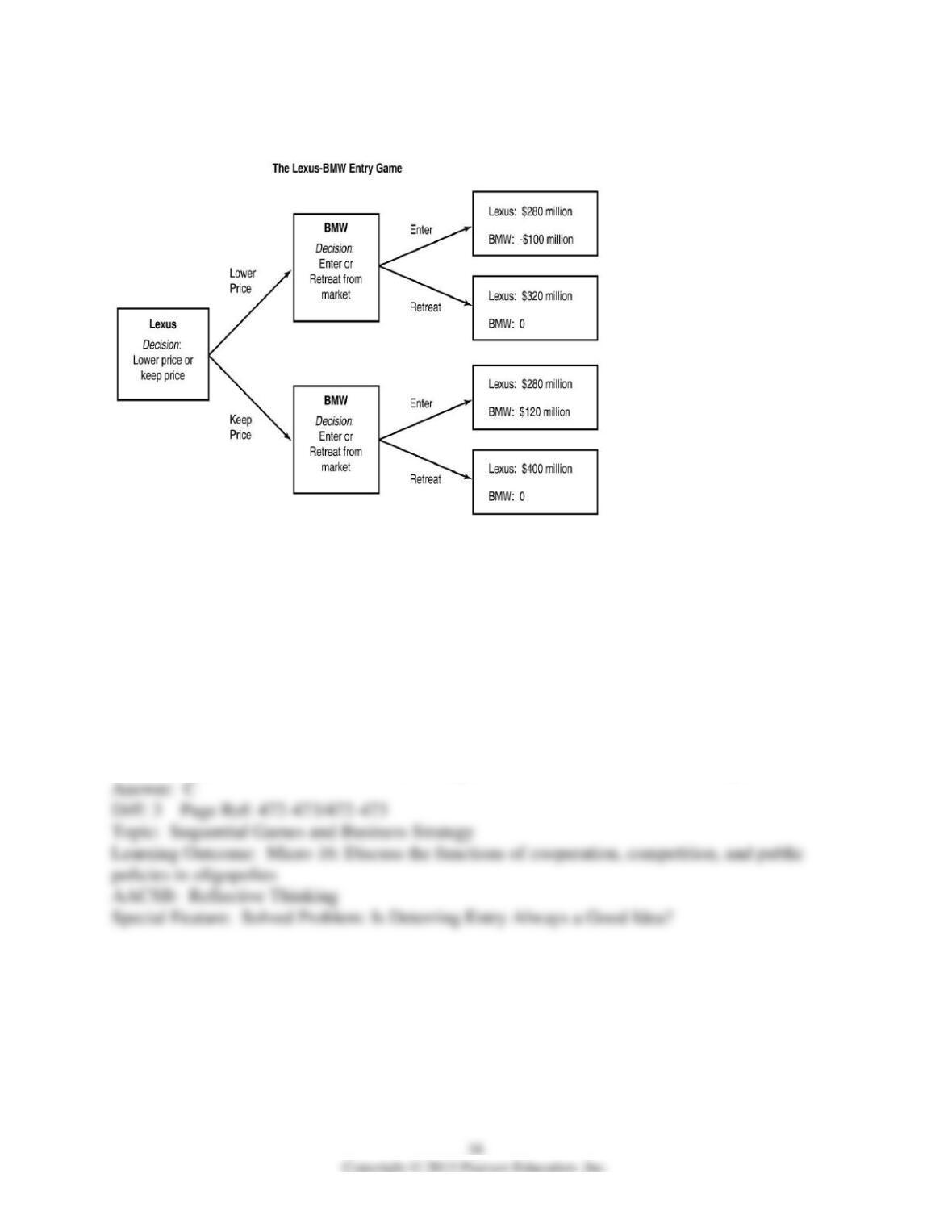
Figure 14-1
Assume that Lexus (L) is the first automobile company to produce a luxury class hybrid
automobile and is the only such company for the past four years. BMW is now considering
producing its own luxury hybrid automobile and Lexus must decide whether or not to lower the
price of its luxury hybrid to counter BMW’s entry into the luxury hybrid niche.
2) Refer to Figure 14-1. Should Lexus lower its price in order to deter BMW’s entry into the
luxury hybrid automobile market?
A) In terms of profit earned, it makes no difference whether Lexus lowers its price or not; in
either case it will make $280 million profit if BMW enters.
B) No, it should keep the same price and work to capitalize on its brand loyalty.
C) Yes, it will drive BMW out of the market.
D) No, because BMW will enter the market regardless of Lexus’ decision about its price.
3) Refer to Figure 14-1. If Lexus lowers its price, will this deter BMW from entering the
market?
A) Yes, because BMW stands to lose $100 million if it competes with Lexus.
B) Yes, because BMW will make a smaller profit than Lexus if it chooses to compete.
C) No, because BMW will still make a profit of $120 if it competes with Lexus.
D) No, because BMW will be able to break Lexus’ first mover advantage.
4) In a subgame perfect equilibrium,
A) the first mover has an advantage over other players.
B) the last mover has an advantage over other players.
C) each player’s strategy constitutes a Nash equilibrium at every subgame of the original game.
D) each player has the same response as the others at every subgame of the tree.
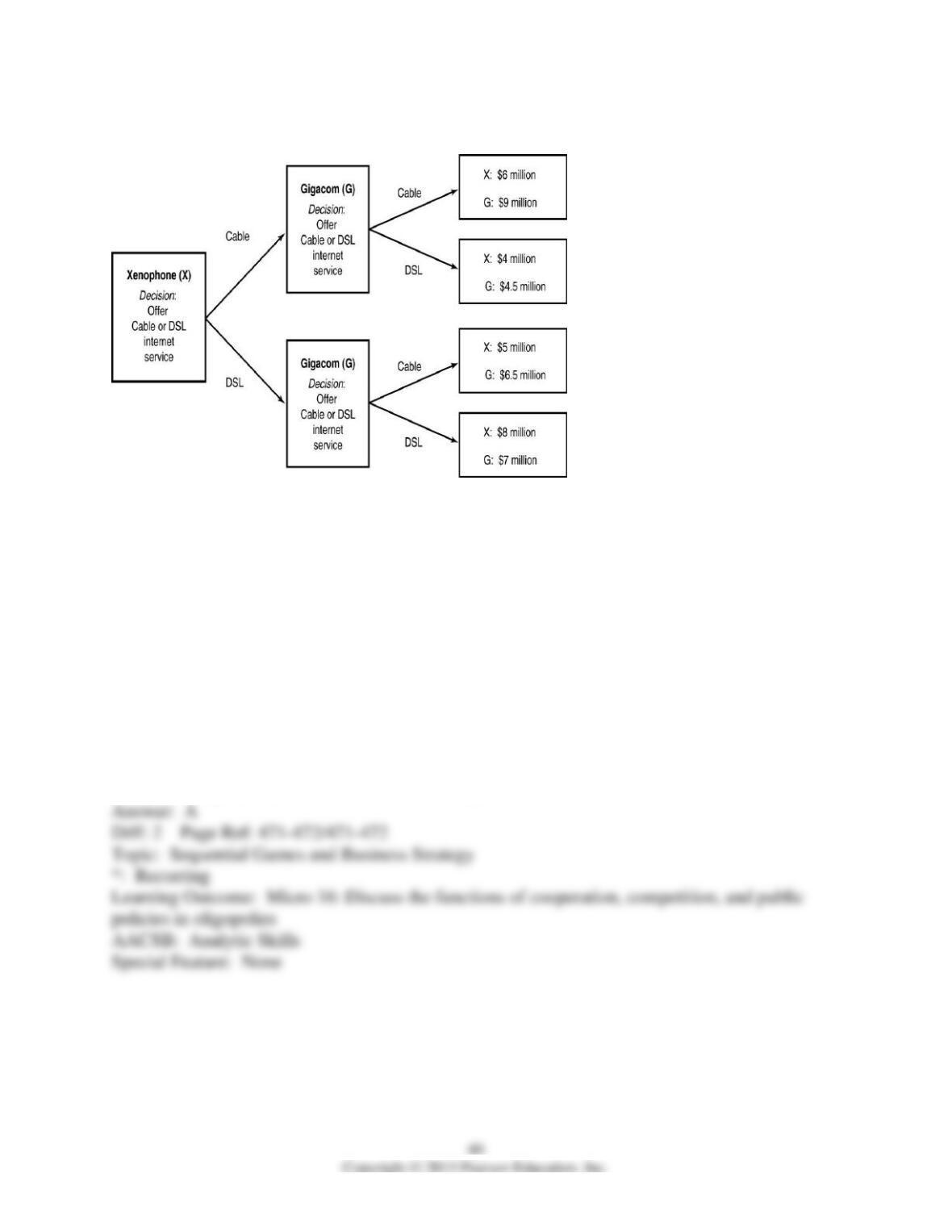
Figure 14-2
The government of a developing country plans to award two firms, Gigacom and Xenophone, the
exclusive rights to share the market for high speed internet service. Gigacom and Xenophone can
both provide the service either via television cable lines or via direct subscriber line (DSL).
Suppose the government is considering a proposal to delay one firm’s entry into the market on
the grounds that it wants to prevent “harmful” competition. Figure 14-2 shows the decision tree
for this game.
5) Refer to Figure 14-2. If the government delays Gigacom’s entry and Xenophone moves first,
is a threat by Gigacom that it will provide DSL service if Gigacom provides cable service a
credible threat?
A) No, because Gigacom will lose $4.5 million in profits if it carries out its threat.
B) Yes, because Gigacom’s DSL service will drive Xenophone out of business.
C) No, because as a second mover, it has no choice but to abide by the choices of the first mover.
D) Yes, Xenophone stands to lose $3 million in profit.
6) Refer to Figure 14-2. If the government delays Gigacom’s entry and Xenophone moves first,
what is the likely outcome in the market?
A) Both offer internet service via cable line; Xenophone earns a profit of $6 million and
Gigacom earns a profit of $9 million.
B) Both offer DSL internet service; Xenophone earns a profit of $8 million and Gigacom earns a
profit of $7 million.
C) Xenophone offers DSL internet service and earns a profit of $5 million while Gigacom offer
internet service via cable line and earns a profit of $6.5 million.
D) Xenophone offers internet service via cable line and earns a profit of $4 million while
Gigacom offers DSL internet service and earns a profit of $4.5 million.
7) Refer to Figure 14-2. Now suppose that the government delays Xenophone’s entry and
Gigacom moves first, what is the likely outcome in the market?
A) Both offer internet service via cable line; Xenophone earns a profit of $6 million and
Gigacom earns a profit of $9 million.
B) Both offer DSL internet service; Xenophone earns a profit of $8 million and Gigacom earns a
profit of $7 million.
C) Xenophone offers DSL internet service and earns a profit of $5 million while Gigacom offer
internet service via cable line and earns a profit of $6.5 million.
D) Xenophone offers internet service via cable line and earns a profit of $4 million while
Gigacom offers DSL internet service and earns a profit of $4.5 million.
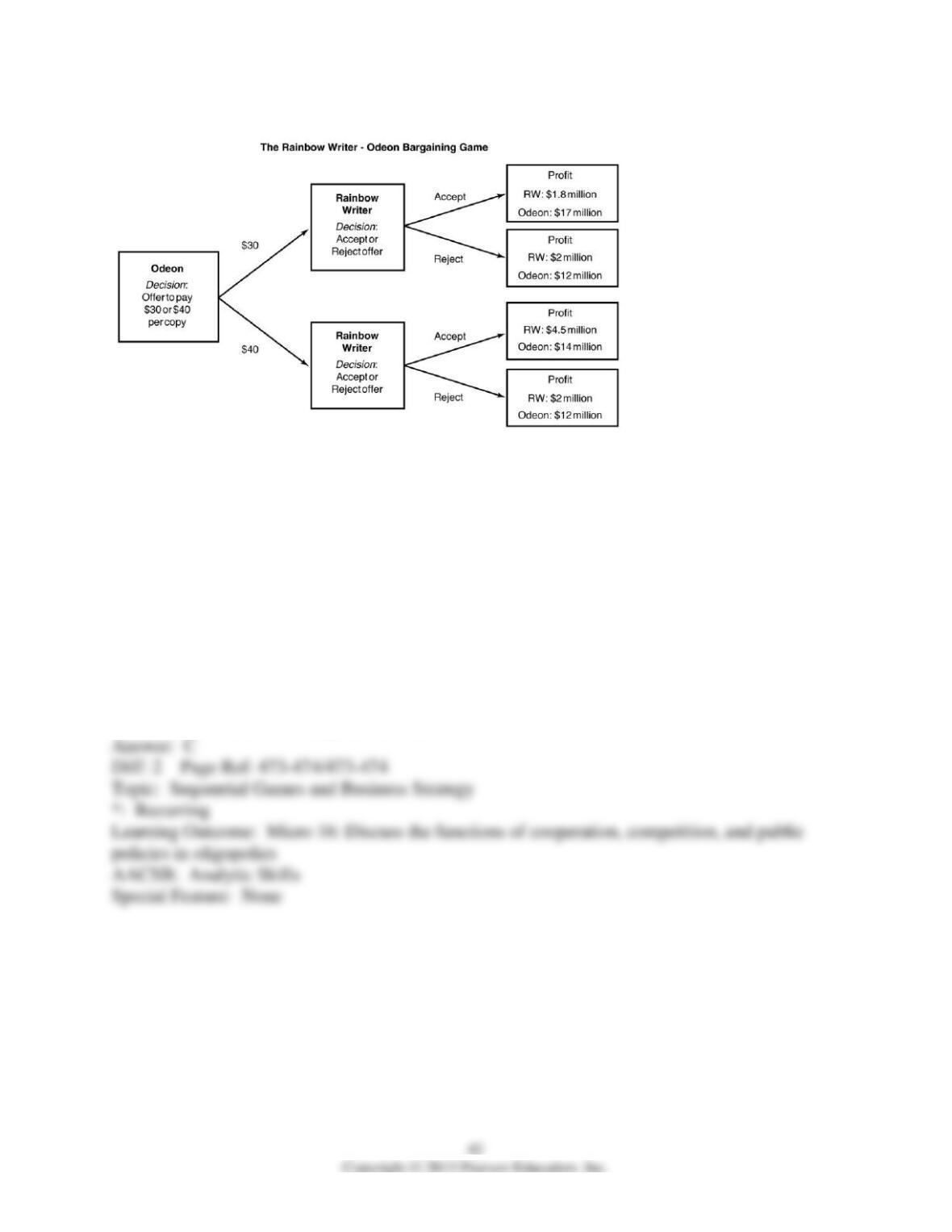
Figure 14-3
Rainbow Writer (RW) is a small online company selling a highly rated software package for
printing color labels directly onto CDs. The firm currently earns a profit of $2 million per year
selling its package exclusively on its Web site. Odeon, the producer of the most popular
software package for editing and burning CDs and DVDs has expressed interest in bundling
Rainbow Writer’s product into its own package. Odeon expects that bundling would further
boost its sales and allow it to sell the new bundled product at a higher price, thus raising its
profits beyond its current profit of $12 million. Figure 14.3 shows the decision tree for the
Rainbow Writer-Odeon bargaining game.
8) Refer to Figure 14-3. How will Rainbow Writer respond to Odeon’s two possible offers?
A) Rainbow Writer will reject either offer.
B) Rainbow Writer will only accept an offer of $30 per copy of the software package.
C) Rainbow Writer will only accept an offer of $40 per copy of the software package.
D) Rainbow Writer will accept either offer.
9) Refer to Figure 14-3. What is the equilibrium outcome in this game and is this a subgame-
perfect equilibrium?
A) Odeon’s offer of $40 per copy of the software package is accepted and this is a subgame-
perfect equilibrium.
B) In the equilibrium, Odeon offers $40 per copy of the software package and is accepted but
this is not a subgame-perfect equilibrium.
C) In the equilibrium, Odeon offers $30 per copy of the software package and is rejected, and
this is a subgame-perfect equilibrium.
D) There is no equilibrium in this game.
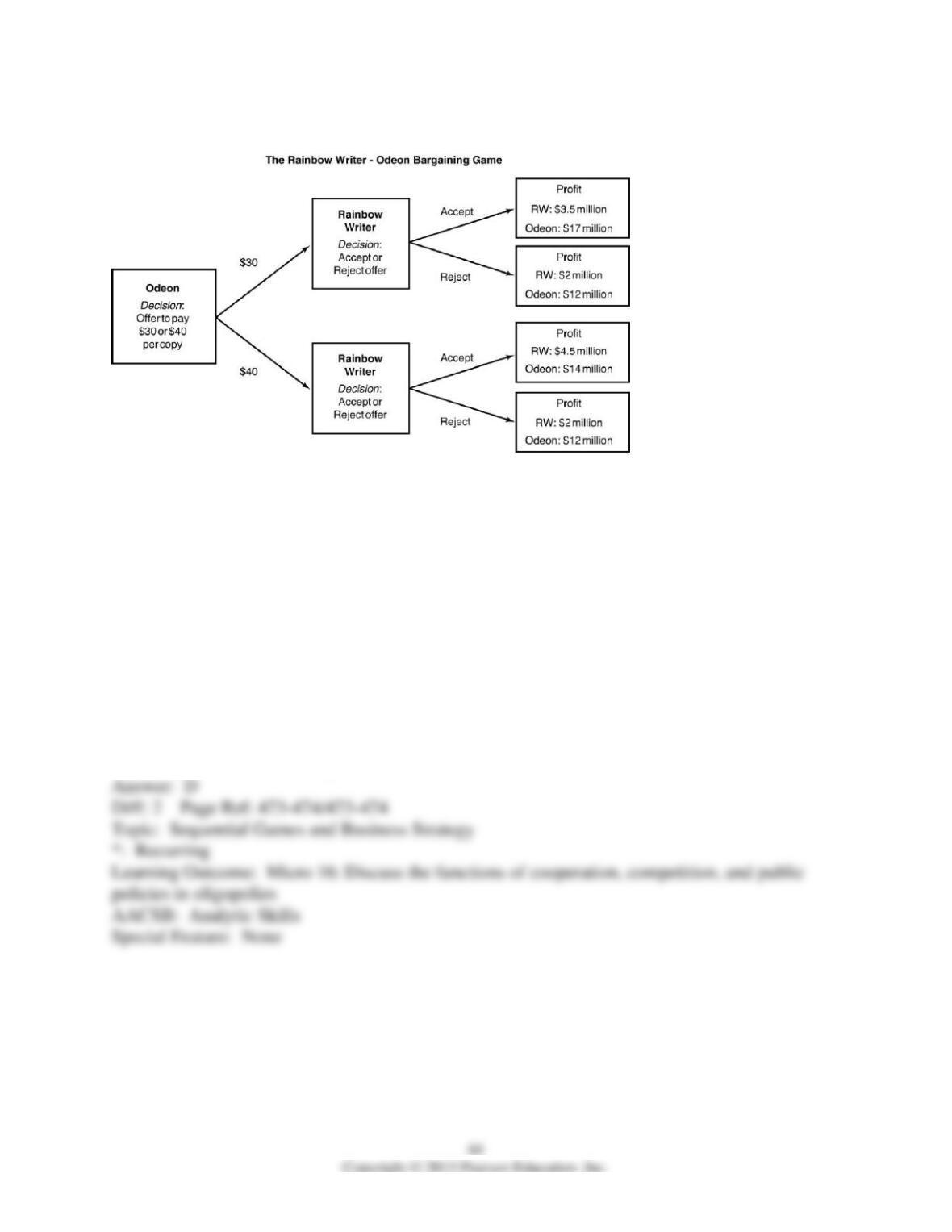
Figure 14-4
Rainbow Writer (RW) is a small online company selling a highly rated software package for
printing color labels directly onto CDs. The firm currently earns a profit of $2 million per year
selling its package exclusively on its Web site. Odeon, the producer of the most popular
software package for editing and burning CDs and DVDs, has expressed interest in bundling
Rainbow Writer’s product into its own package. Odeon expects that bundling would further
boost its sales and allow it to sell the new bundled product at a higher price, thus raising its
profits beyond its current profit of $12 million. Figure 14-4 shows the decision tree for the
Rainbow Writer-Odeon bargaining game.
10) Refer to Figure 14-4. How will Rainbow Writer respond to Odeon’s two possible offers?
A) Rainbow Writer will reject either offer.
B) Rainbow Writer will only accept an offer of $30 per copy of the software package.
C) Rainbow Writer will only accept an offer of $40 per copy of the software package.
D) Rainbow Writer will accept either offer.
11) Refer to Figure 14-4. What is the equilibrium outcome in this game and is this a subgame-
perfect equilibrium?
A) In the equilibrium, neither offer is accepted as Rainbow Writer holds out for a better deal.
The two rejection outcomes are subgame-perfect equilibria.
B) In the equilibrium, Odeon offers $40 per copy of the software package and is accepted but
this is not a subgame-perfect equilibrium.
C) Either offer of $30 or $40 per copy of the software package is accepted and these two
equilibria are subgame-perfect equilibria.
D) Either offer of $30 or $40 per copy of the software package is accepted but these are not are
subgame-perfect equilibria.
12) Refer to Figure 14-4. In a real world situation involving Rainbow Writer and Odeon, what
scenario below might permit Rainbow Writer to rationally refuse an offer from Odeon of $40 per
copy of the software package?
A) Odeon is also negotiating with Swift Colors, Rainbow Writer’s chief rival.
B) Odeon’s competitors are also interested in bundling Rainbow Writer’s software.
C) Odeon hires a software developer to begin developing its own proprietary color labeling
software.
D) Odeon is considering new distribution outlets for its products.
13) In a sequential game, one firm will act first and then other firms will respond.
14) Decision trees can only be used to analyze sequential games.
15) A subgame is a simultaneous game embedded in a sequential game.
16) What is a sequential game? How are decision trees used to analyze sequential games?
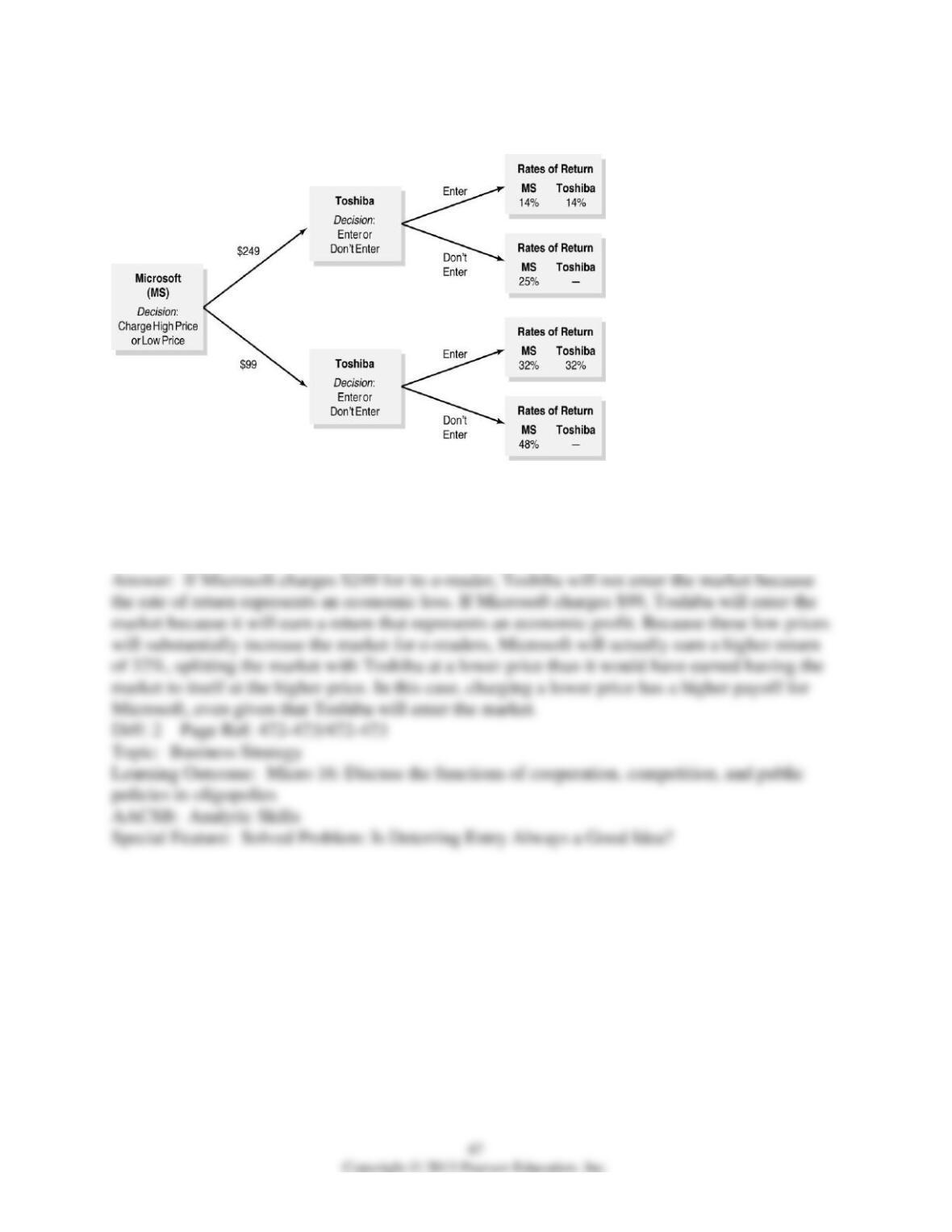
Figure 14-5
17) Refer to Figure 14-5 Use the decision tree to determine whether Microsoft should deter
Toshiba from entering the market for electronic book readers (e-readers). Assume that each firm
must earn a 20% return on investment to break even. Explain Microsoft’s decision process.
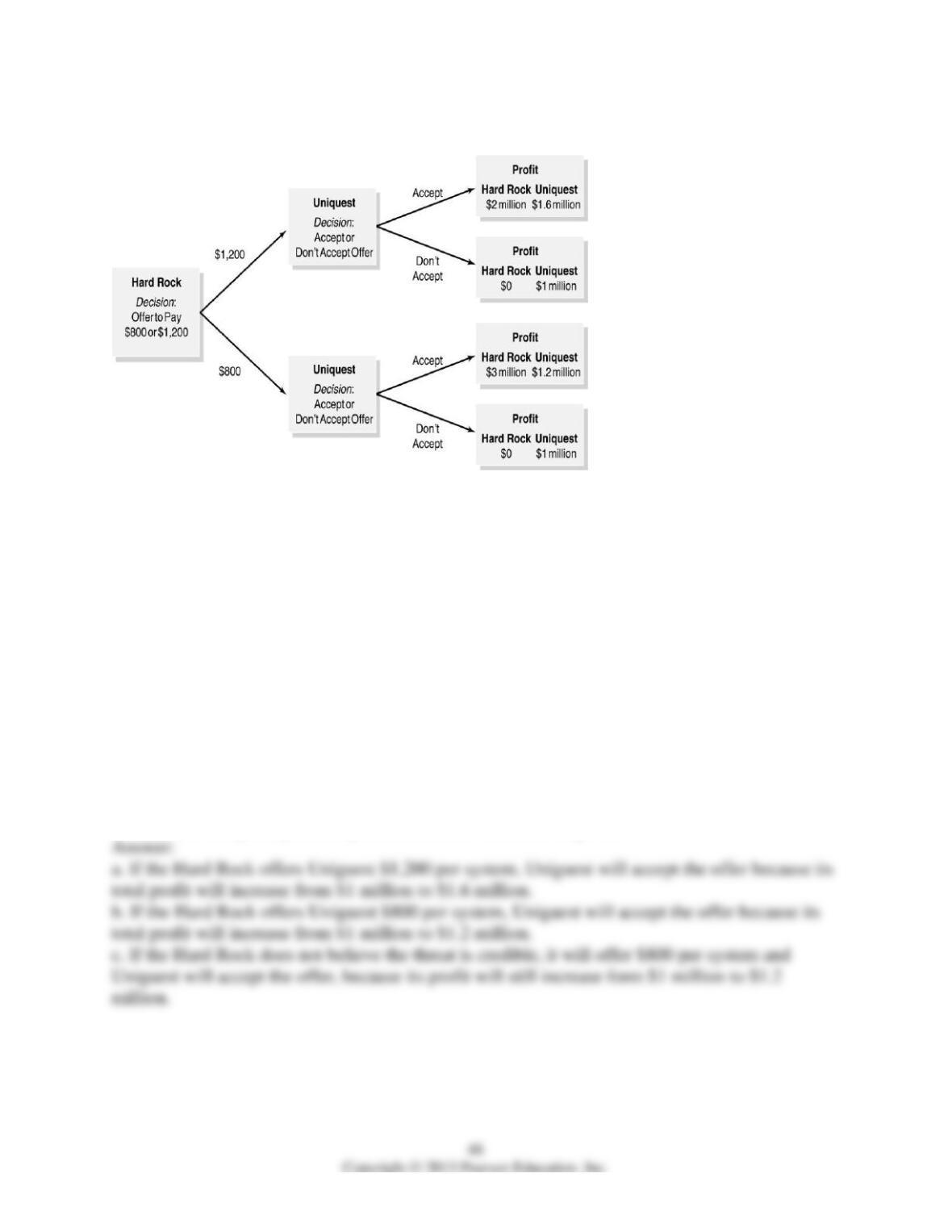
Figure 14-6
18) Refer to Figure 14-6. Uniguest, Inc. is a company that provides PCs with internet access and
touch-sensitive screens to hotels. Suppose the Hard Rock Hotel and Casino in Las Vegas informs
Uniguest that it is considering installing these systems in its hotel rooms. The Hard Rock expects
to be able to charge higher prices for these rooms if it installs Uniguest’s systems in its rooms.
The two companies begin bargaining over what price the Hard Rock will pay Uniguest for its
systems, and the decision tree shown above illustrates this bargaining game. Note that the profit
figures listed in the decision tree are additional profits for the Hard Rock and total profits for
Uniguest.
a. Suppose the Hard Rock offers Uniguest $1,200 per system. Will Uniguest accept or reject this
offer? Why?
b. Suppose the Hard Rock offers Uniguest $800 per system. Will Uniguest accept or reject this
offer? Why?
c. Suppose Uniguest attempts to obtain a favorable outcome from the bargaining by telling the
Hard Rock it will reject an $800-per-system offer. If the Hard Rock does not believe the threat is
credible, what will it do? Why? What will Uniguest do? Why?
d. Is there a sub-game perfect equilibrium in this situation? Explain.
14.4 The Five Competitive Forces Model
1) Which of the following is not among Porter’s competitive forces?
A) power of buyers
B) power of suppliers
C) threat of new entrants
D) changing consumer tastes
2) Which of the following is most likely to exert the bargaining power of a buyer?
A) Barnes and Noble purchases books from publishers for sale in its online stores.
B) Wal-Mart, The world’s largest discount store, seeks vendors to supply products made
exclusively for its stores.
C) Ground beef producers seek to purchase cattle from ranchers.
D) Cowgirl Creamery, a small cheese producer, seeks a dairy farm for its organic milk supplies.
3) As word processing on personal computers expanded, sales of typewriters began to disappear.
Which of Porter’s competitive forces does this event demonstrate?
A) the threat of competition from new entrants
B) bargaining power of suppliers
C) bargaining power of buyers
D) competition from substitute goods or services
4) According to an article the Wall Street Journal, “The big car makers are pushing a wide
array of new technology into production, responding to relentless competitive pressure,
rising energy prices and consumer demand for better safety.
Source: Joseph B. White, “Ford, GM Eye Shift in Buying Habits,” Wall Street Journal, May 22,
2006.
Which of Porter’s competitive forces does this statement allude to?
A) the threat of competition from new entrants
B) competition from foreign auto manufacturers
C) competition from existing firms within the industry
D) competition from substitute products from outside the industry
5) The larger the number of firms in an industry,
A) the easier it is to implicitly collude to fix prices.
B) the more intense the rivalry among firms.
C) the greater the need for a price enforcement mechanism.
D) the larger the potential number of market segments.
6) According to Porter’s Five Competitive Forces Model, which kinds of products are most likely
to limit the ability of firms in an industry to raise prices?
A) differentiated products that target a small subsegment of the industry
B) substitutable products produced by firms in different industries
C) similar products produced by similar industries in low-cost countries
D) complementary products produced by different firms in the same industry
7) In Porter’s Five Competitive Forces model, “competition from substitute goods or services”
refers to
A) substitute products that come from outside the industry.
B) substitute products that come from domestic competitors in the same industry.
C) substitute products that come from foreign competitors in the same industry.
D) competition from producers of substitutes who outsource their production.
8) The bargaining power of suppliers increases if
A) the cost of switching suppliers is relatively low.
B) there are only a few competitors to the supplier.
C) the input in question is not a critical component of production.
D) the input supplied is relatively standardized.
9) The bargaining power of buyers increases if
A) there are many large buyers.
B) the input in question has few substitutes.
C) the input in question is not a critical component of production.
D) there are wide variations in the quality of inputs from supplier to supplier.
10) For years economists believed that market structure explained the ability of some firms to
earn economic profits. Today, economists and business strategists put greater emphasis on
A) the number of years a firm has been in business and the average price of the products sold by
the firm.
B) the number of countries in which a firm conducts business and the number of employees the
firm has in each country.
C) the characteristics of individual firms and the strategies their managements use to continue to
earn economic profits.
D) the size of a firm relative to the industry average and the number of firms in the domestic
industry.
11) Should other firms, such as Apple or Toshiba, decide to develop and sell a laptop-tablet
hybrid to compete with the one being developed by Intel, this best describes which of the five
competitive forces?
A) the bargaining power of buyers
B) the threat from potential entrants
C) competition from substitute goods or services
D) the bargaining power of suppliers
12) A supplier of paper napkins to the fast food industry is unlikely to have significant
bargaining power.
13) Competition from substitute goods is more of a threat when switching costs are high.
14) In the 1930s and 1940s, the Technicolor company was able to leverage its bargaining power
over the movie industry because Technicolor was the sole producer of cameras and films needed
to produce color films.
15) List the competitive forces in the five competitive forces model.
16) In Michael Porter’s five competitive forces model, what do the competitive forces determine?
17) What happens to the profit a car company makes on each car sold if it offers cash rebates to
customers? What happens to the company’s profit per car if it offers zero percent financing? How
might a car company decide which of these strategies to use?