170. The costs of processes that produce, market, deliver, and dispose of products are called:
171. The assignment of private and societal costs to products is referred to as:
172. The assignment of only private costs to individual products is called:
173. Hannibal Company produces a number of chemical products, two of which are Product X1 and Product
X2. The controller and environmental manager have identified the following environmental activities and costs
associated with the two products:
Product X1
Product X2
Pounds produced
400,000
1,000,000
Packaging materials (pounds)
120,000
60,000
Energy usage (kilowatt hours)
40,000
20,000
Toxic releases (pounds into air)
100,000
20,000
Pollution control (machine hours)
16,000
4,000
Costs of activities:
Using packaging materials
$360,000
Using energy
96,000
Releasing toxins (fines)
48,000
Operating pollution control equipment
112,000
What is the packing cost per unit of Product X1?
174. Hannibal Company produces a number of chemical products, two of which are Product X1 and Product
X2. The controller and environmental manager have identified the following environmental activities and costs
associated with the two products:
Product X1
Product X2
Pounds produced
400,000
1,000,000
Packaging materials (pounds)
120,000
60,000
Energy usage (kilowatt hours)
40,000
20,000
Toxic releases (pounds into air)
100,000
20,000
Pollution control (machine hours)
16,000
4,000
Costs of activities:
Using packaging materials
$360,000
Using energy
96,000
Releasing toxins (fines)
48,000
Operating pollution control equipment
112,000
What is the energy usage cost per unit of Product X2?
175. Hannibal Company produces a number of chemical products, two of which are Product X1 and Product
X2. The controller and environmental manager have identified the following environmental activities and costs
associated with the two products:
Product X1
Product X2
Pounds produced
400,000
1,000,000
Packaging materials (pounds)
120,000
60,000
Energy usage (kilowatt hours)
40,000
20,000
Toxic releases (pounds into air)
100,000
20,000
Pollution control (machine hours)
16,000
4,000
Costs of activities:
Using packaging materials
$360,000
Using energy
96,000
Releasing toxins (fines)
48,000
Operating pollution control equipment
112,000
What is the fines cost per unit for toxic releases of Product X1?

176. Hannibal Company produces a number of chemical products, two of which are Product X1 and Product
X2. The controller and environmental manager have identified the following environmental activities and costs
associated with the two products:
Product X1
Product X2
Pounds produced
400,000
1,000,000
Packaging materials (pounds)
120,000
60,000
Energy usage (kilowatt hours)
40,000
20,000
Toxic releases (pounds into air)
100,000
20,000
Pollution control (machine hours)
16,000
4,000
Costs of activities:
Using packaging materials
$360,000
Using energy
96,000
Releasing toxins (fines)
48,000
Operating pollution control equipment
112,000
What is the pollution control cost per unit of Product X2?
177. As part of its environmental cost reporting system, McClaren Company tracks its total environmental
costs. Consider the cost and sales data given:
Total
Year
Environmental Costs
Sales Revenue
Operating Costs
2014
$3,750,000
$31,250,000
$25,000,000
2015
3,125,000
$31,250,000
$25,000,000
2016
2,750,000
$31,250,000
$25,000,000
2017
2,406,250
$31,250,000
$25,000,000
What is the environmental costs as a percentage of sales for 2014?
178. As part of its environmental cost reporting system, McClaren Company tracks its total environmental
costs. Consider the cost and sales data given:
Total
Year
Environmental Costs
Sales Revenue
Operating Costs
2014
$3,750,000
$31,250,000
$25,000,000
2015
3,125,000
31,250,000
$25,000,000
2016
2,750,000
39,375,000
$25,000,000
2017
2,406,250
39,375,000
$25,000,000
What is the environmental costs as a percentage of sales for 2015?
179. Figure 14-9
As part of its environmental cost reporting system, Lamborghini Company tracks its total environmental costs.
Consider the cost and sales data given:
Total
Year
Environmental Costs
Sales Revenue
Operating Costs
2014
$7,500,000
$62,500,000
$50,000,000
2015
6,250,000
62,500,000
$50,000,000
2016
5,500,000
68,750,000
$50,000,000
2017
4,812,500
68,750,000
$50,000,000
Refer to Figure 14-9. What is the environmental costs as a percentage of sales for 2014?
180. Figure 14-9
As part of its environmental cost reporting system, Lamborghini Company tracks its total environmental costs.
Consider the cost and sales data given:
Total
Year
Environmental Costs
Sales Revenue
Operating Costs
2014
$7,500,000
$62,500,000
$50,000,000
2015
6,250,000
62,500,000
$50,000,000
2016
5,500,000
68,750,000
$50,000,000
2017
4,812,500
68,750,000
$50,000,000
Refer to Figure 14-9. What is the environmental costs as a percentage of sales for 2015?
181. Figure 14-9
As part of its environmental cost reporting system, Lamborghini Company tracks its total environmental costs.
Consider the cost and sales data given:
Total
Year
Environmental Costs
Sales Revenue
Operating Costs
2014
$7,500,000
$62,500,000
$50,000,000
2015
6,250,000
62,500,000
$50,000,000
2016
5,500,000
68,750,000
$50,000,000
2017
4,812,500
68,750,000
$50,000,000
Refer to Figure 14-9. What is the environmental costs as a percentage of sales for 2016?
182. Figure 14-9
As part of its environmental cost reporting system, Lamborghini Company tracks its total environmental costs.
Consider the cost and sales data given:
Total
Year
Environmental Costs
Sales Revenue
Operating Costs
2014
$7,500,000
$62,500,000
$50,000,000
2015
6,250,000
62,500,000
$50,000,000
2016
5,500,000
68,750,000
$50,000,000
2017
4,812,500
68,750,000
$50,000,000
Refer to Figure 14-9. What is the environmental costs as a percentage of sales for 2017?
183. Using the abbreviations listed below, indicate for each of the costs whether the cost should be classified as:
P
=
Prevention
A
=
Appraisal
I
=
Internal Failure
E
=
External Failure
N
=
none of the above
1.
Packaging inspections
2.
Process acceptance
3.
Product acceptance
4.
Quality audits
5.
Quality circles
6.
Reinspection after defect is corrected
7.
Returns resulting from poor quality
8.
Rework costs
9.
Supplier evaluations
10.
Warranty costs
A
1.
Packaging inspections
A
2.
Process acceptance
A
3.
Product acceptance
P
4.
Quality audits
P
5.
Quality circles
I
6.
Reinspection after defect is corrected
E
7.
Returns resulting from poor quality
I
8.
Rework costs
E
10.
Warranty costs
184. What does quality mean and how has improving quality increased firm value?
185. Using the abbreviations listed below, indicate for each of the costs whether the cost should be classified as:
P
=
Prevention
A
=
Appraisal
I
=
Internal Failure
E
=
External Failure
N
=
none of the above
1.
Cost of recalling defective products
2.
Design reviews
3.
Downtime due to defects
4.
Field testing
5.
Inspection of work in process
6.
Lost sales due to poor product performance
7.
Process acceptance
8.
Quality training programs
9.
Scrap
10.
Supplier evaluations
E
1.
Cost of recalling defective products
P
2.
Design reviews
I
3.
Downtime due to defects
A
4.
Field testing
A
5.
Inspection of work in process
E
6.
Lost sales due to poor product performance
A
7.
Process acceptance
P
8.
Quality training programs
I
9.
Scrap
P
10.
Supplier evaluations
186. At the beginning of the year, Nevermore, Inc., initiated a quality improvement program. The program was
successful in reducing scrap and rework costs. To help assess the impact of the quality improvement program,
the following data were collected for the current and preceding years:
Preceding Year
Current Year
Sales
$2,000,000
$2,000,000
Quality circles
9,000
10,000
Packaging inspections
20,000
32,000
Scrap
100,000
90,000
Lost sales
180,000
160,000
Downtime
125,000
120,000
Product inspection
40,000
90,000
Required:
a.
Compute each category of quality costs as a percentage of sales for each year.
Prevention costs
Appraisal costs
Internal failure costs
External failure costs
b.
How much has profit increased as a result of quality improvements?
c.
If quality costs can be reduced to 2.0 percent of sales, how much additional profit would result?
187. Within the robust view of strategy, describe the management strategy to reduce quality costs recommended
by the American Society for Quality Control.
Prevention costs $9,000/$2,000,000; $10,000/$2,000,000
0.45%
0.50%
b.
$28,000 = $474,000 – $502,000
$462,000 = $502,000 – (2.0% ´ $2,000,000)
188. Ambrosia Corporation reported the following sales and quality costs for the past four years. Assume that
all quality costs are variable and that all changes in the quality cost ratios are due to a quality improvement
program.
Quality Costs as
Year
Sales Revenues
Percent of Revenues
1
$2,000,000
23.0%
2
2,200,000
20.0%
3
2,200,000
16.0%
4
2,400,000
12.0%
Required:
a.
Compute the quality costs for all four years.
b.
How much did net income increase from Year 1 to Year 2 because of quality improvements? From Year 2 to Year 3? From Year 3 to Year
4?
c.
The management of Ambrosia Corporation believes it is possible to reduce quality costs to 2.5 percent of sales. Assuming sales will
continue at the Year 4 level, calculate the additional profit potential facing Randall.
a.
Quality costs:
Year 1: $460,000
Year 2: $440,000
Year 3: $352,000
Year 4: $288,000
Net income increases:
Year 2:
$460,000 – $440,000 = $20,000
Year 3:
$440,000 – $352,000 = $88,000
Year 4:
$352,000 – $288,000 = $64,000
c.
(0.12 – 0.025) ´ $2,400,000 = $228,000
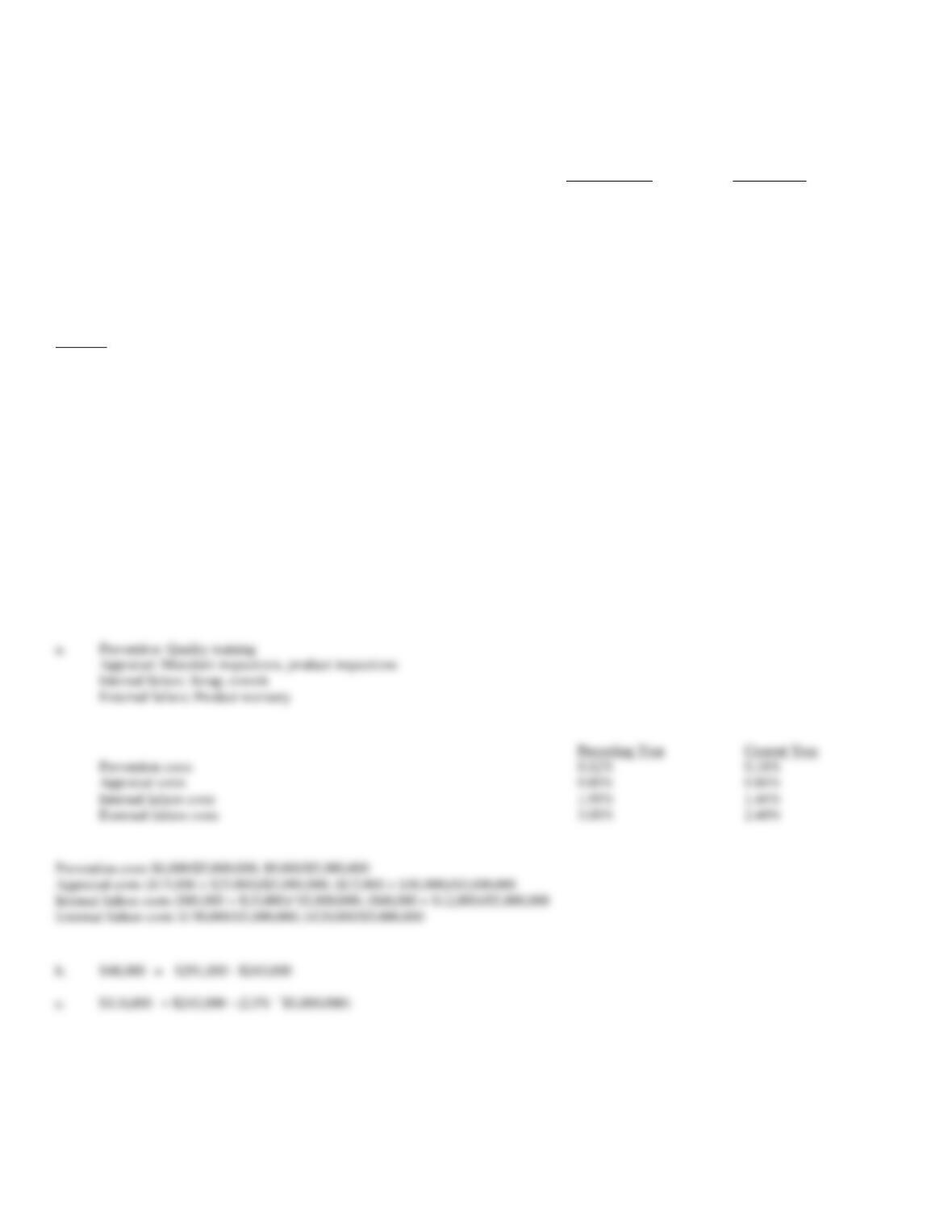
189. At the beginning of the year, Randy Company initiated a quality improvement program. The program was
successful in reducing scrap and rework costs. To help assess the impact of the quality improvement program,
the following data were collected for the current and preceding years:
Preceding Year
Current Year
Sales
$5,000,000
$5,000,000
Quality training
6,000
9,000
Material inspections
15,000
12,000
Scrap
80,000
60,000
Rework
15,000
12,000
Product inspection
25,000
30,000
Product warranty
150,000
120,000
Required:
a.
Compute each category of quality costs as a percentage of sales for each year.
Prevention costs
Appraisal costs
Internal failure costs
External failure costs
b.
How much has profit increased as a result of quality improvements?
c.
If quality costs can be reduced to 2.5 percent of sales, how much additional profit would result?
Appraisal: Materials inspections, product inspections
Internal failure: Scrap, rework
External failure: Product warranty
Preceding Year
Current Year
Prevention costs
0.12%
0.18%
Appraisal costs
0.80%
0.84%
Internal failure costs
1.90%
1.44%
External failure costs
3.00%
2.40%
Prevention costs $6,000/$5,000,000; $9,000/$5,000,000
Appraisal costs ($15,000 + $25,000)/$5,000,000; ($12,000 + $30,000)/$5,000,000
Internal failure costs ($80,000 + $15,000)/ $5,000,000; ($60,000 + $12,000)/$5,000,000
External failure costs $150,000/$5,000,000; $120,000/$5,000,000
b.
$48,000 = $291,000 – $243,000
c.
$118,000 = $243,000 – (2.5% ´ $5,000,000)
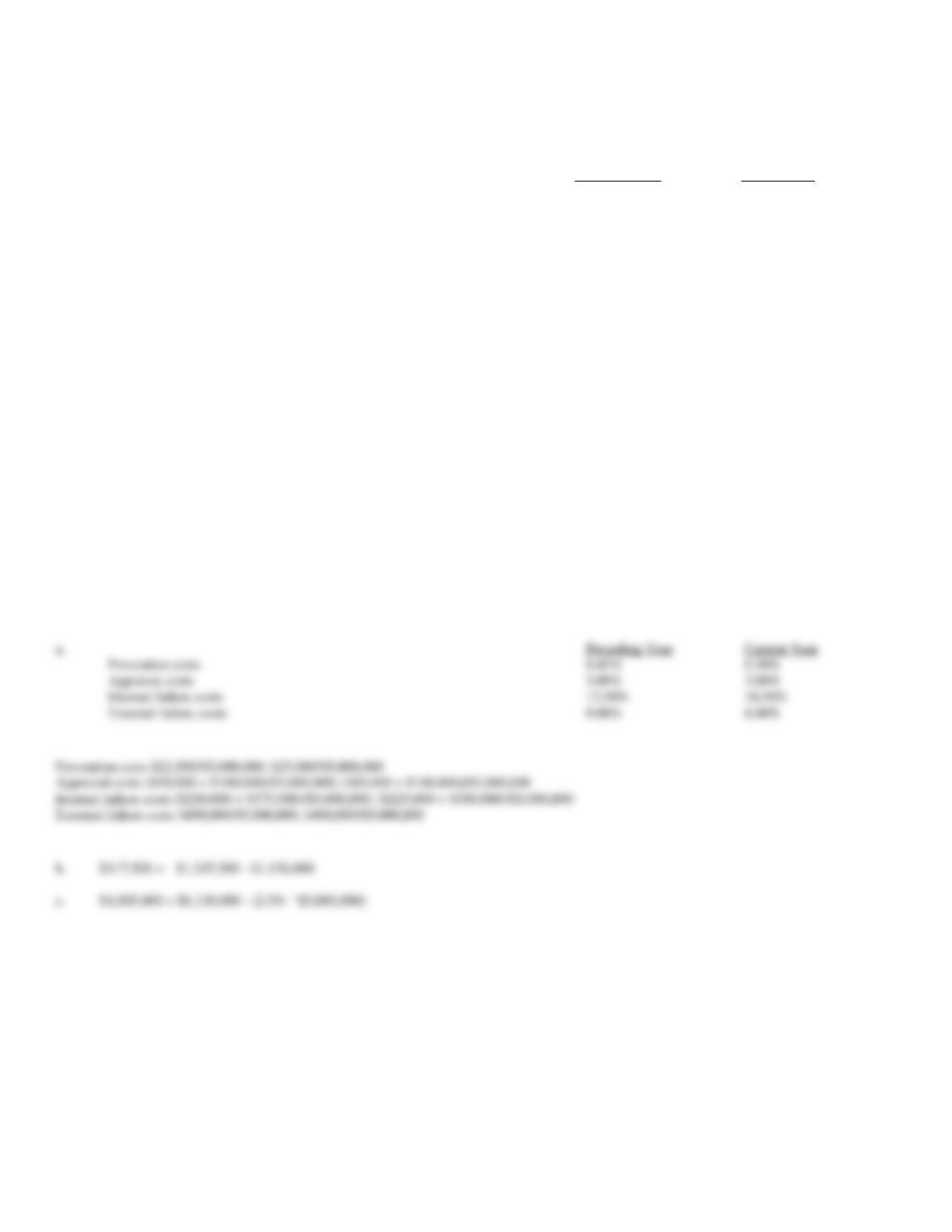
190. At the beginning of the year, Custom Choppers Company initiated a quality improvement program. The
program was successful in reducing scrap and rework costs. To help assess the impact of the quality
improvement program, the following data were collected for the current and preceding years:
Preceding Year
Current Year
Sales
$5,000,000
$5,000,000
Quality training
22,500
25,000
Material inspections
50,000
80,000
Scrap
250,000
225,000
Product warranty
450,000
400,000
Rework
375,000
300,000
Product inspection
100,000
100,000
Required:
a.
Compute each category of quality costs as a percentage of sales for each year.
Prevention costs
Appraisal costs
Internal failure costs
External failure costs
b.
How much has profit increased as a result of quality improvements?
c.
If quality costs can be reduced to 2.5 percent of sales, how much additional profit would result?
Prevention costs
0.45%
0.50%
Appraisal costs
3.00%
3.60%
Internal failure costs
12.50%
10.50%
External failure costs
9.00%
8.00%
Prevention costs $22,500/$5,000,000; $25,000/$5,000,000
Appraisal costs ($50,000 + $100,000)/$5,000,000; ($80,000 + $100,000)/$5,000,000
Internal failure costs ($250,000 + $375,000)/$5,000,000; ($225,000 + $300,000)/$5,000,000
External failure costs $450,000/$5,000,000; $400,000/$5,000,000
$117,500 = $1,247,500 – $1,130,000
c.
$1,005,000 = $1,130,000 – (2.5% ´ $5,000,000)
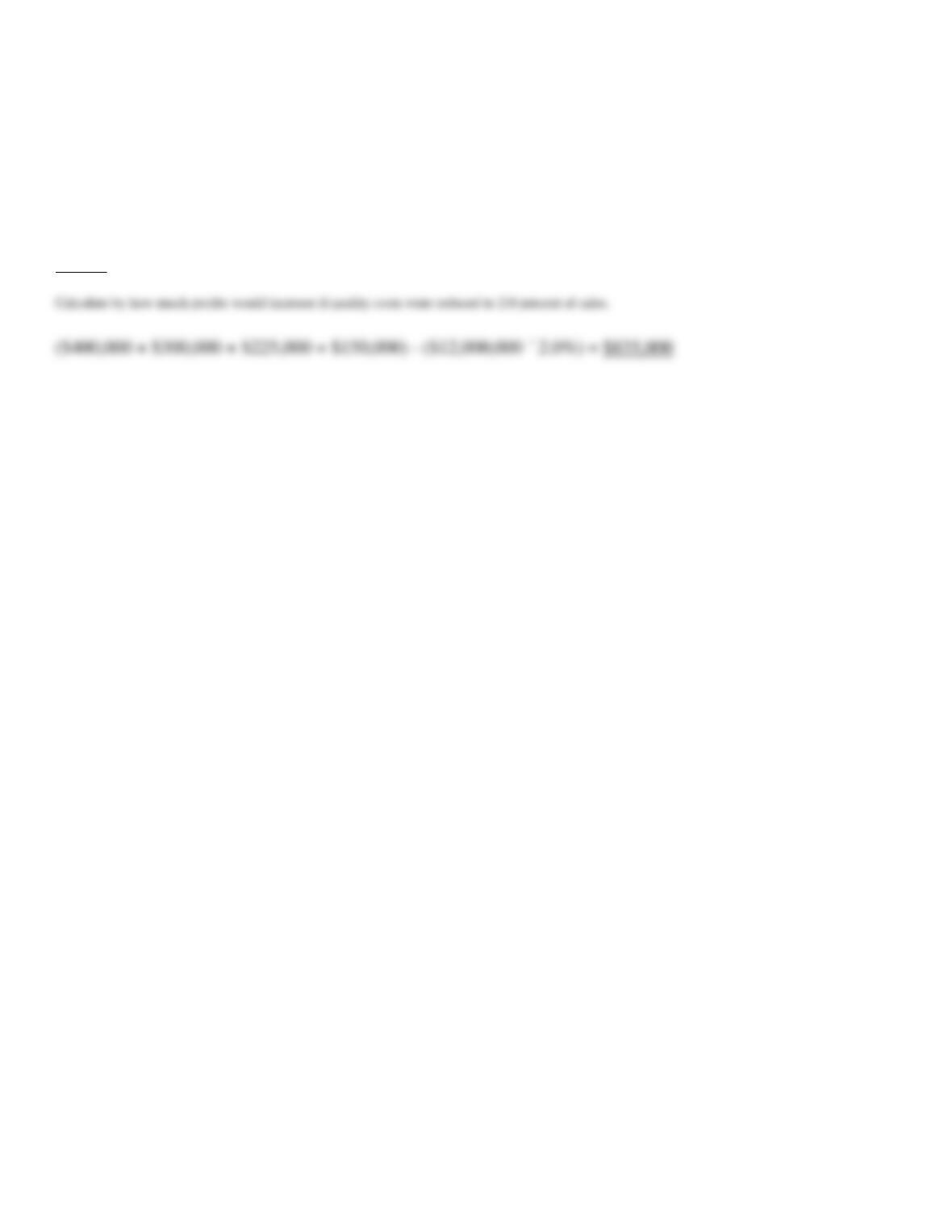
191. The following information pertains to Bartolo Company for 2015:
Sales
$12,000,000
Internal failure costs
400,000
External failure costs
300,000
Appraisal costs
225,000
Prevention costs
150,000
Cost of goods sold
6,500,000
Required:

192. In 2014, Exceptional Foods instituted a quality improvement program. At the end of 2015, the
management of the corporation requested a report to show the amount saved by the measures taken during the
year. The actual sales and actual quality costs for 2014 and 2015 are as follows:
2014
2015
Sales
$1,000,000
$1,500,000
Scrap
30,000
37,500
Rework
40,000
25,000
Training program
10,000
12,000
Consumer complaints
20,000
12,500
Lost sales, incorrect labeling
16,000
—
Test labor
24,000
20,000
Inspection labor
50,000
60,000
Supplier evaluation
30,000
26,000
Exceptional’s management believes that quality costs can be reduced to 2.5 percent of sales within the next five years. At the end of Year 2015,
Exceptional’s sales are projected to have grown to $1,500,000. The relative distribution of quality costs at the end of Year 2015 is as follows:
Scrap
15%
Training
20%
Supplier evaluation
25%
Test labor
25%
Inspection
15%
Total quality costs
100%
Required:
a.
Prepare a long-range performance report that compares the quality costs incurred at the end of 2015 with the quality-cost structure
expected at the end of 2020.
b.
Are the targeted costs in Year 2015 all value-added costs?
c.
What would be the increase in profits in 2015 if the 2.5 percent performance standard is met in that year?