Long-Term Liabilities
14 – 35
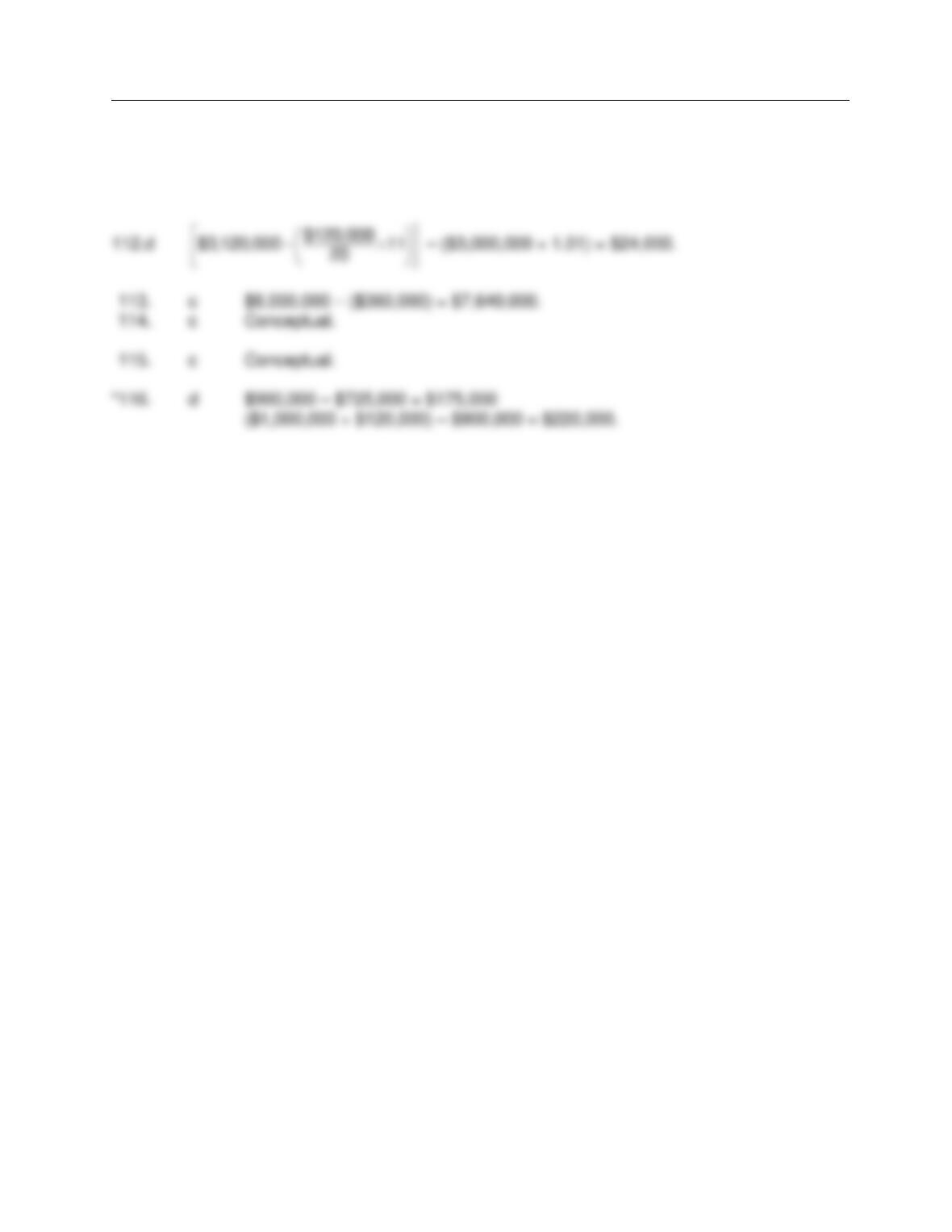
DERIVATIONS — CPA Adapted (cont.)
No. Answer Derivation
BRIEF EXERCISES
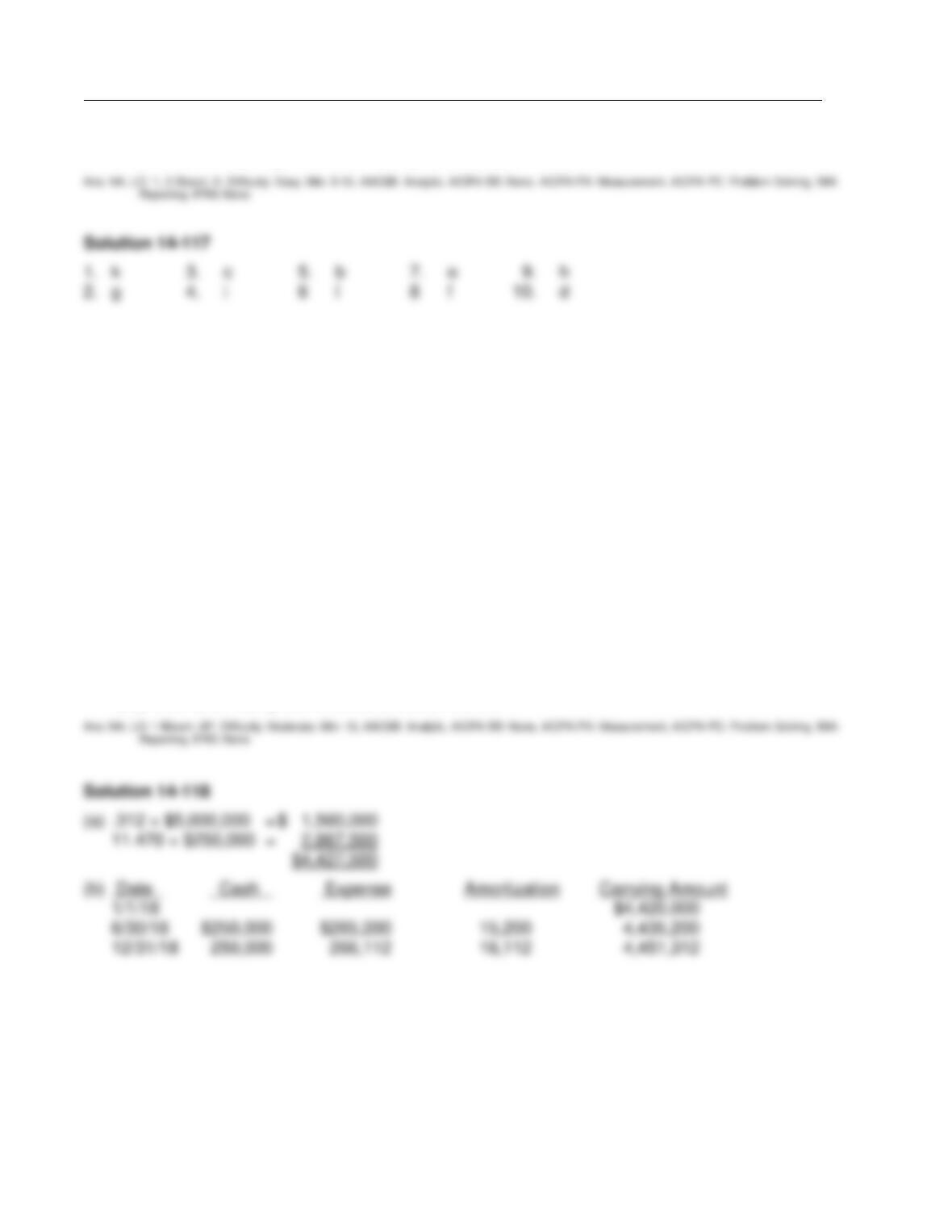
BE. 14-117—Terms related to long-term debt.
Place the letter of the best matching phrase before each word.
____ 1. Indenture ___ 6. Times Interest Earned
____ 2. Refunding ___ 7. Mortgage
____ 3. Bonds Issued at Par ___ 8. Premium on Bonds
____ 4. Carrying Value ___ 9. Reacquisition Price
____ 5. Nominal Rate ___ 10. Market Rate
a. Requires that bond discount be reported in the balance sheet as a direct deduction from the
face of the bond.
b. Rate set by party issuing the bonds which appears on the bond instrument.
c. The interest paid each period is the effective interest at date of issuance.
d. Rate of interest actually earned by the bondholders.
e. Results when bonds are sold below par.
f. Results when bonds are sold above par.
g. The replacement of an existing bond issuance with a new one.
h. Price paid by issuing corporation for its own bonds.
i. Book value of bonds at any given date.
j. Ratio of current assets to current liabilities.
k. The bond contract or agreement.
l. Indicates the company’s ability to meet interest payments as they come due.
m. Ratio of debt to equity.
Test Bank for Intermediate Accounting, Sixteenth Edition
14 – 36
n. Exclusive right to manufacture a product.
o. A document that pledges title to property as security for a loan.
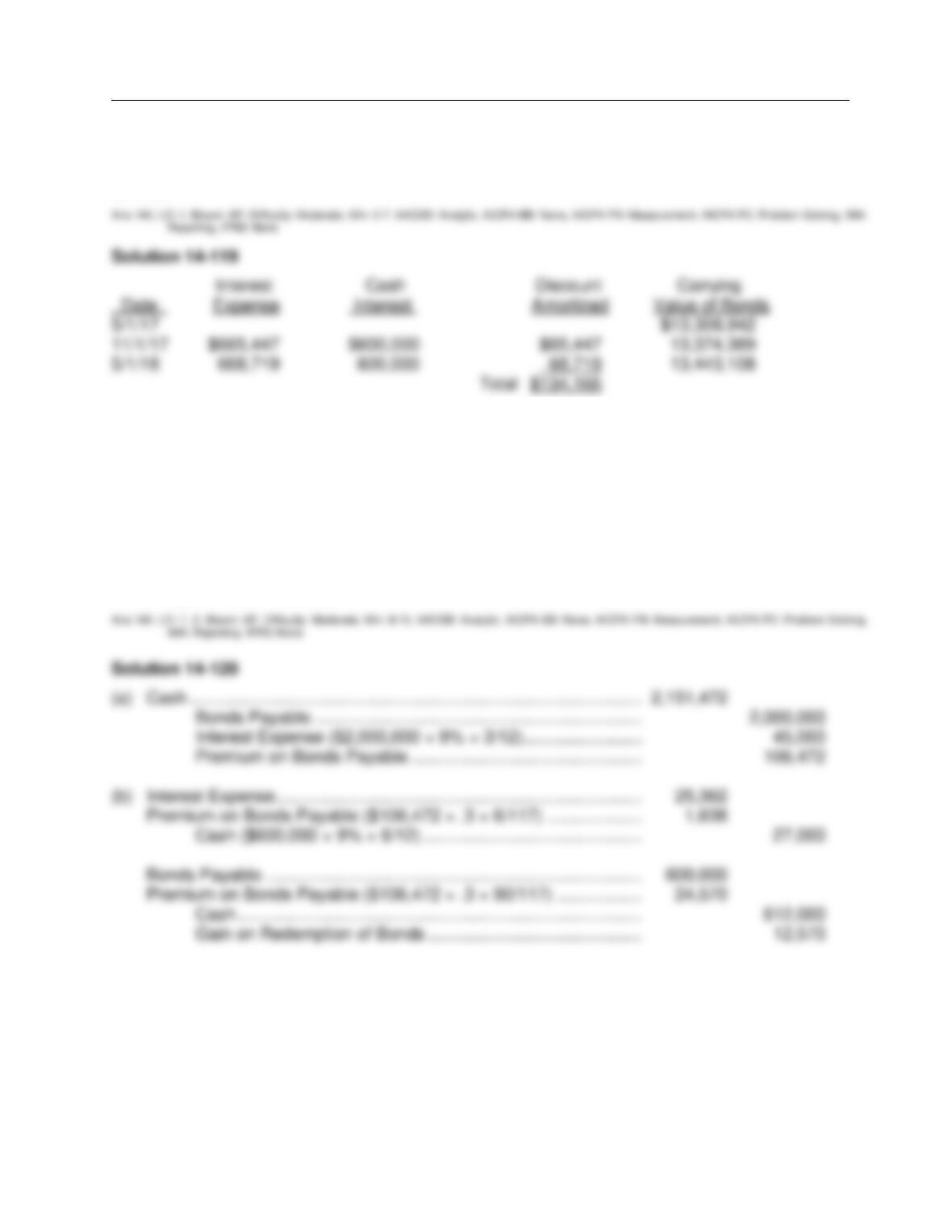
BE. 14-118—Bond issue price and premium amortization.
On January 1, 2018, Piper Co. issued ten-year bonds with a face value of $5,000,000 and a stated
interest rate of 10%, payable semiannually on June 30 and December 31. The bonds were sold to
yield 12%. Table values are:
Present value of 1 for 10 periods at 10% ……………………………. .386
Present value of 1 for 10 periods at 12% ……………………………. .322
Present value of 1 for 20 periods at 5% ……………………………… .377
Present value of 1 for 20 periods at 6% ……………………………… .312
Present value of annuity for 10 periods at 10% …………………… 6.145
Present value of annuity for 10 periods at 12% …………………… 5.650
Present value of annuity for 20 periods at 5% …………………….. 12.462
Present value of annuity for 20 periods at 6% …………………….. 11.470
Instructions
(a) Calculate the issue price of the bonds.
(b) Without prejudice to your solution in part (a), assume that the issue price was $4,420,000.
Prepare the amortization table for 2018, assuming that amortization is recorded on interest
payment dates using the effective-interest method.
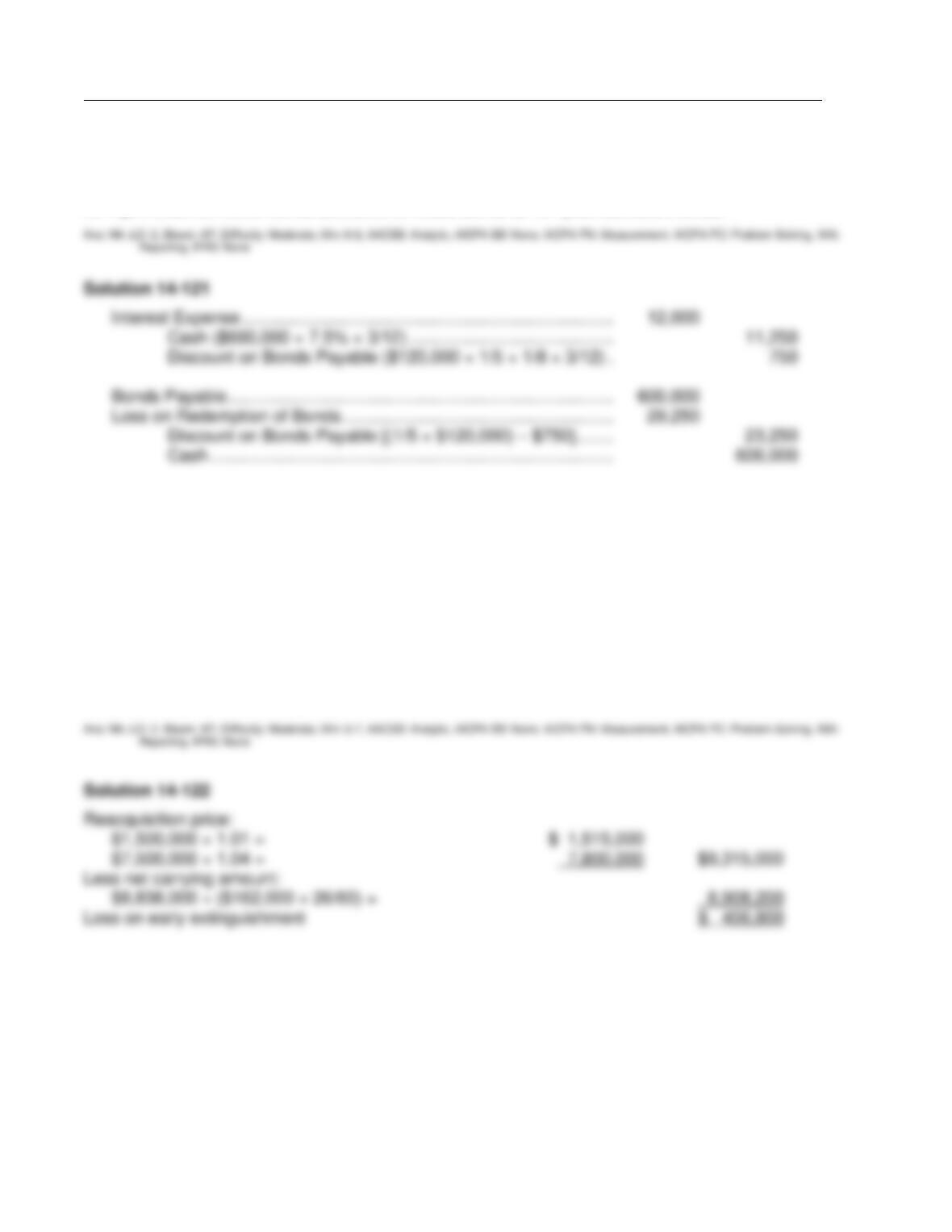
BE. 14-119—Amortization of discount or premium.
Grider Industries, Inc. issued $15,000,000 of 8% debentures on May 1, 2017 and received cash
totaling $13,308,942. The bonds pay interest semiannually on May 1 and November 1. The maturity
date on these bonds is November 1, 2025. The firm uses the effective-interest method of amortizing
discounts and premiums. The bonds were sold to yield an effective-interest rate of 10%.
Long-Term Liabilities
14 – 37
Instructions
Calculate the total dollar amount of discount or premium amortization during the first year (5/1/17
through 4/30/18) these bonds were outstanding. (Show computations and round to the nearest
dollar.)
EXERCISES
Ex. 14-120—Entries for Bonds Payable.
Prepare journal entries to record the following transactions related to long-term bonds of Quirk Co.
(a) On April 1, 2016, Quirk issued $2,000,000, 9% bonds for $2,151,472 including accrued
interest. Interest is payable annually on January 1, and the bonds mature on January 1, 2026.
(b) On July 1, 2018 Quirk retired $600,000 of the bonds at 102 plus accrued interest. Quirk uses
straight-line amortization.
Ex. 14-121—Retirement of bonds.
Prepare journal entries to record the following retirement. (Show computations and round to the
nearest dollar.)
The December 31, 2018 balance sheet of Wolfe Co. included the following items:
7.5% bonds payable due December 31, 2026 $3,000,000
Unamortized discount on bonds payable 120,000
Test Bank for Intermediate Accounting, Sixteenth Edition
14 – 38
The bonds were issued on December 31, 2016 at 95, with interest payable on June 30 and
December 31. (Use straight-line amortization.)
On April 1, 2016, Wolfe retired $600,000 of these bonds at 101 plus accrued interest.
Ex. 14-122—Early extinguishment of debt.
Hurst, Incorporated sold its 8% bonds with a maturity value of $9,000,000 on August 1, 2016 for
$8,838,000. At the time of the sale the bonds had 5 years until they reached maturity. Interest on
the bonds is payable semiannually on August 1 and February 1. The bonds are callable at 104 at
any time after August 1, 2018. By October 1, 2018, the market rate of interest has declined and the
market price of Hurst’s bonds has risen to a price of 101. The firm decides to refund the bonds by
selling a new 6% bond issue to mature in 5 years. Hurst begins to reacquire its 8% bonds in the
market and is able to purchase $1,500,000 worth at 101. The remainder of the outstanding bonds is
reacquired by exercising the bonds’ call feature. In the final analysis, how much was the gain or loss
experienced by Hurst in reacquiring its 8% bonds? (Assume the firm used straight-line
amortization.) Show calculations.
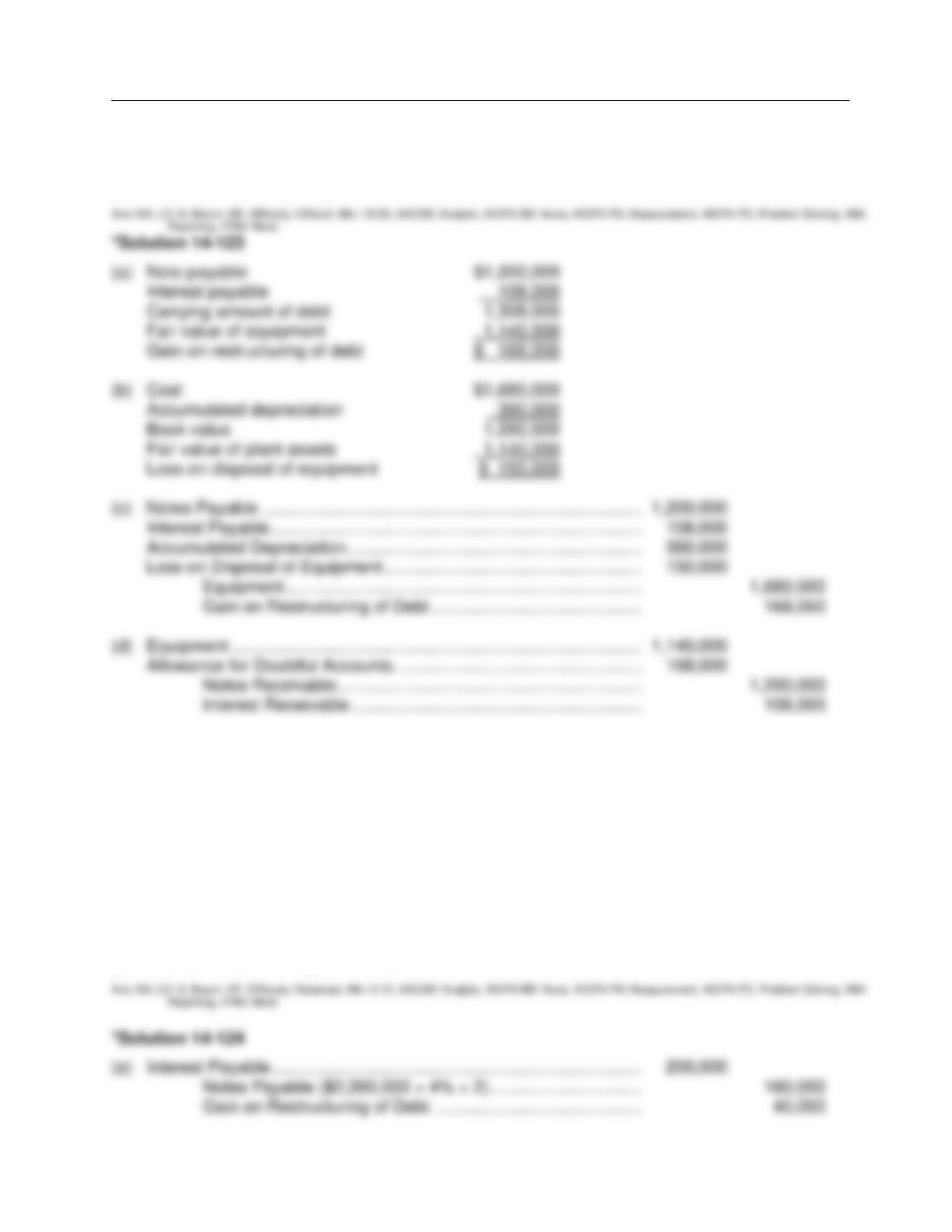
*Ex. 14-123—Accounting for a troubled debt settlement.
Mann, Inc., which owes Doran Co. $1,200,000 in notes payable with accrued interest of $108,000,
is in financial difficulty. To settle the debt, Doran agrees to accept from Mann equipment with a fair
value of $1,140,000, an original cost of $1,680,000, and accumulated depreciation of $390,000.
Instructions
(a) Compute the gain or loss to Mann on the settlement of the debt.
Long-Term Liabilities
14 – 39
(b) Compute the gain or loss to Mann on the transfer of the equipment.
(c) Prepare the journal entry on Mann ‘s books to record the settlement of this debt.
(d) Prepare the journal entry on Doran’s books to record the settlement of the receivable.
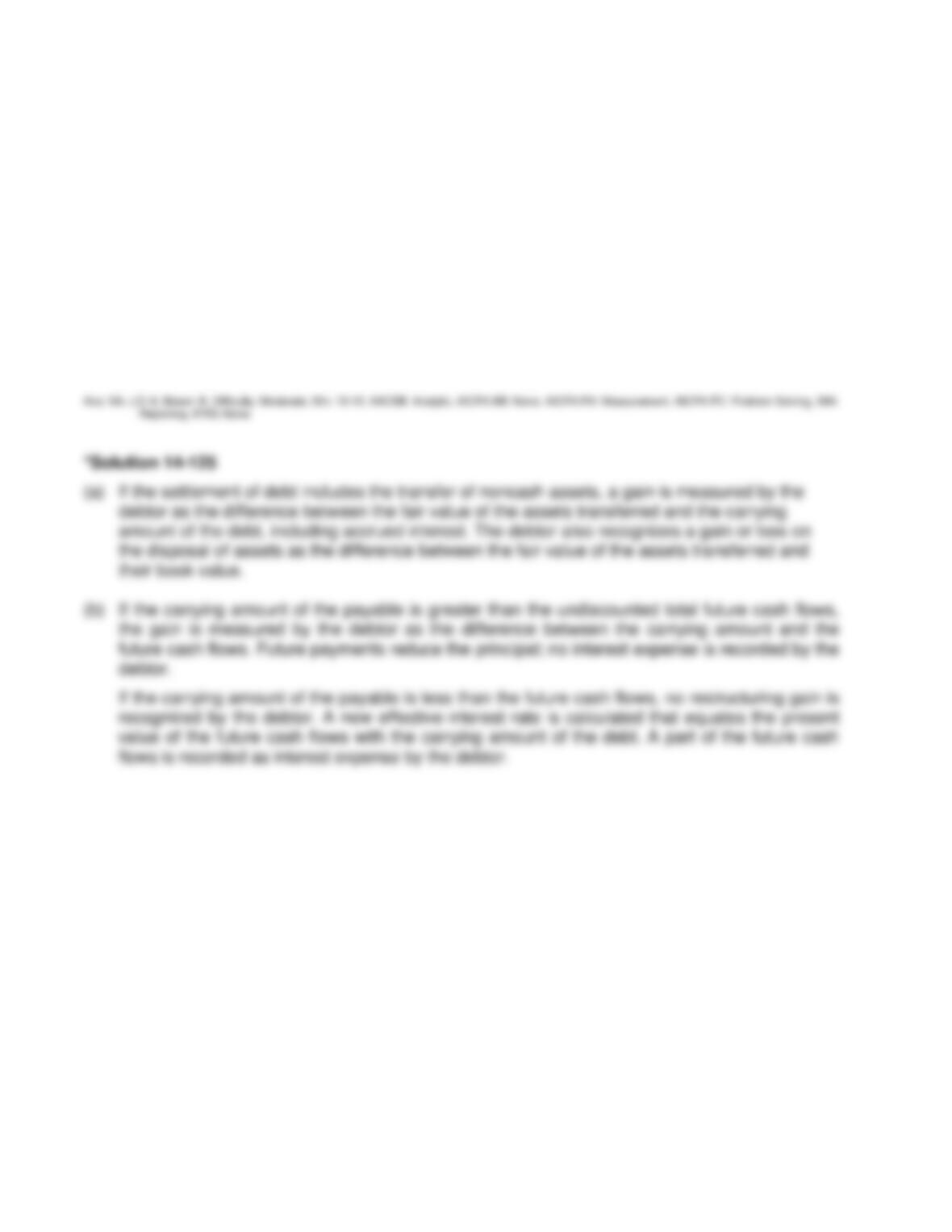
*Ex. 14-124—Accounting for a troubled debt restructuring.
On December 31, 2017, Short Co. is in financial difficulty and cannot pay a note due that day. It is a
$2,000,000 note with $200,000 accrued interest payable to Bryan, Inc. Bryan agrees to forgive the
accrued interest, extend the maturity date to December 31, 2019, and reduce the interest rate to
4%. The present value of the restructured cash flows is $1,712,000.
Instructions
Prepare entries for the following:
(a) The restructure on Short’s books.
(b) The payment of interest on December 31, 2018.
(c) The restructure on Bryan’s books.
Test Bank for Intermediate Accounting, Sixteenth Edition
14 – 40
(b) Notes Payable …………………………………………………………………….. 80,000
Cash ……………………………………………………….………………. 80,000
(c) Allowance for Doubtful Accounts ……………………………………………. 488,000
Notes Receivable (2,000,000 – 1,712,000) …………………… 288,000
Interest Receivable ……………………………………………………. 200,000
*Ex. 14-125—Accounting for troubled debt.
(a) What are the general rules for measuring and recognizing a gain or loss by the debtor on a
settlement of troubled debt which includes the transfer of noncash assets?
(b) What are the general rules for measuring and recognizing a gain and for recording future
payments by the debtor in a troubled debt restructuring?
PROBLEMS
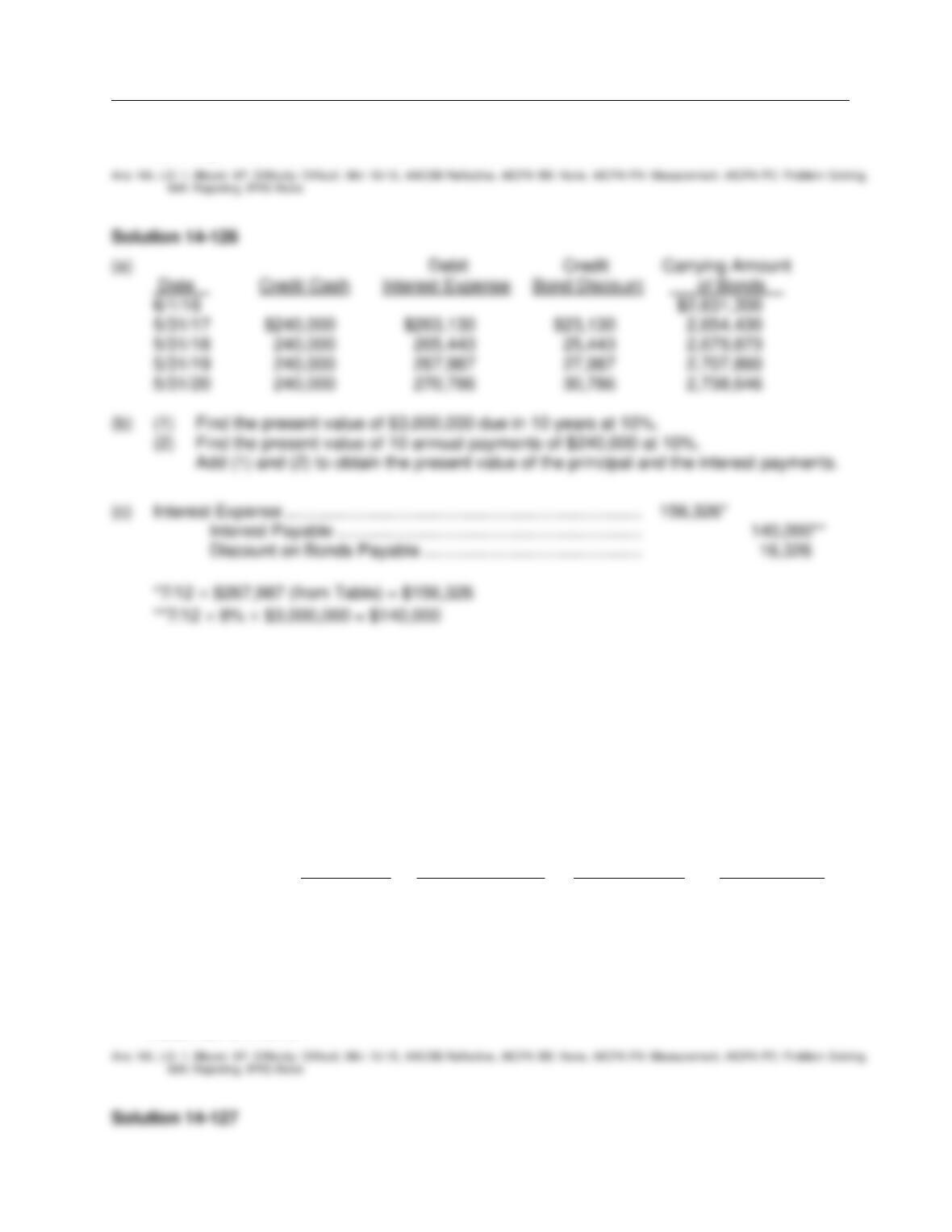
Pr. 14-126—Bond discount amortization.
On June 1, 2016, Everly Bottle Company sold $3,000,000 in long-term bonds for $2,631,300. The
bonds will mature in 10 years and have a stated interest rate of 8% and a yield rate of 10%. The
bonds pay interest annually on May 31 of each year. The bonds are to be accounted for under the
effective-interest method.
Instructions
(a) Construct a bond amortization table for this problem to indicate the amount of interest expense
and discount amortization at each May 31. Include only the first four years. Make sure all
columns and rows are properly labeled. (Round to the nearest dollar.)
(b) The sales price of $2,631,300 was determined from present value tables. Specifically explain
how one would determine the price using present value tables.
Long-Term Liabilities
14 – 41
(c) Assuming that interest and discount amortization are recorded each May 31, prepare the
adjusting entry to be made on December 31, 2018. (Round to the nearest dollar.)
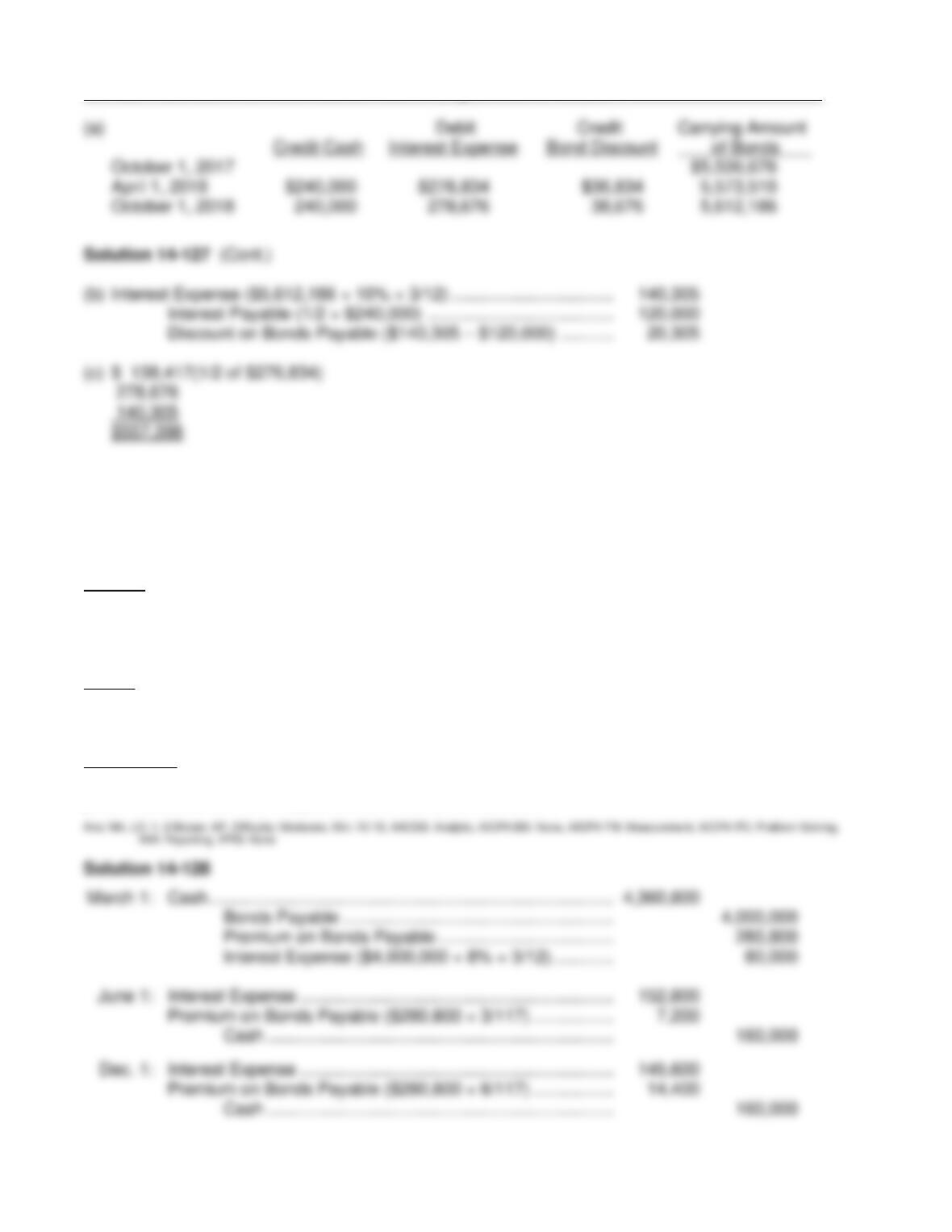
Pr. 14-127—Bond interest and discount amortization.
Grove Corporation issued $6,000,000 of 8% bonds on October 1, 2017, due on October 1, 2022.
The interest is to be paid twice a year on April 1 and October 1. The bonds were sold to yield 10%
effective annual interest. Grove Corporation closes its books annually on December 31.
Instructions
(a) Complete the following amortization schedule for the dates indicated. (Round all answers to
the nearest dollar.) Use the effective-interest method.
Debit Credit Carrying Amount
Credit Cash Interest Expense Bond Discount of Bonds
October 1, 2017 $5,536,676
April 1, 2018
October 1, 2018
(b) Prepare the adjusting entry for December 31, 2018. Use the effective-interest method.
(c) Compute the interest expense to be reported in the income statement for the year ended
December 31, 2018.
Test Bank for Intermediate Accounting, Sixteenth Edition
14 – 42
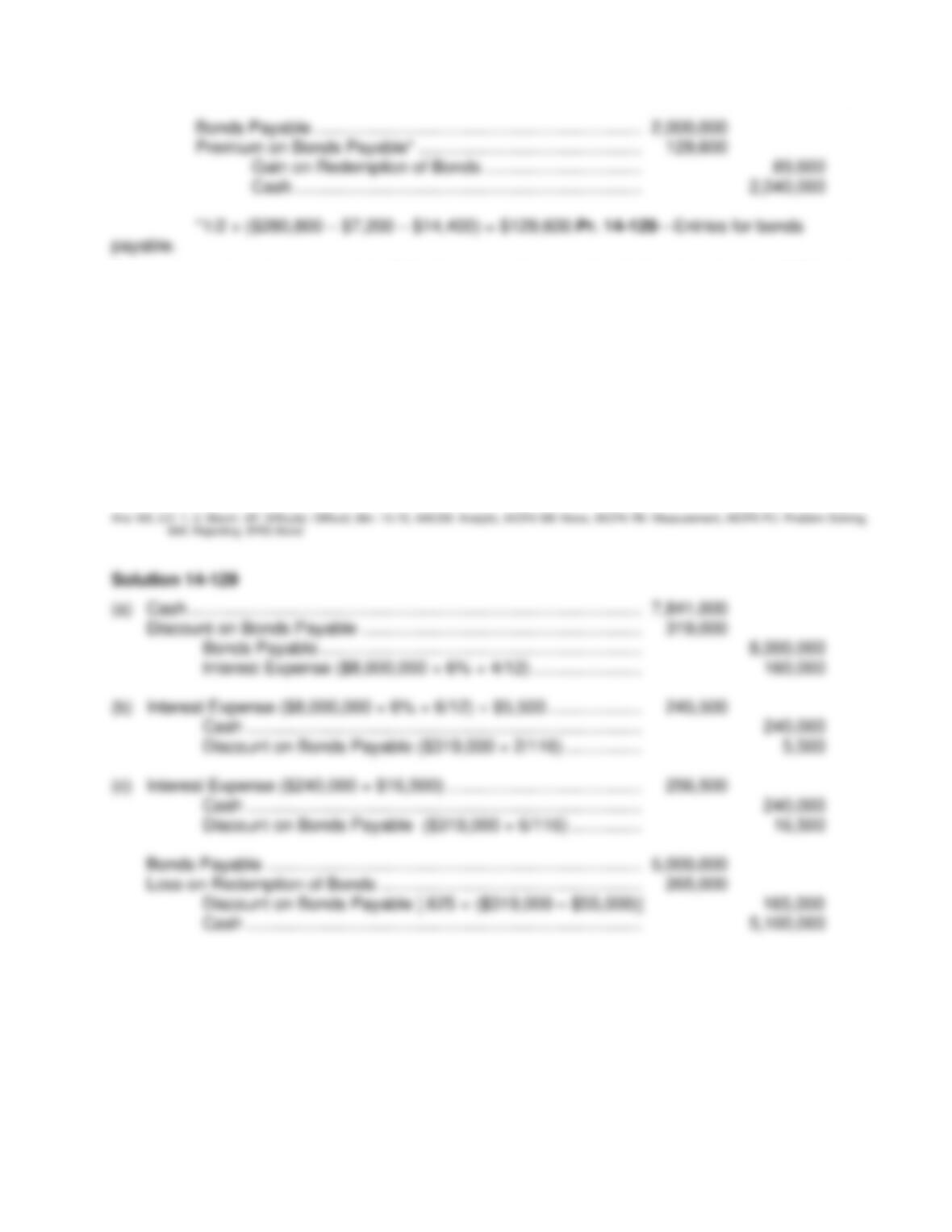
Pr. 14-128—Entries for bonds payable.
Prepare the necessary journal entries to record the following transactions relating to the long-term
issuance of bonds of Pitts Co.:
March 1
Issued $4,000,000 face value Pitts Co. second mortgage, 8% bonds for $4,360,800, including
accrued interest. Interest is payable semiannually on December 1 and June 1 with the bonds
maturing 10 years from this past December 1. The bonds are callable at 102.
June 1
Paid semiannual interest on Pitts Co. bonds. (Use straight-line amortization of any premium or
discount.)
December 1
Paid semiannual interest on Pitts Co. bonds and purchased $2,000,000 face value bonds at the call
price in accordance with the provisions of the bond indenture.
Long-Term Liabilities
14 – 43
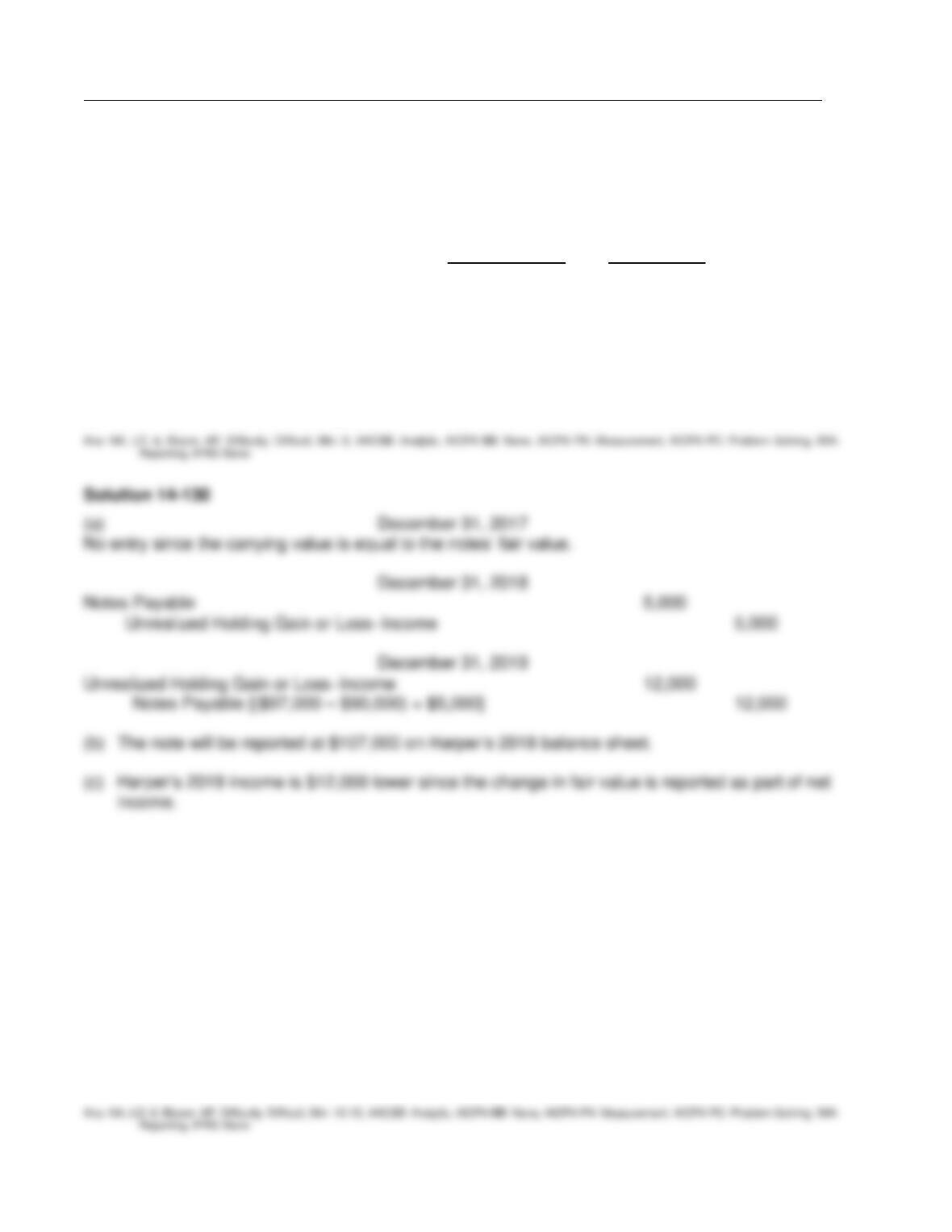
Prepare journal entries to record the following transactions relating to long-term bonds of Kirby, Inc.
(Show computations.)
(a) On June 1, 2017, Kirby, Inc. issued $8,000,000, 6% bonds for $7,841,000, which includes
accrued interest. Interest is payable semiannually on February 1 and August 1 with the bonds
maturing on February 1, 2027. The bonds are callable at 102.
(b) On August 1, 2017, Kirby paid interest on the bonds and recorded amortization. Kirby uses
straight-line amortization.
(c) On February 1, 2019, Kirby paid interest and recorded amortization on all of the bonds, and
purchased $5,000,000 of the bonds at the call price. Assume that a reversing entry was made
on January 1, 2019.
Test Bank for Intermediate Accounting, Sixteenth Edition
14 – 44
Pr. 14-130—Fair value option
Harper Company commonly issues long-term notes payable to its various lenders. Harper has had
a pretty good credit rating such that its effective borrowing rate is quite low (less than 8% on an
annual basis). Harper has elected to use the fair value option for the long-term notes issued to
Barclay’s Bank and has the following data related to the carrying and fair value for these notes.
Carrying Value Fair Value
December 31, 2017 $135,000 $135,000
December 31, 2018 112,000 107,000
December 31, 2019 90,000 97,000
Instructions
(a) Prepare the journal entry at December 31 (Harper’s year-end) for 2017, 2018, and 2019 to
record the fair value option for these notes.
(b) At what amount will the note be reported on Harper’s 2018 balance sheet?
(c) What is the effect of recording the fair value option on these notes on Harper’s 2019 income?
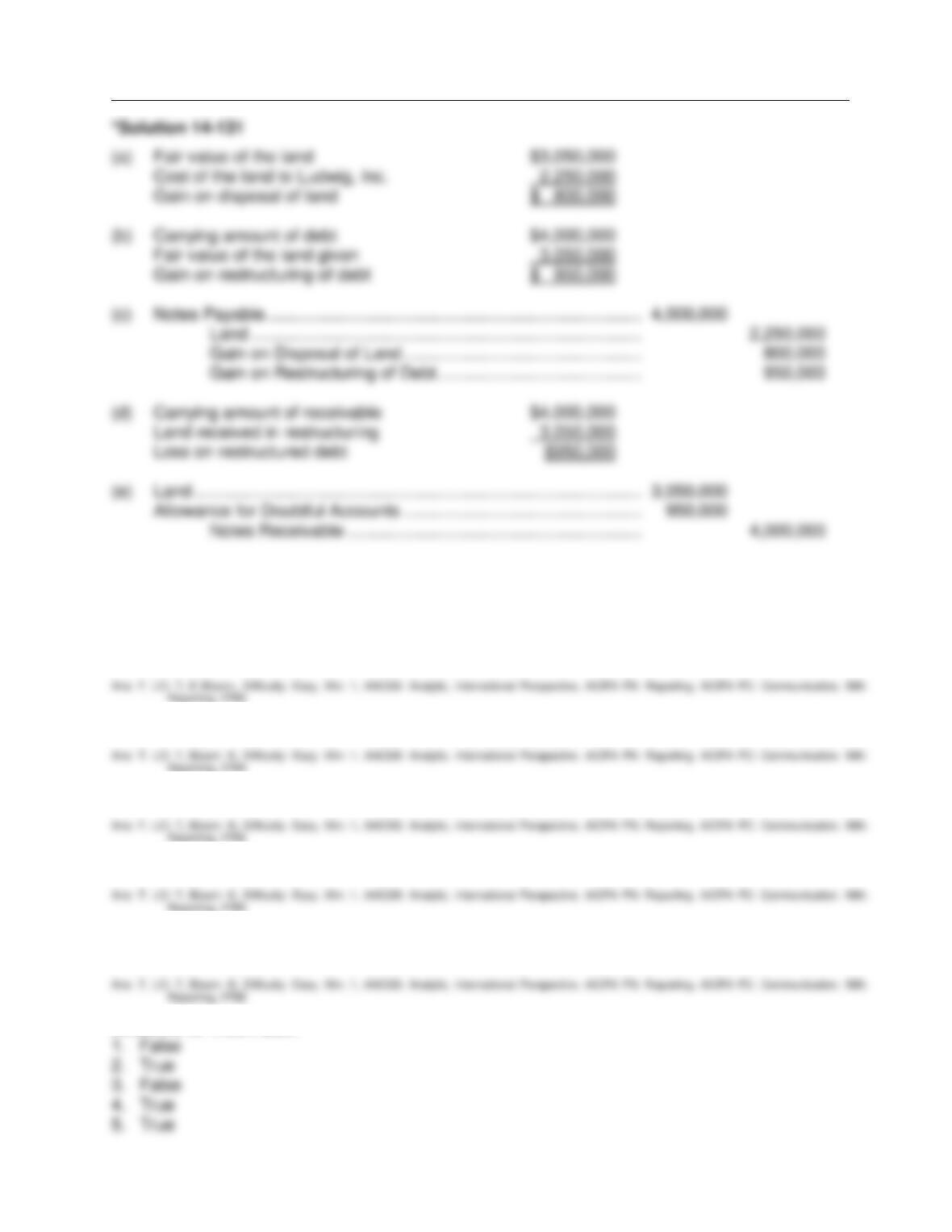
*Pr. 14-131—Accounting for a troubled debt restructuring.
Ludwig, Inc., which owes Giffin Co. $4,000,000 in notes payable, is in financial difficulty. To
eliminate the debt, Giffin agrees to accept from Ludwig land having a fair value of $3,050,000 and a
recorded cost of $2,250,000.
Instructions
(a) Compute the amount of gain or loss to Ludwig, Inc. on the transfer (disposition) of the land.
(b) Compute the amount of gain or loss to Ludwig, Inc. on the restructuring of the debt.
(c) Prepare the journal entry on Ludwig ‘s books to record the restructuring of this debt.
(d) Compute the gain or loss to Giffin Co. from restructuring of its receivable from Ludwig.
(e) Prepare the journal entry on Giffin’s books to record the restructuring of this receivable.
Long-Term Liabilities
14 – 45
IFRS QUESTIONS
True/False
1. IFRS requires the use of straight-line method for amortization of a discount or premium.
2. U.S. GAAP and IFRS have the same accounting guidelines for bond issue costs.
3. Under IFRS, bond issue costs are recorded as an asset.
4. Under IFRS, all troubled-debt restructurings are accounted for as extinguishments.
5. Under IFRS the required procedure for amortization of a discount or premium is the effective–
interest method.
Answers to True/False:

Test Bank for Intermediate Accounting, Sixteenth Edition
14 – 46
Multiple Choice Questions
6. IFRS generally assumes that all restructurings be accounted for as:
a. extinguishments of debt.
b. loss on debt.
c. amortization expense.
d. bad-debt expense.
7. All of the following are differences between IFRS and U.S. GAAP in accounting for liabilities
except:
a. When a bond is issued at a discount U.S. GAAP records the discount in a separate contra–
liability account. IFRS records the bond net of the discount.
b. Under IFRS, bond issuance costs reduces the carrying value of the debt. Under U.S. GAAP,
these costs are recorded as an asset and amortized to expense over the term of the bond.
c. U.S. GAAP, but not IFRS uses the term “troubled debt restructurings.”
d. U.S. GAAP, but not IFRS uses the term “provisions” for contingent liabilities which are
accrued.
8. IFRS requires bond issue costs:
a. to be recorded as an asset.
b. to be excluded while computing the interest expense.
c. to be netted against the carrying amount of the bonds.
d. to be considered when computing income tax payable.
9. Both IFRS and U.S. GAAP permit valuation of long-term debt and other liabilities at
a. present value discounted at the firm’s cost of capital.
b. current market values of the obligations, based on changes in the discount rate with
unrealized gains and losses reflected in a separate account in stockholders’ equity.
c. fair value with gains and losses on changes in fair value recorded in income in certain
situations.
d. historic costs without reflecting changes in valuation as obligations will be retired at their
maturity date.
Answers to multiple choice:

Long-Term Liabilities
14 – 47
IFRS Short Answer:
1. Briefly describe some of the differences between GAAP and IFRS with respect to the
accounting for long-term liabilities.
IFRS and GAAP have similar definitions for liabilities. Although the two standards are quite
similar with respect to treatment of current liabilities, there are a few differences in the treatment
of long-term liabilities:
(1) Under GAAP and under IFRS, bond issue costs are netted against the carrying amount of
the bonds.
(2) GAAP has developed specific guidelines for debt restructuring and terms it as “trouble-debt
restructurings” however IFRS assumes that all restructurings will be accounted for as
extinguishments of debt.
(3) Under IFRS, companies do not use premium or discount accounts but instead show the
bond at its net amount.
(4) GAAP permits the use of straight-line method of amortization for bond discount or premium
in cases where the amount recorded is not materially different from effective-interest
amortization. However IFRS allows only effective-interest method.