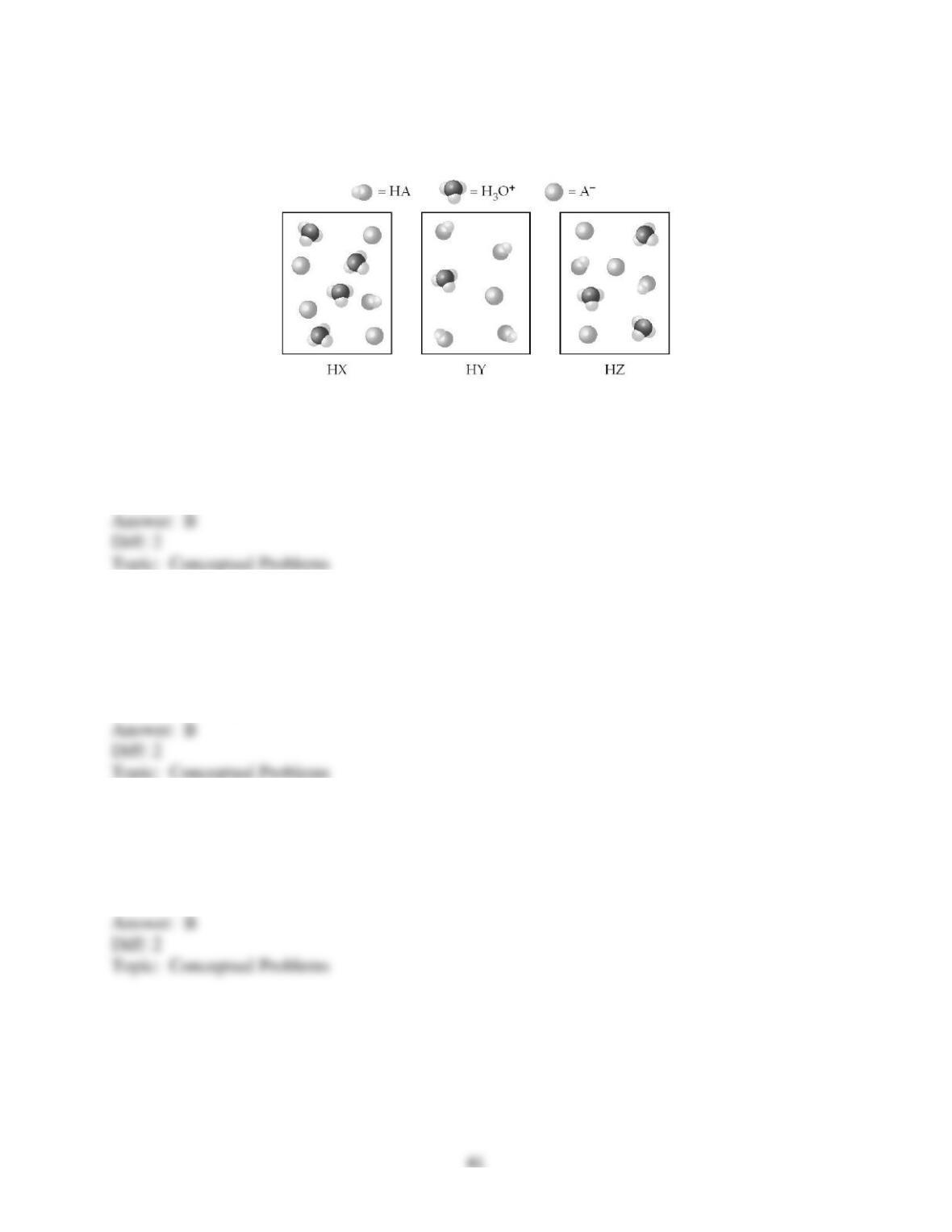
The following pictures represent equal volumes of aqueous solutions of three acids HA (A = X,
Y, or Z); water molecules have been omitted for clarity.
144) Arrange the acids in order of increasing acid strength.
A) HZ < HY < HX
B) HY < HZ < HX
C) HZ < HX < HY
D) HX < HZ < HY
145) Arrange the acids in order of increasing value of Ka.
A) Ka(HZ) < Ka(HY) < Ka(HX)
B) Ka(HY) < Ka(HZ) < Ka(HX)
C) Ka(HZ) < Ka(HX) < Ka(HY)
D) Ka(HX) < Ka(HZ) < Ka(HY)
146) Arrange the acids in order of increasing value of percent dissociation.
A) HZ < HY < HX
B) HY < HZ < HX
C) HZ < HX < HY
D) HX < HZ < HY
147) Arrange the acids in order of increasing pH.
A) HZ < HY < HX
B) HY < HZ < HX
C) HZ < HX < HY
D) HX < HZ < HY
148) Arrange the conjugate bases (A– = X–, Y–, or Z–) in order of increasing base strength.
A) Z– < Y– < X–
B) Y– < Z– < X–
C) Z– < X– < Y–
D) X– < Z– < Y–
149) Arrange the conjugate bases (A– = X–, Y–, or Z–) in order of increasing value of Kb.
A) Kb(Z–) < Kb(Y–) < Kb(X–)
B) Kb(Y–) < Kb(Z–) < Kb(X–)
C) Kb(Z–) < Kb(X–) < Kb(Y–)
D) Kb(X–) < Kb(Z–) < Kb(Y–)
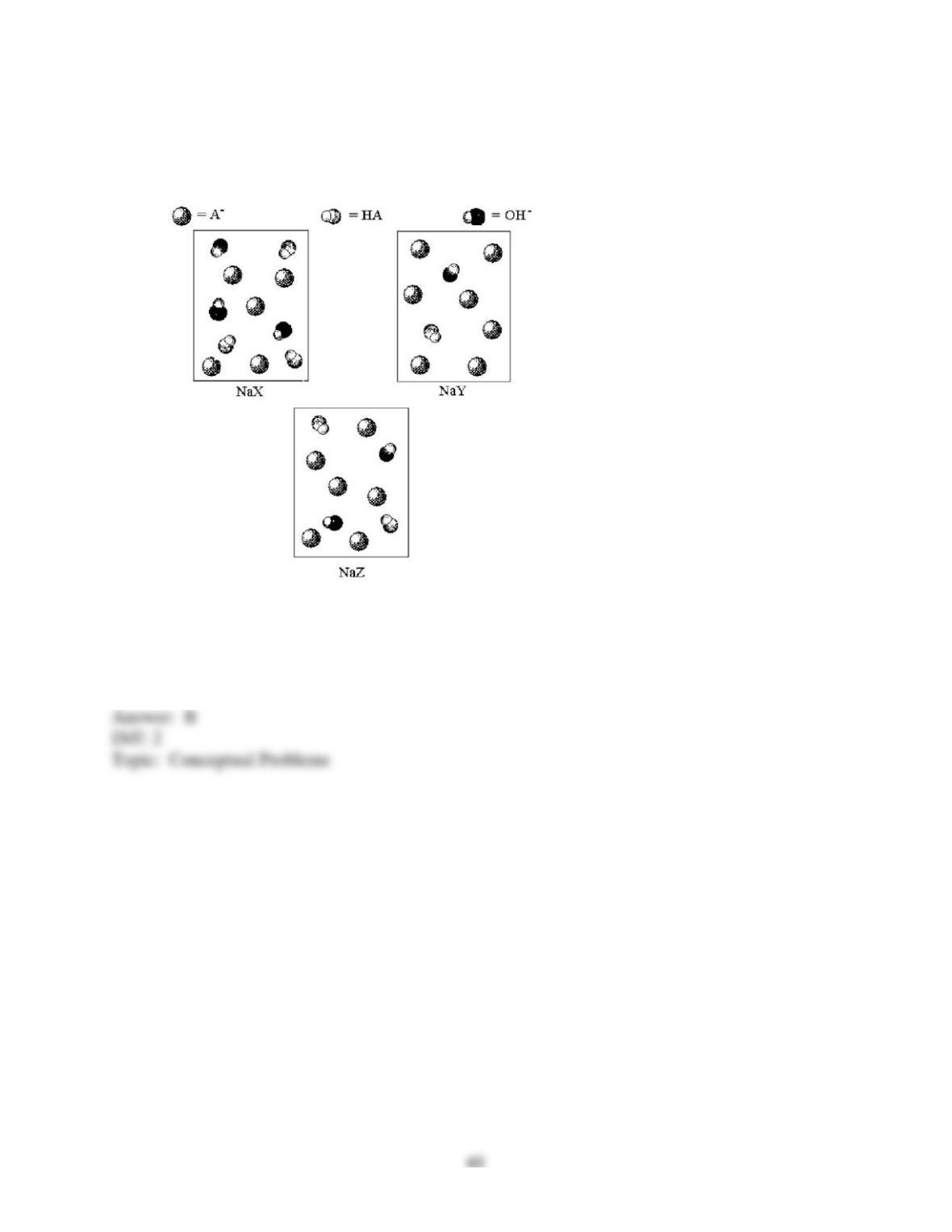
150) The following pictures represent solutions of three salts NaA (A– = X–, Y–, or Z–); water
molecules and Na+ ions have been omitted for clarity. Arrange the three A– ions in order of
decreasing base strength.
A) X– > Y– > Z–
B) X– > Z– > Y–
C) Y– > Z– > X–
D) Z– > Y– > XZ–
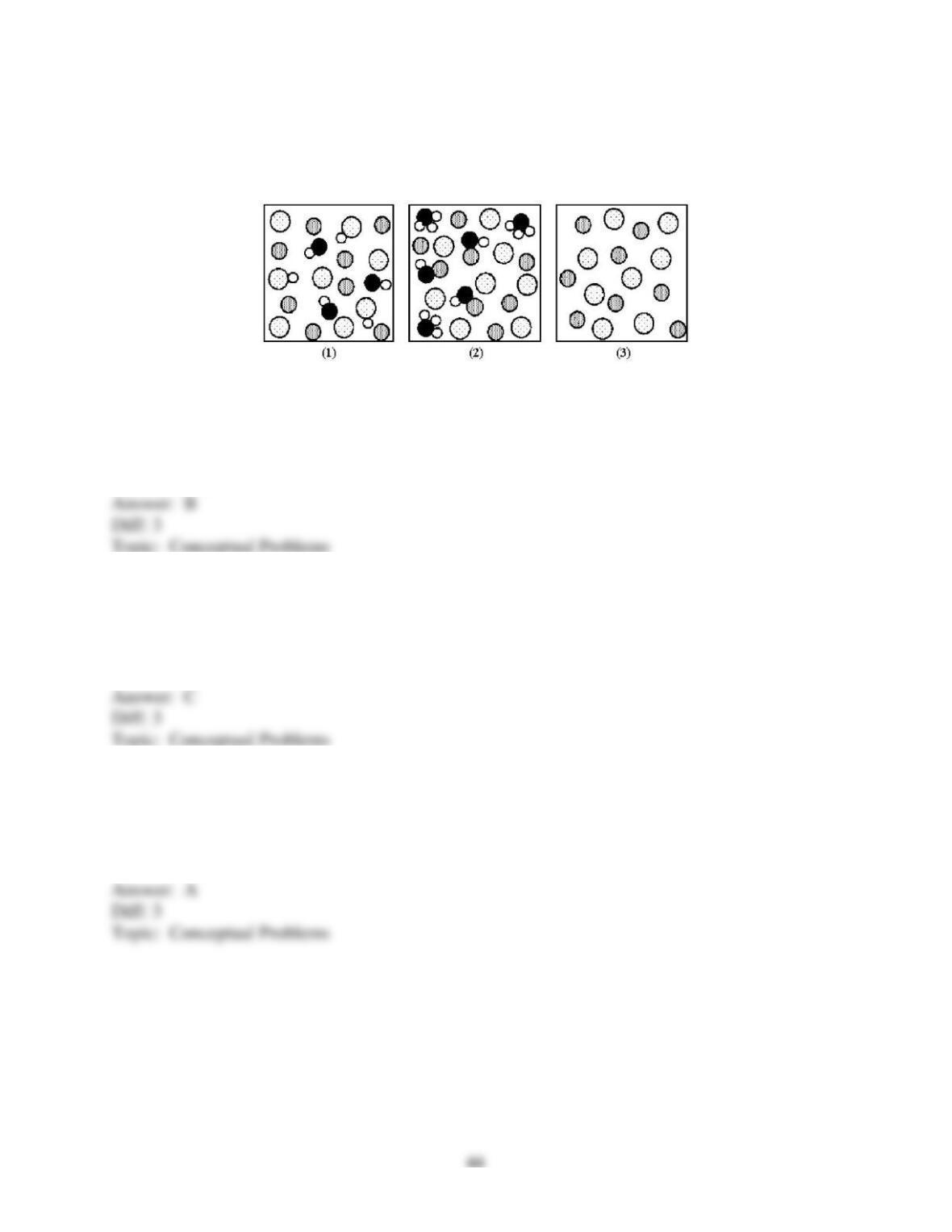
The following pictures represent solutions of three salts MA; water molecules have been omitted
for clarity. Dotted spheres represent Ay– ions; gray spheres represent Mx+ ions; black spheres
represent oxygen atoms; and unshaded spheres represent hydrogen atoms.
151) Which picture represents an acidic salt?
A) (1)
B) (2)
C) (3)
D) none of the above
152) Which picture represents a neutral salt?
A) (1)
B) (2)
C) (3)
D) none of the above
153) Which picture represents a basic salt?
A) (1)
B) (2)
C) (3)
D) none of the above
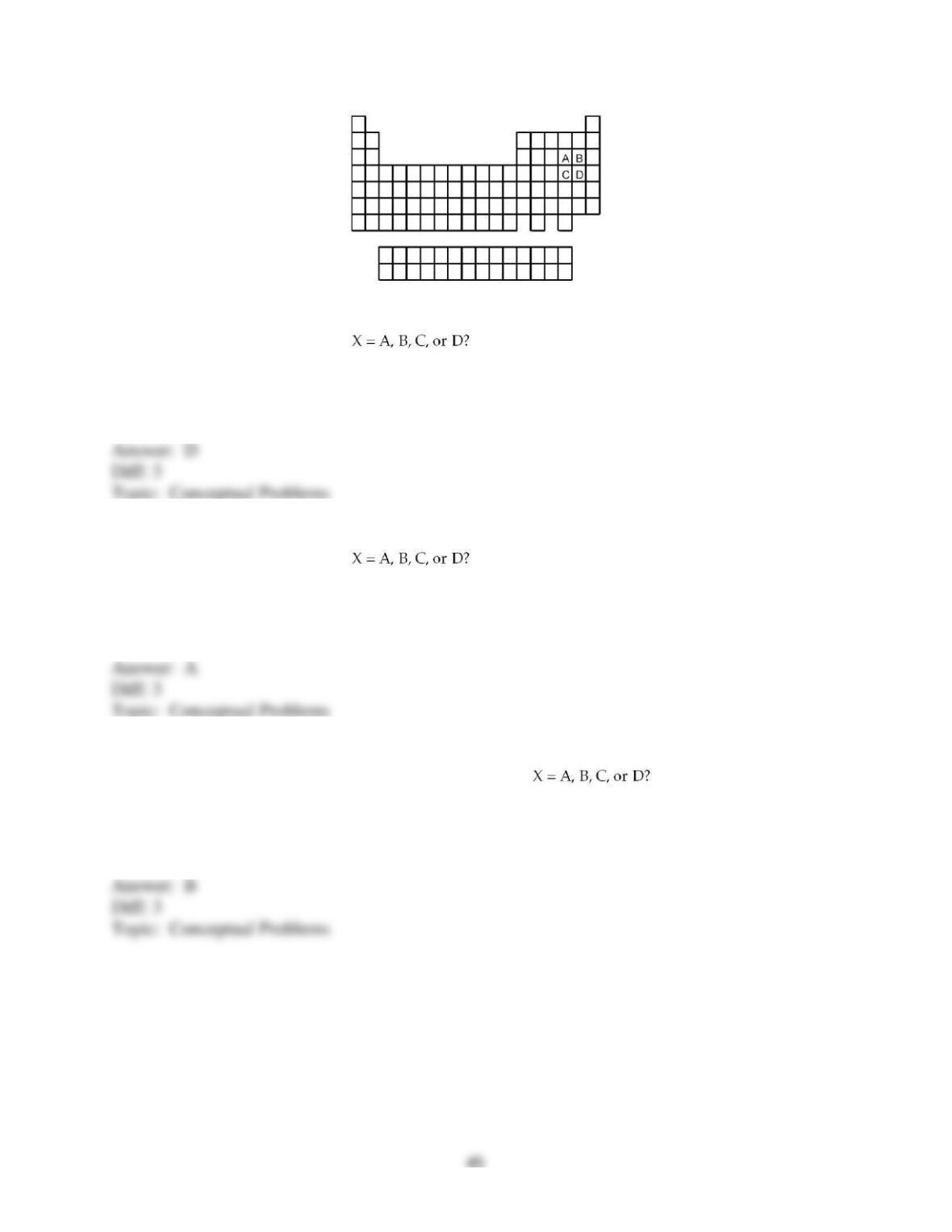
154) Of the elements indicated on the periodic table shown above, which forms the strongest
binary acid, H2X or HX, where
A) A
B) B
C) C
D) D
155) Of the elements indicated on the periodic table shown above, which forms the weakest
binary acid, H2X or HX, where
A) A
B) B
C) C
D) D
156) Of the elements indicated on the periodic table shown above, which forms the strongest
oxoacid acid with the formula H2XO3 or HXO3, where
A) A
B) B
C) C
D) D
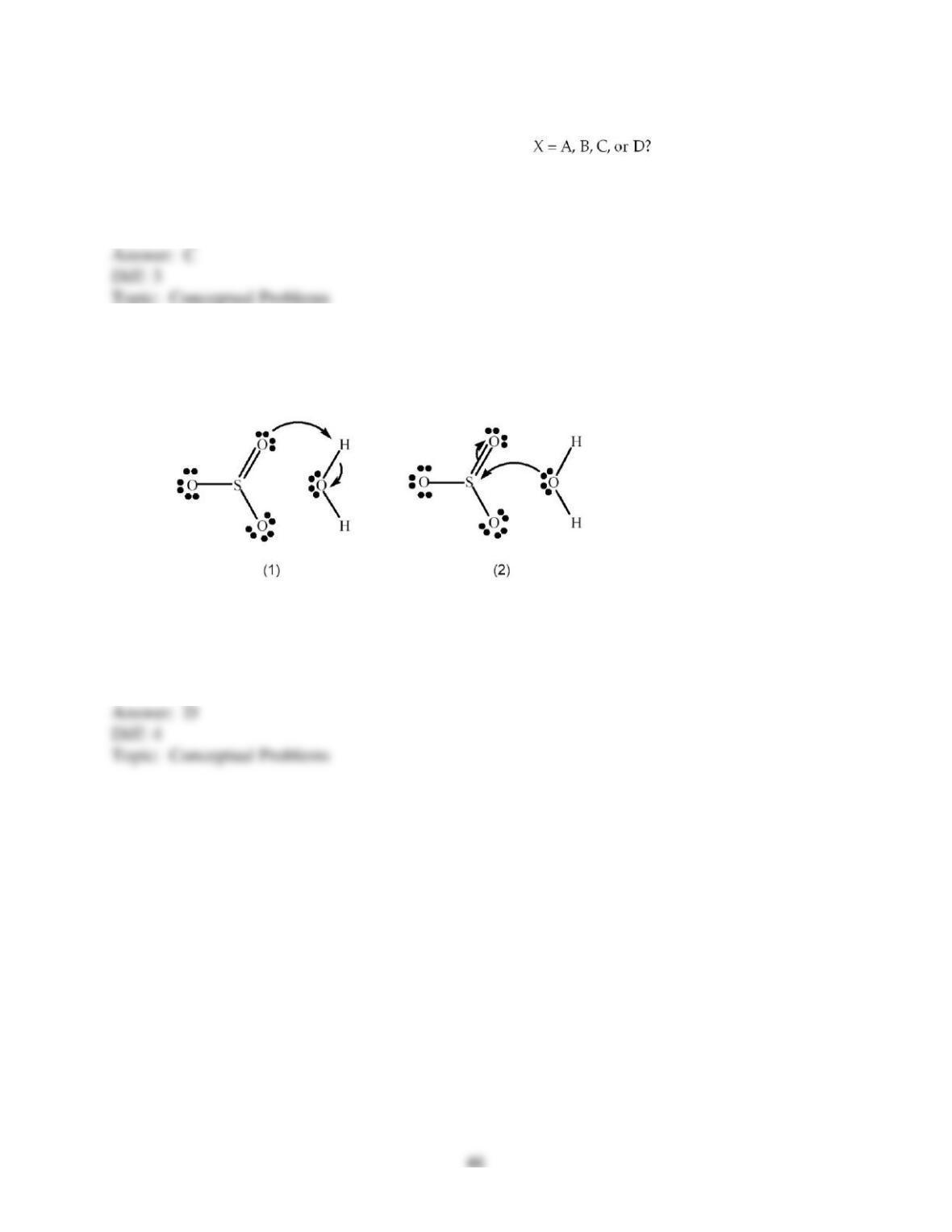
157) Of the elements indicated on the periodic table shown above, which forms the weakest
oxoacid acid with the formula H2XO3 or HXO3, where
A) A
B) B
C) C
D) D
158) SO3 reacts with H2O to form H2SO4. Which picture below correctly represents the curved
arrow notation for the initial Lewis acid-Lewis base interaction in this reaction; what is the
Lewis acid and the Lewis base?
A) Picture (1) is correct; H2O is the Lewis acid and SO3 is the Lewis base.
B) Picture (1) is correct; SO3 is the Lewis acid and H2O is the Lewis base.
C) Picture (2) is correct; H2O is the Lewis acid and SO3 is the Lewis base.
D) Picture (2) is correct; SO3 is the Lewis acid and H2O is the Lewis base.
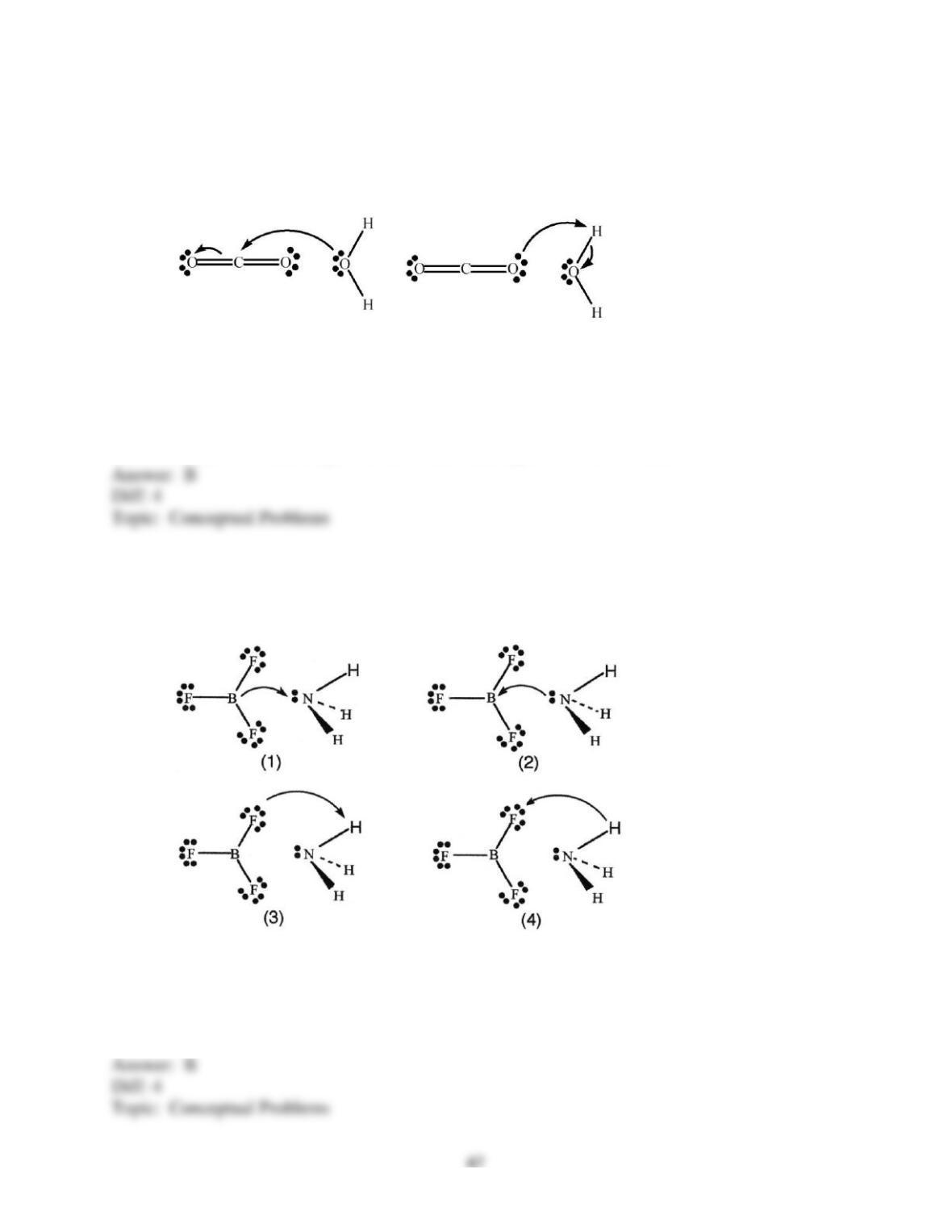
159) CO2 reacts with H2O to form HCO3– and H+. Which picture below correctly represents the
curved arrow notation for the initial Lewis acid-Lewis base interaction in this reaction; what is
the Lewis acid and the Lewis base?
(1) (2)
A) Picture (1) is correct; H2O is the Lewis acid and CO2 is the Lewis base.
B) Picture (1) is correct; CO2 is the Lewis acid and H2O is the Lewis base.
C) Picture (2) is correct; H2O is the Lewis acid and CO2 is the Lewis base.
D) Picture (2) is correct; CO2 is the Lewis acid and H2O is the Lewis base.
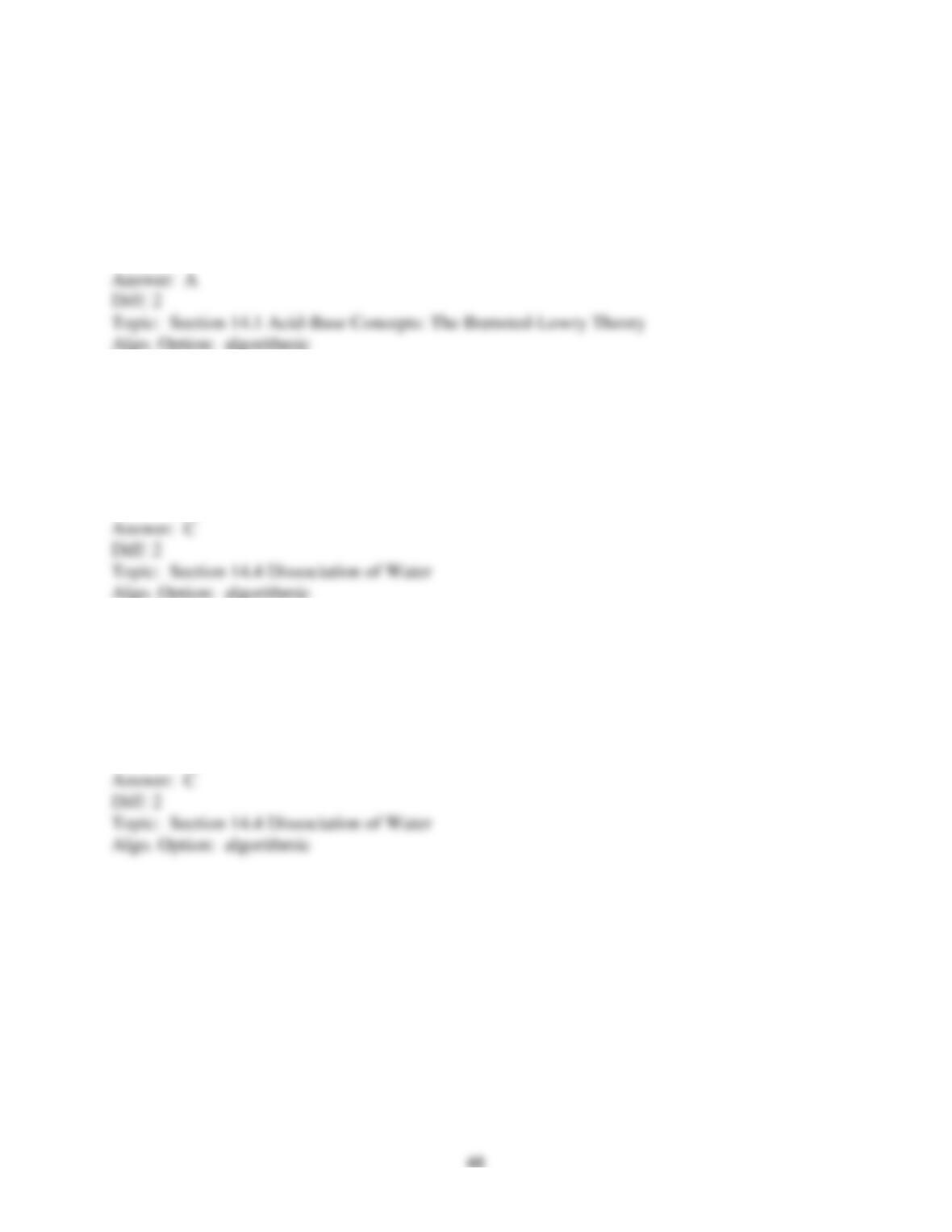
160) BF3 and NH3 undergo a Lewis acid-base reaction forming an adduct. Which picture below
correctly represents the curved arrow notation for the initial Lewis acid-Lewis base interaction in
this reaction; what is the Lewis acid and the Lewis base?
A) Picture (1) is correct; NH3 is the Lewis acid and BF3 is the Lewis base.
B) Picture (2) is correct; BF3 is the Lewis acid and NH3 is the Lewis base.
C) Picture (3) is correct; NH3 is the Lewis acid and BF3 is the Lewis base.
D) Picture (4) is correct; BF3 is the Lewis acid and NH3 is the Lewis base.
14.2 Algorithmic Questions
1) When dissolved in water, which compound is generally considered to be an Arrhenius acid?
A) H NO2
B) KOH
C) Li F
D) CH3OH
2) Calculate the hydronium ion concentration in an aqueous solution that contains 2.50 × 10⁻⁶ M
in hydroxide ion.
A) 4.00 × 10⁻⁷ M
B) 4.00 × 10⁻⁸ M
C) 4.00 × 10⁻⁹ M
D) 5.00 × 10⁻⁹ M
3) Calculate the hydroxide ion concentration in an aqueous solution that contains 3.50 × 10⁻⁴ M
in hydronium ion.
A) 2.86 × 10⁻³ M
B) 2.86 × 10⁻¹⁰ M
C) 2.86 × 10⁻¹¹ M
D) 3.50 × 10⁻¹¹ M
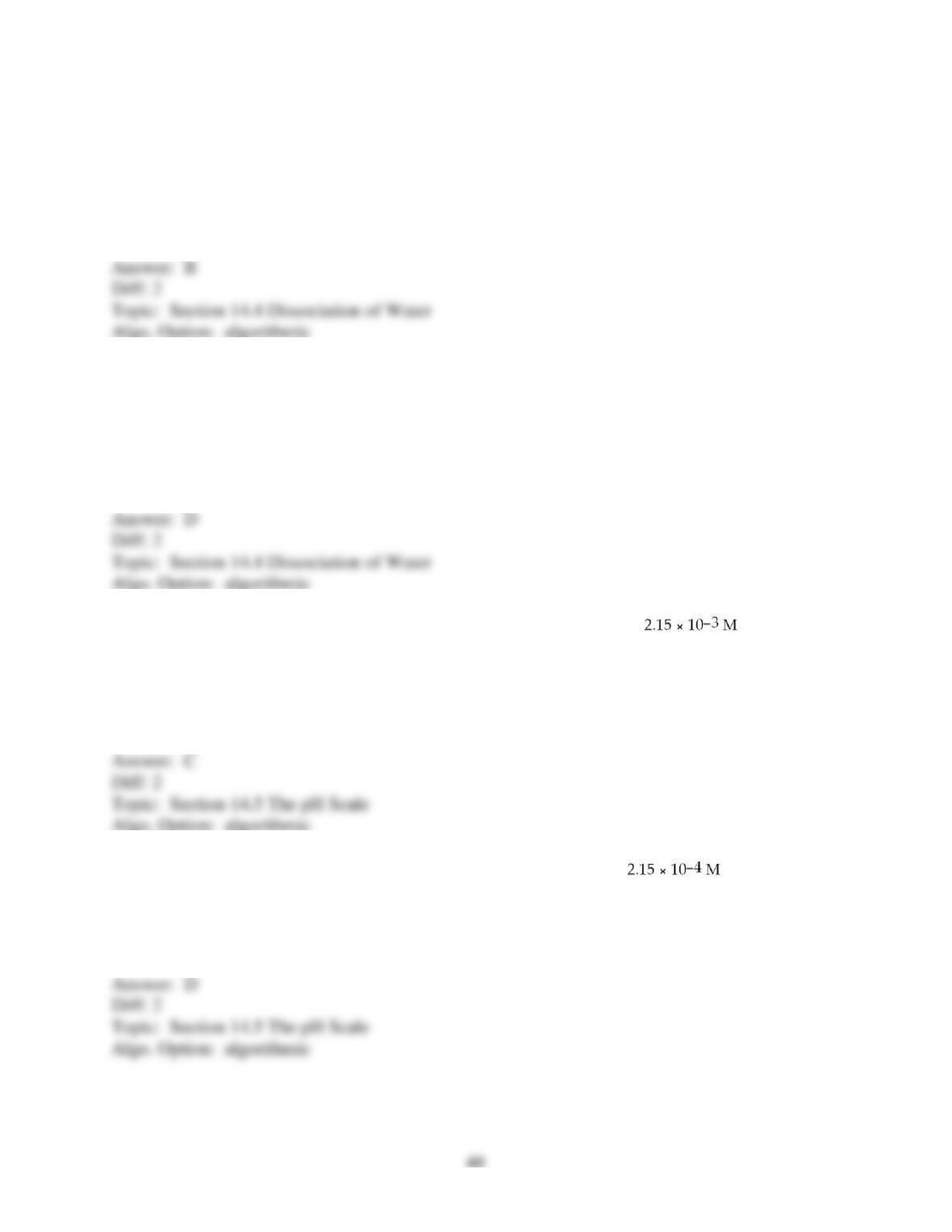
4) A solution with a hydrogen ion concentration of 3.25 × 10⁻⁶ M is ________ and has a
hydroxide ion concentration of ________.
A) acidic, 3.08 × 10⁻⁸ M
B) acidic, 3.08 × 10⁻⁹ M
C) basic, 3.08 × 10⁻⁸ M
D) basic, 3.08 × 10⁻⁹ M
5) A solution with a hydroxide ion concentration of 4.15 × 10⁻⁶ M is ________ and has a
hydrogen ion concentration of ________.
A) acidic, 2.41 × 10⁻⁸ M
B) acidic, 2.41 × 10⁻⁹ M
C) basic, 2.41 × 10⁻⁸ M
D) basic, 2.41 × 10⁻⁹ M
6) Calculate the pH for an aqueous solution of acetic acid that contains hydronium
ion.
A) 4.65 × 10⁻¹² M
B) 2.15 × 10⁻³ M
C) 2.67
D) 11.33
7) Calculate the pH for an aqueous solution of pyridine that contains hydroxide ion.
A) 4.65 × 10⁻¹¹
B) 2.15 × 10⁻⁴
C) 3.67
D) 10.33
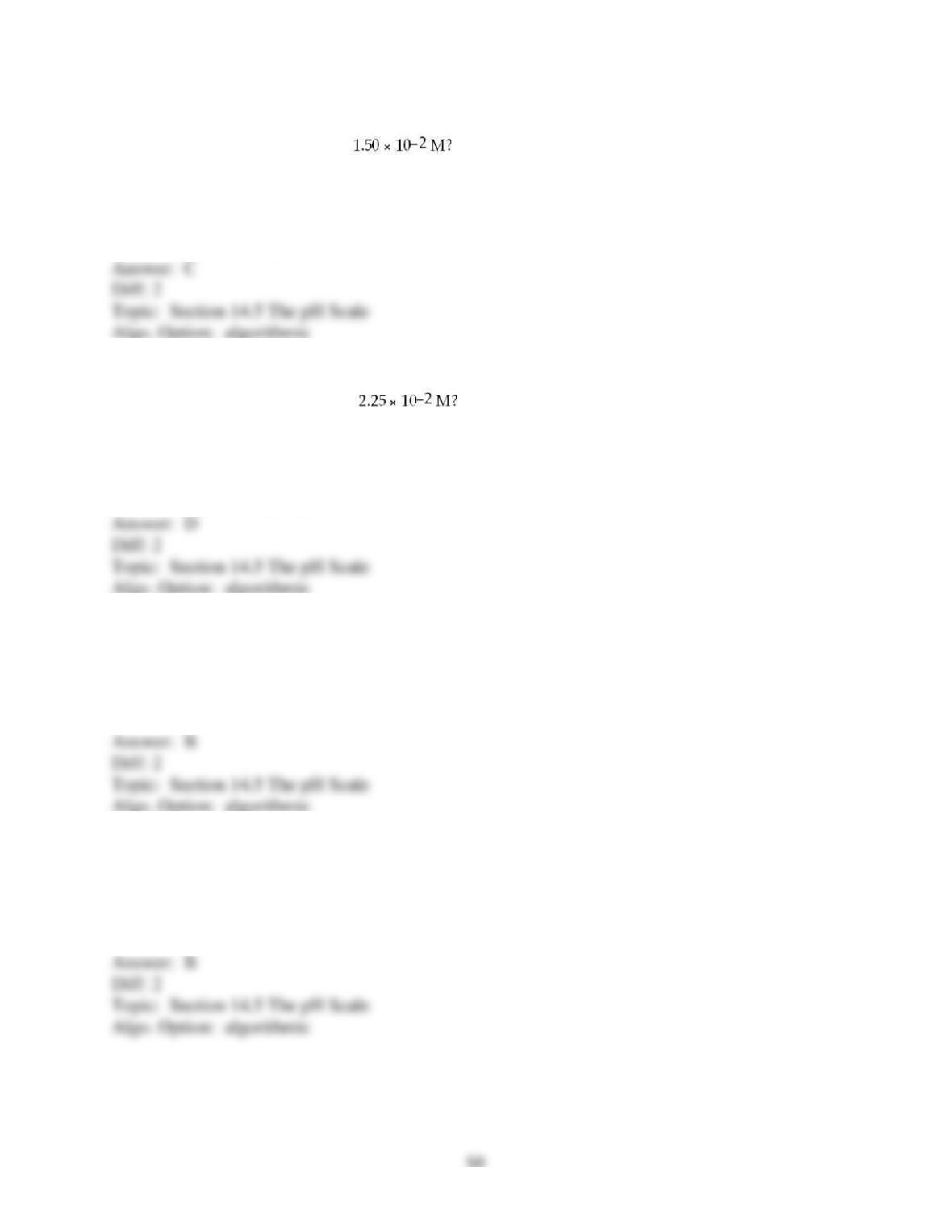
8) What is the hydroxide ion concentration and the pH for a hydrochloric acid solution that has a
hydronium ion concentration of
A) 6.67 × 10⁻¹² M, 2.82
B) 6.67 × 10⁻¹² M, 11.18
C) 6.67 × 10⁻¹³ M, 1.82
D) 6.67 × 10⁻¹³ M, 12.17
9) What is the hydronium ion concentration and the pH for an aqueous solution of NH3 that has
a hydroxide ion concentration of
A) 4.44 × 10⁻¹² M and 2.65
B) 4.44 × 10⁻¹² M and 11.35
C) 4.44 × 10⁻¹³ M and 1.65
D) 4.44 × 10⁻¹³ M and 12.35
10) What is the hydronium ion concentration of an acid rain sample that has a pH of 3.45?
A) 2.82 × 10⁻¹¹ M
B) 3.55 × 10⁻⁴ M
C) 3.45 M
D) 10.55 M
11) What is the hydroxide ion concentration of a lye solution that has a pH of 9.20?
A) 6.31 × 10⁻¹⁰ M
B) 1.58 × 10⁻⁵ M
C) 4.80 M
D) 9.20 M
12) What is the pH of a 0.020 M HClO4 solution?
A) 0.020
B) 0.040
C) 1.70
D) 12.30
13) What is the pH of a 0.040 M Ba(OH)2 solution?
A) 1.10
B) 1.40
C) 12.60
D) 12.90
14) What is the pH of a solution prepared by dissolving 0.45 grams of solid CaO (lime) in
enough water to make 2.00 L of aqueous Ca(OH)2 (limewater)?
CaO(s) + H2O(l) → Ca2+(aq) + 2 OH–(aq)
A) 2.10
B) 2.40
C) 11.60
D) 11.90
15) What is the pH of a solution prepared by diluting 20.00 mL of 0.10 M HCl with enough
water to produce a total volume of 100.00 mL?
A) 1.00
B) 1.70
C) 2.00
D) 3.40
16) What is the pH of a solution prepared by diluting 100.00 mL of 0.020 M Ba(OH)2 with
enough water to produce a total volume of 250.00 mL?
A) 1.80
B) 2.10
C) 11.90
D) 12.20
17) What is the pH of a solution prepared by mixing 100.00 mL of 0.20 M HCl with 150.00 mL
of 0.10 M HCl? Assume that the volumes are additive.
A) 0.17
B) 0.52
C) 0.85
D) 1.70
18) What is the pH of a solution prepared by mixing 100.00 mL of 0.020 M Ca(OH)2 with 50.00
mL of 0.300 M NaOH? Assume that the volumes are additive.
A) 13.05
B) 13.10
C) 13.28
D) 13.58
19) What is the hydronium ion concentration of a 0.500 M acetic acid solution with Ka = 1.8 ×
10-5? The equation for the dissociation of acetic acid is:
CH3CO2H(aq) + H2O(l) ⇌ H3O+(aq) + CH3CO2–(aq).
A) 3.0 × 10⁻² M
B) 4.2 × 10⁻² M
C) 3.0 × 10⁻³ M
D) 4.2 × 10⁻³ M
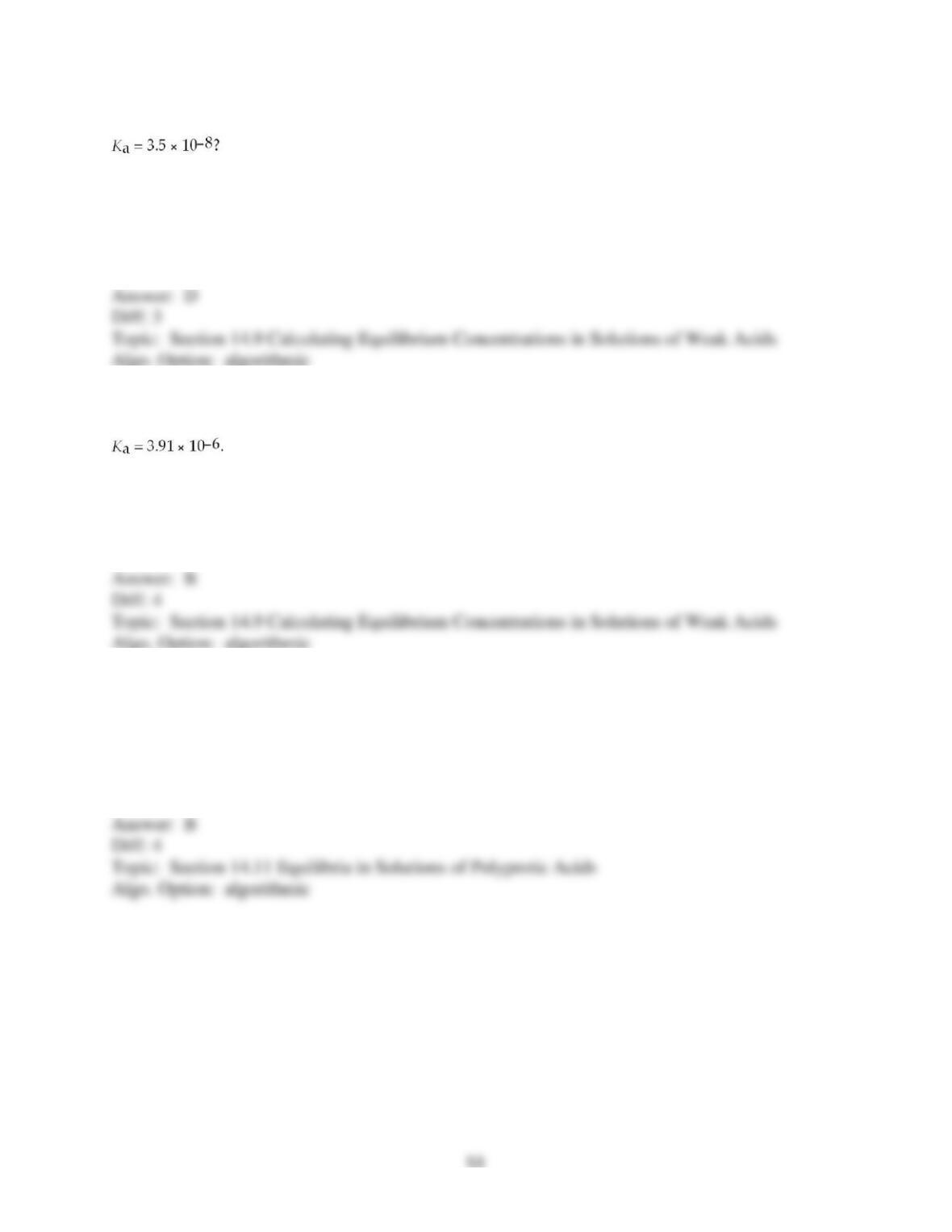
20) What is the hydronium ion concentration of a 0.150 M hypochlorous acid solution with
The equation for the dissociation of hypochlorous acid is:
HOCl(aq) + H2O(l) ⇌ H3O+(aq) + OCl–(aq).
A) 1.9 × 10⁻⁴ M
B) 7.2 × 10⁻⁴ M
C) 2.8 × 10⁻⁵ M
D) 7.2 × 10⁻⁵ M
21) Potassium hydrogen phthalate (molar mass = 204.2 g/mol)is one of the most commonly used
acids for standardizing solutions containing bases. KHP is a monoprotic weak acid with
Calculate the pH of the solution that results when 0.50 g of KHP is dissolved in
enough water to produce 25.0 mL of solution.
A) 2.05
B) 3.21
C) 4.40
D) 5.41
22) Calculate the pH of a 0.080 M carbonic acid solution, H2CO3(aq), that has the stepwise
dissociation constants Ka1 = 4.3 × 10⁻⁷ and Ka2 = 5.6 × 10⁻¹¹.
A) 1.10
B) 3.73
C) 6.37
D) 10.25
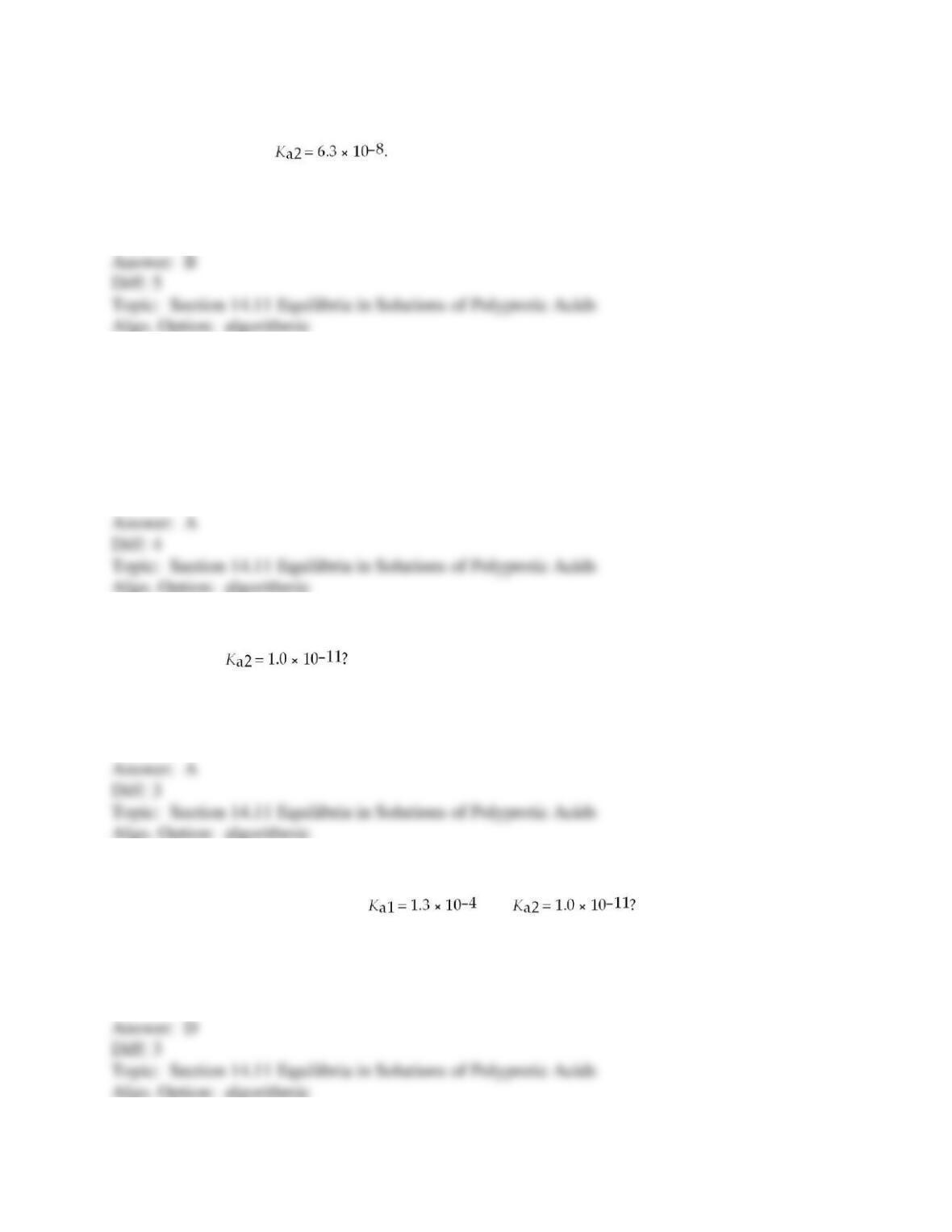
54
23) Calculate the pH of a 0.60 M H2SO3, solution that has the stepwise dissociation constants
Ka1 = 1.5 × 10⁻² and
A) 1.02
B) 1.06
C) 1.82
D) 2.04
24) Calculate the concentration of bicarbonate ion, HCO3–, in a 0.010 M H2CO3 solution that
has the stepwise dissociation constants Ka1 = 4.3 × 10⁻⁷ and Ka2 = 5.6 × 10⁻¹¹.
A) 6.6 × 10⁻⁵ M
B) 4.3 × 10⁻⁷ M
C) 4.3 × 10⁻⁹ M
D) 5.6 × 10⁻¹¹ M
25) What is the pH of a 0.40 M H2Se solution that has the stepwise dissociation constants Ka1 =
1.3 × 10⁻⁴ and
A) 2.14
B) 3.89
C) 4.28
D) 5.57
26) What is the selenide ion concentration [Se2-] for a 0.100 M H2Se solution that has the
stepwise dissociation constants of and
A) 3.6 × 10⁻³ M
B) 1.3 × 10⁻⁴ M
C) 1.3 × 10⁻⁵ M
D) 1.0 × 10⁻¹¹ M
27) What is the pH of a 0.200 M NH3 solution that has Kb = 1.8 × 10⁻⁵? The equation for the
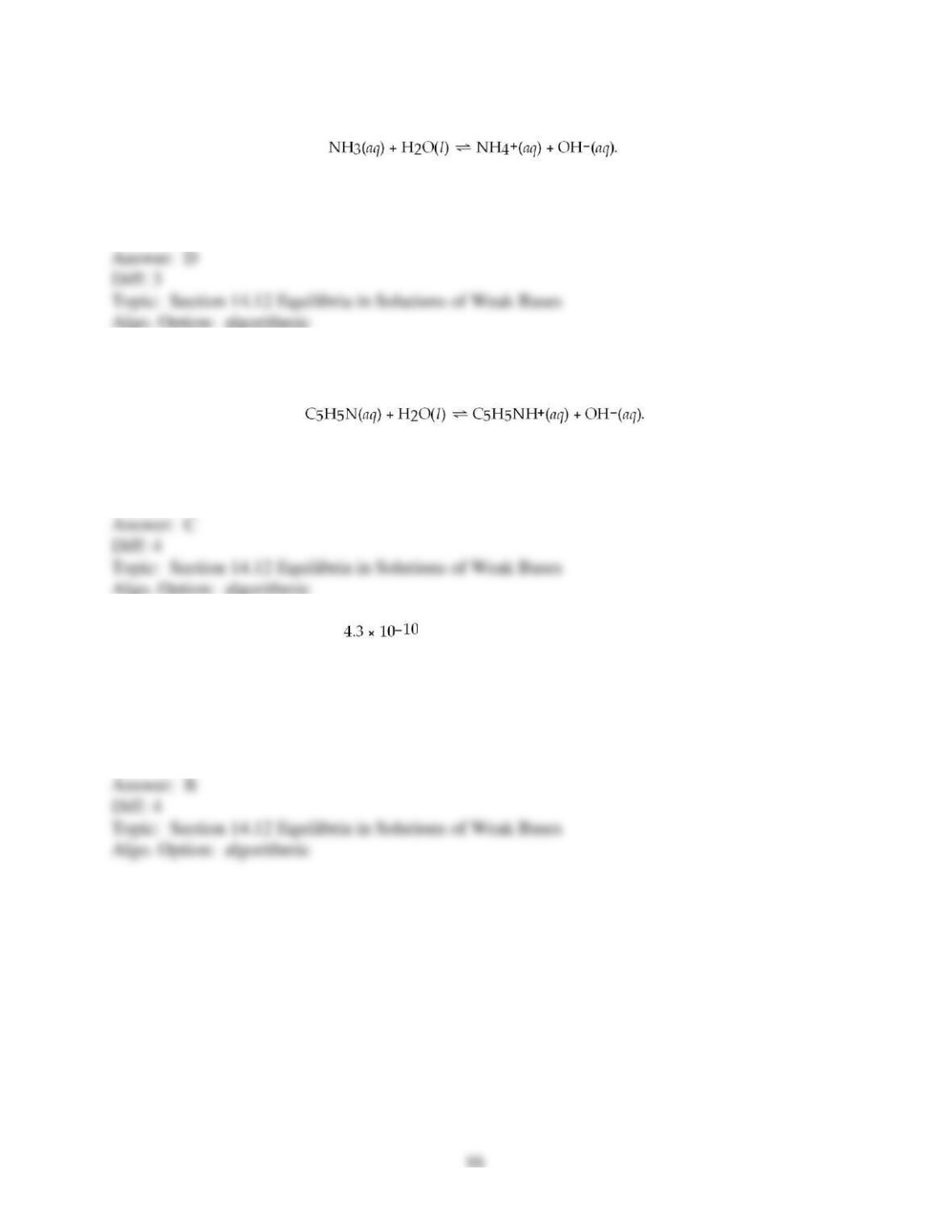
dissociation of NH3 is
A) 2.02
B) 2.72
C) 11.98
D) 11.28
28) What is the pH of a 0.30 M pyridine solution that has Kb = 1.9 × 10⁻⁹? The equation for the
dissociation of pyridine is
A) 4.62
B) 8.72
C) 9.38
D) 10.38
29) Aniline, (C6H5NH2, Kb = at 25°C) is an industrially important amine used in the
making of dyes. Determine the pH of an aniline solution made by dissolving 6.90 g of aniline in
enough water to make 100 mL of solution.
A) 4.75
B) 9.25
C) 9.50
D) 10.50
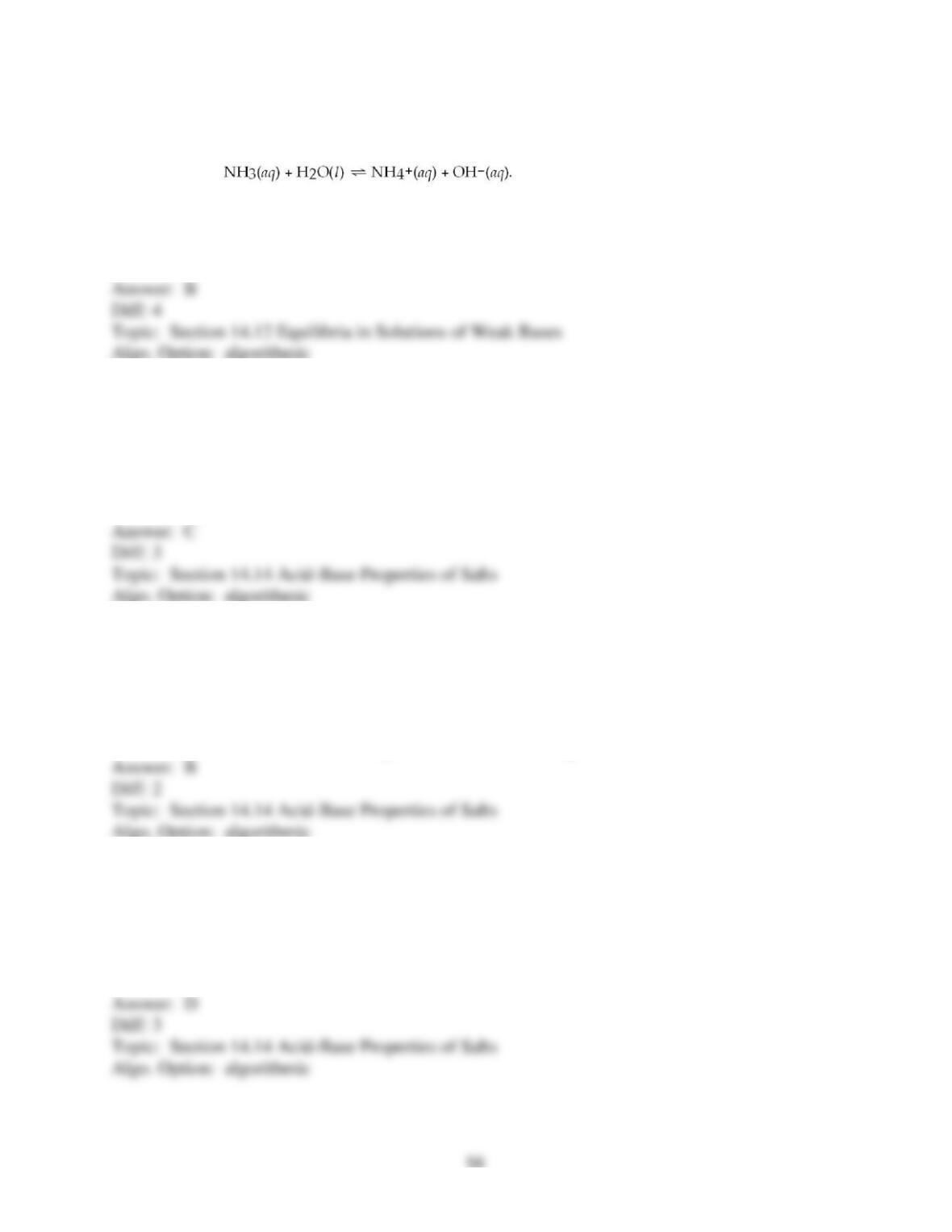
30) Determine the ammonia concentration of an aqueous solution that has a pH of 11.00. The
equation for the dissociation of NH3 (Kb = 1.8 × 10⁻⁵) is
A) 3.0 M
B) 0.056 M
C) 1.8 × 10⁻² M
D) 1.0 × 10⁻³ M
31) Which one of the following salts, when dissolved in water, produces the solution with the
highest pH?
A) KHCO3
B) CsClO4
C) RaO
D) CH3CH3NH3Cl
32) If an equal number of moles of the weak acid HCN and the strong base KOH are added to
water, is the resulting solution acidic, basic, or neutral?
A) acidic
B) basic
C) neutral
D) There is insufficient information provided to answer this question.
33) Which one of the following salts, when dissolved in water, produces the solution with the
highest pH?
A) RbI
B) RbBr
C) RbCl
D) RbF
34) Which one of the following salts, when dissolved in water, produces the solution with a pH
closest to 7.00?
A) NH4Br
B) Ca O
C) K HSO4
D) CsI
35) Calculate the pH of a 0.800 M NaCH3CO2 solution. Ka for acetic acid, CH3CO2H, is
A) 2.42
B) 4.68
C) 9.32
D) 11.58
36) Calculate the pH of a 1.60 M KBrO solution. Ka for hypobromous acid, HBrO, is
A) 2.55
B) 4.25
C) 9.75
D) 11.45
37) Calculate the pH of a 1.60 M CH3NH3Cl solution. Kb for methylamine, CH3NH2, is
A) 1.61
B) 5.18
C) 8.82
D) 12.39
38) Which one of the following salts, when dissolved in water, produces the solution with the
lowest pH?
A) NaCl
B) KCl
C) MgCl2
D) AlCl3
14.3 Short Answer Questions
1) The Brønsted-Lowry acid in the chemical equation below is _________.
HNO2(aq) + H2O(l) ⇌ H3O+(aq) + NO2–(aq)
2) The equilibrium constant for the reaction below has the value Ka = 3.5 × 10⁻⁴. In this
reaction the Brønsted-Lowry acid is ________.
HF(aq) + H2O(l) ⇌ H3O+(aq) + F–(aq)
3) A proton hydrated by four water molecules has the formula ________.
4) An acidic solution with hydronium ion concentration [H+] = 1.60 × 10⁻³ M has a hydroxide
ion concentration [OH–] = ________.
5) At 50°C the value of Kw is 5.5 × 10⁻¹⁴, and the pH of a neutral solution at 50°C is ________.
6) The pH of a 0.025 M KOH solution is ________.
7) The value of Ka for a 0.250 M HCN solution having a pH of 4.956 is ________.
8) A 0.050 M solution of hydroxylamine, NH2OH, having Kb = 9.1 × 10⁻⁹ has a pH of
________.
9) A 0.10 M KNO2 solution will have a pH ________ seven.
10) The acid strength of an oxoacid having the general formula HnYOm increases as the
electronegativity of Y ________ and as the oxidation number of Y ________.