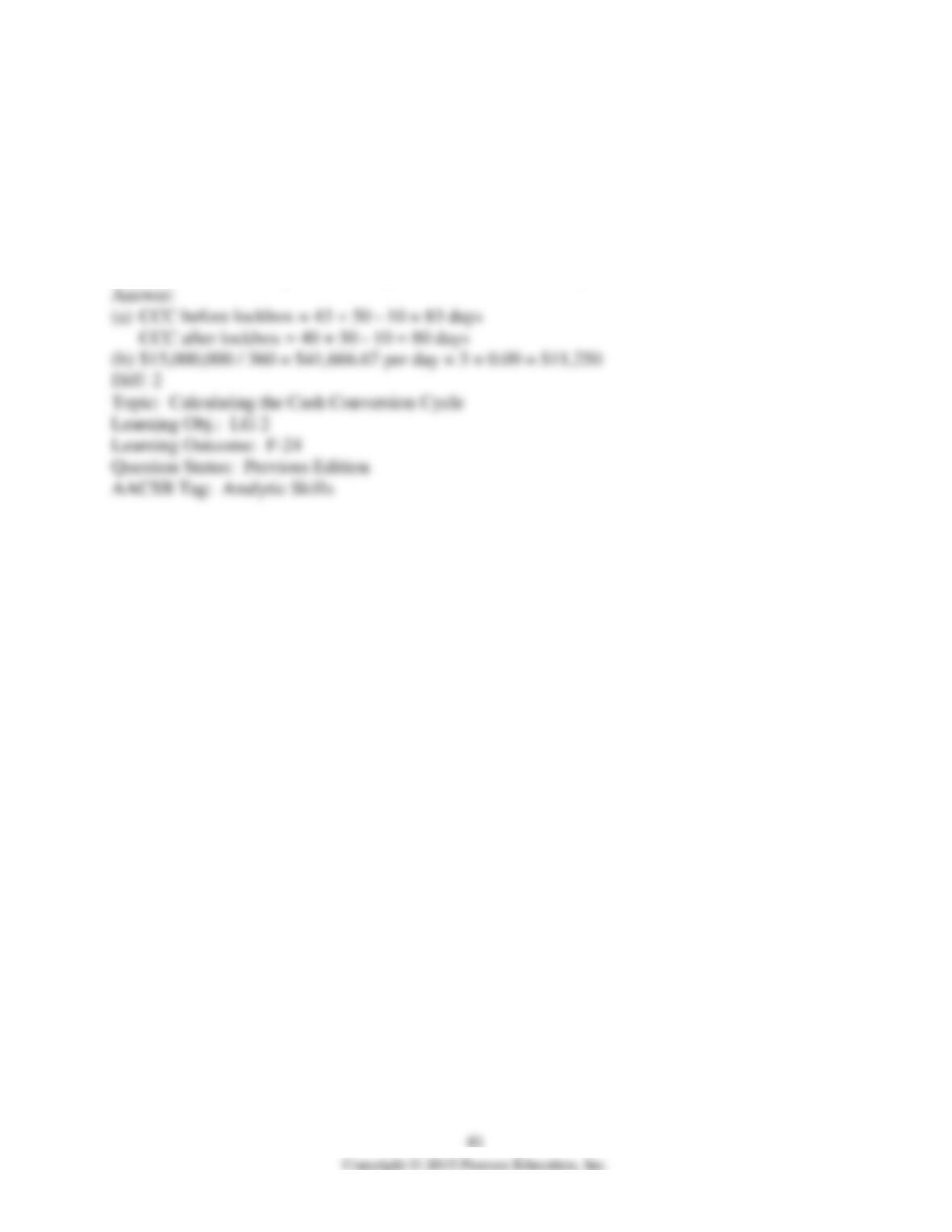
100) A firm has arranged for a lockbox system to reduce collection time of accounts receivable.
Currently the firm has an average collection period of 43 days, an average age of inventory of 50
days, and an average payment period of 10 days. The lockbox system will reduce the average
collection period by 3 days by reducing processing, mail, and clearing float. The firm has total
annual outlays of $15,000,000 and currently pays 9 percent for its financing.(Assume a 360-day
year.)
(a) Calculate the cash conversion cycle before and after the lockbox system.
(b) Calculate the savings in financing costs from the lockbox system.
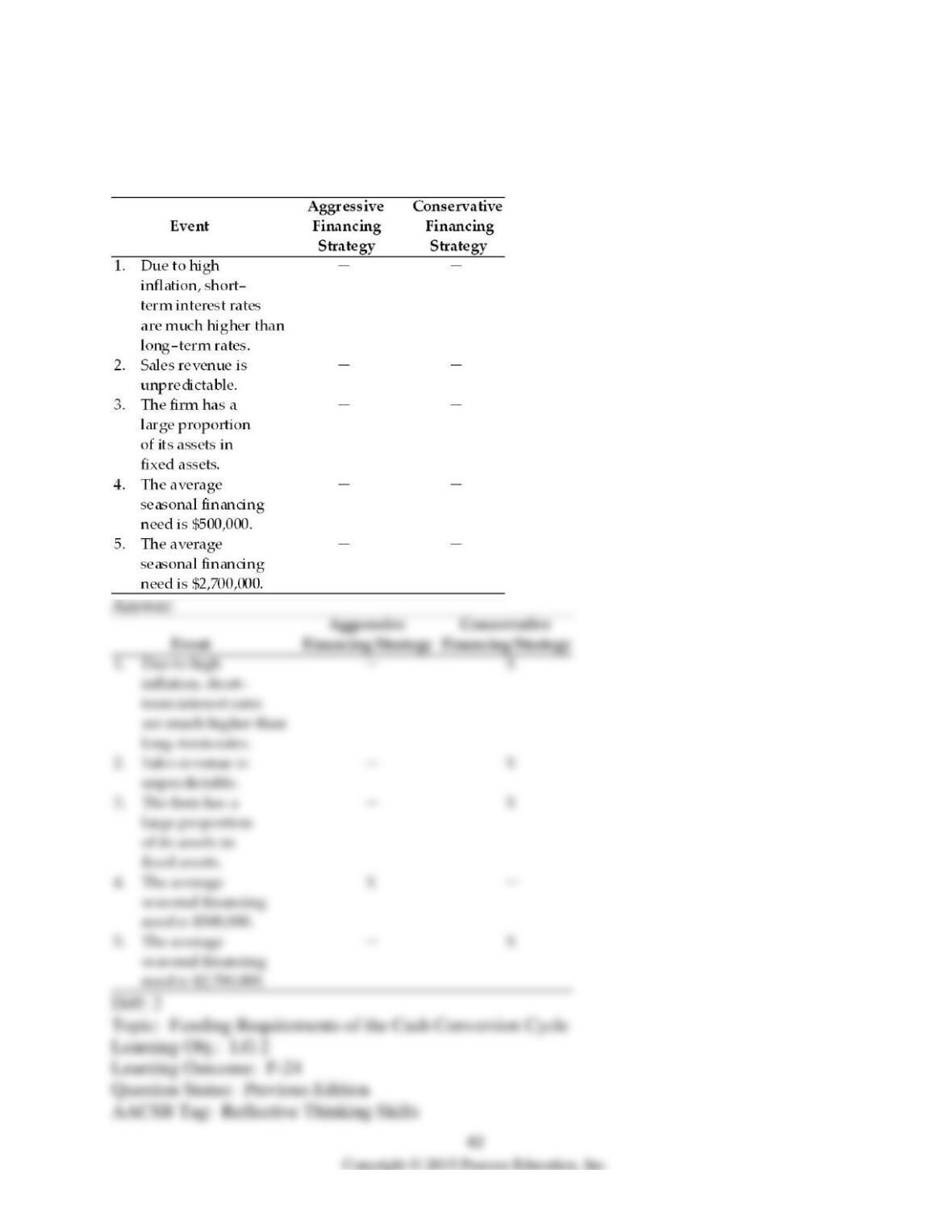
101) Jia’s Jewelers has seasonal financing needs that vary from $250,000 to $2,725,000. The
permanent financing requirement is $4,100,000. Check the appropriate box indicating the better
strategy for each of the following events.
43
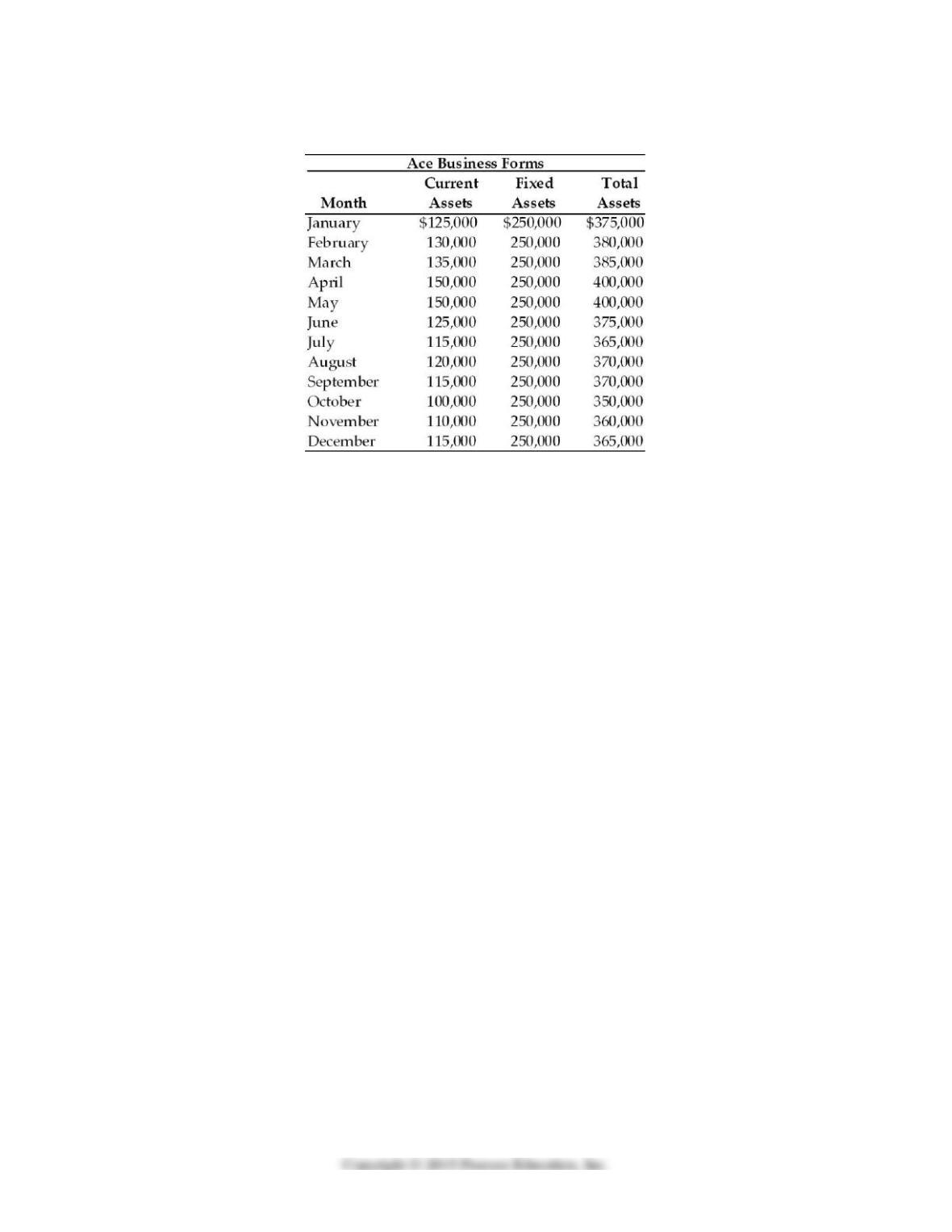
Table 14.3
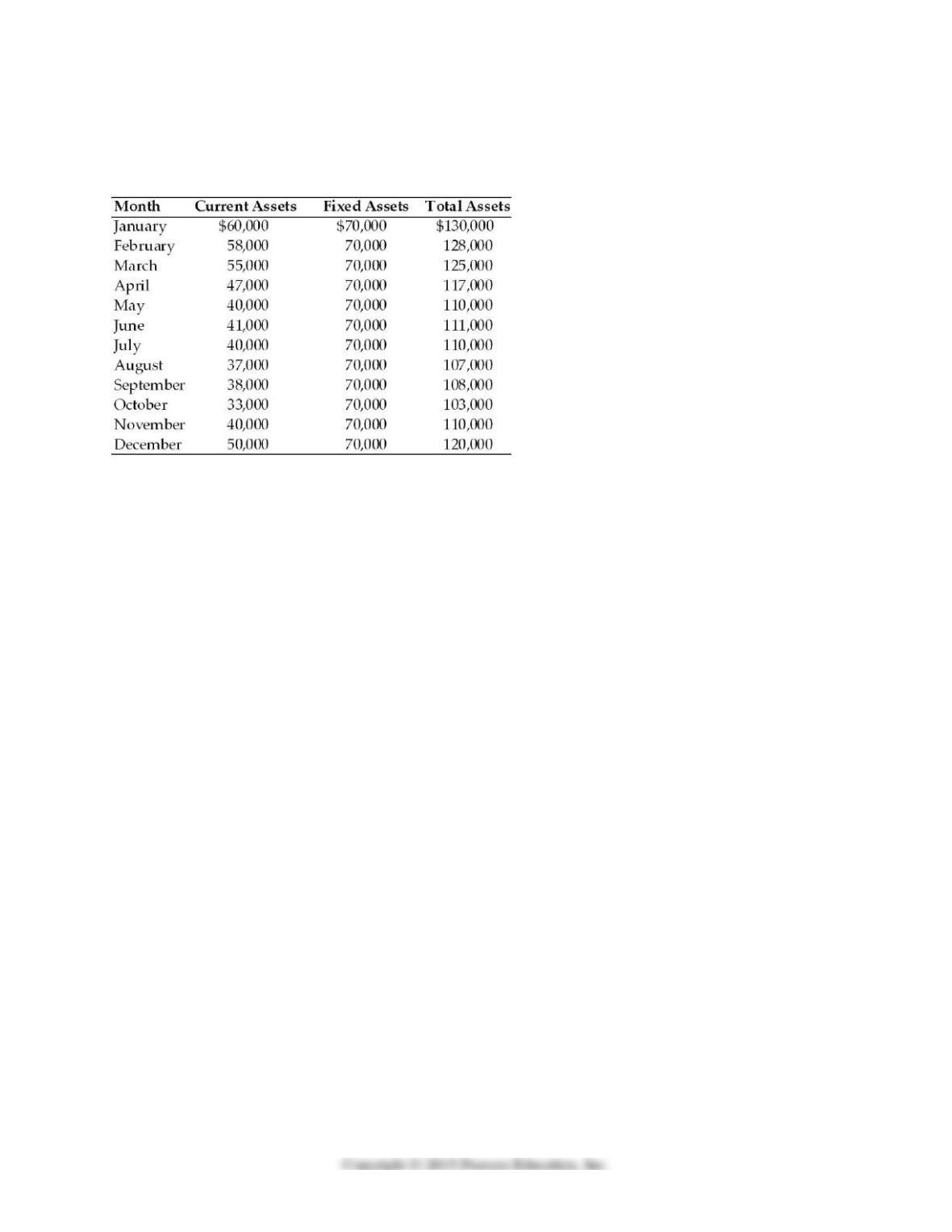
102) Ace’s Business Forms has compiled several factors relative to its financing mix. The firm
pays 8 percent on short-term funds and 10 percent on long-term funds. The firm’s monthly
current, fixed, and total asset requirements for the previous year are summarized in Table 14.3.
Determine:
(a) the monthly permanent funds requirement
(b) the monthly average seasonal funds requirement
(c) the annual financing costs (aggressive strategy)
(d) the annual financing costs (conservative strategy)
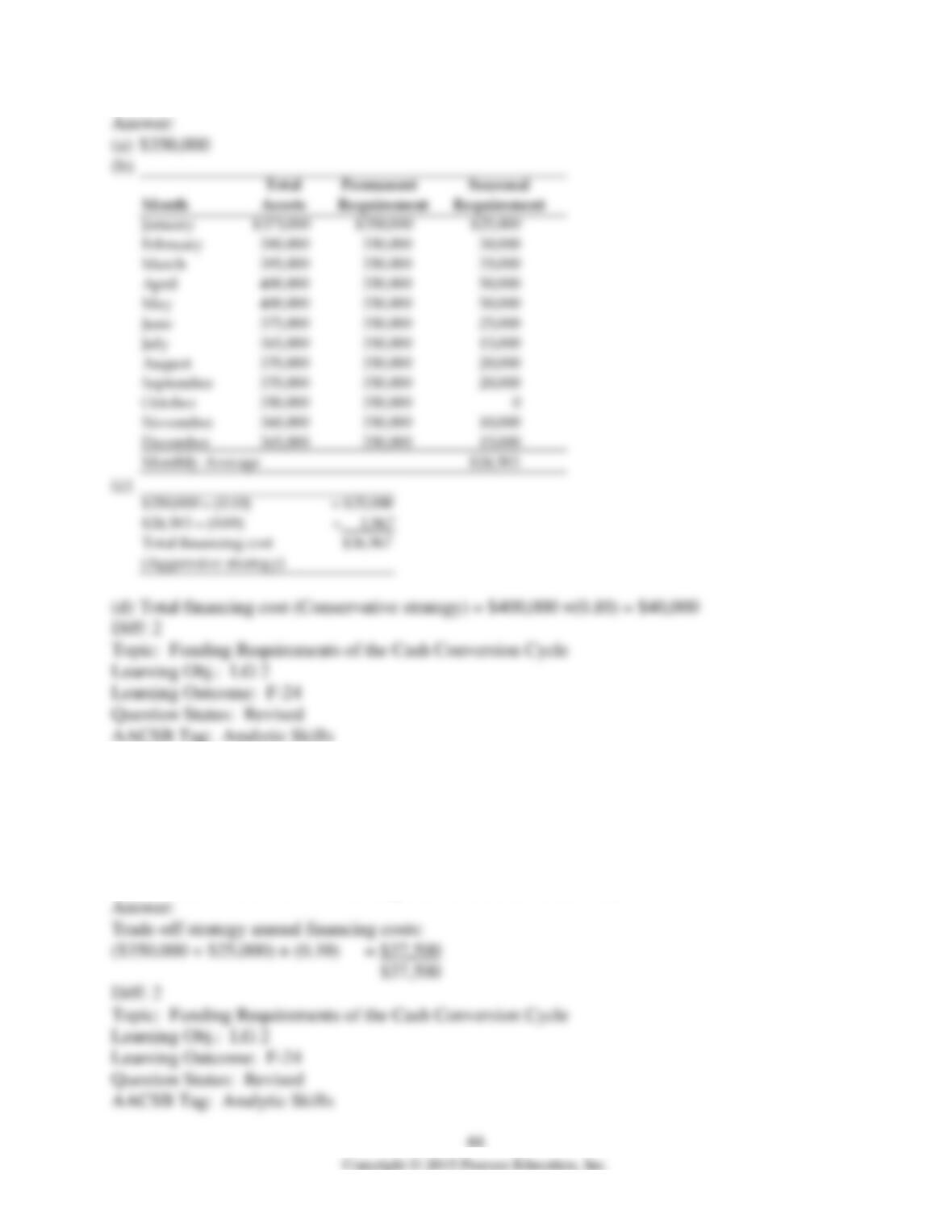
103) Ace’s Business Forms pays 8 percent on short-term funds and 10 percent on long-term
funds. Determine its annual financing costs using the trade-off strategy described: Ace’s Business
Forms has seasonal financing requirements ranging from zero to $50,000 per month. Based on
this range, the firm has decided to finance $25,000 per month of the seasonal funds with long-
term debt and the rest of the seasonal funds with short-term debt. The permanent funds
requirement will be financed with long-term funds. (See Table 14.3)
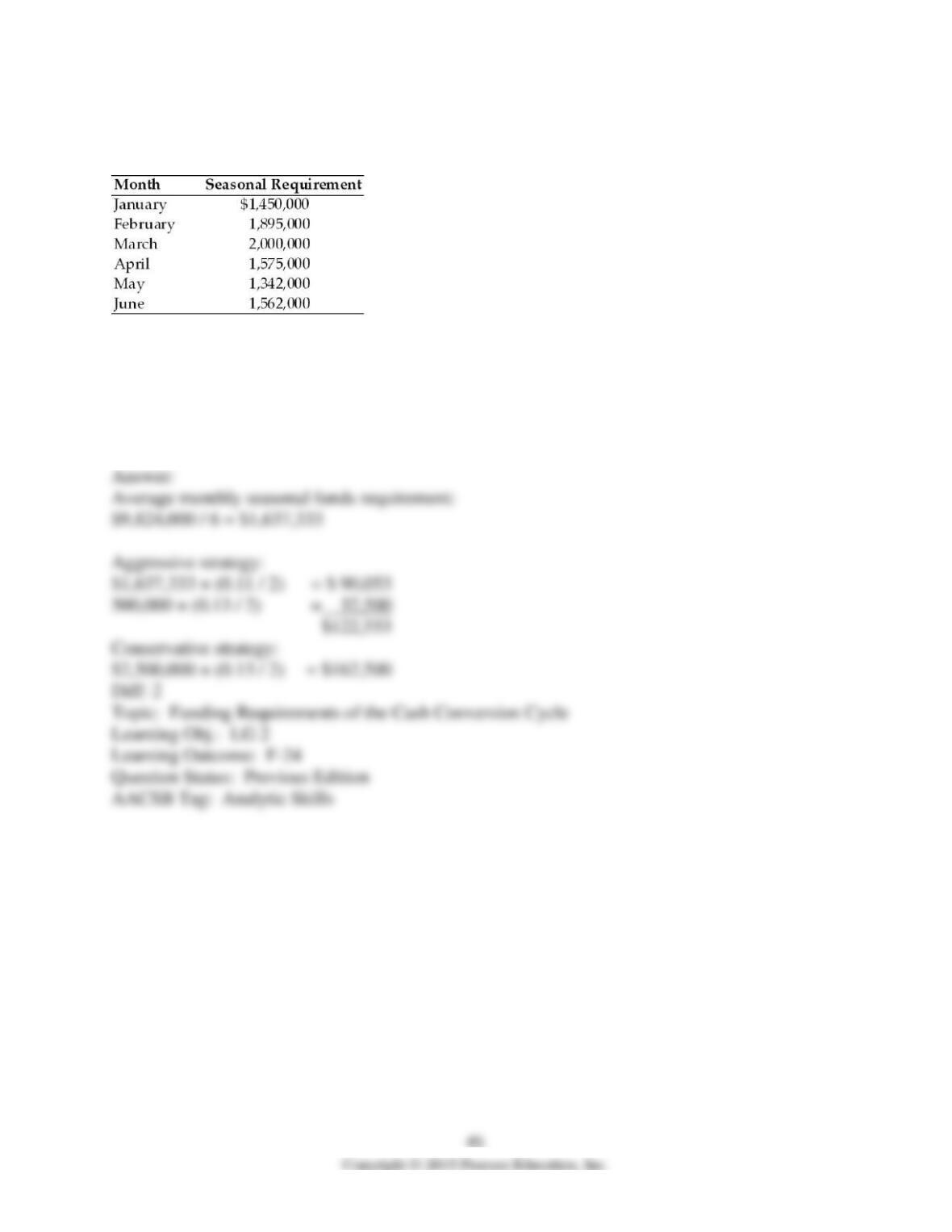
104) Studio San, a dealer in contemporary art, has forecasted its seasonal financing needs for the
next six months as follows:
(a) The firm projects that short-term funds will cost 11 percent and long-term funds will cost 13
percent annually.
(b) The firm’s permanent funds requirement is $500,000.
Calculate financing costs for the first six months using the aggressive and conservative
strategies.
46
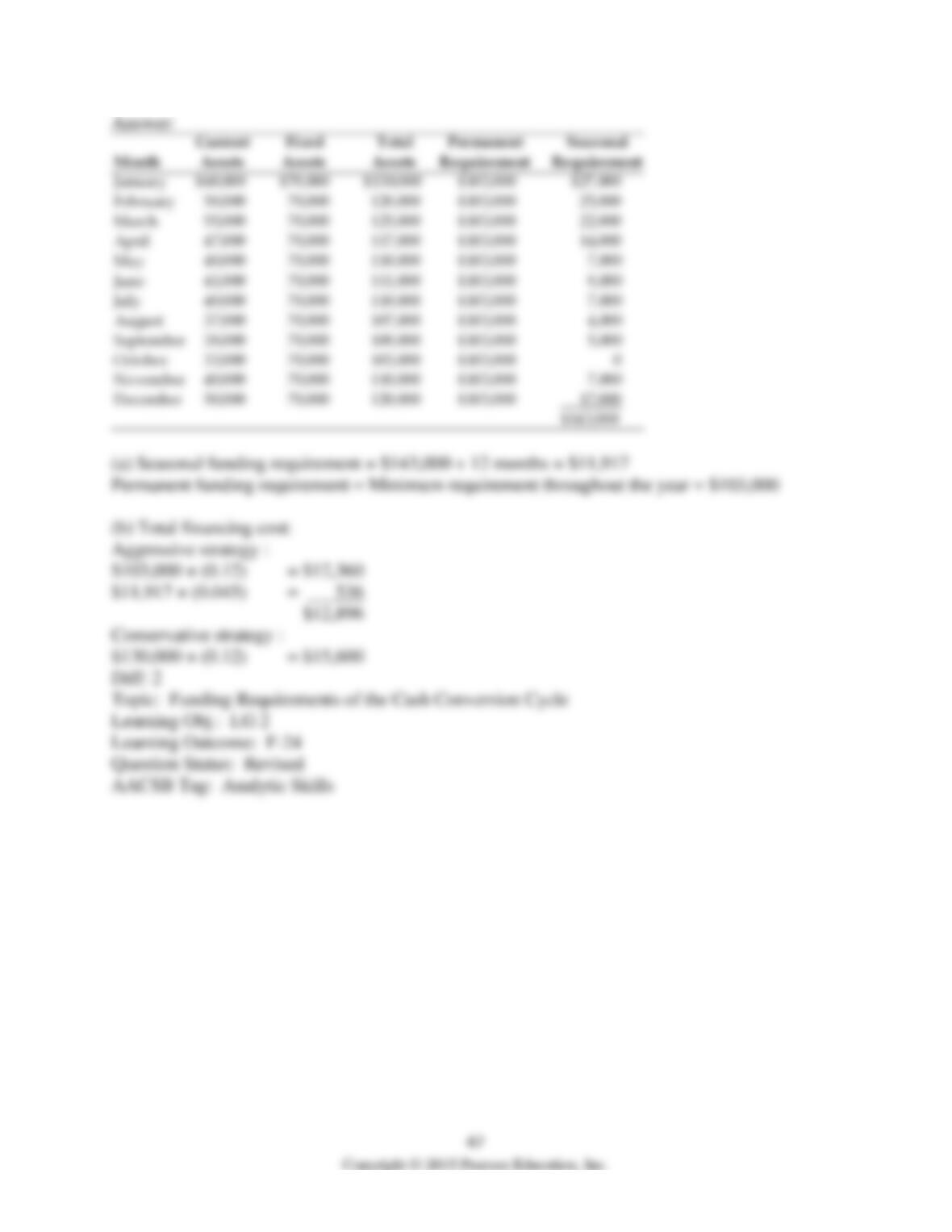
105) Adam’s Aeronautics is interested in making sure it has enough money to finance its assets.
The company’s current assets and fixed assets for the months of January through December are
given in the following table.
(a) Find the average monthly seasonal and permanent funds requirement.
(b) What is the total cost of financing under the aggressive and conservative strategies. Assume
short-term funds costs 4.5 percent and the interest rate for long-term funds is 12 percent.
(c) Find the net working capital under the aggressive and conservative strategies.
14.3 Discuss inventory management: differing views, common techniques, and international
concerns.
1) Because managing inventory is just like managing any other investment, decisions about the
level of inventory should be guided by the effect of inventory levels on sales.
2) The ABC system is an inventory management technique for determining the optimal order
quantity for an item of inventory.
3) The reorder point is the point at which a firm receives orders.
4) Safety stocks are extra inventories that can be drawn down when actual lead times and/or
usage rates are greater than expected.
5) In the ABC system of inventory management, the two-bin method or system could be utilized
to control C items.
6) In EOQ model, the average inventory is defined as the order quantity divided by 2.
7) The economic order quantity (EOQ) is the order quantity which minimizes the carrying costs
per unit per period.
8) In the EOQ model, if carrying costs increase while all other costs remain unchanged, the
number of orders placed would be expected to increase.
9) In the EOQ model, the total cost is minimized at the point where the order costs and carrying
costs are equal.
10) The reorder point is an inventory management system that compares production needs to
available inventory balances and determines when orders should be placed for various items on a
firm’s bill of materials.
11) Since its objective is to minimize inventory investment, a Just-in-Time (JIT) system uses no,
or very little, safety stocks.
12) A popular extension of materials requirement planning is manufacturing resource planning
II, which integrates data from numerous areas such as finance, accounting, marketing,
engineering, and manufacturing using a sophisticated computer system.
13) A popular extension of materials requirement planning is inventory integration automation
II, which integrates data from numerous areas such as finance, accounting, marketing,
engineering, and manufacturing using a sophisticated computer system.
14) The objective for managing inventory is to ________.
A) turn over inventory as quickly as possible without losing sales from stockouts
B) improve the average collection period without affecting the sales
C) make payment for the inventory as slowly as possible without losing suppliers
D) reduce the time taken to process inventory into finished goods and increase sales
15) Which of the following is true of inventory level?
A) A purchasing manager would purchase higher inventories when prices are low and lower
inventories when prices are high irrespective of inventory requirement.
B) A marketing manager would like to have smaller inventories of finished products to ensure
production of goods as per customer specification.
C) A financial manager would keep inventory levels low to ensure that the firm’s money is not
unwisely invested in excess resources.
D) A manufacturing manager would keep raw materials inventories low to ensure use of latest
materials in production process.
16) Which of the following is true of maintaining appropriate inventory levels?
A) A financial manager’s general disposition toward inventory levels is to keep them low.
B) A marketing manager would like to have low inventories of a firm’s finished products.
C) A manufacturing manager would keep raw materials inventories low for the sake of lower
unit production costs.
D) A purchasing manager prefers lower level of inventories than are actually needed at the time.
17) When maintaining appropriate inventory level, a purchasing manager should ________.
A) keep the inventory level low, to ensure that the firm’s money is not being unwisely invested in
excess resources
B) ensure that all orders could be filled quickly, eliminating the need for backorders due to
stockouts
C) implement the production plan to acquire the desired amount of finished goods available on
time at a low cost
D) maintain adequate amount of inventory on hand at desired times and at a favorable price
18) The ________ is a technique that divides inventory into three groups, according to dollar
investment.
A) JIT system
B) ABC system
C) EOQ model
D) LIFO model
19) In the ABC system of inventory management, the ________ method could be utilized to
control C items.
A) basic economic order quantity
B) materials requirement planning
C) two-bin
D) just-in-time
20) In the ABC system of inventory management, the ________ method or system is appropriate
for managing B items.
A) basic economic order quantity
B) materials requirement planning
C) two-bin
D) just-in-time
21) The ________ is an inventory technique that takes into account various operating and
financial costs to determine the order quantity for a specific inventory item.
A) JIT system
B) ABC system
C) EOQ model
D) LIFO model
22) A computerized inventory system that simulates needed materials requirements for the
finished product, and then compares production needs to available inventory balances to
determine when orders should be placed is the ________.
A) basic economic order quantity system
B) materials requirement planning system
C) just-in-time system
D) red-line method
23) The philosophy of the ________ is that a firm would have only work-in-process inventory.
A) basic economic order quantity system
B) materials requirement planning system
C) just-in-time system
D) LIFO method
24) The total cost of a firm’s inventory is found by summing the ________.
A) order cost and the marginal cost of a firm’s inventory
B) order cost and the carrying cost of a firm’s inventory
C) order cost and the actual cost of a firm’s inventory
D) carrying cost and the marginal cost of a firm’s inventory
25) Which of the following is an example of carrying cost?
A) insurance of goods in transit
B) transportation cost
C) insurance cost
D) cost of inventory
26) The ________ uses no, or very little, safety stock.
A) basic economic order quantity system
B) materials requirement planning system
C) just-in-time system
D) FIFO method
27) In the EOQ model, ________ costs are the variable costs per unit of holding an item of
inventory for a specified time period.
A) marginal
B) order
C) carrying
D) processing
28) The economic order quantity (EOQ) is the order quantity which minimizes ________.
A) the order cost per order
B) the total inventory costs
C) the carrying costs per unit per period
D) order quantity in units
29) In the EOQ model, if the size of order increases, the ________.
A) carrying cost will increase
B) order cost will remain unchanged
C) order cost will increase
D) storage cost will decrease
30) The ________ is an inventory management technique that compares production needs to
available inventory balances and determines when orders should be placed for various material
inputs.
A) ABC system
B) EOQ model
C) MRP system
D) JIT system
31) The ________ is an inventory management technique that minimizes inventory investment
by having materials inputs arrive at exactly the time they are needed for production.
A) ABC system
B) FIFO method
C) MRP system
D) JIT system
Table 14.4
Bowring Ball Bearings has 10 different items in its inventory. The average number of units held
in inventory and the average unit cost are listed for each item. The firm uses an ABC system of
inventory control.
32) Inventory items that belong in the A category include ________. (See Table 14.4)
A) Items 4 and 6
B) Items 1 and 7
C) Items 3 and 9
D) Items 1 and 8
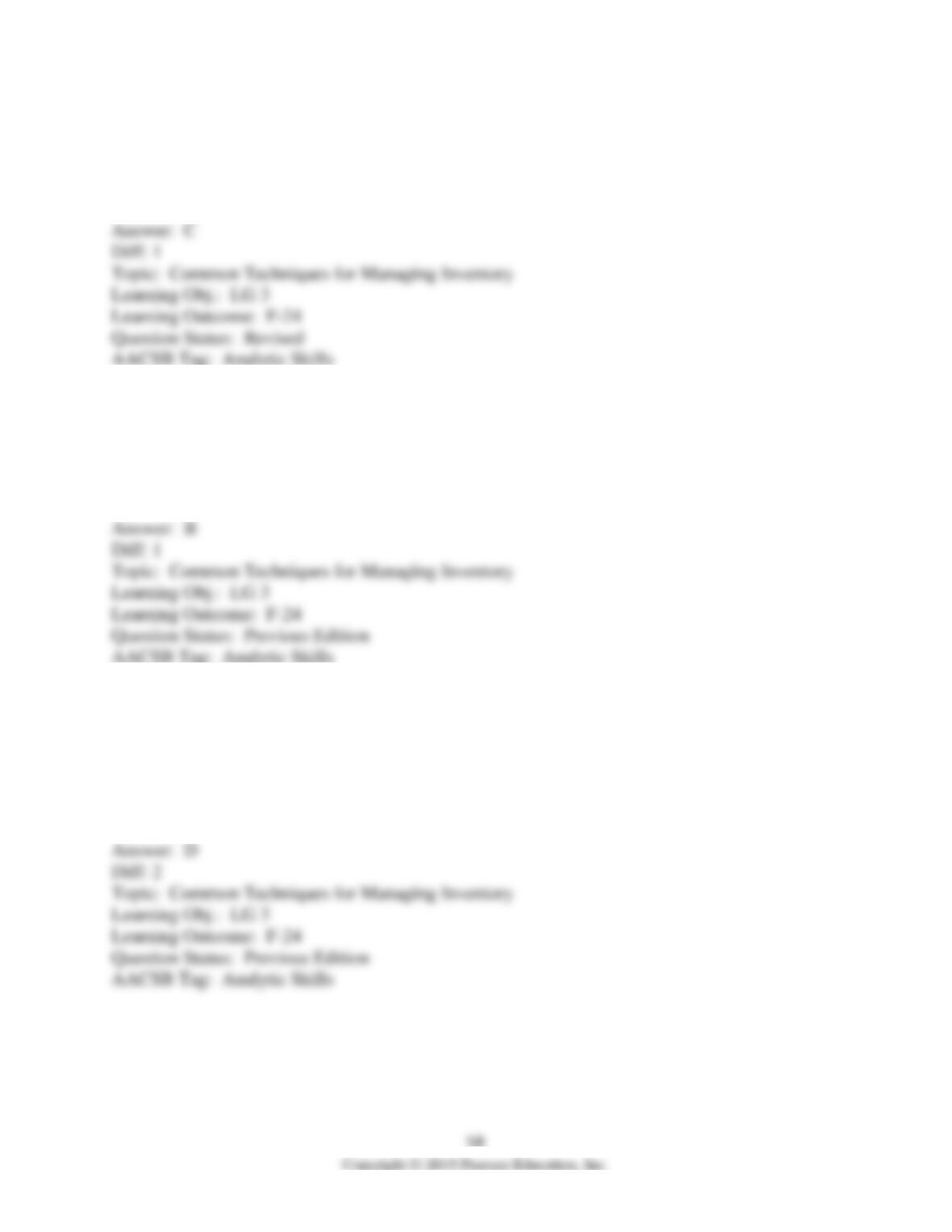
33) Inventory items that belong in the C category include ________. (See Table 14.4)
A) Items 4 and 6
B) Items 6 and 8
C) Items 1, 7, and 9
D) Items 1 and 3
34) In the EOQ model, ________ costs are the fixed clerical cost of writing a purchase order,
processing the paper work, and verifying the invoice.
A) basic
B) order
C) carrying
D) insurance
35) The Steel Works, Inc. is required to carry a minimum of 40 days’ raw steel, which is 250
tons. It takes 15 days between order and delivery. At what level of steel would Steel Works
reorder?
A) 3,750 tons
B) 600 tons
C) 667 tons
D) 344 tons
36) The General Chemical Company uses 150,000 gallons of hydrochloric acid per month. The
cost of carrying the chemical in inventory is 50 cents per gallon per year, and the cost of ordering
the chemical is $150 per order. The firm uses the chemical at a constant rate throughout the year.
It takes 18 days to receive an order once it is placed. The reorder point is ________.
A) 7,500 gallons
B) 25,000 gallons
C) 90,000 gallons
D) 105,000 gallons
37) The General Chemical Company uses 150,000 gallons of hydrochloric acid per month. The
cost of carrying the chemical in inventory is 50 cents per gallon per year, and the cost of ordering
the chemical is $150 per order. The firm uses the chemical at a constant rate throughout the year.
The chemical’s economic order quantity is ________.
A) 32,863 gallons
B) 11,619 gallons
C) 9,487 gallons
D) 1,900 gallons
38) A popular extension of materials requirement planning that integrates data from numerous
areas such as accounting, finance, engineering, and manufacturing using a sophisticated
computer system is called ________.
A) computerized materials integration II
B) manufacturing resource planning II
C) inventory allocation planning II
D) inventory integration planning II
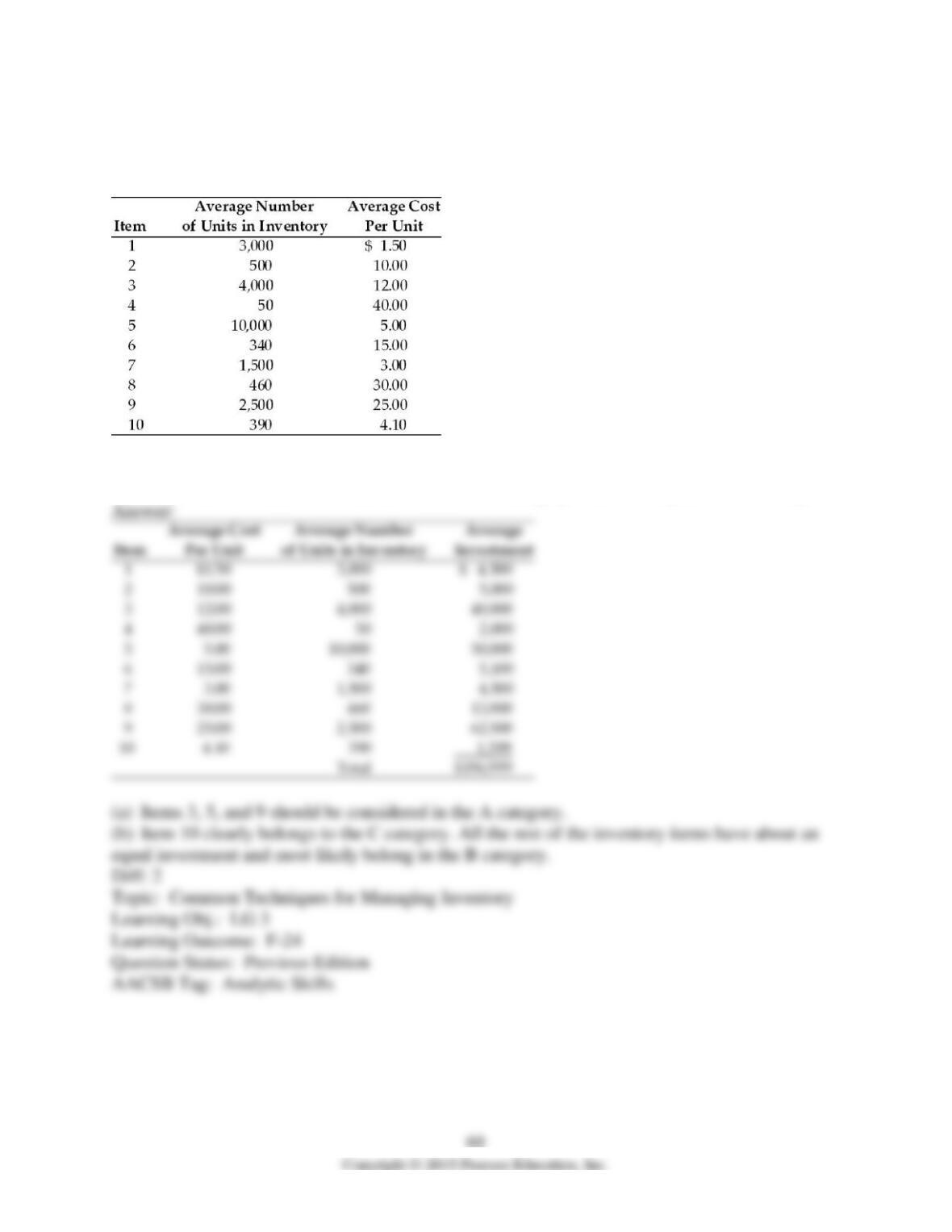
39) Harry’s Sheds has ten different items in its finished goods inventory. The average number of
units held in inventory and the average unit cost are listed for each item. The firm uses an ABC
system of inventory control.
(a) Which items should be considered to be in the A category of an ABC system of inventory?
(b) Which items should be considered to be in the B category of an ABC system of inventory?