66) Consider the following reaction at equilibrium. What effect will reducing the volume have on the
system?
C3H8(g) + 5 O2(g) ⇌ 3 CO2(g) + 4 H2O(l) ΔH° = -2220 kJ
A) The reaction will shift to the right in the direction of products.
B) The reaction will shift to the left in the direction of reactants.
C) The equilibrium constant will increase.
D) The equilibrium constant will decrease.
E) No effect will be observed.
67) Consider the following reaction at equilibrium. What effect will reducing the pressure have on the
system?
C3H8(g) + 5 O2(g) ⇌ 3 CO2(g) + 4 H2O(l) ΔH° = -2220 kJ
A) The reaction will shift to the right in the direction of products.
B) The reaction will shift to the left in the direction of reactants.
C) The equilibrium constant will increase.
D) The equilibrium constant will decrease.
E) No effect will be observed.
Algorithmic Questions
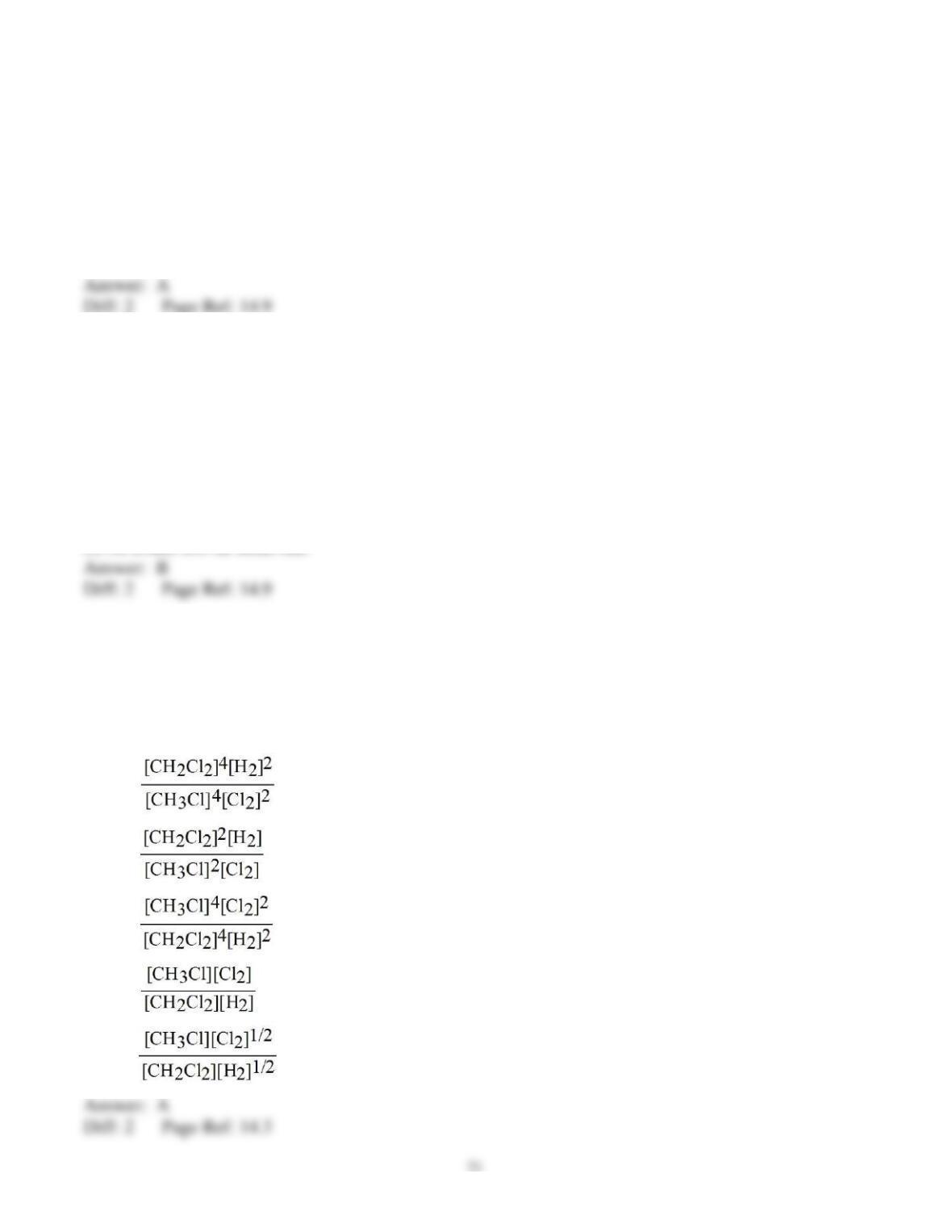
1) Express the equilibrium constant for the following reaction.
4 CH3Cl(g) + 2 Cl2(g) ⇔ 4 CH2Cl2(g) + 2 H2(g)
A) K =
B) K =
C) K =
D) K =
E) K =
2) Express the equilibrium constant for the following reaction.
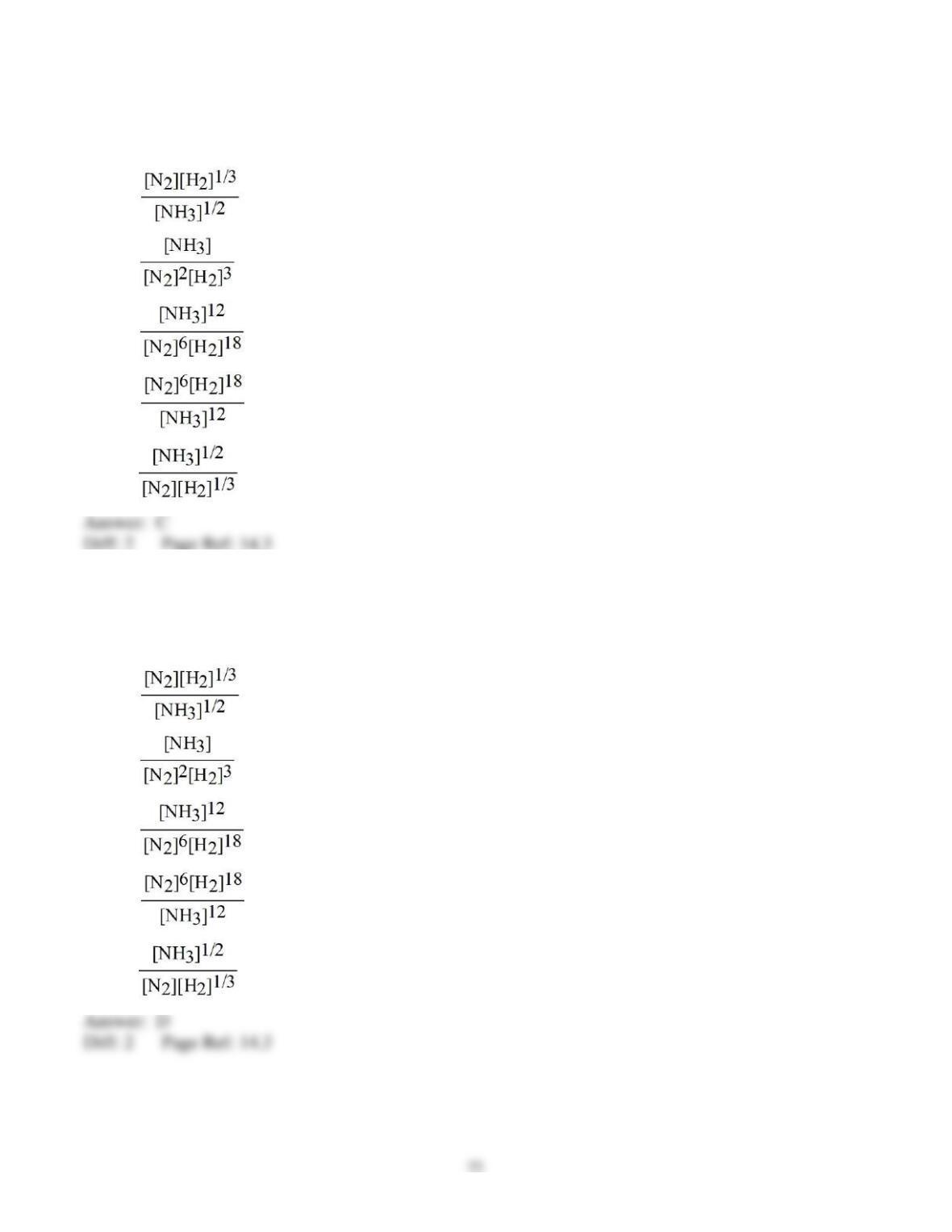
6 N2(g) + 18 H2(g) ⇔ 12 NH3(g)
A) K =
B) K =
C) K =
D) K =
E) K =
3) Express the equilibrium constant for the following reaction.
12 NH3(g) ⇔ 6 N2(g) + 18 H2(g)
A) K =
B) K =
C) K =
D) K =
E) K =
4) Express the equilibrium constant for the following reaction.
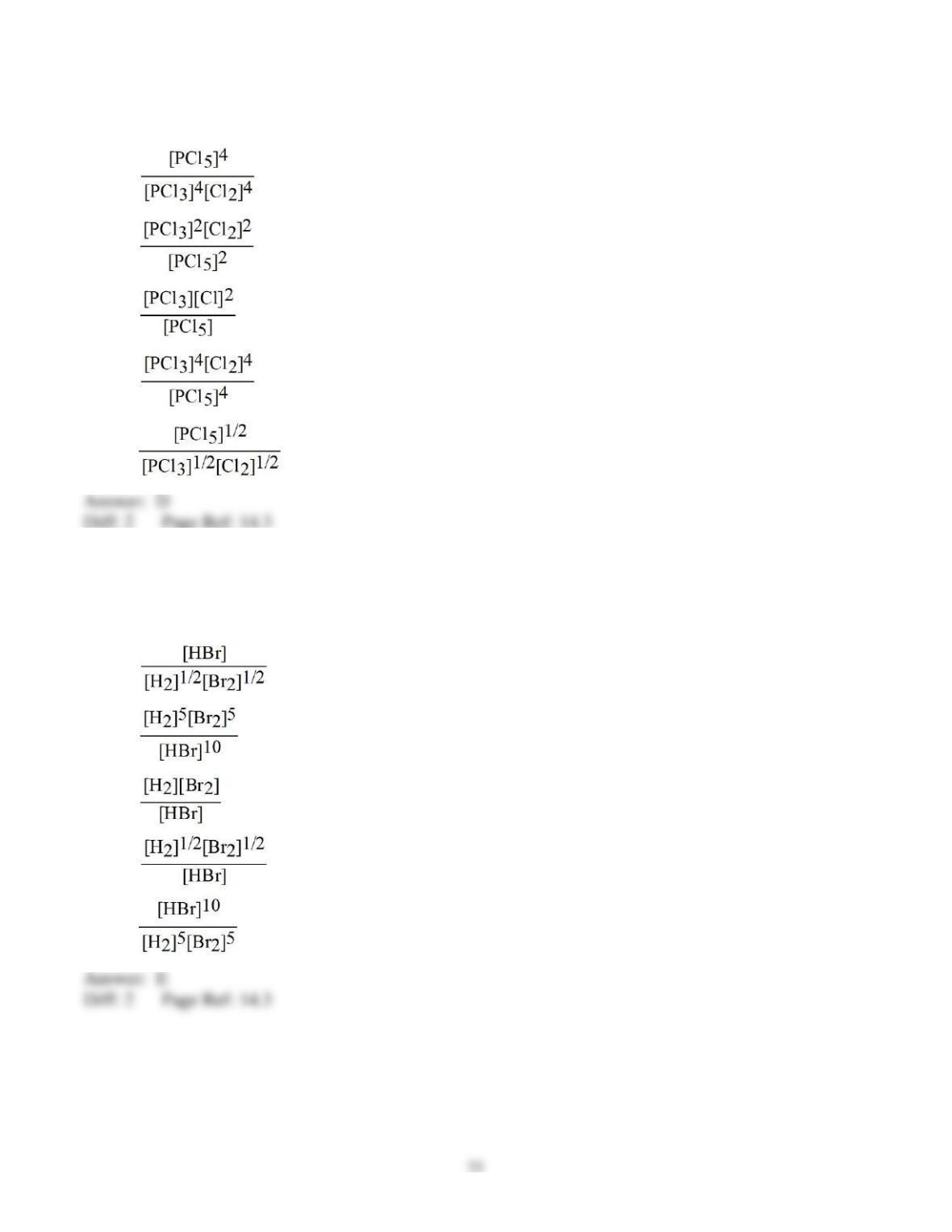
4PCl5(g) ⇌ 4PCl3(g) + 4Cl2(g)
A) K =
B) K =
C) K =
D) K =
E) K =
5) Express the equilibrium constant for the following reaction.
5H2(g) + 5Br2(g) ⇌ 10 HBr(g)
A) K =
B) K =
C) K =
D) K =
E) K =
6) Express the equilibrium constant for the following reaction.
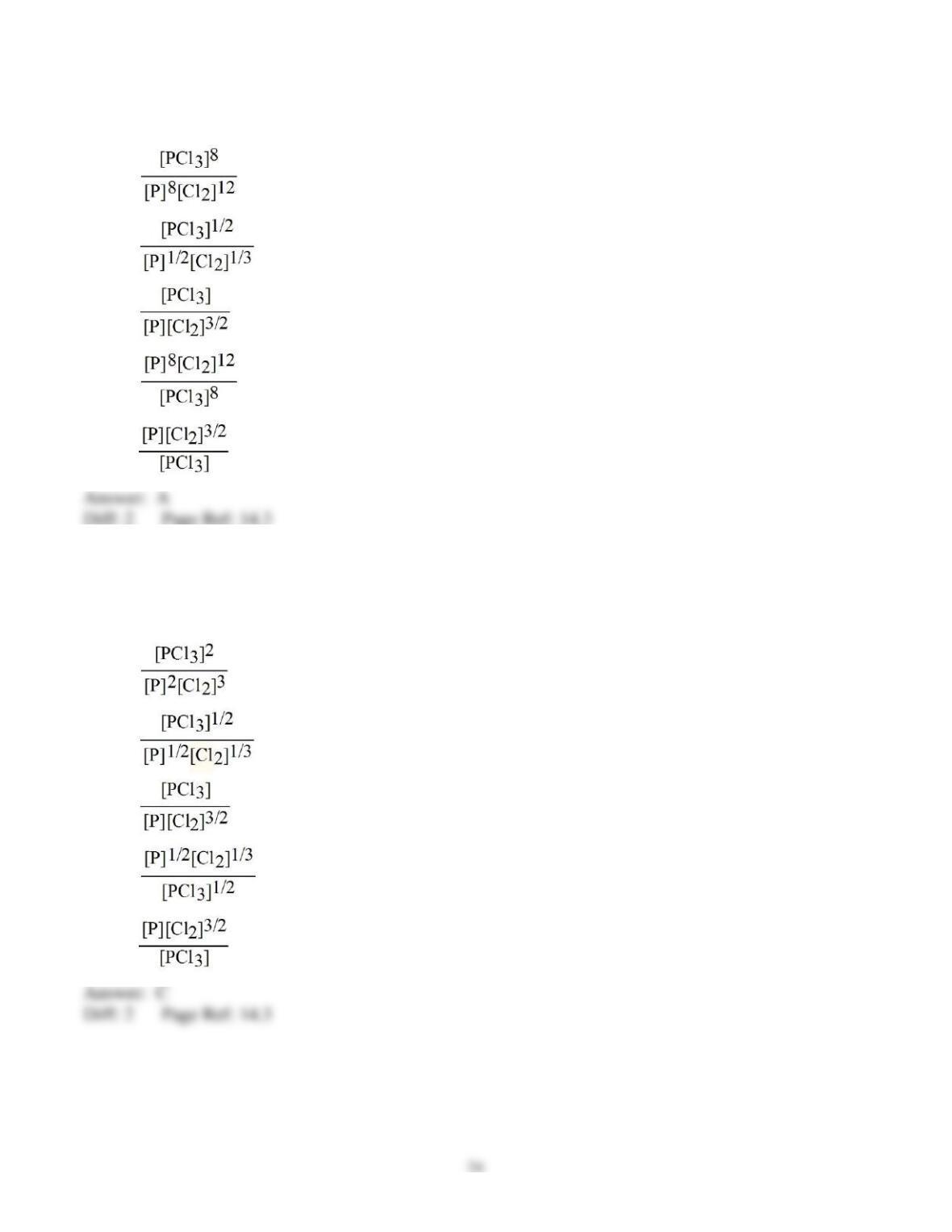
8 P(g) + 12 Cl2(g) ⇌ 8 PCl3(g)
A) K =
B) K =
C) K =
D) K =
E) K =
7) Express the equilibrium constant for the following reaction.
P(g) + 3/2 Cl2(g) ⇌ PCl3(g)
A) K =
B) K =
C) K =
D) K =
E) K =
25
8) The equilibrium constant is given for one of the reactions below. Determine the value of the missing
equilibrium constant.
2 HD(g) ⇌ H2(g) + D2(g) Kc = 0.28
6 H2(g) + 6 D2(g) ⇌ 12 HD(g) Kc = ?
A) 0.00048
B) 1.2
C) 1.62
D) 2075
E) 0.81
9) The equilibrium constant is given for one of the reactions below. Determine the value of the missing
equilibrium constant.
N2O4(g) ⇌ 2 NO2(g) Kc = 1.46
5 N2O4(g) ⇌ 10 NO2(g) Kc = ?
A) 1.46
B) 0.292
C) 6.63
D) 1.08
E) 7.30
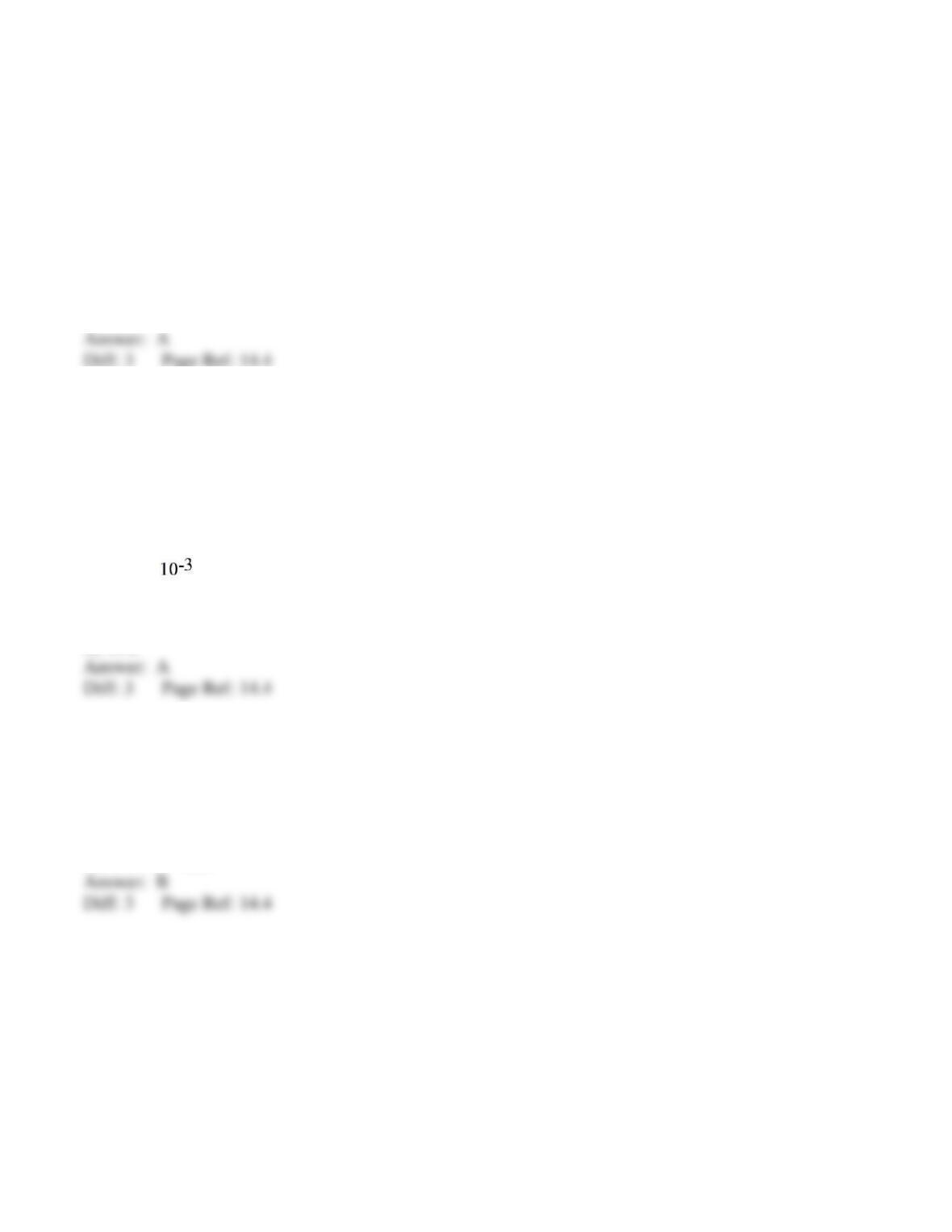
10) For the reaction: N2(g) + 2 O2(g) ⇌ 2 NO2(g), Kc = 8.3 × 10⁻¹⁰ at 25°C. What is the concentration
of N2 gas at equilibrium when the concentration of NO2 is five times the concentration of O2 gas?
A) 3.3 × 10⁻¹¹ M
B) 1.7 × 10⁻¹⁰ M
C) 6.0 × 10⁹ M
D) 3.0 × 10¹⁰ M
26
11) The Kp for the reaction below is 1.49 × 10⁸ at 100.0°C:
CO(g) + Cl2(g) → COCl2(g)
In an equilibrium mixture of the three gases, PCO = PCl2 = 2.22 × 10⁻⁴ atm. The partial pressure of the
product, phosgene (COCl2), is ________ atm.
A) 7.34
B) 3.02 × 10¹⁵
C) 3.31 × 10⁻¹⁶
D) 3.31 × 10⁴
E) 6.67 × 10¹¹
12) At 900.0 K, the equilibrium constant (Kp) for the following reaction is 0.345.
2SO2 + O2(g) → 2SO3(g)
At equilibrium, the partial pressure of SO2 is 35.0 atm and that of O2 is 15.9 atm. The partial pressure of
SO3 is ________ atm.
A) 82.0
B) 4.21 ×
C) 192
D) 6.20 × 10⁻⁴
E) 40.2
13) The decomposition of ammonia is: 2 NH3(g) → N2(g) + 3 H2(g). If Kp is 1.5 × 10³ at 400°C, what
is the partial pressure of ammonia at equilibrium when N2 is 0.10 atm and H2 is 0.15 atm?
A) 2.2 × 10⁻⁷ atm
B) 4.7 × 10⁻⁴ atm
C) 2.1 × 10³ atm
D) 4.4 × 10⁶ atm
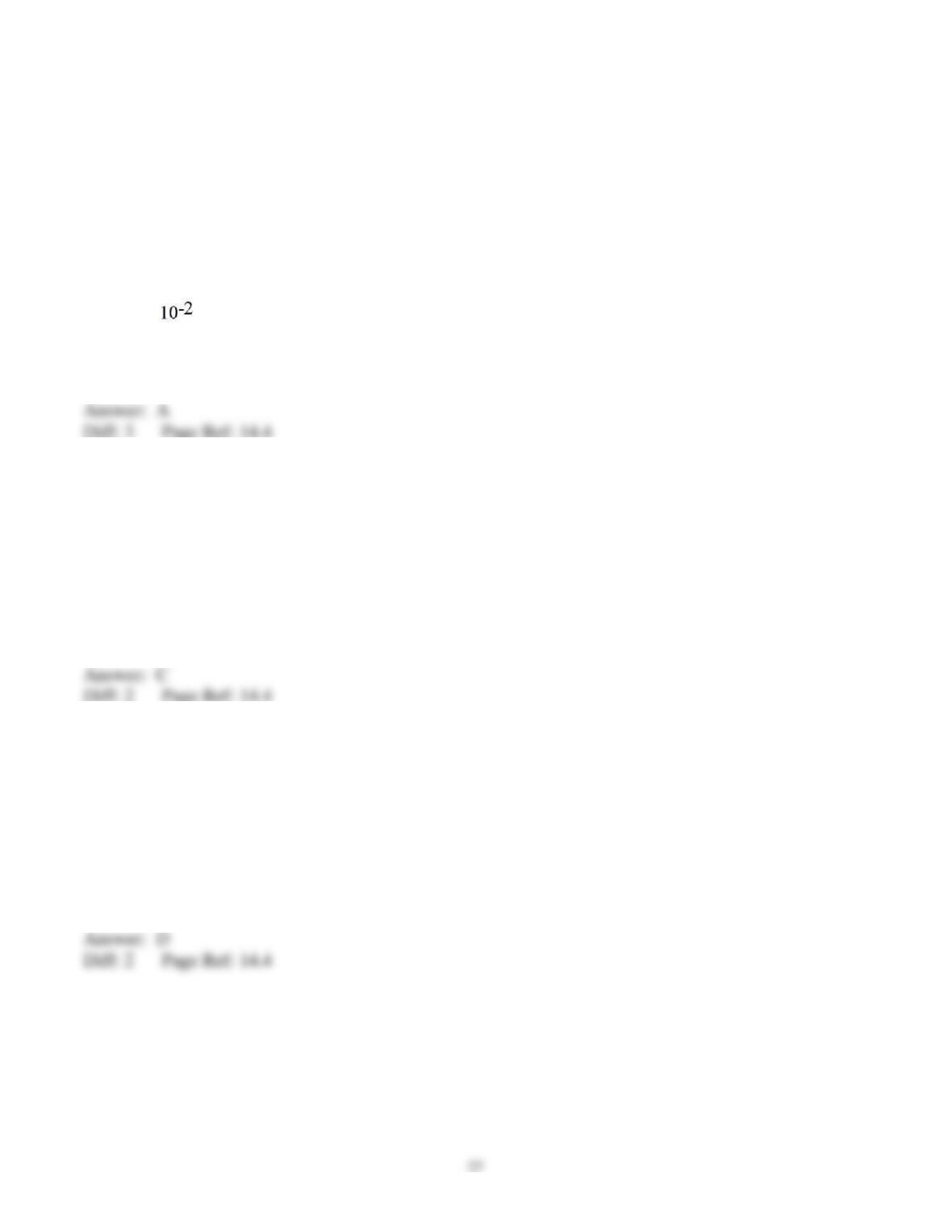
14) Phosphorous trichloride and phosphorous pentachloride equilibrate in the presence of molecular
chlorine according to the reaction:
PCl3(g) + Cl2(g) → PCl5(g)
An equilibrium mixture at 450 K contains
PPCl3 = 0.124 atm,
PCl2 = 0.157 atm, and
PPCl5 = 1.30 atm. What is the value of Kp at this temperature?
A) 66.7
B) 1.50 ×
C) 2.53 × 10⁻²
D) 1.02
E) 4.63
15) What is Δn for the following equation in relating Kc to Kp?
N2(g) + 3 Cl2(g) ⇌ 2 NCl3(g)
A) 4
B) -4
C) -2
D) 2
E) 1
16) What is Δn for the following equation in relating Kc to Kp?
CH4(g) + H2O(g) ⇌ CO(g) + 3 H2(g)
A) -3
B) -1
C) -2
D) 2
E) 0
28
17) In which of the following reactions will Kc = Kp?
A) H2(g) + I2(g) ⇌ 2 HI(g)
B) CH4(g) + H2O(g) ⇌ CO(g) + 3 H2(g)
C) N2O4(g) ⇌ 2NO2(g)
D) CO(g) + 2 H2(g) ⇌ CH3OH(g)
E) N2(g) + 3 Cl2(g) ⇌ 2 NCl3(g)
18) The reaction below has a Kc value of 61. What is the value of Kp for this reaction at 400 K?
N2(g) + 3 H2(g) ⇌ 2 NH3(g)
A) 15
B) 61
C) 1.8
D) 5.7 × 10⁻²
E) 1.9 × 10⁻²
19) The reaction below has a Kp value of 41. What is the value of Kc for this reaction at 400 K?
N2(g) + 3 H2(g) ⇌ 2 NH3(g)
A) 3.8 × 10⁻²
B) 4.4 × 10⁴
C) 26
D) 2.3 × 10⁻⁵
E) 41
20) The reaction below has a Kc value of 1.0 × 10¹². What is the value of Kp for this reaction at 200
K?
2 SO2(g) + O2(g) ⇌ 2 SO3(g)
A) 6.1 × 10⁻¹⁴
B) 1.0 × 10¹²
C) 1.6 × 10⁻¹¹
D) 1.6 × 10¹³
E) 6.1 × 10¹⁰
21) What is △n for the following equation in relating Kc to Kp?
P4(s) + 5 O2(g) ⇌ P4O10(s)
A) 3
B) 4
C) -2
D) -6
E) -5
22) What is △n for the following equation in relating Kc to Kp?
2 Rb(s) + 2 H2O(l) ⇌ 2 RbOH(aq) + H2(g)
A) 3
B) -1
C) -2
D) 2
E) 1
23) What is △n for the following equation in relating Kc to Kp?
KBrO3(s) ⇌ KBrO(s) + O2(g)
A) 3
B) -1
C) -2
D) 2
E) 1
24) For which reaction will Kp = Kc?
A) C(s) + O2(g) ⇌ CO2(g)
B) 2 HgO(s) ⇌ Hg(l) + O2(g)
C) CaCO3(s) ⇌ CaO(s) + CO2(g)
D) H2CO3(s) ⇌ H2O(l) + CO2(g)
E) 2 H2O(l) ⇌ 2 H2(g) + O2(g)
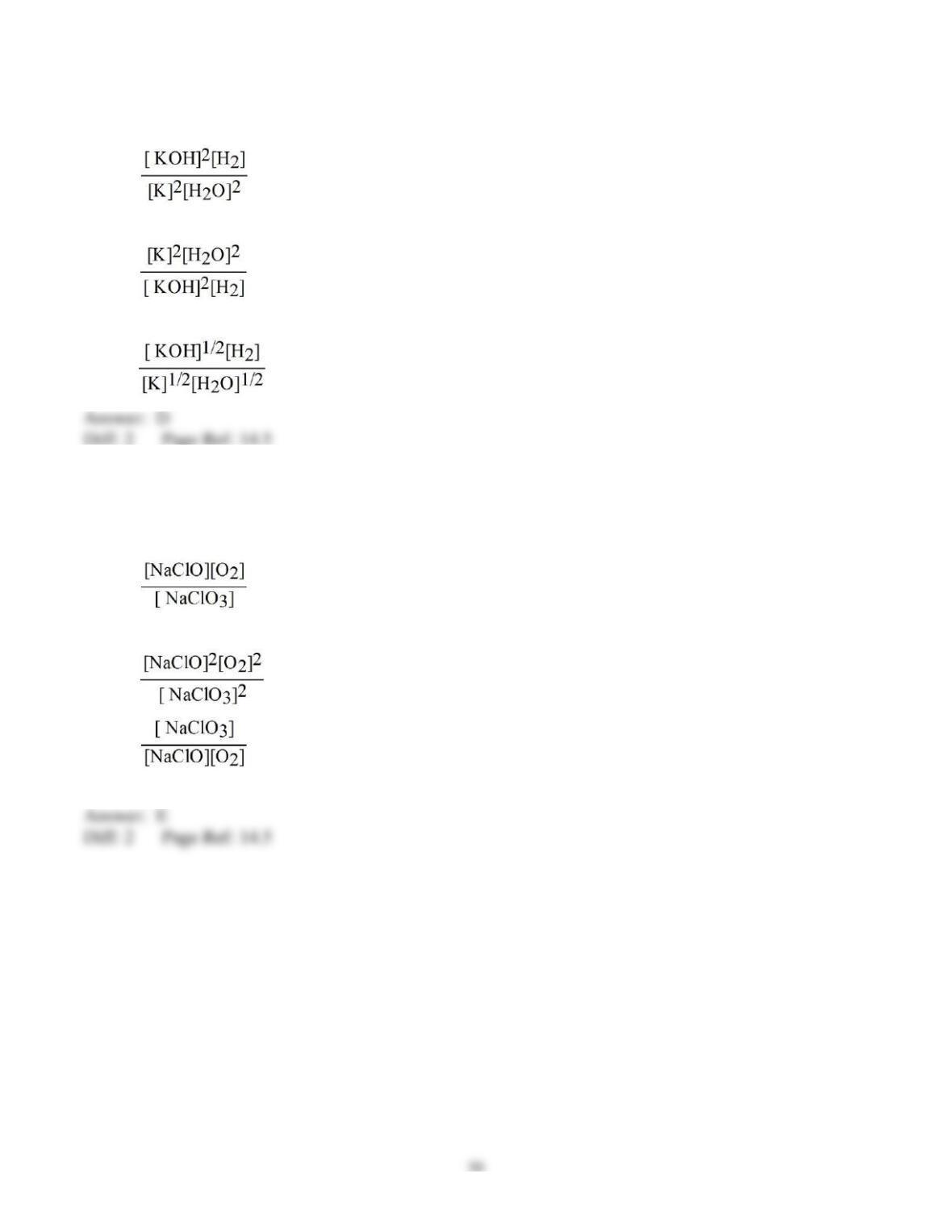
25) Express the equilibrium constant for the following reaction.
2 K(s) + 2 H2O(l) ⇌ 2 KOH(aq) + H2(g)
A) K =
B) K = [H2][KOH]-2
C) K =
D) K = [H2][KOH]2
E) K =
26) Express the equilibrium constant for the following reaction.
NaClO3(s) ⇌ NaClO(s) + O2(g)
A) K =
B) K = [O2]-1
C) K =
D) K =
E) K = [O2]
27) An equilibrium mixture of CO, O2 and CO2 at a certain temperature contains 0.0010 M CO2 and
0.0100 M O2. At this temperature, Kc equals 1.4 × 10² for the reaction:
2 CO(g) + O2(g) ⇌ 2 CO2(g).
What is the equilibrium concentration of CO?
A) 7.1 × 10⁻⁷ M
B) 8.4 × 10⁻⁴ M
C) 1.4 × 10⁻² M
D) 1.2 × 10⁻¹ M
28) At a certain temperature, Kc equals 1.4 × 10² for the reaction:
2 CO(g) + O2(g) ⇌ 2 CO2(g).
If a 3.00-L flask contains 0.400 mol of CO2 and 0.100 mol of O2 at equilibrium, how many moles of
CO are also present in the flask?
A) 0.555 mol
B) 0.185 mol
C) 0.107 mol
D) 0.0114 mol
29) Determine the value of Kc for the following reaction if the equilibrium concentrations are as
follows: [PBr5]eq = 0.56 M, [PBr3]eq = 0.23 M, [Br2]eq = 3.3 M.
PBr5(g) ⇌ PCl3(g) + Br2(g)
A) 1.4
B) 0.93
C) 0.74
D) 1.1
E) 0.76
30) Determine the value of Kc for the following reaction if the equilibrium concentrations are as
follows: [H2]eq = 0.14 M, [Br2]eq = 0.39 M, [HBr]eq = 1.6 M.
H2(g) + Br2(g) ⇌ 2 HBr(g)
A) 2.1 × 10⁻²
B) 29
C) 47
D) 3.4 × 10⁻²
E) 8.7 × 10⁻²
31) Determine the value of Kp for the following reaction if the equilibrium concentrations are as
follows: P(NOCl)eq = 0.22 atm, P(NO)eq = 0.10 atm, P(Cl2)eq = 0.11 atm.
2 NOCl(g) ⇌ 2 NO(g) + Cl2(g)
A) 1.8
B) 44
C) 2.3 x 10²
D) 2.3 × 10⁻²
E) 0.53
32) At a certain temperature, nitrogen and hydrogen react to form ammonia:
N2(g) + 3 H2(g) ⇌ 2 NH3(g).
When initial amounts of N2, H2, and NH3 are mixed, the concentration of NH3 increases. Which
statement below is TRUE?
A) Kc < Q
B) Kc > Q
C) Kc = Q
D) More information is needed to make a statement about Kc.
33) Consider the following reaction and its equilibrium constant:
SO2(g) + NO2(g) ⇌ SO3(g) + NO(g) Kc = 0.33
A reaction mixture contains 0.41 M SO2, 0.14 M NO2, 0.12 M SO3 and 0.14 M NO. Which of the
following statements is TRUE concerning this system?
A) The reaction will shift in the direction of reactants.
B) The equilibrium constant will decrease.
C) The reaction will shift in the direction of products.
D) The reaction quotient will decrease.
E) The system is at equilibrium.
34) Consider the following reaction and its equilibrium constant:
4 CuO(s) + CH4(g) ⇌ CO2(g) + 4 Cu(s) + 2 H2O(g) Kc = 1.10
A reaction mixture contains 0.22 M CH4, 0.67 M CO2 and 1.3 M H2O. Which of the following
statements is TRUE concerning this system?
A) The reaction will shift in the direction of products.
B) The equilibrium constant will increase.
C) The reaction quotient will increase.
D) The reaction will shift in the direction of reactants.
E) The system is at equilibrium.
35) Consider the following reaction and its equilibrium constant:
I2(g) + Br2(g) ⇌ 2 IBr(g) Kc = 1.1 × 10²
A reaction mixture contains 0.35 M I2, 0.31 M Br2 and 3.5 M IBr. Which of the following statements is
TRUE concerning this system?
A) The reaction will shift in the direction of products.
B) The reaction will shift in the direction of reactants.
C) The reaction quotient will decrease.
D) The equilibrium constant will increase.
E) The system is at equilibrium.
36) Consider the following reaction and its equilibrium constant:
I2(g) ⇌ 2I(g) Kp = 0.209
A reaction mixture contains 0.89atm I2 and1.601.60 atm I. Which of the following statements is TRUE
concerning this system?
A) The reaction will shift in the direction of reactants.
B) The reaction quotient will increase.
C) The reaction will shift in the direction of products.
D) The equilibrium constant will decrease.
E) The system is at equilibrium.
37) Consider the following reaction, equilibrium concentrations, and equilibrium constant at a particular
temperature. Determine the equilibrium concentration of NO2(g).
N2O4(g) ⇌ 2 NO2(g) Kc = 0.21
[N2O4]eq = 0.033 M
A) 1.44 M
B) 8.3 × 10⁻² M
C) 12 × 10-2 M
D) 6.9 × 10⁻³ M
E) 144 M
38) Consider the following reaction, equilibrium concentrations, and equilibrium constant at a particular
temperature. Determine the equilibrium concentration of CO2(g).
NH2COONH4(s) ⇌ 2 NH3(g) + CO2(g) Kc = 1.58 × 10⁻⁸
[NH3]eq = 2.3 × 10⁻³ M
A) 0.053 M
B) 3.6 × 10⁻¹¹ M
C) 3.0 × 10⁻³ M
D) 6.9 × 10⁻⁶ M
E) 0.022 M
39) For the isomerization reaction:
butane ⇌ isobutane
Kp equals 25 at 500°C. If the initial pressures of butane and isobutane are 20. atm and 0.0 atm,
respectively, what are the pressures of the two gases at equilibrium?
A) P(butane) = 0.77 atm and P(isobutane) = 19.2 atm
B) P(butane) = 0.80 atm and P(isobutane) = 20. atm
C) P(butane) = 19.2 atm and P(isobutane) = 0.77 atm
D) P(butane) = 20 atm and P(isobutane) = 0.80 atm
40) Cyclohexane, C6H12, undergoes a molecular rearrangement in the presence of AlCl3 to form
methylcyclopentane, CH3C5H9, according to the equation:
C6H12 ⇌ CH3C5H9
If Kc = 0.143 at 25°C for this reaction, find the equilibrium concentrations of C6H12 and CH3C5H9 if
the initial concentrations are 0.200 M and 0.075 M, respectively.
A) [C6H12] = 0.041 M, [CH3C5H9] = 0.041 M
B) [C6H12] = 0.159 M, [CH3C5H9] = 0.116 M
C) [C6H12] = 0.241 M, [CH3C5H9] = 0.034 M
D) [C6H12] = 0.253 M, [CH3C5H9] = 0.022 M
41) At a certain temperature the equilibrium constant, Kc, equals 0.11 for the reaction:
2 ICl(g) ⇌ I2(g) + Cl2(g).
What is the equilibrium concentration of ICl if 0.45 mol of I2 and 0.45 mol of Cl2 are initially mixed in
a 2.0-L flask?
A) 0.14 M
B) 0.17 M
C) 0.27 M
D) 0.34 M
42) The equilibrium constant, Kp, equals 3.40 for the isomerization reaction:
cis-2-butene ⇌ trans-2-butene.
If a flask initially contains 0.250 atm of cis-2-butene and 0.145 atm of trans-2-butene, what is the
equilibrium pressure of each gas?
A) P(cis-2-butene) = 0.0426 atm and P(trans-2-butene) = 0.145 atm
B) P(cis-2-butene) = 0.0471 atm and P(trans-2-butene) = 0.160 atm
C) P(cis-2-butene) = 0.0735 atm and P(trans-2-butene) = 0.250 atm
D) P(cis-2-butene) = 0.0898 atm and P(trans-2-butene) = 0.305 atm
43) Phosphorus pentachloride decomposes to phosphorus trichloride at high temperatures according to
the equation:
PCl5(g) ⇌ PCl3(g) + Cl2(g)
At 250° 0.125 M PCl5 is added to the flask. If Kc = 1.80, what are the equilibrium concentrations of
each gas?
A) [PCl5] = 0.00765 M, [PCl3] = 0.117 M, and [Cl2] = 0.117 M
B) [PCl5] = 0.0625 M, [PCl3] = 0.335 M, and [Cl2] = 0.335 M
C) [PCl5] = 1.80 M, [PCl3] = 1.80 M, and [Cl2] = 1.80 M
D) [PCl5] = 3.96 M, [PCl3] = 3.83 M, and [Cl2] = 3.83 M
44) Kc is 1.67 × 10²⁰ at 25°C for the formation of iron(III) oxalate complex ion:
Fe3+(aq) + 3 C2O42-(aq) ⇌ [Fe(C2O4)3]3-(aq).
If 0.0200 M Fe3+ is initially mixed with 1.00 M oxalate ion, what is the concentration of Fe3+ ion at
equilibrium?
A) 1.44 × 10⁻²² M
B) 0.0100 M
C) 8.35 × 10¹⁹ M
D) 6.94 × 10²¹ M
45) Dinitrogen tetroxide partially decomposes according to the following equilibrium:
N2O4(g) → 2NO2(g)
A 1.000-L flask is charged with 3.00 × 10⁻² mol of N2O4. At equilibrium, 2.36 × 10⁻² mol of N2O4
remains. Keq for this reaction is ________.
A) 0.723
B) 0.391
C) 0.212
D) 6.94 ×
E) 1.92 × 10⁻⁴
46) Identify the change that will always shift the equilibrium to the right.
A) remove reactant
B) increase product
C) decrease volume
D) increase pressure
E) increase volume
47) The following reaction is exothermic. Which change will shift the equilibrium to the left?
2 SO2(g) + O2(g) ⇌ 2 SO3(g)
A) raising the temperature
B) adding argon
C) decrease volume
D) all of the above
E) none of the above
48) Cyclohexane (C6H12) undergoes a molecular rearrangement in the presence of AlCl3 to form
methylcyclopentane (MCP) according to the equation:
C6H12 ⇌ MCP
If Kc = 0.143 at 25°C for this reaction, predict the direction in which the system will shift if the initial
concentrations of C6H12 and MCP are 0.0400 M and 0.0200 M, respectively. The system
A) will shift left.
B) will shift right.
C) is already at equilibrium.
D) is not at equilibrium and will remain in an unequilibrated state.
49) The equilibrium constant is equal to 5.00 at 1300 K for the reaction:
2 SO2(g) + O2(g) ⇌ 2 SO3(g).
If initial concentrations are [SO2] = 6.00 M, [O2] = 0.45 M, and [SO3] = 9.00 M, the system is
A) at equilibrium.
B) not at equilibrium and will remain in an unequilibrated state.
C) not at equilibrium and will shift to the left to achieve an equilibrium state.
D) not at equilibrium and will shift to the right to achieve an equilibrium state.
50) The equilibrium constant, Kp, equals 3.40 at 25°C for the isomerization reaction:
cis-2-butene ⇌ trans-2-butene.
If a flask initially contains 5.00 atm of each gas, in what direction will the system shift to reach
equilibrium?
A) It will shift left.
B) It will shift right.
C) The system is already at equilibrium.
D) The system is not at equilibrium and will remain in an unequilibrated state.
Matching Questions
Match the following.
A) reaction favors formation of more products
B) reaction is at equilibrium
C) reverse reaction is favored
D) reaction does not strongly favor reactants or products
E) reaction will favor formation of reactants
F) reaction has a larger amount of products than reactants
1) K << 1
Diff: 1 Page Ref: 14.3
2) K ≈ 1
Diff: 1 Page Ref: 14.3
3) Q < K
Diff: 1 Page Ref: 14.7
4) Q > K
Diff: 1 Page Ref: 14.7
5) Q = K
Diff: 1 Page Ref: 14.7
6) Q >> 1
Diff: 1 Page Ref: 14.7
Short Answer Questions
1) Explain dynamic equilibrium. Use the generic reaction A(g) ⇌ B(g) to explain.
2) Why is an equilibrium constant unitless?
3) Can the Kp and Kc for a reaction ever have the same value? Why or why not?
4) Why aren’t solids or liquids included in an equilibrium expression?
5) How is the reaction quotient different from an equilibrium constant for a given reaction?
6) Define Le Chatelier’s Principle.
7) How will equilibrium be affected, with the same number of moles of gas on both sides, if the pressure
is increased?