74) Benzoic acid (C6H5CO2H = HBz) solutions are sometimes used in experiments to determine
the molarity of a basic solution of unknown concentration. What is the pH of a 0.100 M solution
of benzoic acid if and the equilibrium equation of interest is
A) 1.00
B) 2.59
C) 4.19
D) 5.19
75) Potassium hydrogen phthalate (molar mass = 204.2 g/mol) is one of the most commonly
used acids for standardizing solutions containing bases. KHP is a monoprotic weak acid with
Calculate the pH of the solution that results when 0.40 g of KHP is dissolved in
enough water to produce 25.0 mL of solution.
A) 2.10
B) 3.26
C) 4.30
D) 5.41
76) Vinegar is a 5.0% solution by weight of acetic acid (CH3CO2H) in water. Given that
for acetic acid and assuming the density of vinegar to be 1.00 g/cm3, what is the
pH of this vinegar solution?
A) 2.00
B) 2.41
C) 2.87
D) 4.74
77) Vinegar is a 5.0% solution by weight of acetic acid (CH3CO2H) in water. Given that the pH
for acetic acid is 2.41, the and assuming the density of vinegar to be 1.00 g/cm3,
what is the percent dissociation of acetic acid in vinegar?
A) 0.47%
B) 1.5%
C) 4.0%
D) 5.0%
78) What is the percent dissociation of a benzoic acid solution with pH = 2.59? The acid
dissociation constant for this monoprotic acid is
A) 0.50%
B) 1.5%
C) 2.5%
D) 3.5%
79) The percent dissociation of acetic acid changes as the concentration of the acid decreases. A
100-fold decrease in acetic acid concentration results in a ________ fold ________ in the percent
dissociation.
A) 10, increase
B) 10, decrease
C) 100, increase
D) 100, decrease
80) Which of the following are weak diprotic acids?
A) carbonic acid – H2CO3, hydrosulfuric acid – H2S, acetic acid – CH3CO2H
B) formic acid – HCO2H, acetic acid CH3CO2H, benzoic acid C6H5CO2H
C) carbonic acid – H2CO3, oxalic acid – H2C2O4, sulfurous acid – H2SO3
D) hydrocyanic acid – HCN, sulfuric acid – H2SO4, phosphoric acid – H3PO4
81) What is the second stepwise equilibrium constant expression for phosphoric acid H3PO4?
A) Ka2 = ([H3O+][H2PO4–])/([H3PO4])
B) Ka2 = ([H3O+]2[HPO42-])/([H3PO4])
C) Ka2 = ([H3O+]3[PO43-])/([H3PO4])
D) Ka2 = ([H3O+][HPO42-])/([H2PO4–])
82) Calculate the pH of a 0.020 M carbonic acid solution, H2CO3(aq), that has the stepwise
dissociation constants and
A) 1.70
B) 4.03
C) 6.37
D) 10.25
83) Calculate the pH of a 0.20 M H2SO3 solution that has the stepwise dissociation constants
Ka1 = 1.5 × 10⁻² and Ka2 = 6.3 × 10⁻⁸.
A) 1.26
B) 1.32
C) 1.82
D) 2.52
84) Calculate the concentration of bicarbonate ion, HCO3–, in a 0.010 M H2CO3 solution that
has the stepwise dissociation constants and
A) 6.6 × 10⁻⁵ M
B) 4.3 × 10⁻⁷ M
C) 4.3 × 10⁻⁹ M
D) 5.6 × 10⁻¹¹ M
85) What is the pH of a 0.10 M H2Se solution that has the stepwise dissociation constants Ka1 =
1.3 × 10⁻⁴ and Ka2 = 1.0 × 10⁻¹¹?
A) 2.44
B) 3.89
C) 4.89
D) 5.50
86) What is the selenide ion concentration [Se2-] for a 0.100 M H2Se solution that has the
stepwise dissociation constants of Ka1 = 1.3 × 10⁻⁴ and Ka2 = 1.0 × 10⁻¹¹?
A) 3.6 × 10⁻³ M
B) 1.3 × 10⁻⁴ M
C) 1.3 × 10⁻⁵ M
D) 1.0 × 10⁻¹¹ M
87) Which of the following can be classified as a weak base?
A) CH3NH2
B) NH2OH
C) Both CH3NH2 and NH2OH
D) Neither CH3NH2 nor NH2OH
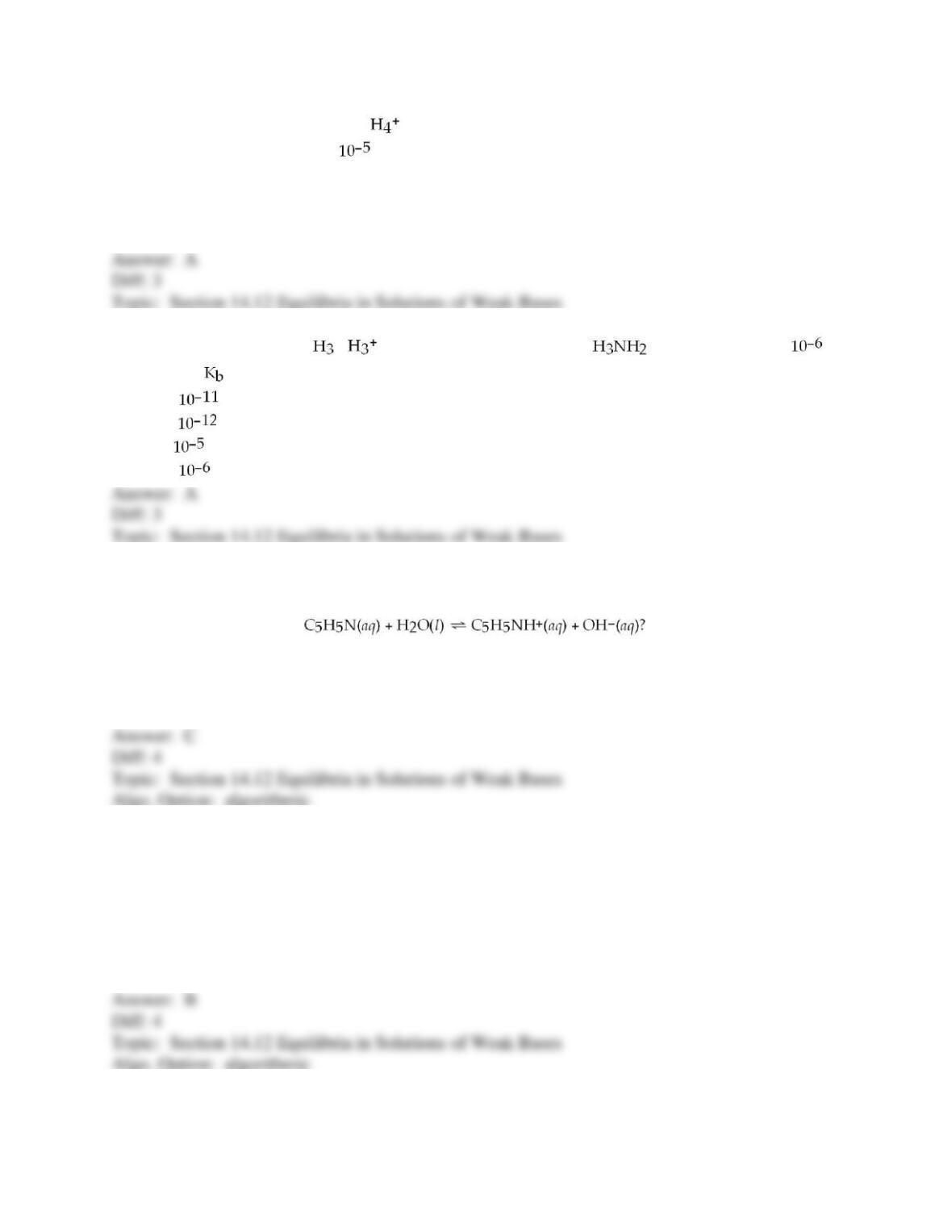
88) What is the pH of a 0.100 M NH3 solution that has Kb = 1.8 × 10⁻⁵ ? The equation for the
dissociation of NH3 is
A) 1.87
B) 2.87
C) 11.13
D) 12.13
25
89) What is the concentration of N in a 0.20 M ammonia solution? The base dissociaton
constant for ammonia is 1.8 × .
A) 0.0019 M
B) 0.20 M
C) 0.020 M
D) 0.040 M
90) The concentration of C N in a 0.20 M methylamine (C ) solution is 2.32 ×
M. What is for methylamine?
A) 2.7 ×
B) 5.4 ×
C) 1.2 ×
D) 3.3 ×
91) What is the pH of a 0.30 M pyridine solution that has a Kb = 1.9 × 10⁻⁹ ? The equation for
the dissociation of pyridine is
A) 4.62
B) 8.72
C) 9.38
D) 10.38
92) Aniline, (C6H5NH2, Kb = 4.3 × 10⁻¹⁰ at 25°C) is an industrially important amine used in
the making of dyes. Determine the pH of an aniline solution made by dissolving 3.90 g of aniline
in enough water to make 100 mL of solution.
A) 4.87
B) 9.13
C) 9.74
D) 10.74
93) Determine the ammonia concentration of an aqueous solution that has a pH of 11.50. The
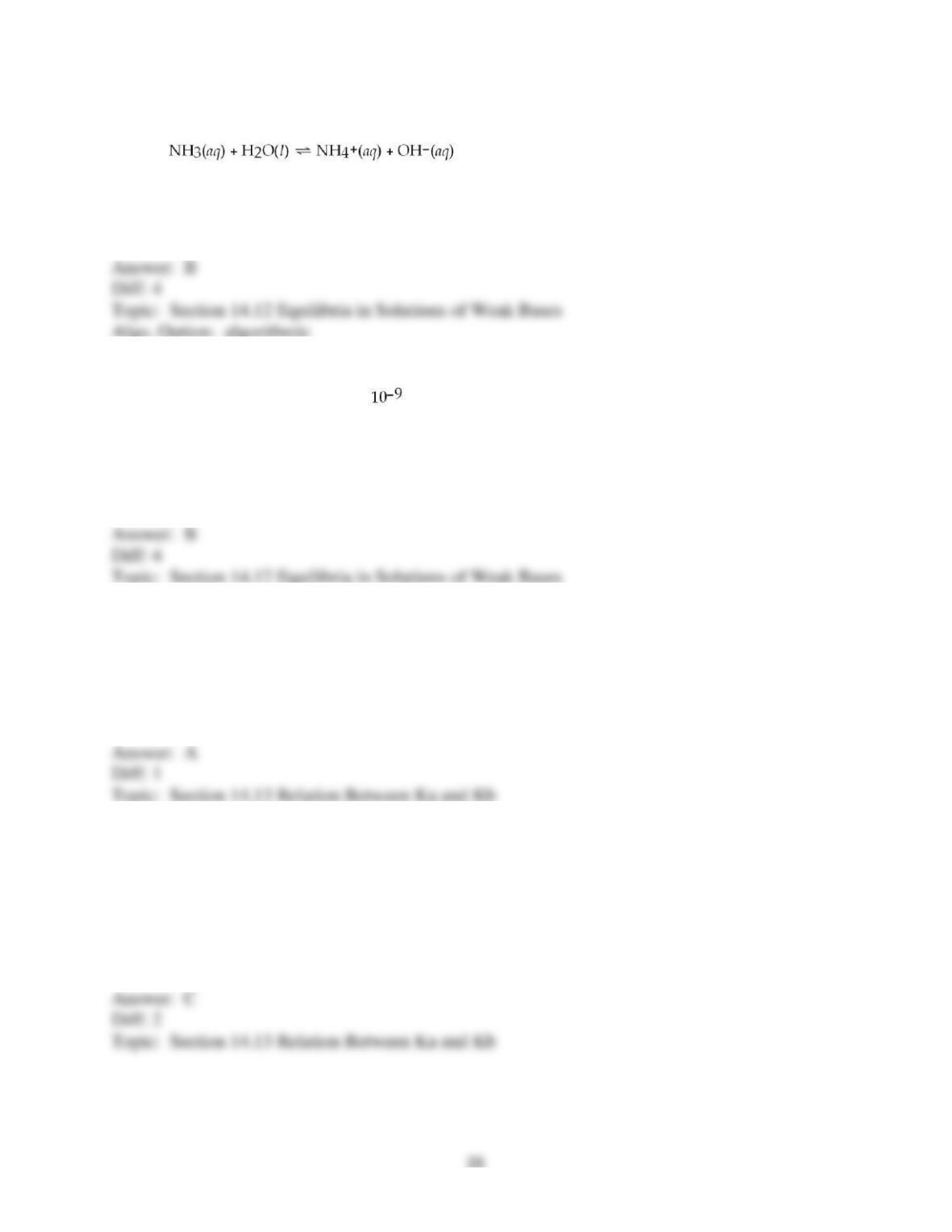
equation for the dissociation of NH3 (Kb = 1.8 × 10⁻⁵) is
A) 2.5 M
B) 0.55 M
C) 5.7 × 10⁻³ M
D) 3.2 × 10⁻³ M
94) How many grams of pyridine are there in 100 mL of an aqueous solution that has a pH of
9.00? The Kb for pyridine is 1.9 × and the equation of interest is
C5H5N(aq) + H2O(l) ⇌ C5H5NH+(aq) + OH–(aq).
A) 0.053 g
B) 0.42 g
C) 0.79 g
D) 7.9 g
95) What is the relationship between Ka and Kb at 25°C for a conjugate acid base pair?
A) Ka × Kb = 1 × 10-14
B) Ka/Kb = 1 × 10–14
C) Kb/Ka = 1 × 10-14
D) Ka + Kb = 1 × 10-14
96) Ammonia NH3, has a base dissociation constant of 1.8 × 10⁻⁵. What is the conjugate acid of
ammonia and what is its acid dissociation constant?
A) NH4+, 1.9 × 10⁹
B) NH4+, 1.8 × 10⁻⁵
C) NH4+, 5.6 × 10⁻¹⁰
D) NH2–, 5.6 × 10⁻¹⁰
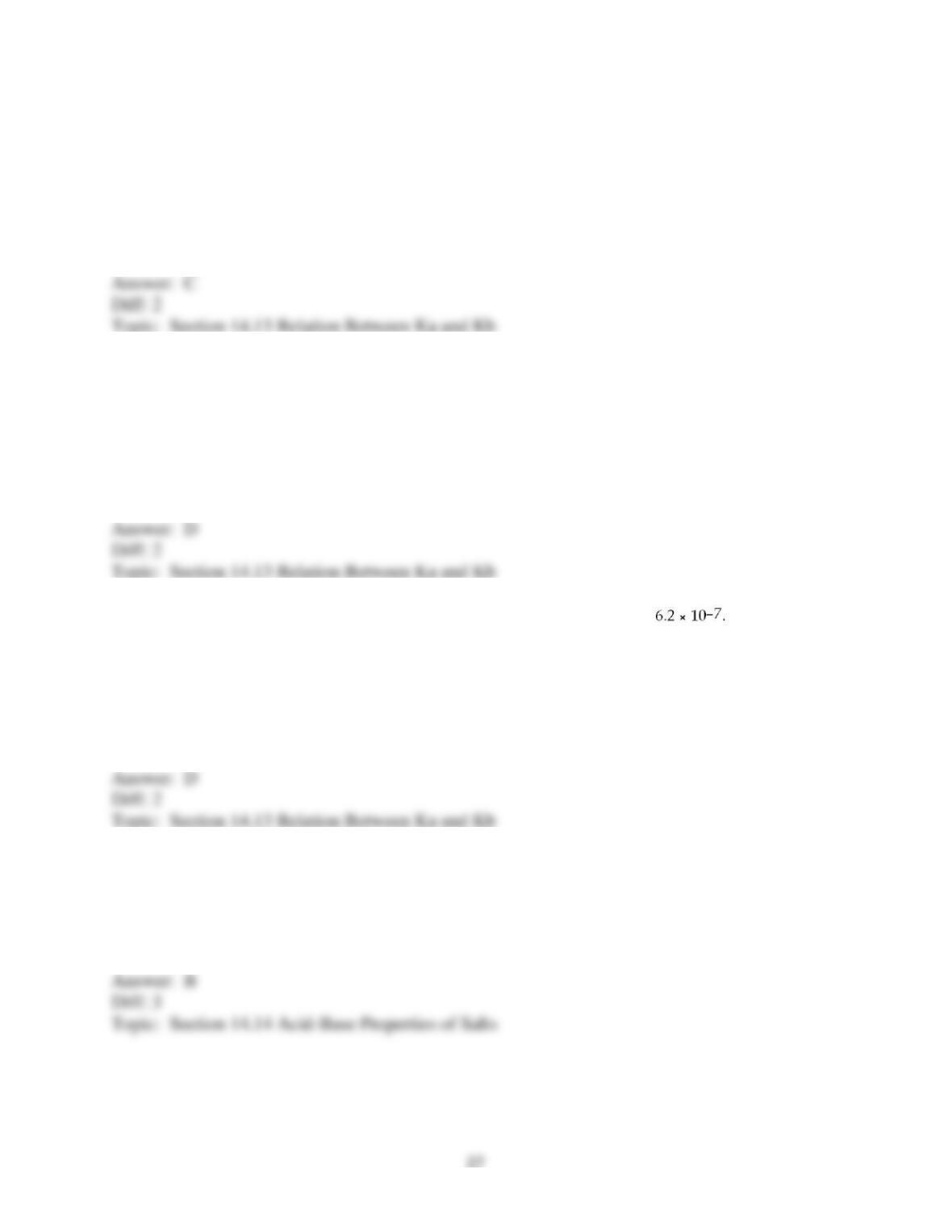
97) Methylamine CH3NH2, has a base dissociation constant of 3.7 × 10⁻⁴. What is the conjugate
acid of methylamine and what is its acid dissociation constant?
A) CH3NH3+, 2.7 × 10³
B) CH3NH3+, 3.7 × 10⁻⁴
C) CH3NH3+, 2.7 × 10⁻¹¹
D) CH3NH2–, 2.7 × 10⁻¹¹
98) Acetic acid CH3COOH, has an acid dissociation constant of 1.8 × 10⁻⁵. What is the
conjugate base of acetic acid and what is its base dissociation constant?
A) CH3C(OH)2+, 5.6 × 10⁴
B) CH3C(OH)2+, 5.6 × 10⁻¹⁰
C) CH3COOH, 5.6 × 10⁻¹⁰
D) CH3CO2–, 5.6 × 10⁻¹⁰
99) Dihydrogen phosphate H2PO4–, has an acid dissociation constant of What is the
conjugate base of H2PO4– and what is its base dissociation constant?
A) H3PO4, 1.6 × 10⁶
B) H3PO4, 1.6 × 10⁻⁸
C) HPO42-, 1.6 × 10⁶
D) HPO42-, 1.6 × 10⁻⁸
100) Which of the following salts are acidic?
A) LiCl, NaCl, KCl
B) NH4Cl, CuCl2, AlCl3
C) NaCH3CO2, KCH3CO2, RbCH3CO2
D) NaCl, NH4Cl, Na2CO3
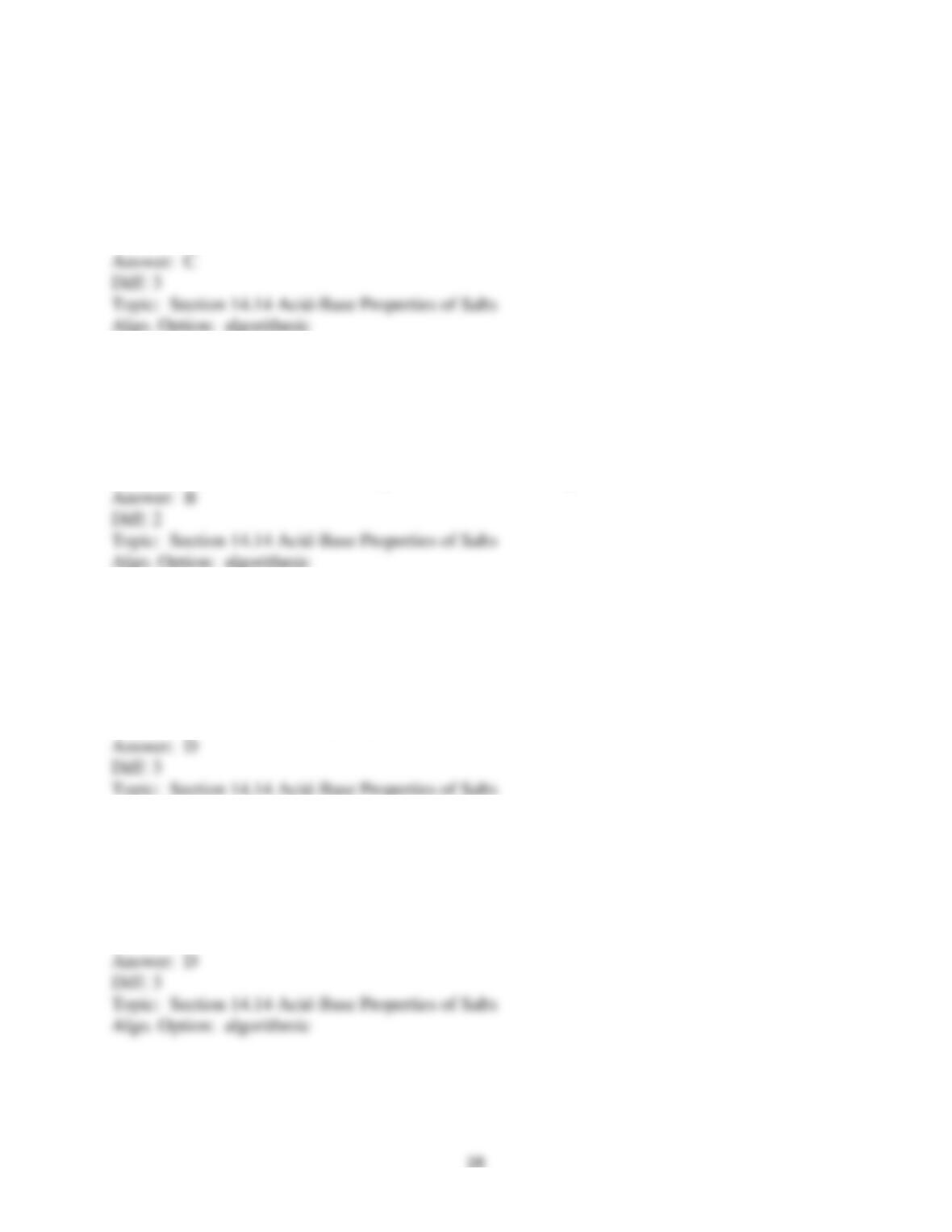
101) Which one of the following salts, when dissolved in water, produces the solution with the
highest pH?
A) NaHSO4
B) LiClO4
C) MgO
D) CH3NH3I
102) If an equal number of moles of the weak acid HCN and the strong base KOH are added to
water, is the resulting solution acidic, basic, or neutral?
A) acidic
B) basic
C) neutral
D) There is insufficient information provided to answer this question.
103) Arrange the following 0.10 M aqueous solutions in order of increasing pH: NaOH, HBr,
NaCH3CO2, KBr, NH4Br.
A) HBr, KBr, NH4Br, NaCH3CO2, NaOH
B) NaOH, NaCH3CO2, NH4Br, KBr, HBr
C) NaOH, NaCH3CO2, KBr, NH4Br, HBr
D) HBr, NH4Br, KBr, NaCH3CO2, NaOH
104) Which one of the following salts, when dissolved in water, produces the solution with the
highest pH?
A) KI
B) KBr
C) KCl
D) KF
105) Which one of the following salts, when dissolved in water, produces the solution with a pH
closest to 7.00?
A) NH4Cl
B) BaO
C) NaHSO4
D) RbI
106) Calculate the pH of a 0.100 M NaCH3CO2 solution. Ka for acetic acid, CH3CO2H, is
A) 2.87
B) 5.13
C) 8.87
D) 11.13
107) Calculate the pH of a of 0.100 M KBrO solution. Ka for hypobromous acid, HBrO, is
A) 3.15
B) 4.85
C) 9.15
D) 10.85
108) Calculate the pH of a 0.100 M CH3NH3Cl solution. Kb for methylamine, CH3NH2, is
A) 2.22
B) 5.78
C) 8.22
D) 11.78
30
109) Equal volumes of 0.10 M NH3 (Kb = 1.8 × 10⁻⁵) and 0.10 M HCN (Ka = 4.9 × 10⁻¹⁰) are
mixed together. Will the resulting solution be acidic, basic, or neutral?
A) acidic
B) basic
C) neutral
D) insufficient information to solve
110) Which one of the following salts, when dissolved in water, produces the solution with the
lowest pH?
A) NaCl
B) NH4Cl
C) MgCl2
D) AlCl3
111) What is the identity of M in the hydrate M(H2O)6n+ that has the 0.10 M solution with the
lowest pH?
A) Li+
B) Na+
C) Mg2+
D) Al3+
112) What is the identity of M in the hydrate M(H2O)6n+ that has the 0.10 M solution with the
highest pH?
A) Li+
B) Na+
C) Mg2+
D) Al3+
31
113) What is the strongest acid among the following?
A) HF
B) HCl
C) HBr
D) HI
114) What is the strongest acid among the following?
A) H2O
B) H2S
C) H2Se
D) H2Te
115) What is the strongest acid among the following?
A) HF
B) HCl
C) H2O
D) H2S
116) What is the weakest acid among the following?
A) SiH4
B) PH3
C) H2S
D) HCl
117) Which acid of the following set has the strongest conjugate base?
A) CH4
B) NH3
C) H2O
D) HF
118) What is the strongest base among the following?
32
A) ClO–
B) ClO2–
C) ClO3–
D) ClO4–
119) What is the strongest acid among the following?
A) H2SO3
B) H2SO4
C) H2SeO3
D) H2SeO4
120) What is the strongest acid of the following?
A) HOI
B) HOBr
C) HOCl
D) All are equivalent.
121) What is the strongest acid among the following?
A) HIO
B) HIO2
C) HIO3
D) HIO4
122) What is the strongest acid among the following?
A) CH3CO2H
B) ClCH2CO2H
C) Cl2CHCO2H
D) Cl3CCO2H
123) Identify the Lewis acid that acts as a reactant in the following reaction
Fe(H2O)63+(aq) + 6 CN–(aq) → Fe(CN)63-(aq) + 6 H2O(l).
A) Fe3+
B) H2O
C) CN–
D) Fe(H2O)63+
124) Identify the Lewis acid that acts as a reactant in the following reaction
Co(H2O)63+(aq) + 6 NH3(aq) → Co(NH3)63+(aq) + 6 H2O(l).
A) Co(H2O)63+
B) Co3+
C) NH3
D) H2O
125) For Cu2+ and CO2, which will behave as a Lewis acid toward OH– in water?
A) only Cu2+
B) only CO2
C) Cu2+ and CO2
D) neither Cu2+ nor CO2
126) Which one of the following is not considered to be a Lewis base?
A) H2O
B) NH3
C) NH4+
D) Cl–
127) Which one of the following is least able to behave as a Lewis base?
A) CH3NH2
B) (CH3)2NH
C) (CH3)3N
D) (CH3)3NH+
128) The compound BF3 can be described as a(n)
A) Arrhenius acid.
B) Brønsted-Lowry acid.
C) Lewis acid.
D) Lewis base.
129) Identify the set of Lewis acids.
A) BH3, BF3, Cu2+, CO2
B) Cl–, OH–, NH3, H2O
C) H3PO4, H2PO4–, HPO42-, PO43-
D) CH3–, NH2–, OH–, F–
130) Which one of the following is expected to be the strongest Lewis acid?
A) Fe
B) Fe+
C) Fe2+
D) Fe3+
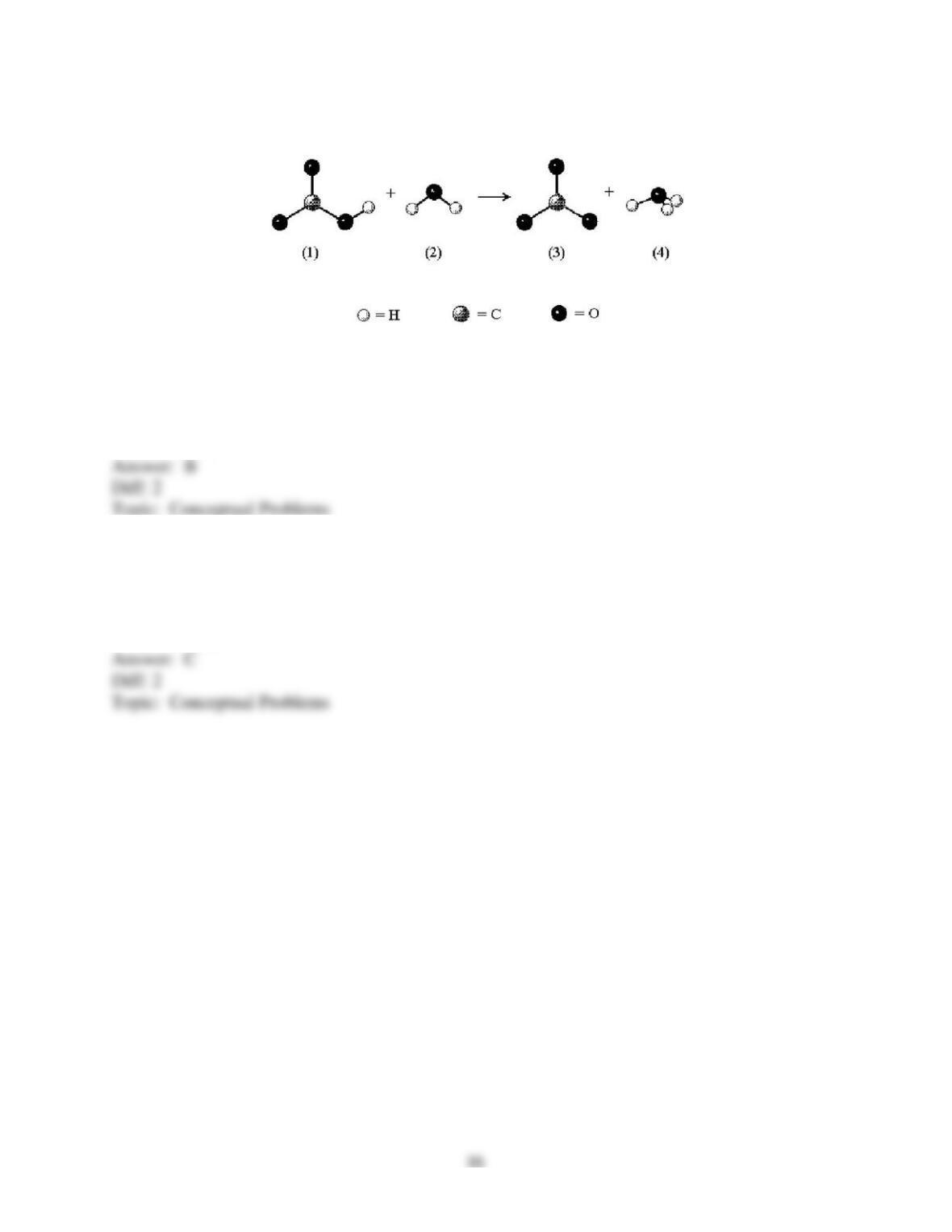
In the following reaction the unshaded spheres represent H atoms.
131) Identify the Brønsted-Lowry acids.
A) (1) and (3)
B) (1)
C) (2) and (3)
D) (2) and (4)
132) Identify the Brønsted-Lowry bases.
A) (1) and (3)
B) (1) and (4)
C) (2)
D) (2) and (4)
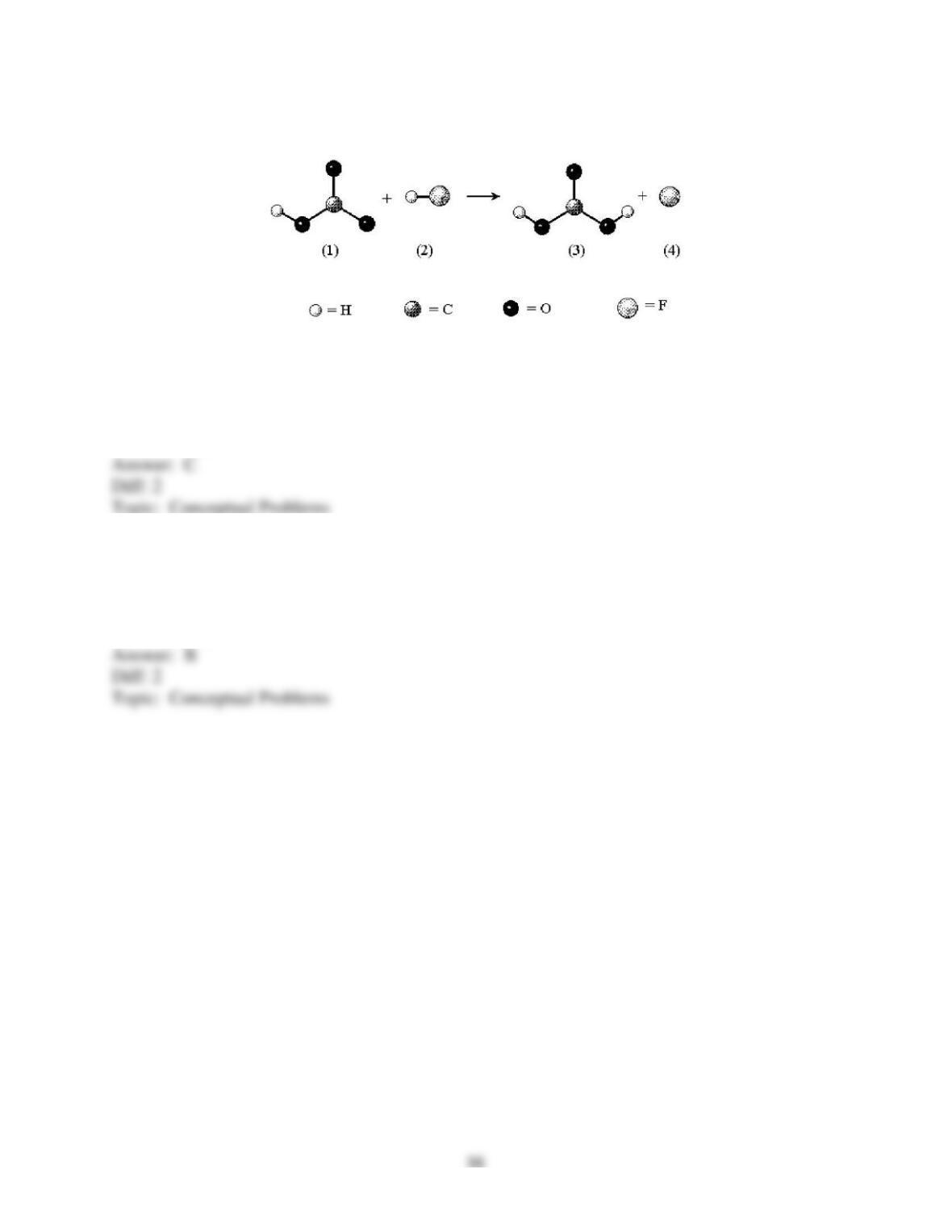
In the following reaction the unshaded spheres represent H atoms.
133) Identify the Brønsted-Lowry acids.
A) (1) and (3)
B) (1) and (4)
C) (2)
D) (2) and (4)
134) Identify the Brønsted-Lowry bases.
A) (1) and (3)
B) (1)
C) (2) and (3)
D) (2) and (4)
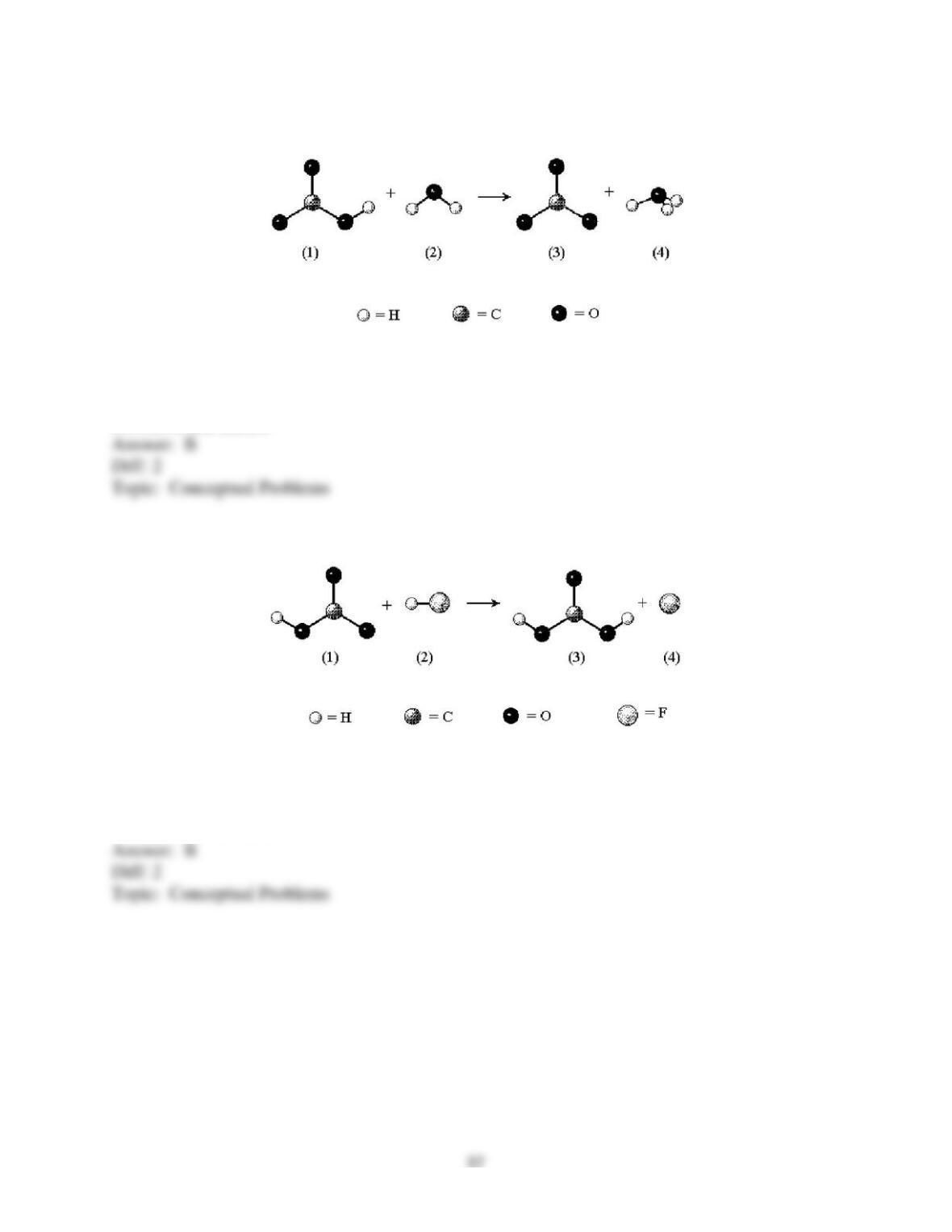
In the following reaction the unshaded spheres represent H atoms.
135) Identify the Brønsted-Lowry acid/base conjugate pairs.
A) (1)/(2) and (3)/(4)
B) (1)/(3) and (2)/(4)
C) (1)/(4) and (2)/(3)
In the following reaction the unshaded spheres represent H atoms.
136) Identify the Brønsted-Lowry acid/base conjugate pairs.
A) (1)/(2) and (3)/(4)
B) (1)/(3) and (2)/(4)
C) (1)/(4) and (2)/(3)
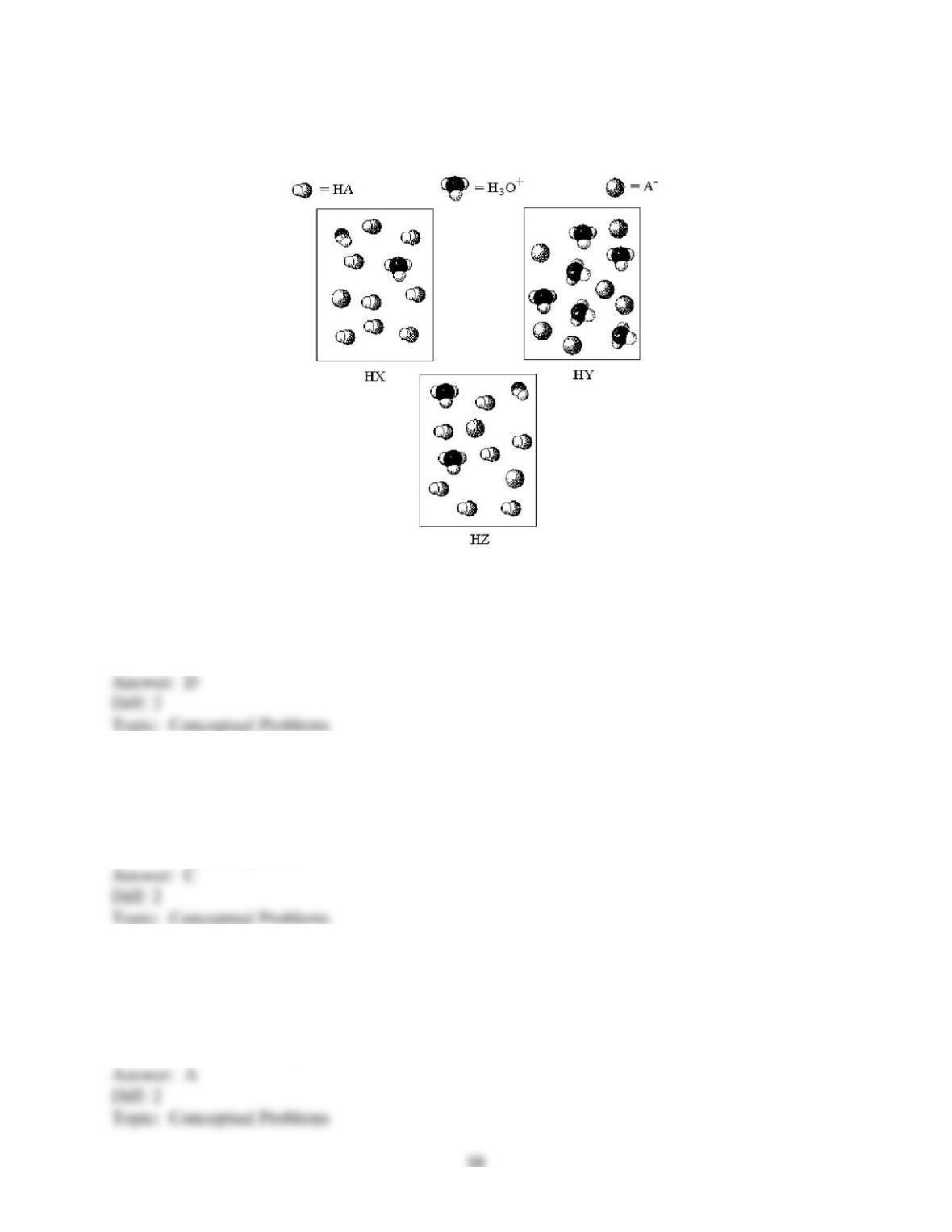
The following pictures represent aqueous solutions of three acids HA (A = X, Y, or Z); water
molecules have been omitted for clarity.
137) Arrange the three acids in order of increasing acid strength.
A) HZ < HY < HX
B) HY < HZ < HX
C) HZ < HX < HY
D) HX < HZ < HY
138) Which acid, if any, is a strong acid?
A) All are strong acids.
B) HX and HZ
C) HY
D) None are strong acids.
139) Which acid has the smallest value of Ka?
A) HX
B) HY
C) HZ
D) All have the same Ka value.
140) Which acid has the lowest percent dissociation?
A) HX
B) HY
C) HZ
D) All have the same percent dissociation.
141) Which acid solution has the lowest pH?
A) HX
B) HY
C) HZ
D) All have the same pH.
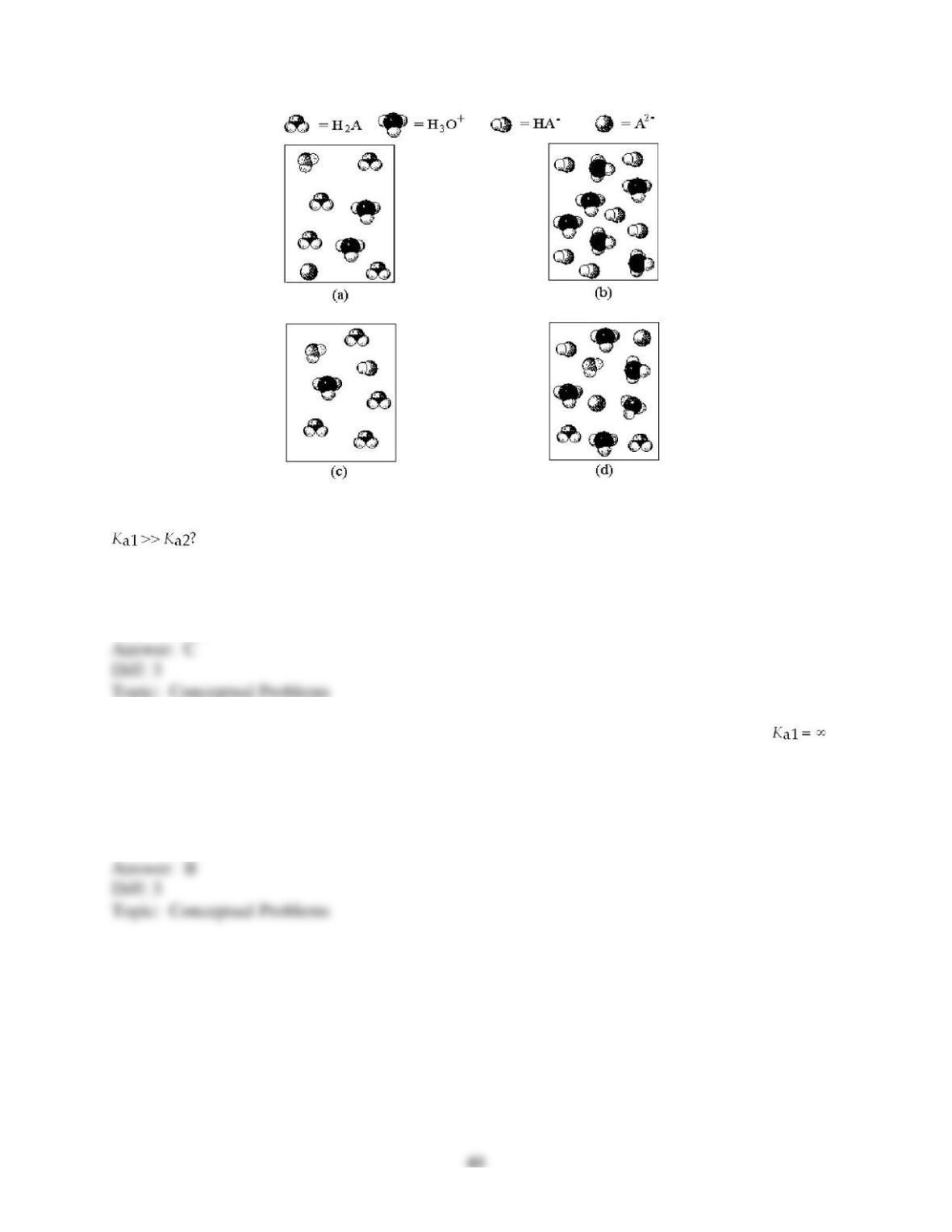
142) Which of the above pictures represents a solution of a weak diprotic acid H2A for which
(Water molecules have been omitted for clarity.)
A) picture (a)
B) picture (b)
C) picture (c)
D) picture (d)
143) Which of the above pictures represents a solution of a diprotic acid H2A for which
and Ka2 is exceptionally small. (Water molecules have been omitted for clarity.)
A) picture (a)
B) picture (b)
C) picture (c)
D) picture (d)