22) An object oscillates such that its position x as a function of time t obeys the equation x =
(0.222 m) sin(314 s-1 t), where t is in seconds.
(a) In one period, what total distance does the object move?
(b) What is the frequency of the motion?
(c) What is the position of the object when t = 1.00 s?
23) An object undergoing simple harmonic motion has a maximum displacement of at
If the angular frequency of oscillation is what is the object’s displacement when
A) 4.8 m
B) 5.6 m
C) 3.7 m
D) 3.1 m
24) If the frequency of the motion of a simple harmonic oscillator is doubled, by what factor
does the maximum speed of the oscillator change?
A) 2
B) 4
C) It does not change.
D) 1/2
E) 1/4
25) If the amplitude of the motion of a simple harmonic oscillator is doubled, by what factor
does the maximum speed of the oscillator change?
A) 2
B) 4
C) It does not change.
D) 1/2
E) 1/4
26) If the angular frequency of the motion of a simple harmonic oscillator is doubled, by what
factor does the maximum acceleration of the oscillator change?
A) 2
B) 4
C) It does not change.
D) 1/2
E) 1/4
27) The equation of motion of a particle undergoing simple harmonic motion in the y direction is
y = (2.0 cm) sin(0.60 s-1 t). At time t = 0.60 s determine the particle’s (a) position, (b) velocity,
and (c) acceleration.
28) A 0.25 kg harmonic oscillator has a total mechanical energy of If the oscillation
amplitude is what is the oscillation frequency?
A) 4.6 Hz
B) 1.4 Hz
C) 2.3 Hz
D) 3.2 Hz
29) A 0.250-kg stone is attached to an ideal spring and undergoes simple harmonic oscillations
with a period of 0.640 s. What is the force constant (spring constant) of the spring?
A) 2.45 N/m
B) 12.1 N/m
C) 24.1 N/m
D) 0.102 N/m
E) 0.610 N/m
30) A 0.150-kg air track cart is attached to an ideal spring with a force constant (spring constant)
of 3.58 N/m and undergoes simple harmonic oscillations. What is the period of the oscillations?
A) 2.57 s
B) 0.527 s
C) 0.263 s
D) 1.14 s
E) 1.29 s
31) In a supermarket, you place a 22.3-N (around 5 lb) bag of oranges on a scale, and the scale
starts to oscillate at 2.7 Hz. What is the force constant (spring constant) of the spring of the
scale?
A) 650 N/m
B) 600 N/m
C) 330 N/m
D) 820 N/m
E) 410 N/m
32) When a 0.350-kg package is attached to a vertical spring and lowered slowly, the spring
stretches 12.0 cm. The package is now displaced from its equilibrium position and undergoes
simple harmonic oscillations when released. What is the period of the oscillations?
A) 0.695 s
B) 0.483 s
C) 0.286 s
D) 0.0769 s
E) 1.44 s
33) A 1.15-kg beaker (including its contents) is placed on a vertical spring scale. When the
system is sent into vertical vibrations, it obeys the equation y = (2.3 cm)cos(17.4 s-1 t). What is
the force constant (spring constant) of the spring scale, assuming it to be ideal?
34) When a laboratory sample of unknown mass is placed on a vertical spring-scale having a
force constant (spring constant) of 467 N/m, the system obeys the equation y = (4.4 cm) cos(33.3
s-1 t). What is the mass of this laboratory sample?
35) A 3.42-kg stone hanging vertically from an ideal spring on the earth undergoes simple
harmonic motion at a place where g = 9.80 m/s2. If the force constant (spring constant) of the
spring is find the period of oscillation of this setup on a planet where g = 1.60 m/s2.
A) 3.35 s
B) 2.51 s
C) 4.36 s
D) 5.70 s
36) A 51.8-kg bungee jumper jumps off a bridge and undergoes simple harmonic motion. If the
period of oscillation is 11.2 s, what is the spring constant (force constant) of the bungee cord?
A) 16.3 N/m
B) 19.6 N/m
C) 26.1 N/m
37) A 4.8-kg block attached to an ideal spring executes simple harmonic motion on a frictionless
horizontal surface. At time t = 0.00 s, the block has a displacement of a velocity of
and an acceleration of The force constant (spring constant) of the spring is
closest to
A) 15 N/m.
B) 14 N/m.
C) 13 N/m.
D) 12 N/m.
E) 11 N/m.
38) An object of mass m = 8.0 kg is attached to an ideal spring and allowed to hang in the earth’s
gravitational field. The spring stretches before it reaches its equilibrium position. If it were
now allowed to oscillate by this spring, what would be its frequency?
A) 3.4 Hz
B) 0.28 x 10⁻³ Hz
C) 0.52 Hz
D) 1.6 Hz
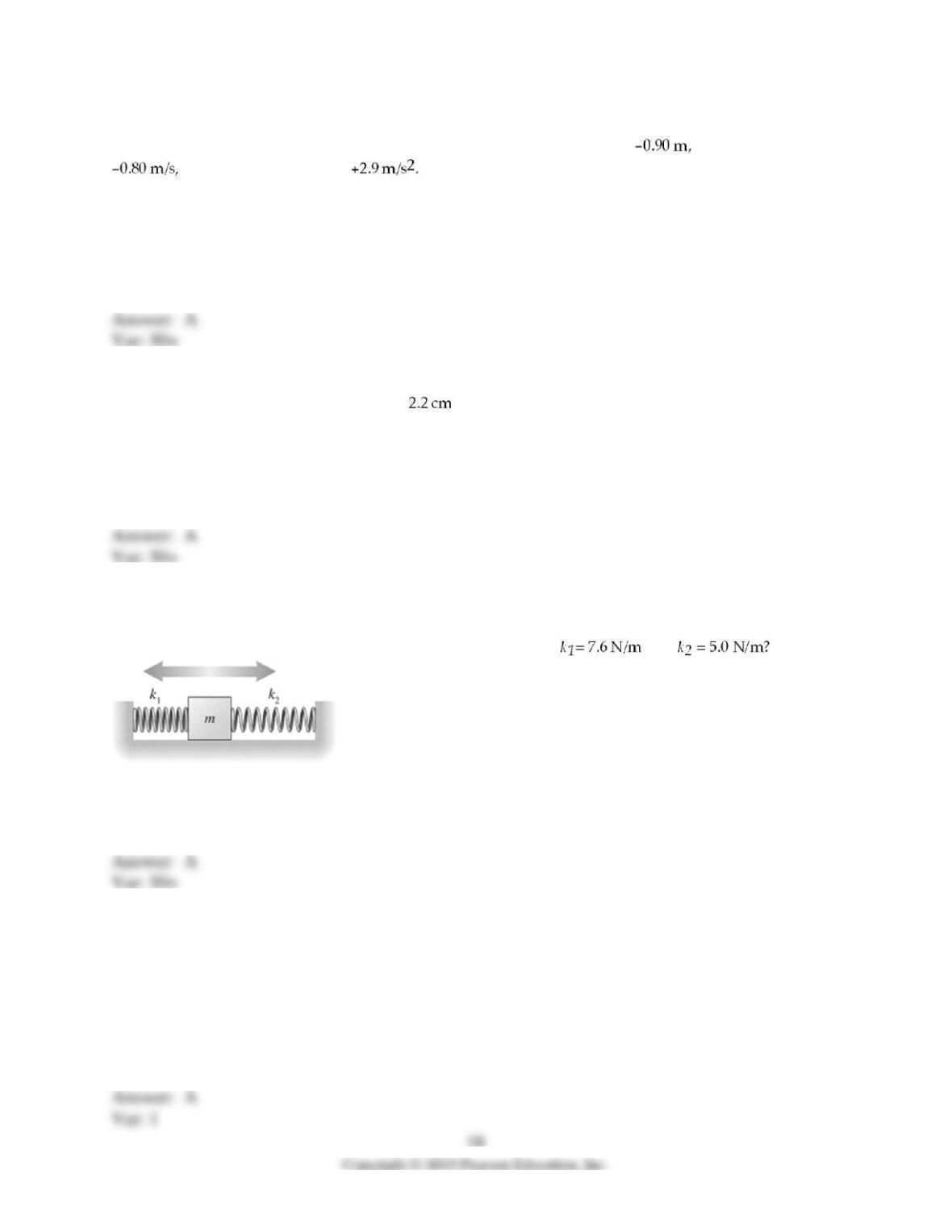
39) A 2.0-kg block on a frictionless table is connected to two springs whose opposite ends are
fixed to walls, as shown in the figure. The springs have force constants (spring constants) k1 and
k2. What is the oscillation angular frequency of the block if and
A) 2.5 rad/s
B) 3.5 rad/s
C) 0.40 rad/s
D) 0.56 rad/s
40) A 92-kg man climbs into a car with worn out shock absorbers, and this causes the car to drop
down 4.5 cm. As he drives along he hits a bump, which starts the car oscillating at an angular
frequency of 4.52 rad/s. What is the mass of the car?
A) 890 kg
B) 760 kg
C) 920 kg
D) 990 kg
E) 1900 kg
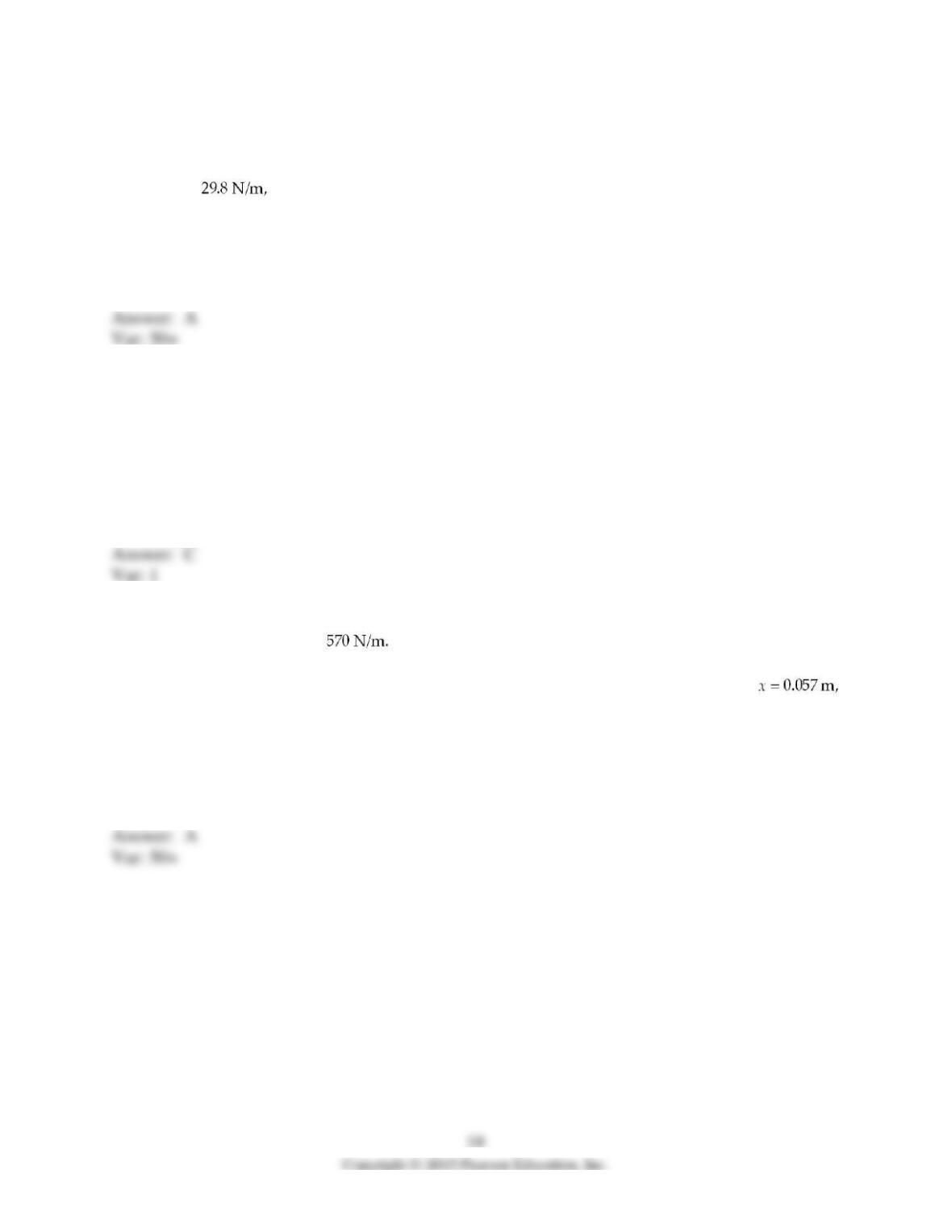
41) An object attached to an ideal spring oscillates with an angular frequency of 2.81 rad/s. The
object has a maximum displacement at t = 0.00 s of 0.232 m. If the force constant (spring
constant) is what is the potential energy stored in the mass-spring system when t = 1.42
s?
A) 0.350 J
B) 0.256 J
C) 0.329 J
D) 0.399 J
42) A block attached to an ideal spring of force constant (spring constant) 15 N/m executes
simple harmonic motion on a frictionless horizontal surface. At time t = 0 s, the block has a
displacement of -0.90 m, a velocity of -0.80 m/s, and an acceleration of +2.9 m/s2 . The mass of
the block is closest to
A) 2.3 kg
B) 2.6 kg
C) 4.7 kg
D) 9.4 kg
43) A 0.39-kg block on a horizontal frictionless surface is attached to an ideal spring whose force
constant (spring constant) is The block is pulled from its equilibrium position at x =
0.000 m to a displacement x = +0.080 m and is released from rest. The block then executes
simple harmonic motion along the horizontal x-axis. When the position of the block is
its kinetic energy is closest to
A) 0.90 J.
B) 0.84 J.
C) 0.95 J.
D) 1.0 J.
E) 1.1 J.
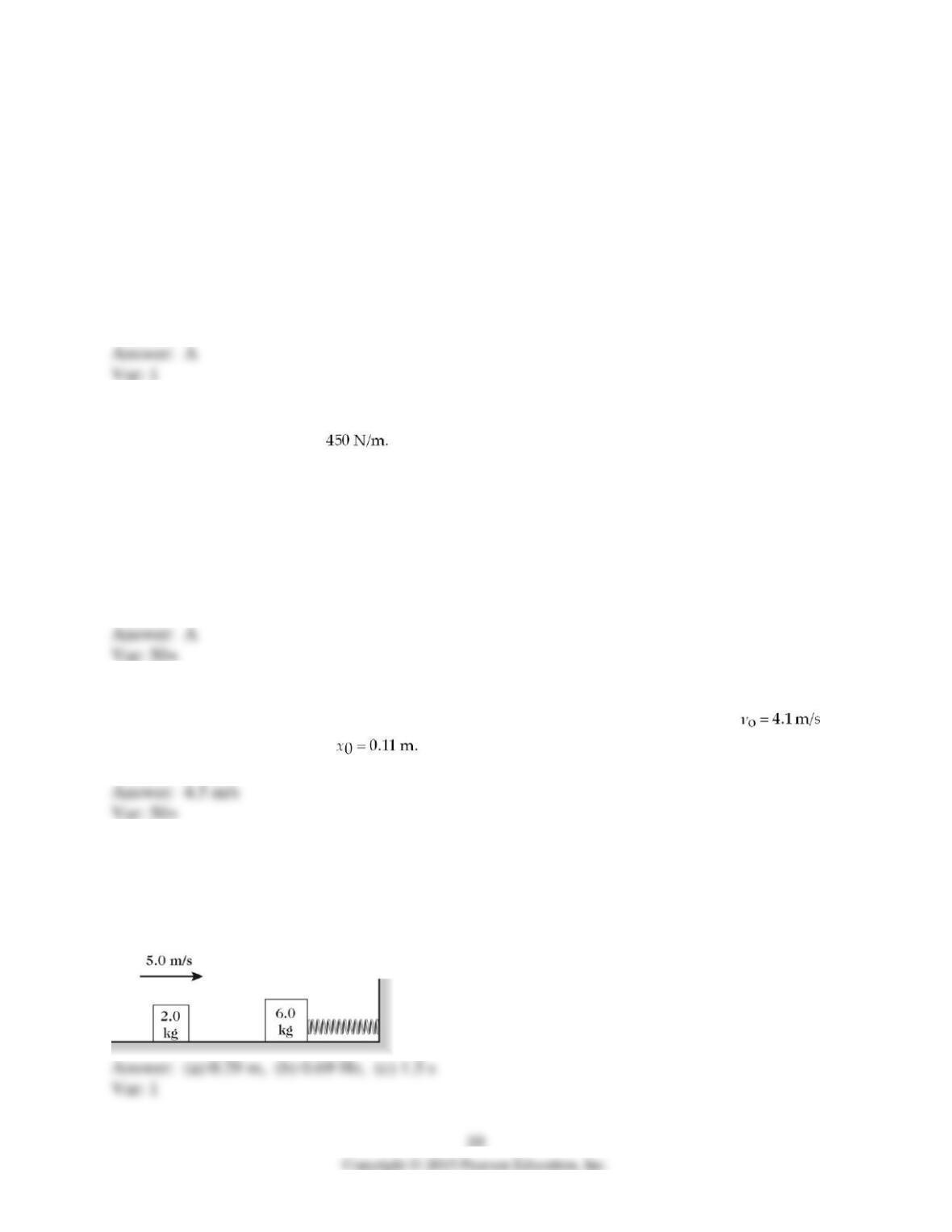
44) A 0.16-kg block on a horizontal frictionless surface is attached to an ideal spring whose force
constant (spring constant) is 360 N/m. The block is pulled from its equilibrium position at x =
0.000 m to a position x = +0.080 m and is released from rest. The block then executes simple
harmonic motion along the horizontal x-axis. When the position is x = -0.037 m, what is the
acceleration of the block?
A) 83 m/s2
B) 43 m/s2
C) 64 m/s2
D) 270 m/s2
E) 370 m/s2
45) A 3.7-kg block on a horizontal frictionless surface is attached to an ideal spring whose force
constant (spring constant) is The block is pulled from its equilibrium position at x =
0.000 m to a position x = +0.080 m and is released from rest. The block then executes simple
harmonic motion along the horizontal x-axis. The maximum elastic potential energy of the
system is closest to
A) 1.4 J.
B) 1.3 J.
C) 1.6 J.
D) 1.7 J.
E) 1.8 J.
46) An object of mass 6.8 kg is attached to an ideal spring of force constant (spring constant)
1720 N/m. The object is set into simple harmonic motion, with an initial velocity of
and an initial displacement of Calculate the maximum speed the object raches during
its motion.
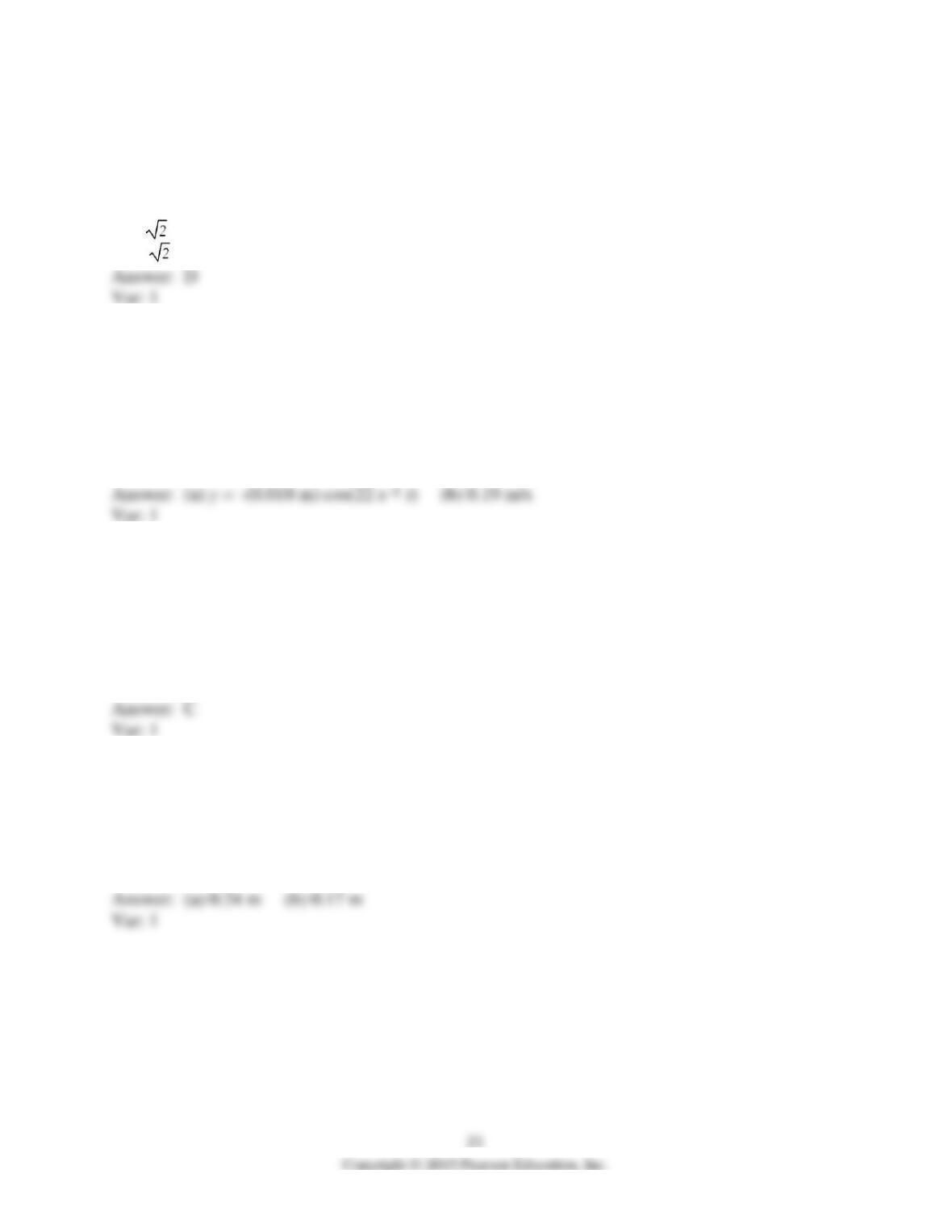
47) A 2.0 kg box is traveling at 5.0 m/s on a smooth horizontal surface when it collides with and
sticks to a stationary 6.0 kg box. The larger box is attached to an ideal spring of force constant
(spring constant) 150 N/m, as shown in the figure. Find (a) the amplitude of the resulting
oscillations of this system, (b) the frequency of the oscillations and (c) the period of the
oscillations.
48) A ball is attached to an ideal spring and oscillates with a period T. If the mass of the ball is
doubled, what is the new period?
A) 2T
B) T/2
C) T
D) T
E) T/
49) A geologist suspends a 0.30-kg stone on an ideal spring. In equilibrium the stone stretches
the spring 2.0 cm downward. The stone is then pulled an additional distance of 1.0 cm down and
released from rest.
(a) Write down the equation for the vertical position y of the stone as a function of time t, using
the cosine function. Take the origin at the equilibrium point of the stone, with the positive y
direction upward.
(b) How fast is the stone moving at a time equal to 1/3 of its period of motion?
50) How much mass should be attached to a vertical ideal spring having a spring constant (force
constant) of 39.5 N/m so that it will oscillate at 1.00 Hz?
A) 39.5 kg
B) 2.00 kg
C) 1.00 kg
D) 1.56 kg
E) 6.29 kg
51) A 0.50-kg box is attached to an ideal spring of force constant (spring constant) 20 N/m on a
horizontal, frictionless floor. The box oscillates in simple harmonic motion and has a speed of
1.5 m/s at the equilibrium position.
(a) What is the amplitude of vibration?
(b) At what distance from the equilibrium position are the kinetic energy and the potential energy
the same?
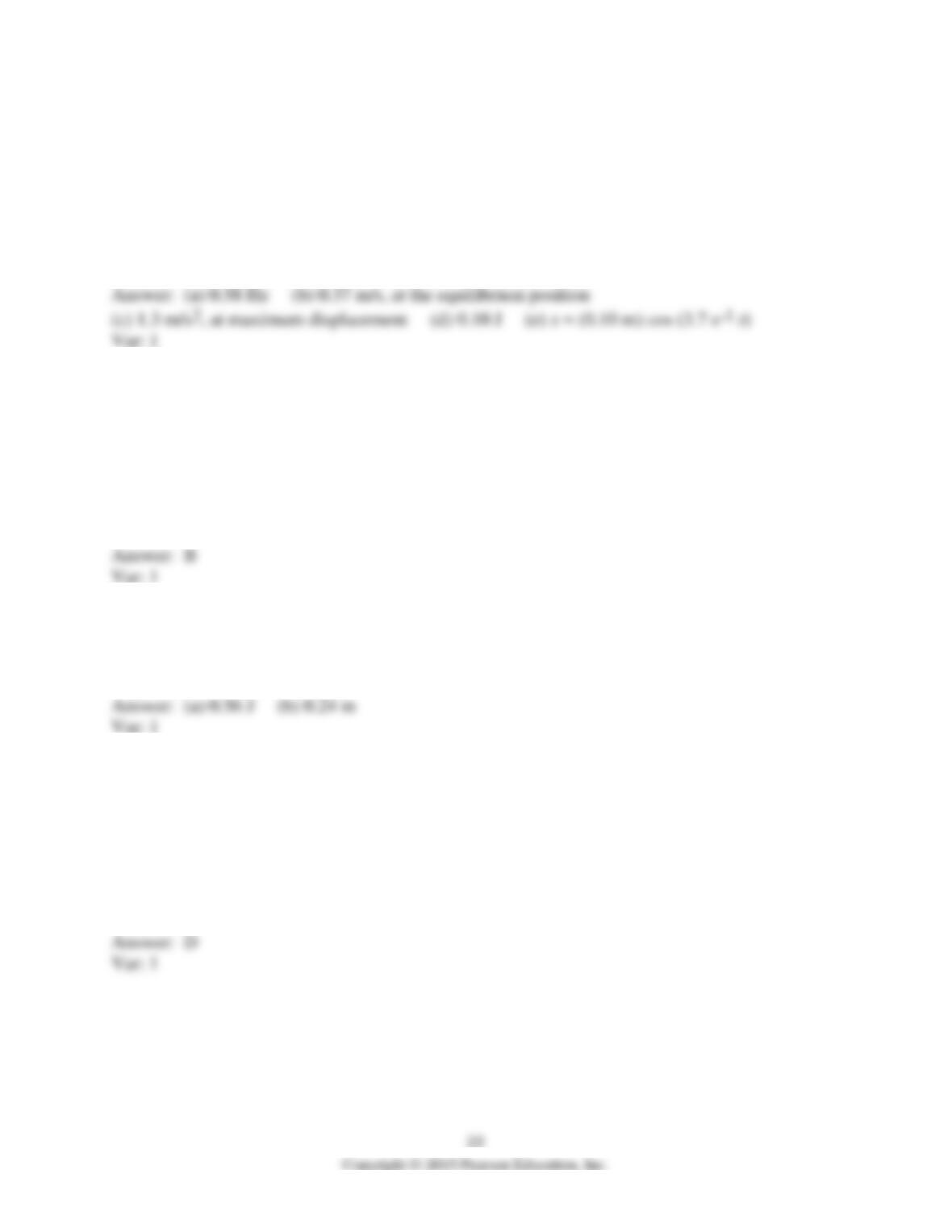
52) A 1.5-kg cart attached to an ideal spring with a force constant (spring constant) of 20 N/m
oscillates on a horizontal, frictionless track. At time t = 0.00 s, the cart is released from rest at
position x = 10 cm from the equilibrium position.
(a) What is the frequency of the oscillations of the cart?
(b) Determine the maximum speed of the cart. Where does the maximum speed occur?
(c) Find the maximum acceleration of the mass. Where does the maximum acceleration occur?
(d) How much total energy does this oscillating system contain?
(e) Express the displacement as a function of time using a cosine function.
53) A 0.150-kg cart that is attached to an ideal spring with a force constant (spring constant) of
3.58 N/m undergoes simple harmonic oscillations with an amplitude of 7.50 cm. What is the total
mechanical energy of the system?
A) 0.0201 J
B) 0.0101 J
C) 0.269 J
D) 0.134 J
E) 0 J
54) A 0.50-kg object is attached to an ideal spring of spring constant (force constant) 20 N/m
along a horizontal, frictionless surface. The object oscillates in simple harmonic motion and has
a speed of 1.5 m/s at the equilibrium position. What are (a) the total energy and (b) the
amplitude of vibration of the system?
55) A 0.50-kg object is attached to an ideal spring of spring constant (force constant) 20 N/m
along a horizontal, frictionless surface. The object oscillates in simple harmonic motion and has
a speed of 1.5 m/s at the equilibrium position. At what distance from the equilibrium position
are the kinetic energy and potential energy of the system the same?
A) 0.017 m
B) 0.029 m
C) 0.12 m
D) 0.17 m
56) A 1.53-kg piece of iron is hung by a vertical ideal spring. When perturbed slightly, the
system is moves up and down in simple harmonic oscillations with a frequency of 1.95 Hz and
an amplitude of 7.50 cm. If we choose the total potential energy (elastic and gravitational) to be
zero at the equilibrium position of the hanging iron, what is the total mechanical energy of the
system?
A) 0.844 J
B) 0.646 J
C) 0.633 J
D) 0.955 J
E) 0.000 J
57) A 0.30-kg block of wood is suspended on a spring. In equilibrium the wood stretches the
spring 2.0 cm downward. The wood is then pulled an additional distance of 1.0 cm down and
released from rest.
(a) How long does it take the wood to make 3 complete cycles of vibration?
(b) How much total mechanical energy does this system contain if we choose the total potential
energy (elastic and gravitational) to be zero at the equilibrium position of the hanging block?
58) A ball vibrates back and forth from the free end of an ideal spring having a force constant
(spring constant) of 20 N/m. If the amplitude of this motion is 0.30 m, what is the kinetic energy
of the ball when it is 0.30 m from its equilibrium position?
A) 0.00 J
B) 0.22 J
C) 0.45 J
D) 0.90 J
E) 1.4 J
59) What is the length of a simple pendulum with a period of 2.0 s?
A) 20 m
B) 0.99 m
C) 1.2 m
D) 1.6 m
E) 0.87 m
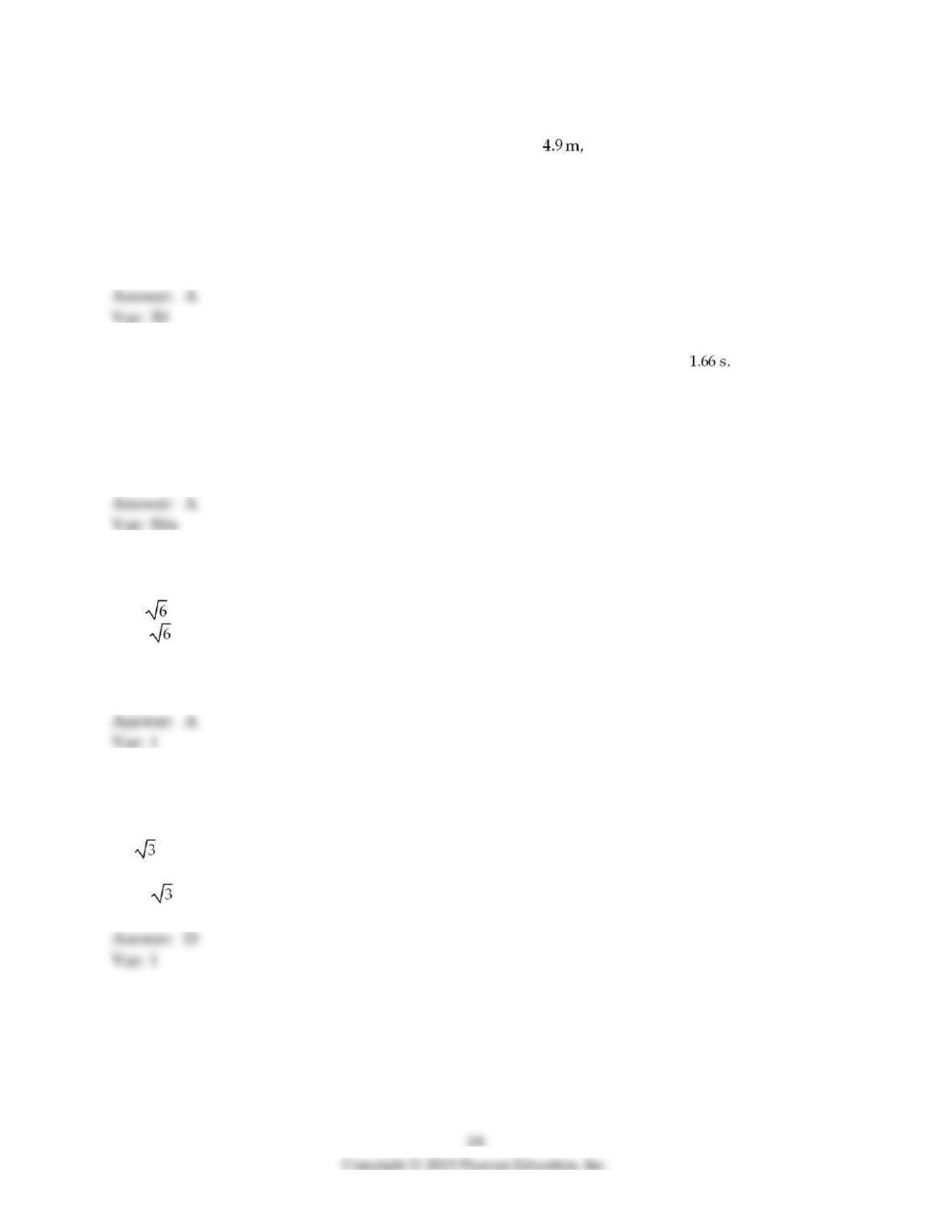
60) A 34-kg child on an 18-kg swing set swings back and forth through small angles. If the
length of the very light supporting cables for the swing is how long does it take for each
complete back-and-forth swing? Assume that the child and swing set are very small compared to
the length of the cables.
A) 4.4 s
B) 4.8 s
C) 5.3 s
D) 5.7 s
61) The period of a simple pendulum that is 1.00 m long on another planet is What is the
acceleration due to gravity on this planet if the mass of the pendulum bob is 1.5 kg?
A) 14.3 m/s2
B) 13.3 m/s2
C) 15.7 m/s2
D) 17.2 m/s2
62) On the Moon, the acceleration of gravity is g/6. If a pendulum has a period T on Earth, what
will its period be on the Moon?
A) T
B) T/
C) T/6
D) 6T
E) T/3
63) A simple pendulum has a period T on Earth. If it were used on Planet X, where the
acceleration due to gravity is 3 times what it is on Earth, what would its period be?
A) 3T
B) T
C) T
D) T/
E) T/3
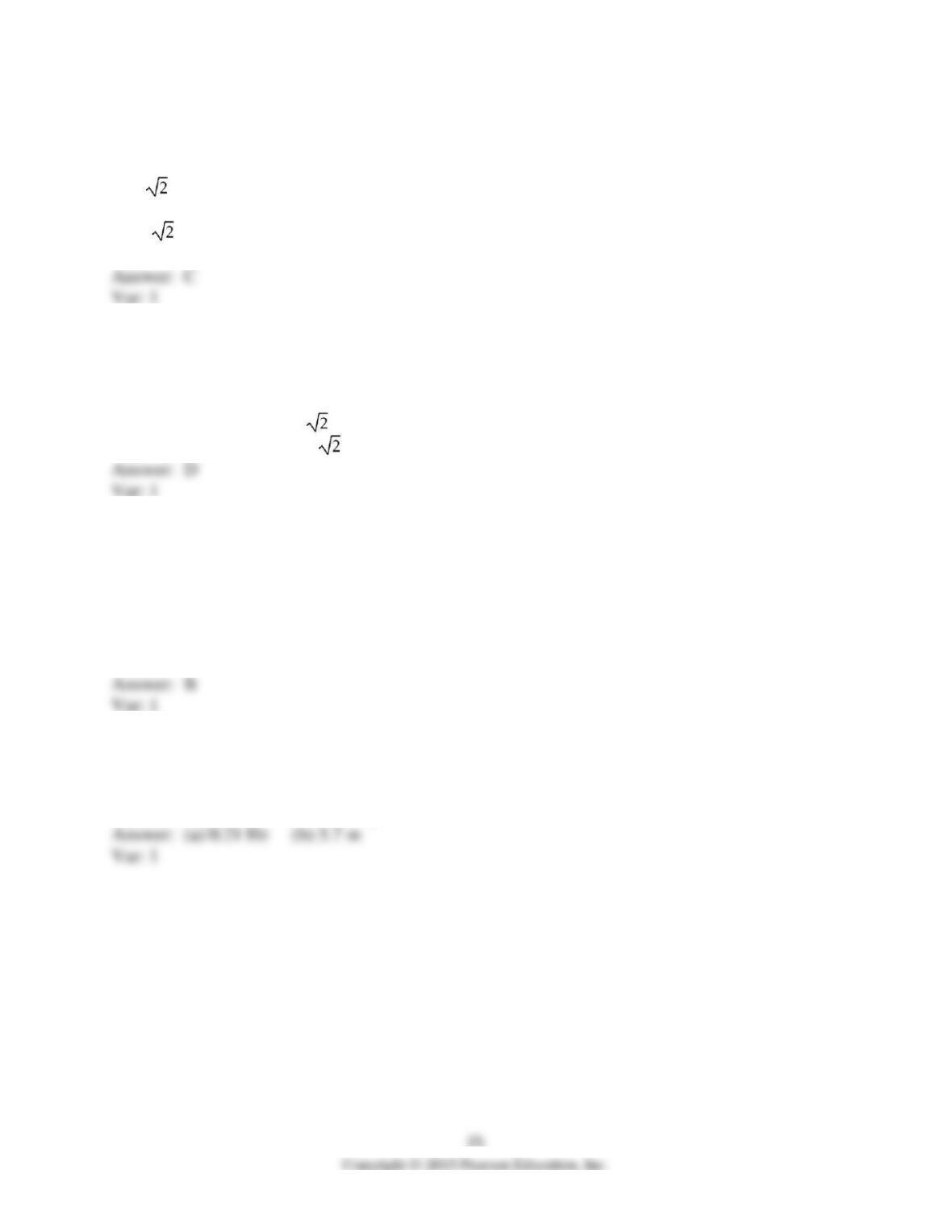
64) A simple pendulum having a bob of mass M has a period T. If you double M but change
nothing else, what would be the new period?
A) 2T
B) T
C) T
D) T/
E) T/2
65) If both the mass of a simple pendulum and its length are doubled, the period will
A) be unchanged.
B) increase by a factor of 2.
C) increase by a factor of 4.
D) increase by a factor of .
E) increase by a factor of 1/.
66) A simple pendulum takes 2.00 s to make one compete swing. If we now triple the length,
how long will it take for one complete swing?
A) 6.00 s
B) 3.46 s
C) 2.00 s
D) 1.15 s
E) 0.667 s
67) Tarzan swings back and forth on a long vine. His friend Jane notices in amazement that he
makes 30 complete swings in 2.4 minutes.
(a) What is the frequency (in hertz) of Tarzan’s swing?
(b) How long is the vine he is using?
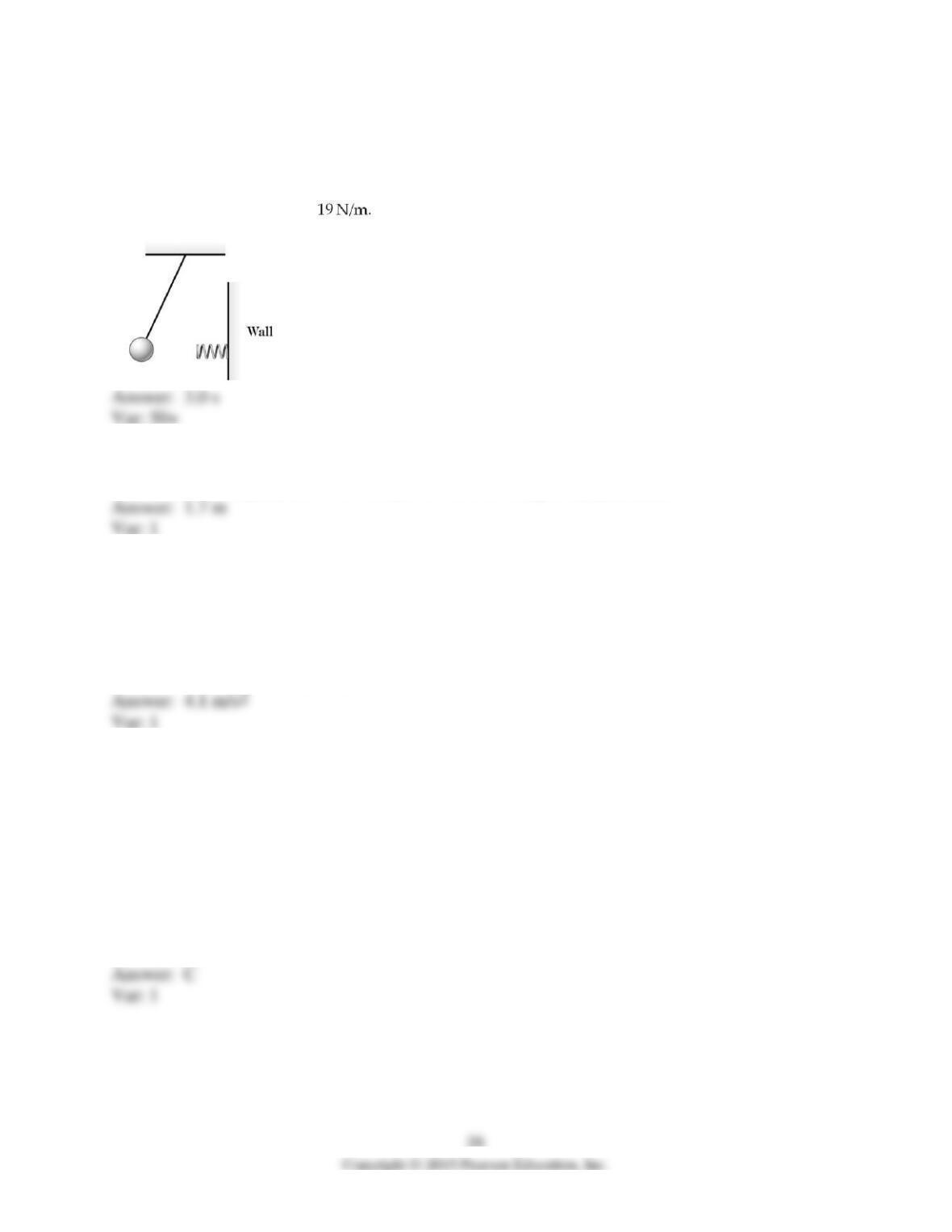
68) As shown in the figure, a 0.23-kg ball is suspended from a string 6.87 m long and is pulled
slightly to the left. As the ball swings through the lowest part of its motion it encounters a spring
attached to the wall. The spring pushes against the ball and eventually the ball is returned to its
original starting position. Find the time for one complete cycle of this motion if the spring
constant (force constant) is (Assume that once the pendulum ball hits the spring there is
no effect due to the vertical movement of the ball.)
69) When a certain simple pendulum is set swinging, its angular displacement θ as a function of
time t obeys the equation θ = 8.5° cos(2.4 s-1t). How long is the pendulum?
70) A spaceship captain lands on an unknown planet. Before venturing forth, he needs to find out
the acceleration due to gravity on that planet. All he has available to him is some thin light string,
a stopwatch, and a small 2.75-kg metal ball (it was a rough landing). So he lets the ball swing
from a 1.5-m length of the string, starting at rest, and measures that it takes 1.9 s for it to swing
from the place where he released it to the place where it first stops as it reverses direction. What
is the acceleration due to gravity on this planet?
71) An astronaut has landed on Planet N-40 and conducts an experiment to determine the
acceleration due to gravity on that planet. She uses a simple pendulum that is 0.640 m long and
measures that 10 complete oscillations 26.0 s. What is the acceleration of gravity on Planet N-
40?
A) 4.85 m/s2
B) 1.66 m/s2
C) 3.74 m/s2
D) 2.39 m/s2
E) 9.81 m/s2
72) An astronaut has landed on an asteroid and conducts an experiment to determine the
acceleration of gravity on that asteroid. He uses a simple pendulum that has a period of
oscillation of 2.00 s on Earth and finds that on the asteroid the period is 11.3 s. What is the
acceleration of gravity on that asteroid?
A) 0.307 m/s2
B) 1.66 m/s2
C) 1.74 m/s2
D) 5.51 m/s2
E) 0.0544 m/s2
73) In 1851 Jean Bernard Leon Foucault demonstrated the rotation of the earth using a pendulum
11.0 m long, which was set up in the Paris Observatory. How long would it have taken for
Foucault’s pendulum to make one complete swing back to its starting point if g = 9.81 m/s2 at the
observatory?
A) 6.65 s
B) 5.63 s
C) 1.79 s
D) 2.12 s
E) 2.58 s
74) A pendulum that was originally erected by Foucault at the Pantheon in Paris for the Paris
Exhibition in 1851 was restored in 1995. It has a 28.0-kg sphere suspended from a 67.0-m light
cable. How long would it take for the bob in this pendulum to move from the position of
maximum displacement down to the equilibrium point?
A) 4.11 s
B) 21.5 s
C) 2.58 s
D) 32.2 s
E) 42.9 s
75) Suppose you want to set up a simple pendulum with a period of 2.50 s. How long should it
be
(a) on Earth, at a location where g = 9.80 m/s2?
(b) on a planet where g is 5.00 times what it is on Earth?
76) A thin hoop is supported in a vertical plane by a nail. What should the radius of the hoop be
in order for it to have a period of oscillation of 1.00 s? The moment of inertia of a hoop of mass
M and radius R about a point on its rim is 2MR2.
A) 0.0154 m
B) 0.0621 m
C) 0.124 m
D) 0.1876 m
E) 0.248 m
77) A Christmas ornament made from a thin hollow glass sphere hangs from a small hook at its
surface. It is observed to oscillate with a frequency of 2.50 Hz in a city where g = 9.80 m/s2.
What is the radius of the ornament? The moment of inertia of a hollow sphere of mass M and
radius R about a point on its edge is 5MR2/3.
A) 1.84 cm
B) 3.68 cm
C) 2.38 cm
D) 3.98 cm
E) 4.69 cm