31) Assuming the price level has not changed, how would an increase in the aggregate demand
affect real GDP?
A) It decreases.
B) It increases.
C) It only changes with changes in imports.
D) It only changes with changes in exports.
32) A decrease in spending on new homes will, other things equal,
A) increase aggregate demand.
B) decrease aggregate demand.
C) increase aggregate supply.
D) decrease aggregate supply.
33) Any change in demand from ________ will also change aggregate demand.
A) households
B) firms
C) the foreign sector
D) all of the above
34) The relationship between consumer spending and income is known as the
A) rate of income.
B) consumption function.
C) inflation rate.
D) rate of individual wealth.
35) When consumers spend and buy things regardless of their level of income, this is known as
A) bad financial management.
B) living the good life.
C) autonomous consumption spending.
D) using credit to its maximum.
36) When consumers realize additional income in a household and spend the additional monies,
the portion of the additional income that is spent is measured by the
A) credit increase theory.
B) marginal propensity to consume.
C) aggregate demand factor.
D) measure of individual wealth.
37) The multiplier represents the ratio of the total shift in aggregate demand to the
A) total shift in short-run aggregate supply.
B) initial shift in short-run aggregate supply.
C) initial shift in aggregate demand.
D) total shift in long-run aggregate supply.
38) The marginal propensity to save (MPS) is the
A) amount of saving that is later consumed.
B) fraction of additional income that is saved.
C) part of consumption spending that does not depend on income.
D) total amount of income that is saved.
39) If the government increases its purchases of goods and services by $3,000 and the MPC is
0.8, GDP and income will eventually increase by
A) $2,400.
B) $6,000.
C) $15,000.
D) $24,000.
40) If the government decreases its purchases of goods and services by $12,000 and the MPS is
0.5, GDP and income will eventually decrease by
A) $2,400.
B) $6,000.
C) $24,000.
D) $60,000.
41) If the government increased its purchases of goods and services by $12,000, and this resulted
in an eventual increase in GDP and income of $60,000, the MPS would be equal to
A) 0.2.
B) 0.4.
C) 0.8.
D) 2.
42) If the government decreased its purchases of goods and services by $4,000, and this resulted
in an eventual decrease in GDP and income of $10,000, the MPC would be equal to
A) 2.5.
B) 1.5.
C) 0.6.
D) 0.4.
43) If the MPC = 0.9, the multiplier would be
A) 0.1.
B) 2.
C) 9.
D) 10.
44) If the MPS = 0.2, the multiplier would be
A) 0.5.
B) 1.
C) 2.
D) 5.
45) If the multiplier = 2.5, the MPC would be
A) 0.25.
B) 0.4.
C) 0.6.
D) 0.75.
46) If the multiplier = 2.5, the MPS would be
A) 0.25.
B) 0.4.
C) 0.6.
D) 0.75.

47) Aggregate demand is the total demand for intermediate goods and services in an entire
economy.
48) Higher prices lead to higher levels of real wealth.
49) Aggregate demand will be affected by the purchasing power of money.
50) The purchasing power of money decreases as the price level increases.
51) When considering the aggregate demand curve, the wealth effect, interest rate effect and
effects from international trade reinforce each other.

52) Decreases in taxes shift the aggregate demand curve to the right.
53) An increase in the money supply will increase aggregate demand.
54) An increase in government spending will shift the aggregate demand curve to the left.
55) The ratio of the total shift in aggregate demand to the initial shift in aggregate demand is
known as the multiplier.
56) The relationship between the level of income and investment spending is known as the
consumption function.

57) What are the four components of aggregate demand?
58) What three effects can alter the aggregate demand curve?
59) Explain how the wealth effect can affect aggregate demand.
60) Explain how the interest rate effect can increase aggregate demand.
61) Identify three key factors that can cause a shift in the aggregate demand curve.

62) Define the “consumption function.”
63) Define “autonomous consumption spending.”
64) Define the marginal propensity to consume (MPC) and the marginal propensity to save
(MPS), and explain why MPC + MPS always equals 1.
14.3 Understanding Aggregate Supply
1) The relationship between the level of prices and the quantity of real GDP supplied is known as
A) aggregate supply.
B) market supply.
C) aggregate demand.
D) market demand.
2) The relationship between the level of prices and total quantity of goods and services producers
are willing to supply is represented by the
A) aggregate demand curve.
B) aggregate supply curve.
C) sticky price curve.
D) GDP multiplier.
3) To determine the equilibrium price level and equilibrium level of real GDP, the aggregate
demand and aggregate supply must
A) be considered separately.
B) intersect.
C) be disregarded.
D) be considered as a multiplier.
4) The long-run aggregate supply curve is
A) downward sloping.
B) upward sloping.
C) a vertical line at potential output.
D) a horizontal line at the current price level.
5) Assuming a long-run aggregate supply curve, an increase in the money supply results in
________ in output and ________ in price level.
A) a decrease; a decrease
B) an increase; no change
C) a decrease; no change
D) no change; an increase
6) Assuming a long-run aggregate supply curve, a decrease in government spending results in
________ in output and ________ in price level.
A) no change; an increase
B) no change; a decrease
C) a decrease; a decrease
D) an increase; no change
7) Assuming a long-run aggregate supply curve, a decrease in taxes results in ________ in output
and ________ in price level.
A) a decrease; a decrease
B) no change; an increase
C) no change; a decrease
D) an increase; no change
8) Assuming a long-run aggregate supply curve, a decrease in consumer confidence results in
________ in output and ________ in price level.
A) a decrease; no change
B) no change; a decrease
C) a decrease; a decrease
D) an increase; no change
9) Which of the following curves reflects the idea that in the long run, output is determined only
by the factors of production and given technology?
A) the aggregate demand curve
B) the market supply curve
C) the long-run aggregate supply curve
D) the Keynesian aggregate supply curve
10) An implication of the long-run aggregate supply curve is that continuous increases in the
money supply will result in continuous
A) increases in price level.
B) decreases in output and price level.
C) decreases in output.
D) increases in output and price level.
11) Which of the following factors influence the position of the long-run aggregate supply
curve?
A) the supply of money
B) government spending
C) taxes
D) the level of full-employment output
12) In the long run
A) price and output levels are mutually dependent.
B) the level of output depends on the price level.
C) the level of output is independent of the price level.
D) the price level depends on the level of output.
13) Output in the long run is determined by which of the two following factors when an
economy operates at full employment?
A) capital and supply
B) imports and exports
C) capital and labor
D) the “real” GDP and purchases
14) The level of output determined by the intersection of the short-run aggregate supply curve
and the aggregate demand curve
A) is always below full-employment output.
B) is always above full-employment output.
C) always corresponds to full-employment output.
D) may be above, below, or equal to full-employment output.
15) Output in the short run is determined by which of the following factors when an economy
operates at full employment?
A) demand
B) supply
C) the price level
D) the labor force
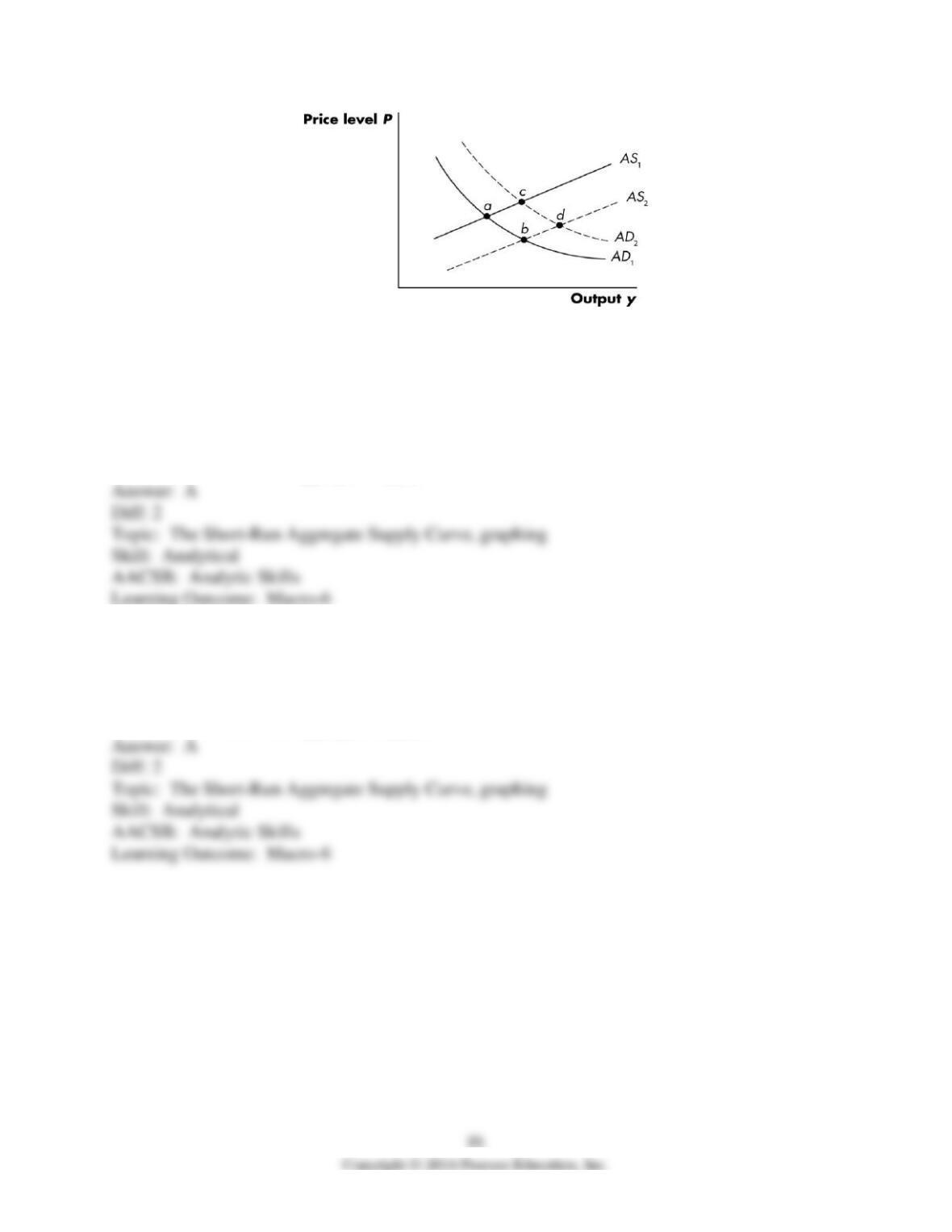
Figure 14.2
16) Refer to Figure 14.2. A movement from point a to point c could be caused by a(n)
A) increase in government spending.
B) decrease in the price of oil.
C) increase in taxes.
D) increase in short-run aggregate supply.
17) Refer to Figure 14.2. A movement from point c to point a could be caused by a(n)
A) decrease in government spending.
B) increase in the price of oil.
C) decrease in taxes.
D) decrease in short-run aggregate supply.