Test Bank – Chapter 14 – The Statement of Cash Flows 14–21
60. The following information was taken from the records of Albert’s Fine Coffee:
2017
2016
Machinery
$90,000
$40,000
Accumulated depreciation
(30,000)
(20,000)
Depreciation expense
14,000
12,000
Gain on sale of machinery
4,000
1,000
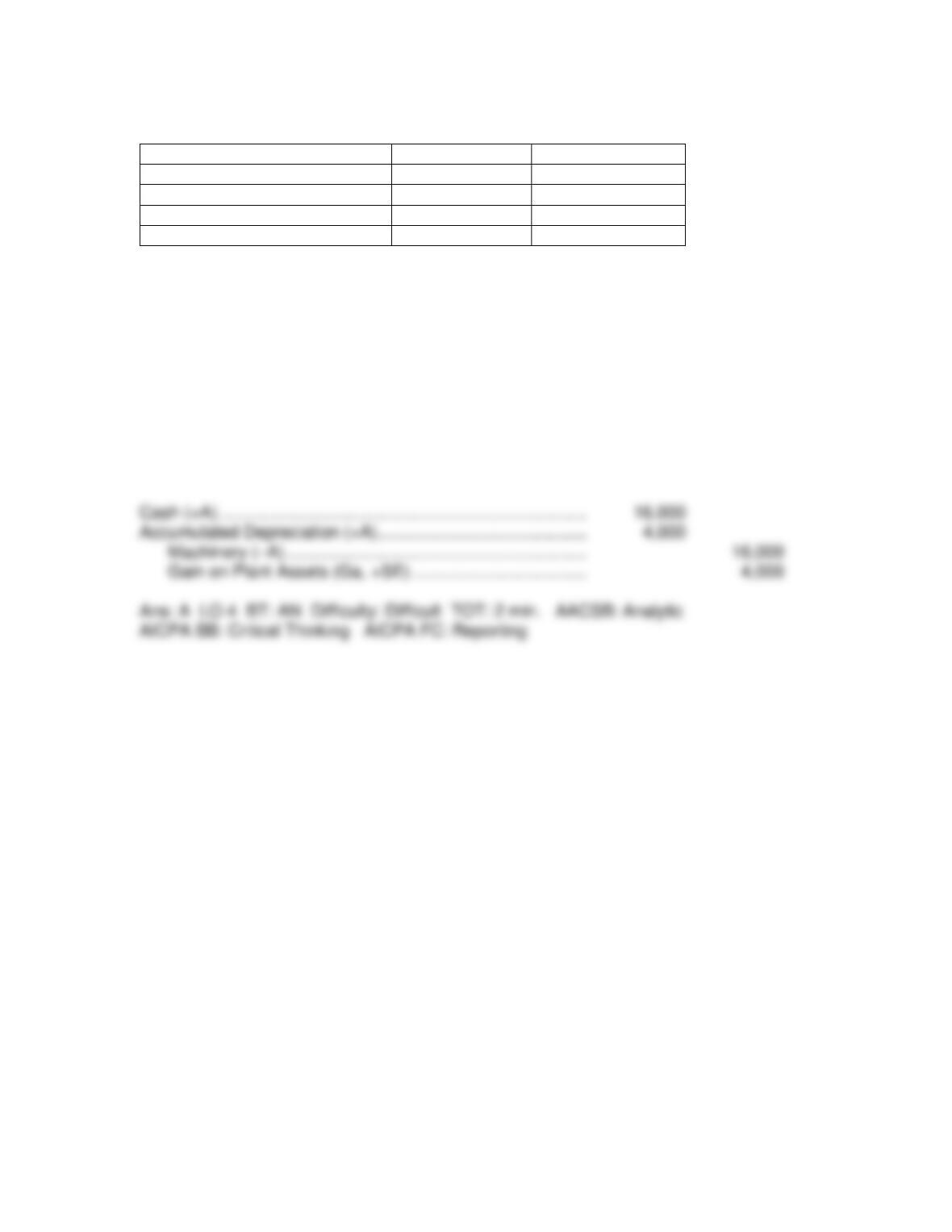
During 2017, machinery with a cost of $16,000 was sold.
The journal entry to record the sale of the machinery would include:
a. a debit to Accumulated Depreciation of $4,000.
b. a debit to Cash of $2,000.
c. a debit to Machinery for $16,000.
d. a credit to Gain on Plant Assets for $3,000.
Solution:
14–22 Test Bank – Chapter 14 – The Statement of Cash Flows
61. The following year-end totals were taken from the records of Langston Company.
2017
2016
Prepaid insurance
$8,000
$5,200
Wages payable
7,000
0
Insurance expense
4,000
5,700
Wage expense
9,500
4,000
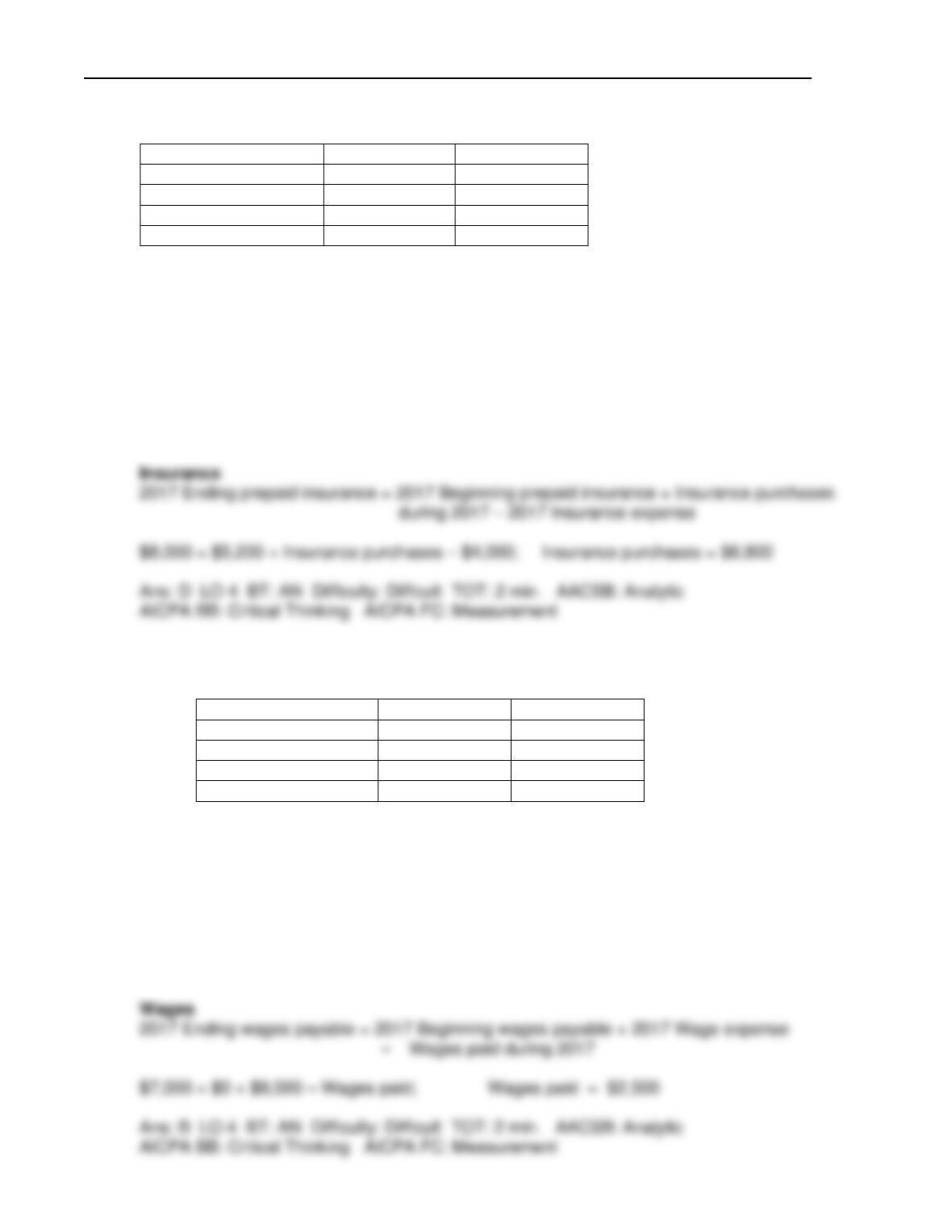
What is the amount of cash outflow associated with insurance during 2017?
a. $4,000
b. $2,800
c. $1,700
d. $6,800
Solution:
62. The following year-end totals were taken from the records of Langston Company.
2017
2016
Prepaid insurance
$8,000
$5,200
Wages payable
7,000
0
Insurance expense
4,000
5,700
Wage expense
9,500
4,000
What is the amount of cash outflow associated with wages during 2017?
a. $9,500
b. $2,500
c. $5,500
d. $7,000
Solution:
Test Bank – Chapter 14 – The Statement of Cash Flows 14–23
MATCHING QUESTIONS
1. For each transaction provided in items 1 through 12, select the proper section of the statement
of cash flows (direct method) in which it should be reported from the reporting categories
provided below.
Reporting Categories
A. Cash provided/used by financing activities
B Cash provided/used by investing activities
C. Cash provided/used by operating activities
D. Disclosed in notes
1. Principal payment on long-term note payable
2. Customers paid cash for inventory items
3. Cash dividends paid to stockholders
4. Issuance of stock for more than its par value
5. Payment of employees’ salaries
6. Issuance of common stock for cash
7. Payment of income taxes
8. Issuance of bonds at a premium
9. Sale of available-for-sale securities (long-term)
10. Purchase of equipment
11. Purchase of treasury stock
12. Sale of long-term investment
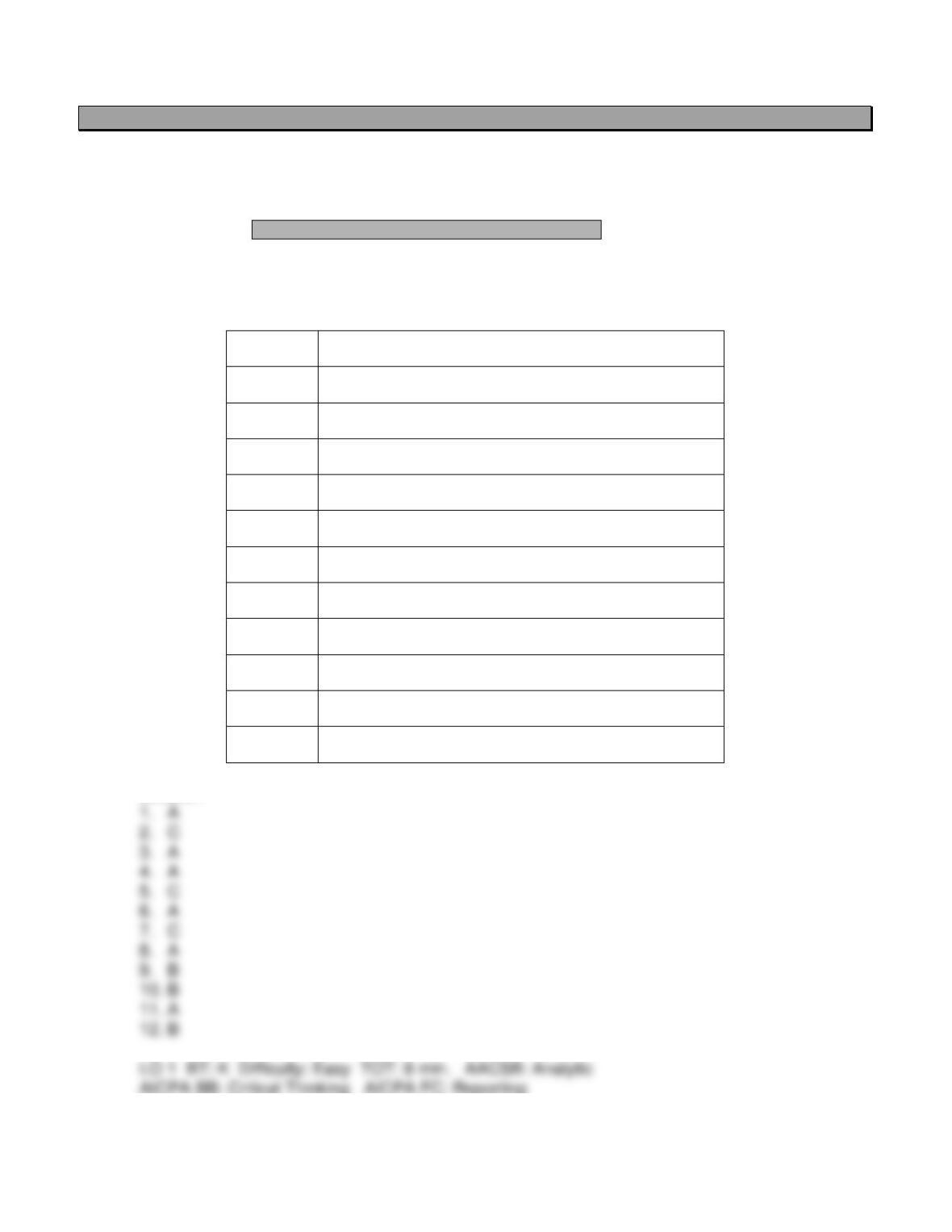
Solution:
14–24 Test Bank – Chapter 14 – The Statement of Cash Flows
2. For each transaction provided in items 1 through 5, select the proper section of the statement of
cash flows in which it should be reported using the indirect method from the reporting categories
provided in a through h below. If the item is not required to be reported on the statement of cash
flows, place an ‘X’ in the space provided.
Reporting Categories
a. Cash flows from operating activities—will be added to net income
b. Cash flows from operating activities—will be subtracted from net income
c. Cash flows from investing activities—increase as a result of cash inflows
d. Cash flows from investing activities—decrease as a result of cash outflows
e. Cash flows from financing activities—increase as a result of cash inflows
f. Cash flows from financing activities—decrease as a result of cash outflows
g. Disclosed as a non-cash transaction in the notes
h. Appears in operating activities only under the direct method
1. Increase in unearned revenue
2. Payment of cash dividends
3. Increase in income taxes payable
4. Issuance of common stock to acquire land
5. Increase in accounts receivable
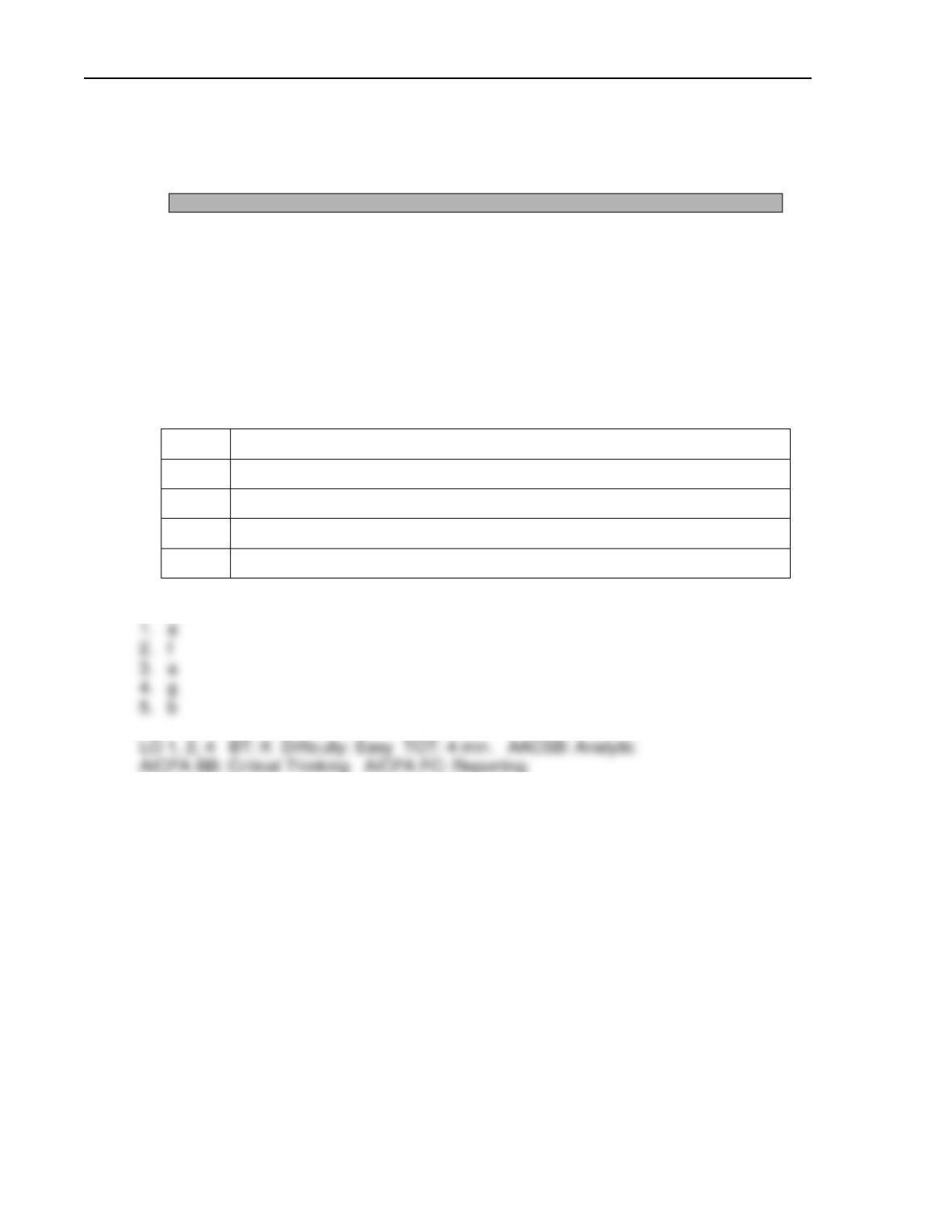
Solution:
Test Bank – Chapter 14 – The Statement of Cash Flows 14–25
3. For each transaction provided in items 1 through 5, select the proper section of the statement of
cash flows in which it should be reported using the indirect method from the reporting categories
provided in a through h below. If the item is not required to be reported on the statement of cash
flows, place an ‘X’ in the space provided.
Reporting Categories
a. Cash flows from operating activities—will be added to net income
b. Cash flows from operating activities—will be subtracted from net income
c. Cash flows from investing activities—increase as a result of cash inflows
d. Cash flows from investing activities—decrease as a result of cash outflows
e. Cash flows from financing activities—increase as a result of cash inflows
f. Cash flows from financing activities—decrease as a result of cash outflows
g. Disclosed as a non-cash transaction in the notes
h. Appears in operating activities only under the direct method
1. Retired long-term debt before its maturity date
2. Decrease in income taxes payable
3. Recognized loss on the sale of equipment
4. Declared cash dividends
5. Amortization of patent
Solution:
14–26 Test Bank – Chapter 14 – The Statement of Cash Flows
4. For each transaction provided in items 1 through 7, select the proper section of the statement of
cash flows in which it should be reported using the indirect method from the reporting categories
provided in a through h below.
Reporting Categories
a. Cash flows from operating activities—will be added to net income
b. Cash flows from operating activities—will be subtracted from net income
c. Cash flows from investing activities—increase as a result of cash inflows
d. Cash flows from investing activities—decrease as a result of cash outflows
e. Cash flows from financing activities—increase as a result of cash inflows
f. Cash flows from financing activities—decrease as a result of cash outflows
g. Disclosed as a non-cash transaction in the notes
h. Cash flows are already included in net income – not necessary to
separately report on statement of cash flows
1. Loss on sale of old equipment
2. Issuance of stock to pay off bonds payable
3. Recorded amortization on intangible assets
4. Sold trading investments at book value (no gain or loss)
5. Paid salaries expense for the current period
6. Decrease in salaries payable
7. Acquired machinery by issuing bonds payable
SHORT PROBLEMS
1. Accrued wages payable on December 31, 2016 and 2017 are $9,000 and $4,000, respectively.
During 2017, wages expense is $36,000. Calculate the amount of cash paid for wages during
2017.
Test Bank – Chapter 14 – The Statement of Cash Flows 14–27
2. Graham, Inc. experienced the following changes in its cash balance during the current calendar
year:
Increases in Cash:
From customers
$6,000
Sale of investments
3,100
Collection of interest
800
Issue of common stock
3,000
Decreases in Cash:
Payment to suppliers
$3,000
Wages
1,000
Purchase of building
3,000
Payment of interest
400
Retirement of long-term debt
600
Payment of dividends
500
Payment of salespersons’ commissions
200
Prepare, in good form, a cash flow statement for the current year.
3. Beginning and ending balances for relevant balance sheet accounts are as follows:
12/31/17
1/01/17
Merchandise inventory
$32,000
$21,000
Accounts payable
15,000
8,000
During 2017, cost of goods sold was $102,000. Calculate the amount of cash paid to suppliers
of merchandise inventory.
14–28 Test Bank – Chapter 14 – The Statement of Cash Flows
4. The following is the cash ledger account for Jensen Corp. for 2017.
CASH
Balance 1/02/17
15,000
Interest payments
4,000
Receivable collections
26,000
Fixed asset purchases
56,000
Cash sales
59,000
Wages
12,000
Sale of land
48,000
Dividend payments
7,000
Issuance of com. stock
31,000
Accounts payable payments
36,000
Interest collections
3,000
Using the information above, complete the following cash flow statement.
Cash provided by operations:
Amounts
Add:
Less:
Cash inflows (outflows) from operations
Cash flows from investing activities:
Cash flows from financing activities:
Net increase (decrease) cash
Cash provided by operations:
Add:
From customers
Less: Interest payments
Wages paid
(12,000)
Payment on accounts payable
(36,000)
(52,000)
Cash inflows (outflows) from operations
$36,000
Cash flows from investing activities:
Sale of land
Fixed asset purchase
(56,000)
Cash flows from financing activities:
Issuance of stock
Dividend payment
Net increase in cash
$52,000
Test Bank – Chapter 14 – The Statement of Cash Flows 14–29
5. Richards Inc. presented its comparative financial data and other data as follows:
Dec. 31, 2017
Dec. 31, 2016
Cash
$ 16,000
$ 9,000
Accounts receivable
22,000
16,000
Prepaid expenses
3,800
3,000
Investment in stock (no fair value)
8,000
21,000
Building and equipment
103,200
80,000
Accumulated depreciation
(60,000)
(51,000)
$ 93,000
$ 78,000
Accounts payable
$ 9,000
$ 6,000
Notes payable (used for operations)
6,000
8,000
Accrued expenses
13,000
7,000
Mortgage payable
25,000
31,000
Common stock
9,000
5,000
Additional paid-in capital
21,000
16,000
Retained earnings
10,000
5,000
$ 93,000
$78,000
Additional information:
1. Equipment was purchased for $43,200 and was paid in cash. Other equipment was sold
at a $3,000 gain and was 50% depreciated at the time of sale.
2. During 2017, Richards Inc. declared and paid cash dividends.
3. Part of the investment in the stock portfolio was sold at book value. The stock is closely–
held so no fair value adjustments were made.
4. Net income was $49,000.
Prepare a statement of cash flows (indirect method) for 2017. Omit the heading.
Net income
Increase in accounts receivable
Increase in prepaid expenses
Increase in accounts payable
Decrease in short-term operating loan
Increase in accrued expenses
Payments on mortgage
Sale of common stock
Net increase in cash flows
14–30 Test Bank – Chapter 14 – The Statement of Cash Flows
6. The comparative balance sheets of Shad Inc. contain prepaid insurance of $48,000 on January
1, 2017 and $37,000 on December 31, 2017. Shad’s 2017 income statement contains insurance
expense of $15,000. Calculate the amount of cash paid for insurance premiums during 2017.
7. Beginning and ending balances for relevant balance sheet accounts are as follows:
12/31/17
1/01/17
Merchandise inventory
$32,000
$18,000
Accounts payable
13,000
20,000
During 2017, cost of goods sold was $148,000. Calculate the amount of cash paid to suppliers
of merchandise inventory.
8. List two distinct examples of investing activities and two distinct examples of financing activities.
Test Bank – Chapter 14 – The Statement of Cash Flows 14–31
9. The accounts receivable balances on January 1 and December 31 are $22,000 and $18,000,
respectively. The income statement for the year included sales revenue of $120,000. Determine
the amount of cash collected from customers during the year.
10. Selected information from Thompson Corporation is provided below for the years ending
December 31, 2017 and 2016.
2017
2016
Accumulated depreciation
$41,000
$35,000
Accounts payable
39,000
25,000
Equipment
55,000
49,000
During 2017 depreciation expense was recorded. New equipment was acquired for cash. Old
equipment which was 60% depreciated with an original cost of $26,000 was sold for a loss of
$4,000. Prepare the investing activities section of the statement of cash flows.
11. Beginning and ending balances for selected accounts are as follows:
12/31/17
1/01/17
Accounts receivable
$14,000
$19,000
Revenue received in advance
6,000
3,000
During 2017, sales revenue is $110,000. Calculate the cash collected from customers.