75. Consolidated financial statements are typically prepared when one company has
76. Marley Company had the following portfolio of securities at the end of its first year of operations:
Year-End
Security
Classification
Cost
Market Value
A
Trading
$18,000
$23,000
B
Trading
$25,000
$27,000
(1)
Provide the entry necessary to adjust the portfolio of securities to market value.
(2)
After adjusting the securities to market, Marley elects to reclassify Security B as an available-for-sale security. On the date
of the transfer, Security B’s market value is $26,500. Provide the journal entry to reclassify Security B.
(1)
Market Adjustment—Trading Securities ……..
7,000
Unrealized Gain on Trading Securities ……
7,000
(2)
Investment in Available-for Sale Securities—Security B
26,500
Unrealized Loss on Transfer of Securities ….
Market Adjustment—Trading Securities ……
2,000
Investment in Trading Securities—Security B
25,000
77. What role does management intent play in the accounting treatment of marketable equity securities?
78. In 2013, Kentucky Inc. purchased stock as follows:
(a)
Acquired 2,000 shares of Gallen Corp. common stock (par value $20) in exchange for 1,200 shares of Kentucky Inc.
preferred stock (par value $30). The preferred stock had a market value of $75 per share on the date of the exchange.
(b)
Purchased 800 shares of Carlton Corp. common stock (par value $10) at $70 per share, plus a brokerage fee of $800.
At December 31, 2013, the market values of the securities were as follows:
Security
Market Value
Kentucky Inc. …………………………………..
$71
Gallen Corp. ……….………………….
41
Carlton Corp. ………..………………..…..
72
The investments in common stock are classified by Kentucky Inc. as available-for-sale securities accounted for by the cost method. The fiscal year of
Kentucky ends on December 31.
(1)
Prepare all entries relating to the investments in common stock for 2013.
(2)
Prepare the entry to record the sale of 200 shares of Carlton Corp. common stock on January 15, 2014, at $74 per share.
(3)
Prepare the entry to reclassify the remaining 600 shares of Carlton Corp. common stock from available-for-sale securities to
trading securities on January 31, 2014. The stock was selling at $67 per share on that date.
(1)
Available-for-Sale Securities—Gallen Corp.Stock (1,200 X $75)
90,000
Preferred Stock (1,200 X $30) …………..
36,000
Paid-In Capital in Excess of Par (1,200 X $45)
54,000
Available-for-Sale Securities—Carlton Corp.Stock [(800 X $70) + $800]
56,800
Cash
56,800
Market
Increase/
Security
Cost
Value
Decrease
Gallen Corp.
$ 90,000
$ 82,000
$(8,000) (2,000 X $41)
Carlton Corp.
56,800
57,600
800 (800 X $72)
$146,800
$139,600
$(7,200)
Market Adjustment-Available-for-Sale Securities
7,200
(2)
Cash (200 X $74) …………………….…
14,800
Realized Gain on Sale of Trading Securities [($74-$71) X 200]
600
Available-for-Sale Securities—Carlton Corp. Stock
14,200
(3)
Investment in Trading Securities—Carlton Corp. Stock (600 X $67)
40,200
Unrealized Increase/Decrease in Value of Available-for-Sale Sec-Equity
600
Unrealized Loss on Transfer of Securities—Income
2,400
79. Why would a firm choose to acquire less than 50 percent of an organization yet not desire to exercise
significant influence within the organization?
80. Assume that P uses the equity method of accounting for its investment in S. Solve for the unknown in each
of the following independent cases:
CASE A
CASE B
CASE C
P’s ownership of S
A
30%
40%
Investment in beginning of year
$100
B
$130
Investment in end of year
105
$128
C
S’s income (loss)
100
90
40
S’s dividends paid
80
30
20
25%
$110
$138
81. The Flavor Company owns 25 percent of the shares of Mac, and accounts for its investment using the equity
method. During the year Mac earned income of $1,500 million and declared dividends. Flavor’s share of the
dividends were $150.0 million.
Required:
a.
What amount of income did Flavor report from its investment in Mac?
b.
What amount of cash flow from operations did Flavor report for the year from its investment in Mac?
$375.0 million = .25 ´ $1,500 million
$150.0 million
82. Assume that P uses the equity method of accounting for its investment in S. Solve for the unknown in each
of the following independent cases:
CASE A
CASE B
CASE C
P’s ownership of S
40%
25%
40%
Investment in S—beginning of year
$100
$100
$130
Investment in S—end of year
$120
$150
$120
S’s income (loss)
A
300
C
S’s dividends paid
80
B
0
83. State the purpose of consolidated financial statements. Define which subsidiaries must be included in
consolidated financial statements.
$130
$100
$(25)
84. The Canada Corporation has been using the equity method for its 100-percent owned subsidiary, Trenton
Company, which has both assets and liabilities on its balance sheet and both revenues and expenses on its
income statement. Trenton has positive cash flow from operations. Canada now consolidates the accounts of the
Trenton Company, which it has owned 100 percent since organizing it. Trenton has no investments of its own
and regularly declares dividends greater than zero, but less than net income.
Required:
Answer the following questions with one of these: larger, smaller, unchanged, or insufficient (information given
to answer question).
a.
What would be the effect on net income of Canada Corporation?
b.
What would be the effect on revenues, including investment income, of Canada Corporation?
c.
What would be the effect on investments of Canada Corporation?
d.
What would be the effect on assets of Canada Corporation?
e.
What would be the effect on liabilities of Canada Corporation?
f.
What would be the effect on the debt/equity ratio (= Liabilities/Total Equities)?
a.
Unchanged
d.
Larger
Larger
e.
Larger
c.
Smaller
f.
Larger
85. The adjusted, preclosing trial balances of Pie Company and Soup Company on December 31, Year 2, appear
below.
Pie Company
Soup Company
$ 4,000
$ 1,000
Accounts Receivable
Merchandise Inventory
10,000
10,000
Investment in Soup Company
9,000
—
Land
l,000
2,000
Buildings and Equipment, net
5,000
Accounts Payable
$17,500
$12,500
Bonds Payable
5,000
4,000
Common Stock
2,500
1,000
Additional Paid-in Capital
1,000
2,500
Retained Earnings, January 1
10,500
2,000
Sales
35,000
25,000
Equity in Earnings of Soup Company
5,000
—
Cost of Goods Sold
25,000
17,500
Selling and Administrative Expenses
5,000
2,500
Dividends Declared
2,500
_______
1,500
Totals
$76,500
$76,500
$47,000
$47,000
Parent Company owns 100 percent of the common stock of Soup Company. It acquired the shares on January 2, Year 1, for an amount equal to the
book value of Soup Company’s underlying net assets. On December 31, Year 2, Soup Company owes Pie Company $1,100 arising from short-term
working capital loans.
Required:
Prepare in journal entry form the elimination entries required on December 31, Year 2, to prepare a consolidated financial statement for Pie Company
and Soup Company. Note that neither a formal work sheet nor formal financial statements are required.
Common Stock
1,000
Additional Paid-in Capital
2,500
Retained Earnings
2,000
Equity in Earnings of Soup Company
5,000
Dividends Declared
1,500
Investment in Soup Company
9,000
To eliminate the investment account.
Accounts Payable
1,100
Accounts Receivable
l,100
To eliminate intercompany loan.
86. Piu Co. owns 100% of Xu Co. Piu has owned Xu since Xu was incorporated. At December 31, $15,000 of
Xu’s accounts receivable represent amounts payable by Piu. $10,000 of Piu’s accounts receivable represent
amounts payable by Xu. During the current year, Xu sold $10,000 in merchandise to Piu (at cost its cost of
$10,000). Piu has sold all the merchandise purchased from Xu.
CONDENSED BALANCE SHEETS
As of December 31
Assets
Piu
Xu
Accounts receivable
$ 60,000
$ 40,000
Investment in Xu (equity)
130,000
–
Other assets
1,000,000
200,000
Total assets
$1,190,000
$240,000
Liabilities and Equity
Accounts payable
$ 50,000
$ 20,000
Other liabilities
640,000
90,000
Common stock
100,000
150,000
Retained earnings
400,000
(20,000)
Total liabilities and equity
$1,190,000
$240,000
CONDENSED INCOME STATEMENT
for Current Year
Piu
Xu
Sales
$300,000
$ 90,000
Equity in earnings of Xu
(10,000)
—
Total revenues
$290,000
$ 90,000
Cost of goods sold
$160,000
60,000
Depreciation
50,000
20,000
Other expenses
20,000
20,000
Tax expense
20,000
—
Total expenses
$250,000
$100,000
Net income
$ 40,000
$(10,000)
Required:
Prepare the appropriate elimination entries necessary to prepare a consolidated balance sheet and income statement.
Common Stock—Xu
150,000
Retained Earnings—Xu (1/1)
10,000
Equity in Earnings of Xu
10,000
Investment in Xu
130,000
Accounts Payable
25,000
Accounts Receivable
25,000
Sales
10,000
87. On January 1, Year 1, Plano Co. purchased for $180,000, 90% of Santa Fe Co. at a time when Santa Fe had
a book value of $200,000. There were no intercompany transactions during year 4.
CONDENSED BALANCE SHEETS
As of December 31, Year 4
Assets
Plano
Santa Fe
Accounts receivable
$ 50,000
$ 40,000
Investment in Santa Fe (equity)
270,000
–
Other assets
1,680,000
710,000
Total assets
$2,000,000
$750,000
Liabilities and Equity
Accounts payable
$ 40,000
$ 50,000
Other liabilities
1,360,000
400,000
Common stock
200,000
200,000
Retained earnings
400,000
100,000
Total liabilities and equity
$2,000,000
$750,000
CONDENSED INCOME STATEMENT
for Current Year
Plano
Santa Fe
Sales
$800,000
$200,000
Equity in earnings of Santa Fe
18,000
–
Total revenues
$818,000
$200,000
Cost of goods sold
500,000
$120,000
Depreciation
100,000
30,000
Other expenses
78,000
20,000
Tax expense
40,000
10,000
Total expenses
$718,000
$180,000
Net income
$100,000
$ 20,000
Required:
Prepare the appropriate elimination and reclassification entries necessary to prepare a consolidated balance sheet and income statement.
Common Stock-Santa Fe
180,000
Retained Earnings—Santa Fe (1/1)
72,000
Equity in Earnings of Santa Fe
18,000
Investment in Santa Fe
270,000
Common Stock-Santa Fe
20,000
Retained Earnings—Santa Fe (1/1)
8,000
Minority Equity in Earnings
2,000
Minority Interest in Net Assets of Santa Fe
30,000

88. Given the following separate company balance sheets and income statements, answer the following
questions.
CONDENSED BALANCE SHEETS
As of December 31, Year 4
Assets
Plea
Settle
Accounts receivable
$ 50,000
$ 40,000
Investment in Settle (equity)
300,000
–
Other assets
1,680,000
710,000
Total assets
$2,030,000
$750,000
Liabilities and Equity
Accounts payable
$ 70,000
$ 50,000
Other liabilities
1,360,000
400,000
Common stock
200,000
200,000
Retained earnings
400,000
100,000
Total liabilities and equity
$2,030,000
$750,000
CONDENSED INCOME STATEMENT
for the year ended December 31, Year 4
Plea
Settle
Sales
$800,000
$200,000
Equity in earnings of Settle
20,000
–
Total revenues
$820,000
$200,000
Cost of goods sold
$500,000
$120,000
Depreciation
100,000
30,000
Other expenses
80,000
20,000
Tax expense
40,000
10,000
Total expenses
$720,000
$180,000
Net income
$100,000
$ 20,000
Additional information:
Plea acquired its investment in the stock of Settle on the date of Settle’s incorporation.
Consolidated accounts receivable is $80,000.
Consolidated sales total $900,000.
No purchases from Settle remain in Plea’s ending inventory.
Required:
a.
What percentage of Settle does Plea appear to own?
b.
What is beginning retained earnings of Plea?
c.
How much was Plea’s initial investment in Settle?
d.
What is the amount of intercompany accounts receivable?
e.
What is consolidated cost of goods sold?
a.
100%
b.
$300,000
c.
$200,000
d.
$ 10,000
e.
$520,000
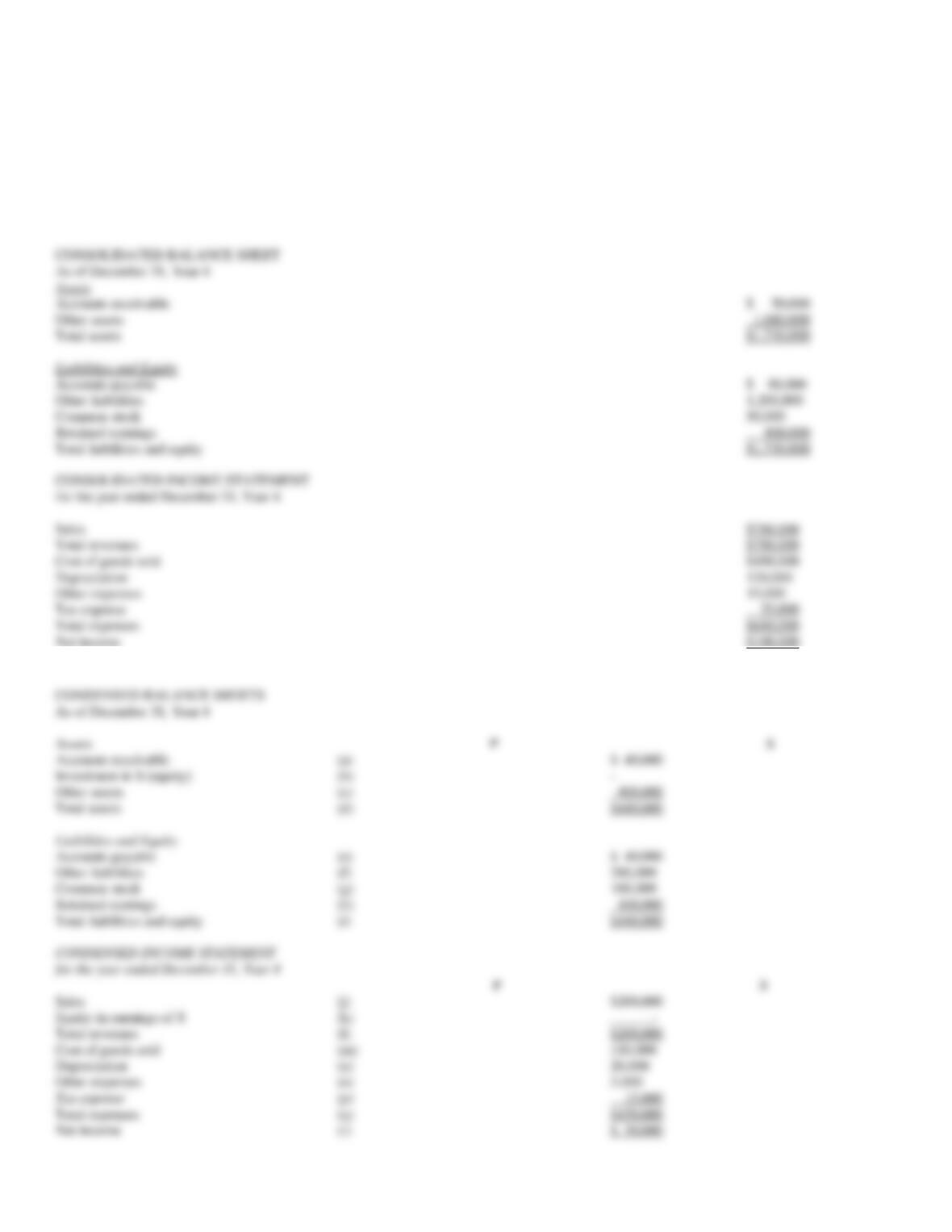
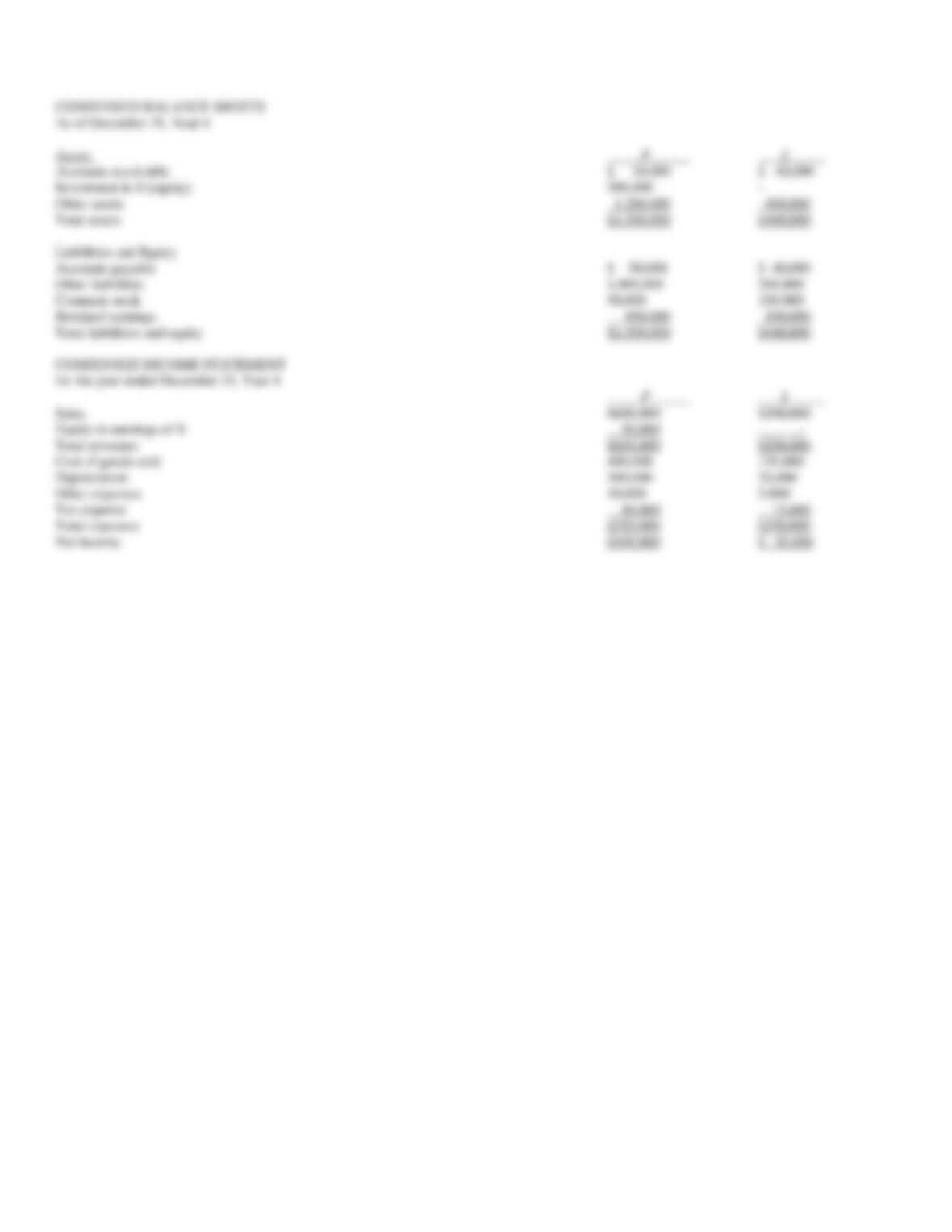
89. Given the following consolidated balance sheet and additional information, prepare a separate company
balance sheet and income statement for P.
–
P owns 100% of S.
–
S sold $20,000 of inventory to P.
–
P sold all of the inventory it purchased from S.
–
$10,000 of S’s accounts receivable are payable by P.
Assets
Accounts receivable
(a)
$ 40,000
Investment in S (equity)
(b)
–
Other assets
(c)
400,000
Total assets
(d)
$440,000
Accounts payable
(e)
$ 40,000
Other liabilities
200,000
Common stock
(g)
100,000
Total liabilities and equity
(i)
$440,000
Sales
(j)
$200,000
Equity in earnings of S
(k)
Total revenues
(l)
$200,000
Cost of goods sold
(m)
110,000
Depreciation
(n)
20,000
Accounts receivable
$ 50,000
Other assets
1,680,000
Total assets
$1,730,000
Other liabilities
1,200,000
Common stock
50,000
Retained earnings
400,000
Total liabilities and equity
$1,730,000
Sales
$780,000
Total revenues
$780,000
Cost of goods sold
$490,000
Depreciation
120,000
Other expenses
15,000
Tax expense
55,000
Total expenses
$680,000
Net income
$100,000
90. Large, global enterprises typically have an equity interest in other entities throughout the world. Some of the
interests represent wholly-owned (100%-owned) subsidiaries, while others represent lesser percentages of
ownership. These large global conglomerates provide information on the percentage ownership of their various
affiliated companies in the notes to the consolidated financial statements.
The following list of companies represents the ownership percentage of selected companies by a large global
company:
Company A
50% plus
one share
Company B
100%
Company C
68%
Company D
50%
Company E
23.8%
Company F
20%
Required:
Explain how you would expect the global company holding the indicated interests to account for each of the companies listed above, based on the
percentage ownership reported.
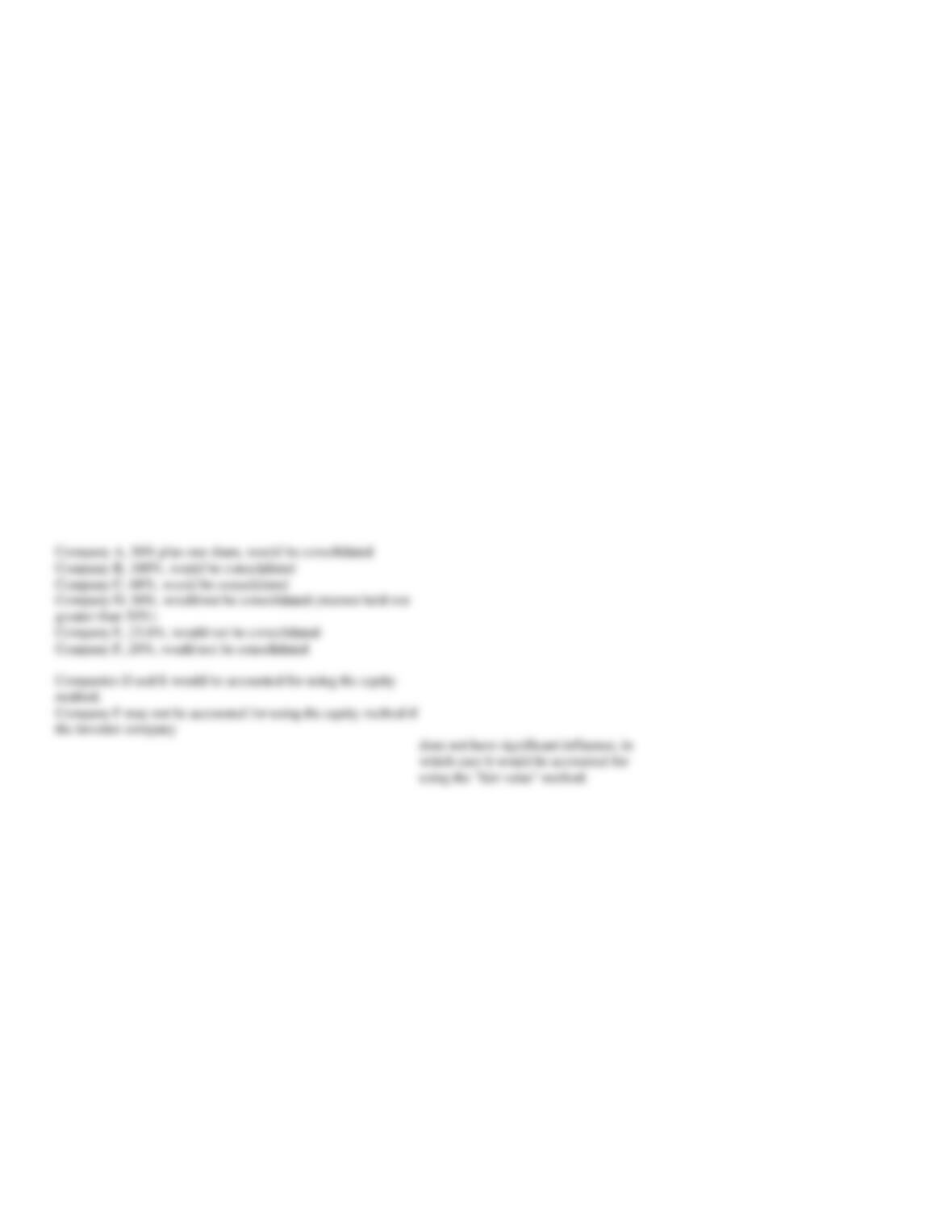
Company A, 50% plus one share, would be consolidated
Company B, 100%, would be consolidated
Company C, 68%, would be consolidated
Company E, 23.8%, would not be consolidated
Company F, 20%, would not be consolidated
Company F may not be accounted for using the equity method if
the investor company
using the “fair value” method.