
Long-Term Liabilities
14 – 21
83. On January 1, Martinez Inc. issued $5,000,000, 11% bonds for $5,325,000. The market
rate of interest for these bonds is 10%. Interest is payable annually on December 31.
Martinez uses the effective-interest method of amortizing bond premium. At the end of the
first year, Martinez should report unamortized bond premium of:
a. $308,550
b. $307,500
c. $289,250
d. $275,000
84. At the beginning of 2014, Winston Corporation issued 10% bonds with a face value of
$2,000,000. These bonds mature in five years, and interest is paid semiannually on June
30 and December 31. The bonds were sold for $1,852,800 to yield 12%. Winston uses a
calendar-year reporting period. Using the effective-interest method of amortization, what
amount of interest expense should be reported for 2014? (Round your answer to the
nearest dollar.)
a. $221,667
b. $222,333
c. $223,006
d. $229,440
85. Kant Corporation retires its $300,000 face value bonds at 102 on January 1, following the
payment of interest. The carrying value of the bonds at the redemption date is $288,750.
The entry to record the redemption will include a
a. credit of $11,250 to Loss on Bond Redemption.
b. credit of $11,250 to Discount on Bonds Payable.
c. debit of $17,250 to Gain on Bond Redemption.
d. debit of $16,000 to Premium on Bonds Payable.
86. Carr Corporation retires its $300,000 face value bonds at 105 on January 1, following the
payment of interest. The carrying value of the bonds at the redemption date is $311,235.
The entry to record the redemption will include a
a. credit of $11,235 to Loss on Bond Redemption.
b. debit of $11,235 to Premium on Bonds Payable.
c. credit of $3,765 to Gain on Bond Redemption.
d. debit of $15,000 to Premium on Bonds Payable.
87. At December 31, 2014 the following balances existed on the books of Foxworth
Corporation:
Bonds Payable $4,000,000
Discount on Bonds Payable 320,000
Interest Payable 100,000
Unamortized Bond Issue Costs 240,000
If the bonds are retired on January 1, 2015, at 102, what will Foxworth report as a loss on
redemption?
a. $740,000
b. $640,000
c. $540,000
d. $400,000

Test Bank for Intermediate Accounting, Fifteenth Edition
14 – 22
88. At December 31, 2014 the following balances existed on the books of Rentro Corporation:
Bonds Payable $3,500,000
Discount on Bonds Payable 280,000
Interest Payable 84,000
Unamortized Bond Issue Costs 210,000
If the bonds are retired on January 1, 2015, at 102, what will Rentro report as a loss on
redemption?
a. $350,000
b. $472,500
c. $560,000
d. $644,000
89. The December 31, 2014, balance sheet of Hess Corporation includes the following items:
9% bonds payable due December 31, 2023 $3,000,000
Unamortized premium on bonds payable 81,000
The bonds were issued on December 31, 2013, at 103, with interest payable on July 1
and December 31 of each year. Hess uses straight-line amortization. On March 1, 2015,
Hess retired $1,200,000 of these bonds at 98 plus accrued interest. What should Hess
record as a gain on retirement of these bonds? Ignore taxes.
a. $56,400.
b. $32,400.
c. $55,800.
d. $60,000.
90. On January 1, 2008, Hernandez Corporation issued $9,000,000 of 10% ten-year bonds at
103. The bonds are callable at the option of Hernandez at 105. Hernandez has recorded
amortization of the bond premium on the straight-line method (which was not materially
different from the effective-interest method).
On December 31, 2014, when the fair value of the bonds was 96, Hernandez repurchased
$2,000,000 of the bonds in the open market at 96. Hernandez has recorded interest and
amortization for 2014. Ignoring income taxes and assuming that the gain is material,
Hernandez should report this reacquisition as
a. a loss of $98,000.
b. a gain of $98,000.
c. a loss of $122,000.
d. a gain of $122,000.
91. The 10% bonds payable of Nixon Company had a net carrying amount of $950,000 on
December 31, 2014. The bonds, which had a face value of $1,000,000, were issued at a
discount to yield 12%. The amortization of the bond discount was recorded under the
effective-interest method. Interest was paid on January 1 and July 1 of each year. On
July 2, 2015, several years before their maturity, Nixon retired the bonds at 102. The
interest payment on July 1, 2015 was made as scheduled. What is the loss that Nixon
should record on the early retirement of the bonds on July 2, 2015? Ignore taxes.
a. $20,000.
b. $63,000.
c. $56,000.
d. $70,000.

Long-Term Liabilities
14 – 23
92. A corporation called an outstanding bond obligation four years before maturity. At that
time there was an unamortized discount of $750,000. To extinguish this debt, the
company had to pay a call premium of $250,000. Ignoring income tax considerations, how
should these amounts be treated for accounting purposes?
a. Amortize $1,000,000 over four years.
b. Charge $1,000,000 to a loss in the year of extinguishment.
c. Charge $250,000 to a loss in the year of extinguishment and amortize $750,000 over
four years.
d. Either amortize $1,000,000 over four years or charge $1,000,000 to a loss
immediately, whichever management selects.
93. The 12% bonds payable of Nyman Co. had a carrying amount of $3,120,000 on
December 31, 2014. The bonds, which had a face value of $3,000,000, were issued at a
premium to yield 10%. Nyman uses the effective-interest method of amortization. Interest is
paid on June 30 and December 31. On June 30, 2015, several years before their maturity,
Nyman retired the bonds at 104 plus accrued interest. The loss on retirement, ignoring
taxes, is
a. $0.
b. $24,000.
c. $37,200.
d. $120,000.
94. Didde Company issues $20,000,000 face value of bonds at 96 on January 1, 2013. The
bonds are dated January 1, 2013, pay interest semiannually at 8% on June 30 and
December 31, and mature in 10 years. Straight-line amortization is used for discounts and
premiums. On September 1, 2016, $12,000,000 of the bonds are called at 102 plus
accrued interest. What gain or loss would be recognized on the called bonds on
September 1, 2016?
a. $1,200,000 loss
b. $544,000 loss
c. $720,000 loss
d. $907,000 loss
95. Cortez Company issues $4,000,000 face value of bonds at 96 on January 1, 2013. The
bonds are dated January 1, 2013, pay interest semiannually at 8% on June 30 and
December 31, and mature in 10 years. Straight-line amortization is used for discounts and
premiums. On September 1, 2016, $2,400,000 of the bonds are called at 102 plus
accrued interest. What gain or loss would be recognized on the called bonds on
September 1, 2016?
a. $240,000 loss
b. $108,800 loss
c. $144,000 loss
d. $181,000 loss

Test Bank for Intermediate Accounting, Fifteenth Edition
14 – 24
96. On January 1, 2014, Ann Price loaned $112,695 to Joe Kiger. A zero-interest-bearing
note (face amount, $150,000) was exchanged solely for cash; no other rights or privileges
were exchanged. The note is to be repaid on December 31, 2016. The prevailing rate of
interest for a loan of this type is 10%. The present value of $150,000 at 10% for three
years is $112,695. What amount of interest income should Ms. Price recognize in 2014?
a. $11,270.
b. $15,000.
c. $45,000.
d. $33,810.
97. On January 1, 2014, Jacobs Company sold property to Dains Company which originally
cost Jacobs $1,330,000. There was no established exchange price for this property. Danis
gave Jacobs a $2,100,000 zero-interest-bearing note payable in three equal annual
installments of $700,000 with the first payment due December 31, 2014. The note has no
ready market. The prevailing rate of interest for a note of this type is 10%. The present
value of a $2,100,000 note payable in three equal annual installments of $700,000 at a
10% rate of interest is $1,740,900. What is the amount of interest income that should be
recognized by Jacobs in 2014, using the effective-interest method?
a. $0.
b. $70,000.
c. $174,090.
d. $210,000.
98. On January 1, 2014, Crown Company sold property to Leary Company. There was no
established exchange price for the property, and Leary gave Crown a $4,000,000 zero-
interest-bearing note payable in 5 equal annual installments of $800,000, with the first
payment due December 31, 2014. The prevailing rate of interest for a note of this type is
9%. The present value of the note at 9% was $2,884,000 at January 1, 2014. What should
be the balance of the Discount on Notes Payable account on the books of Leary at
December 31, 2014 after adjusting entries are made, assuming that the effective-interest
method is used?
a. $0
b. $856,440
c. $892,800
d. $1,116,000
99. Putnam Company’s 2014 financial statements contain the following selected data:
Income taxes $40,000
Interest expense 15,000
Net income 60,000
Putnam’s times interest earned for 2014 is
a. 4.0 times
b. 5.0 times.
c. 6.7 times.
d. 7.7 times.

Long-Term Liabilities
14 – 25
100. In the recent year Hill Corporation had net income of $210,000, interest expense of
$60,000, and tax expense of $90,000. What was Hill Corporation’s times interest earned
ratio for the year?
a. 6.0
b. 5.0
c. 4.5
d. 3.5
101. In recent year Cey Corporation had net income of $500,000, interest expense of
$100,000, and a times interest earned ratio of 9. What was Cey Corporation’s income
before taxes for the year?
a. $1,000,000
b. $900,000
c. $800,000
d. None of these answers are correct.
102. The adjusted trial balance for Lifesaver Corp. at the end of the current year, 2014,
contained the following accounts.
5-year Bonds Payable 8% $2,500,000
Interest Payable 50,000
Premium on Bonds Payable 100,000
Notes Payable (3 months.) 40,000
Notes Payable (5 yr.) 165,000
Mortgage Payable ($15,000 due currently) 200,000
Salaries and wages Payable 18,000
Income Taxes Payable (due 3/15 of 2015) 25,000
The total long-term liabilities reported on the balance sheet are
a. $2,865,000.
b. $2,850,000.
c. $2,965,000.
d. $2,950,000.
Use the following information for questions *103 through *105:
On December 31, 2012, Nolte Co. is in financial difficulty and cannot pay a note due that day. It is
a $1,800,000 note with $180,000 accrued interest payable to Piper, Inc. Piper agrees to accept
from Nolte equipment that has a fair value of $870,000, an original cost of $1,440,000, and
accumulated depreciation of $690,000. Piper also forgives the accrued interest, extends the
maturity date to December 31, 2015, reduces the face amount of the note to $750,000, and
reduces the interest rate to 6%, with interest payable at the end of each year.
*103. Nolte should recognize a gain or loss on the transfer of the equipment of
a. $0.
b. $120,000 gain.
c. $180,000 gain.
d. $570,000 loss.
Test Bank for Intermediate Accounting, Fifteenth Edition
14 – 26
*104. Nolte should recognize a gain on the partial settlement and restructure of the debt of
a. $0.
b. $45,000.
c. $165,000.
d. $225,000.
*105. Nolte should record interest expense for 2015 of
a. $0.
b. $45,000.
c. $90,000.
d. $135,000.
Multiple Choice Answers—Computational
Item
Ans.
Item
Ans.
Item
Ans.
Item
Ans.
Item
Ans.
Item
Ans.
Item
Ans.
MULTIPLE CHOICE—CPA Adapted
106. On July 1, 2014, Spear Co. issued 2,000 of its 10%, $1,000 bonds at 99 plus accrued
interest. The bonds are dated April 1, 2014 and mature on April 1, 2024. Interest is
payable semiannually on April 1 and October 1. What amount did Spear receive from the
bond issuance?
a. $2,030,000
b. $2,000,000
c. $1,980,000
d. $1,930,000
107. On January 1, 2014, Solis Co. issued its 10% bonds in the face amount of $6,000,000,
which mature on January 1, 2024. The bonds were issued for $6,810,000 to yield 8%,
resulting in bond premium of $810,000. Solis uses the effective-interest method of
amortizing bond premium. Interest is payable annually on December 31. At December 31,
2014, Solis’s adjusted unamortized bond premium should be
a. $810,000.
b. $754,800.
c. $729,000.
d. $609,000.

Long-Term Liabilities
14 – 27
108. On July 1, 2013, Noble, Inc. issued 9% bonds in the face amount of $8,000,000, which
mature on July 1, 2019. The bonds were issued for $7,648,000 to yield 10%, resulting in a
bond discount of $352,000. Noble uses the effective-interest method of amortizing bond
discount. Interest is payable annually on June 30. At June 30, 2015, Noble’s unamortized
bond discount should be
a. $257,920.
b. $272,000.
c. $281,600.
d. $248,000.
109. On January 1, 2014, Huff Co. sold $4,000,000 of its 10% bonds for $3,541,184 to yield
12%. Interest is payable semiannually on January 1 and July 1. What amount should Huff
report as interest expense for the six months ended June 30, 2014?
a. $177,064
b. $200,000
c. $212,471
d. $240,000
110. On January 1, 2015, Doty Co. redeemed its 15-year bonds of $5,000,000 par value for
102. They were originally issued on January 1, 2003 at 98 with a maturity date of
January 1, 2018. The bond issue costs relating to this transaction were $300,000. Doty
amortizes discounts, premiums, and bond issue costs using the straight-line method.
What amount of loss should Doty recognize on the redemption of these bonds (ignore
taxes)?
a. $180,000
b. $120,000
c. $100,000
d. $0
111. On its December 31, 2014 balance sheet, Emig Corp. reported bonds payable of
$3,000,000 and related unamortized bond issue costs of $160,000. The bonds had been
issued at par. On January 2, 2015, Emig retired $1,500,000 of the outstanding bonds at
par plus a call premium of $35,000. What amount should Emig report in its 2015 income
statement as loss on extinguishment of debt (ignore taxes)?
a. $0
b. $35,000
c. $80,000
d. $115,000
112. On January 1, 2010, Goll Corp. issued 2,000 of its 10%, $1,000 bonds for $2,080,000.
These bonds were to mature on January 1, 2020 but were callable at 101 any time after
December 31, 2013. Interest was payable semiannually on July 1 and January 1. On
July 1, 2015, Goll called all of the bonds and retired them. Bond premium was amortized
on a straight-line basis. Before income taxes, Goll’s gain or loss in 2015 on this early
extinguishment of debt was
a. $60,000 gain.
b. $24,000 gain.
c. $20,000 loss.
d. $16,000 gain.

Test Bank for Intermediate Accounting, Fifteenth Edition
14 – 28
113. On June 30, 2015, Omara Co. had outstanding 8%, $6,000,000 face amount, 15-year
bonds maturing on June 30, 2025. Interest is payable on June 30 and December 31. The
unamortized balances in the bond discount and deferred bond issue costs accounts on
June 30, 2015 were $210,000 and $60,000, respectively. On June 30, 2015, Omara
acquired all of these bonds at 94 and retired them. What net carrying amount should be
used in computing gain or loss on this early extinguishment of debt?
a. $5,940,000.
b. $5,790,000.
c. $5,730,000.
d. $5,640,000.
114. A ten-year bond was issued in 2013 at a discount with a call provision to retire the bonds.
When the bond issuer exercised the call provision on an interest date in 2015, the carrying
amount of the bond was less than the call price. The amount of bond liability removed
from the accounts in 2015 should have equaled the
a. call price.
b. call price less unamortized discount.
c. face amount less unamortized discount.
d. face amount plus unamortized discount.
115. Paige Co. took advantage of market conditions to refund debt. This was the fourth
refunding operation carried out by Paige within the last three years. The excess of the
carrying amount of the old debt over the amount paid to extinguish it should be reported
as a
a. gain, net of income taxes.
b. loss, net of income taxes.
c. part of continuing operations.
d. deferred credit to be amortized over the life of the new debt.
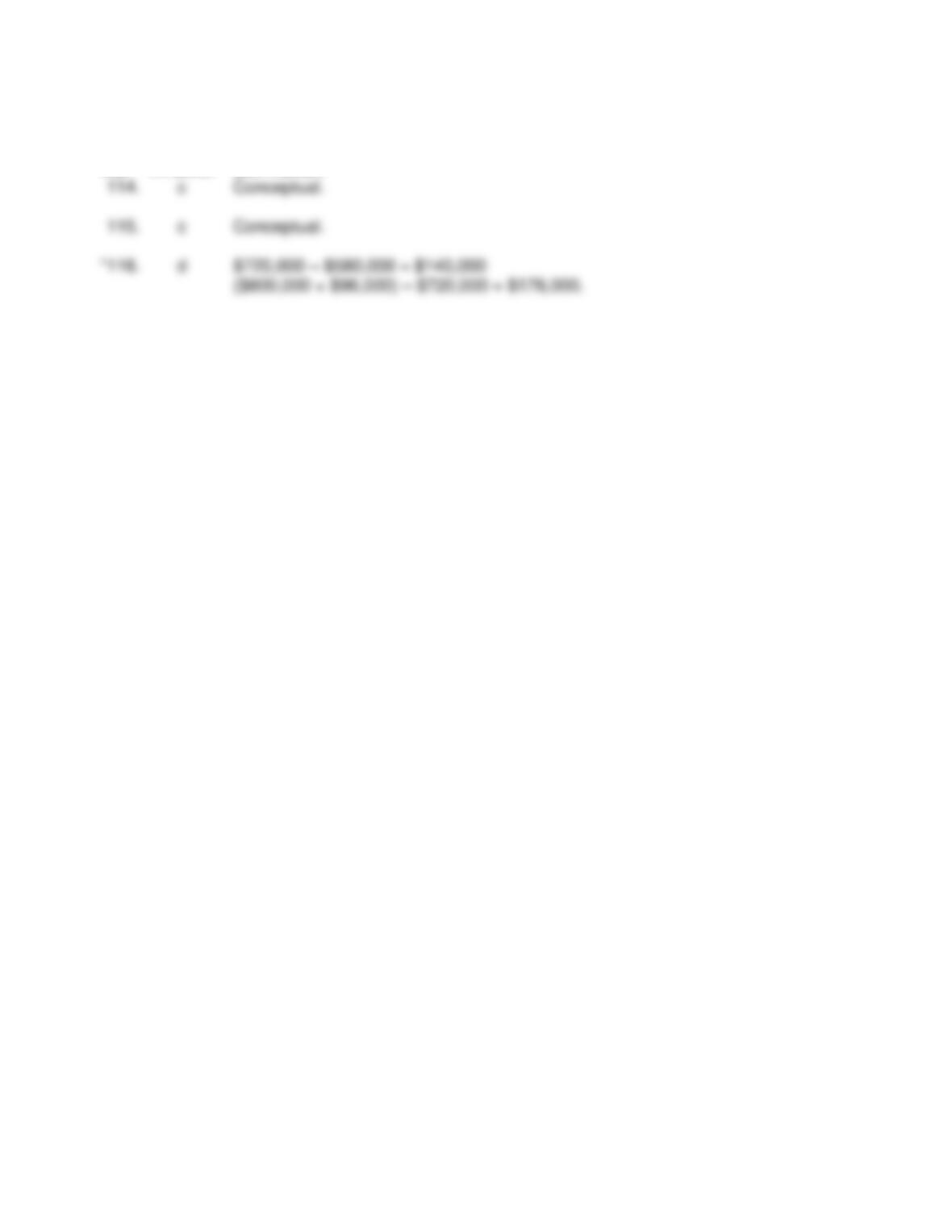
*116. Eddy Co. is indebted to Cole under a $800,000, 12%, three-year note dated
December 31, 2013. Because of Eddy’s financial difficulties developing in 2015, Eddy
owed accrued interest of $96,000 on the note at December 31, 2015. Under a troubled
debt restructuring, on December 31, 2015, Cole agreed to settle the note and accrued
interest for a tract of land having a fair value of $720,000. Eddy’s acquisition cost of the
land is $580,000. Ignoring income taxes, on its 2015 income statement Eddy should
report as a result of the troubled debt restructuring
Gain on Disposal Restructuring Gain
a. $316,000 $0
b. $220,000 $0
c. $140,000 $80,000
d. $140,000 $176,000
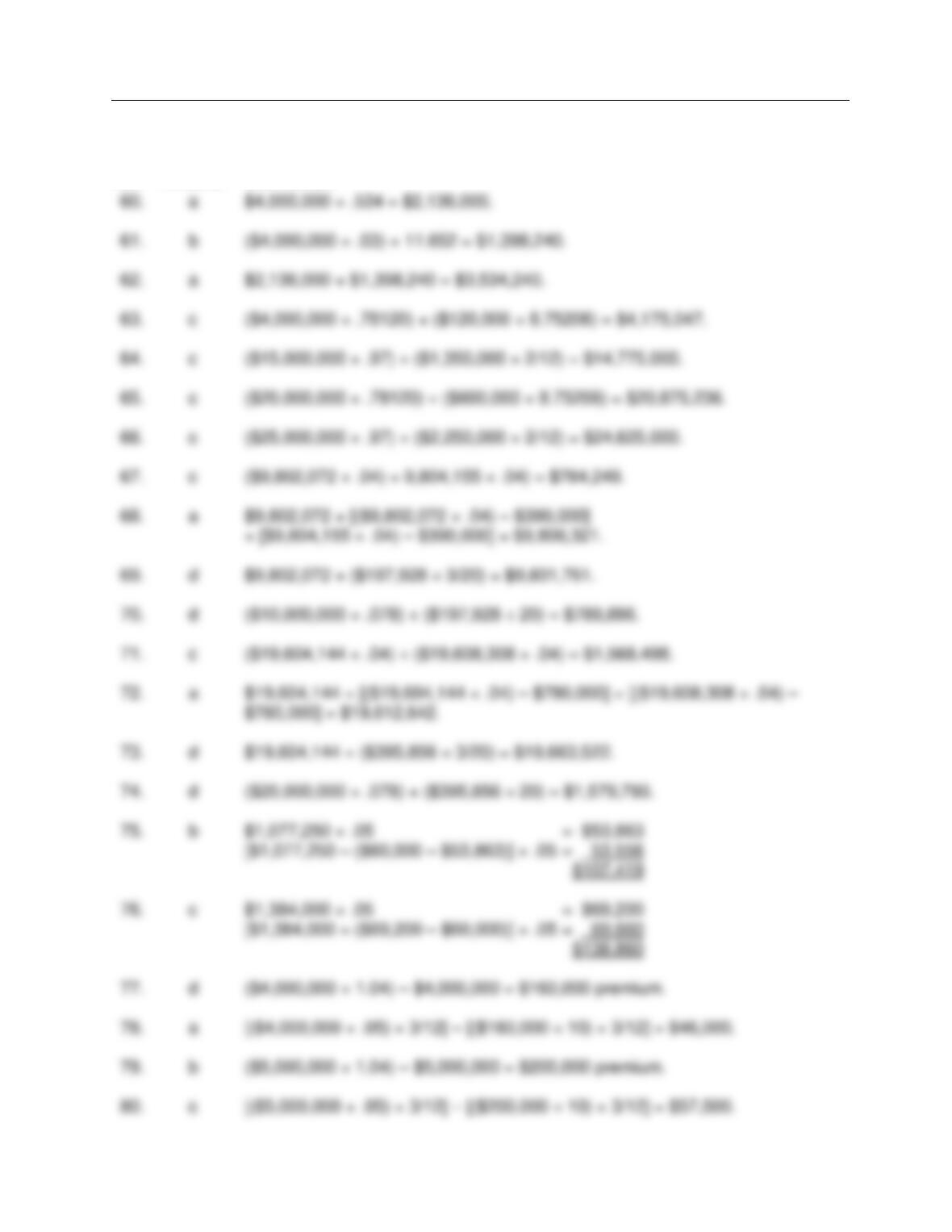
Multiple Choice Answers—CPA Adapted
Item
Ans.
Item
Ans.
Item
Ans.
Item
Ans.
Item
Ans.
Item
Ans.
Long-Term Liabilities
14 – 29
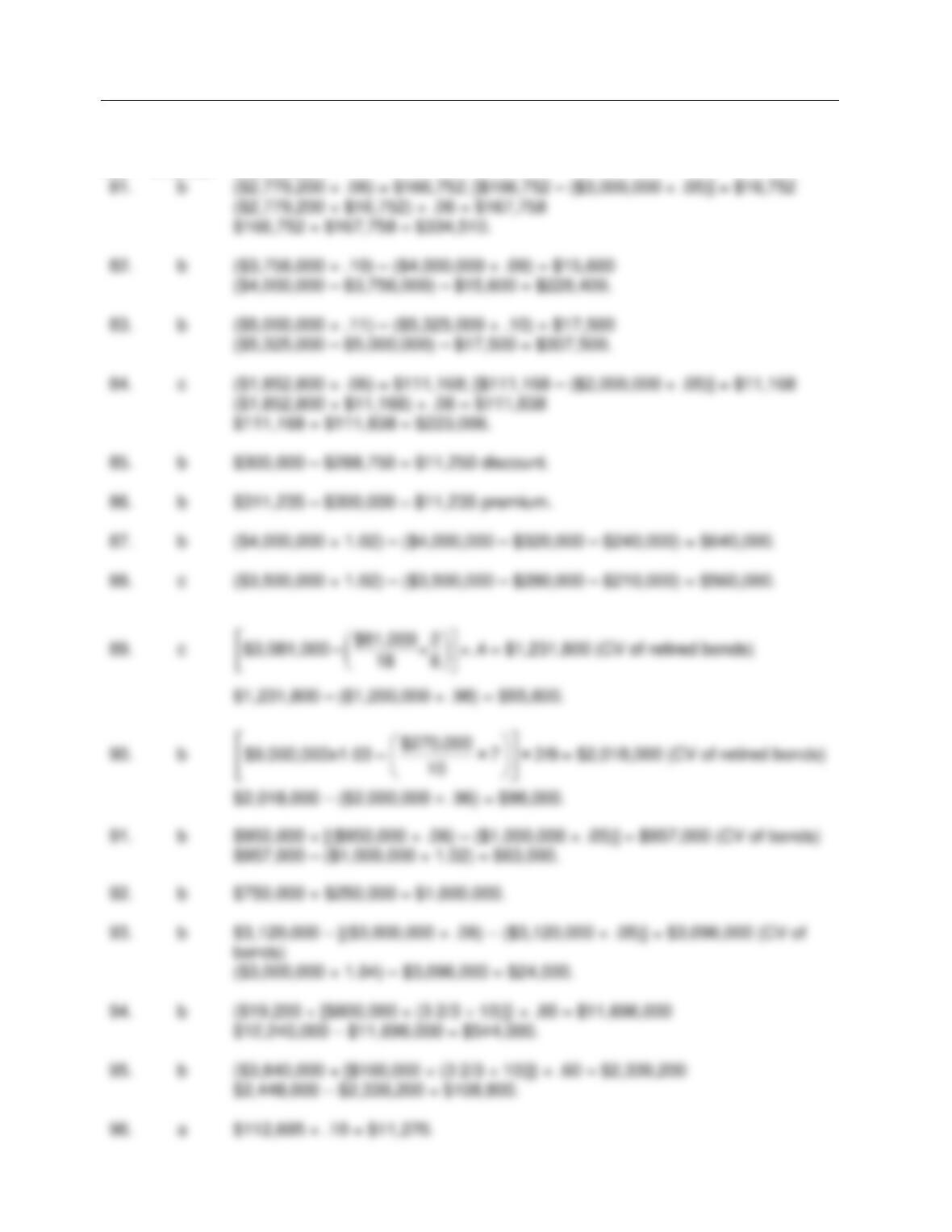
DERIVATIONS — Computational
No. Answer Derivation
Test Bank for Intermediate Accounting, Fifteenth Edition
14 – 30
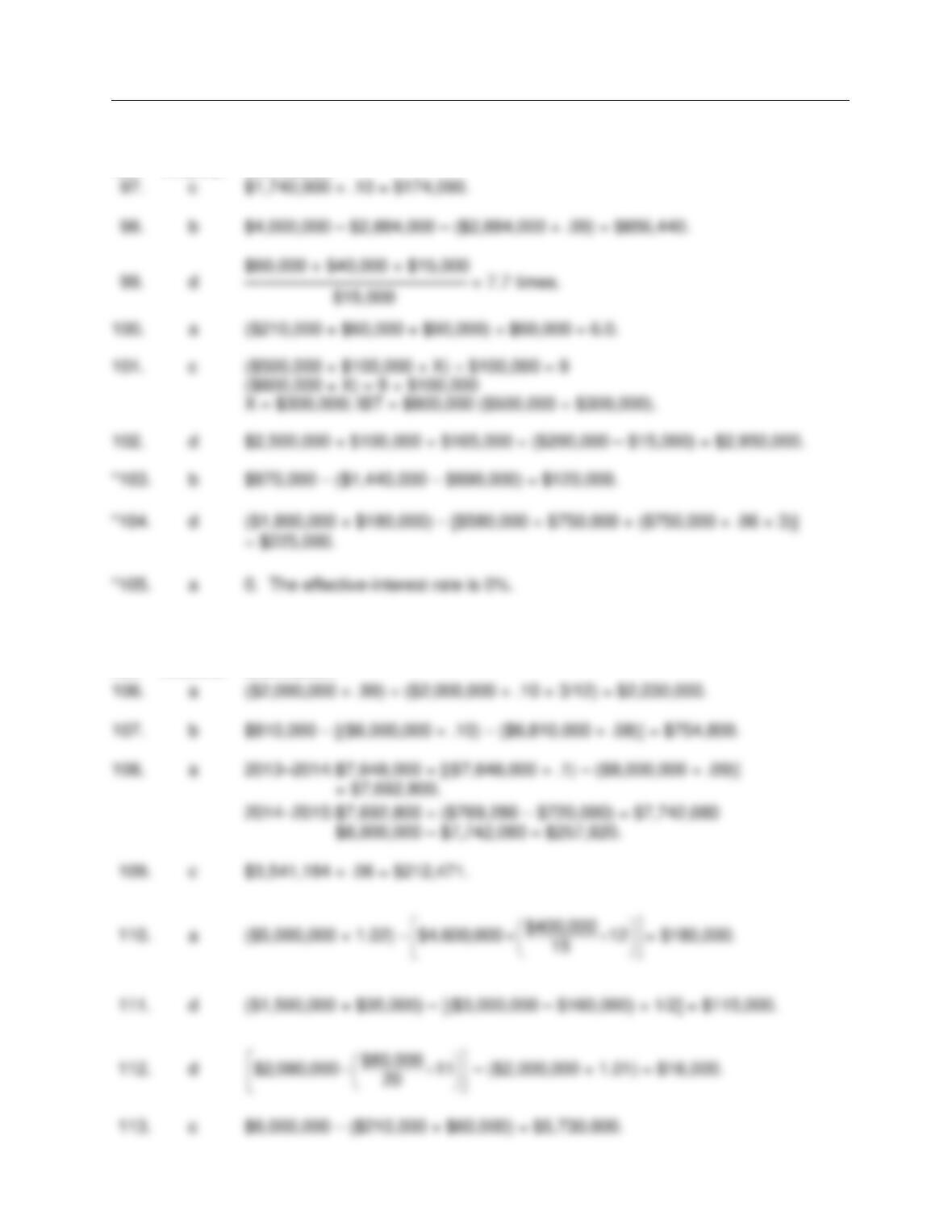
DERIVATIONS — Computational (cont.)
No. Answer Derivation
Long-Term Liabilities
14 – 31
DERIVATIONS — Computational (cont.)
No. Answer Derivation
DERIVATIONS — CPA Adapted
No. Answer Derivation
Test Bank for Intermediate Accounting, Fifteenth Edition
14 – 32
DERIVATIONS — CPA Adapted (cont.)
No. Answer Derivation
BRIEF EXERCISES
BE. 14-117—Terms related to long-term debt.
Place the letter of the best matching phrase before each word.
____ 1. Indenture ____ 6. Times Interest Earned Ratio
____ 2. Refunding ____ 7. Mortgage
____ 3. Bonds Issued at Par ____ 8. Premium on Bonds
____ 4. Carrying Value ____ 9. Reacquisition Price
____ 5. Nominal Rate ____ 10. Market Rate
a. Requires that bond discount be reported in the balance sheet as a direct deduction from the
face of the bond.
b. Rate set by party issuing the bonds which appears on the bond instrument.
c. The interest paid each period is the effective interest at date of issuance.
d. Rate of interest actually earned by the bondholders.
e. Results when bonds are sold below par.
f. Results when bonds are sold above par.
g. The replacement of an existing bond issuance with a new one.
h. Price paid by issuing corporation for its own bonds.
i. Book value of bonds at any given date.
j. Ratio of current assets to current liabilities.
k. The bond contract or agreement.
l. Indicates the company’s ability to meet interest payments as they come due.
m. Ratio of debt to equity.
n. Exclusive right to manufacture a product.
o. A document that pledges title to property as security for a loan.