
67. (Appendix) The acquisition of the new production machine by Steinberg Industries will contribute a
discounted net-of-tax contribution margin of:
68. (Appendix) The overall discounted cash flow impact of Steinberg Industries’ working capital investment for
the new production machine would be:
D. $(40,000)
69. (Appendix) What is the after-tax present value of the sale of the machine for $20,000 in five years?
70. (Appendix) The net present value of the machine is
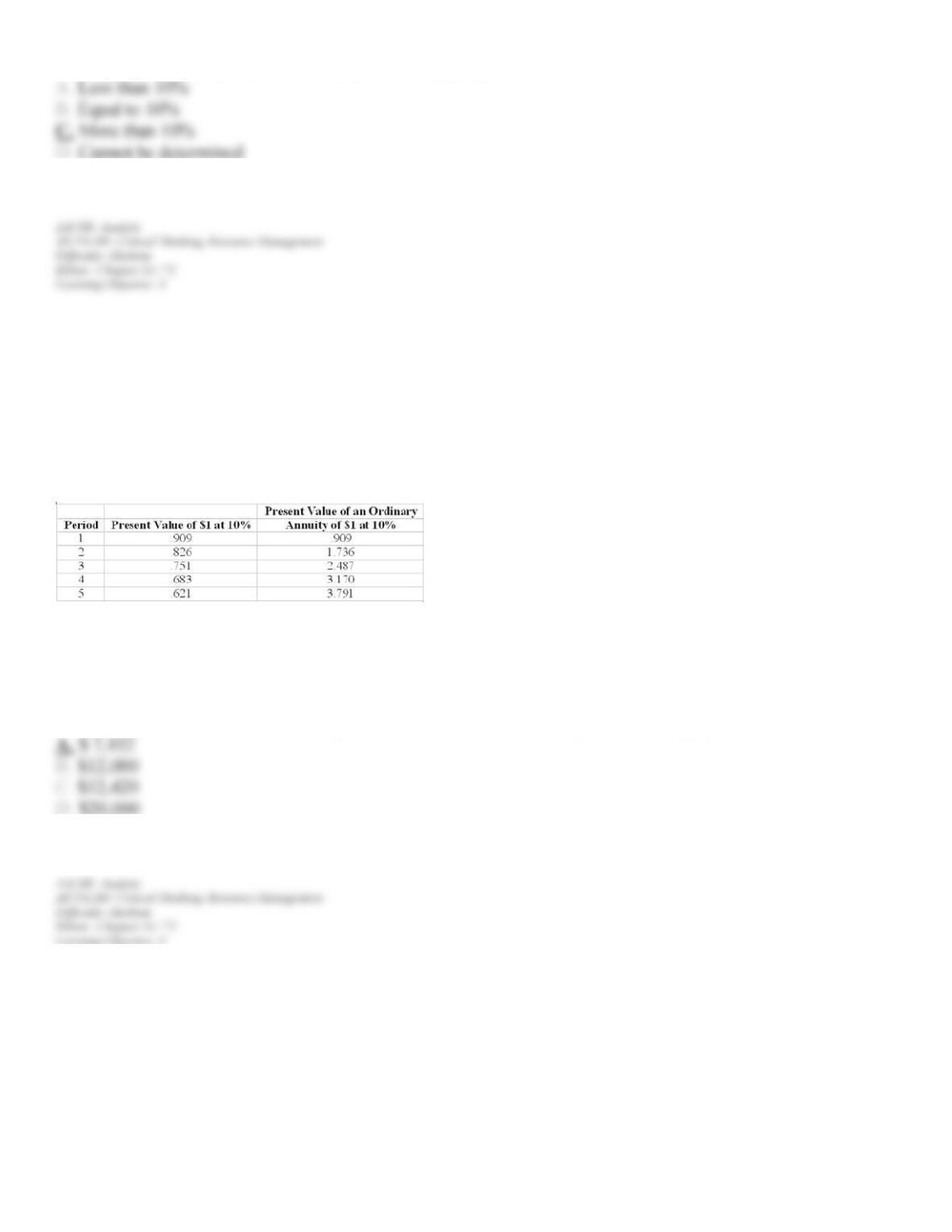
71. (Appendix) The internal rate of return for the machine is:
Use the following to answer questions 72-75:
Exron Corp. is considering the purchase of a new machine costing $300,000. The new machine will expand
Exron’s sales capacity and provide $90,000 in additional cash flows (before taxes) over the next five years. The
company has decided to depreciate the machine using the straight–line method and no salvage value. At the end
of the five years, Exron expects to sell the machine for $20,000.
Exron has a 40% tax rate and uses a 10% discount rate to evaluate the purchase of new machines.
Hilton – Chapter 14
72. (Appendix) What is the after-tax present value of the sale of the machine in five years?

73. (Appendix) What is the present value of the machine‘s depreciation tax shield?
74. (Appendix) What is the after-tax present value of the net cash inflows generated by the new machine?
75. (Appendix) What is the machine’s net present value?
76. (Appendix) Petzall Corp. incurred a $9,000 tax liability on the sale of an old machine. The before-tax gain
or loss is equal to 10% of the sale price of the machine. If Petzall’s income tax rate is 30%, what was the book
value of the machine before it was sold?

77. Which one of the following would not be a primary area investigated in a due diligence investigation?
78. When analyzing investment options, managers should consider
79. A Real Option Value Decision Tree will typically include a specific reference to
80. When reviewing an analysis of investment decisions utilizing the Real Option Value computation, managers
should be aware that the
81. The Sarbanes Oxley Act of 2002 requires an effective internal control system for publicly owned firms.
Therefore, with regards to strategic investment decisions, it is important that management consider including
82. To analyze strategic decisions, real option value analysis combines which of the following:
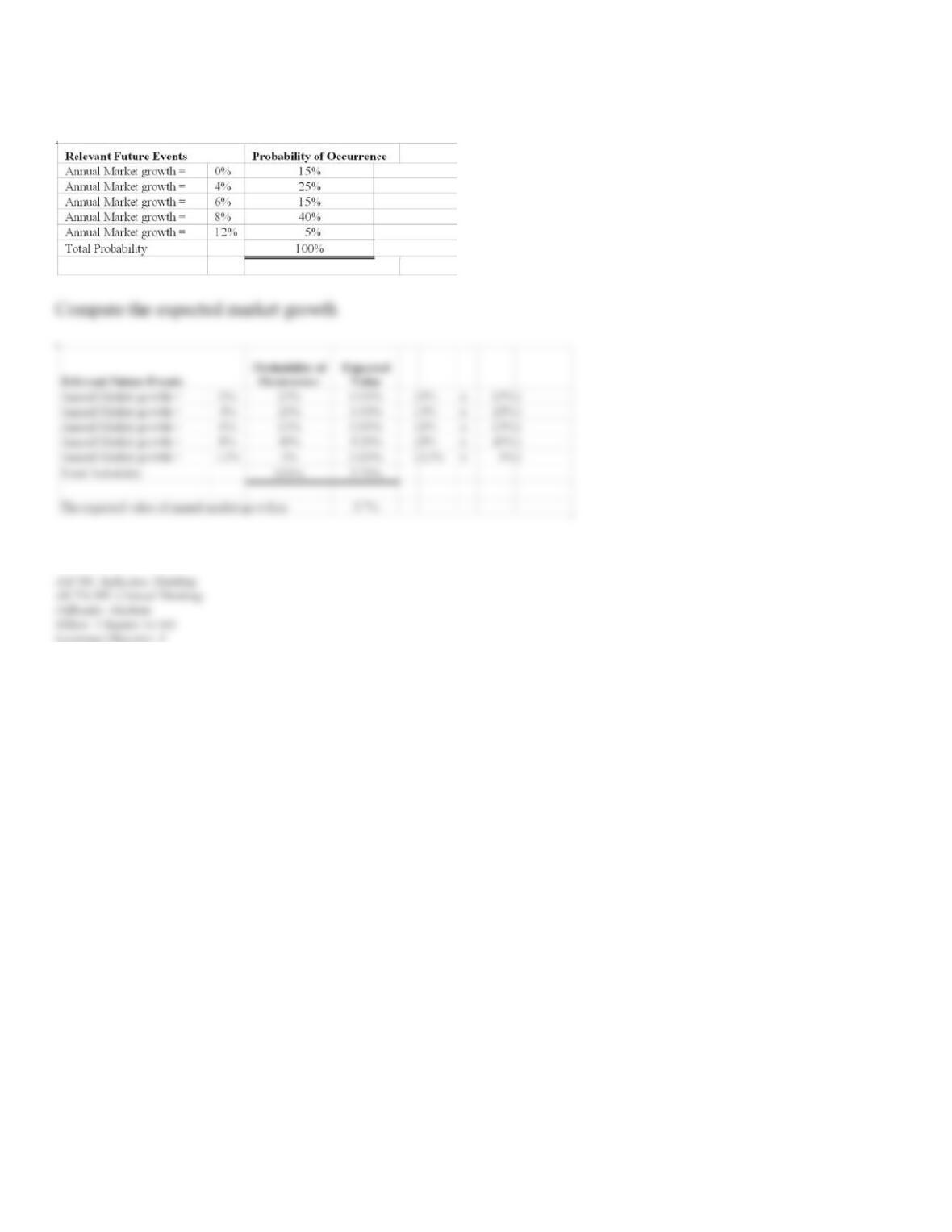
83. A project manager provided the following information regarding the potential growth in the market for
pre-cut and bagged vegetables.
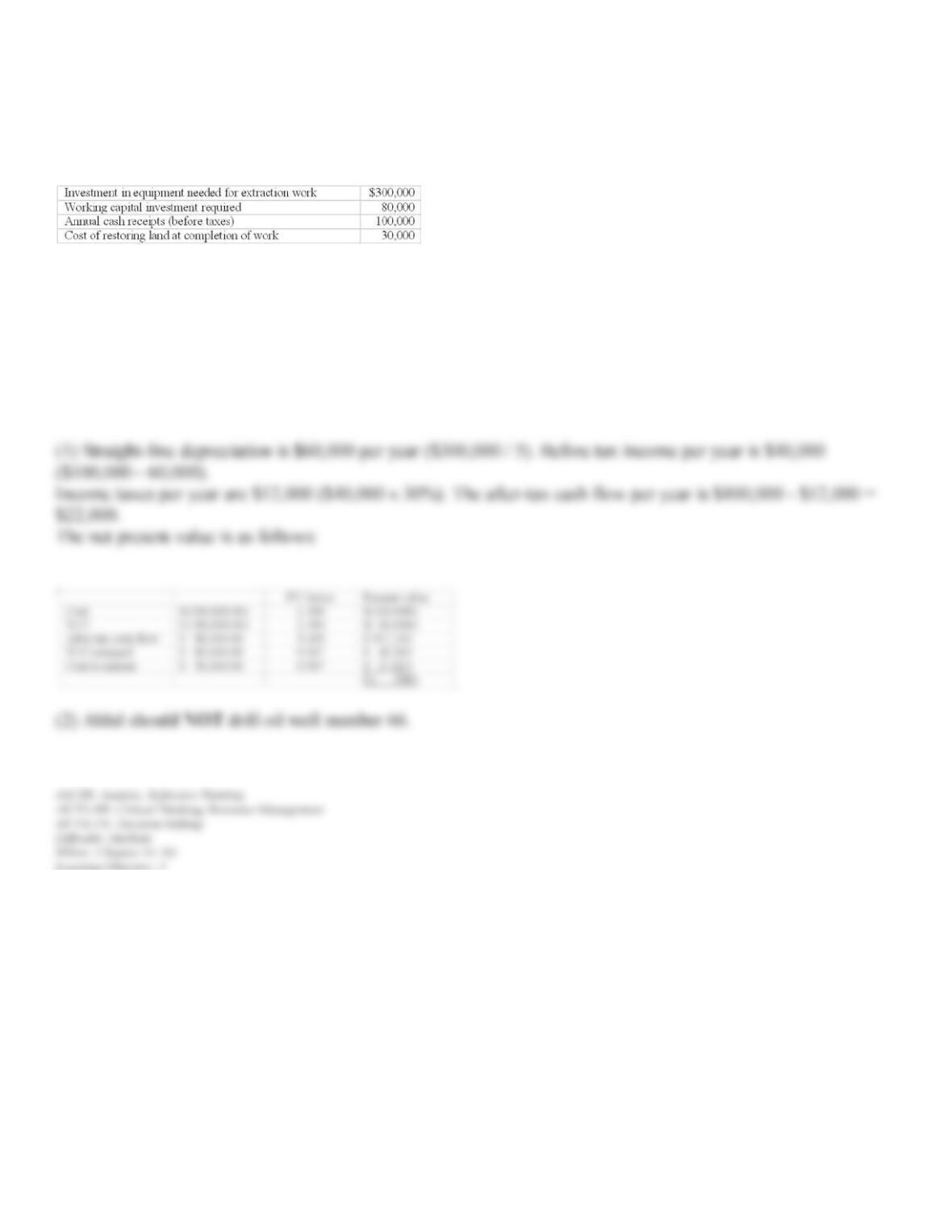
84. (Appendix) Ahlul Oil Company owns the drilling rights to several oil wells.
The amount of oil in some of the wells is somewhat marginal, and the company is unsure whether it would be
profitable to drill the oil that is contained in these wells. One such oil well is number 66, on which the following
is gathered:
The oil in well number 66 would be fully drilled after five years of work. The equipment will have no value at
the end of this time and will be scrapped. Ahlul uses straight–line depreciation for tax purposes. The tax rate is
30% and Ahlul uses a 12% discount rate in investment proposals. The working capital would be released for
other uses at the end of the five years.
Required:
(1) Compute the net present value of Well Number 66.
(2) What should management’s decision be?
85. (Appendix) Goldman Corp. is considering an investment in new automated equipment. The equipment will
save $275,000 per year in labor costs. The equipment will cost $1,500,000 and is expected to have a life of
seven years. The company requires a minimum 12% return on all purchases. Management expects this
equipment to provide a certain amount of intangible benefits such as an overall higher quality of output and
greater flexibility. What dollar value per year would management have to attach to these intangible benefits to
make the decision to invest in the equipment? (Ignore income tax considerations for this problem)
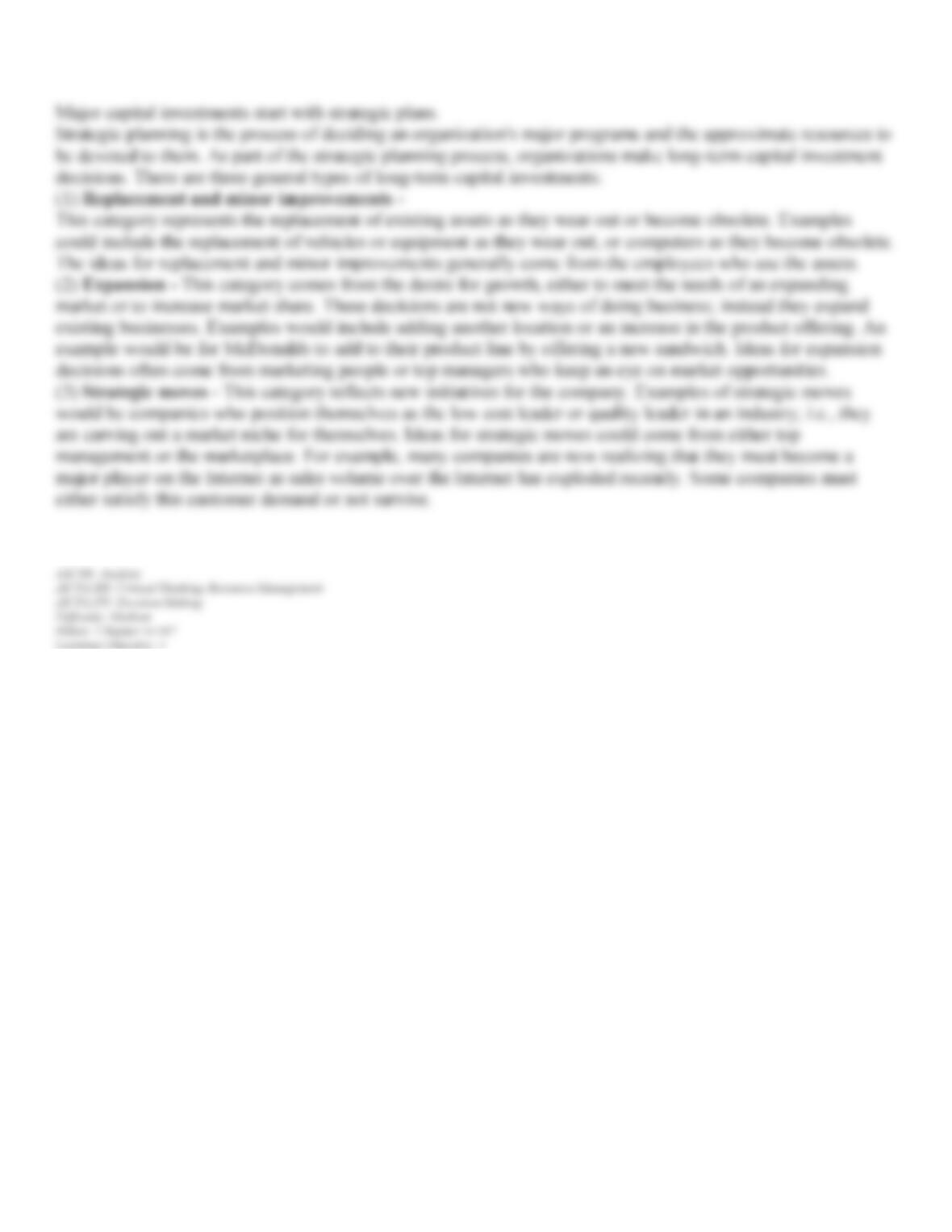
86. (Appendix) Horwitz Company has $20,000 to invest. The company is trying to decide between two
alternative projects to invest in, which are as follows:
87. What are the three general types of long-term capital investments and gives examples of each?
88. What is the role of due diligence in investment decision–making and what are major areas for due diligence
investigations?
89. What are three sources of financial information for making long-term investment decisions, and their
usefulness?
90. What are the three major categories of project cash flows and give examples of each?
91. You are the new Assistant Director of Budgeting for Daurthty Oil, an international oil and gas company.
You recommend an audit of all capital budgeting projects over $1,000,000. Your boss wants to know why you
would waste time auditing projects she has already approved. Prepare a list of reasons to conduct an audit of
investment decision.
92. Your company is considering a new processing system for waste disposal. While the project has a positive
net present value and the internal rate of return is 2 percentage points greater than the required rate of return,
you are uncomfortable with the project. What other factors need to be considered in evaluating a project?
93. Your company is considering a new processing system for waste disposal. While the project has a negative
net present value and the internal rate of return is 1.5 percentage points lower than the required rate of return,
you are determined to go ahead with the project. What other factors need to be considered in evaluating a
project?

94. (Appendix) Calculate the following items:
(1) The amount that must be deposited today at 8% to accumulate to $150,000 in 5 years.
(2) The annual payment on a 7-year, 10%, $200,000 note payable.
95. (Appendix) Kwan Corp. has contracted with Lee Contractors to build a new building. The building is
scheduled for completion in two years. Lee has given Kwan one of three payment options:
Option #1 – Pay $2,100,000 immediately.
Option #2 – Pay $1,100,000 at the end of each year for the next two years.
Option #3 – Pay $2,500,000 at the end of the two year period.
Assume that both Lee and Kwan use a 12% discount rate in making investment decisions.
Required:
(1) Which investment option should Kwan choose?
(2) What payment option would Lee like for Kwan to choose?

96. The Lions Football Team has installed a new electronic scoreboard at its football stadium at a cost of
$300,000. The scoreboard has an estimated 10–year life and a salvage value of $30,000. Using straight-line
depreciation, determine the present value of its tax savings from the depreciation tax shield. Assume an income
tax rate of 30% and a discount rate of 8%.
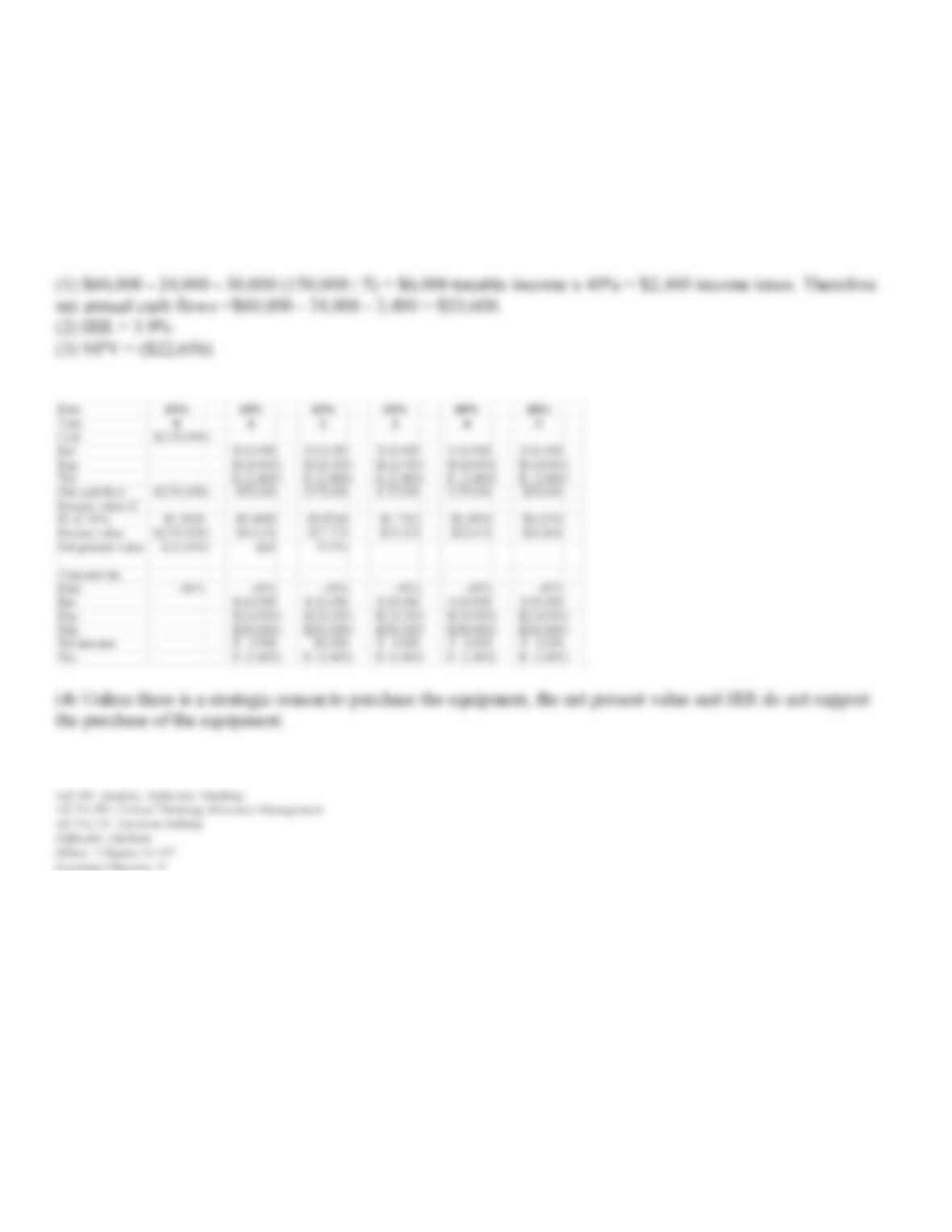
97. Jared Corp. invests in a piece of equipment that cost $150,000, has a useful life of five years with no salvage
value and will be depreciated using straight–line depreciation. The equipment will generate annual revenues of
$60,000 and the company will incur annual cash Expenses of $24,000 in operating the equipment. Jared has a
tax rate of 40%.
Required:
(1) What is the expected annual after-tax cash flow from this equipment?
(2) What is the internal rate of return (rounded to the nearest tenth of a percent) on the equipment?
(3) What is the net present value of the equipment if the required rate of return is 10%?
(4) Would you recommend the investment?
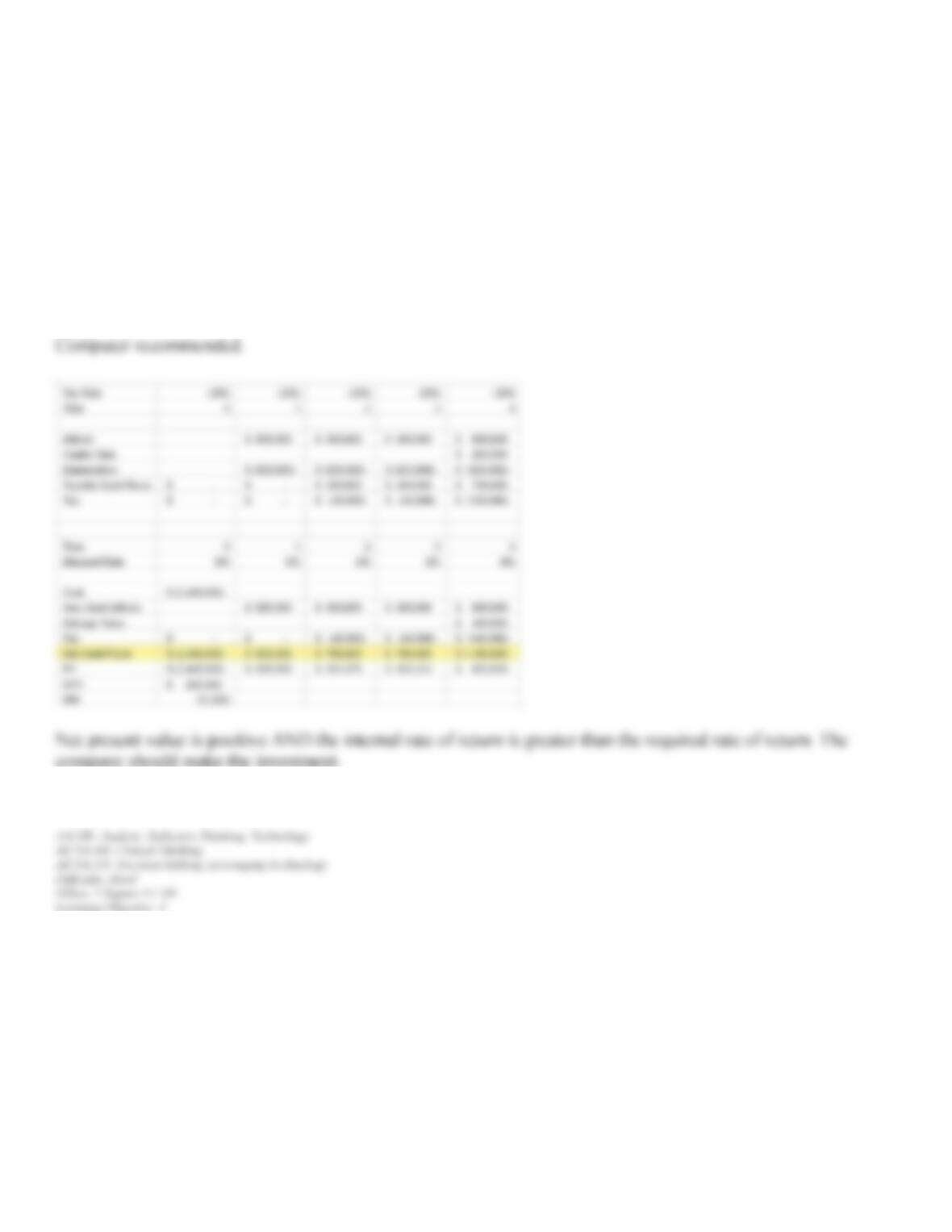
98. (Appendix) Pluto Corp. is considering investing in an automated manufacturing line. Installation of the line
will cost $2,440,000. This amount will be paid up front. It will be depreciated using straight-line depreciation
and is expected to last four years and will be fully depreciated for tax purposes. The cost savings for each year
are expected to be as follows:
Year 1 – $600,000
Year 2 – $800,000
Year 3 – $800,000
Year 4 – $900,000
At the end of year 4, management expects to discontinue the manufacturing line and sell the equipment for
$400,000. The equipment will be fully depreciated when sold, so the entire sales price is a taxable gain. Pluto is
subject to a 20% tax rate and using a discount rate of 8% when making investment decisions. Compute the net
present value. Compute the internal rate of return. Would you recommend that management invest in the
equipment?

99. (Appendix) Sufam Corp. is considering an investment in automated equipment for the manufacturing
Process. The equipment will cost $250,000, have a useful life of six years, generate after-tax cash flows of
$60,000, and have no salvage value at the end of six years. The company uses a discount rate of 15%. Computer
access recommended.
Required:
(1) Calculate the net present value of the automated equipment.
(2) Calculate the internal rate of return of the automated equipment, to the nearest tenth of a percent.

100. (Appendix) The United States Postal Service is considering investing in automatic postal machines that
charge credit or debit cards for the postage due on parcels. The following cash flow savings are expected:
The project will require an immediate cash outlay of $100 million up front. The US Postal Service is tax exempt.
Computer access recommended.
Required:
(1) Calculate the net present value assuming a discount rate of 11 percent.
(2) Calculate the net present value assuming a discount rate of 15 percent.
(3) Would changing the discount rate from 12 to 14 percent likely change the US Postal Services’ decision to
adopt the new machines or not?