20) A game in which each player adopts its dominant strategy
A) will not lead to an equilibrium.
B) must be a cooperative game.
C) could result in a Nash equilibrium.
D) can never result in a Nash equilibrium.
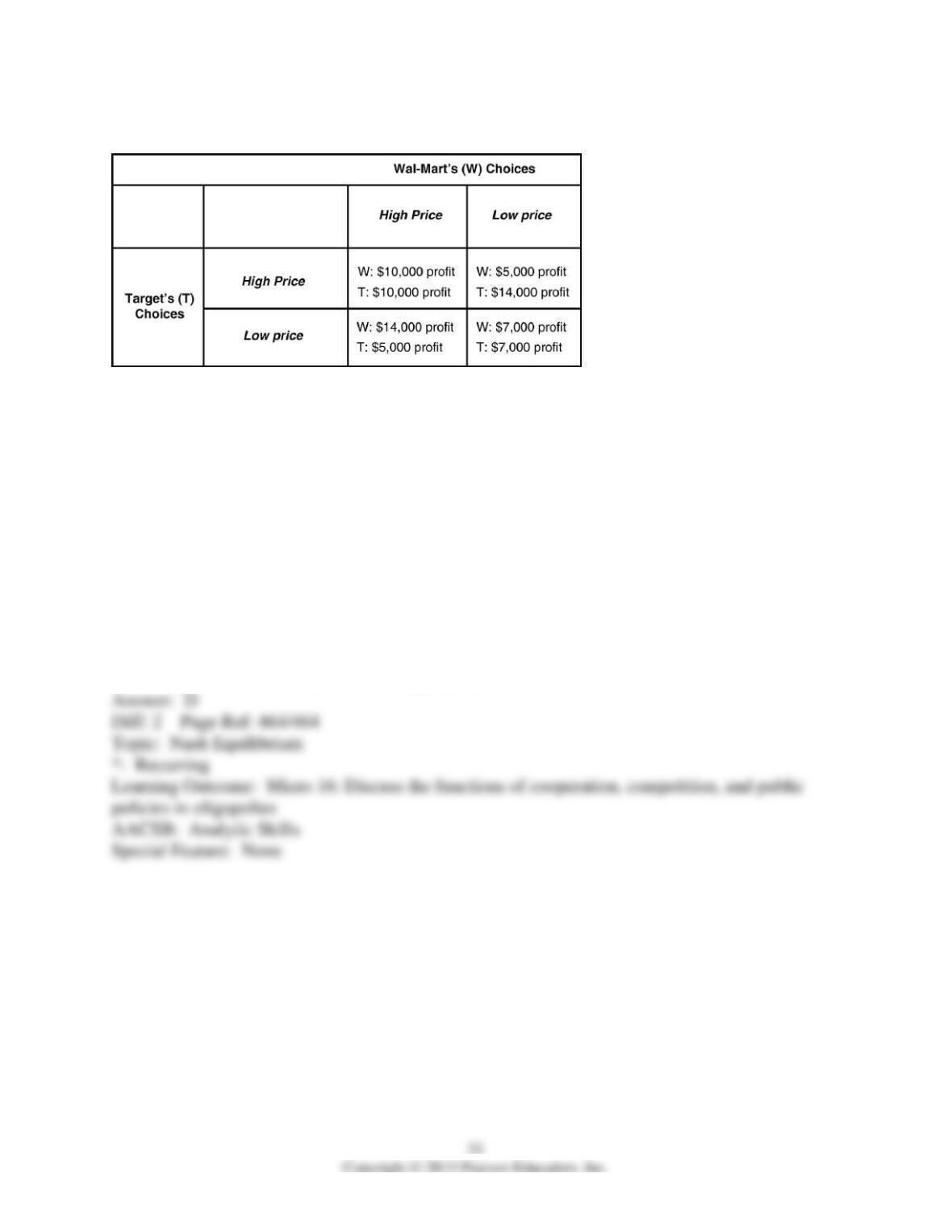
Table 14-2
Table 14-2 shows the payoff matrix for Wal-Mart and Target from every combination of pricing
strategies for the popular PlayStation 3. At the start of the game each firm charges a low price
and each earns a profit of $7,000.
21) Refer to Table 14-2. Is the current strategy in which each firm charges the low price and
earns a profit of $7,000 a Nash equilibrium? If not, why and what is the Nash equilibrium?
A) No, it is not a Nash equilibrium because each firm can do better by charging the high price.
The Nash equilibrium occurs when each firm charges the high price and earns a profit of
$10,000.
B) No, the current situation is not a Nash equilibrium; it is a dominant strategy equilibrium.
There is no Nash equilibrium in this game.
C) No, the current situation is not a Nash equilibrium. The Nash equilibrium for each firm is to
have the other charge a high price and for the firm in question charge a low price.
D) Yes, the current situation is a Nash equilibrium.
22) Refer to Table 14-2. For each firm, is there a better outcome than the current situation in
which each firm charges the low price and earns a profit of $7,000?
A) Yes, the firms can implicitly collude and agree to charge a higher price.
B) No, there is no incentive for each firm to consider any other strategy.
C) No, any other strategy hurts consumers.
D) Yes, each firm can implicitly agree to increase output and not to deviate from a low price.
23) Refer to Table 14-2. Suppose Wal-Mart and Target both advertise that they will match the
lowest price offered by any competitor. What is the purpose of such a strategy?
A) to signal to each other not to charge below the current low price
B) to signal to each other that they will not hesitate to initiate a price war
C) to signal to each other that they intend to charge the high price
D) to signal to each other to share the market equally
24) Refer to Table 14-2. Suppose pricing PlayStations is a repeated game in which Wal-Mart
and Target will be selling the game system in competition over a long period of time. In this
case, what is the most likely outcome?
A) a noncooperative equilibrium in which each firm charges the high price
B) a cooperative equilibrium in which each firm charges the high price
C) a noncooperative equilibrium in which each firm charges the low price
D) a cooperative equilibrium in which each firm charges the low price
25) What is a second-price auction?
A) An auction in which the bidder who submitted the highest bid is awarded the object being
sold and pays a price equal to the second highest amount bid.
B) An auction in which the bidder who submitted the second highest bid is awarded the object
being sold.
C) An auction in which the bidder who submitted the highest bid is awarded the object being
sold and pays a price equal to the average of the highest and second highest amount bid.
D) An auction in which the bidder who submitted the second highest bid is awarded the object
being sold and pays a price equal to the average of the highest and second highest amount bid.
26) What is the dominant strategy in a second-price auction?
A) bidding below one’s true value
B) bidding above one’s true value
C) bidding one’s true value
D) There is no dominant strategy.
27) In most business situations where firms compete, often they can escape the prisoner’s
dilemma and reach the most profitable outcome. Which of the following is a reason for this?
A) Firms engage in aggressive advertising to overcome the barriers to loyalty.
B) Most games are one-shot games so firms learn from their mistakes.
C) Most games are repeated games and firms can employ retaliation strategies against those who
do not cooperate.
D) Firms are constantly improving their products and anticipating changing consumer tastes.
28) Suppose two firms in a duopoly implicitly collude and charge a high price. How might each
firm benefit from advertising that it will match the lowest price offered by its competitor?
A) The offer to match prices is a way of deterring entry by other large firms, thereby keeping the
market share of the existing firms intact.
B) The advertisement ensures that the other firm does not cheat. If a firm cheats on the
agreement and charges the lower price, the rival firm will retaliate by doing the same.
C) The offer to match prices is a way of signaling to antitrust authorities that the firms are not
engaged in illegal collusion.
D) The advertisement is meant to suggest to consumers that the offered price is actually the
lowest price available.
29) In an oligopoly, firms can increase their market power by
A) selling to buyers who have market power.
B) pursuing dominant strategies.
C) colluding to set prices.
D) undertaking heavy advertising expenditure.
30) If the painting firms in a city sign a contract outlining a pricing plan, they are involved in
A) price competition.
B) a legal form of business contract in the United States.
C) collusion.
D) price regulation.
31) Collusion
A) is rampant in perfect competition as all firms charge the same price.
B) reduces market concentration in an industry.
C) among firms is difficult to maintain because it eliminates long run economic profit.
D) is more difficult when there are many firms producing differentiated products in an industry.
32) Airlines often engage in last-minute price cutting to fill remaining empty seats on a flight
because this practice will generally
A) prevent rival airlines from competing in that market.
B) increase marginal revenue more than marginal cost.
C) maximize marginal revenue.
D) discourage rivals from matching price cuts.
33) There is much evidence to suggest that airlines are more likely to match price cuts than price
increases. Which of the following best explains this evidence?
A) The law of demand which states that an increase in price leads to a decrease in quantity
demanded.
B) No one airline wants to be the first to renege on a tacit collusive agreement in which all
airlines implicitly agree to match price cuts but not price increases.
C) An airline fears that if it does not match a price cut, its sales may fall considerably but if it
does not match a price increase, it will be able to attract customers away from its rivals.
D) Airlines have different costs of production and therefore it is more difficult to agree on a price
increase than on a price decrease.
34) A cartel is
A) a temporary storage facility for automobiles.
B) a group of firms that enter into an informal agreement to fix prices to maximize joint profits.
C) a group of firms that enter into a formal agreement to fix prices to maximize joint profits.
D) an example of a group of firms that collectively regulate a competitive industry.
35) What is the incentive for a firm to join a cartel?
A) to be able to earn profits in the long run but not in the short run
B) to be able to earn larger profits than if it was not part of the cartel
C) to completely insulate itself from competition
D) to produce a larger amount of output than if it was not part of the cartel
36) A member of a cartel like OPEC has an incentive to
A) argue for larger production quotas for each member of the cartel.
B) agree to a low cartel production level and then produce more than its quota.
C) abide by its individual production quota.
D) support equal production quotas for each member.
37) In which of the following cartels is total cartel profit likely to be the highest?
A) a cartel made up of equal sized firms each producing different quantities of a differentiated
product
B) a cartel made up of firms of various sizes each producing different quantities of a
homogeneous product
C) a cartel made up of firms of various sizes each producing the same quantity of a differentiated
product
D) a cartel made up of identical firms each producing the same quantity of a homogeneous
product
38) Each member of OPEC can increase its income by selling more oil than its output quota
because
A) by selling more at OPEC’s cartel price, a member will automatically earn more income.
B) each member’s demand is more elastic than the total demand for oil.
C) the demand for oil is inelastic so total revenue increases.
D) the demand for oil is perfectly elastic.
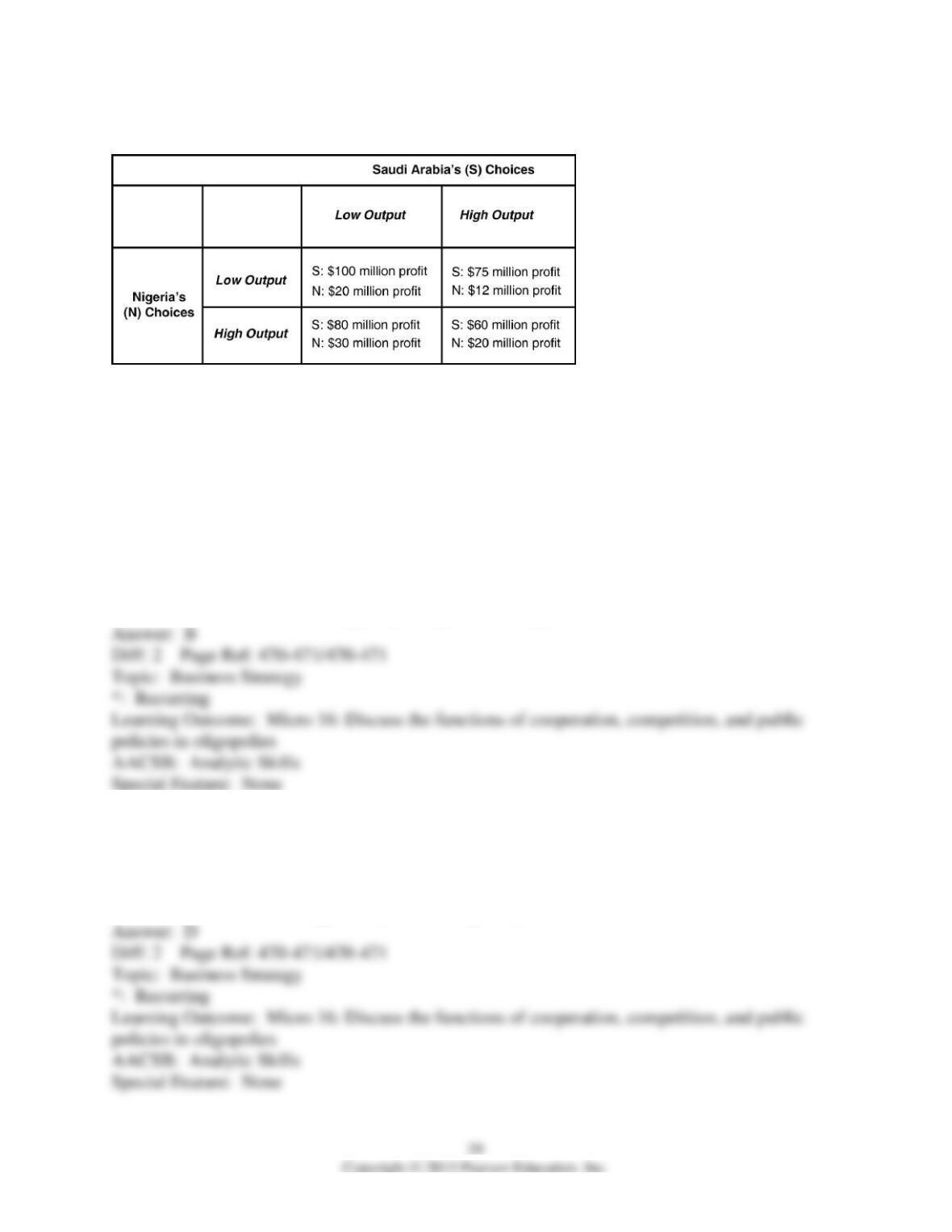
Table 14-3
Suppose OPEC has only two producers, Saudi Arabia and Nigeria. Saudi Arabia has far more oil
reserves and is the lower cost producer compared to Nigeria. The payoff matrix in Table 14-3
shows the profits earned per day by each country. “Low output” corresponds to producing the
OPEC assigned quota and “high output” corresponds to producing the maximum capacity
beyond the assigned quota.
39) Refer to Table 14-3. Is there a dominant strategy for Saudi Arabia and, if so, what is it?
A) Yes, the dominant strategy is to produce a high output.
B) Yes, the dominant strategy is to produce a low output.
C) No, there is no dominant strategy.
D) Yes, it has a dominant strategy depending on what Nigeria does.
40) Refer to Table 14-3. Is there a dominant strategy for Nigeria and, if so, what is it?
A) Yes, it has a dominant strategy depending on what Saudi Arabia does.
B) No, there is no dominant strategy.
C) Yes, the dominant strategy is to produce a low output.
D) Yes, the dominant strategy is to produce a high output.
41) Refer to Table 14-3. What is the Nash equilibrium in this game?
A) In the Nash equilibrium both Saudi Arabia and Nigeria produce a low output and earn a profit
of $100 million and $20 million respectively.
B) In the Nash equilibrium both Saudi Arabia and Nigeria produce a high output and earn a
profit of $60 million and $20 million respectively.
C) In the Nash equilibrium Saudi Arabia produces a low output and earns a profit of $80 million
and Nigeria produces a high output and $30 million respectively.
D) There is no Nash equilibrium.
42) Refer to Table 14-3. Which of the following statements is true?
A) The Nash equilibrium is a noncooperative, dominant strategy equilibrium.
B) The Nash equilibrium is a cooperative equilibrium.
C) The Nash equilibrium is a collusive equilibrium.
D) There is no Nash equilibrium in this game because each party pursues its dominant strategy.
43) OPEC periodically meets to agree to restrict the cartel’s oil output, and yet almost every
member of OPEC produces more than its own output quota. This suggests that OPEC has
A) a cooperative equilibrium.
B) a noncooperative equilibrium.
C) new potential entrants.
D) a threat of substitute goods.
44) An equilibrium in which each player chooses its best strategy given the strategies chosen by
the other players is called a Nash equilibrium.
45) The equilibrium in the prisoner’s dilemma is a dominant strategy Nash equilibrium.
46) A prisoner’s dilemma leads to a noncooperative equilibrium.
47) A member of a cartel earns more profits by producing more than its quota and selling at a
price higher than the cartel’s price.
48) Collusion would be common in an oligopoly and a monopolistically competitive industry.
49) Explain the difference between a cooperative equilibrium and a noncooperative equilibrium
in game theory.
50) On November 7, 1996, the Distilled Spirits Council of the United States decided to end its
voluntary ban on television and radio liquor advertisement. The ban on hard liquor advertising
had been in effect since 1936 for radio and 1948 for television. Did the lifting of this ban likely
increase or decrease the profits of hard liquor companies? Briefly explain.
51) Explain why OPEC is caught in a prisoner’s dilemma?
52) Explain how collusion makes firms better off. Given the incentives to collude, briefly explain
why every industry does not become a cartel.
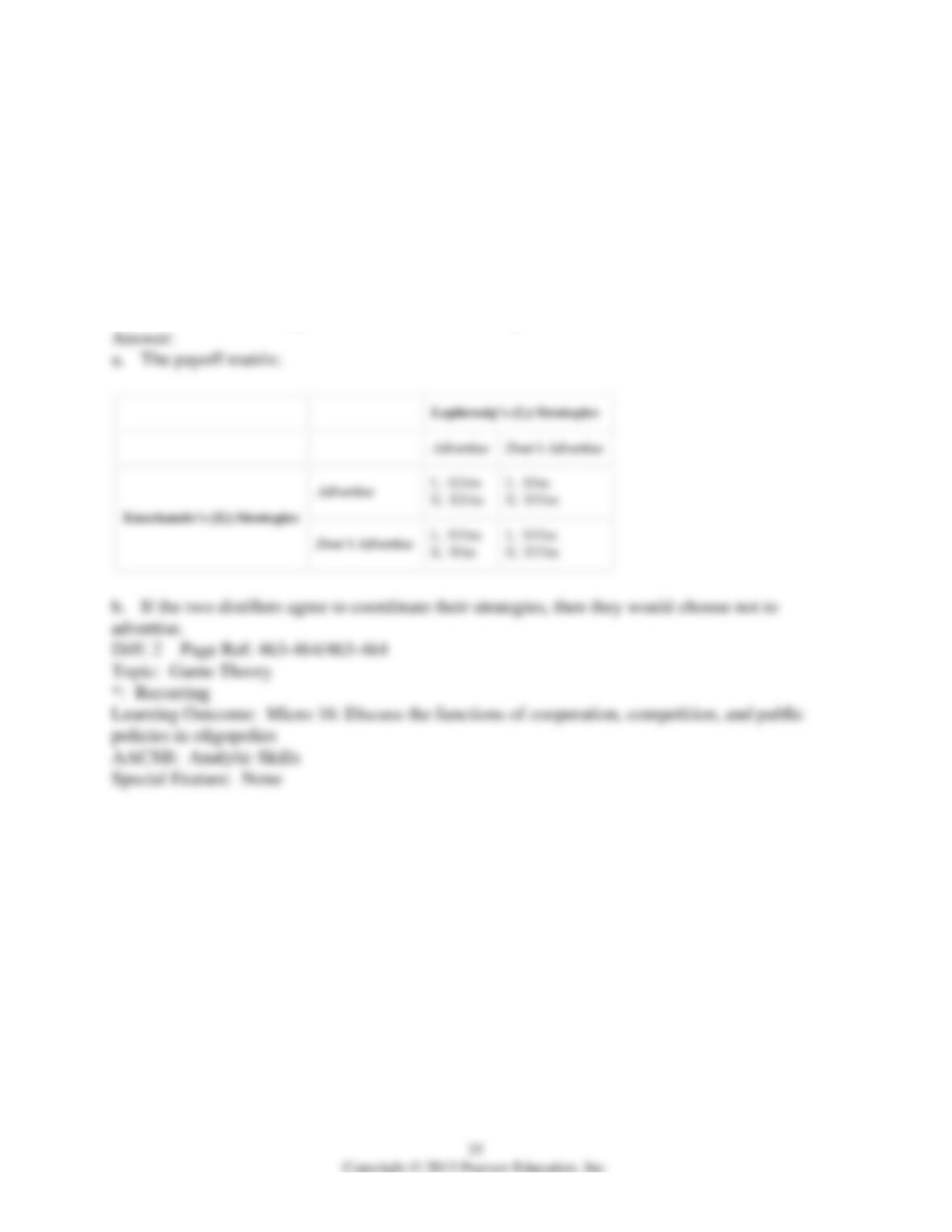
53) Assume that two interior design companies, Alistair and Baine, are competing for customers
and if they both advertise, they would each earn $30 million in profits. If neither advertises, they
each earn $50 million in profits. If one advertises and the other doesn’t, the firm that advertises
earns $40 million in profit while the other earns $20 million in profit.
a. Present the information above in the form of a payoff matrix. Let Baine be the row player
and Alistair the column player.
b. Does each firm have a dominant strategy and if so what is it?
c. What is the Nash equilibrium?
54) Consider two single-malt whiskey distillers, Laphroaig and Knockando. If they advertise,
they can both sell more whiskey and increase their revenue. However, the cost of advertising
more than offsets the increased revenue so that each distiller ends up with a lower profit than if
they do not advertise. On the other hand, if only one advertises, that distiller increases its market
share and also its profit.
a. Construct a payoff matrix using the following hypothetical information: If neither distiller
advertises: each earns a profit of $35 million per year. If both advertise: each earns a profit of
$20 million per year. If one advertises and the other does not: the distiller who advertises earns a
profit of $50 million and the distiller who does not advertise earns a profit of $9 million.
b. If the two distillers agree to coordinate their strategies, what is the outcome?
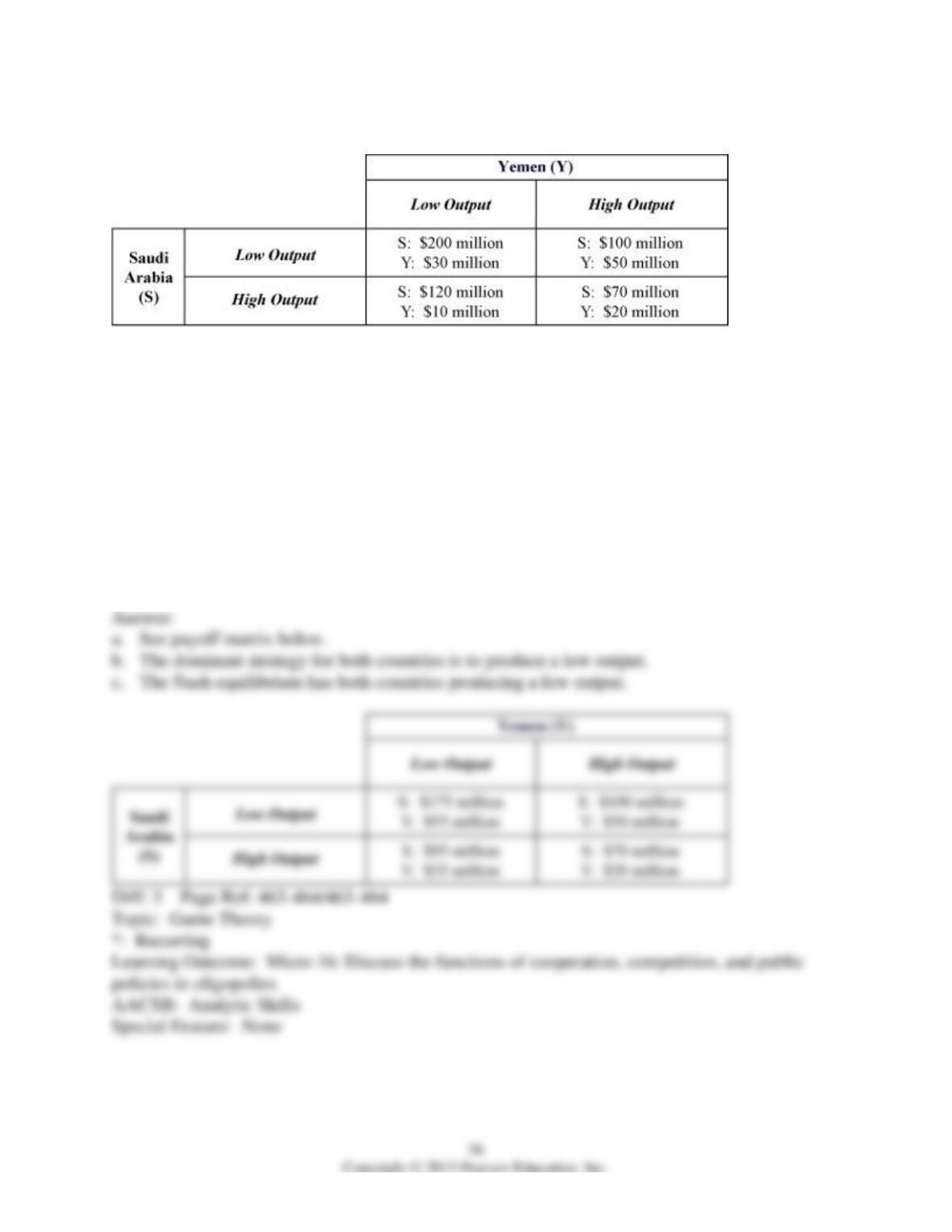
Table 14-4
55) Refer to Table 14-4. Suppose the payoff matrix in the above figure represents the payoffs to
Saudi Arabia and Yemen for the production of oil. Saudi Arabia and Yemen must decide how
much oil to produce. Since the demand for oil is inelastic, relatively low production rates drive
up prices and profits. Saudi Arabia, the world’s largest and lowest cost producer, is able to
influence market price; it has an incentive to keep output low. Yemen, on the other hand, is a
relatively high cost producer with much smaller reserves. Assume Saudi Arabia now decides to
try to further influence the oil market by offering to pay Yemen $25 million to produce a low
output.
a. Create a new payoff matrix that reflects Saudi Arabia’s willingness to pay Yemen $25 million
to produce a low output.
b. What is the dominant strategy for each country in this new game?
c. What is the new Nash equilibrium?
14.3 Sequential Games and Business Strategy
1) In a decision tree, the difference between a decision node and a terminal node is that
A) at a decision node all participants are free to make individual decisions but at a terminal node
they must agree on a collective decision.
B) at a decision node all participants make the same decision, while at a terminal node different
players may make different decisions.
C) at a decision node, a decision must be made while a terminal node shows the payoff.
D) at a decision node a decision must be made, while at a terminal node the final decision must
be made.