1
Chemistry, 7e (McMurry/Fay)
Chapter 14 Chemical Equilibrium
14.1 Multiple-Choice Questions
1) Which one of the following statements does not describe the equilibrium state?
A) Equilibrium is dynamic and there is no net conversion to reactants and products.
B) The concentration of the reactants is equal to the concentration of the products.
C) The concentration of the reactants and products reach a constant level.
D) The rate of the forward reaction is equal to the rate of the reverse reaction.
2) The equilibrium equation is also known as the law of
A) coefficients.
B) constant concentration.
C) dynamic equilibrium.
D) mass action.
3) Which of the following statements is false regarding the equilibrium constant, Kc?
A) Kc for a reaction at a particular temperature always has the same value.
B) Kc for the reverse reaction is the negative of Kc for the forward reaction.
C) The numerical value of Kc depends on the form of the balanced equation.
D) When quoting Kc it is customary to omit units.
4) Which statement about the equilibrium constant is true? The value of Kc
A) changes as product concentration changes.
B) changes as reactant concentration changes.
C) changes as temperature changes.
D) never changes.
5) If Kc is the equilibrium constant for a forward reaction what is Kc’ for the reverse reaction?
A) – Kc
B) Kc
C) (Kc)-1
D) none of these
6) If Kc is the equilibrium constant for a forward reaction, 2 A⇌ B, what is Kc‘ for the reaction 4 A⇌ 2B?
A) Kc
B) Kc
C) 2 Kc
D) (Kc)2
7) Nitric oxide reacts with oxygen to form nitrogen dioxide:
2 NO(g) + O2(g) ⇌ 2 NO2(g)
What is Kc‘ for the reverse reaction if the equilibrium concentration of NO is 0.300 M, O2 is 0.200 M, and
NO2 is 0.530 M at 25°C?
A) 0.0340
B) 0.0641
C) 0.624
D) 15.6
3
8) A mixture of carbon monoxide, hydrogen, and methanol is at equilibrium. The balanced chemical
equation is: CO(g) + 2 H2(g) ⇌ CH3OH(g). At 250°C, the mixture contains 0.0960 M CO, 0.191 M H2, and
0.150 M CH3OH. What is the value for Kc?
A) 2.33 × 10⁻²
B) 0.244
C) 4.09
D) 42.8
9) Given the reaction: 2 HI ⇌ H2 + I2. If Kc‘ for the reverse reaction is 1.85 × 10⁻² at 425°C, what is Kc for
the forward reaction at the same temperature?
A) -1.85 × 10⁻²
B) 1.85 × 10⁻²
C) 3.70 × 10⁻²
D) 54.1
10) For the reaction: N2(g) + 2 O2(g) ⇌ 2 NO2(g), Kc = 8.3 × 10⁻¹⁰ at 25°C. What is the concentration of N2
gas at equilibrium when the concentration of NO2 is twice the concentration of O2 gas?
A) 2.1 × 10⁻¹⁰ M
B) 4.2 × 10⁻¹⁰ M
C) 2.4 × 10⁹ M
D) 4.8 × 10⁹ M
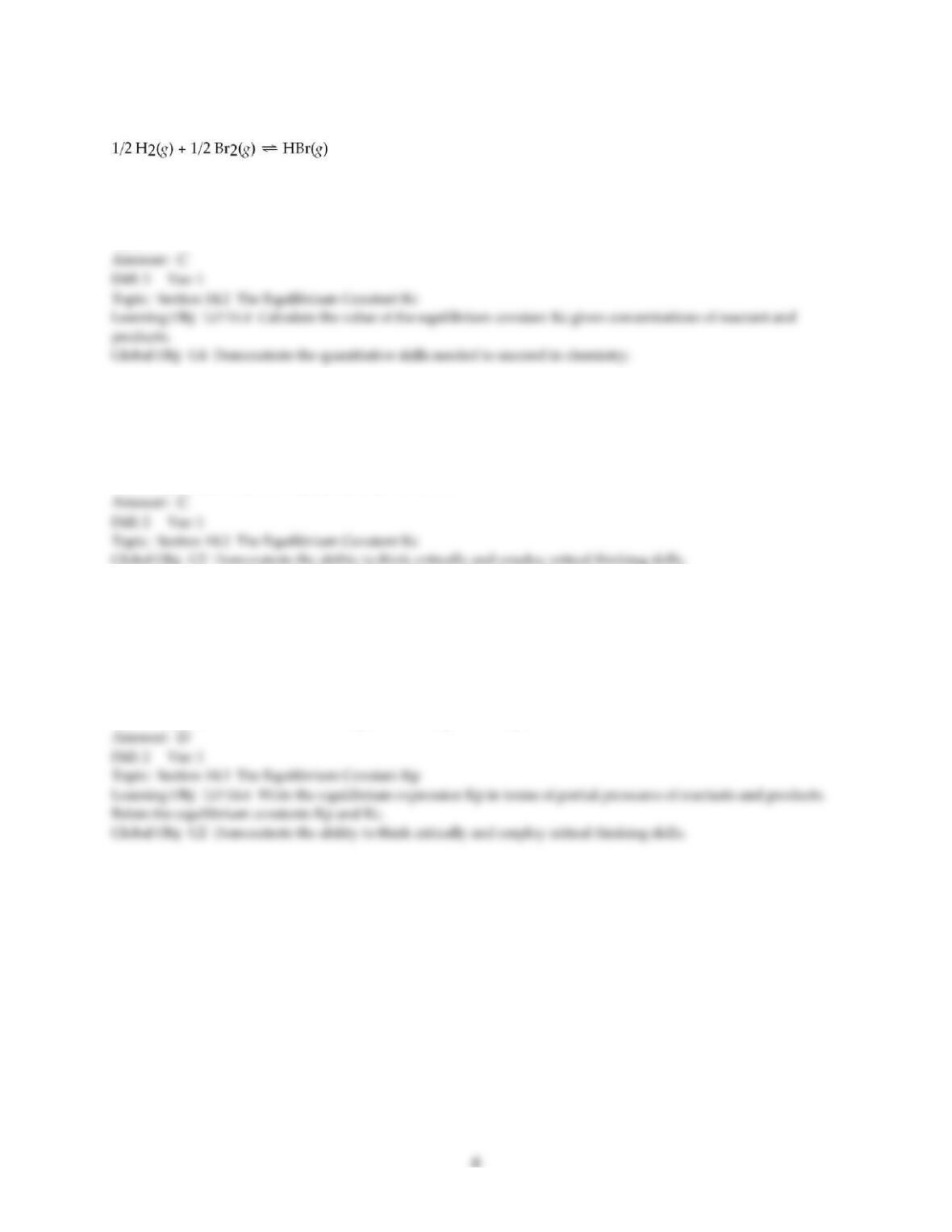
11) If Kc = 7.04 × 10⁻² for the reaction: 2 HBr(g) ⇌ H2(g) + Br2(g), what is the value of Kc for the reaction:
?
A) 3.52 × 10⁻²
B) 0.265
C) 3.77
D) 28.4
12) Which statement about the equilibrium constant is true? The value of Kc
A) changes as product concentration changes.
B) changes as reactant concentration changes.
C) changes as temperature changes.
D) changes under the conditions described in A–C.
13) Which one of the following statements about the equilibrium constant, Kp, is false?
A) Δn is equal to the sum of the coefficients of the gaseous products minus the sum of the coefficients of
the gaseous reactants.
B) The relationship between Kp and Kc is: Kp = Kc (RT)Δn
C) The units for Kp are usually omitted.
D) Total pressures are used in the equilibrium equation in place of molar concentrations.
14) Kp is related to Kc by the equation Kp = Kc (RT)n. What is the value of n for the reaction below?
NH4NO3(s) ⇌ N2O(g) + 2 H2O(g)
A) -2
B) -1
C) +1
D) +2
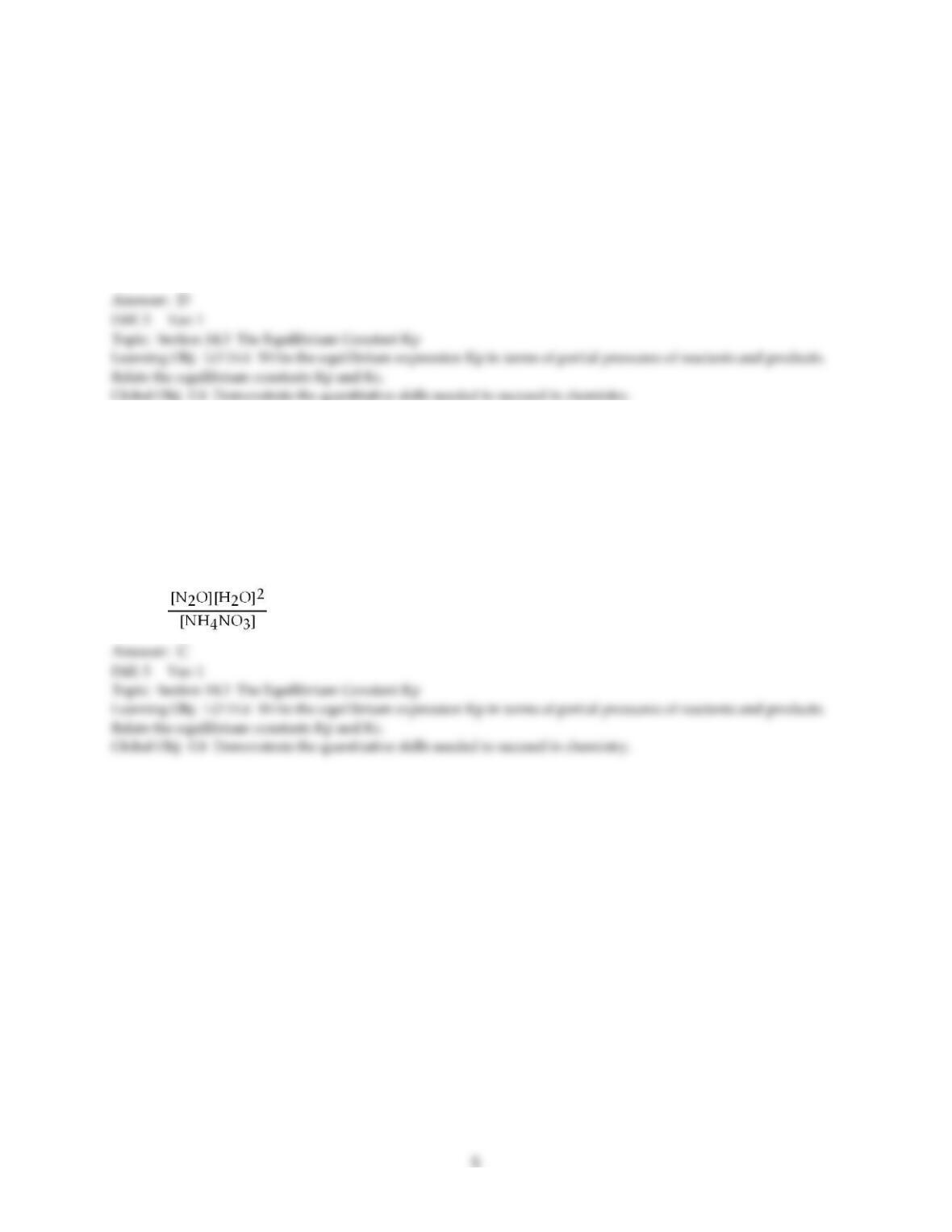
15) What is the equilibrium equation for the reaction:
NH4NO3(s) ⇌ N2O(g) + 2 H2O(g)?
A) Kp = [N2O]
B) Kp = [N2O][H2O]
C) Kp = [N2O][H2O]2
D) Kp =
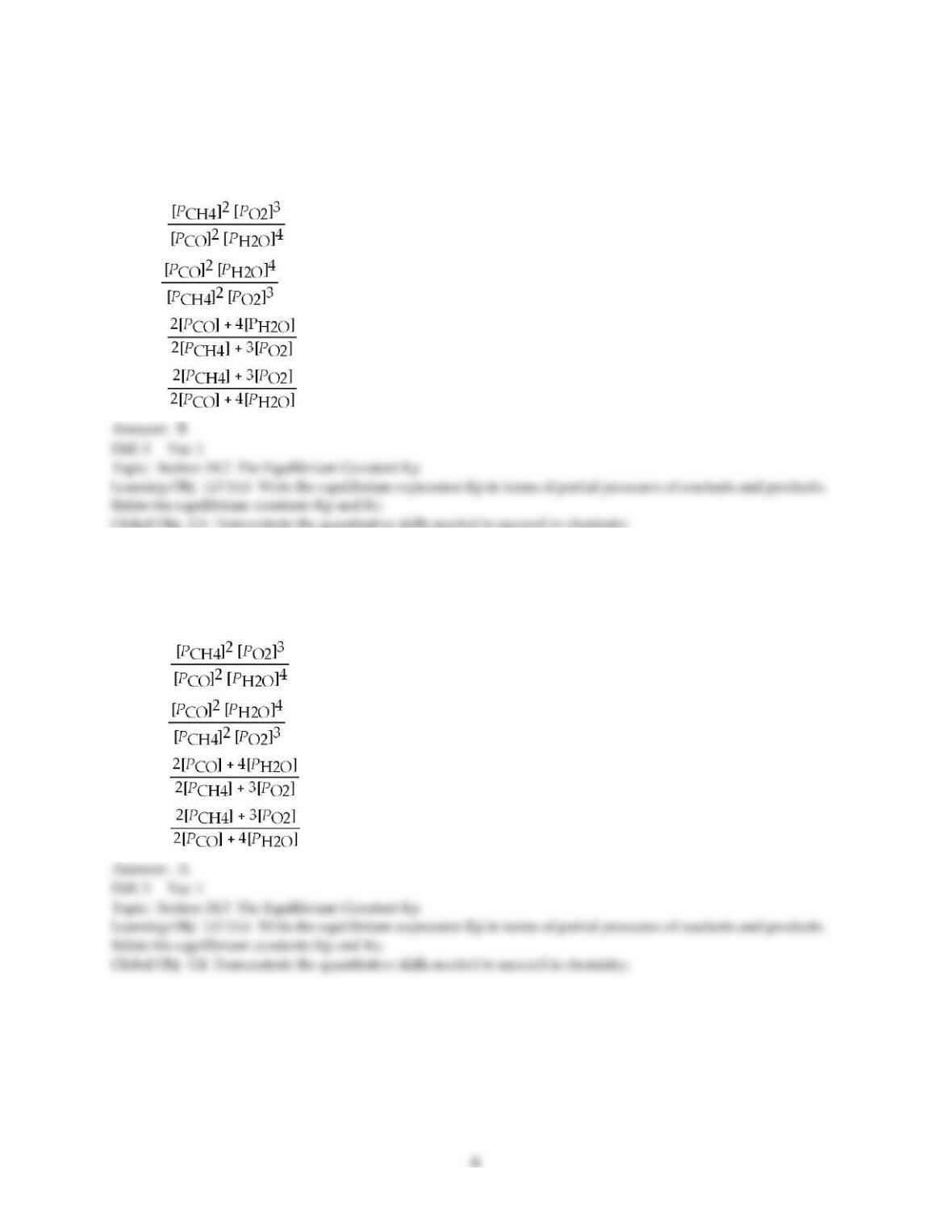
16) Write the equilibrium equation for the forward reaction:
2 CH4(g) + 3 O2(g) ⇌ 2 CO(g) + 4 H2O(g)
A) Kp =
B) Kp=
C) Kp =
D) Kp =
17) Write the equilibrium equation for the reverse reaction:
2 CH4(g) + 3 O2(g) ⇌ 2 CO(g) + 4 H2O(g)
A) Kp‘ =
B) Kp‘ =
C) Kp‘ =
D) Kp‘ =
18) Kp = 1.5 × 10³ at 400°C for the reaction 2 NH3(g) ⇌ N2(g) + 3 H2(g). What is the value of Kp for the
reaction:
2 N2(g) + 6 H2(g) ⇌ 4 NH3(g)?
A) 4.4 × 10⁻⁷
B) 3.3 × 10⁻⁴
C) 6.7 × 10⁻⁴
D) 2.3 × 10⁶
19) What is true about the relationship of Kp and Kc for the reaction:
2 CH4(g) + 3 O2(g) ⇌ 2 CO(g) + 4 H2O(g)?
A) Kp < Kc
B) Kp = Kc
C) Kp > Kc
D) Kp and Kc are not related.
20) The oxidation of sulfur dioxide by oxygen to sulfur trioxide has been implicated as an important step
in the formation of acid rain: 2 SO2(g) + O2(g) ⇌ 2 SO3(g). If the equilibrium partial pressures of SO2, O2,
and SO3 are 0.564 atm, 0.102 atm, and 0.333 atm respectively at 1000 K, what is Kp at that temperature?
A) 0.292
B) 3.42
C) 5.79
D) 8.11
21) Given the reaction at a certain temperature: 2 HI(g) ⇌ H2(g) + I2(g). At equilibrium, the partial
pressure of HI is 1.8 × 10⁻³ atm, and the partial pressures for H2 and I2 are 0.10 atm each. Find Kp at that
temperature.
A) 3.2 × 10⁻⁴
B) 5.6 × 101
C) 3.1 × 10³
D) 3.1 × 10⁴
22) If Kc = 2.0 × 1033 at 25°C, for the following reaction: H2(g) + Cl2(g) ⇌ 2 HCl(g), then find Kp at the
same temperature.
A) 8.2 × 1031
B) 9.7× 1032
C) 2.0 × 1033
D) 4.9 × 1034
23) Phosphorus pentachloride decomposes to phosphorus trichloride and chlorine gas at elevated
temperatures by the following reaction:
PCl5(g) ⇌ PCl3(g) + Cl2(g). If Kc = 1.8 at 250°C.
What is the value of Kp at the same temperature?
A) 4.2 × 10⁻²
B) 8.8 × 10⁻²
C) 65
D) 77
24) The decomposition of ammonia is: 2 NH3(g) = N2(g) + 3 H2(g). If Kp is 1.5 × 10³ at 400°C, what is the
partial pressure of ammonia at equilibrium when N2 is 0.10 atm and H2 is 0.15 atm?
A) 2.2 × 10⁻⁷ atm
B) 4.7 × 10⁻⁴ atm
C) 2.1 × 10³ atm
D) 4.4 × 10⁶ atm
25) The decomposition of ammonia is: 2 NH3(g) ⇌ N2(g) + 3 H2(g). If the pressure of ammonia is 1.0 ×
10-3 atm, and the pressures of N2 and H2 are each 0.20 atm, what is the value for Kp‘ at 400°C for the
reverse reaction?
A) -6.2 × 10⁻⁴
B) -1.6 × 10³
C) 6.2 × 10⁻⁴
D) 1.6 × 10³
26) A 1.50 L vessel contains an equilibrium mixture of 0.100 mol of NO, 0.150 mol of Br2, and 0.250 mol of
NOBr at 25°C. What is the value of Kp for the reaction below?
2 NO(g) + Br2(g) ⇌ 2 NOBr(g)
A) 2.56
B) 62.5
C) 1.28 × 10²
D) 1.53 × 10³
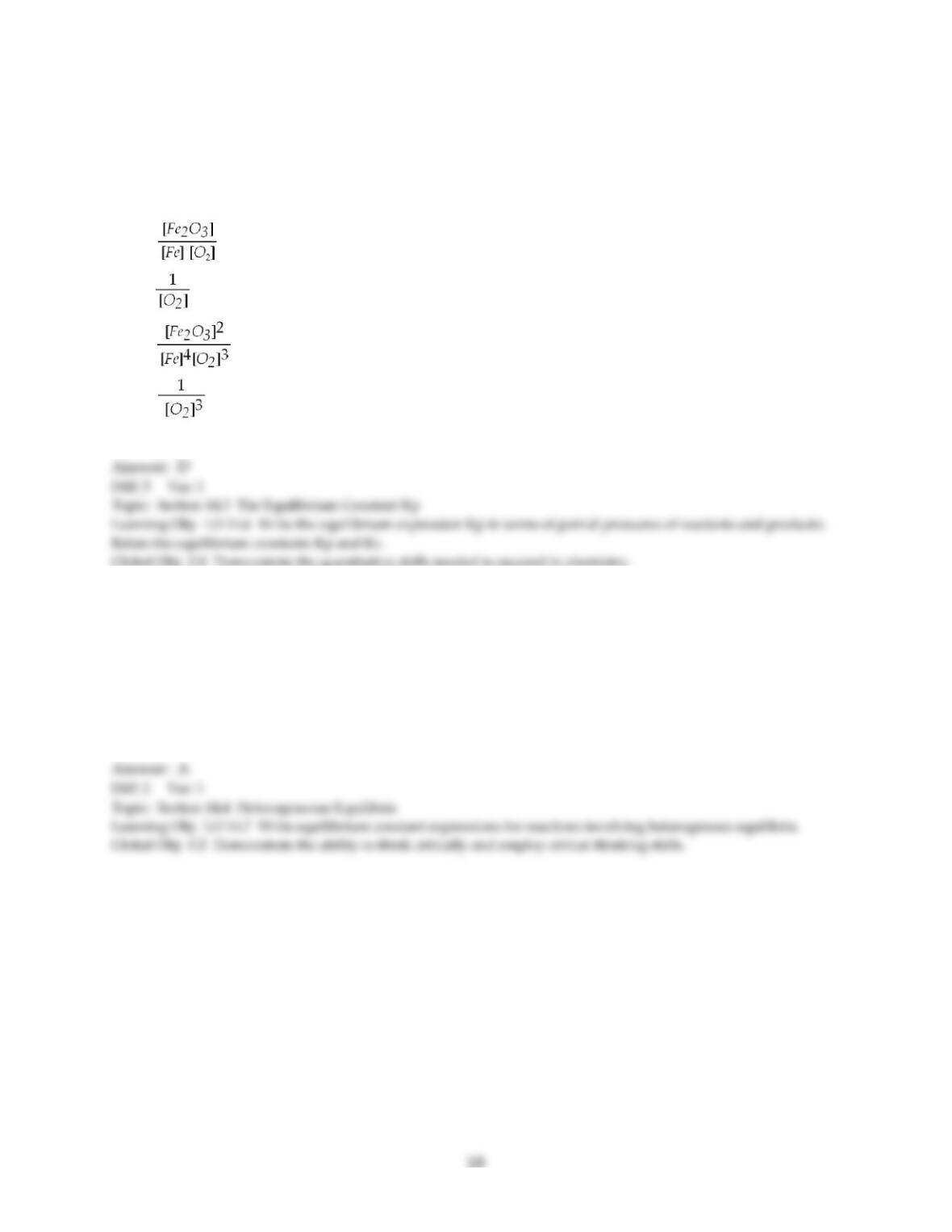
27) Which of the following is the correct equilibrium constant expression for this reaction? (Hint: check the
reaction coefficients)
Fe(s) + O2(g) ⇌ Fe2O3(s)
A) K =
B) K =
C) K =
D) K =
E) K = [O2}3
28) As a rule, which of the following phases are not included in the equilibrium constant expression?
I. pure liquids II. pure solids III. aqueous solutions IV. gases
A) I, II
B) I, IV
C) III, IV
D) II, III
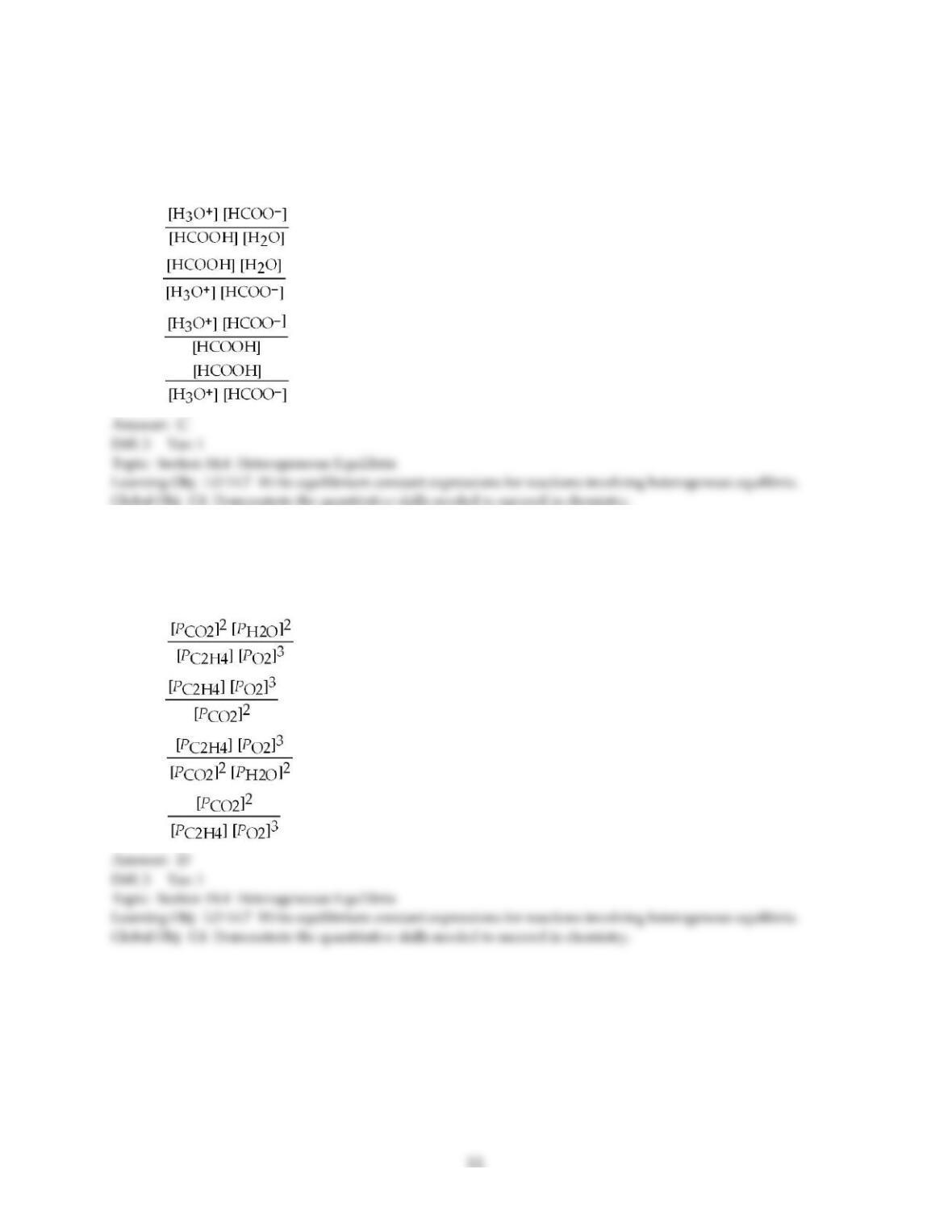
29) What is the equilibrium equation for the dissociation of formic acid in water?
HCOOH (aq) + H2O (l) ⇌ H3O+ (aq) + HCOO– (aq)
A) Kc =
B) Kc =
C) Kc =
D) Kc =
30) What is the equilibrium equation for the following reaction?
C2H4 (g) + 3 O2 (g) ⇌ 2 CO2 (g) + 2 H2O (l)
A) Kp =
B) Kp =
C) Kp =
D) Kp =
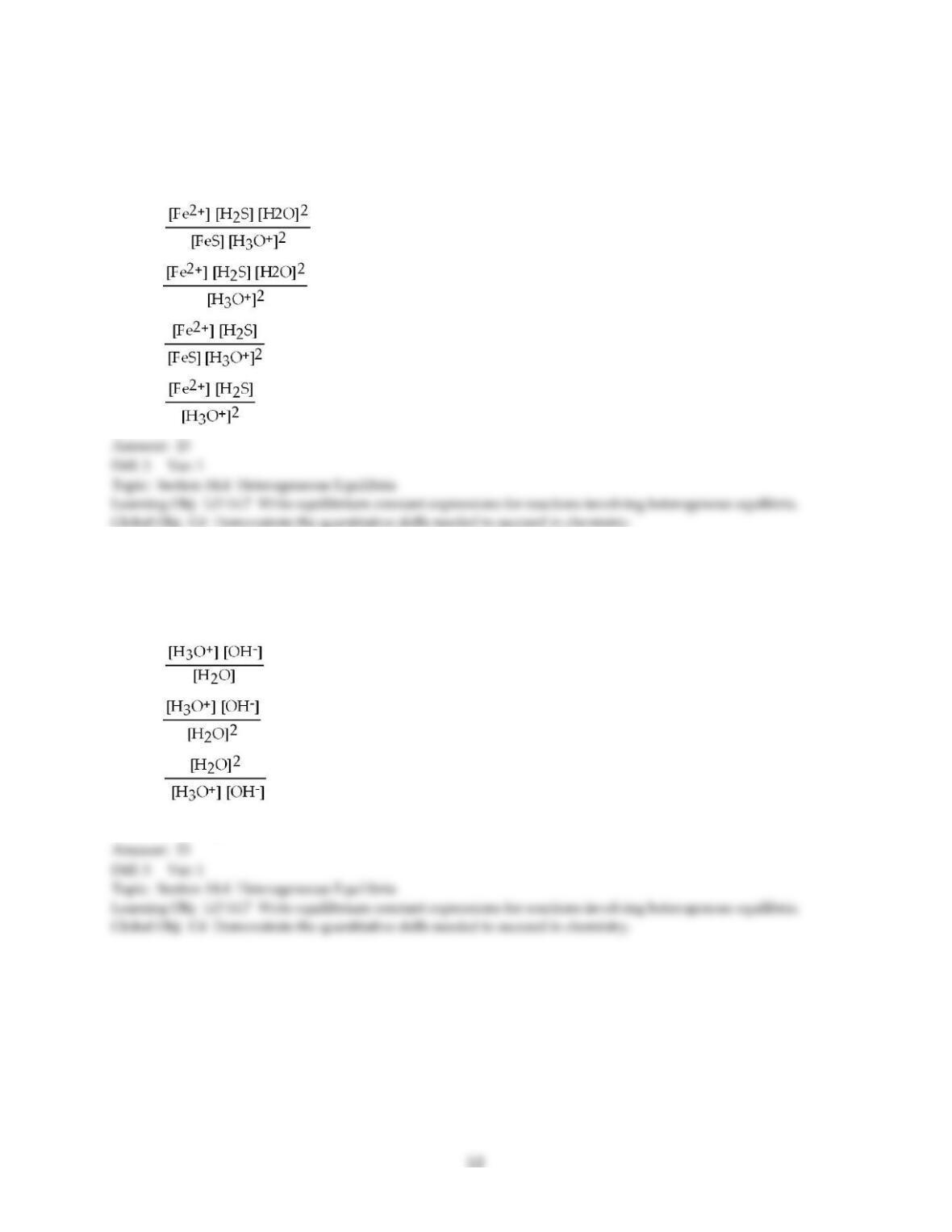
31) What is the equilibrium equation for the following reaction?
FeS(s) + 2 H3O+ (aq) ⇌ Fe2+(aq) + H2S (aq) + 2 H2O (l)
A) Kc =
B) Kc =
C) Kc =
D) Kc =
32) What is the equilibrium equation for the following reaction?
2 H2O (l) ⇌ H3O+ (aq) + OH– (aq)
A) Kc =
B) Kc =
C) Kc =
D) Kc = [H3O+] [OH–]
13
33) What is the value for Kc for the following reaction:
PbCl2(s) ⇌ Pb2+(aq) + 2 Cl–(aq),
if PbCl2(s) = 1.50 grams, [Pb2+] = 1.6 × 10⁻² M and [Cl–] = 3.2 × 10⁻² M at equilibrium? (The molar mass of
PbCl2(s) is 278 g/mol and its density is 5.85 g/cm3.)
A) 7.6 × 10⁻⁷
B) 1.6 × 10⁻⁵
C) 6.2 × 10⁴
D) 1.3 × 10⁶
34) What is the equilibrium constant, Kc, for the reaction:
2 Hg(l) + O2(g) ⇌ 2 HgO(s)
if the amounts of reactants and products at equilibrium are: 1.00 g of HgO(s), 2.00 mL of Hg(l), and 1.60
M O2(g)? (The molar mass and density of HgO(s) is 217 g/mol, and 1.10 g/cm3. The molar mass and
density of Hg(l) is 201 g/mol, and 13.6 g/mL.)
A) 6.85 × 10⁻⁴
B) 4.66 × 10⁻²
C) 0.625
D) 1.46 × 10³
35) Given the hypothetical reaction: 2 A(s) + x B(g) ⇌ 3 C(g), Kp = 0.0105 and Kc = 0.45 at 250°C. What is
the value of the coefficient x?
A) 1
B) 2
C) 3
D) 4
36) The equilibrium constant is equal to 5.00 at 1300 K for the reaction:
2 SO2(g) + O2(g) ⇌ 2 SO3(g).
If initial concentrations are [SO2] = 1.20 M, [O2] = 0.45 M, and [SO3] = 1.80 M, the system is
A) at equilibrium.
B) not at equilibrium and will remain in an unequilibrated state.
C) not at equilibrium and will shift to the left to achieve an equilibrium state.
D) not at equilibrium and will shift to the right to achieve an equilibrium state.
37) The equilibrium constant, Kp, equals 3.40 at 25°C for the isomerization reaction:
cis-2-butene ⇌ trans-2-butene.
If a flask initially contains 1.00 atm of each gas, in what direction will the system shift to reach
equilibrium?
A) It will shift left.
B) It will shift right.
C) The system is already at equilibrium.
D) The system is not at equilibrium and will remain in an unequilibrated state.
38) Cyclohexane (C6H12) undergoes a molecular rearrangement in the presence of AlCl3 to form
methylcyclopentane (MCP) according to the equation:
C6H12 ⇌ MCP
If Kc = 0.143 at 25°C for this reaction, predict the direction the reaction will shift if the initial
concentrations of C6H12 and MCP are 0.200 M and 0.100 M, respectively. The system
A) will shift left.
B) will shift right.
C) is already at equilibrium.
D) is not at equilibrium and will remain in an unequilibrated state.
39) At a certain temperature, bromine and nitric oxide react to form nitrosyl bromide:
Br2(g) + 2 NO(g) ⇌ 2 NOBr(g).
When initial amounts of Br2, NO, and NOBr are mixed, the concentration of NOBr increases. Which
statement below is true?
A) Kc < Q
B) Kc > Q
C) Kc = Q
D) More information is needed to make a statement about Kc.
40) At a certain temperature, bromine and nitric oxide react to form nitrosyl bromide:
Br2(g) + 2 NO(g) ⇌ 2 NOBr(g).
When 0.010 mol Br2 is mixed with 0.025 mol NO and 0.015 mol NOBr in a 2.50 L flask, the concentration
of NOBr decreases. Which statement below is true?
A) Kc < 36
B) Kc > 36
C) Kc < 90
D) Kc > 90
41) An equilibrium mixture of CO, O2 and CO2 at a certain temperature contains 0.0010 M CO2 and
0.0015 M O2. At this temperature, Kc, equals 1.4 × 10² for the reaction:
2 CO(g) + O2(g) ⇌ 2 CO2(g).
What is the equilibrium concentration of CO?
A) 4.8 × 10⁻⁶ M
B) 2.2 × 10⁻³ M
C) 9.3 × 10⁻² M
D) 3.1 × 10⁻¹ M
42) At a certain temperature, Kc equals 1.4 × 10² for the reaction:
2 CO(g) + O2(g) ⇌ 2 CO2(g).
If a 2.50-L flask contains 0.400 mol of CO2 and 0.100 mol of O2 at equilibrium, how many moles of CO are
also present in the flask?
A) 0.422 mol
B) 0.169 mol
C) 0.107 mol
D) 0.0114 mol
43) For the isomerization reaction:
butane ⇌ isobutane
Kp equals 25 at 500°C. If the initial pressures of butane and isobutane are 10. atm and 0.0 atm,
respectively, what are the pressures of the two gases at equilibrium?
A) P(butane) = 0.38 atm and P(isobutane) = 9.6 atm
B) P(butane) = 0.40 atm and P(isobutane) = 10. atm
C) P(butane) = 9.6 atm and P(isobutane) = 0.38 atm
D) P(butane) = 10 atm and P(isobutane) = 0.40 atm
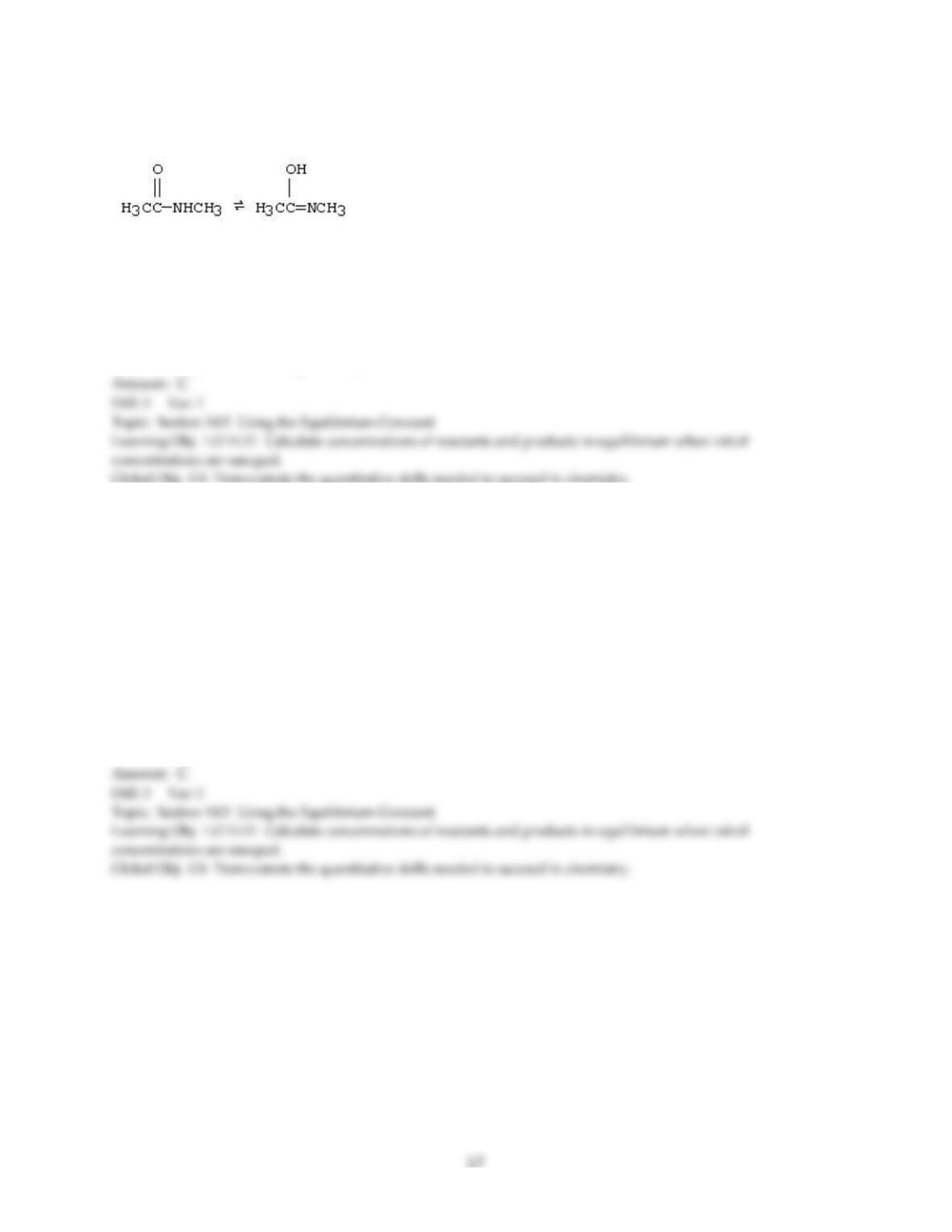
44) The following two isomers of C3H7NO exist in equilibrium with each other in solution:
If Kc = 0.57 at 25°C and the initial concentration of the reactant is 0.50 M and the product is 0.70 M, what
are the concentrations at equilibrium?
A) [reactant] = 0.43 M and [product] = 0.24 M
B) [reactant] = 0.67 M and [product] = 0.38 M
C) [reactant] = 0.76 M and [product] = 0.44 M
D) [reactant] = 0.82 M and [product] = 0.47 M
45) Cyclohexane (C6H12) undergoes a molecular rearrangement in the presence of AlCl3 to form
methylcyclopentane (CH3C5H9) according to the equation:
C6H12 ⇌ CH3C5H9
If Kc = 0.143 at 25°C for this reaction, find the equilibrium concentrations of C6H12 and CH3C5H9 if the
initial concentrations are 0.200 M and 0.100 M, respectively.
A) [C6H12] = 0.0625 and [CH3C5H9] = 0.062 M
B) [C6H12] = 0.138 and [CH3C5H9] = 0.162 M
C) [C6H12] = 0.262 M and [CH3C5H9] = 0.038 M
D) [C6H12] = 0.282 and [CH3C5H9] = 0.018 M
46) At a certain temperature the equilibrium constant, Kc, equals 0.11 for the reaction:
2 ICl(g) ⇌ I2(g) + Cl2(g).
What is the equilibrium concentration of ICl if 0.75 mol of I2 and 0.75 mol of Cl2 are initially mixed in a
2.0-L flask?
A) 0.23 M
B) 0.28 M
C) 0.45 M
D) 0.56
47) The equilibrium constant, Kp, equals 3.40 for the isomerization reaction:
cis-2-butene ⇌ trans-2-butene.
If a flask initially contains 0.250 atm of cis-2-butene and 0.125 atm of trans-2-butene, what is the
equilibrium pressure of each gas?
A) P(cis-2-butene) = 0.037 atm, P(trans-2-butene) = 0.125 atm
B) P(cis-2-butene) = 0.048 atm, P(trans-2-butene) = 0.165 atm
C) P(cis-2-butene) = 0.074 atm, P(trans-2-butene) = 0.250 atm
D) P(cis-2-butene) = 0.085 atm, P(trans-2-butene) = 0.290 atm
19
48) Phosphorus pentachloride decomposes to phosphorus trichloride at high temperatures according to
the reaction:
PCl5(g) ⇌ PCl3(g) + Cl2(g)
At 250°C, 0.250 M PCl5 is added to a flask. If Kc = 1.80, what are the equilibrium concentrations of each
gas?
A) [PCl5] = 0.0280 M, [PCl3] = 0.222 M, [Cl2] = 0.222 M
B) [PCl5] = 1.25 M, [PCl3] = 0.474 M, [Cl2] = 0.474 M
C) [PCl5] = 1.80 M, [PCl3] = 1.80 M, [Cl2] = 1.80 M
D) [PCl5] = 2.27 M, [PCl3] = 2.02 M, [Cl2] = 2.02 M
49) The esterification of acetic acid and ethanol is given by the reaction below:
C2H5OH(aq) + CH3COOH(aq) ⇌ CH3COOC2H5(aq) + H2O(l)
When 1.00 mol of ethanol was mixed with 2.00 mol of acid in a 1.00 L flask, 0.86 mol of ester was formed
at room temperature. What is the value of the equilibrium constant, Kc?
A) 0.43
B) 2.3
C) 4.6
D) 5.4
50) Kp is equal to 48.70 at 731 K for the reaction: H2(g) + I2(g) ⇌ 2 HI(g). Initially the mixture contains
0.08592 atm each of H2 and I2 and 1.0000 atm of HI. What is the pressure of HI at equilibrium?
A) 0.7955 atm
B) 0.9108 atm
C) 0.9140 atm
D) 0.9498 atm
51) When baking soda is heated it decomposes according to the following reaction:
2 NaHCO3(s) ⇌ Na2CO3(s) + H2O(g) + CO2(g)
If sufficient baking soda is placed in a container and heated to 90°C, the total pressure of the gases is
0.5451 atm. What is the value of Kp at that temperature?
A) 0.07428
B) 0.2973
C) 0.4228
D) 1.091
52) Ammonium carbamate can dissociate into gases at 25°C according to the reaction:
NH2COONH4(s) ⇌ 2 NH3(g) + CO2(g)
If sufficient ammonium carbamate is sealed in a flask, the total pressure will be 0.117 atm at equilibrium.
What is the value of Kp at 25°C?
A) 2.37 × 10⁻⁴
B) 2.00 × 10⁻⁴
C) 1.60 × 10⁻³
D) 3.42 × 10⁻¹