Survey of Economics, 6e (O’Sullivan/Sheffrin/Perez)
Chapter 14 Aggregate Demand and Aggregate Supply
14.1 Sticky Prices and Their Macroeconomic Consequences
1) Recessions occur because of
A) real adverse shocks to the economy.
B) shocks to technology.
C) difficulties in coordinating economic affairs.
D) all of the above
2) Real business cycle theory emphasizes the role of
A) demand shocks as a cause of economic fluctuations.
B) technology shocks as a cause of economic fluctuations.
C) shocks to the money supply as a cause of economic fluctuations.
D) government spending as a cause of economic fluctuations.
3) The economic theory that emphasizes the role of difficulties in coordinating economic affairs
as a cause of economic fluctuations is known as
A) Keynesian economics.
B) investment cycle theory.
C) real business cycle theory.
D) technology shock theory.
4) The mechanism that normally coordinates what goes on in an economy is the
A) government.
B) price system.
C) stock market.
D) Federal Reserve.
5) In modern economies
A) all prices are very flexible.
B) some prices are very flexible while others are not.
C) no prices are very flexible.
D) prices become less flexible as they increase.
6) Which of the following is a problem with the price system that can lead to a breakdown in the
coordination of economic activity?
A) The price system works silently in the background.
B) Prices can be slow to adjust.
C) Prices may be flexible.
D) all of the above
7) Which of the following is a problem with the price system that can lead to fluctuations in
output?
A) The price system works silently in the background.
B) Prices can be slow to adjust.
C) Prices may be flexible.
D) all of the above
8) Prices that adjust nearly on a daily basis are
A) custom prices.
B) auction prices.
C) sticky prices.
D) heavy prices.
9) Prices that adjust slowly are
A) custom prices.
B) auction prices.
C) flexible prices.
D) heavy prices.
10) Prices for fresh fruit, vegetables and other food products are examples of
A) custom prices.
B) auction prices.
C) sticky prices.
D) temporary prices.
11) Prices for industrial commodities such as steel rods or machine tools are
A) heavy prices.
B) sticky prices.
C) auction prices.
D) custom prices.
12) If prices are sticky
A) economic activity will be coordinated efficiently.
B) economic activity will not be coordinated efficiently.
C) prices will quickly adjust to changes in demand.
D) quantity supplied will always equal quantity demand.
13) Workers often have ________ contracts and so their wages are ________.
A) long-term; flexible
B) long-term; sticky
C) short-term; sticky
D) short-term; flexible
14) Stickiness of wages
A) is unrelated to stickiness of prices.
B) lessens the stickiness of prices.
C) reinforces stickiness of prices.
D) may or may not reinforce stickiness of prices.
15) The economy’s ability to coordinate economic activity is hindered by
A) sticky wages causing sticky prices.
B) auction prices.
C) workers whose wages change quickly.
D) all of the above
16) Workers whose wages tend to adjust slowly include all of the following EXCEPT
A) union workers.
B) unskilled, low wage workers.
C) those with long-term contracts.
D) movie stars, professional athletes, and rock stars.
17) Which of the following types of workers might have wages that change quickly?
A) unskilled, low-wage workers
B) union workers
C) employees of state and local governments
D) movie stars and rock stars
18) In which market would the price be least likely to be “sticky?”
A) refrigerators
B) steel rods
C) fresh fruit
D) trucks
19) Suppose the demand for hot dogs decreases. In the short run, firms that produce hot dogs will
experience a fall in prices, which will induce them to
A) increase production and increase the number of workers.
B) decrease production and increase the number of workers.
C) decrease production and reduce the number of workers.
D) increase production and reduce the number of workers.
20) Suppose the demand for hamburgers increases. In the short run, firms that produce
hamburgers will experience a rise in prices, which will induce them to
A) decrease production and decrease the number of workers.
B) increase production and increase the number of workers.
C) decrease production and increase the number of workers.
D) increase production and decrease the number of workers.
21) Suppose consumer tastes and preferences shift from pizza to tacos. In the short run case,
these changing tastes will result in pizza restaurants ________ pizza prices and taco restaurants
________ taco prices.
A) increasing; decreasing
B) decreasing; increasing
C) decreasing; decreasing
D) increasing; increasing
22) Suppose consumer tastes and preferences shift from tacos to pizzas. In the short run, these
changing tastes will result in pizza restaurants ________ pizza prices and taco restaurants
________ taco prices.
A) increasing; decreasing
B) decreasing; increasing
C) decreasing; decreasing
D) increasing; increasing
23) The short run in macroeconomics is the period in which
A) prices change significantly.
B) no contracts or agreements exist to fix prices.
C) demand determines output.
D) the demand curve is vertical.
Recall the Application about the behavior of prices in retail catalogs to answer the
following question(s). Economist Anil Kashyap of the University of Chicago examined the
prices of 12 selected goods from L.L. Bean, REI, and The Orvis Company, Inc. Kashyap
tracked the prices from the companies’ catalogs which were reissued every six months.
24) Recall the application. This Application examines the concept of
A) the wealth effect.
B) sticky prices.
C) consumer spending habits.
D) stagflation.
25) Recall the application. Even though the catalogs listed in the Application were reissued every
six months, the prices which were tracked in these retail catalogs
A) were typically fixed for a year or more.
B) changed every month.
C) tended to fall during periods of high inflation.
D) were not listed due to low rates of inflation.
26) Recall the application. The prices which were tracked in the retail catalogs exemplified the
macroeconomic concept of the short run, a period of time in which
A) price changes are significant because the aggregate supply curve is vertical.
B) prices never change because the aggregate demand curve is vertical.
C) prices change frequently because of changes in aggregate supply.
D) prices don’t change very much, implying that the aggregate supply curve is relatively flat.
27) The price system always works instantaneously.
28) Prices of industrial products and wages tend to be the most “flexible.”
29) For most firms, the biggest cost of doing business is wages.
30) The price system works in an economy on a day-to-day basis to match the desires of
consumers with the output from producers.
31) Changes in demand will often be met with changes in output rather than changes in prices
because of formal and informal contracts.
32) What are some reasons why coordination of economic affairs through the price system may
not work perfectly?
33) What are the two types of prices in an economy?
34) Suppose that demand for a product falls, but prices are sticky. What is likely to happen to
prices and output in that market, in the short run?
14.2 Understanding Aggregate Demand
1) The relationship between the level of prices and the total demand for all goods and services is
known as
A) aggregate supply.
B) market supply.
C) aggregate demand.
D) market demand.
2) Aggregate demand refers to the relationship between
A) prices and the quantity of a good supplied.
B) the price level and the quantity of real GDP supplied.
C) prices and the quantity of a good demanded.
D) the price level and the quantity of real GDP demanded.
3) What is the total demand for goods and services in an entire economy called?
A) supply and demand
B) aggregate demand
C) consumer demand
D) GDP demand
4) The aggregate demand curve is
A) downward sloping.
B) upward sloping.
C) a vertical line at potential output.
D) a horizontal line at the current price level.
5) As the price level ________, the purchasing power of money ________.
A) increases; increases
B) increases; decreases
C) decreases; decreases
D) decreases; stays the same
6) The increase in spending that occurs because the real value of money increases when the price
level falls is known as the
A) interest rate effect.
B) international trade effect.
C) price effect.
D) wealth effect.
7) One reason the aggregate demand curve is downward sloping is because of the
A) interest rate effect.
B) welfare effect.
C) price effect.
D) tariff effect.
8) The increase in spending that occurs because the demand for investment goods increases when
the price level falls is known as the
A) interest rate effect.
B) international trade effect.
C) price effect.
D) wealth effect.
9) The increase in spending that occurs because domestic goods become cheaper relative to
foreign goods when the price level falls is known as the
A) interest rate effect.
B) international trade effect.
C) price effect.
D) wealth effect.
10) The purchasing power of money increases as the
A) demand increases.
B) unemployment decreases.
C) price level falls.
D) production increases.
11) The purchasing power of money decreases as the
A) production decreases.
B) price level increases.
C) employment increases.
D) demand increases.
12) The real value of money ________ as the price level falls.
A) remains the same
B) decreases
C) increases
D) none of the above
13) When interest rates are lower, consumers and companies are able to borrow money cheaply
in order to make major purchases. As a result, the demand for goods in an economy will
generally
A) decrease.
B) increase.
C) remain the same.
D) be minimally affected.
14) When the price level is low, resulting in domestic goods being cheaper than imported foreign
goods,
A) consumers hold more money.
B) consumers spend less.
C) the demand for domestic goods will increase.
D) there will be a reduction in import tariffs.
15) When the price level is low and the demand for domestic goods increases, how does it affect
international trade?
A) Net exports will decrease.
B) Net exports will increase.
C) Prices of all international goods will decrease.
D) Prices of all international goods will increase.
16) If home prices are falling, consumers purchasing a home will find their purchasing power of
money has increased. This benefit to consumers is called the
A) inflation effect.
B) wealth effect.
C) home equity effect.
D) multiplier effect.
17) Which of the following does NOT shift the U.S. aggregate demand curve?
A) an increase in the supply of money
B) an increase in GDP in Japan
C) a decrease in taxes
D) a decrease in the price level
18) Which of the following does NOT decrease aggregate demand in the United States?
A) a decrease in the price of oil
B) a decrease in GDP in Germany
C) a decrease in government spending
D) a decrease in the supply of money
19) Which of the following would cause an increase in aggregate demand in the short run?
A) an increase in the supply of money
B) a decrease in the price level
C) an increase in taxes
D) a crop failure
20) Which of the following would cause a decrease in aggregate demand?
A) a rise in wages
B) an increase in the price level
C) an increase in the money supply
D) a fall in investor confidence
21) Which of the following causes a movement along the aggregate demand curve?
A) a fall in wages
B) an increase in the price level
C) an increase in government spending
D) an increase in the money supply
22) Which one of the following would shift the aggregate demand curve to the left?
A) an increase in the money supply
B) an increase in government spending
C) an increase in exports
D) an increase in taxes
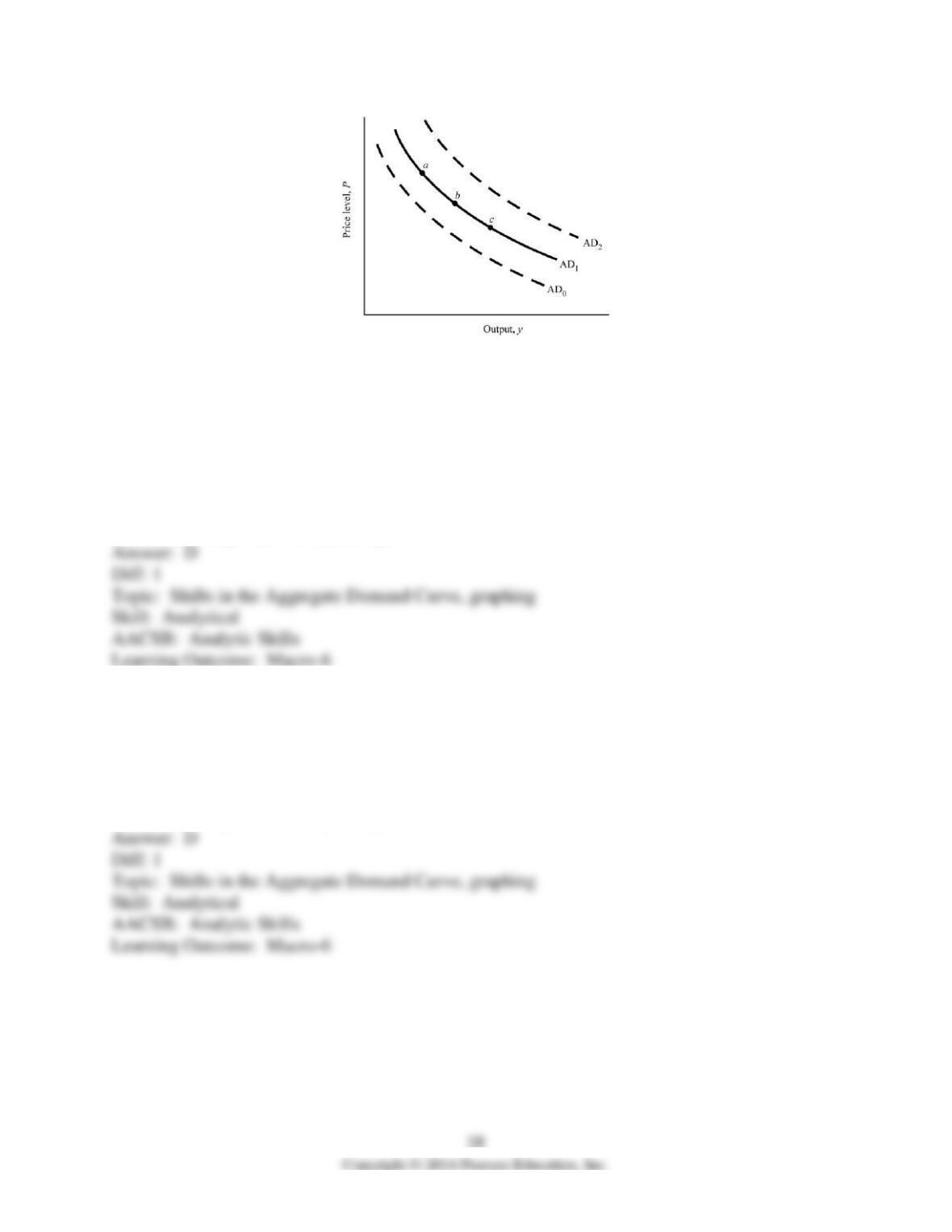
Figure 14.1
23) Figure 14.1 shows three aggregate demand curves. A movement from curve AD1 to curve
AD0 could be caused by a(n)
A) increase in the money supply.
B) decrease in taxes.
C) increase in the price level.
D) decrease in government spending.
24) Figure 14.1 shows three aggregate demand curves. A movement from curve AD1 to curve
AD2 could be caused by a(n)
A) decrease in the money supply.
B) increase in taxes.
C) decrease in the price level.
D) increase in government spending.
25) Figure 14.1 shows three aggregate demand curves. A movement from curve AD1 to curve
AD2 could be caused by a(n)
A) increase in the money supply.
B) increase in taxes.
C) increase in the price level.
D) decrease in government spending.
26) Figure 14.1 shows three aggregate demand curves. A movement from curve AD1 to curve
AD0 could be caused by a(n)
A) decrease in the money supply.
B) decrease in taxes.
C) increase in the price level.
D) increase in government spending.
27) Figure 14.1 shows three aggregate demand curves. A movement from curve AD0 to curve
AD1 could be caused by a(n)
A) decrease in the money supply.
B) decrease in taxes.
C) decrease in the price level.
D) decrease in government spending.
28) Figure 14.1 shows three aggregate demand curves. A movement from curve AD2 to curve
AD1 could be caused by a(n)
A) increase in the money supply.
B) increase in taxes.
C) increase in the price level.
D) increase in government spending.
29) Figure 14.1 shows three aggregate demand curves. A movement from point b to point a
could be caused by a(n)
A) decrease in the money supply.
B) increase in taxes.
C) increase in the price level.
D) increase in government spending.
30) Figure 14.1 shows three aggregate demand curves. A movement from point b to point c
could be caused by a(n)
A) increase in the money supply.
B) decrease in taxes.
C) decrease in the price level.
D) decrease in government spending.