General Chemistry: Atoms First, 2e (McMurry and Fay)
Chapter 14 Aqueous Equilibria: Acids and Bases
14.1 Multiple Choice Questions
1) An Arrhenius acid is best defined as a
A) hydroxide donor.
B) proton acceptor.
C) substance that dissociates in water to produce aqueous hydrogen ions.
D) substance that dissociates in water to produce aqueous hydroxide ions.
2) When dissolved in water, which of the following compounds is an Arrhenius acid?
A) HCN
B) NaOH
C) NaF
D) CH3CH2OH
3) An Arrhenius base is best defined as a
A) proton donor.
B) hydroxide acceptor.
C) substance that dissociates in water to produce aqueous hydrogen ions.
D) substance that dissociates in water to produce aqueous hydroxide ions.
4) When dissolved in water, which of the following compounds is an Arrhenius base?
A) CH3OH
B) HOCl
C) KOH
D) KCl
5) A Brønsted-Lowry acid is best defined as a substance that can
A) accept a hydroxide ion.
B) donate a hydroxide ion.
C) accept a proton.
D) donate a proton.
6) Which one of the following species acts as a Brønsted-Lowry acid in water?
A) NaH
B) NH4+
C) CH3NH2
D) C6H6
7) In the following chemical equation indicate the reactant that is a Brønsted-Lowry acid
HCN(aq) + H2O(l) ⇌ H3O+(aq) + CN–(aq).
A) HCN
B) H2O
C) H3O+
D) CN–
8) Indicate all the Brønsted-Lowry acids in the following chemical reaction
HCl(aq) + H2O(aq) ⇌ H3O+(aq) + Cl–(aq).
A) HCl, H2O
B) HCl,
C) HCl, Cl–
D) HCl, H2O, H3O+
9) What are the Brønsted-Lowry bases in the following chemical reaction
C5H5N(aq) + H2O(l) ⇌ C5H5NH+(aq) + OH-(aq)?
A) C5H5N, H2O
B) C5H5N, C5H5NH+
C) C5H5N,
D) C5H5N, H2O, OH–
10) What are the Brønsted-Lowry acids in the following chemical reaction
HBr(sol) + CH3COOH(sol) ⇌ CH3C(OH)2+(sol) + Br–(sol)?
A) HBr, CH3COOH
B) HBr,
C) CH3COOH, CH3C(OH)2+
D) CH3COOH, Br–
11) What are the conjugate acid-base pairs in the following chemical reaction
NH3(aq) + H2O(l) ⇌ NH4+(aq) + OH–(aq)?
A) NH3, H2O and NH4+, OH–
B) NH3, NH4+ and H2O, OH–
C) NH3, OH– and H2O, NH4+
D) NH3 and NH4+
12) Identify the conjugate acid/base pairs present in an aqueous solution of hydrogen sulfate ion,
HSO4–.
A) HSO4–/SO42- and H3O+/H2O
B) H2SO4/HSO4– and H2O/OH–
C) HSO4–/H2O and H3O+/SO42-
D) HSO4–/H2O and H2SO4/OH–
13) What is the conjugate base of the Brønsted-Lowry acid HPO42-?
A) H3PO4
B) H2PO4–
C) HPO42-
D) PO43-
14) What is the conjugate acid of the Brønsted-Lowry base HAsO42-?
A) H2AsO4–
B) AsO43-
C) H2O
D) H3O+
15) Which one of the following can behave either as a Brønsted-Lowry acid or a Brønsted-
Lowry base in an aqueous solution reaction?
A) HSO3–
B) NH3
C) HI
D) H3PO4
16) Write a balanced equation for the dissociation of the Brønsted-Lowry acid HSO4– in water.
A) HSO4–(aq) + H2O(l) ⇌ H2SO4(aq) + OH–(aq)
B) HSO4–(aq) + H2O(l) ⇌ SO42-(aq) + H3O+(aq)
C) HSO4–(aq) + H2O(l) ⇌ SO32-(aq) + OH–(aq)
D) HSO4–(aq) + H2O(l) ⇌ SO3(g) + OH–(aq) + H2O(l)
17) Which of the following Brønsted-Lowry acids does not behave as a strong acid when it is
dissolved in water?
A) H
B) HCl
C) HNO2
D) HClO4
18) Which Brønsted -Lowry base has the strongest conjugate acid?
A) CH3CO2–
B) CN–
C) F–
D) NO3–
19) Which Brønsted-Lowry acid has the strongest conjugate base?
A) HCl
B) HClO4
C) HF
D) H
20) What is the strongest Brønsted-Lowry acid in the chemical reaction shown below?
2 HNO3(aq) + Ba(OH)2(aq) → Ba(NO3)2(aq) + 2 H2O(l)
A) HNO3
B) Ba(OH)2
C) Ba(NO3)2
D) H2O
21) From the following chemical reactions determine the relative Brønsted-Lowry acid strengths
(strongest to weakest).
HCl(aq) + H2O(l) → H3O+(aq) + Cl–(aq)
HCN(aq) + H2O(l) ⇌ H3O+(aq) + CN–(aq)
A) HCl > HCN > H3O+
B) HCl > H3O+ > HCN
C) H3O+ > HCl > HCN
D) HCN > H3O+ > HCl
22) From the following chemical reactions determine the relative Brønsted-Lowry acid strengths
(strongest to weakest).
HClO4(aq) + H2O(l) → H3O+(aq) + ClO4–(aq)
HNO2(aq) + H2O(l) ⇌ H3O+(aq) + NO2–(aq)
A) HClO4 > H3O+ > HNO2
B) HClO4 > HNO2 > H3O+
C) H3O+ > HClO4 > HNO2
D) H3O+ > HNO2 > HClO4
23) From the following chemical reactions determine the relative Brønsted-Lowry acid strengths
(strongest to weakest).
HClO4(sol) + CH3COOH(l) → CH3C2(OH)2+(sol) + ClO4–(aq)
H2SO4(sol) + CH3COOH(l) ⇌ CH3C(OH)2+(sol) + HSO4–(sol)
A) HClO4 > H2SO4 > CH3COOH
B) HClO4 > H2SO4 > CH3C(OH)2+
C) HClO4 > CH3COOH > H2SO4
D) HClO4 > CH3C(OH)2+ > H2SO4
24) From the following chemical reactions determine the relative Brønsted-Lowry base strengths
(strongest to weakest).
HNO3(aq) + H2O(l) → H3O+(aq) + NO3–(aq)
HF(aq) + H2O(l) ⇌ H3O+(aq) + F–(aq)
A) HNO3 > H3O+ > HF
B) NO3– > H2O > F–
C) F– > H2O > NO3–
D) F– > NO3– > H2O
25) From the following chemical reactions determine the relative Brønsted-Lowry base strengths
(strongest to weakest).
2 NaH(s) + H2O(l) → 2 NaOH + H2(g)
NH3(aq) + H2O(l) ⇌ NH4+(aq) + OH–(aq)
A) H– > OH– > NH3
B) H– > NH3 > OH–
C) OH–> H– > NH3
D) OH– > NH3 > H–
26) The equilibrium constant, K, for the reaction shown below has a value 1.8 × 10⁻⁵. In this
reaction which is the strongest acid and which is the strongest base?
CH3CO2H(aq) + H2O(l) ⇌ H3O+(aq) + CH3CO2–(aq)
A) CH3CO2H and CH3CO2–
B) CH3CO2H and H2O
C) H3O+ and H2O
D) H3O+ and CH3CO2–
8
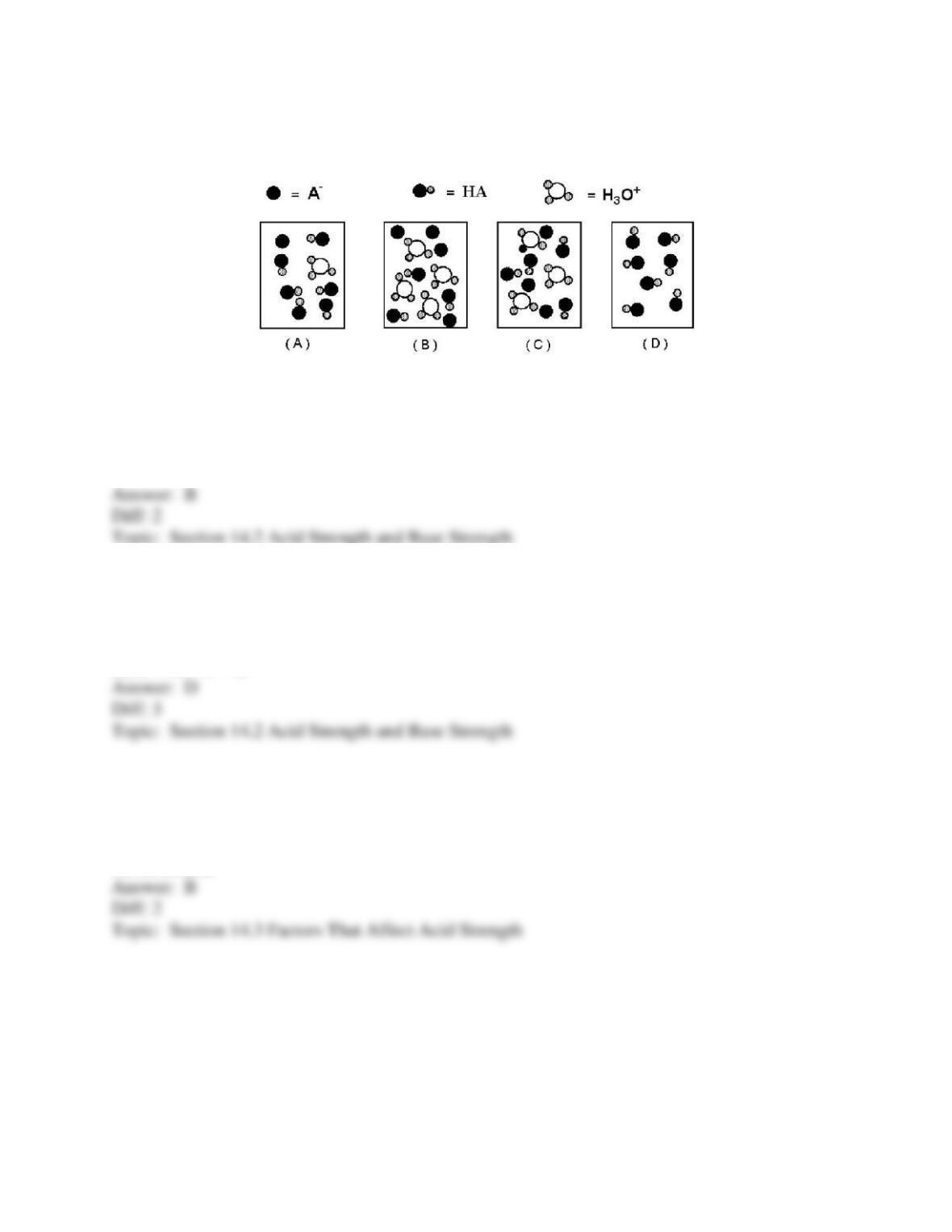
The following pictures represent aqueous solutions of binary acids of the type HA where the
water molecules have been omitted for clarity.
27) Determine the strongest acid of the set.
A) A
B) B
C) C
D) D
28) Arrange the acids in order of increasing acid strength.
A) D < C < A < B
B) D < C < B < A
C) D < B < A < C
D) D < A < C < B
29) What is the geometric shape of the hydrated proton; that is, the hydronium ion H3O+?
A) angular
B) trigonal pyramidal
C) trigonal planar
D) tetrahedral
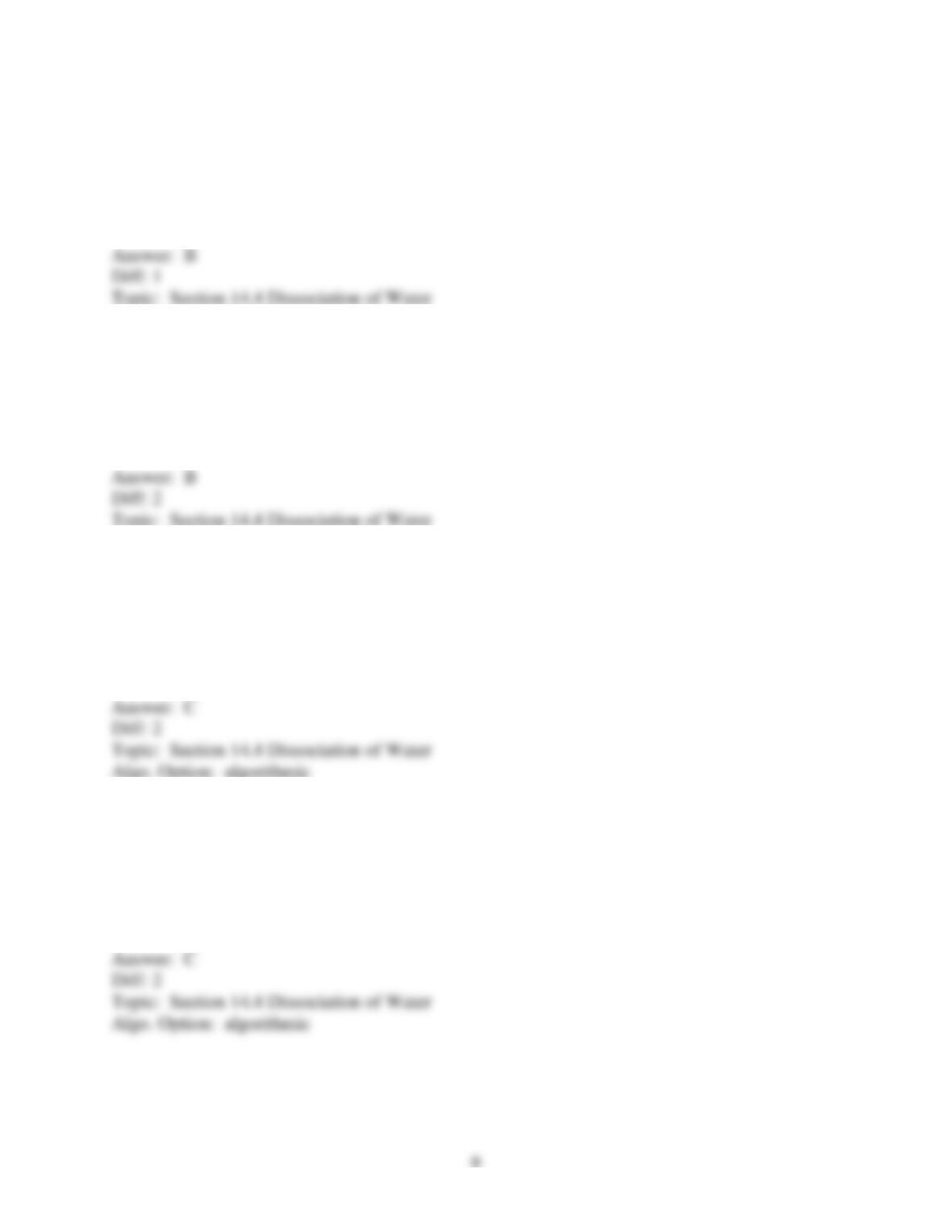
30) An acidic solution at 25°C has
A) [H3O+] > [OH–] > 1 × 10⁻⁷ M.
B) [H3O+] > 1 × 10⁻⁷ M > [OH–].
C) [H3O+] = [OH–] > 1 × 10⁻⁷ M.
D) [H3O+] < 1 × 10⁻⁷ M > [OH–].
31) At 50°C the value of Kw is 5.5 × 10⁻¹⁴. A basic solution at 50°C has
A) [H3O+] < [OH–] < 2.3 × 10⁻⁷ M.
B) [H3O+] < 2.3 × 10⁻⁷ M < [OH–].
C) [H3O+] = [OH–] < 2.3 × 10⁻⁷ M.
D) [H3O+] > 2.3 × 10⁻⁷ M < [OH–].
32) Calculate the hydronium ion concentration in an aqueous solution that contains 2.50 × 10⁻⁴
M in hydroxide ion.
A) 4.00 × 10⁻⁹ M
B) 4.00 × 10⁻¹⁰ M
C) 4.00 × 10⁻¹¹ M
D) 5.00 × 10⁻¹¹ M
33) Calculate the hydroxide ion concentration in an aqueous solution that contains 3.50 × 10⁻³ M
in hydronium ion.
A) 2.86 × 10⁻⁴ M
B) 2.86 × 10⁻¹¹ M
C) 2.86 × 10⁻¹² M
D) 3.50 × 10⁻¹² M
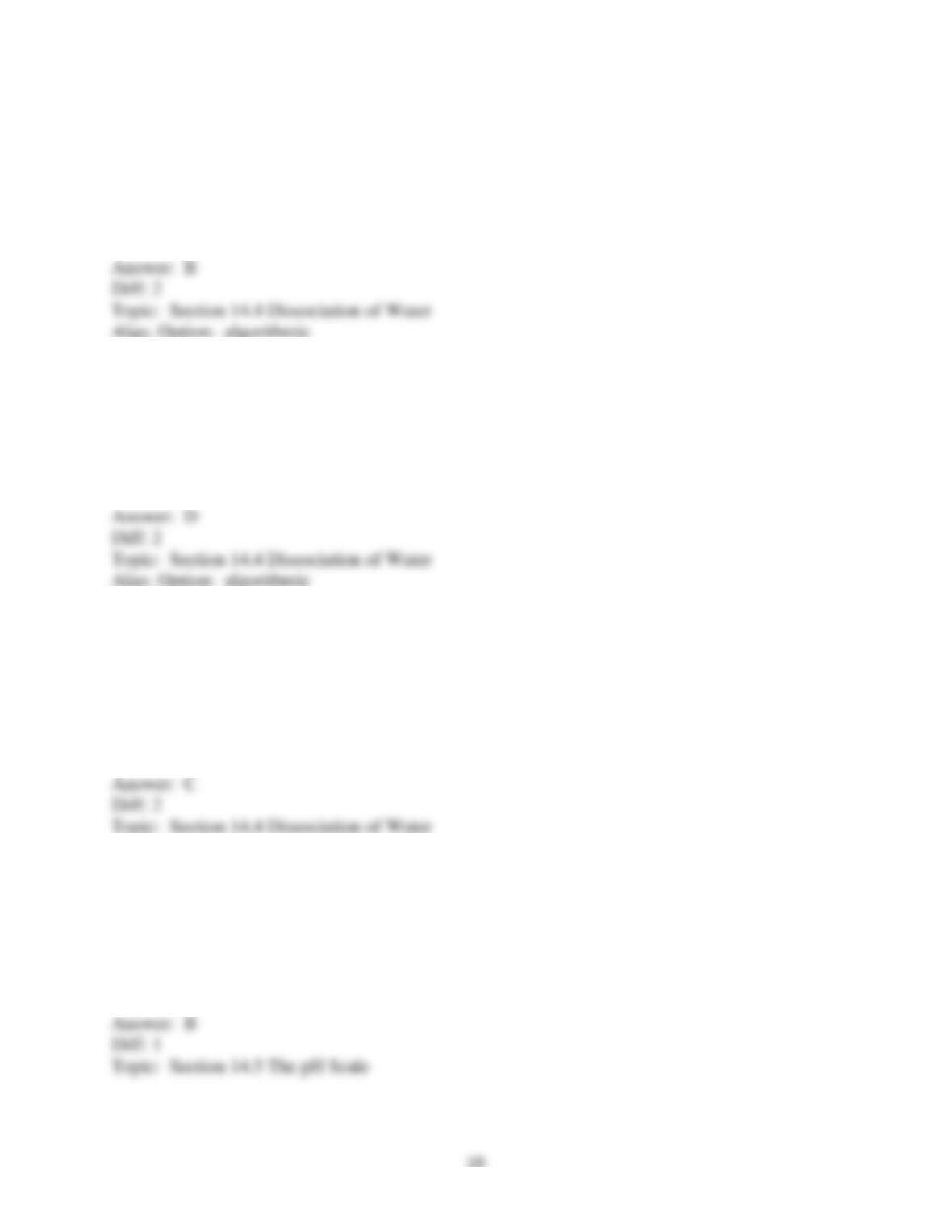
34) A solution with a hydrogen ion concentration of 3.25 × 10⁻² M is ________ and has a
hydroxide concentration of ________.
A) acidic, 3.08 × 10⁻¹² M
B) acidic, 3.08 × 10⁻¹³ M
C) basic, 3.08 × 10⁻¹² M
D) basic, 3.08 × 10⁻¹³ M
35) A solution with a hydroxide ion concentration of 4.15 × 10⁻⁴ M is ________ and has a
hydrogen ion concentration of ________.
A) acidic, 2.41 × 10⁻¹⁰ M
B) acidic, 2.41 × 10⁻¹¹ M
C) basic, 2.41 × 10⁻¹⁰ M
D) basic, 2.41 × 10⁻¹¹ M
36) If the ionization constant of water, Kw, at 40°C is 2.92 × 10⁻¹⁴, then what is the hydronium
ion concentration for a neutral solution?
A) [H3O+] < 1.00 × 10⁻⁷ M
B) [H3O+] > 1.71 × 10⁻⁷ M
C) [H3O+] = 1.71 × 10⁻⁷ M
D) [H3O+] < 1.71 × 10⁻⁷ M
37) An acidic solution at 25°C will have a hydronium ion concentration ________ and a pH
value ________.
A) [H3O+] > 1 × 10⁻⁷ M, pH > 7.00
B) [H3O+] > 1 × 10⁻⁷ M, pH < 7.00
C) [H3O+] < 1 × 10⁻⁷ M, pH > 7.00
D) [H3O+] < 1 × 10⁻⁷ M, pH < 7.00
38) If the ionization constant of water, Kw, at 40°C is 2.92 × 10⁻¹⁴, then what is the hydronium
ion concentration and pH for an acidic solution?
A) [H3O+] > 1.71 × 10⁻⁷ M and pH > 6.77
B) [H3O+] > 1.71 × 10⁻⁷ M and pH < 6.77
C) [H3O+] < 1.71 × 10⁻⁷ M and pH > 6.77
D) [H3O+] < 1.71 × 10⁻⁷ M and pH < 6.77
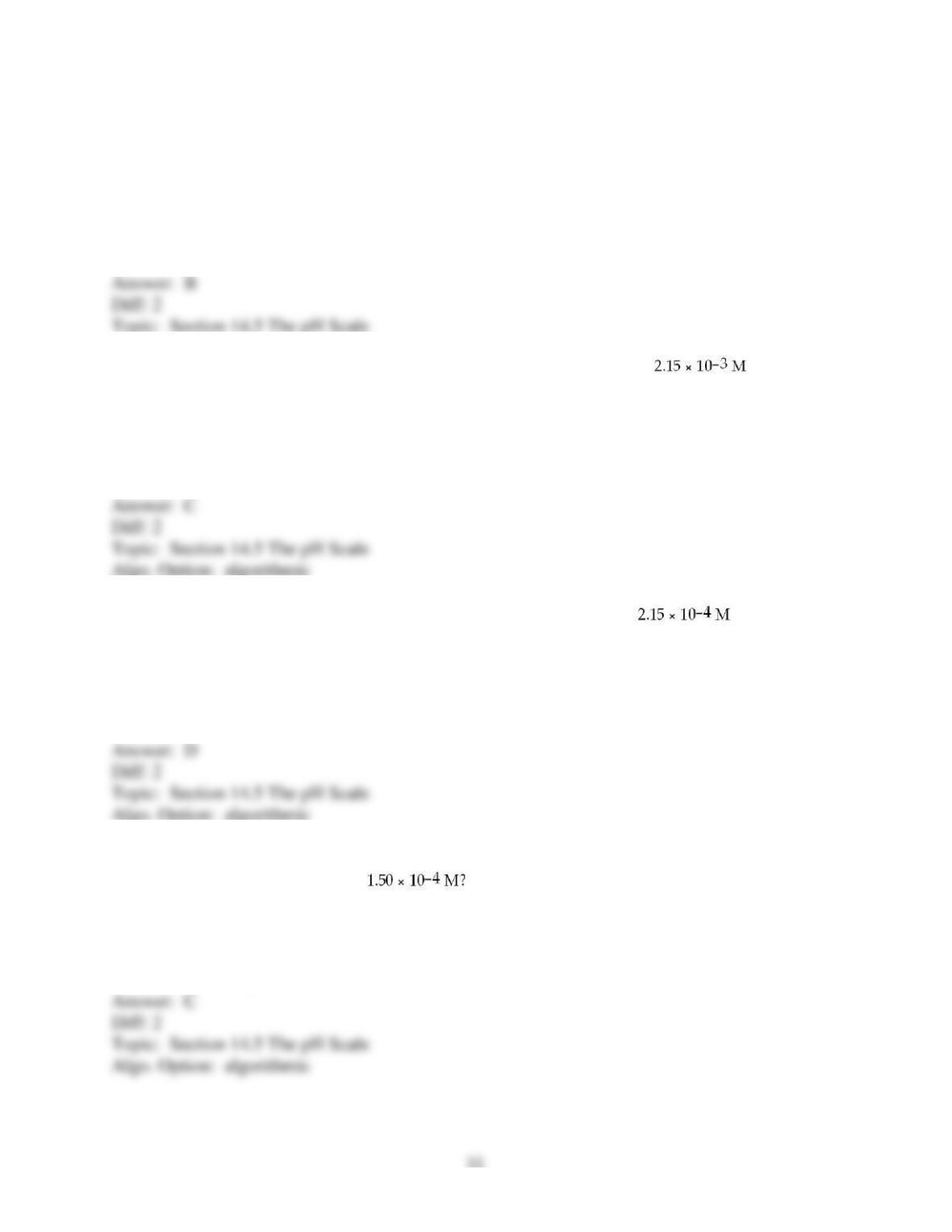
39) Calculate the pH for an aqueous solution of acetic acid that contains hydronium
ion.
A) 4.65 × 10⁻¹²
B) 2.15 × 10⁻³
C) 2.67
D) 11.33
40) Calculate the pH for an aqueous solution of pyridine that contains hydroxide
ion.
A) 4.65 × 10⁻¹¹
B) 2.15 × 10⁻⁴
C) 3.67
D) 10.33
41) What is the hydroxide ion concentration and the pH for a hydrochloric acid solution that has
a hydronium ion concentration of
A) 6.67 × 10⁻¹⁰ M, 4.82
B) 6.67 × 10⁻¹⁰ M, 9.18
C) 6.67 × 10⁻¹¹ M, 3.82
D) 6.67 × 10⁻¹¹ M, 10.18
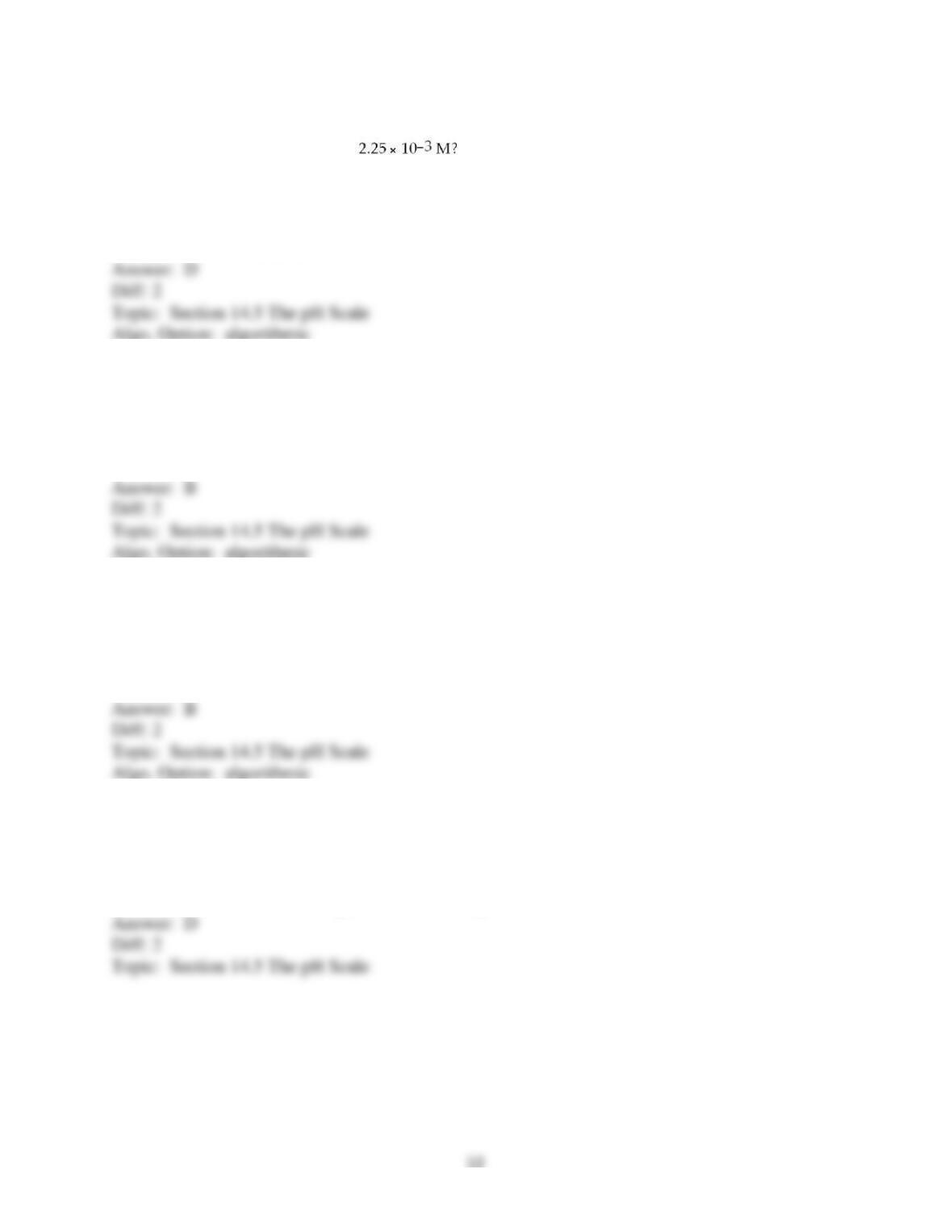
42) What is the hydronium ion concentration and the pH for an aqueous solution of NH3 that has
a hydroxide ion concentration of
A) 4.44 × 10⁻¹¹ M, 3.65
B) 4.44 × 10⁻¹¹ M, 10.35
C) 4.44 × 10⁻¹² M, 2.65
D) 4.44 × 10⁻¹² M, 11.35
43) What is the hydronium ion concentration of an acid rain sample that has a pH of 3.15?
A) 1.41 × 10⁻¹¹ M
B) 7.08 × 10⁻⁴ M
C) 3.15 M
D) 10.85 M
44) What is the hydroxide ion concentration of a lye solution that has a pH of 11.20?
A) 6.31 × 10⁻¹² M
B) 1.58 × 10⁻³ M
C) 2.80 M
D) 11.20 M
45) What statement is most consistent for an acid with a pH = 3?
A) one one-hundredth as strong as an acid with a pH of 5
B) half a strong as an acid with a pH = 5
C) twice as strong as an acid with a pH of 5
D) one hundred times as strong as an acid with a pH = 5
13
46) At 25°C, the pH of a vinegar solution is 2.60. What are the values of [H3O+] and [OH–] in
the solution?
A) 3.99 × 10⁻¹² M, 2.51 × 10⁻³ M
B) 2.51 × 10⁻³ M, 3.98 × 10⁻¹² M
C) 2.51 × 10⁻³ M, 11.40 M
D) 2.60 M, 11.40 M
47) What is the approximate pH of a solution X that gives the following responses with the
indicators shown?
Indicators
HIn —
In–
pH
range
Solution
X
methyl orange
red-yellow
3.2-4.4
yellow
methyl red
red-yellow
4.8-6.0
yellow
bromthymol blue
yellow-blue
6.0-7.6
green
phenolphthalein
colorless-pink
8.2-10.0
colorless
A) 3.2 – 4.4
B) 4.8 – 6.0
C) 6.0 – 7.6
D) 8.2 – 10.0
48) What is the approximate pH of a solution X that gives the following responses with the
indicators shown?
Indicators
HIn —
In–
pH
range
Solution
X
methyl orange
red-yellow
3.2-4.4
yellow
methyl red
red-yellow
4.8-6.0
orange
bromthymol blue
yellow-blue
6.0-7.6
yellow
phenolphthalein
colorless-pink
8.2-10.0
colorless
A) 3.2 – 4.4
B) 4.8 – 6.0
C) 6.0 – 7.6
D) 8.2 – 10.0
49) What is the approximate pH of a solution X that gives the following responses with the
indicators shown?
Indicators
HIn —
In–
pH
range
Solution
X
methyl orange
red-yellow
3.2-4.4
yellow
methyl red
red-yellow
4.8-6.0
yellow
bromthymol blue
yellow-blue
6.0-7.6
blue
phenolphthalein
colorless-pink
8.2-10.0
pink
A) 4.8 – 6.0
B) 6.0 – 7.6
C) 7.6 – 8.2
D) > 8.2
50) What is the pH of a 0.020 M HClO4 solution?
A) 0.020
B) 0.040
C) 1.70
D) 12.30
51) What is the pH of a 0.020 M RbOH solution?
A) 0.020
B) 0.040
C) 1.70
D) 12.30
52) What is the pH of a 0.020 M Ba(OH)2 solution?
A) 1.40
B) 1.70
C) 12.30
D) 12.60
53) What is the pH of a solution prepared by dissolving 0.15 gram of solid CaO (lime) in enough
water to make 2.00 L of aqueous Ca(OH)2 (limewater)?
CaO(s) + H2O(l) → Ca2+(aq) + 2 OH–(aq)
A) 2.57
B) 2.87
C) 11.13
D) 11.43
54) What is the pH of a solution prepared by diluting 25.00 mL of 0.10 M HCl with enough
water to produce a total volume of 100.00 mL?
A) 1.00
B) 1.60
C) 2.00
D) 3.20
55) What is the pH of a solution prepared by diluting 25.00 mL of 0.020 M Ba(OH)2 with
enough water to produce a total volume of 250.00 mL?
A) 2.40
B) 2.70
C) 11.30
D) 11.60
56) What is the pH of a solution made by mixing 100.00 mL of 0.20 M HCl with 50.00 mL of
0.10 M HCl? Assume that the volumes are additive.
A) 0.15
B) 0.52
C) 0.78
D) 1.70
57) What is the pH of a solution made by mixing 100.0 mL of 0.10 M HNO3, 50.0 mL of 0.20 M
HCl, and 100.0 mL of water? Assume that the volumes are additive.
A) 0.30
B) 0.82
C) 1.00
D) 1.10
58) What is the pH of a solution prepared by mixing 100.00 mL of 0.020 M Ca(OH)2 with 50.00
mL of 0.100 M NaOH? Assume that the volumes are additive.
A) 12.67
B) 12.78
C) 12.95
D) 13.25
59) What is the equilibrium constant expression (Ka) for the acid dissociation of hydrocyanic
acid HCN? The equation of interest is
HCN(aq) + H2O(l) ⇌ H3O+(aq) + CN–(aq).
A) Ka = ([H3O+][CN–])/([HCN][H2O])
B) Ka = ([H3O+][CN–])/([HCN])
C) Ka = ([HCN][H2O])/([H3O+][CN–])
D) Ka = ([HCN])/([H3O+][CN–])
60) What is the equilibrium constant expression (Ka) for the acid dissociation of nitrous acid
HNO2? The equation of interest is
HNO2(aq) + H2O(l) ⇌ H3O+(aq) + NO2–(aq).
A) Ka = ([H3O+][NO2–])/([HNO2][H2O])
B) Ka = ([H3O+][NO2–])/([HNO2])
C) Ka = ([HNO2][H2O])/([H3O+][NO2–])
D) Ka = ([HNO2])/([H3O+][NO2–])
61) Determine the acid dissociation constant for a 0.10 M acetic acid solution that has a pH of
2.87. Acetic acid is a weak monoprotic acid and the equilibrium equation of interest is
A) 1.3 × 10⁻²
B) 1.3 × 10⁻³
C) 1.8 × 10⁻⁵
D) 1.8 × 10⁻⁶
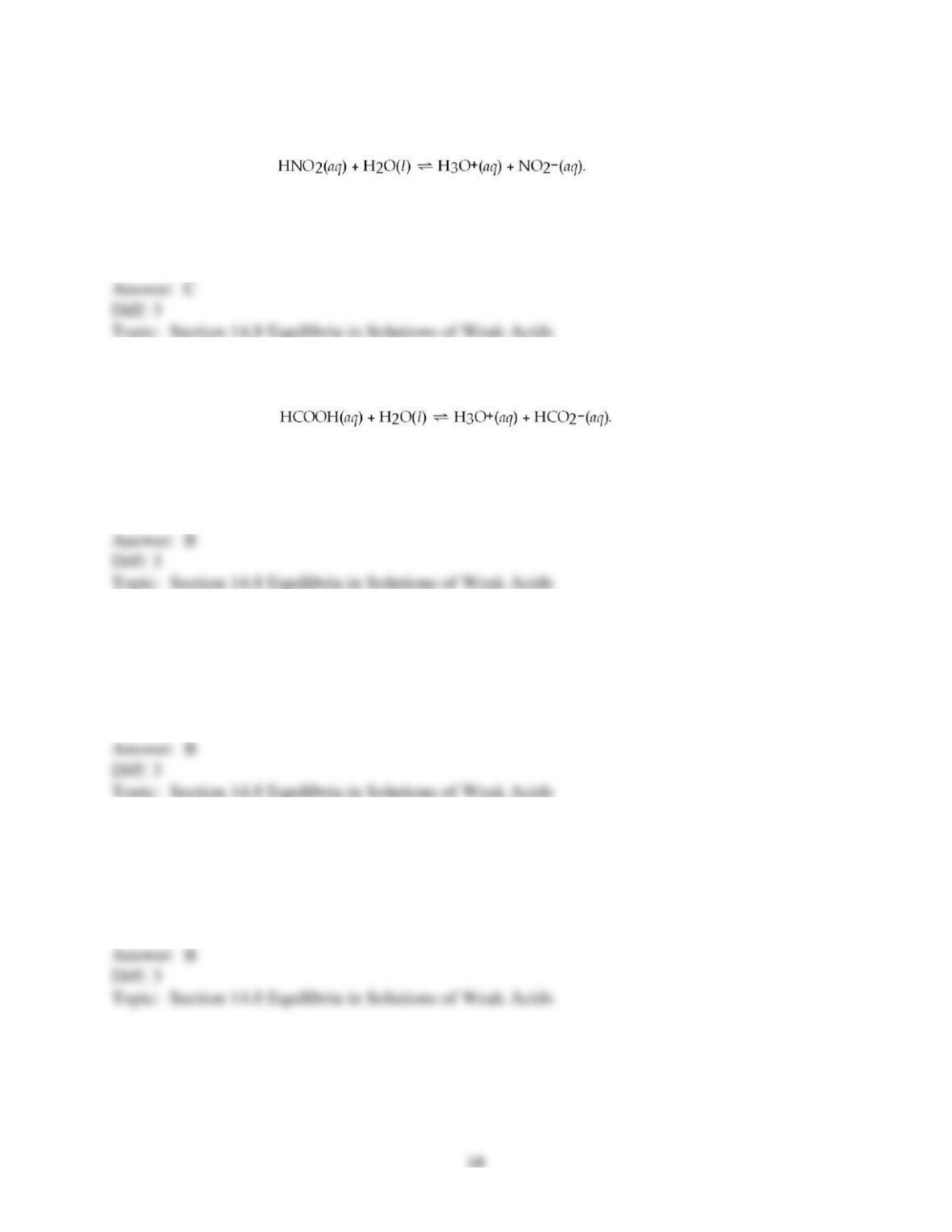
62) Determine the acid dissociation constant for a 0.010 M nitrous acid solution that has a pH of
2.70. Nitrous acid is a weak monoprotic acid and the equilibrium equation of interest is
A) 8.0 × 10⁻³
B) 2.0 × 10⁻³
C) 5.0 × 10⁻⁴
D) 4.0 × 10⁻⁴
63) Determine the acid dissociation constant for a 0.020 M formic acid solution that has a pH of
2.74. Formic acid is a weak monoprotic acid and the equilibrium equation of interest is
A) 1.8 × 10⁻³
B) 1.8 × 10⁻⁴
C) 3.6 × 10⁻⁴
D) 3.6 × 10⁻⁵
64) The pH of 0.255 M HCN is 4.95. What is the value of Ka for hydrocyanic acid?
A) 1.3 × 10⁻¹⁰
B) 4.9 × 10⁻¹⁰
C) 1.1 × 10⁻⁵
D) 4.4 × 10⁻⁵
65) The pH of 0.150 M CH3CO2H, acetic acid, is 2.78. What is the value of Ka for acetic acid?
A) 2.8 × 10⁻⁶
B) 1.9 × 10⁻⁵
C) 1.7 × 10⁻³
D) 1.1 × 10⁻²
66) What is the strongest monoprotic acid of the following set if all the acids are at 0.100 M
concentration?
A) hydrofluoric acid with Ka = 3.5 × 10⁻⁴
B) benzoic acid with Ka = 6.5 × 10⁻⁵
C) acetic acid with Ka = 1.8 × 10⁻⁵
D) hypochlorous acid with Ka = 3.5 × 10⁻⁸
67) What is the hydronium ion concentration of a 0.100 M acetic acid solution with a Ka = 1.8 ×
10-5? The equation for the dissociation of acetic acid is:
CH3CO2H(aq) + H2O(l) ⇌ H3O+(aq) + CH3CO2–(aq).
A) 1.3 × 10⁻² M
B) 4.2 × 10⁻² M
C) 1.3 × 10⁻³ M
D) 4.2 × 10⁻³ M
68) The p of HCN is 9.31. What is the pH of a 0.52 M solution of HCN?
A) 4.80
B) 5.20
C) 6.79
D) 6.33
69) The of hypochlorous acid, HOCl, is 3.5 × . What is the pH of 0.78 M HOCl?
A) 3.78
B) 3.50
C) 2.82
D) 2.53
70) What is the p of hypobromous acid, HOBr, if a 0.40 M HOBr has a pH of 4.50?
A) 8.60
B) 4.50
C) 6.11
D) 4.92
71) What is the hydronium ion concentration of a 0.100 M hypochlorous acid solution with
The equation for the dissociation of hypochlorous acid is:
HOCl(aq) + H2O(l) ⇌ H3O+(aq) + OCl–(aq).
A) 1.9 × 10⁻⁴
B) 5.9 × 10⁻⁴
C) 1.9 × 10⁻⁵
D) 5.9 × 10⁻⁵
72) Para-Aminobenzoic acid (PABA), p-H2NC6H4(COOH), is used in some sunscreens and hair
conditioning products. Calculate the pH of an aqueous solution with and
A) 1.52
B) 3.09
C) 4.66
D) 6.18
73) A tablet containing 500.0 mg of aspirin (acetylsalicylic acid or was dissolved in
enough water to make 100 mL of solution. Given that Ka = 3.0 × 10⁻⁴ for aspirin, what is the pH
of the solution?
A) 1.57
B) 2.54
C) 3.52
D) 5.08