Exam
Name___________________________________
MULTIPLE CHOICE. Choose the one alternative that best completes the statement or answers the question.
Provide an appropriate response.
1)
If y’ = 6x– 3 and y(2) = 4, then y=
1)
A)
6x2– 3x + 2.
B)
3x2– 3x– 2.
C)
6.
D)
3x2– 3x.
E)
3x2– 3x+ 2.
2)
Use the trapezoidal rule with n= 4 to estimate the value of
4
2
(x2+ 1) dx.
2)
A)
83
B)
62
3
C)
105
8
D)
83
4
E)
62
3)
If dy
dx = 3x2– 3 – 4e2x and y(0) = 8, then y=
3)
A)
8.
B)
x3– 3x– 2e2x+ 8.
C)
x3– 3x– 2e2x+ 10.
D)
x3– 3x– 4e2x.
E)
x3– 3x– 2e2x.
4)
1
–1
(x2+ 2x+ 1) dx =
4)
A)
0
B)
8
3
C)
8
D)
16
3
E)
16
5)
By using differentials, an approximation of 3123 is
5)
A)
473
75 .
B)
423
25 .
C)
52
15 .
D)
413
15 .
E)
497
100.
6)
2
1
x+ 3
x2dx =
6)
A)
ln(2) +3
2
B)
8
5
C)
ln(2) +5
2
D)
–ln(2) +3
2
E)
–ln(2) +5
2
7)
The exact area of the region bounded by the graphs of y=x and y=x2 is
7)
A)
1
2 sq unit.
B)
1
6 sq unit.
C)
5
6 sq unit.
D)
1
3 sq unit.
E)
2
3 sq unit.
8)
A manufacturer’s marginal revenue function is dr
dq = 200 – 6q, where r is in dollars. What is the
change in revenue if the number of units sold increases from q= 10 to q= 20?
8)
A)
$900
B)
$1000
C)
$1100
D)
$1200
E)
$1300
9)
2x– 1
3dx =
9)
A)
x2–x
3x+C
B)
(2x– 1)2
6+C
C)
1
3(x2–x) +C
D)
2
3+C
E)
1
2+C
10)
By using differentials, an approximation of ln(1.03) is
10)
A)
–0.01.
B)
0.01.
C)
0.02.
D)
0.03.
E)
0.04.
11)
2
–1
(2x2– 4x+ 4) dx =
11)
A)
38
3
B)
32
3
C)
25
3
D)
14
E)
12
E)
12)
The demand equation for a certain product is p= 400 – 2q, where p is the price per unit (in dollars)
for q units. If its supply equation is p=q+ 100, then the consumers’ surplus when market
equilibrium is established is
12)
A)
$9000.
B)
$9500.
C)
$10,000.
D)
$10,500.
E)
$11,000.
B)
E)
13)
The demand equation for a certain product is p= 25 – 0.005q, where p is the price per unit (in
dollars) for q units. If its supply equation is p= 1 + 0.03q, then the consumers’ surplus when market
equilibrium is established is
13)
A)
$1176.49
B)
$1250.87
C)
$1500.
D)
$1675.30
E)
$1800.
B)
E)
B)
14)
x3–1
x4+ 2 dx =
14)
A)
3x2–1
4x3+C
B)
x4
4–1
3x3+ 2x+C
C)
3x2+ 4x–5+C
D)
x4
4+1
3x3+ 2x+C
E)
x4
4–3
x3+ 2x+C
15)
e3x+4dx =
15)
A)
3e3x+4+C
B)
e3x+4+C
C)
1
3e3x+4+C
D)
(3x+ 4)e3x+3+C
E)
e3x+5
3x+ 5 +C
16)
0
–1
4(x+ 1)e(x+1)2dx =
16)
A)
1 –
e
B)
e
(3
e
– 2)
C)
1
2(
e
– 1)
D)
2(
e
– 1)
E)
0
5
17)
Suppose that the points (–1, 2), (–0.5, 1), (0, 0.5), (0.5, 0), and (1, 1) lie on the graph of the continuous
function f, where f(x) 0. Using Simpson‘s rule and all of these points, an approximation to the area
between the graph of f and the x–axis on the interval –1, 1 is
17)
A)
9
4 sq units.
B)
4
9 sq units.
C)
4
3 sq units.
D)
3
4 sq units.
E)
none of the above
18)
4x
x2+ 1 dx =
18)
A)
2
x+C
B)
1
2 ln(x2+ 1) +C
C)
4 ln x+ 1 +C
D)
2 ln(x2+ 1) +C
E)
ln(x2+ 1) +C
19)
0
–2
1
1 – 4xdx =
19)
A)
1
B)
2
C)
3
D)
4
E)
5
20)
If y’ =xex2 and y(0) =7
2, then y=
20)
A)
2
ex
2+3
2
B)
2
ex
2+7
2
C)
ex
2+7
2
D)
ex2
E)
1
2
ex
2+ 3
21)
Suppose the points (0, 2), (1, 3) and (2, 0) lie on the graph of the continuous function f. Using the
trapezoidal rule and all of these points, an approximation to
2
0
f(x) dx is
21)
A)
4.
B)
6.
C)
8.
D)
2.
E)
10.
22)
3
1
1
3pdp =
22)
A)
2 –2
33
B)
6 – 2 3
C)
3 –3
D)
1 –3
3
E)
6 –2
33
23)
If y=3x2– 4, then dy =
23)
A)
3x
3x2– 4
dx.
B)
2 3x2– 4
3xdx.
C)
6x3x2– 4 dx.
D)
1
3x2– 4
dx.
E)
6x
3x2– 4
dx.
24)
2
0
2ex/2 dx =
24)
A)
1
2(
e
– 1)
B)
1
4(
e
– 1)
C)
e
– 1
D)
2(
e
– 1)
E)
4(
e
– 1)
25)
0
–1
(1 + 1) dx =
25)
A)
–1
B)
–1
C)
–2
D)
–2
E)
none of the above
8
26)
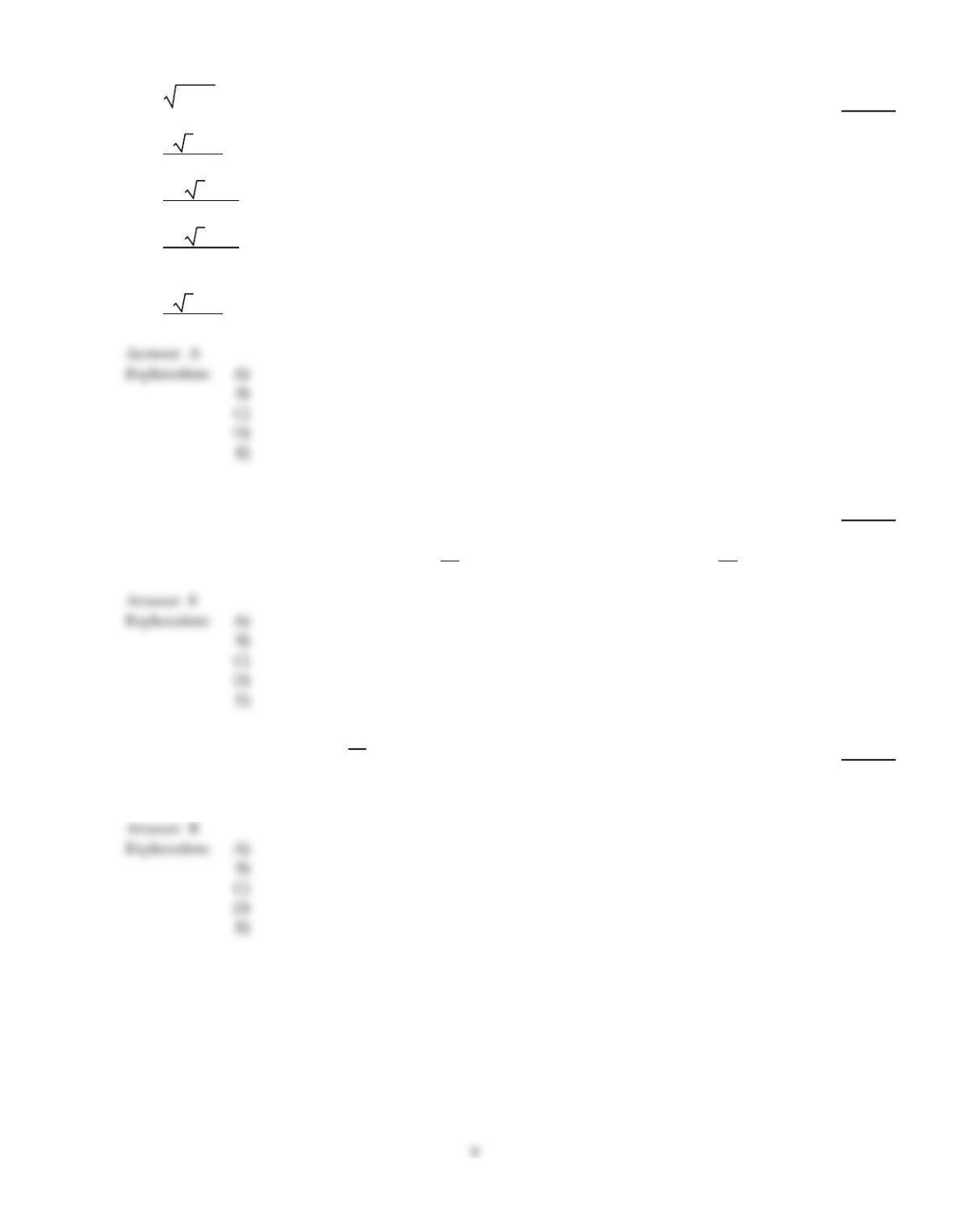
1
0
x x2+ 1 dx =
26)
A)
2 2 – 1
3
B)
2(2 2– 1)
3
C)
2(2 2+ 1)
3
D)
1
E)
2 2 + 1
3
27)
1
0
x(x2+ 5) dx =
27)
A)
11
B)
18
C)
11
2
D)
9
E)
11
4
E
28)
Given the marginal cost function dc
dq = 2q+ 50, where c is in dollars, how much would it cost to
increase production from q= 50 to q= 100?
28)
A)
$5000
B)
$10,000
C)
$15,000
D)
$16,000
E)
$20,000
B
A
29)
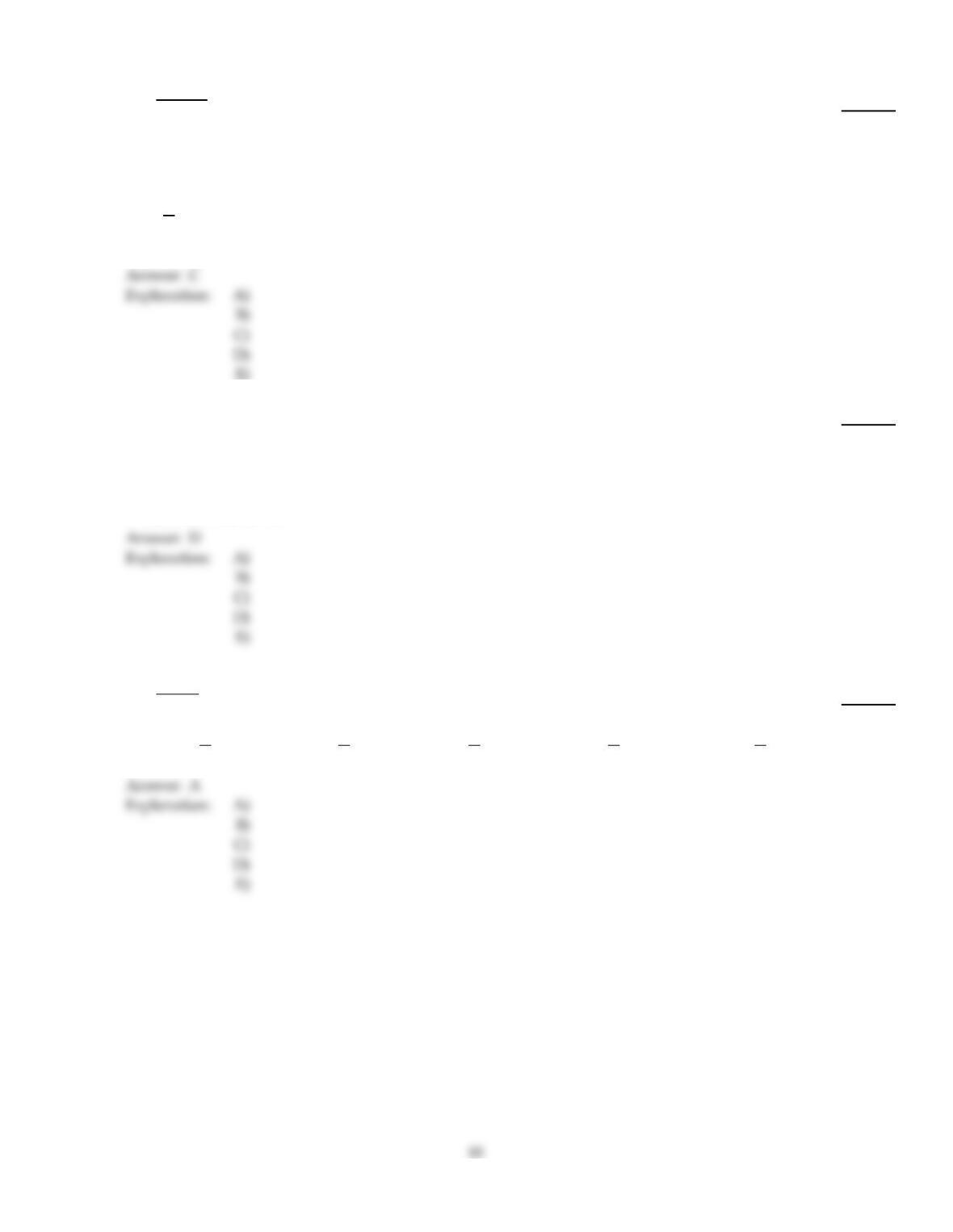
2
1
2x– 3
x2– 3xdx =
29)
A)
7 ln 2
B)
e5
C)
0
D)
1
2(4 – 3 ln 2)
E)
none of the above
30)
If y=x ln x, then dy =
30)
A)
1 + ln x.
B)
x+ ln x.
C)
(x+ ln x) dx.
D)
(1 + ln x) dx.
E)
none of the above
D
31)
3
2
4
1 – 2xdx =
31)
A)
–2 ln 5
3
B)
–4 ln 5
3
C)
8 ln 5
3
D)
2 ln 5
3
E)
–8 ln 5
3
A
C
32)
The exact area of the region bounded by the graphs of y=x2+x+ 1, x= – 2, x= 1, and the x–axis is
32)
A)
13
2 sq units.
B)
9
2 sq units.
C)
7
2 sq units.
D)
11
2 sq units.
E)
5
2 sq units.
33)
The exact area of the region bounded by the graphs of y=x2– 4, and the x–axis from x= 0 to x= 4
is
33)
A)
12 sq units.
B)
16
3 sq units.
C)
32
3 sq units.
D)
16 sq units.
E)
64
3 sq units.
34)
The exact area of the region bounded by the graphs of y=x2– 5 and y= 2x+ 3 is
34)
A)
60 sq units.
B)
24 sq units.
C)
73
3 sq units.
D)
28
3 sq units.
E)
36 sq units.
11
35)
If dy
dx = 3x2– 3 and y(0) = 8, then y(1) =
35)
A)
12.
B)
0.
C)
8.
D)
6.
E)
4.
36)
A manufacturer of a product has a marginal revenue function given by dr
dq =200 + 70q – 3q2. The
demand function for the product is given by
36)
A)
p= 200q+ 35q2–q3.
B)
p= 200 + 35q–q2.
C)
p= 200q+ 35q3–q4.
D)
p= 70 – 6q.
E)
p=70
q– 6.
37)
1
0
2dx =
37)
A)
1
2 2
B)
2
C)
3
2(23/2)
D)
2
3(23/2)
E)
2
2
38)
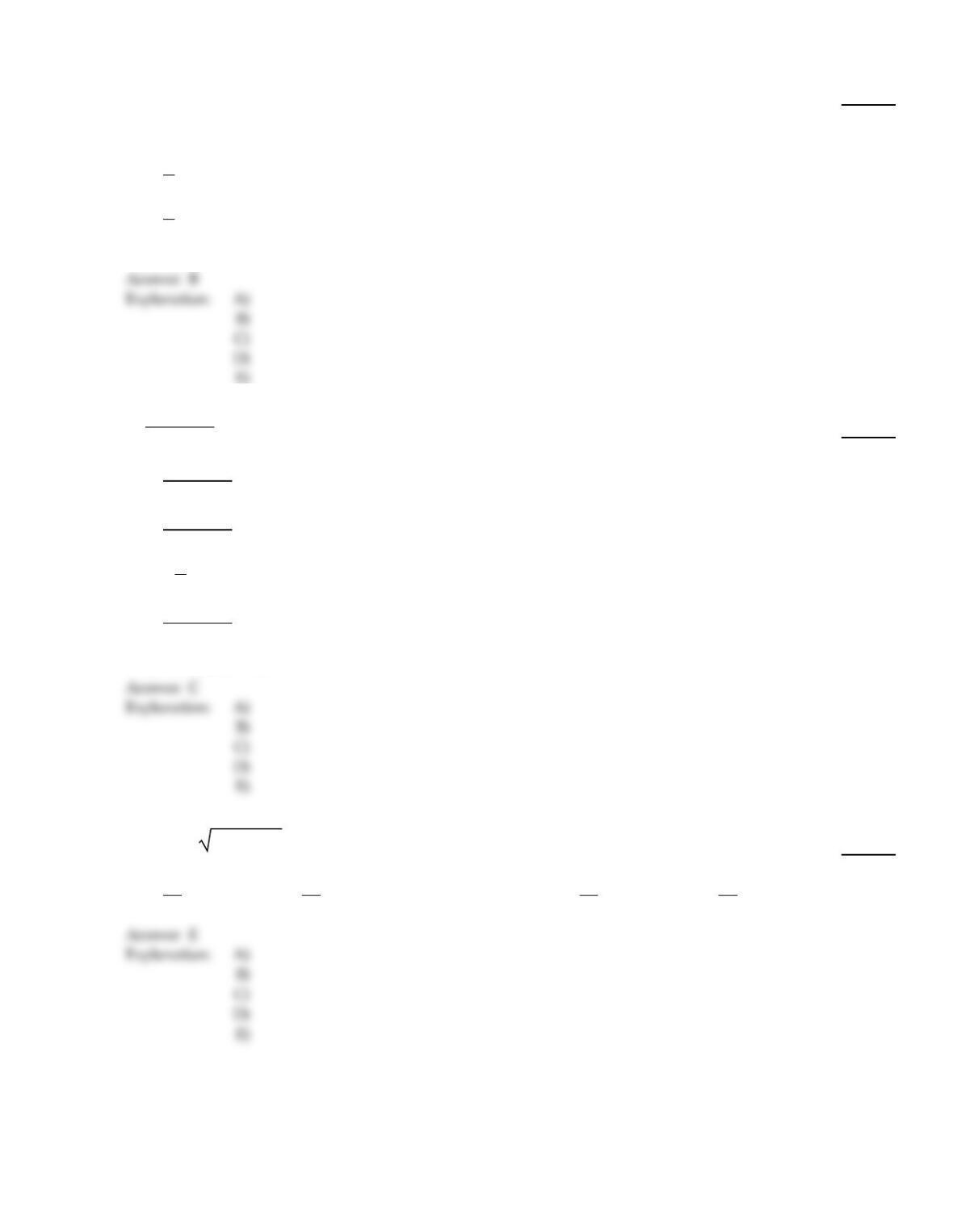
32/3 dx =
38)
A)
0 +C
B)
32/3x+C
C)
5
3·35/3+C
D)
3
5· 35/3+C
E)
0
39)
x+ 1
(x2+ 2x)2dx =
39)
A)
(x2+ 2x)3
6+C
B)
(x2+ 2x)3
2+C
C)
–1
2(x2+ 2x)–1+C
D)
(x2+ 2x)3
3+C
E)
–(x2+ 2x)–1+C
C
40)
1
0
(x+ 4) 3x2+ 8x– 1 dx =
40)
A)
45
2
B)
33
8
C)
0
D)
33
2
E)
45
8
E
13
B
41)
1
0
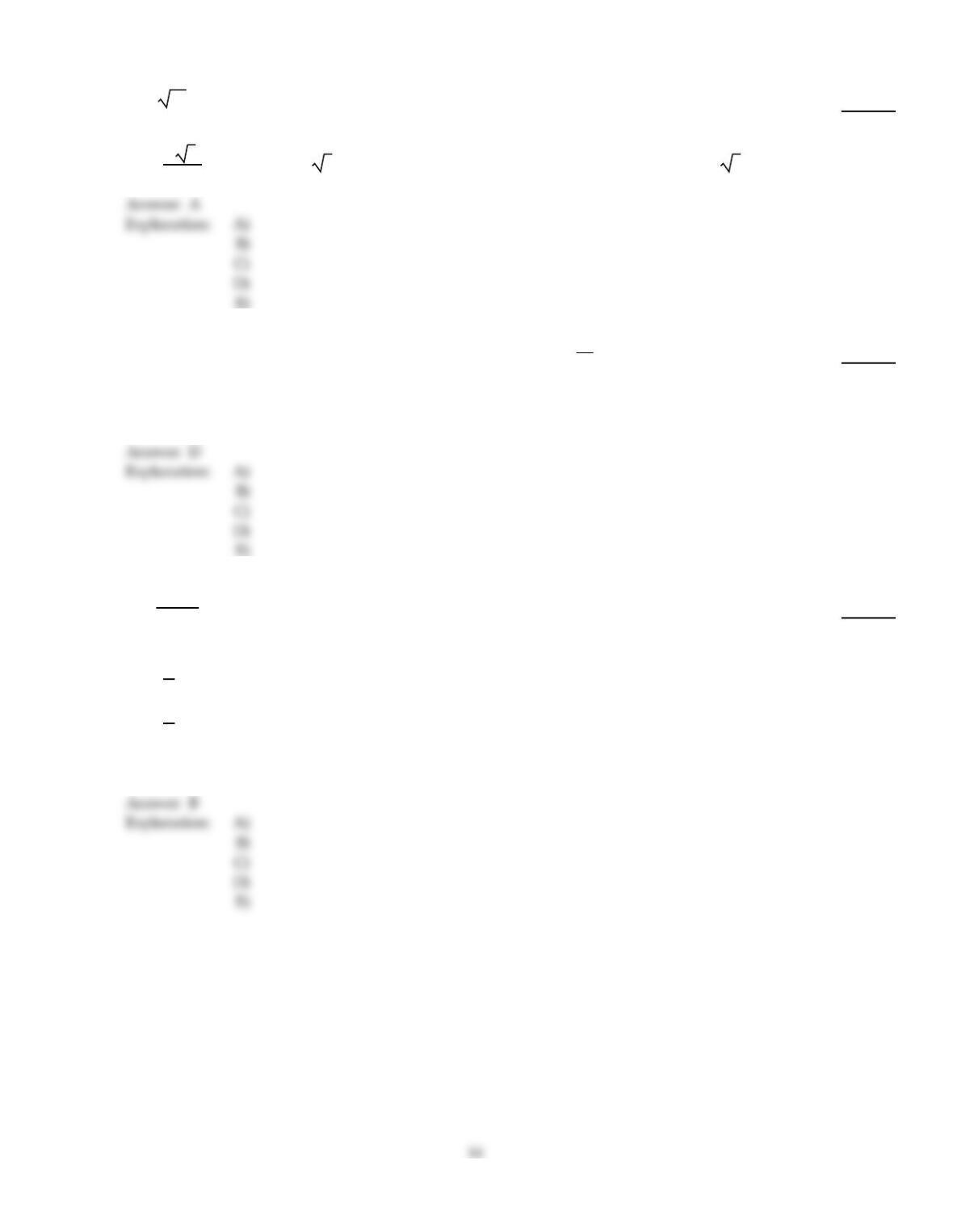
32xdx =
41)
A)
332
4
B)
432
C)
1
D)
0
E)
32
42)
A manufacturer of a product has a marginal cost function given by dc
dq = 0.1q2– 20q + 1500, where c
is the total cost (in dollars) of producing q units of a product. If fixed costs are $30,000, then the total
cost of producing 30 units is
42)
A)
$66,600.
B)
$66,700.
C)
$66,800.
D)
$66,900.
E)
$67,000.
43)
5
0
x
x2+ 1 dx =
43)
A)
ln 26
B)
1
2 ln 26
C)
1
2 ln 24
D)
ln 24
E)
none of the above

44)
The exact area of the region bounded by the graphs of y=x, y=x
2, y= 2, and y= 3 is
44)
A)
7
4 sq units.
B)
3
2 sq units.
C)
5
4 sq units.
D)
5
2 sq units.
E)
3
4 sq units.
45)
If
e4
e2
k
xdx = 1, then k=
45)
A)
1
4
B)
2
C)
ln 2
D)
1
2
E)
4

46)
x2+ 3x–4
x+ 2 dx =
46)
A)
1
2 ln x+ 2 +C
B)
x2
2+x– 6 ln x+ 2 +C
C)
x3
3+3x2
2– 4x
x2
2+ 2x
+C
D)
1
3 ln x+ 2 +C
E)
x2
2+ 5x+ 6 ln x+ 2 +C
47)
2
5/3
(3z–5)1000 dz =
47)
A)
1
1001
B)
–1
C)
1
3
D)
1
3003
E)
1

48)
(x4–x2+ 3) dx =
48)
A)
5x5– 3x3+ 3x+C
B)
x5
5–x3
3+ 3x+C
C)
(x4–x2+3)2
2+C
D)
4x3
3–2x+C
E)
4x3– 2x+C
49)
x2+ 4x– 3
x– 1 dx =
49)
A)
7x2
2– 2x+C
B)
x2
2+ 6x + 3 ln x– 1 +C
C)
1
2 ln x– 1 +C
D)
x2
2+ 5x + 2 ln x– 1 +C
E)
1
3 ln x– 1 +C
50)
2
1
(2x–3)4dx =
50)
A)
0
B)
–1
5
C)
2
5
D)
3
10
E)
1
5
51)
3
1
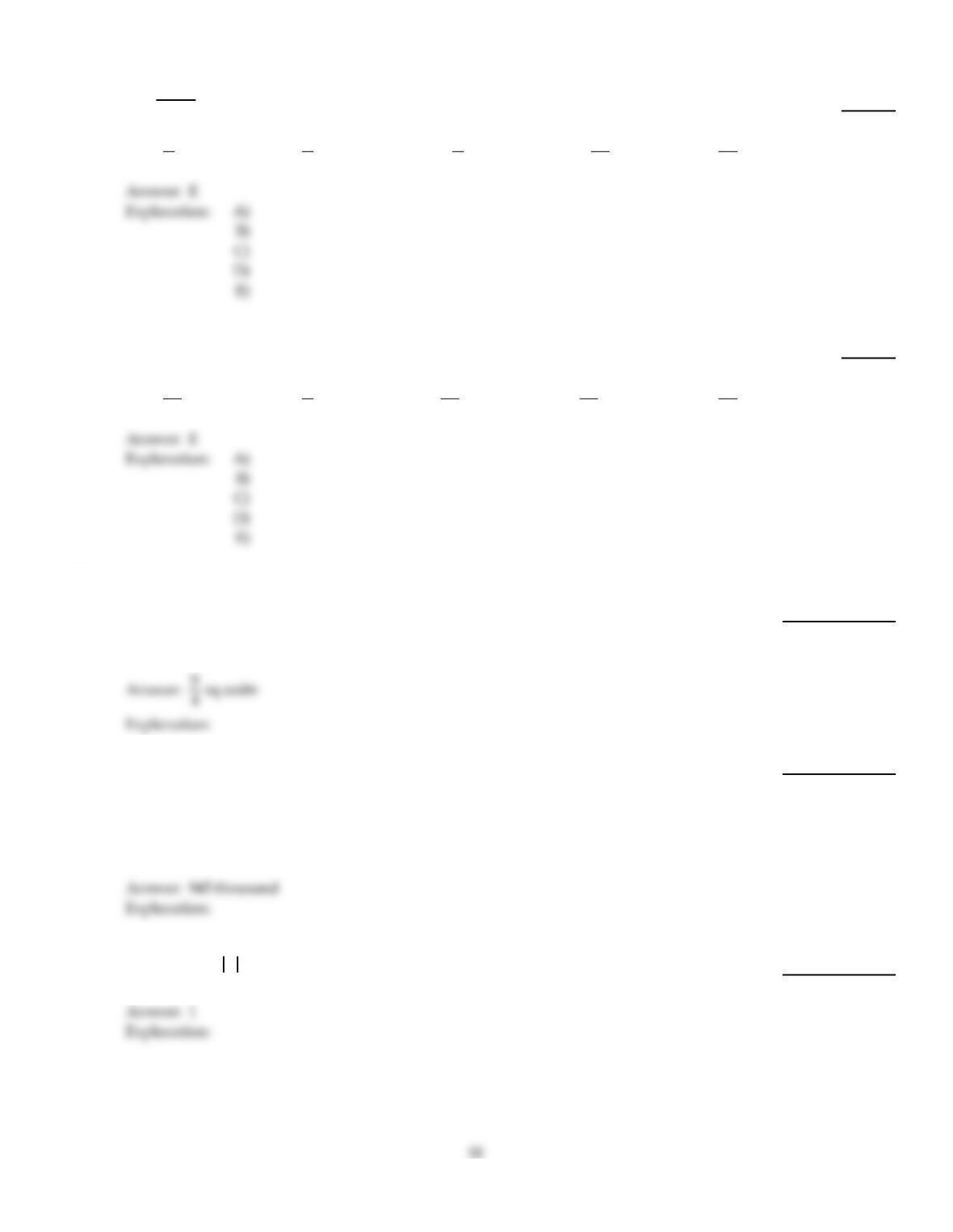
t3+2
t2dt =
51)
A)
4
3
B)
2
9
C)
–4
3
D)
–16
3
E)
16
3
52)
If
3
1
(kx2– 2) dx = 1, then k=
52)
A)
9
13
B)
3
4
C)
15
28
D)
9
14
E)
15
26
SHORT ANSWER. Write the word or phrase that best completes each statement or answers the question.
53)
For the region in the first quadrant bounded by f(x) = 2x+ 1, x= 0, y= 0, and x= 1,
approximate the area by evaluating S4. (Use the right–hand endpoint of each
sub–interval.)
53)
54)
The producers of a new television show expect the number of viewers (in thousands) to
increase at a rate of V‘(x) = 100 + 10x, where x is the number of weeks after the show
premiers. Find the total increase in viewers in the first seven weeks by evaluating
7
0
(100 + 10x) dx .
54)
55)
Evaluate
1
–1
x dx
55)
56)
The producers of a new radio show expect the number of listeners (in hundreds) to
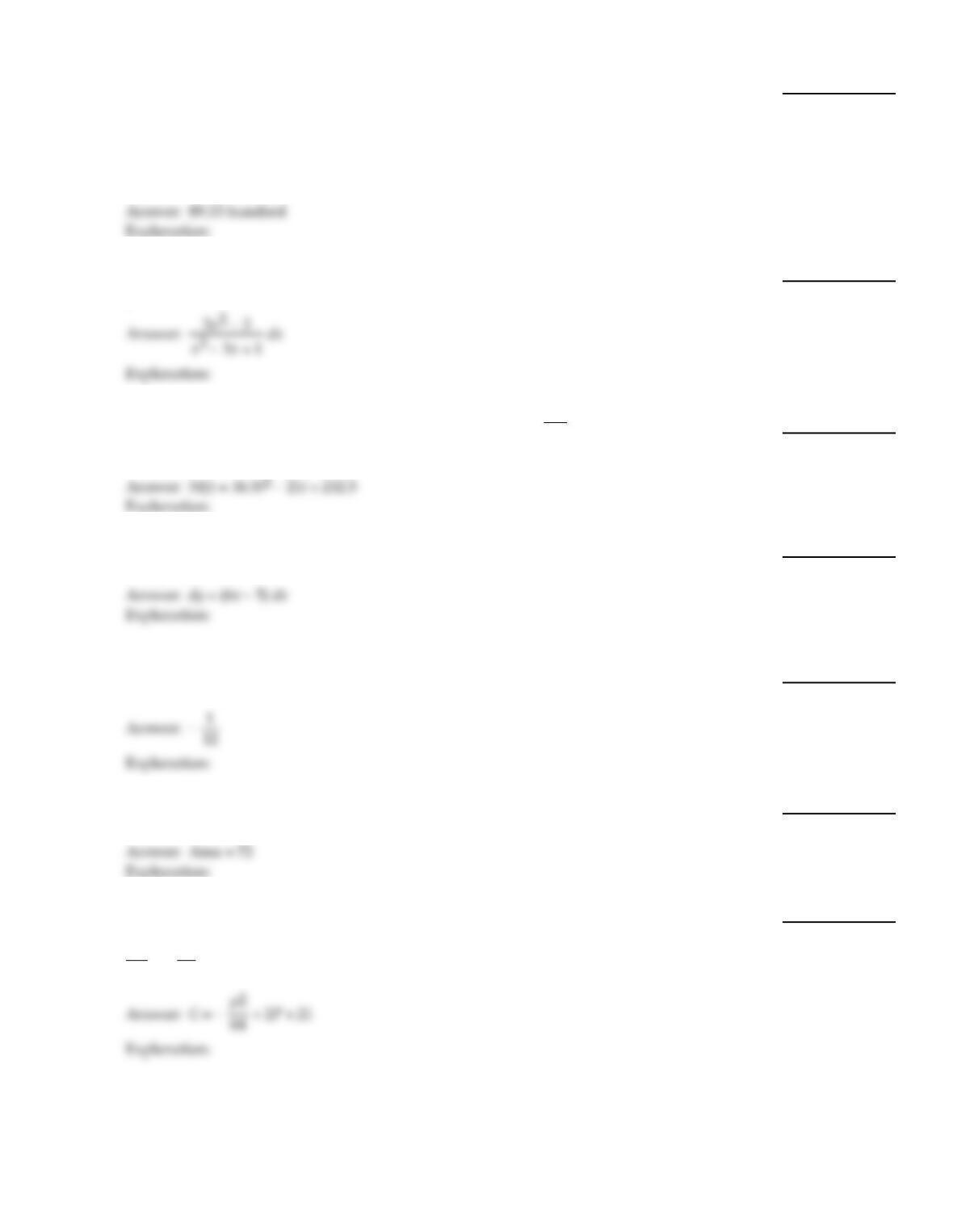
increase at a rate of L’(x) = 17 +x2, where x is the number of weeks after the show
premiers. Find the total increase in listeners in the first four weeks by evaluating
4
0
(17 +x2) dx .
56)
57)
Find the differential of the function in terms of x and dx.
y= ln(x3– 3x+ 1)
57)
58)
The rate of growth of a bacteria (in thousands) is estimated by dN
dt = 73t– 21, where t is in
hours. If N(9) = 3000, then find N(t).
58)
59)
Find the differential in terms of x and dx.
y= 3x2– 5x + 4
59)
60)
Determine:
1
0
x(x2–1)5dx
60)
61)
Find the area of the region bounded by the given equations:
y=x2–x – 9 and y= – x2 + 3x + 7
61)
62)
For a group of rats that were fed a particular diet, the rate of change of the average weight
gain G (in grams) of a rat with respect to the percent P of yeast in the diet is
dG
dP = – P
32 + 2; 0 P 100. If G= 36 when P= 8, find G.
62)
19
63)
The acceleration of an object after t seconds is given by y” = 5t– 6, the velocity at 4 seconds
is given by y’(4) = 18 feet/sec, and the position at 1 second is given by y(1) = 0 feet. Find
y(t).
63)
64)
Determine: x6x7– 8 dx
64)
65)
Find dy if y=2
x+ 3 .
65)
66)
Use Simpson’s rule with n= 4 to find an approximate value of
2
0
1
3 +x2dx.
66)
67)
Use definite integrals to find the area between y = – x2, the x–axis, x= – 1, and x= 1.
67)
68)
The income (in dollars) from a clothing store is increasing at a rate of f(t) = 500e0.08t where
t is in weeks. Find
12
6
500e0.08tdt, the total income for the store between the sixth and
twelfth weeks.
68)
69)
Determine: x2– 2x+ 1
x3– 3x2+ 3x– 4 dx
69)
20