Chapter 14
The Statement of Cash Flows
MULTIPLE CHOICE QUESTIONS
1. How will a company classify ‘proceeds received from the issuance of long–term bonds’ on its
statement of cash flows?
a. Cash provided from operations
b. Cash used in operations
c. Cash provided from investing activities
d. Cash provided from financing activities
2. How will a company classify the exchange of common stock for land on its statement of cash
flows?
a. An operating activity
b. An investing activity
c. A financing activity
d. A footnote
3. How will a company classify a payment for the acquisition of land on its statement of cash
flows?
a. Cash provided from operations
b. Cash used in financing activities
c. Cash provided from investing activities
d. Cash used for investing activities
14-2 Test Bank – Chapter 14 – The Statement of Cash Flows
4. Equipment that cost $10,000 that had a book value of $6,000 was sold for $7,000. Data from
the comparative balance sheets are:
12/31/17
12/31/16
Equipment
$420,000
$310,000
Accumulated Depreciation
59,000
36,000
Equipment purchased during 2017 cost
a. $120,000.
b. $110,000.
c. $145,000.
d. $10,000.
Solution: $420,000 – ($310,000 – $10,000) = $120,000
5. If an investor is interested in the solvency of a company, he/she should analyze the
a. balance sheet and income statement.
b. income statement, balance sheet, and statement of cash flows.
c. balance sheet and statement of cash flows.
d. statement of cash flows only.
6. How will a company classify the sale of treasury stock at an amount equal to its cost on its
statement of cash flows?
a. Operating activity
b. Investing activity
c. Extraordinary activity
d. Financing activity
7. How will a company classify payments to suppliers on its statement of cash flows?
a. Cash provided from operations
b. Cash used in operations
c. Cash provided from investing activities
d. Cash used in financing activities
Test Bank – Chapter 14 – The Statement of Cash Flows 14-3
8. Payments for purchases of property, plant, and equipment and other productive assets are
classified as cash outflows from
a. operating activities.
b. financing activities.
c. investing activities.
d. selling activities.
9. How will a company classify payments for inventory acquisitions on its statement of cash flows?
a. Cash provided from operations
b. Cash used in operations
c. Cash provided from investing activities
d. Cash used for investing activities
10. How will a company classify cash receipts from selling equipment no longer used in operations
on its statement of cash flows?
a. Cash provided from operations
b. Cash provided from financing activities
c. Cash provided from investing activities
d. Cash used for investing activities
11. A company uses the indirect method of preparing the statement of cash flows. Current year
depreciation expense can be found on the
a. income statement and statement of cash flows.
b. balance sheet and income statement.
c. statement of cash flows and balance sheet.
d. income statement and statement of comprehensive income.
14-4 Test Bank – Chapter 14 – The Statement of Cash Flows
12. A company uses the direct method of preparing the statement of cash flows. Current year
depreciation expense can be found on the
a. balance sheet and income statement.
b. income statement and statement of cash flows.
c. income statement only.
d. statement of cash flows only.
13. An investor is interested in assessing the effectiveness of a company’s cash management.
Where will the investor look to evaluate this?
a. Statement of cash flows
b. Income statement
c. Balance sheet
d. Company’s bank statements
14. A company declares cash dividends on the last day of the year. Payment will be made during
the following fiscal period. Cash flows
a. from operations will be less than if dividends were not declared.
b. from operations will be more than if dividends were not declared.
c. from financing activities will be less than if dividends were not declared.
d. will be the same as if dividends had not been declared.
15. What is reported on the statement of cash flows?
a. Operating, investing, and financing activities of an entity for a period of time
b. All revenues and expense listed by operating, financing, and operating activity
c. Operating, investing, and financing activities of an entity at the balance sheet date
d. A detail of all incoming and outgoing cash flows of a business
Test Bank – Chapter 14 – The Statement of Cash Flows 14-5
16. Which statement is true with respect to the preparation of the cash flows from operating
activities’ section?
a. It can be calculated by using the direct or indirect methods.
b. Cash flows are calculated as the difference between revenues and expenses.
c. It is always equal to accrual accounting income.
d. Cash payments for depreciation and dividends are reported in the operating activates
sections.
17. Which one of the following transactions is an investing activity?
a. Sale of equipment at book value
b. Sale of merchandise on credit
c. Declaration of cash dividend
d. Issuance of bonds payable at a discount
18. How will a company classify the income tax payments on its statement of cash flows?
a. Operating activities
b. Taxing activities
c. Lending activities
d. Financing activities
19. A company uses straight-line instead of the units of production method of depreciation.
Assuming a tax rate of zero, which statement is true as a result of its choice of depreciation
methods?
a. Cash flows from operations will be less than under the straight-line method
b. Cash flows from operations will be more than under the straight-line method
c. Cash used for investing activities will be more than under the straight-line method
d. Cash flows are the same as if the straight-line method had been used.
20. An acquisition of land by signing a 10-year mortgage payable is reported on the statement of
cash flows as
a. an operating activity.
b. an investing activity.
c. a financing activity.
d. a footnote.
14-6 Test Bank – Chapter 14 – The Statement of Cash Flows
21. Which one of the following is consistent with a company recording a large operating loss but still
having healthy cash flows from operations?
a. A large amount of depreciation and/or amortization expense
b. An increase in accounts receivable and inventory
c. A decrease in accounts payable
d. All sales are on a cash basis.
22. Which one of the following is consistent with a company recording a large operating income but
having a net cash outflow from operations?
a. A great amount of depreciation expense
b. An increase in accounts receivable and inventory
c. An increase in accounts payable
d. Acquisition of new plant assets for cash
23. Which one of the following is added to net income when using the indirect method to determine
cash flows from operations?
a. Decrease in amounts paid to reduce long-term notes
b. Decrease in accounts payable
c. Depreciation or amortization
d. Cash received from selling treasury stock
24. Which one of the following is added to net income when using the indirect method to determine
cash flows from operations?
a. Amortization of intangibles
b. Decrease in accounts payable
c. Increase in accounts receivable
d. A gain on the sale of plant assets
Test Bank – Chapter 14 – The Statement of Cash Flows 14-7
25. Which of the following is added to net income when using the indirect method to determine cash
flows from operations?
a. Cash dividends paid
b. Increase in accounts payable and decrease in accounts receivable
c. Decrease in accounts receivable and cash dividends declared
d. Increase in prepaid expenses
26. Which one of the following is added to net income when using the indirect method to determine
cash flows from operations?
a. Increase in inventory
b. Decrease in wages payable
c. Loss from sale of land
d. Gain from selling treasury stock above its original cost
27. Which one of the following is subtracted from net income when using the indirect method to
determine cash flows from operations?
a. Loss from sale of land
b. Depreciation expense
c. Stock dividends declared and distributed
d. Gain from sale of equipment
28. Which one of the following is subtracted from net income when using the indirect method to
determine cash flows from operations?
a. Increase in prepaid insurance
b. Increase in accounts payable
c. Decrease in accounts receivable
d. Decrease in prepaid insurance
29. The statement of cash flows is designed to highlight
a. the revenues and expenses of an entity’s operations during a period.
b. the predicted future cash flows.
c. the operating, investing, and financing activities of an entity during a period.
d. the future cash balance
14-8 Test Bank – Chapter 14 – The Statement of Cash Flows
30. An increase in inventory is reported in a statement of cash flows using the indirect method as
a(n)
a. addition to net income in arriving at net cash flows from operating activities.
b. deduction from net income in arriving at net cash flows from operating activities.
c. cash outflow from investing activities.
d. cash outflow from financing activities.
31. Which one of the following would you expect to find as part of cash flows from investing
activities?
a. The issuance of common stock in exchange for a factory
b. Cash dividends paid
c. Cash inflows from the proceeds of a sale of a building
d. The write-off of accounts receivable
32. When preparing a statement of cash flows using the indirect method, an increase in inventory
will result in an adjustment to reported net income because
a. cost of goods sold on an accrual basis is less than on a cash basis.
b. inventory was paid for with cash, but is still on hand at the end of the period.
c. acquisition of inventory is an investment activity.
d. inventory purchased created smaller cash outflows than cash inflows received from
inventory sales.
33. In determining cash flow from operating activities, which of the following adjustments will be
made as a result of an increase in accounts receivable during a period?
a. An addition to net income when the direct method is used
b. An addition to net income when the indirect method is used
c. A deduction from net income when the direct method is used
d. A deduction from net income when the indirect method is used
Test Bank – Chapter 14 – The Statement of Cash Flows 14-9
34. In determining net cash flows from operating activities, a decrease in salaries payable during a
period
a. means that income on an accrual basis is equal to income on a cash basis.
b. must be added to net income under the indirect method.
c. creates a cash outflow to pay for salaries that were previously accrued.
d. creates a cash inflow from employees.
35. Calvin Company provided the following information during 2017:
Purchase of land by issuing bonds
$ 550,000
Proceeds from issuing long-term debt
300,000
Dividends paid to shareholders
120,000
Proceeds from issuing stock
300,000
Proceeds from sale of building
360,000
Purchases of inventories
800,000
Purchase of treasury stock
430,000
How much is ‘net cash provided (used) by investing activities’ during 2017?
a. $790,000
b. $360,000
c. $910,000
d. $(120,000)
36. Calvin Company provided the following information during 2017:
Purchase of land by issuing bonds
$ 550,000
Proceeds from issuing long-term debt
300,000
Dividends paid to shareholders
120,000
Proceeds from issuing stock
300,000
Proceeds from sale of building
360,000
Purchases of inventories
800,000
Purchase of treasury stock
430,000
How much is ‘net cash provided by financing activities’ during 2017?
a. $(500,000)
b. $550,000
c. $50,000
d. $600,000
14–10 Test Bank – Chapter 14 – The Statement of Cash Flows
37. Which of the following is subtracted from income when using the indirect method to determine
cash flows from operations?
a. Decrease in accounts payable
b. Depreciation
c. Cash dividends declared and distributed
d. Amounts due from customers at yearend
38. Selected information from Hsu Inc. is provided below for the years ending December 31, 2017
and 2016.
During 2017, depreciation expense was recorded. New equipment was acquired for cash. Old
equipment which was 70% depreciated with an original cost of $26,000 was sold for a gain of
$4,000. For how much was the equipment sold?
a. $11,800
b. $5,000
c. $3,800
d. $31,000
Solution: (30% X $26,000) + $4,000 = $11,800
39. Relevant account balances for Martinez Corporation are:
12/31/17
1/01/17
Accounts receivable
$18,000
$14,000
Inventory
24,000
26,000
Prepaid insurance
1,500
2,100
Accounts payable
25,000
26,000
Income information for 2017_______
_________
_________
Revenue
$120,000
Cost of goods sold
$60,000
Insurance expense
6,000
Operating expenses
18,000
Depreciation
10,000
94,000
Net income
$ 26,000
39. How much cash was received from customers during 2017?
a. $120,000
b. $116,000
c. $138,000
d. $124,000
2017
2016
Accumulated depreciation
$32,000
$29,000
Equipment
60,000
55,000
Test Bank – Chapter 14 – The Statement of Cash Flows 14–11
40. Relevant account balances for Martinez Corporation are:
12/31/17
1/01/17
Accounts receivable
$18,000
$14,000
Inventory
24,000
26,000
Prepaid insurance
1,500
2,100
Accounts payable
25,000
26,000
Income information for 2017_______
_________
_________
Revenue
$120,000
Cost of goods sold
$60,000
Insurance expense
6,000
Operating expenses
18,000
Depreciation
10,000
94,000
Net income
$ 26,000
How much cash was paid to suppliers for inventory during 2017?
a. $2,000
b. $59,000
c. $63,000
d. $61,000
41. Relevant account balances for Martinez Corporation are:
12/31/17
1/01/17
Accounts receivable
$18,000
$14,000
Inventory
24,000
26,000
Prepaid insurance
1,500
2,100
Accounts payable
25,000
26,000
Income information for 2017_______
_________
_________
Revenue
$120,000
Cost of goods sold
$60,000
Insurance expense
6,000
Operating expenses
18,000
Depreciation
10,000
94,000
Net income
$ 26,000
How much cash was paid for insurance during 2017?
a. $5,400
b. $6,000
c. $6,600
d. $ 600
14–12 Test Bank – Chapter 14 – The Statement of Cash Flows
42. How does depreciation appear on the statement of cash flows under the direct method?
a. Added in the operating activities section
b. Subtracted in the operating activities section
c. In the investing activities section since it relates to plant assets
d. It will not be reported since it is not a cash flow.
43. Relevant account balances for Martinez Corporation are:
12/31/17
1/01/17
Accounts receivable
$18,000
$14,000
Inventory
24,000
26,000
Prepaid insurance
1,500
2,100
Accounts payable
25,000
26,000
Income information for 2017_______
_________
_________
Revenue
$120,000
Cost of goods sold
$60,000
Insurance expense
6,000
Operating expenses
18,000
Depreciation
10,000
94,000
Net income
$ 26,000
How much is Martinez’s cash flows from operations for 2017?
a. $28,400
b. $38,400
c. $23,600
d. $33,600
44. Selected information from Cooke Inc. is provided below for the years ending December 31,
2017 and 2016.
During 2017, depreciation expense was recorded. New equipment was acquired for cash. Old
equipment which was 70% depreciated with an original cost of $26,000 was sold for a gain of
$4,000. What is the cost of the new equipment acquired?
a. $11,800
b. $ 5,000
c. $21,000
d. $31,000
2017
2016
Accumulated depreciation
$32,000
$29,000
Equipment
60,000
55,000
Test Bank – Chapter 14 – The Statement of Cash Flows 14–13
45. The May 1 and May 31 balances in accounts receivable are $35,000 and $36,000, respectively.
During May, the company reported sales totaling $235,000 from its customers. The company
incurred $211,000 of expenses, although $12,000 was not paid as of May 31. How much is
cash flows from operations for May?
a. $24,000
b. $37,000
c. $11,000
d. $35,000
46. The following are from Forman’s comparative balance sheet and 2017 income statement:
December 31, 2017
January 1, 2017
Accounts receivable
$ 22,000
$19,000
Unearned revenue
3,000
4,000
Salaries payable
8,000
5,000
Sales revenue
154,000
Salaries expense
88,000
Determine the amount of cash that Forman collected from customers during 2017.
a. $150,000
b. $158,000
c. $151,000
d. $156,000
47. The following are from Forman’s comparative balance sheet and 2017 income statement:
December 31, 2017
January 1, 2017
Accounts receivable
$ 22,000
$19,000
Unearned revenue
3,000
4,000
Salaries payable
8,000
5,000
Sales revenue
154,000
Salaries expense
88,000
Determine the amount of cash that Forman Incorporated paid for salaries during 2017.
a. $91,000
b. $88,000
c. $85,000
d. $80,000
14–14 Test Bank – Chapter 14 – The Statement of Cash Flows
48. Johnson Company engaged in the following transactions during 2017:
1. Johnson wrote off an account receivable against the allowance account.
2. Johnson purchased a piece of plant equipment
3. Johnson reacquired 5,000 shares of its common stock.
4. Johnson sold a building at a loss in exchange for a five-year note.
5. Johnson declared, but did not pay, a cash dividend.
If Johnson uses the indirect method, which of these transactions or parts of these transactions
would be included in the operating activity section of the statement of cash flows?
a. Transaction 4
b. Transaction 1
c. More than one of these transactions would be found in the operating activity section.
d. None of these transactions would be found in the operating activity section.
49. Johnson Company engaged in the following transactions during 2017:
1. Johnson wrote off an open receivable as uncollected.
2. Johnson purchased a piece of plant equipment
3. Johnson reacquired 5,000 shares of its common stock.
4. Johnson sold a building at a loss in exchange for a five-year note.
5. Johnson declared, but did not pay a cash dividend.
Which of these transactions or parts of these transactions would be included in the financing
activity section of the statement of cash flows?
a. Transactions 2 and 4.
b. Transactions 2 through 5
c. Transaction 3
d. None of these choices are correct.
Test Bank – Chapter 14 – The Statement of Cash Flows 14–15
50. Johnson Company engaged in the following transactions during 2017:
1. Johnson wrote off an account receivable against the allowance account.
2. Johnson purchased a piece of plant equipment
3. Johnson reacquired 5,000 shares of its common stock.
4. Johnson sold a building at a loss in exchange for a five-year note.
5. Johnson declared, but did not pay a cash dividend.
If Johnson uses the indirect method, which of these transactions would not appear in whole or in
part on the statement of cash flows?
a. Transaction 1 and 5 only.
b. Transactions 4 and 5 only.
c. Transactions 1, 4, and 5.
d. None of these would appear on the statement of cash flows.
51. Denver Company prepares its statement of cash flows using the direct method and engaged in
the following transactions during 2017:
1. Denver retired bonds payable by issuing common stock.
2. Denver collected on a long-term note receivable.
3. Denver issued a stock dividend.
4. Denver recorded depreciation on fixed assets.
5. Denver paid interest on long-term debt.
Which of these transactions or parts of these transactions would be included in the operating
activity section of the statement of cash flows?
a. Transaction 2
b. Transaction 5
c. Transaction 4
d. None of these choices is correct.
14–16 Test Bank – Chapter 14 – The Statement of Cash Flows
52. Denver Company prepares its statement of cash flows using the direct method and engaged in
the following transactions during 2017:
1. Denver retired bonds payable by issuing common stock.
2. Denver collected on a long-term note receivable.
3. Denver issued a stock dividend.
4. Denver recorded depreciation on fixed assets.
5. Denver paid interest on long-term debt.
Which of these transactions would not appear in whole or in part on the statement of cash
flows?
a. Transactions 1 & 2
b. Transactions 2 & 3
c. Transactions 1, 2, 3, & 4
d. Transactions 1, 3, & 4
53. Denver Company prepares its statement of cash flows using the direct method and engaged in
the following transactions during 2017:
1. Denver retired bonds payable by issuing common stock.
2. Denver collected on a long-term note receivable.
3. Denver issued a stock dividend.
4. Denver recorded depreciation on fixed assets.
5. Denver paid interest on long-term debt.
Which of these transactions or parts of these transactions would be included in the financing
activity section of the statement of cash flows?
a. Transaction 1
b. Transaction 3
c. Transactions 1 & 3
d. None of these transactions would be found in the financing activity section.
Test Bank – Chapter 14 – The Statement of Cash Flows 14–17
54. Samuels Company prepares its statement of cash flows using the direct method and engaged in
the following transactions during 2017:
1. Samuels purchased inventory on account.
2. Samuels collected open accounts receivable.
3. Samuels exchanged a building for land and realized a gain.
4. Samuels issued 75,000 shares of preferred stock.
5. Samuels purchased a three-year fire insurance policy.
Which of these transactions or parts of these transactions would be included in the operating
activity section of the statement of cash flows?
a. Transactions 1,2 & 5
b. Transactions 2 & 5 only
c. Transactions 2, 3, & 5
d. None of these choices is correct.
55. Samuels Company prepares its statement of cash flows using the direct method and engaged in
the following transactions during 2017:
1. Samuels purchased inventory on account.
2. Samuels collected open accounts receivable.
3. Samuels exchanged a building for land and realized a gain.
4. Samuels issued 75,000 shares of preferred stock.
5. Samuels purchased a three-year fire insurance policy.
Which of these transactions or parts of these transactions would be included in the financing
activity section of the statement of cash flows?
a. Transaction 3 only.
b. Transaction 4 only.
c. Transactions 3 & 4
d. None of these transactions would be found in the financing activity section.
14–18 Test Bank – Chapter 14 – The Statement of Cash Flows
56. Samuels Company prepares its statement of cash flows using the direct method and engaged in
the following transactions during 2017:
1. Samuels purchased inventory on account.
2. Samuels collected open accounts receivable.
3. Samuels exchanged a building for land and realized a gain.
4. Samuels issued 75,000 shares of preferred stock.
5. Samuels purchased a three-year fire insurance policy.
Which of these transactions or parts of these transactions would be included in the investing
activity section of the statement of cash flows?
a. Transaction 3 only.
b. Transaction 4 only.
c. Transactions 3 & 4.
d. None of these transactions would be found in the investing activity section.
57. Samuels Company prepares its statement of cash flows using the direct method and engaged in
the following transactions during 2017:
1. Samuels purchased inventory on account.
2. Samuels collected open accounts receivable.
3. Samuels exchanged a building for land and realized a gain.
4. Samuels issued 75,000 shares of preferred stock.
5. Samuels purchased a three-year fire insurance policy.
Which of these transactions would not be included in whole or in part on the statement of cash
flows?
a. Transaction 1 only.
b. Transaction 5 only.
c. Transactions 1, 3, & 5.
d. Transactions 1 & 3.
Test Bank – Chapter 14 – The Statement of Cash Flows 14–19
58. The following information was taken from the records of Albert’s Fine Coffee:
2017
2016
Machinery
$90,000
$40,000
Accumulated depreciation
(30,000)
(20,000)
Depreciation expense
14,000
12,000
Gain on sale of machinery
4,000
1,000
During 2017, machinery with a cost of $16,000 was sold.
Based on this information, how much machinery was purchased during 2017?
a. $50,000
b. $66,000
c. $40,000
d. $60,000
Solution:
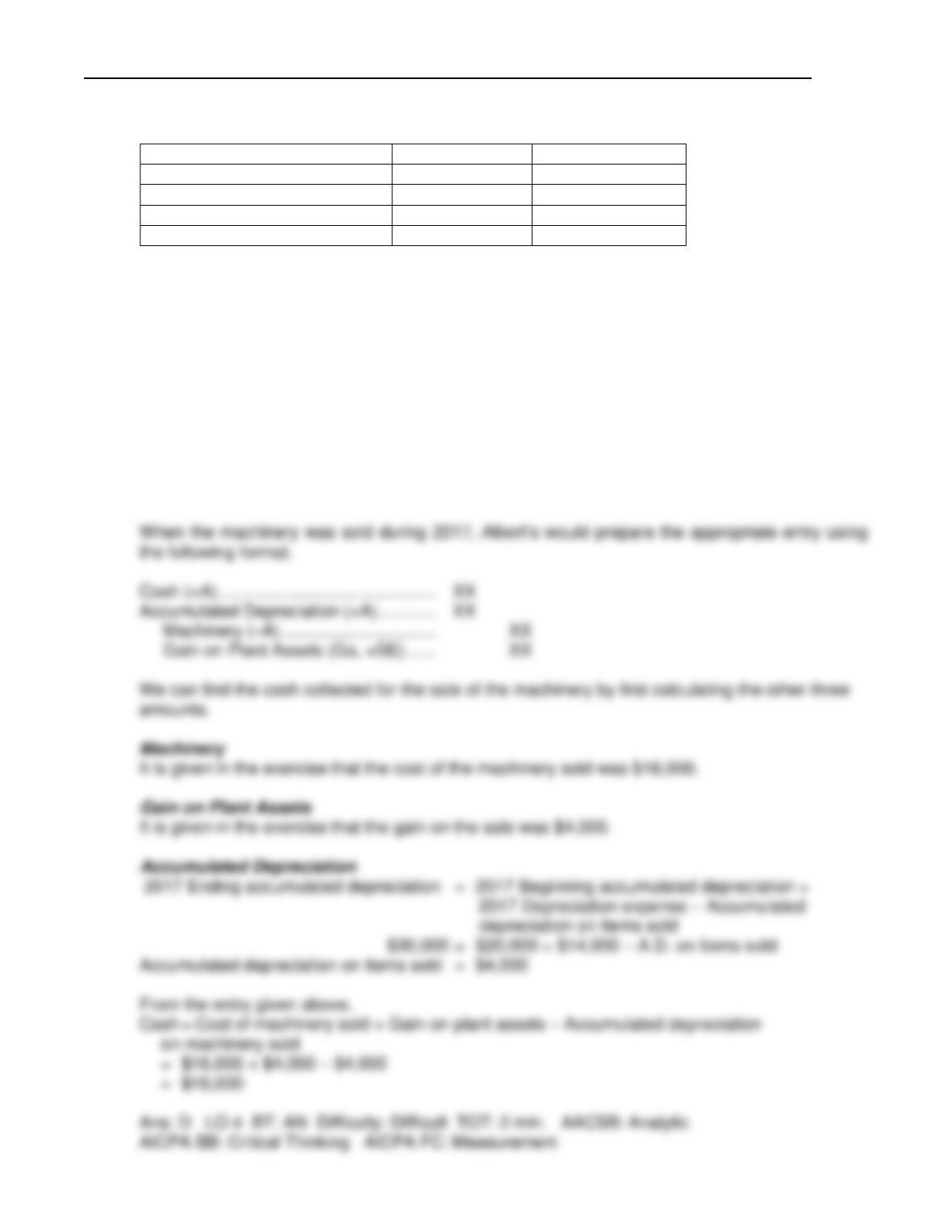
14–20 Test Bank – Chapter 14 – The Statement of Cash Flows
59. The following information was taken from the records of Albert’s Fine Coffee:
2017
2016
Machinery
$90,000
$40,000
Accumulated depreciation
(30,000)
(20,000)
Depreciation expense
14,000
12,000
Gain on sale of machinery
4,000
1,000
During 2017, machinery with a cost of $16,000 was sold.
Based on this information, how much cash was collected on the sale of the machinery during
2017?
a. $10,000
b. $20,000
c. $4,000
d. $16,000
Solution: