
College Physics: A Strategic Approach, 3e (Knight)
Chapter 14 Oscillations
14.1 Conceptual Questions
1) If we double the frequency of a system undergoing simple harmonic motion, which of the
following statements about that system are true? (There could be more than one correct choice.)
A) The period is doubled.
B) The angular frequency is doubled.
C) The amplitude is doubled.
D) The period is reduced to one-half of what it was.
E) The angular frequency is reduced to one-half of what it was.
2) A simple harmonic oscillator oscillates with frequency f when its amplitude is A. If the
amplitude is now doubled to 2A, what is the new frequency?
A) 2f
B) 4f
C) f
D) f/2
E) f/4
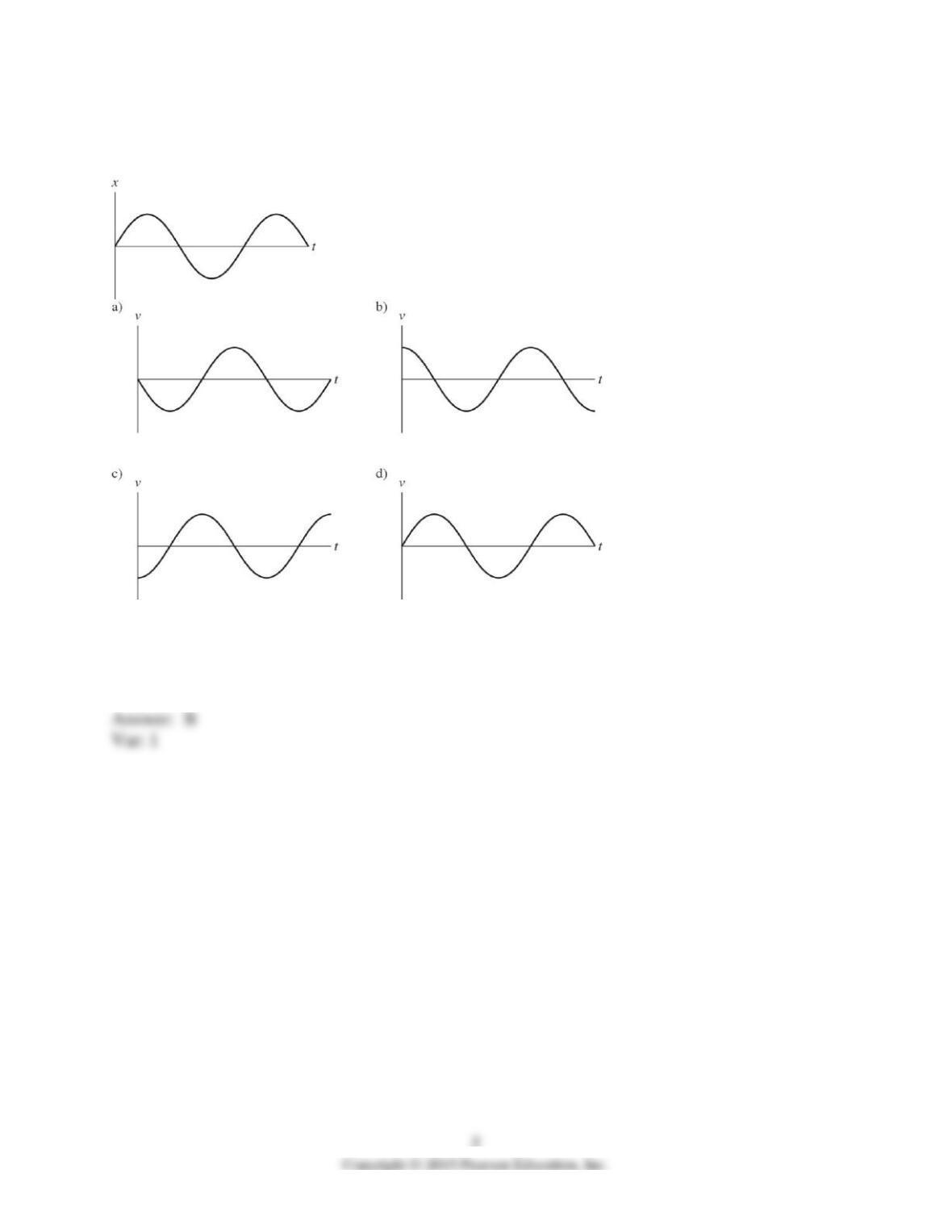
3) The figure shows a graph of the position x as a function of time t for a system undergoing
simple harmonic motion. Which one of the following graphs represents the velocity of this
system as a function of time?
A) graph a
B) graph b
C) graph c
D) graph d
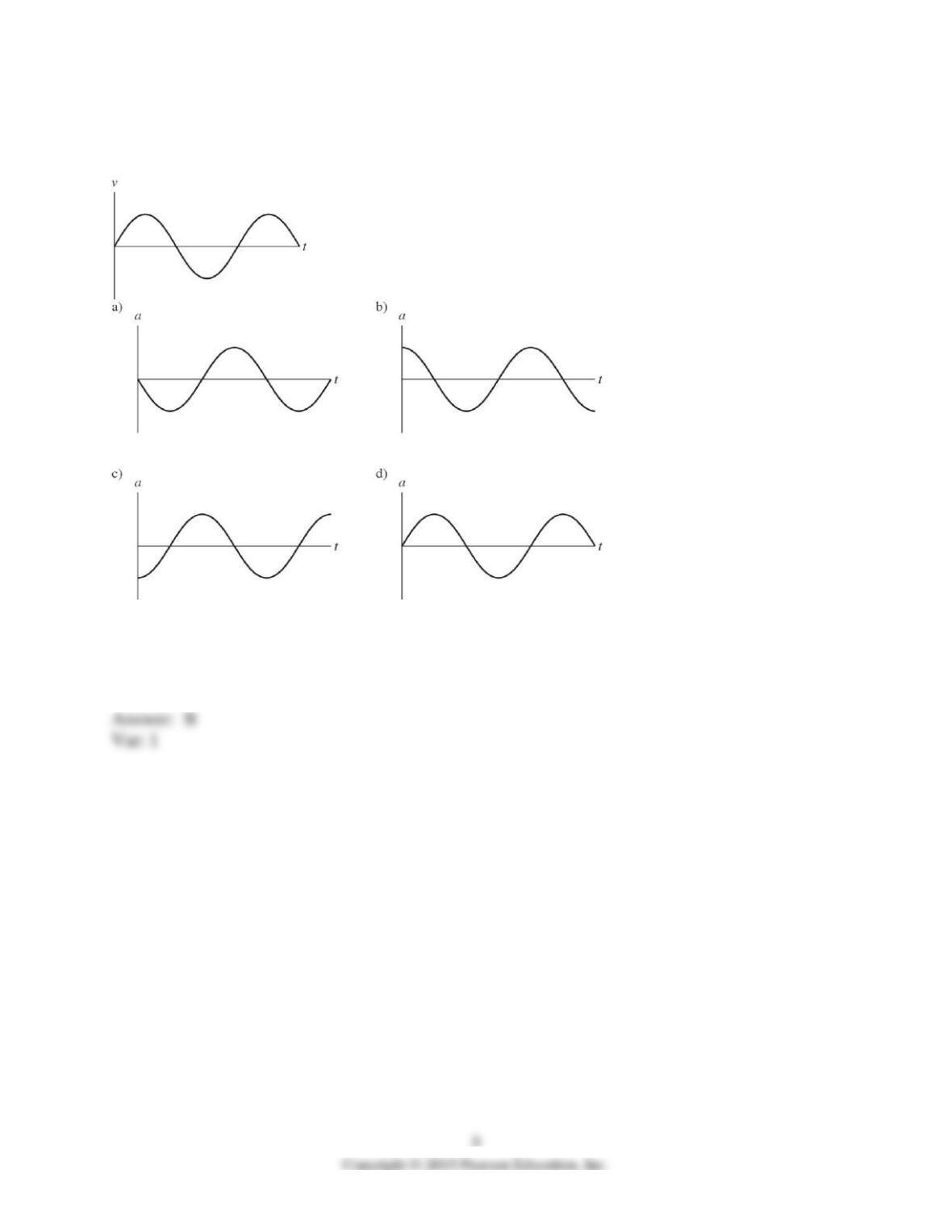
4) The figure shows a graph of the velocity v as a function of time t for a system undergoing
simple harmonic motion. Which one of the following graphs represents the acceleration of this
system as a function of time?
A) graph a
B) graph b
C) graph c
D) graph d
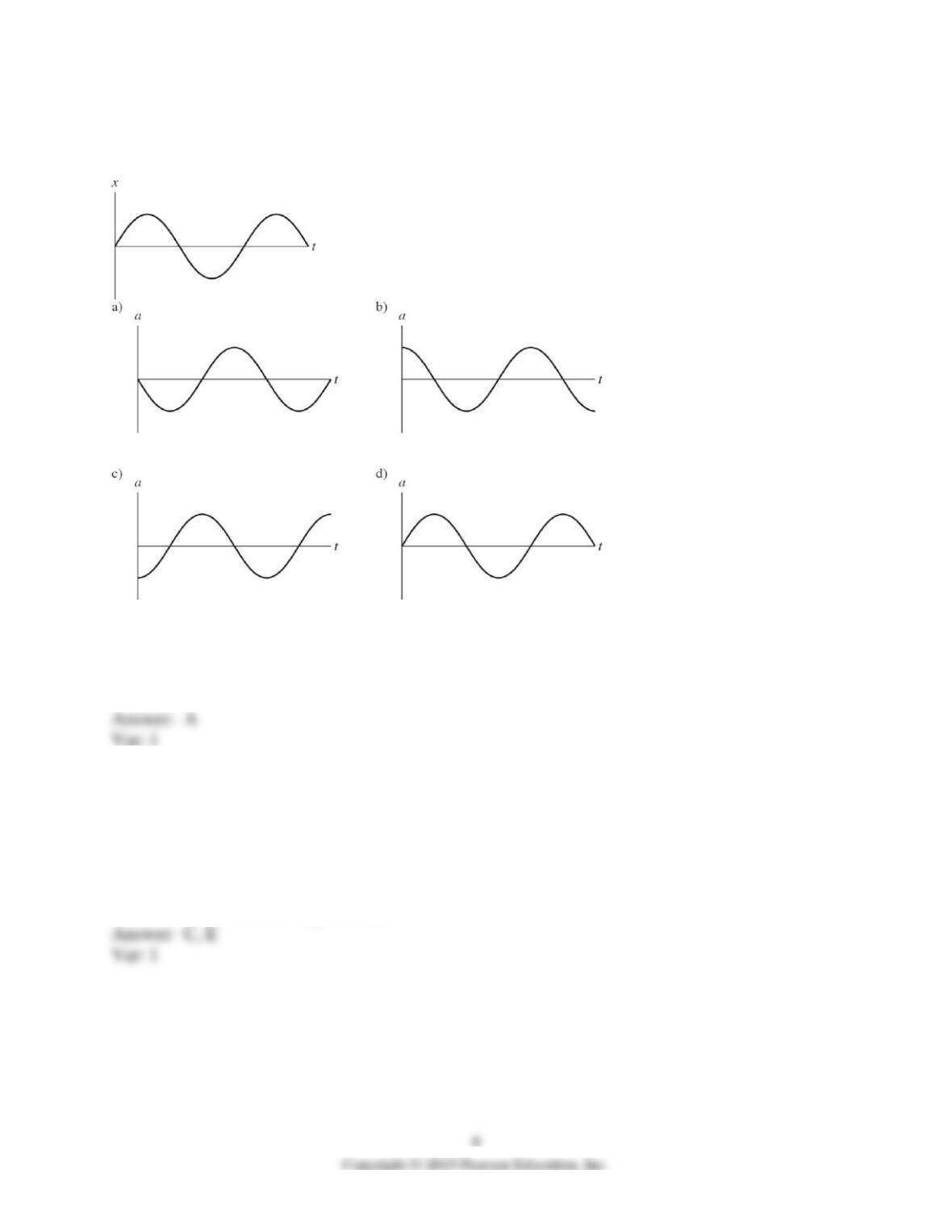
5) The figure shows a graph of the position x as a function of time t for a system undergoing
simple harmonic motion. Which one of the following graphs represents the acceleration of this
system as a function of time?
A) graph a
B) graph b
C) graph c
D) graph d
6) In simple harmonic motion, when is the speed the greatest? (There could be more than one
correct choice.)
A) when the magnitude of the acceleration is a maximum
B) when the displacement is a maximum
C) when the magnitude of the acceleration is a minimum
D) when the potential energy is a maximum
E) when the potential energy is a zero

7) In simple harmonic motion, when is the magnitude of the acceleration the greatest? (There
could be more than one correct choice.)
A) when the speed is a maximum
B) when the displacement is a zero
C) when the magnitude of the displacement is a maximum
D) when the potential energy is a maximum
E) when the kinetic energy is a minimum
8) The total mechanical energy of a simple harmonic oscillating system is
A) zero as it passes the equilibrium point.
B) zero when it reaches the maximum displacement.
C) a maximum when it passes through the equilibrium point.
D) a minimum when it passes through the equilibrium point.
E) a non-zero constant.
9) An object attached to an ideal spring executes simple harmonic motion. If you want to double
its total energy, you could
A) double the amplitude of vibration.
B) double the force constant (spring constant) of the spring.
C) double both the amplitude and force constant (spring constant).
D) double the mass.
E) double both the mass and amplitude of vibration.
10) An object that hangs from the ceiling of a stationary elevator by an ideal spring oscillates
with a period T. If the elevator accelerates upward with acceleration 2g, what will be the period
of oscillation of the object?
A) 4T
B) 2T
C) T
D) T/2
E) T/4

11) A mass on a spring undergoes SHM. When the mass passes through the equilibrium
position, which of the following statements about it are true? (There could be more than one
correct choice.)
A) Its acceleration is zero.
B) Its speed is zero.
C) Its elastic potential energy is zero.
D) Its kinetic energy is a maximum.
E) Its total mechanical energy is zero.
12) A mass on a spring undergoes SHM. When the mass is at its maximum distance from the
equilibrium position, which of the following statements about it are true? (There could be more
than one correct choice.)
A) Its acceleration is zero.
B) Its speed is zero.
C) Its elastic potential energy is zero.
D) Its kinetic energy is a maximum.
E) Its total mechanical energy is zero.
13) An object is attached to a vertical spring and bobs up and down between points A and B.
Where is the object located when its kinetic energy is a minimum?
A) at either A or B
B) midway between A and B
C) one-third of the way between A and B
D) one-fourth of the way between A and B
E) at none of the above points
14) An object is attached to a vertical spring and bobs up and down between points A and B.
Where is the object located when its kinetic energy is a maximum?
A) at either A or B
B) midway between A and B
C) one-third of the way between A and B
D) one-fourth of the way between A and B
E) at none of the above points
15) An object is attached to a vertical spring and bobs up and down between points A and B.
Where is the object located when its elastic potential energy is a minimum?
A) at either A or B
B) midway between A and B
C) one-third of the way between A and B
D) one-fourth of the way between A and B
E) at none of the above points
16) An object is attached to a vertical spring and bobs up and down between points A and B.
Where is the object located when its elastic potential energy is a maximum?
A) at either A or B
B) midway between A and B
C) one-third of the way between A and B
D) one-fourth of the way between A and B
E) at none of the above points
17) Two simple pendulums, A and B, are each 3.0 m long, and the period of pendulum A is T.
Pendulum A is twice as heavy as pendulum B. What is the period of pendulum B?
A) T/
B) T
C) T
D) 2T
E) T/2
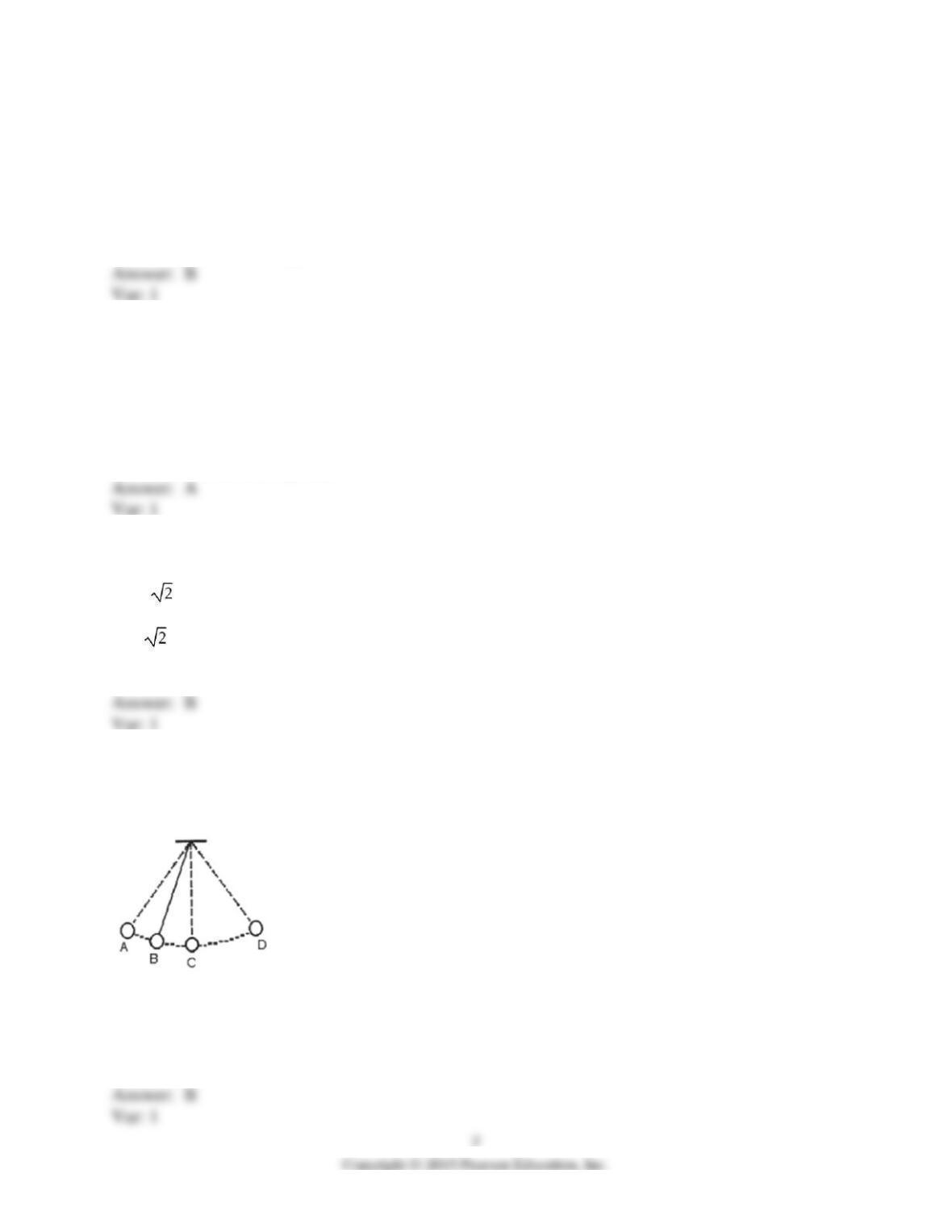
18) A ball swinging at the end of a massless string, as shown in the figure, undergoes simple
harmonic motion. At what point (or points) is the magnitude of the instantaneous acceleration of
the ball the greatest?
A) C
B) A and D
C) A and C
D) A and B
E) B

19) Identical balls oscillate with the same period T on Earth. Ball A is attached to an ideal spring
and ball B swings back and forth to form a simple pendulum. These systems are now taken to the
Moon, where g = 1.6 m/s2, and set into oscillation. Which of the following statements about
these systems are true? (There could be more than one correct choice.)
A) Both systems will have the same period on the Moon as on Earth.
B) On the Moon, ball A will take longer to complete one cycle than ball B.
C) On the Moon, ball B will take longer to complete one cycle than ball A.
D) On the Moon, ball A will execute more vibrations each minute than ball B.
E) On the Moon, ball B will execute more vibrations each minute than ball A.
20) Grandfather clocks are designed so they can be adjusted by moving the weight at the bottom
of the pendulum up or down. Suppose you have a grandfather clock at home that runs slow.
Which of the following adjustments of the weight would make it more accurate? (There could be
more than one correct choice.)
A) Raise the weight.
B) Lower the weight.
C) Add more mass to the weight.
D) Remove some mass from the weight.
E) Increase the amplitude of swing by a small amount.
21) Grandfather clocks are designed so they can be adjusted by moving the weight at the bottom
of the pendulum up or down. Suppose you have a grandfather clock at home that runs fast.
Which of the following adjustments of the weight would make it more accurate? (There could be
more than one correct choice.)
A) Raise the weight.
B) Lower the weight.
C) Add more mass to the weight.
D) Remove some mass from the weight.
E) Decrease the amplitude of swing by a small amount.

22) A pendulum of length L is suspended from the ceiling of an elevator. When the elevator is at
rest the period of the pendulum is T. How does the period of the pendulum change when the
elevator moves upward with constant acceleration?
A) The period does not change.
B) The period increases.
C) The period decreases.
D) The period becomes zero.
E) The period increases if the upward acceleration is more than g/2 but decreases if the upward
acceleration is less than g/2.
23) A pendulum of length L is suspended from the ceiling of an elevator. When the elevator is at
rest the period of the pendulum is T. How does the period of the pendulum change when the
elevator moves downward with constant acceleration?
A) The period does not change.
B) The period increases.
C) The period decreases.
D) The period becomes zero.
E) The period increases if the upward acceleration is more than g/2 but decreases if the upward
acceleration is less than g/2.
24) A pendulum of length L is suspended from the ceiling of an elevator. When the elevator is at
rest the period of the pendulum is T. How does the period of the pendulum change when the
elevator moves upward with constant velocity?
A) The period does not change.
B) The period increases.
C) The period decreases.
D) The period becomes zero.
E) The period increases if the upward acceleration is more than g/2 but decreases if the upward
acceleration is less than g/2.
25) A pendulum of length L is suspended from the ceiling of an elevator. When the elevator is at
rest the period of the pendulum is T. How would the period of the pendulum change if the
supporting chain were to break, putting the elevator into freefall?
A) The period does not change.
B) The period increases slightly.
C) The period decreases slightly.
D) The period becomes zero.
E) The period becomes infinite because the pendulum would not swing.

26) A simple pendulum and a mass oscillating on an ideal spring both have period T in an
elevator at rest. If the elevator now accelerates downward uniformly at 2 m/s2, what is true about
the periods of these two systems?
A) Both periods would remain the same.
B) Both periods would increase.
C) Both periods would decrease.
D) The period of the pendulum would increase but the period of the spring would stay the same.
E) The period of the pendulum would decrease but the period of the spring would stay the same.
27) A simple pendulum and a mass oscillating on an ideal spring both have period T in an
elevator at rest. If the elevator now moves downward at a uniform 2 m/s, what is true about the
periods of these two systems?
A) Both periods would remain the same.
B) Both periods would increase.
C) Both periods would decrease.
D) The period of the pendulum would increase but the period of the spring would stay the same.
E) The period of the pendulum would decrease but the period of the spring would stay the same.
28) A simple pendulum that consists of a small ball of mass m and a massless wire of length L
swings with a period T. Suppose now that the mass is rearranged so that mass of the ball was
reduced but the mass of the wire was increased, with the total mass remaining m and the length
being L. What is true about the new period of swing? (There could be more than one correct
choice.)
A) The new period is T because the total mass m has not changed.
B) The new period is T because the length L has not changed.
C) The new period is greater than T.
D) The new period is less than T
E) The new period is T because neither L nor m have changed.
14.2 Problems
1) A leaky faucet drips 40 times in What is the frequency of the dripping?
A) 1.3 Hz
B) 0.75 Hz
C) 1.6 Hz
D) 0.63 Hz
2) An object is undergoing simple harmonic motion of amplitude 2.3 m. If the maximum
velocity of the object is 10 m/s, what is the object’s angular frequency?
A) 4.3 rad/s
B) 4.8 rad/s
C) 3.5 rad/s
D) 4.0 rad/s
3) If a floating log is seen to bob up and down 15 times in 1.0 min as waves pass by you, what
are the frequency and period of the wave?
4) The quartz crystal in a digital watch has a frequency of 32.8 kHz. What is its period of
oscillation?
A) 30.5 µs
B) 15.3 µs
C) 95.8 µs
D) 0.191 ms
E) 9.71 µs
5) If your heart is beating at 76.0 beats per minute, what is the frequency of your heart’s
oscillations in hertz?
A) 4560 Hz
B) 1450 Hz
C) 3.98 Hz
D) 2.54 Hz
E) 1.27 Hz
6) A guitar string is set into vibration with a frequency of 512 Hz. How many oscillations does it
undergo each minute?
A) 30,700
B) 8.53
C) 26.8
D) 1610
E) 512
7) A sewing machine needle moves up and down in simple harmonic motion with an amplitude
of 1.27 cm and a frequency of 2.55 Hz. What are the (a) maximum speed and (b) maximum
acceleration of the tip of the needle?
8) A sewing machine needle moves in simple harmonic motion with a frequency of 2.5 Hz and
an amplitude of 1.27 cm.
(a) How long does it take the tip of the needle to move from the highest point to the lowest point
in its travel?
(b) How long does it take the needle tip to travel a total distance of 11.43 cm?
9) If the frequency of a system undergoing simple harmonic motion doubles, by what factor does
the maximum value of acceleration change?
A) 4
B) 2
C)
D) 2/π
10) If a pendulum makes 12 complete swings in 8.0 s, what are its (a) frequency and (b) period?
11) A point on the string of a violin moves up and down in simple harmonic motion with an
amplitude of 1.24 mm and a frequency of 875 Hz.
(a) What is the maximum speed of that point in SI units?
(b) What is the maximum acceleration of the point in SI units?

12) The position of a cart that is oscillating on a spring is given by the equation x = (12.3 cm)
cos[(1.26 s-1)t]. When t = 0.805 s, what are the (a) velocity and (b) acceleration of the cart?
13) The position of an object that is oscillating on a spring is given by the equation x = (18.3 cm)
cos[(2.35 s-1)t]. What are the (a) frequency, (b) amplitude, and (c) period of this motion?
14) The position of an air-track cart that is oscillating on a spring is given by the equation x =
(12.4 cm) cos[(6.35 s-1)t]. At what value of t after t = 0.00 s is the cart first located at x = 8.47
cm?
A) 4.34 s
B) 0.108 s
C) 0.129 s
D) 7.39 s
E) 7.75 s
15) An air-track cart is attached to a spring and completes one oscillation every 5.67 s in simple
harmonic motion. At time t = 0.00 s the cart is released at the position x = +0.250 m. What is the
position of the cart when t = 29.6 s?
A) x = 0.0461 m
B) x = 0.210 m
C) x = 0.218 m
D) x = 0.342 m
E) x = -0.218 m
16) The position of an object that is oscillating on a spring is given by the equation x = (17.4 cm)
cos[(5.46 s-1)t]. What is the angular frequency for this motion?
A) 0.183 rad/s
B) 5.46 rad/s
C) 2.34 rad/s
D) 17.4 rad/s
E) 0.869 rad/s
17) An object is oscillating on a spring with a period of 4.60 s. At time t = 0.00 s the object has
zero speed and is at x = 8.30 cm. What is the acceleration of the object at t = 2.50 s?
A) 1.33 cm/s2
B) 0.784 cm/s2
C) 11.5 cm/s2
D) 14.9 cm/s2
E) 0.00 cm/s2
18) A package is oscillating on a spring scale with a period of 4.60 s. At time t = 0.00 s the
package has zero speed and is at x = 8.30 cm. At what time after t = 0.00 s will the package first
be at x = 4.15 cm?
A) 0.575 s
B) 0.767 s
C) 1.15 s
D) 1.30 s
E) 1.53 s
19) A ball is oscillating on an ideal spring with an amplitude of 8.3 cm and a period of 4.6 s.
Write an expression for its position, x, as a function of time t, if x is equal to 8.3 cm at t = 0.0 s.
Use the cosine function.
20) The position of an object that is oscillating on an ideal spring is given by x = (17.4 cm)
cos[(5.46 s-1)t]. Write an expression for the velocity of the particle as a function of time using
the sine function.
21) The position of an object that is oscillating on an ideal spring is given by x = (17.4 cm)
cos[(5.46 s-1)t]. Write an expression for the acceleration of the particle as a function of time
using the cosine function.