
Chapter 14: Intercorporate Investments in Common Stock Key
1. The accounting for investments in common stock depends on (1) the expected holding period, and (2) the
purpose of the investment, as determined by both the percentage held and management intent.
2. Securities that firms expect to sell within the next year appear as investment securities in current assets on the
balance sheet.
3. Securities that firms expect to hold for more than one year from the date of the balance sheet appear in
investments in securities, classified as a current asset on the balance sheet.
4. U.S. GAAP and IFRS view investments of between 20% and 50% of the voting stock of another company as
minority, active investments unless evidence indicates that the investor cannot exert significant influence.
5. U.S. GAAP and IFRS view investments of less than 20% of the voting shares of another company as
minority, passive investments in most cases.
6. U.S. GAAP and IFRS view ownership of more than 50% of an investee as implying an ability to control the
investee, unless evidence indicates to the contrary.
7. The rationale for the equity method is that it better measures an investor’s income from investing activities
when, because of its ownership interest, it can exert significant influence over the operations and dividend
policy of the investee.
8. For various reasons, a single economic entity may exist in the form of a parent and several legally separate
subsidiaries, often referred to as an affiliated group.
9. A major mining company owns a mining subsidiary in South America, where the government enforces
stringent control over cash payments outside the country. The parent cannot control all the assets of the
subsidiary, despite owning a majority of the voting shares, but should prepare consolidated statements with the
subsidiary.
10. In the acquisition method for a business combination, the excess of the fair value of the consideration over
the fair value of the acquired firm’s identifiable assets net of identifiable liabilities is goodwill.
11. The summary of significant accounting principles, a required part of the financial statement notes, must
include a statement about the parent’s consolidation policy. If an investor does not consolidate a significant
majority-owned subsidiary, the notes will disclose that fact.
12. If an entity qualifies as a variable interest entity (VIE), U.S. GAAP requires the primary beneficiary of the
VIE to consolidate the VIE.
13. Which of the following is/are true?
14. If the combined market value of trading securities at the end of the year is less than the market value of the
same portfolio of trading securities at the beginning of the year, the difference should be accounted for by
15. The accounting for investments in common stock depends on the
16. Which of the following is/are true regarding minority, passive investments?
17. Which of the following is/are true regarding minority, active investments?
18. Which of the following is/are true regarding majority, active investments?
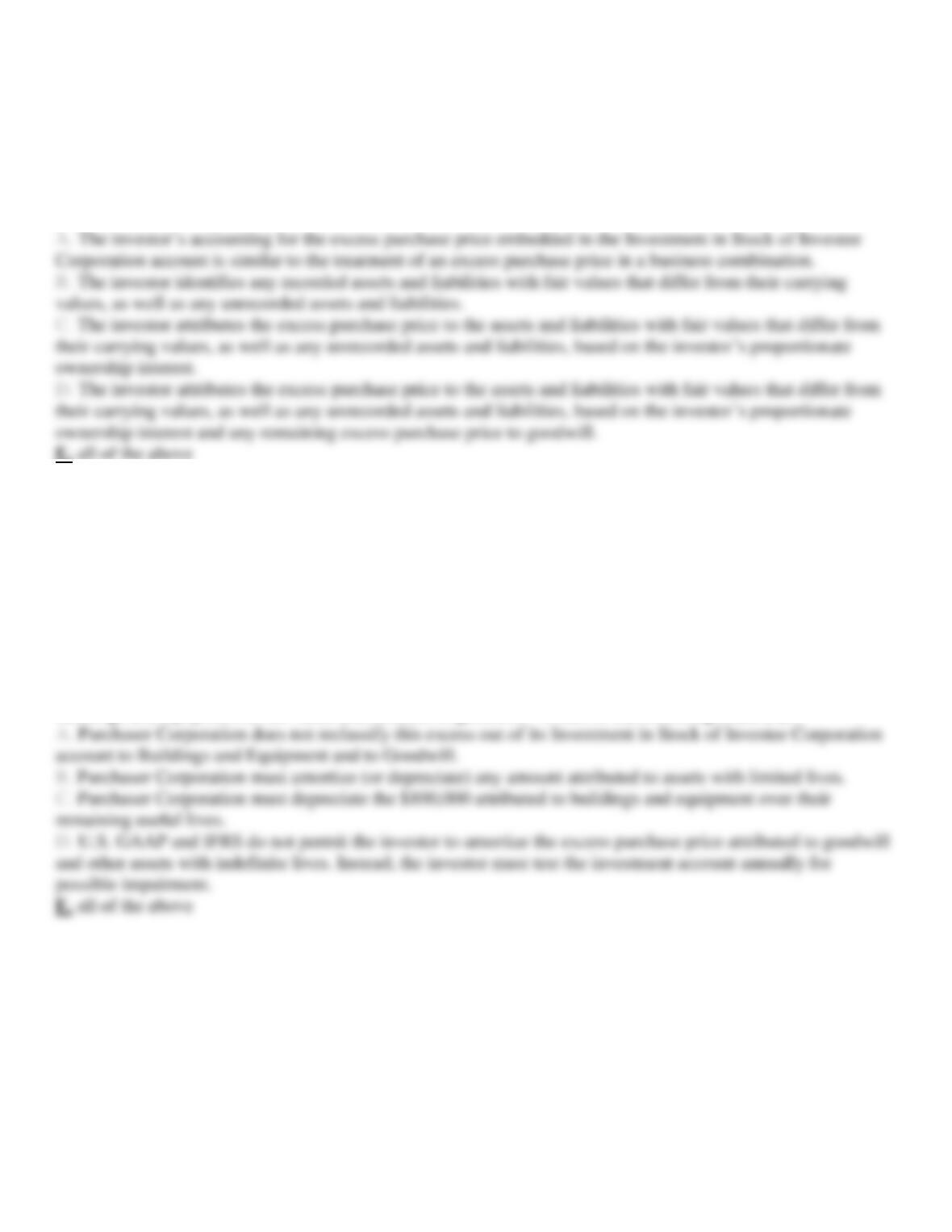
19. When an investor owns less than a majority of the voting stock of another corporation, the accountant must
judge when the investor can exert significant influence. For the sake of uniformity, U.S. GAAP and IFRS
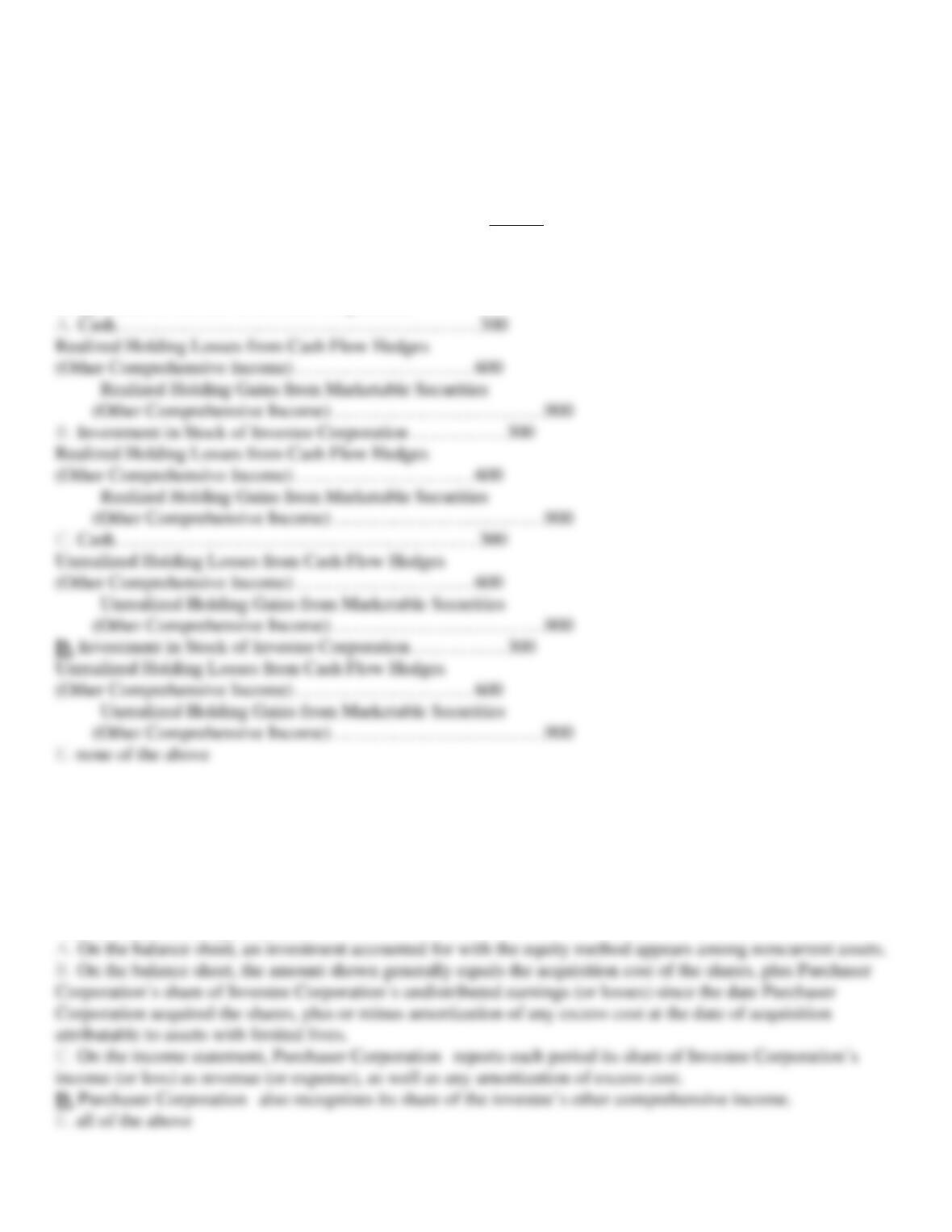
presume that significant influence exists at ownership of _____ or more of the voting stock of the
investee. (Assume that management does not have a contractual or other basis to demonstrate that influence.)
20. U.S. GAAP and IFRS require firms to account for minority, active investments, generally those where the
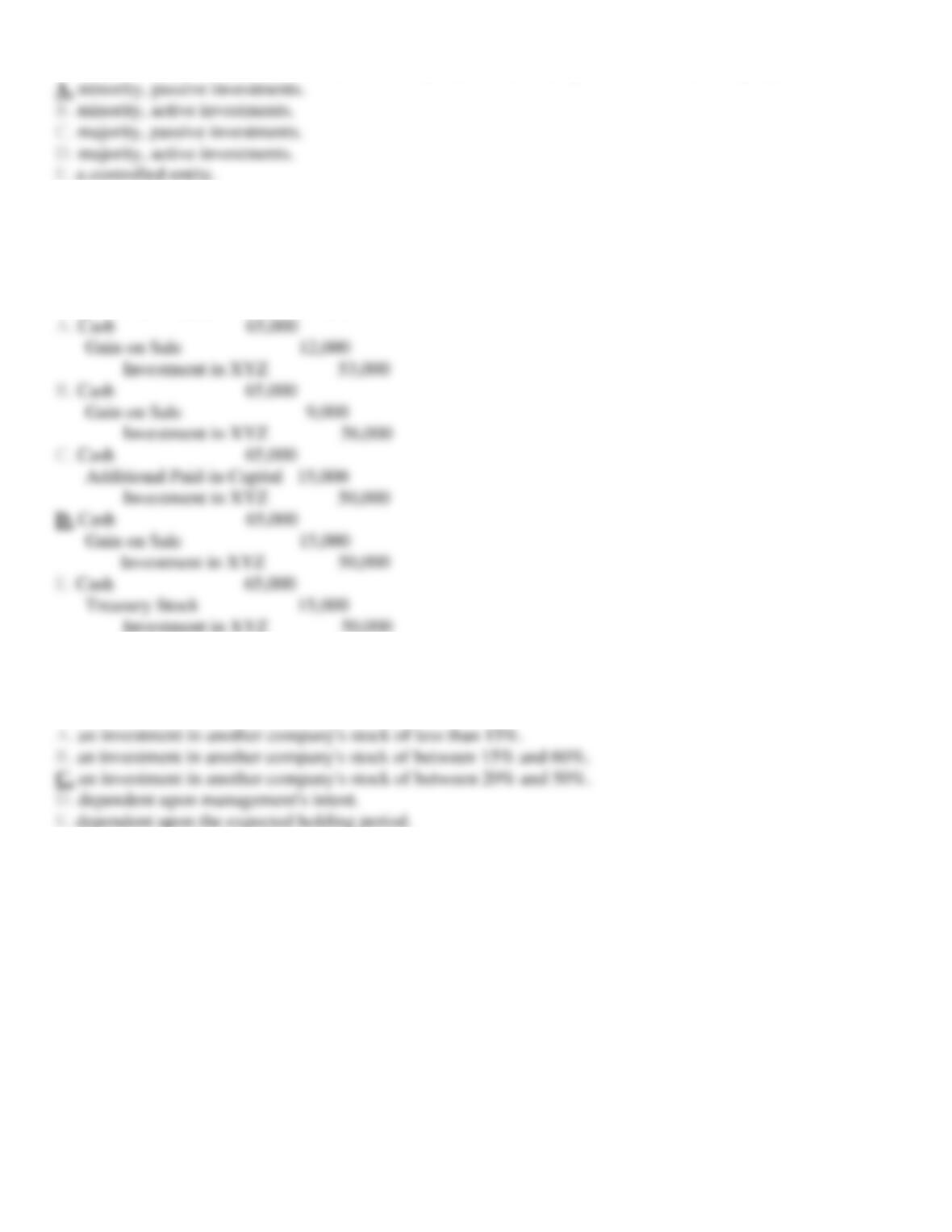
investor owns between _____ using the equity method. Under the equity method, the investor recognizes as
revenue (expense) each period its share of the net income (loss) of the investee. The investor recognizes
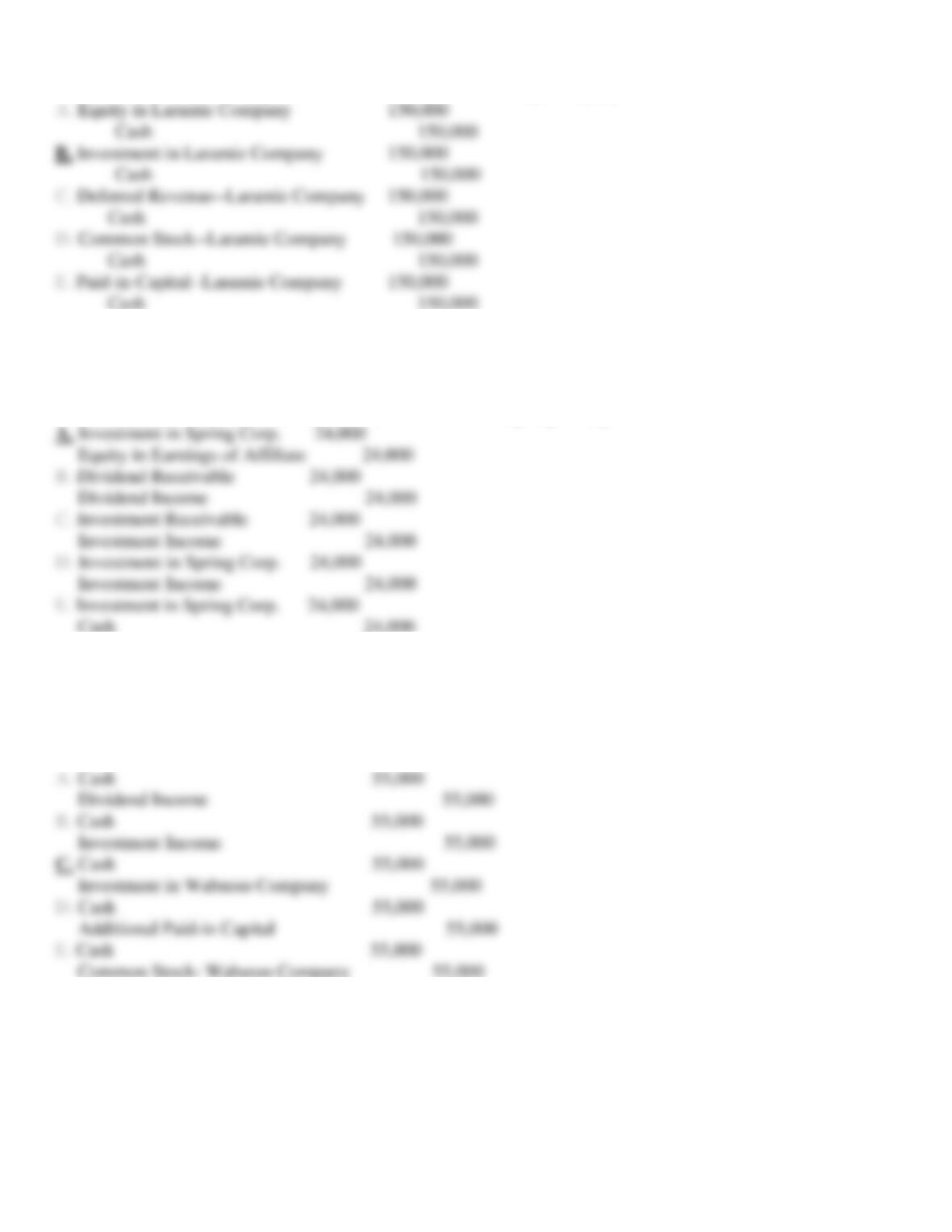
dividends received from the investee as a return (reduction) of investment, not as income.
21. Under the equity method, the investor recognizes as revenue (expense) each period _____. The investor
recognizes dividends received from the investee as a(n) _____.
22. U.S. GAAP and IFRS require firms to account for minority, active investments, using the _____ method.
23. The rationale for the equity method is that it better measures an investor’s income from investing activities
when, because of its ownership interest, it
24. Paula Company measures its investments in available-for-sale marketable securities
25. Paula Company recognizes unrealized changes in the fair value of available-for-sale securities in
26. The equity method records the initial purchase of an investment in voting common stock at _____. Each
period, the investor treats as revenue its share of the _____ of the investee. The investor treats dividends
declared by the investee as _____.
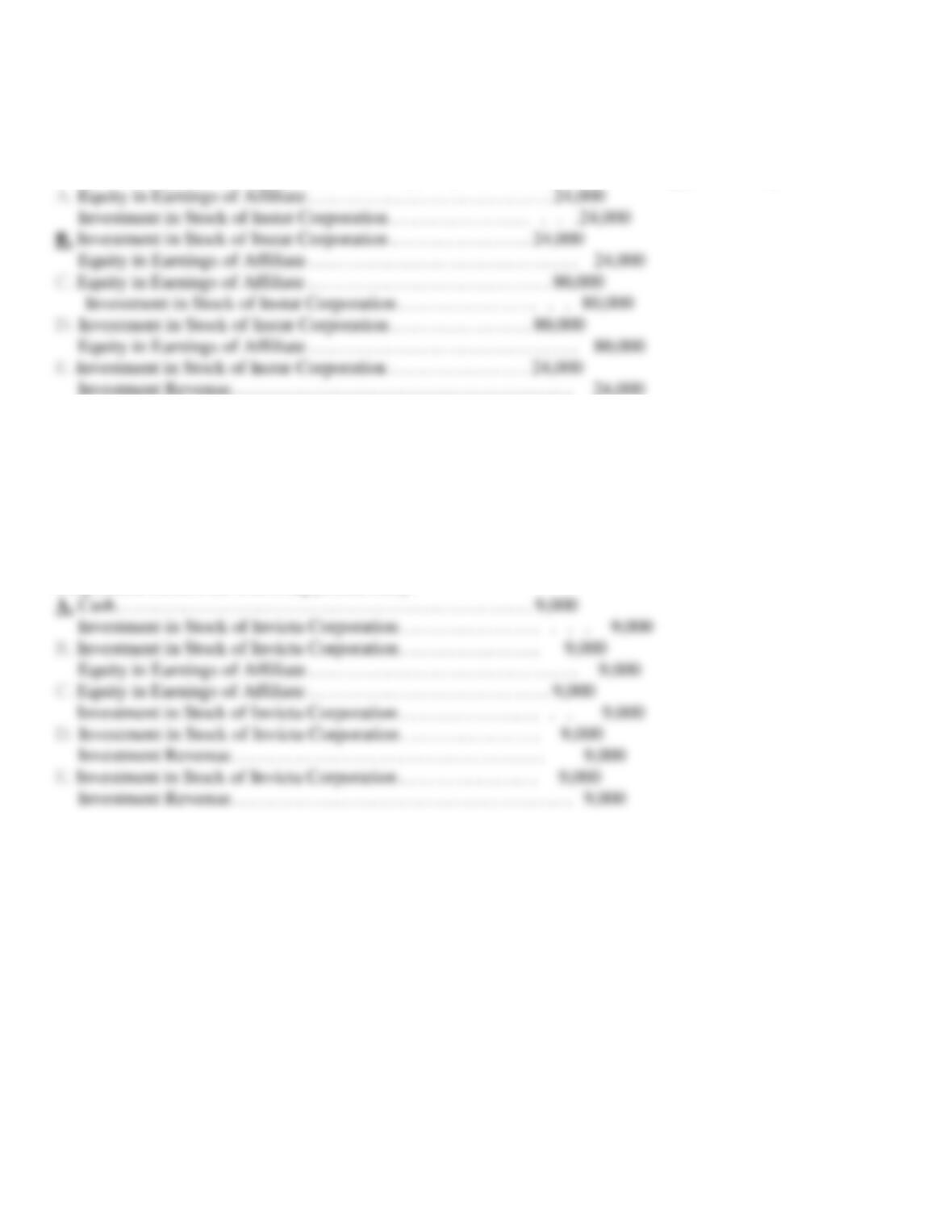
27. Marcoff Corporation acquires 30% of the outstanding voting common shares of the Invicta Corporation for
$600,000. Marcoff Corporation acquires the investment in Invicta Corporation by buying previously issued
shares of Invicta Corporation from other investors.
The entry to record the acquisition is:
28. Penney Corporation acquires 30% of the outstanding voting common shares of the Instat Corporation for
$600,000. Penney Corporation acquires the investment in Instat Corporation by buying previously issued shares
of Instat Corporation from other investors.
Between the time of the acquisition and the end of Penney Corporation’s next accounting period, Instat
Corporation reports earnings of $80,000. Penney Corporation records the following journal entry:
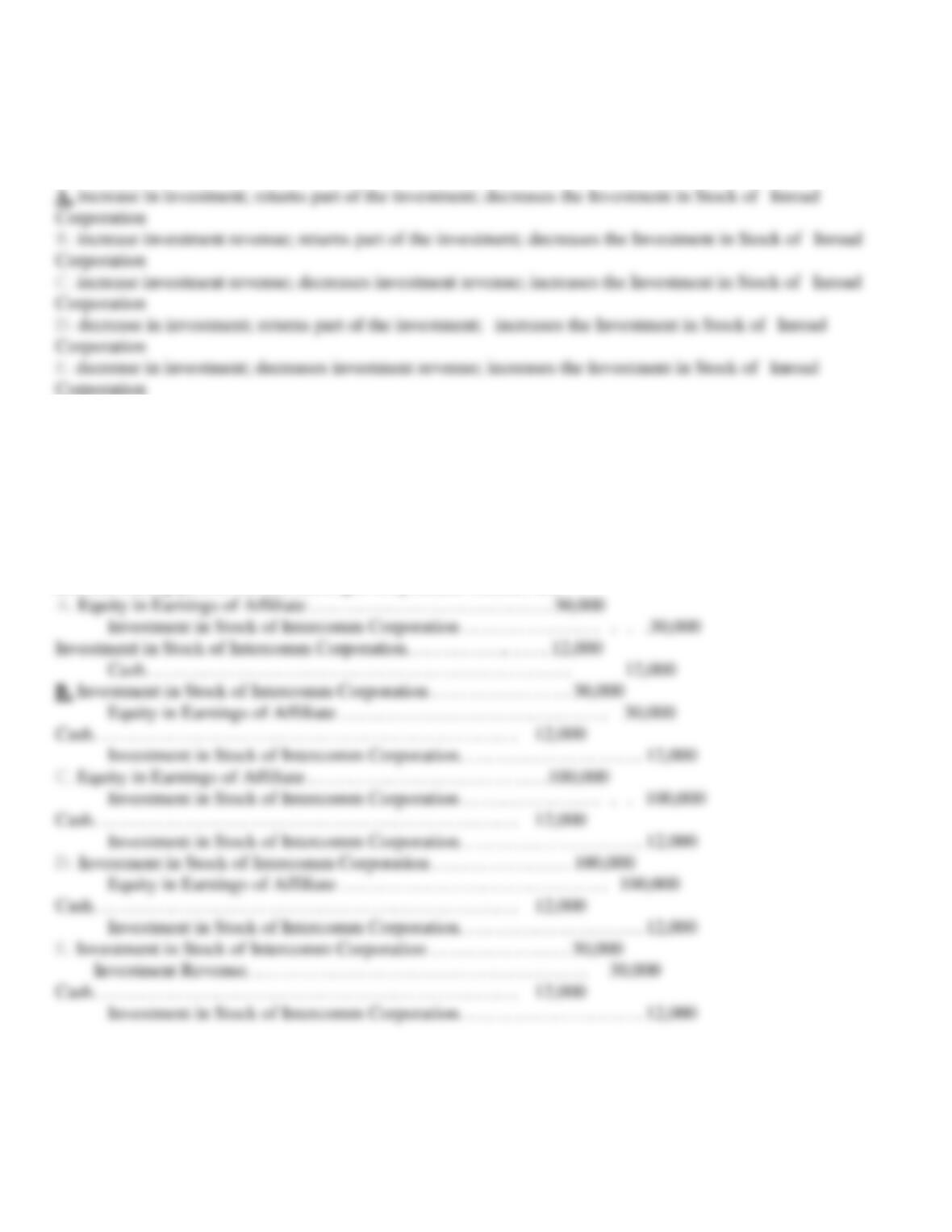
29. Marcoff Corporation acquires 30% of the outstanding voting common shares of the Invicta Corporation for
$600,000. Marcoff Corporation acquires the investment in Invicta Corporation by buying previously issued
shares of Invicta Corporation from other investors.
If Invicta Corporation declares and pays a dividend of $30,000 to holders of its common stock, Marcoff
Corporation records the following journal entry:
30. Power Corporation acquires 30% of the outstanding voting common shares of the Inroad Corporation for
$600,000. Power Corporation acquires the investment in Inroad Corporation by buying previously issued shares
of Inroad Corporation from other investors.
Power Corporation records income earned by Inroad Corporation as a(n) _____, while the dividend _____,
and _____ account.
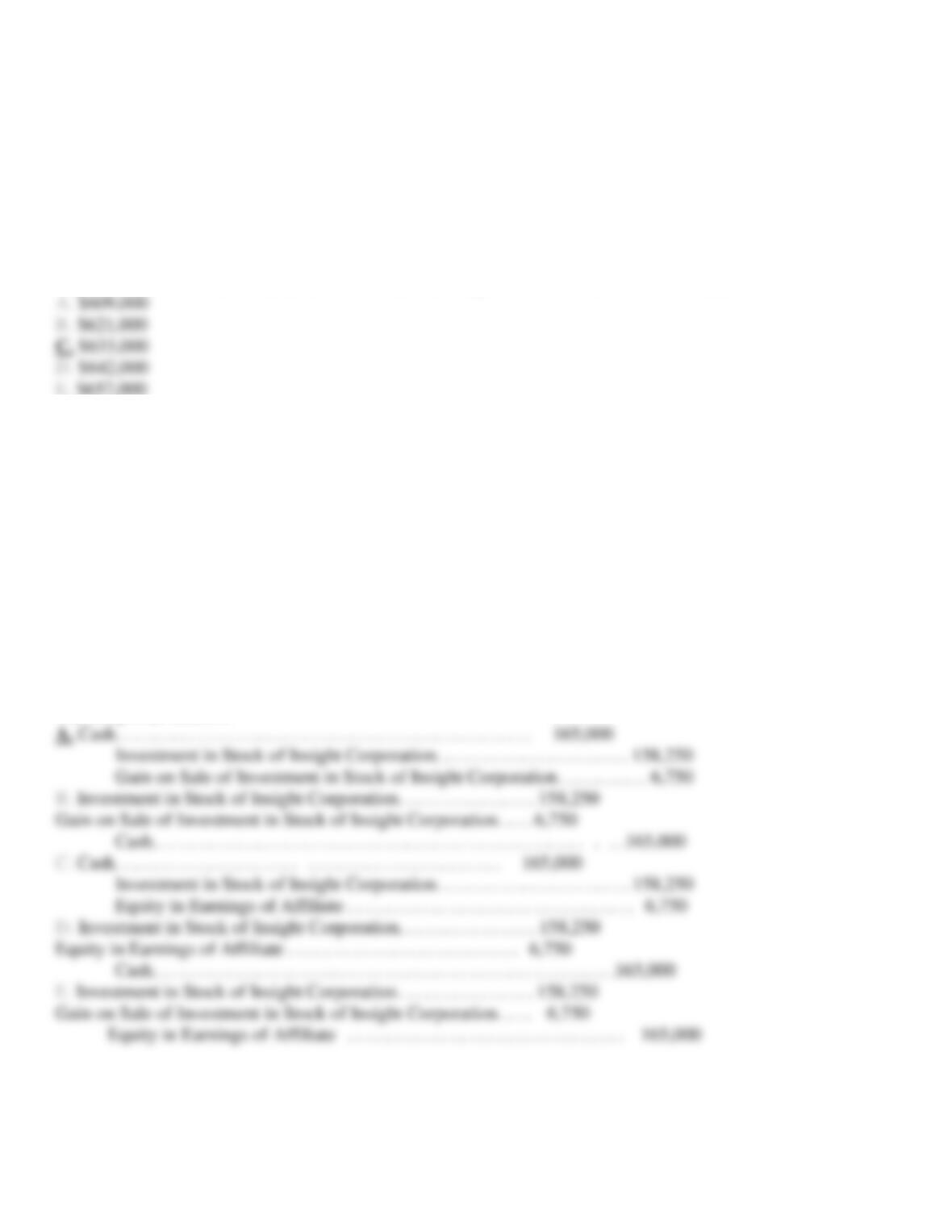
31. Pager Corporation acquires 30% of the outstanding voting common shares of the Intercomm Corporation for
$600,000. Pager Corporation acquires the investment in Intercomm Corporation by buying previously issued
shares of Intercomm Corporation from other investors.
Suppose that Intercomm Corporation reports earnings of $100,000 and pays dividends of $40,000, during the
next accounting period. As a result, Pager Corporation’s entries are:
32. Pagoli Corporation acquires 30% of the outstanding voting common shares of the Inform Corporation for
$600,000. Pagoli Corporation acquires the investment in Inform Corporation by buying previously issued shares
of Inform Corporation from other investors.
Between the time of the acquisition and the end of Pagoli Corporation’s next accounting period, Inform
Corporation reports earnings of $80,000; and pays a dividend of $30,000 to holders of its common stock.
Inform Corporation reports earnings of $100,000 and pays dividends of $40,000 during the subsequent
accounting period.
Pagoli Corporation’s Investment in Stock of Inform Corporation account now has a balance of:
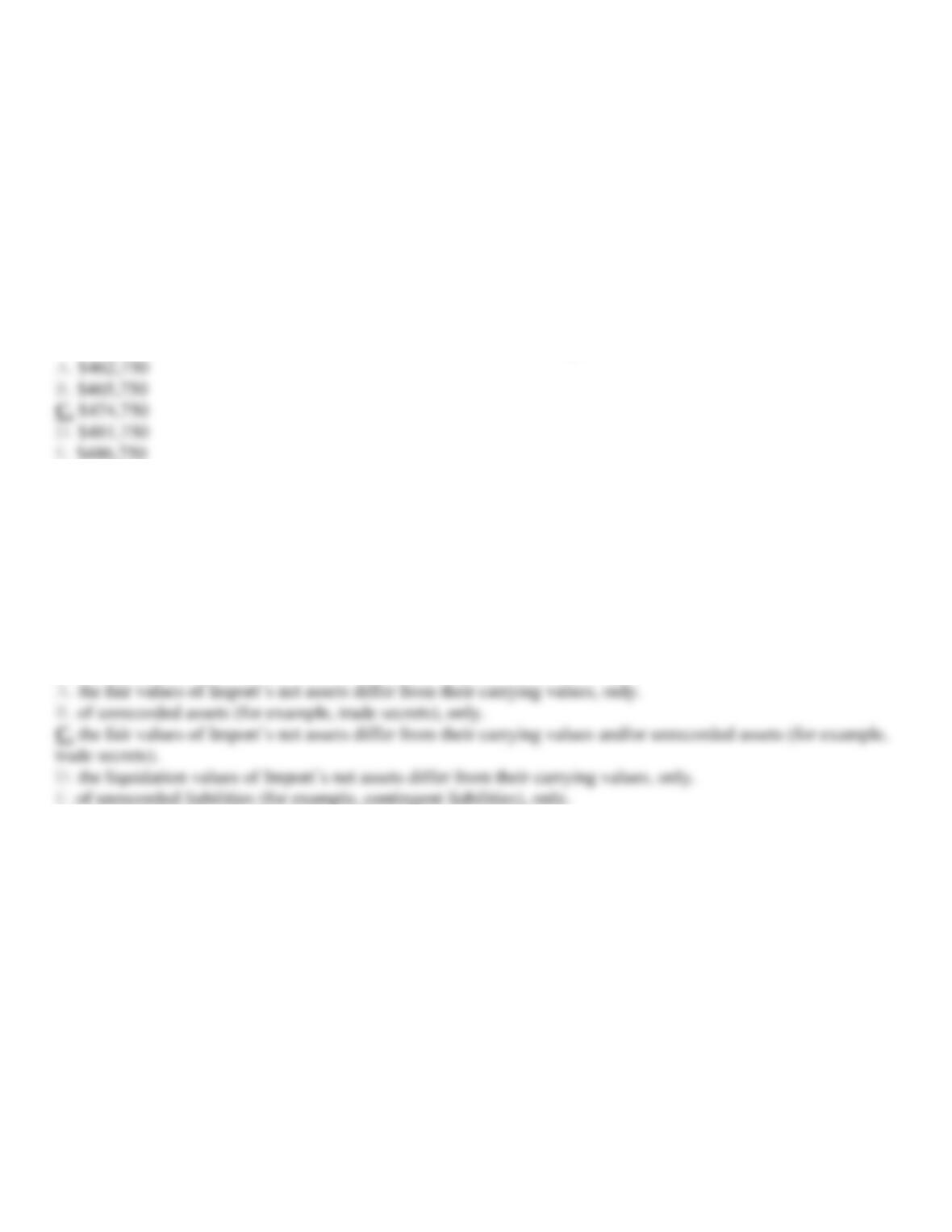
33. acker Corporation acquires 30% of the outstanding voting common shares of the Insight Corporation for
$600,000. Packer Corporation acquires the investment in Insight Corporation by buying previously issued
shares of Insight Corporation from other investors.
Between the time of the acquisition and the end of Packer Corporation’s next accounting period, Insight
Corporation reports earnings of $80,000; and pays a dividend of $30,000 to holders of its common stock.
Insight Corporation reports earnings of $100,000 and pays dividends of $40,000 during the subsequent
accounting period.
Assume now that Packer Corporation sells one-fourth of its investment in Insight Corporation for $165,000.
The entry is as follows:
34. Potion Corporation acquires 30% of the outstanding voting common shares of the Formula Corporation for
$600,000. Potion Corporation acquires the investment in Formula Corporation by buying previously issued
shares of Formula Corporation from other investors.
Between the time of the acquisition and the end of Potion Corporation’s next accounting period, Formula
Corporation reports earnings of $80,000; and pays a dividend of $30,000 to holders of its common stock.
Formula Corporation reports earnings of $100,000 and pays dividends of $40,000 during the subsequent
accounting period.
During the next accounting period, Potion Corporation sells one-fourth of its investment in Formula
Corporation for $165,000.
After the sale, the balance in the Investment in Stock of Formula Corporation account is:
35. Parton Corporation acquires 30% of the outstanding voting common shares of the Investee Corporation for
$600,000. Parton Corporation acquires the investment in Import Corporation by buying previously issued shares
of Import Corporation from other investors.
When Parton Corporation acquired 30% of Import Corporation’s common shares for $600,000, Import
Corporation’s total shareholders’ equity was $1.5 million. Parton Corporation’s cost exceeds the carrying value
of the net assets acquired by $150,000 [ $600,000 – (0.30 x $1,500,000)]. Parton Corporation may pay this
premium because
36. Purchaser Corporation acquires 30% of the outstanding voting common shares of the Investee Corporation
for $600,000. Purchaser Corporation acquires the investment in Investee Corporation by buying previously
issued shares of Investee Corporation from other investors.
When Purchaser Corporation acquired 30% of Investee Corporation’s common shares for $600,000, Investee
Corporation’s total shareholders’ equity was $1.5 million. Purchaser Corporation’s cost exceeds the carrying
value of the net assets acquired by $150,000 [ $600,000 – (0.30 x $1,500,000)]. What is/are the accounting
procedure(s) for this premium?
37. Purchaser Corporation acquires 30% of the outstanding voting common shares of the Investee Corporation
for $600,000. Purchaser Corporation acquires the investment in Investee Corporation by buying previously
issued shares of Investee Corporation from other investors. When Purchaser Corporation acquired 30% of
Investee Corporation’s common shares for $600,000, Investee Corporation’s total shareholders’ equity was $1.5
million. Purchaser Corporation’s cost exceeds the carrying value of the net assets acquired by $150,000 [
$600,000 – (0.30 x $1,500,000)].
Purchaser Corporation attributes the $150,000 excess purchase price as follows: $100,000 to remeasure
buildings and equipment to fair value and $50,000 to goodwill. Which of the following is/are true?
38. Purchaser Corporation acquires 30% of the outstanding voting common shares of the Investee Corporation
for $600,000. Purchaser Corporation acquires the investment in Investee Corporation by buying previously
issued shares of Investee Corporation from other investors.
Investee Corporation’s other comprehensive income during the first period is as follows:
Unrealized Holding Gains from Marketable Securities. . .$ 3,000
Unrealized Losses from Cash Flow Hedges . . . . . . . . . . (2,000)
Other Comprehensive Income. . . . . . . . . . . . . . . . . . . . $ 1,000
Purchaser Corporation would make the following entry to recognize its share of the items of other
comprehensive income of Investee Corporation:
39. Purchaser Corporation acquires 30% of the outstanding voting common shares of the Investee Corporation
for $600,000. Purchaser Corporation acquires the investment in Investee Corporation by buying previously
issued shares of Investee Corporation from other investors.
Which of the following is/are true?
40. U.S. GAAP view investments of less than 20 percent of the voting stock of another company as
41. In Year 2, ABC Corp. acquired a 15% interest in XYZ, Inc., for $50,000. During the year, XYZ paid
dividends of $10,000 and had net income of $30,000. ABC sold the shares of XYZ for $65,000 cash. What
entry will ABC make to record the sale?
42. A minority, active investment is generally
43. If Barton Company purchases a minority active interest in Laramie Company for $150,000, Barton will
make which of the following entries to record the purchase using the equity method?
44. Pareto Corporation owns 40% of Spring Corporation. During Year 3, Spring has net income of $60,000.
What entry should Pareto record related to its investment in Spring during Year 3?
45. If Wabasso Company pays $55,000 in dividends to its corporate investor Lament Corporation (Lament
owns 35% of The Wabasso Company), what entry should Lament Corporation record when it receives the
dividends?
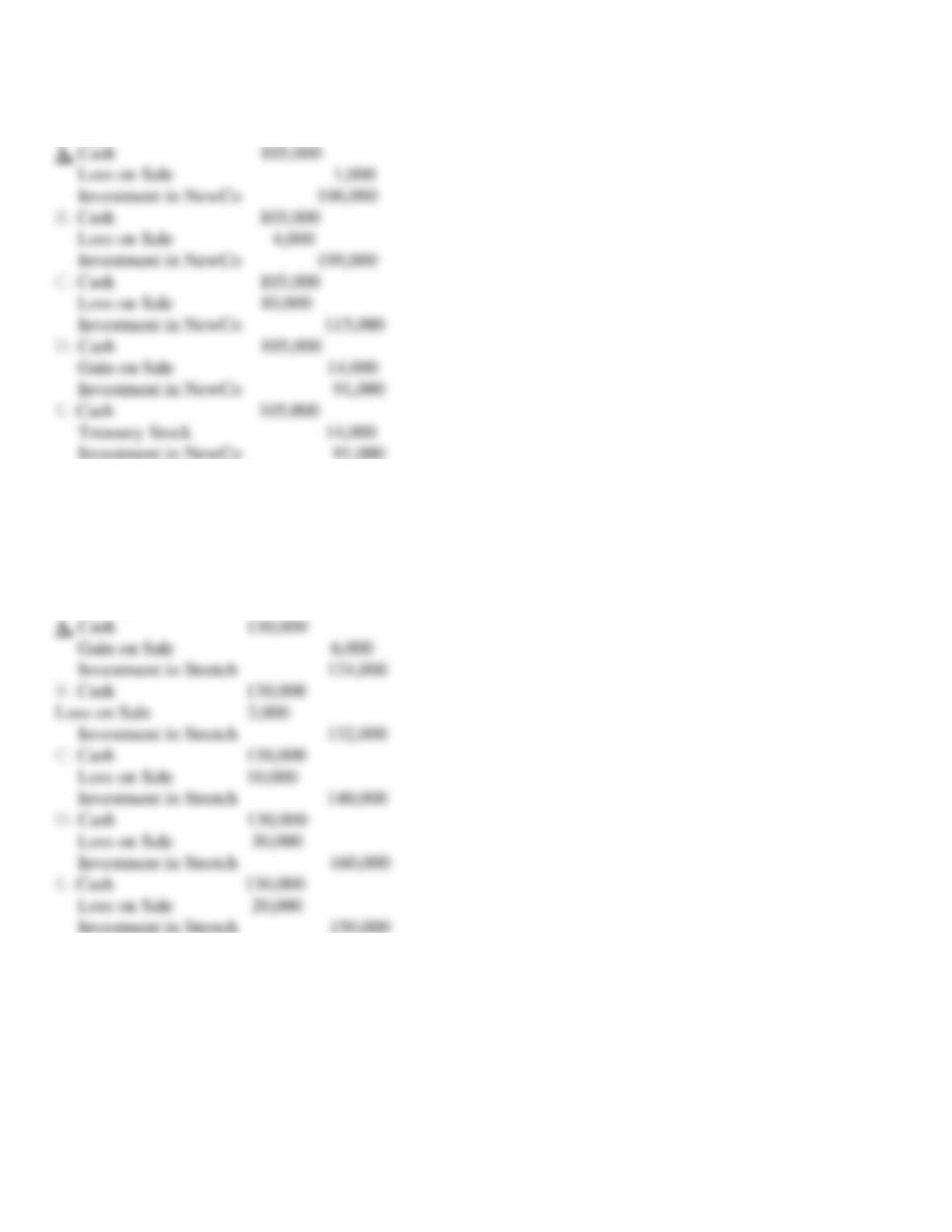
46. InvestCo purchases 30% of NewCo’s stock on January 1, Year 1, for $100,000. In Year 1, NewCo paid total
dividends of $30,000 and had a net income of $70,000. In Year 2, NewCo suffered a loss of $20,000 and paid
no dividends. On January 1, Year 3, InvestCo sells its investment in NewCo for $105,000. How is the sale
recorded?
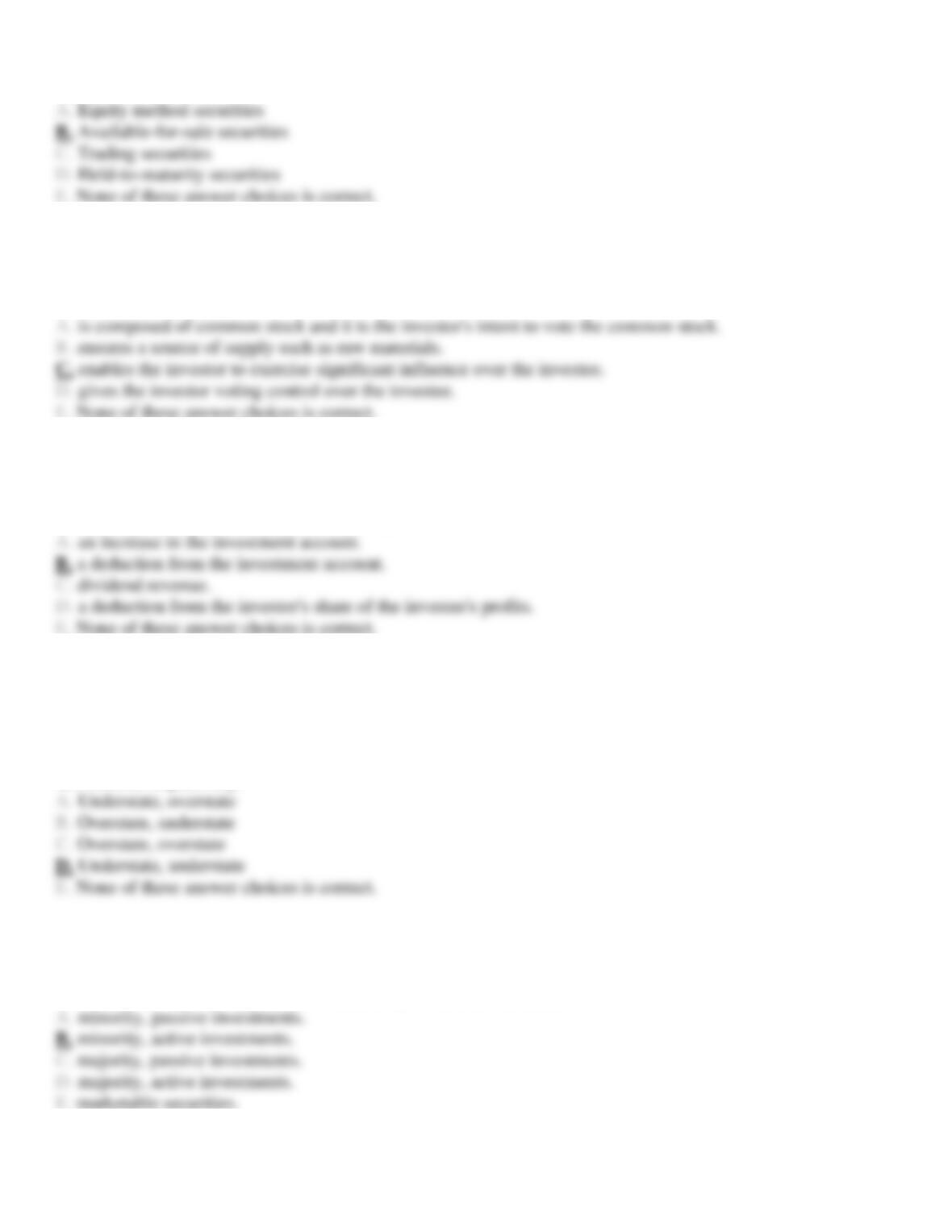
47. Pense Co. purchased 40% of the stock of Stretch Co. in Year 1 for $100,000. Stretch had net income in Year
1 of $50,000 and net income in Year 2 of $30,000. Stretch also paid total dividends of $20,000 in Year 2. On
January 1, Year 3, Pense Co. sold its investment in Stretch Co. to GE Capital Corporation (GE) for $130,000.
What entry would Pense Co. make to record the sale of Stretch Co.?
48. For which type of investments would unrealized increases and decreases be recorded directly in an owners’
equity account?
49. The equity method of accounting for an investment in the common stock of another company should be
used when the investment
50. When an investor uses the equity method to account for investments in common stock, cash dividends
received by the investor from the investee should be recorded as
51. Park Inc. owns 35 percent of Exeter Corporation. During the calendar year 2013, Exeter had net earnings of
$300,000 and paid dividends of $36,000. Park mistakenly accounted for the investment in Exeter using the cost
method rather than the equity method of accounting. What effect would this have on the investment account and
net income, respectively?
52. U.S. GAAP view investments of between 20 and 50 percent of the voting stock of another company (unless
evidence indicates that significant influence cannot be exercised) as
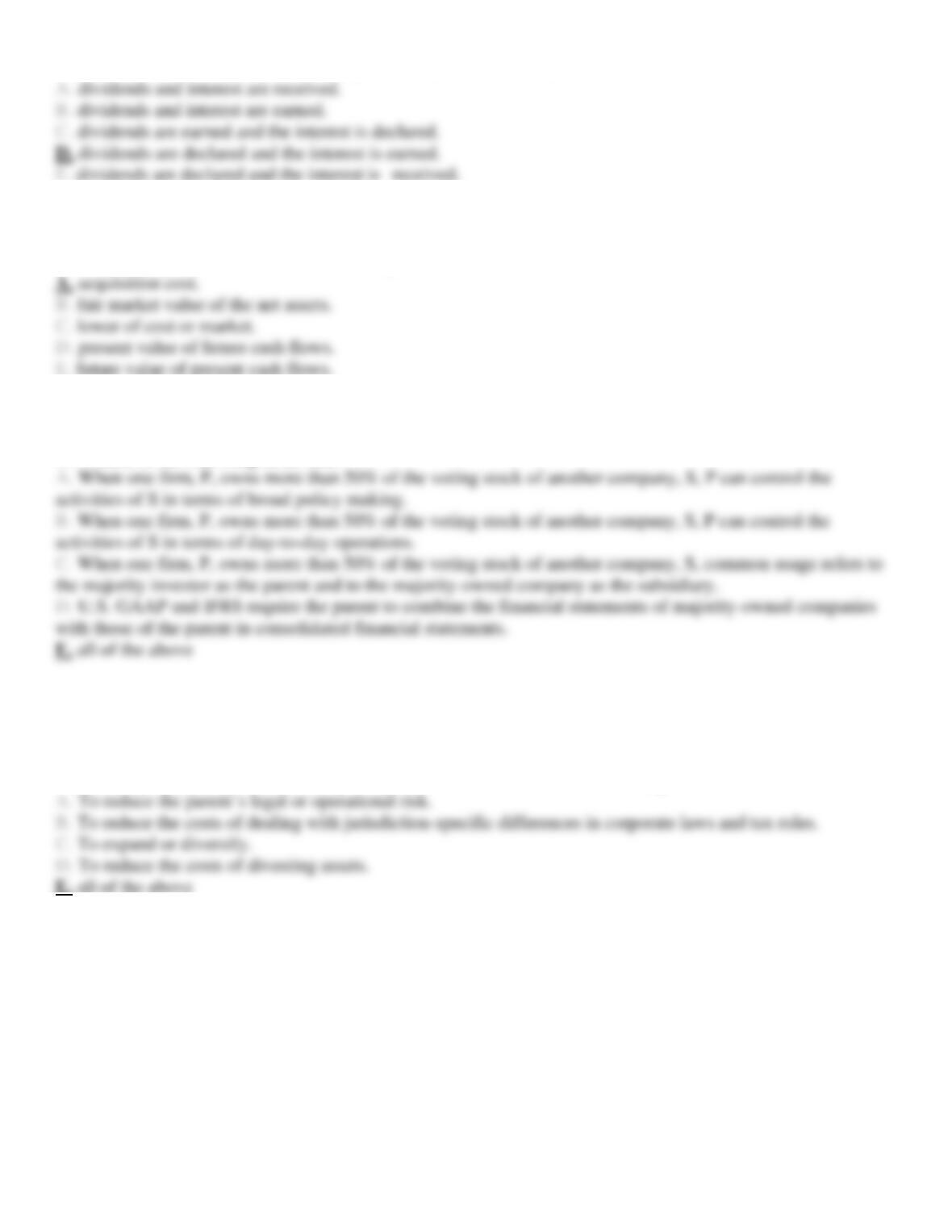
53. Dividends and interest from Minority, Passive Investments become income when the
54. Minority, passive investments are initially recorded at the
55. Which of the following is/are true?
56. Business firms have several reasons for preferring to operate as a group of legally separate corporations,
rather than as a single entity. From the standpoint of the parent company, the more important reasons for
maintaining legally separate subsidiary companies include which of the following?
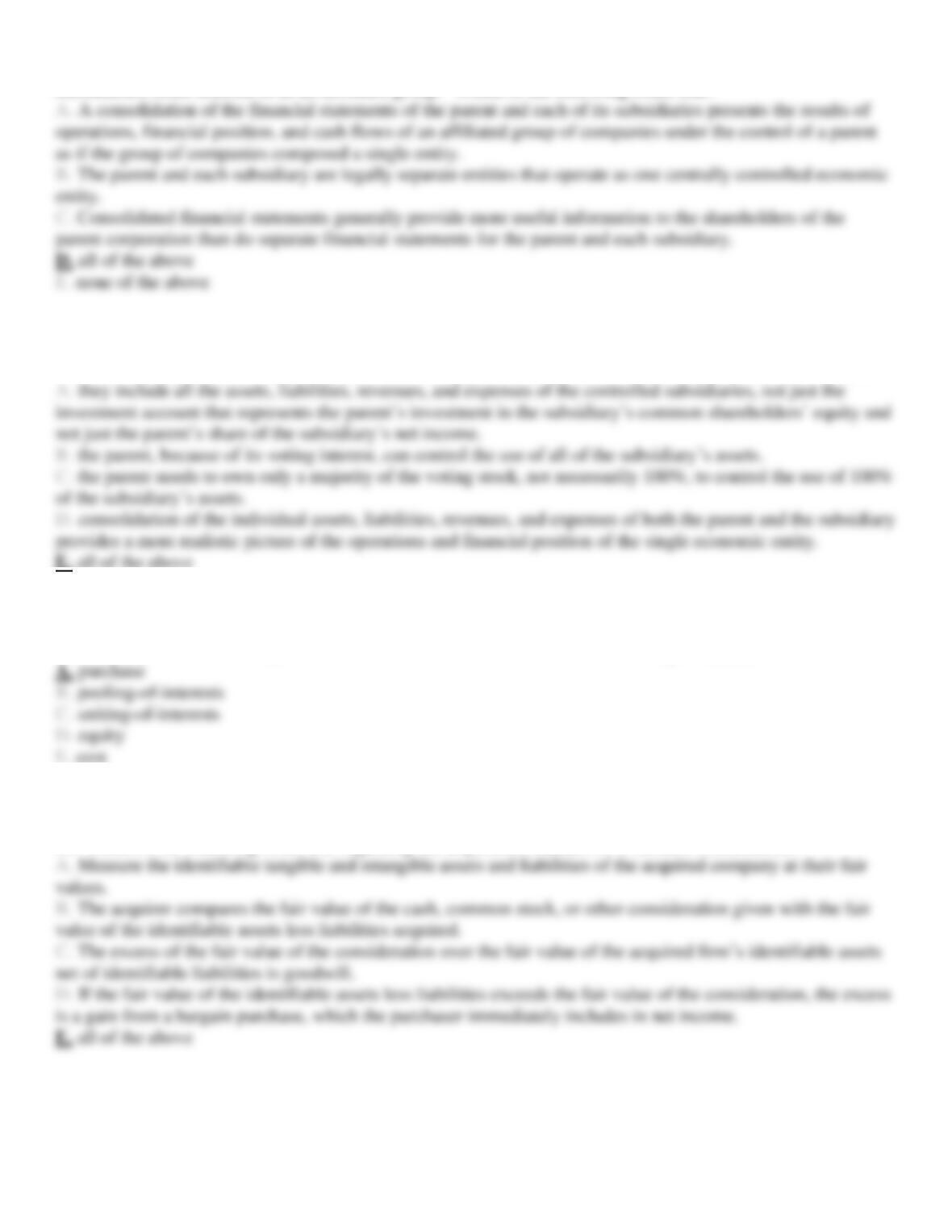
57. For various reasons, a single economic entity may exist in the form of a parent and several legally separate
subsidiaries, often referred to as an affiliated group. Which of the following is/are true?
58. Consolidated financial statements provide more helpful information than does the equity method, because
59. U.S. GAAP and IFRS require firms to account for business combinations using the _____ method.
60. Which of the following is/are true regarding the acquisition method for a business combination?
61. Accountants sometimes refer to the equity method as a one-line consolidation because
62. Accountants sometimes refer to the equity method as a(n)
63. Management and shareholders may desire to have legally separate corporations because
64. (CMA adapted, Dec 92 #9) In a business combination that is accounted for as a purchase and does not
create negative goodwill, the assets of the acquired company are to be recorded on the books of the acquiring
company at
65. An intercompany transaction is a transaction between
66. To avoid double counting P’s investment in S, P must eliminate
67. Intercompany sales
68. When preparing consolidated financial statements, the result of the elimination process generally is the
69. Which of the following investments in securities would require the preparation of consolidated financial
statements by the investor corporation?
70. U.S. GAAP view investments of over 50 percent of the voting stock of another company (for the purpose of
controlling the other company at the broad policy-making level and at the day-to-day operational level) as
71. Often, the parent does not own 100% of the voting stock of a consolidated subsidiary. The parent refers to
the owners of the remaining shares of voting stock as a
72. The consolidated income statement shows
73. The usual criterion for preparing consolidated financial statements is voting control in the form of majority
ownership of common stock. However, for some entities common stock ownership does not indicate control
because the common stock of the entity lacks one or more of the economic characteristics associated with
equity. U. S. GAAP refers to such entities as a _____ entity.
74. The usual criterion for preparing consolidated financial statements is voting control in the form of majority
ownership of common stock. However, for some entities common stock ownership does not indicate control
because the common stock of the entity lacks one or more of the economic characteristics associated with
equity. Which of the following is/are true?