14-1: Productivity Measure With A Single Input and Output
An tax accountant is examining his productivity. In 1996 he did 300 tax returns in 1400
hours. In 1997 he did 250 tax returns in 1200 hours.
What was his percentage increase in productivity from 1996 to 1997?
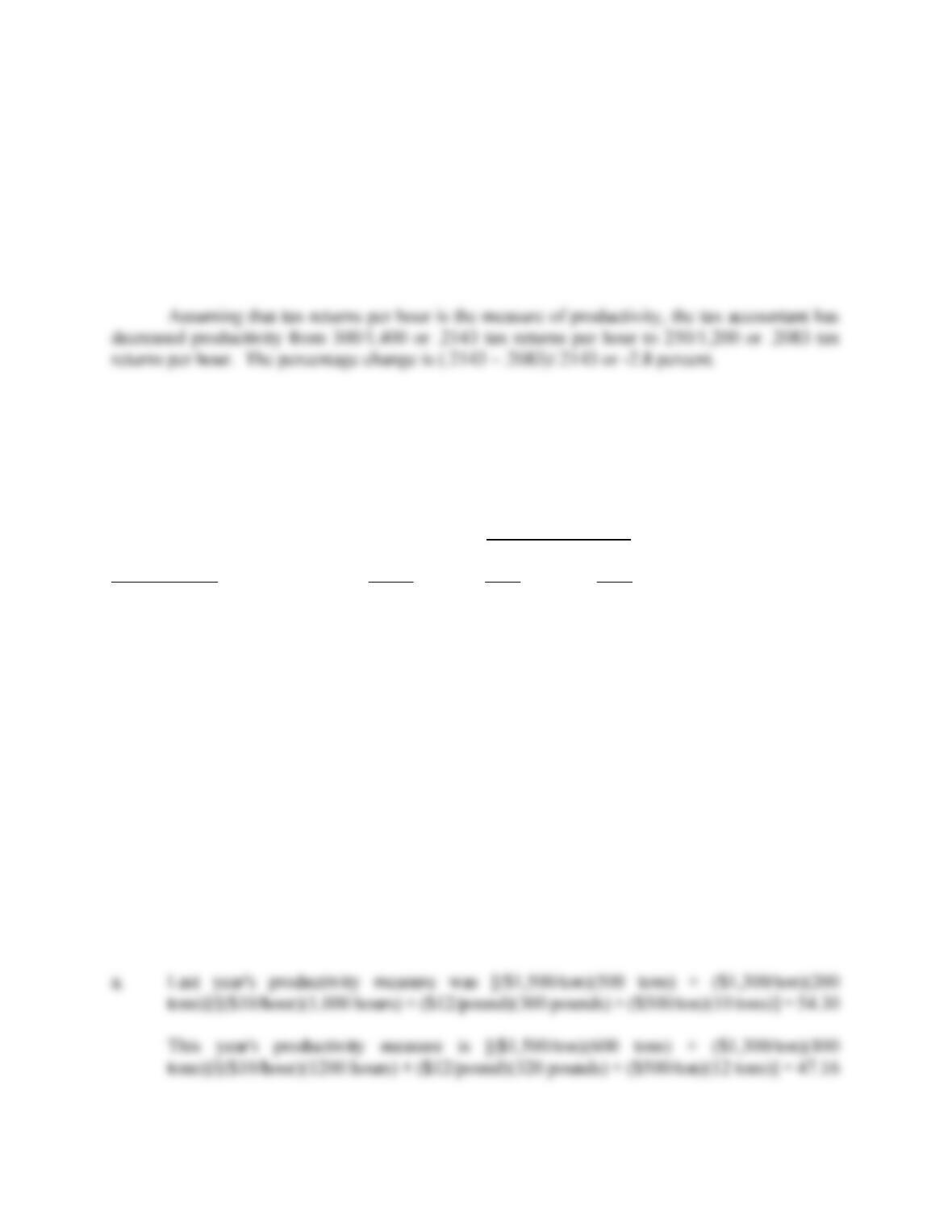
14-1: Solution to Productivity Measure With a Single Input and Output
(5 minutes)
14-2: Productivity Measures With Multiple Inputs and Outputs
A farmer grows two crops: lettuce and beans. The farmer uses three inputs: labor, seed,
and fertilizer. The past prices and the quantities of each are given in the following tables:
Physical Quantities
Past Last This
Inputs/outputs Prices Year Year
Outputs:
Lettuce $1500/ton 500 tons 600 tons
Beans $1300/ton 200 tons 100 tons
Inputs:
Labor $10/hour 1,000 hrs. 1,200 hrs.
Seeds $12/pound 300 lbs. 320 lbs.
Fertilizer $500/ton 10 tons 12 tons
Required:
a. Calculate productivity measures for last year and this year using past prices.
b. Calculate the percentage change in productivity.
14-2: Solution to Productivity Measures With Multiple Inputs and Outputs
(15 minutes)
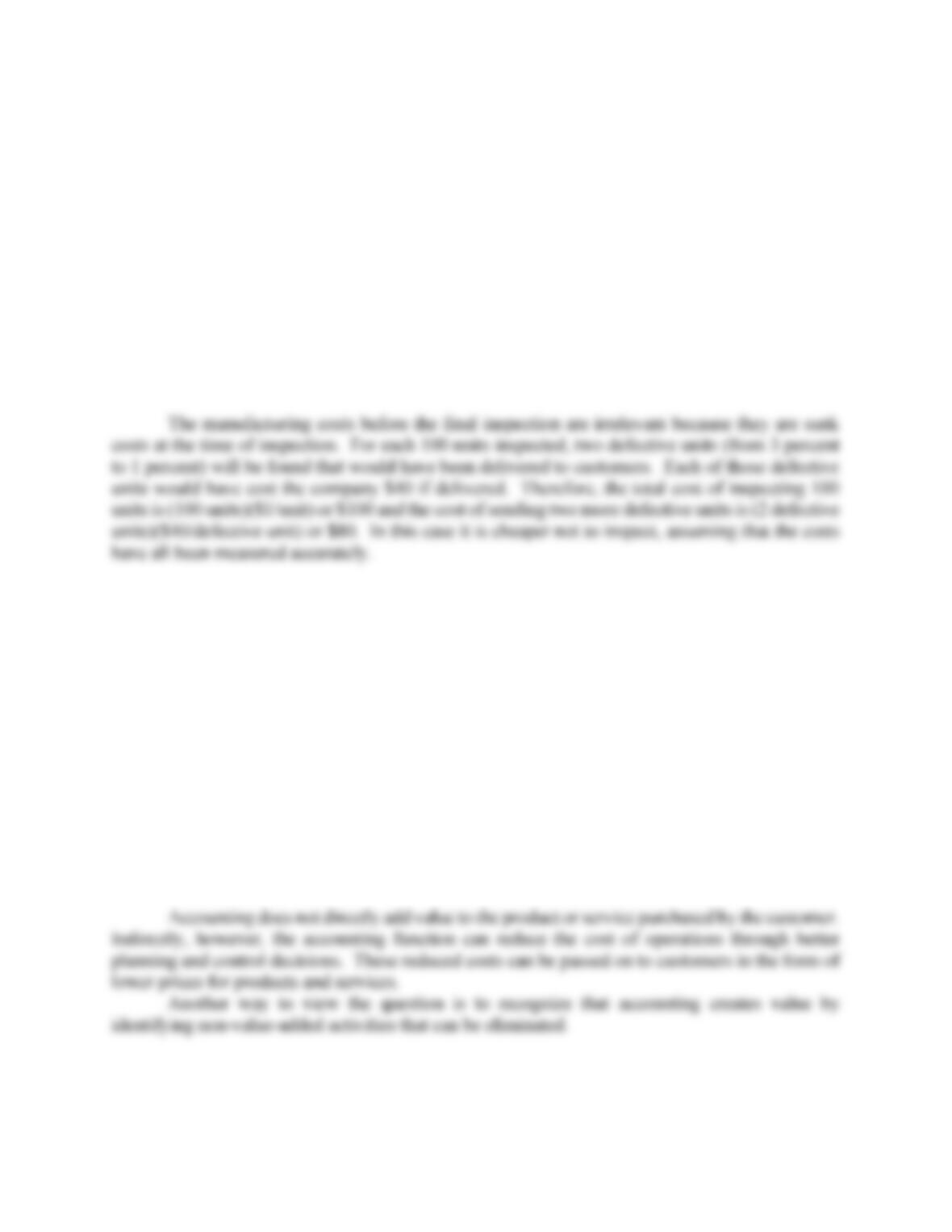
b. The percentage change in productivity is (47.16 – 54.30)/54.30 = -13.15%.
14-3: An Inspection Decision With Quality Costs
A company is considering additional final inspection costs of $1 per unit before delivery
to customers. The additional inspection should reduce the defective rate from 3 percent to 1
percent. If a defective unit is found, it is scrapped at no additional cost. The manufacturing costs
before the final inspection are $200 per unit. The management believes that the external failure
costs are $40 per defective unit.
Should the management incur the additional inspection costs?
14-3: Solution to An Inspection Decision With Quality Costs (5 minutes)
14-4: JIT and the Role of Accounting
The president of Kelly Windows is an avid believer in JIT. Kelly Windows manufactures
bay windows. The president wants no inventory or work-in-process on the floor at the end of each
day. Windows are only manufactured after being ordered and throughput time is quick enough to
complete most orders during the day of the order. The president is also trying to eliminate all non–
value added activities. She considers accounting to be non-value added and would like to reduce
accounting activities sharply if not completely.
As the controller, how can you defend the accounting activities performed by your
department?
14-4: Solution to JIT and the Role of Accounting (10 minutes)
14-5: JIT and Stock-Out Costs
James Industries is considering a shift to JIT. The president feels that considerable costs
can be saved by reducing inventory. The marketing manager is worried, however. She recognizes
that the inventory holding costs such as storage and the opportunity cost of cash used to hold
inventory are high and will be reduced if the company changes to JIT. But she is worried that the
president has forgotten about stock-out costs. Stock-out costs occur when customers want to
purchase an item, but the item is not immediately available so the customer goes elsewhere to
make the purchase.
How should the company measure stock-out costs and what can be done to minimize stock-
out costs?
14-5: Solution to JIT and Stock-Out Costs (15 minutes)
14-6: Accounting for JIT
Vail operates a JIT plant assembling ceiling fans. The Sunset Model ceiling fam has a
standard material cost of $28.40, a standard direct labor cost of $14.80, and overhead (fixed and
variable) of $16.10. On Monday, a batch of 100 Sunset fans is completed. All of the materials for
the 100 fans were on hand prior to Monday and had been previously recorded in the raw and in–
process inventory account.
Required:
In analyzing the financial statements of a firm using JIT and another firm in the same
industry not using JIT, what differences would you expect to observe?
14-6: Solution to Accounting for JIT (15 minutes)