Environment: Science Behind the Stories, 2e Cdn. Ed. (Withgott)
Chapter 14 Atmospheric Science and Air Pollution
14.1 Graph and Figure Interpretation Questions
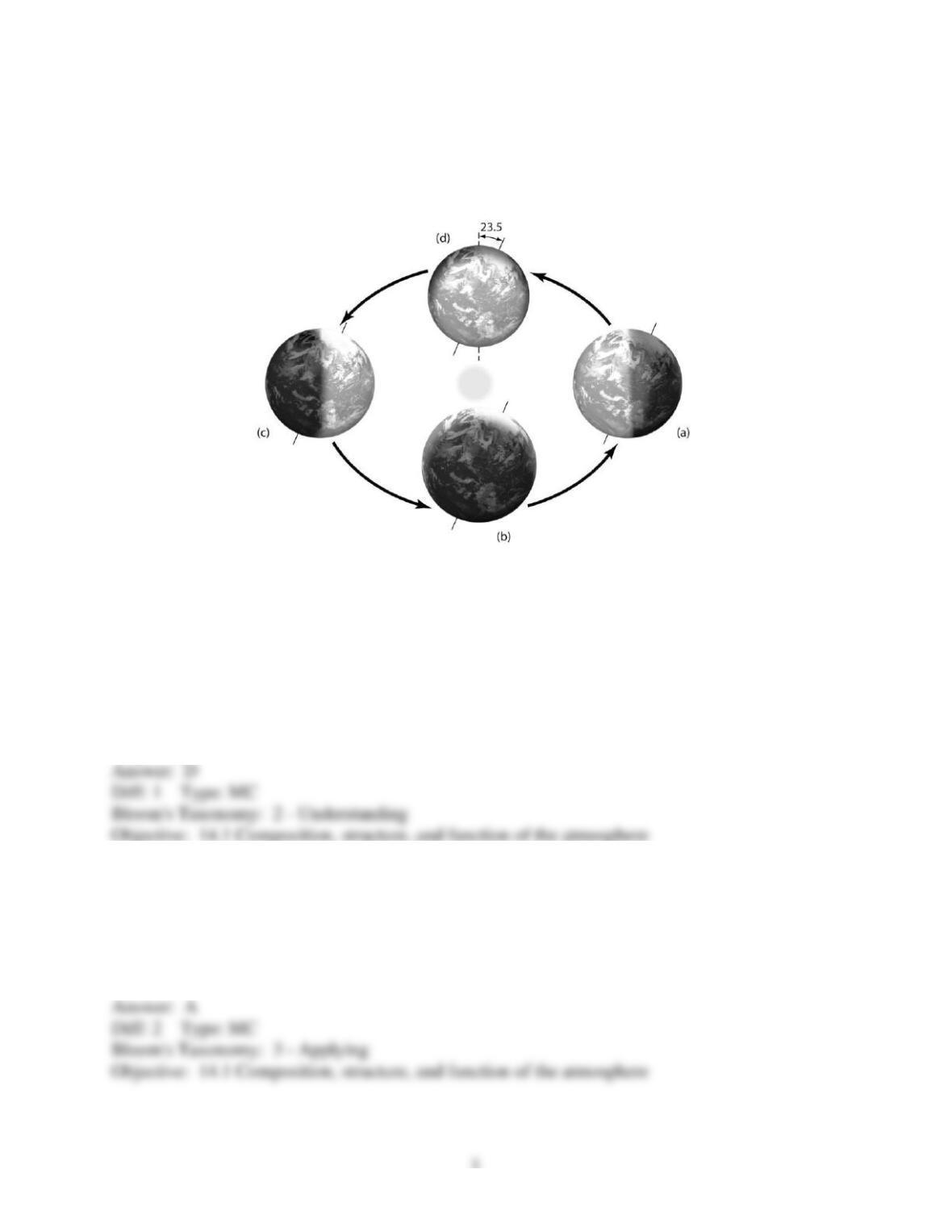
Figure 14.1
Use Figure 14.1 to answer the following questions.
1) Figure 14.1 shows the effects of ________ on our planet.
A) the Moon
B) the Coriolis effect
C) the convection cells
D) the Sun
E) gravity
2) Refer to Figure 14.1. Part (a) depicts Earth during ________.
A) December
B) the winter
C) the summer
D) the June solstice
E) equinox

3) Refer to Figure 14.1. According to the figure, the major reason we have ________.
A) tides is because of the seasons
B) tides is because of the Moon’s rotation around us
C) seasons is because of the Sun’s rotation around us, as it gets nearer and farther away
D) seasons is because of our rotation around the Sun, as we get nearer and farther away
E) seasons is because of the tilt to our axis

14.2 Matching Questions
Match the following.
A) low-pressure system
B) high-pressure system
D) thermal inversion
C) Coriolis effect
E) thermosphere
F) troposphere
G) Ferrel cells
H) thermocline
I) solar angle
J) mesosphere
K) Hadley cells
L) stratosphere
1) Convective cells near the equator
2) The bottom layer of Earth’s atmosphere in which we live
3) The highest level of our atmosphere, with comparatively few molecules per unit area
4) A system which contains air that moves outward away from the centre as it descends
5) Reversal of normal vertical temperature distribution in the lower layers of the atmosphere
6) Hadley cell results from changes in ________ with latitude
Diff: 1 Type: MA
Bloom’s Taxonomy: 1 – Remembering
Objective: 14.1 Composition, structure, and function of the atmosphere

14.3 Short Answer Questions
1) Why was London’s “killer smog” of 1952 important?
2) List the three most important atmospheric properties.
3) List the six air pollutants that are commonly monitored by air quality stations throughout
Canada.
4) Differentiate between primary and secondary pollutants.
5) A departure from the normal temperature distribution in the troposphere is called a(n)
________.

6) How does indoor pollution in developing countries differ from indoor pollution in developed
countries?
7) Discuss the effect the Asian Brown Cloud has on life expectancy and agriculture.
8) The most successful international effort to address a global environmental problem was the
________, where nations agreed to cut CFC production in half.
9) The term ________ describes a specific location where large quantities of pollution are
discharged, such as a factory.
10) List the four major categories of air pollutants according to Environment Canada.

14.4 Multiple-Choice Questions
1) The largest portion of atmospheric gases by weight is ________.
A) oxygen
B) nitrogen
C) sulfur
D) ozone
E) argon
2) The relative humidity is the ________.
A) ratio of water vapour to oxygen in the atmosphere
B) amount of oxygen in a given volume of water vapour relative to the maximum concentration
C) amount of water vapour in the atmosphere
D) amount of water vapour relative to the maximum amount this volume of air could hold
E) difference in available water vapour at midnight and at noon
3) Weather patterns are largely determined in the ________.
A) stratosphere
B) mesosphere
C) troposphere
D) thermal inversion
E) tropopause
4) Seasons are a result of ________.
A) Earth rotating near the Sun and then farther away from the Sun
B) differences in the amount and intensity of sunlight brought about by the tilt of the axis
C) alterations in Hadley cells
D) changes in day length
E) the phases of the Moon

5) The patterns of convection currents between the equator and subtropical latitudes are called
________.
A) Coriolis cells
B) Hadley cells
C) high-pressure cells
D) El Niño events
E) Ferrel cells
6) Low-pressure storm systems have wind patterns shaped by two factors: (a) the air flows from
areas of high pressure to areas of low pressure, and (b) the movement of air is deflected by the
Coriolis effect. As a result of interplay between these two factors , in the low-pressure storm
systems in the North Atlantic, the air circulates counterclockwise. In which direction does the air
rotate in the low-pressure storm systems in the South Atlantic?
A) counterclockwise, because nothing has changed: (a) and (b) in the South Atlantic have the
same directions as in the North Atlantic
B) counterclockwise, because although both (a) and (b) have changed, these changes were made
in the opposite direction, neutralizing each other
C) clockwise, because (b) has changed from deflection to the right to deflection to the left
D) clockwise, because (b) has changed from deflection to the left to deflection to the right
E) clockwise, because (a) has changed direction, but (b) did not
7) The dust storms that have large impacts on the Caribbean ________.
A) provide nutrients which benefit the coral reef systems
B) are the result of polar cells increasing in strength
C) are the result of poor farming techniques
D) are a natural phenomenon that have existed for millenia
E) are the result of ozone depletion

8) Carbon monoxide ________.
A) increase has been linked to ozone depletion
B) is the fourth (by weight) component of the atmosphere
C) concentration increases during wildfires
D) is a waste product created by plants during photosynthesis
E) is consumed by plants for photosynthesis
9) Tropospheric ozone ________.
A) protects Earth from most of the harmful UV radiation
B) causes respiratory diseases by binding with hemoglobin and preventing it from binding with
oxygen in red blood cells
C) has higher concentrations in urban areas
D) is a primary pollutant
E) is caused by poor farming techniques
10) Lead enters the atmosphere as a particulate pollutant. This is a problem because it ________.
A) is a precious metal, and it is being lost to the atmosphere
B) will cause the ozone hole to increase
C) can be inhaled or ingested and affect the central nervous system
D) can become attached to radon
E) causes excess nutrification of waterways, resulting in eutrophication
11) Radon ________.
A) is caused by the breakdown of the ozone layer
B) may cause damage to respiratory tissues when inhaled
C) binds with hemoglobin, preventing binding with oxygen
D) contributes to the breakdown of the ozone layer
E) in the atmosphere limits the availability of sunlight for plants

12) Photochemical smog differs from industrial smog in that it ________.
A) is formed in the presence of sunlight
B) has large quantities of soot
C) is primarily composed of carbon monoxide
D) consists of primary pollutants
E) is caused by similar substances to those used in non-digital photography
13) One of the problems that occurs as a consequence of CFC pollution is ________.
A) increasing skin cancer in humans
B) toxins accumulating in homes
C) damage to human red blood cells
D) movement of toxins into lakes and rivers, which poisons fish
E) eutrophication
14) In developed countries, a great deal of indoor air pollution comes from ________.
A) outdoor pollution
B) carbon monoxide
C) cooking
D) carpets and furniture
E) washing dishes
15) In developed countries, the two most deadly sources of indoor pollution are ________.
A) pesticides and cleaning agents
B) synthetic furniture materials and radiation from electronic equipment
C) radiation from electronic equipment and pesticides
D) radon and cigarette smoke
E) pesticides and cigarette smoke

16) Bacteria and fungal spores are ________.
A) contributors to indoor pollutants
B) VOCs and POPs
C) sources of radon in the home
D) problems in degrading the ozone layer
E) the cause of high pesticide use in the home
17) Particulate matter dispersed as aerosols ________.
A) includes nitrogen oxides
B) may cause damage to respiratory tissues when inhaled
C) binds with hemoglobin, preventing hemoglobin’s binding with oxygen
D) interacts only with surface tissues of humans, causing irritation
E) cause melanoma and other skin cancers
18) Acidic deposition ________.
A) contributes to ozone depletion
B) is a major component of indoor air pollution
C) causes eutrophication in streams and rivers
D) often crosses national boundaries, creating international disputes
E) is primarily a local problem near point sources
19) Which of the following is a consequence of acidic deposition?
A) It increases the likelihood of smog associated with thermal inversion.
B) It results in offshore eutrophication, damaging coral reefs.
C) It damages skin cells or causes cancers.
D) It impoverishes soils, leaching out important minerals.
E) It is increasing the rate of global warming.

20) The Coriolis effect ________.
A) keeps Earth from spinning too fast
B) is caused by the Moon
C) results in ice and darkness at the poles in winter
D) keeps the wind circulating at a constant speed around the planet
E) is caused by Earth’s rotational forces
21) The Coriolis effect contributes to ________.
A) global wind patterns
B) global warming
C) increased acidic deposition
D) a reduction in eutrophication
E) an increase in eutrophication
22) The long-term health effects of indoor air pollution ________.
A) is considered to be a minor hazard compared to outdoor air pollution
B) are not well understood; studies are under way
C) has only a few causes, which can easily be remedied
D) is primarily caused by CFCs
E) is one of the causes of the increase in skin cancer in Canada
23) Air near Earth’s surface tends to be ________.
A) warmer and wetter; then it rises, expanding and cooling
B) warmer and drier; then it rises, condensing and gathering moisture
C) cooler and wetter; then it rises, is warmed by the Sun, and sinks again
D) cooler and drier; it rises when it is displaced by sinking warm air
E) warmer; it rises as it is displaced by Coriolis forces