
CHAPTER 14
LONG-TERM LIABILITIES
IFRS questions are available at the end of this chapter.
TRUE-FALSE—Conceptual
Answer No. Description
MULTIPLE CHOICE—Conceptual
Answer No. Description
Test Bank for Intermediate Accounting, Sixteenth Edition
14 – 2
MULTIPLE CHOICE—Conceptual (cont.)
Answer No. Description
MULTIPLE CHOICE—Computational
Answer No. Description
Long-Term Liabilities
14 – 3
MULTIPLE CHOICE—Computational (cont.)
Answer No. Description
MULTIPLE CHOICE—CPA Adapted
Answer No. Description

Test Bank for Intermediate Accounting, Sixteenth Edition
14 – 4
BRIEF EXERCISES
Item Description
BE14-117 Terms related to long-term debt.
BE14-118 Bond issue price and premium amortization.
BE14-119 Amortization of discount or premium.
EXERCISES
Item Description
E14-120 Entries for bonds payable.
E14-121 Retirement of bonds.
E14-122 Early extinguishment of debt.
*E14-123 Accounting for a troubled debt settlement.
*E14-124 Accounting for troubled debt restructuring.
*E14-125 Accounting for troubled debt.
PROBLEMS
Item Description
P14-126 Bond discount amortization.
P14-127 Bond interest and discount amortization.
P14-128 Entries for bonds payable.
P14-129 Entries for bonds payable.
P14-130 Fair value option
*P14-131 Accounting for a troubled debt restructuring.
CHAPTER LEARNING OBJECTIVES
1. Describe the nature of bonds and indicate the accounting for bond issuances.
2. Describe the accounting for the extinguishment of debt.
3. Explain the accounting for long-term notes payable.
4. Describe the accounting for the fair value option.
5. Indicate how to present and analyze long-term debt.
*6. Describe the accounting for a debt restructuring.
7. Compare the accounting procedures for long-term liabilities under GAAP and IFRS.
Long-Term Liabilities
14 – 5
SUMMARY OF QUESTIONS BY LEARNING OBJECTIVES AND BLOOM’S TAXONOMY
Item
LO
BT
Item
LO
BT
Item
LO
BT
Item
LO
BT
Item
LO
BT
TRUE-FALSE STATEMENTS
1.
1
K
5.
1
K
9.
1
C
13.
3
K
17.
5
C
2.
1
K
6.
1
K
10.
1
K
14.
4
K
18.
5
K
3.
1
K
7.
1
C
11.
2
K
15.
5
K
19.
6
K
4.
1
K
8.
1
K
12.
3
K
16.
5
AN
20.
6
K
MULTIPLE CHOICE QUESTIONS
21.
1
C
41.
2
K
61.
1
AP
81.
1
AP
101.
5
AN
22.
1
K
42.
2
K
62.
1
AP
82.
1
AP
102.
5
AP
23.
1
K
43.
3
C
63.
1
AP
83.
1
AP
103.
6
AP
24.
1
K
44.
3
C
64.
1
AP
84.
1
AP
104.
6
AP
25.
1
K
45.
3
K
65.
1
AP
85.
2
AP
105.
6
AP
26.
1
C
46.
4
K
66.
1
AP
86.
2
AP
106.
1
AP
27.
1
K
47.
4
C
67.
1
AP
87.
2
AP
107.
1
AP
28.
1
K
48.
5
K
68.
1
AP
88.
2
AP
108.
1
AP
29.
1
K
49.
5
K
69.
1
AP
89.
2
AP
109.
1
AP
30.
1
K
50.
5
K
70.
1
AP
90.
2
AP
110.
2
AP
31.
1
C
51.
5
K
71.
1
AP
91.
2
AP
111.
2
AP
32.
1
C
52.
5
K
72.
1
AP
92.
2
AP
112.
2
AP
33.
1
K
53.
5
K
73.
1
AP
93.
2
AP
113.
2
AP
34.
1
C
54.
5
K
74.
1
AP
94.
2
AP
114.
2
C
35.
1
C
55.
6
C
75.
1
AP
95.
2
AP
115.
2
C
36.
1
C
56.
6
K
76.
1
AP
96.
3
AP
116.
6
AP
37.
1
K
57.
6
C
77.
1
AP
97.
3
AP
38.
1
K
58.
6
C
78.
1
AP
98.
3
AP
39.
1
K
59.
6
C
79.
1
AP
99.
5
AP
40.
2
C
60.
1
AP
80.
1
AP
100.
5
AP
BRIEF EXERCISES
117.
1, 2,
K
118.
1
AP
119.
1
AP
EXERCISES
120.
1, 2
AP
122.
2
AP
124.
6
AP
121.
2
AP
123.
6
AP
125.
6
K
PROBLEMS
126.
1
AP
128.
1, 2
AP
130.
4
AP
127.
1
AP
129.
1,2
AP
131.
6
AP

Test Bank for Intermediate Accounting, Sixteenth Edition
14 – 6
TRUE FALSE—Conceptual
1. Companies usually make bond interest payments semiannually, although the interest rate is
generally expressed as an annual rate.
2. A mortgage bond is referred to as a debenture bond.
3. Bond issues that mature in installments are called serial bonds.
4. If the market rate is greater than the coupon rate, bonds will be sold at a premium.
5. The interest rate written in the terms of the bond indenture is called the effective yield or
market rate.
6. The stated rate is the same as the coupon rate.
7. Amortization of a premium increases bond interest expense, while amortization of a discount
decreases bond interest expense.
8. A bond may only be issued on an interest payment date.
9. The cash paid for interest will always be greater than interest expense when using effective–
interest amortization for a bond.
10. Companies report bond discounts as a direct deduction from the face amount of the bond.
11. The replacement of an existing bond issue with a new one is called refunding.
12. If a long-term note payable has a stated interest rate, that rate should be considered to be
the effective rate.
Long-Term Liabilities
14 – 7
13. The interest rate of variable-rate mortgages is tied to changes in the fluctuating market rate.
14. An unrealized holding gain or loss is the net change in the fair value of the liability from one
period to another, exclusive of interest expense recognized but not recorded.
15. Off-balance-sheet financing is an attempt to borrow monies in such a way to minimize the
reporting of debt on the balance sheet.
16. The debt to assets ratio will go up if an equal amount of assets and liabilities are added to
the balance sheet.
17. If a company plans to retire long-term debt from a bond retirement fund, it should report the
debt as current.
18. The times interest earned is computed by dividing income before interest expense by
interest expense.
*19. The loss to be recognized by a creditor on an impaired loan is the difference between the
investment in the loan and the expected undiscounted future cash flows from the loan.
*20. In a troubled debt restructuring, the loss recognized by the creditor will equal the gain
recognized by the debtor.
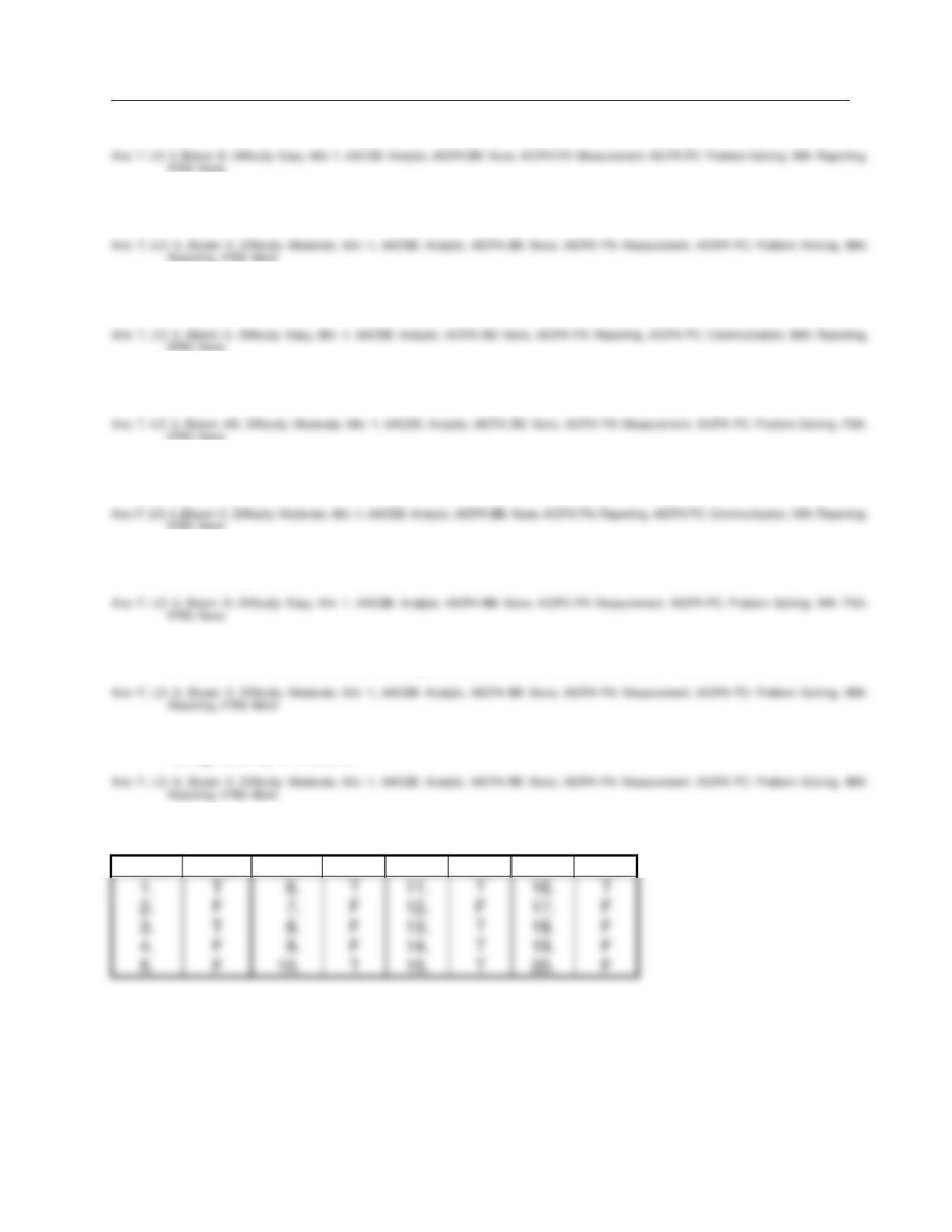
True False Answers—Conceptual
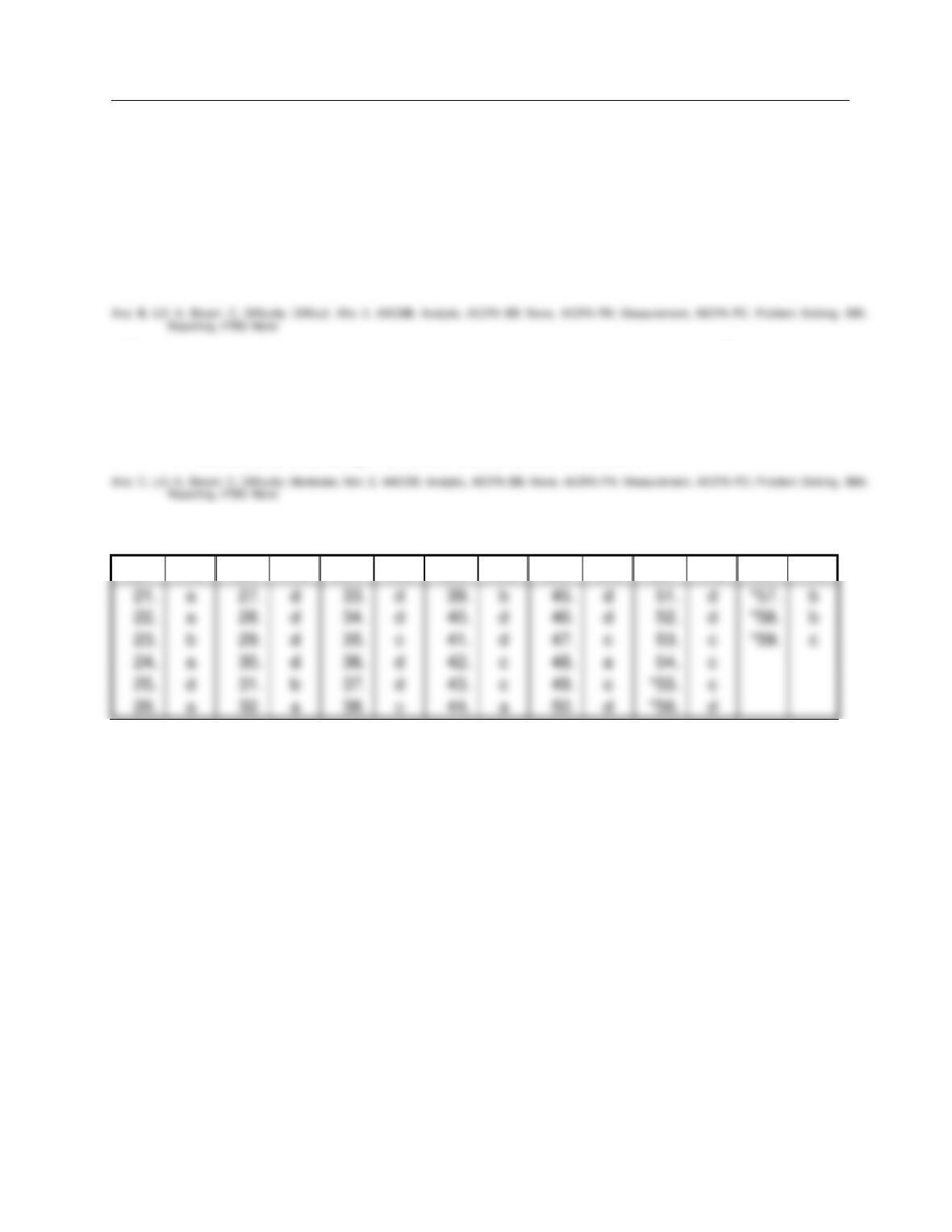
Item
Ans.
Item
Ans.
Item
Ans.
Item
Ans.

Test Bank for Intermediate Accounting, Sixteenth Edition
14 – 8
MULTIPLE CHOICE—Conceptual
21. An example of an item which is not a liability is
a. dividends payable in stock.
b. advances from customers on contracts.
c. accrued estimated warranty costs.
d. the portion of long-term debt due within one year.
22. The covenants and other terms of the agreement between the issuer of bonds and the
lender are set forth in the
a. bond indenture.
b. bond debenture.
c. registered bond.
d. bond coupon.
23. The term used for bonds that are unsecured as to principal is
a. mortgage bonds.
b. debenture bonds.
c. indenture bonds.
d. callable bonds.
P24. Bonds for which the owners’ names are not registered with the issuing corporation are
called
a. bearer bonds.
b. term bonds.
c. debenture bonds.
d. secured bonds.
S25. Bonds that pay no interest unless the issuing company is profitable are called
a. collateral trust bonds.
b. debenture bonds.
c. revenue bonds.
d. income bonds.
S26. If bonds are issued initially at a premium and the effective-interest method of amortization is
used, interest expense in the earlier years will be
a. greater than if the straight-line method were used.
b. greater than the amount of the interest payments.
c the same as if the straight-line method were used.
d. less than if the straight-line method were used.

Long-Term Liabilities
14 – 9
27. The interest rate written in the terms of the bond indenture is known as the
a. coupon rate.
b. nominal rate.
c. stated rate.
d. coupon rate, nominal rate, or stated rate.
28. The rate of interest actually earned by bondholders is called the
a. stated rate.
b. coupon rate.
c. nominal rate.
d. effective rate.
29. One step in calculating the issue price of the bonds is to multiply the face value by the table
value for
a. 10 periods and 10% from the present value of 1 table.
b. 20 periods and 5% from the present value of 1 table.
c. 10 periods and 8% from the present value of 1 table.
d. 20 periods and 4% from the present value of 1 table.
30. Another step in calculating the issue price of the bonds is to
a. multiply $10,000 by the table value for 10 periods and 10% from the present value of an
annuity table.
b. multiply $10,000 by the table value for 20 periods and 5% from the present value of an
annuity table.
c. multiply $10,000 by the table value for 20 periods and 4% from the present value of an
annuity table.
d. None of these answers is correct.
31. Reich, Inc. issued bonds with a maturity amount of $200,000 and a maturity ten years from
date of issue. If the bonds were issued at a premium, this indicates that
a. the effective yield or market rate of interest exceeded the stated (nominal) rate.
b. the nominal rate of interest exceeded the market rate.
c. the market and nominal rates coincided.
d. no necessary relationship exists between the two rates.

Test Bank for Intermediate Accounting, Sixteenth Edition
14 – 10
32. If bonds are initially sold at a discount and the straight-line method of amortization is used,
interest expense in the earlier years will
a. exceed what it would have been had the effective-interest method of amortization been
used.
b. be less than what it would have been had the effective-interest method of amortization
been used.
c. be the same as what it would have been had the effective-interest method of amortiza-
tion been used.
d. be less than the stated (nominal) rate of interest.
33. Under the effective-interest method of bond discount or premium amortization, the periodic
interest expense is equal to
a. the stated (nominal) rate of interest multiplied by the face value of the bonds.
b. the market rate of interest multiplied by the face value of the bonds.
c. the stated rate multiplied by the beginning-of-period carrying amount of the bonds.
d. the market rate multiplied by the beginning–of-period carrying amount of the bonds.
34. When the effective-interest method is used to amortize bond premium or discount, the
periodic amortization will
a. increase only if the bonds were issued at a discount.
b. decrease only if the bonds were issued at a premium.
c. increase only if the bonds were issued at a premium.
d. increase if the bonds were issued at either a discount or a premium.
35. If bonds are issued between interest dates, the entry on the books of the issuing corporation
could include a
a. debit to Interest Payable.
b. credit to Interest Receivable.
c. credit to Interest Expense.
d. credit to Unearned Interest.
36. When the interest payment dates of a bond are May 1 and November 1, and a bond issue is
sold on June 1, the amount of cash received by the issuer will be
a. decreased by accrued interest from June 1 to November 1.
b. decreased by accrued interest from May 1 to June 1.
c. increased by accrued interest from June 1 to November 1.
d. increased by accrued interest from May 1 to June 1.
37. Premium on bonds payable is
a. a contra account.
b. reported as a reduction of the bond liability.
c. debited to a deferred charge account and amortized over the life of the bonds.
d. an adjunct account.

Long-Term Liabilities
14 – 11
38. Bond interest paid is equal to the
a. carrying value of the bonds multiplied by the effective-interest rate.
b. carrying value of the bonds multiplied by the stated interest rate.
c. face amount of the bonds multiplied by the stated interest rate.
d. face amount of the bonds multiplied by the effective-interest rate.
39. The face value of bonds is also called each of the following except
a. maturity value.
b. stated value.
c. par value.
d. principal.
40. An early extinguishment of bonds payable, which were originally issued at a premium, is
made by purchase of the bonds between interest dates. At the time of reacquisition
a. any costs of issuing the bonds must be amortized up to the purchase date.
b. the premium must be amortized up to the purchase date.
c. interest must be accrued from the last interest date to the purchase date.
d. All of these answers are correct.
41. The generally accepted method of accounting for gains or losses from the early
extinguishment of debt treats any gain or loss as
a. an adjustment to the cost basis of the asset obtained by the debt issue.
b. an amount that should be considered a cash adjustment to the cost of any other debt
issued over the remaining life of the old debt instrument.
c. an amount received or paid to obtain a new debt instrument and, as such, should be
amortized over the life of the new debt.
d. a difference between the reacquisition price and the net carrying amount of the debt
which should be recognized in the period of redemption.
P42. “In-substance defeasance” is a term used to refer to an arrangement whereby
a. a company gets another company to cover its payments due on long-term debt.
b. a governmental unit issues debt instruments to corporations.
c. a company provides for the future repayment of a long-term debt by placing purchased
securities in an irrevocable trust.
d. a company legally extinguishes debt before its due date.

Test Bank for Intermediate Accounting, Sixteenth Edition
14 – 12
P43. A corporation borrowed money from a bank to build a building. The long-term note signed by
the corporation is secured by a mortgage that pledges title to the building as security for the
loan. The corporation is to pay the bank $80,000 each year for 10 years to repay the loan.
Which of the following relationships can you expect to apply to the situation?
a. The balance of mortgage payable at a given balance sheet date will be reported as a
long-term liability.
b. The balance of mortgage payable will remain a constant amount over the 10-year
period.
c. The amount of interest expense will decrease each period the loan is outstanding, while
the portion of the annual payment applied to the loan principal will increase each period.
d. The amount of interest expense will remain constant over the 10-year period.
S44. A debt instrument with no ready market is exchanged for property whose fair value is
currently indeterminable. When such a transaction takes place
a. the present value of the debt instrument must be approximated using an imputed interest
rate.
b. it should not be recorded on the books of either party until the fair value of the property
becomes evident.
c. the board of directors of the entity receiving the property should estimate a value for the
property that will serve as a basis for the transaction.
d. the directors of both entities involved in the transaction should negotiate a value to be
assigned to the property.
45. When a note payable is exchanged for property, goods, or services, the stated interest rate
is presumed to be fair unless
a. no interest rate is stated.
b. the stated interest rate is unreasonable.
c. the stated face amount of the note is materially different from the current cash sales
price for similar items or from current fair value of the note.
d. any of these answers are correct.
46. Which of the following arguments is presented by FASB to explain why a gain is recorded by
a company when its creditworthiness is becoming worse?
a. The shareholders’ loss is the debtholders’ gain.
b. The income of the company will increase as the amount of interest payment will reduce.
c. The decrease in market rate will increase the value of equity shares.
d. The debtholders’ loss is the shareholders’ gain.

Long-Term Liabilities
14 – 13
47. If a company chooses the fair value option, a decrease in the fair value of the liability is
recorded by crediting
a. Bonds Payable.
b. Gain on Restructuring of Debt.
c. Unrealized Holding Gain/Loss-Income.
d. Realized Holding Gain.
48. A project financing arrangement refers to:
a. an arrangement where a company creates a special-purpose entity to perform a special
project.
b. an arrangement where a company borrows from its subsidiary to finance a project.
c. an arrangement where a company promises future repayment by placing purchased
assets in an irrevocable trust.
d. an arrangement where a company finances a project from a sinking fund established for
bond repayments.
S49. When a company enters into what is referred to as off-balance-sheet financing, the
company
a. is attempting to conceal the debt from shareholders by having no information about the
debt included in the balance sheet.
b. wishes to confine all information related to the debt to the income statement and the
statement of cash flow.
c. can enhance the quality of the balance sheet and permits credit to be obtained more
readily and at less cost.
d. is in violation of generally accepted accounting principles.
S50. Long-term debt that matures within one year and is to be converted into stock should be
reported
a. as a current liability.
b. in a special section between liabilities and stockholders’ equity.
c. as noncurrent.
d. as noncurrent and accompanied with a note explaining the method to be used in its
liquidation.
51. Which of the following must be disclosed relative to long-term debt maturities and sinking
fund requirements?
a. The present value of future payments for sinking fund requirements and long-term debt
maturities during each of the next five years.
b. The present value of scheduled interest payments on long-term debt during each of the
next five years.
c. The amount of scheduled interest payments on long-term debt during each of the next
five years.
d. The amount of future payments for sinking fund requirements and long-term debt
maturities during each of the next five years.

Test Bank for Intermediate Accounting, Sixteenth Edition
14 – 14
52. Note disclosures for long-term debt generally include all of the following except
a. assets pledged as security.
b. call provisions and conversion privileges.
c. restrictions imposed by the creditor.
d. names of specific creditors.
53. The times interest earned is computed by dividing
a. net income by interest expense.
b. income before taxes by interest expense.
c. income before income taxes and interest expense by interest expense.
d. net income and interest expense by interest expense.
54. The debt to assets ratio is computed by dividing
a. current liabilities by total assets.
b. long-term liabilities by total assets.
c. total liabilities by total assets.
d. total assets by total liabilities.
*55. In a troubled debt restructuring in which the debt is continued with modified terms and the
carrying amount of the debt is less than the total future cash flows,
a. a loss should be recognized by the debtor.
b. a gain should be recognized by the debtor.
c. a new effective-interest rate must be computed.
d. no interest expense or revenue should be recognized in the future.
*56. A troubled debt restructuring will generally result in a
a. loss by the debtor and a gain by the creditor.
b. loss by both the debtor and the creditor.
c. gain by both the debtor and the creditor.
d. gain by the debtor and a loss by the creditor.
*57. In a troubled debt restructuring in which the debt is restructured by a transfer of assets with
a fair value less than the carrying amount of the debt, the debtor would recognize
a. no gain or loss on the restructuring.
b. a gain on the restructuring.
c. a loss on the restructuring.
d. None of these answers are correct.
Long-Term Liabilities
14 – 15
*58. In a troubled debt restructuring in which the debt is continued with modified terms, a gain
should be recognized at the date of restructure, but no interest expense should be
recognized over the remaining life of the debt, whenever the
a. carrying amount of the pre-restructure debt is less than the total future cash flows.
b. carrying amount of the pre-restructure debt is greater than the total future cash flows.
c. present value of the pre-restructure debt is less than the present value of the future cash
flows.
d. present value of the pre-restructure debt is greater than the present value of the future
cash flows.
*59. In a troubled debt restructuring in which the debt is continued with modified terms and the
carrying amount of the debt is less than the total future cash flows, the creditor should
a. compute a new effective-interest rate.
b. not recognize a loss.
c. calculate its loss using the historical effective rate of the loan.
d. calculate its loss using the current effective rate of the loan.
Multiple Choice Answers—Conceptual
Item
Ans.
Item
Ans.
Item
Ans.
Item
Ans.
Item
Ans.
Item
Ans.
Item
Ans.
Solutions to those Multiple Choice questions for which the answer is “none of these.”
30. multiply $5,000 by the table value for 20 periods and 4% from the present value of an
annuity table.
Test Bank for Intermediate Accounting, Sixteenth Edition
14 – 16
MULTIPLE CHOICE—Computational
On January 1, 2017, Ellison Co. issued eight-year bonds with a face value of $6,000,000 and a
stated interest rate of 6%, payable semiannually on June 30 and December 31. The bonds were
sold to yield 8%. Table values are:
Present value of 1 for 8 periods at 6% …………………………………… .627
Present value of 1 for 8 periods at 8% …………………………………… .540
Present value of 1 for 16 periods at 3% …………………………………. .623
Present value of 1 for 16 periods at 4% …………………………………. .534
Present value of annuity for 8 periods at 6% ………………………….. 6.210
Present value of annuity for 8 periods at 8% ………………………….. 5.747
Present value of annuity for 16 periods at 3% ………………………… 12.561
Present value of annuity for 16 periods at 4% ………………………… 11.652
60. The present value of the principal is
a. $3,204,000.
b. $3,240,000.
c. $3,738,000.
d. $3,762,000.
61. The present value of the interest is
a. $2,068,920.
b. $2,097,360.
c. $2,235,600.
d. $2,260,980.

Long-Term Liabilities
14 – 17
Present value of annuity for 16 periods at 3% ………………………… 12.561
Present value of annuity for 16 periods at 4% ………………………… 11.652
62. The issue price of the bonds is
a. $5,301,360.
b. $5,308,920.
c. $5,337,360.
d. $5,997,600.
63. Downing Company issues $5,000,000, 6%, 5-year bonds dated January 1, 2017 on January
1, 2017. The bonds pay interest semiannually on June 30 and December 31. The bonds are
issued to yield 5%. What are the proceeds from the bond issue?
2.5%
3.0%
5.0%
6.0%
Present value of a single sum for 5 periods
.88385
.86261
.78353
.74726
Present value of a single sum for 10 periods
.78120
.74409
.61391
.55839
Present value of an annuity for 5 periods
4.64583
4.57971
4.32948
4.21236
Present value of an annuity for 10 periods
8.75206
8.53020
7.72173
7.36009
a. $5,000,000
b. $5,216,494
c. $5,218,809
d. $5,217,309
64. Feller Company issues $20,000,000 of 10-year, 9% bonds on March 1, 2017 at 97 plus
accrued interest. The bonds are dated January 1, 2017, and pay interest on June 30 and
December 31. What is the total cash received on the issue date?
a. $19,400,000
b. $20,450,000
c. $19,700,000
d. $19,100,000
65. Everhart Company issues $25,000,000, 6%, 5-year bonds dated January 1, 2017 on
January 1, 2017. The bonds pay interest semiannually on June 30 and December 31. The
bonds are issued to yield 5%. What are the proceeds from the bond issue?
2.5%
3.0%
5.0%
6.0%
Present value of a single sum for 5 periods
.88385
.86261
.78353
.74726
Present value of a single sum for 10 periods
.78120
.74409
.61391
.55839
Present value of an annuity for 5 periods
4.64583
4.57971
4.32948
4.21236
Present value of an annuity for 10 periods
8.75206
8.53020
7.72173
7.36009
a. $25,000,000
b. $26,082,470
c. $26,094,045
d. $26,086,540

Test Bank for Intermediate Accounting, Sixteenth Edition
14 – 18
66. Farmer Company issues $30,000,000 of 10-year, 9% bonds on March 1, 2017 at 97 plus
accrued interest. The bonds are dated January 1, 2017, and pay interest on June 30 and
December 31. What is the total cash received on the issue date?
a. $29,100,000
b. $30,675,000
c. $29,550,000
d. $28,650,000

Long-Term Liabilities
14 – 19
67. A company issues $15,000,000, 7.8%, 20–year bonds to yield 8% on January 1, 2017.
Interest is paid on June 30 and December 31. The proceeds from the bonds are
$14,703,108. Using effective-interest amortization, how much interest expense will be
recognized in 2017?
a. $585,000
b. $1,170,000
c. $1,176,373
d. $1,176,249
68. A company issues $15,000,000, 7.8%, 20–year bonds to yield 8% on January 1, 2017.
Interest is paid on June 30 and December 31. The proceeds from the bonds are
$14,703,108. Using effective-interest amortization, what will the carrying value of the bonds
be on the December 31, 2017 balance sheet?
a. $14,709,481
b. $15,000,000
c. $14,718,844
d. $14,706,232
69. A company issues $15,000,000, 7.8%, 20–year bonds to yield 8% on January 1, 2016.
Interest is paid on June 30 and December 31. The proceeds from the bonds are
$14,703,108. Using straight-line amortization, what is the carrying value of the bonds on
December 31, 2018?
a. $14,752,672
b. $14,955,466
c. $14,725,374
d. $14,747,642
70. A company issues $15,000,000, 7.8%, 20–year bonds to yield 8% on January 1, 2017.
Interest is paid on June 30 and December 31. The proceeds from the bonds are
$14,703,108. What is interest expense for 2018, using straight-line amortization?
a. $1,540,208
b. $1,170,000
c. $1,176,894
d. $1,184,845
71. A company issues $25,000,000, 7.8%, 20–year bonds to yield 8% on January 1, 2017.
Interest is paid on June 30 and December 31. The proceeds from the bonds are
$24,505,180. Using effective-interest amortization, how much interest expense will be
recognized in 2017?
a. $975,000
b. $1,950,000
c. $1,960,623
d. $1,960,415

Test Bank for Intermediate Accounting, Sixteenth Edition
14 – 20
72. A company issues $25,000,000, 7.8%, 20-year bonds to yield 8% on January 1, 2017.
Interest is paid on June 30 and December 31. The proceeds from the bonds are
$24,505,180. Using effective-interest amortization, what will the carrying value of the bonds
be on the December 31, 2017 balance sheet?
a. $24,515,802
b. $25,000,000
c. $24,531,405
d. $24,510,385
73. A company issues $25,000,000, 7.8%, 20-year bonds to yield 8% on January 1, 2016.
Interest is paid on June 30 and December 31. The proceeds from the bonds are
$24,505,180. Using straight-line amortization, what is the carrying value of the bonds on
December 31, 2018?
a. $24,587,790
b. $24,925,780
c. $24,545,290
d. $24,579,403
74. A company issues $25,000,000, 7.8%, 20-year bonds to yield 8% on January 1, 2017.
Interest is paid on June 30 and December 31. The proceeds from the bonds are
$24,505,180. What is interest expense for 2018, using straight-line amortization?
a. $1,925,260
b. $1,950,000
c. $1,961,490
d. $1,974,741
75. On January 1, 2017, Huber Co. sold 12% bonds with a face value of $2,000,000. The bonds
mature in five years, and interest is paid semiannually on June 30 and December 31. The
bonds were sold for $2,154,500 to yield 10%. Using the effective-interest method of
amortization, interest expense for 2017 is
a. $200,000.
b. $214,836.
c. $215,400.
d. $240,000.
76. On January 2, 2017, a calendar-year corporation sold 8% bonds with a face value of
$3,000,000. These bonds mature in five years, and interest is paid semiannually on June 30
and December 31. The bonds were sold for $2,768,000 to yield 10%. Using the effective-
interest method of computing interest, how much should be charged to interest expense in
2017?
a. $240,000.
b. $276,800.
c. $277,720.
d. $300,000.