Microeconomics, 4e (Hubbard/O’Brien)
Chapter 14 Oligopoly: Firms in Less Competitive Markets
14.1 Oligopoly and Barriers to Entry
1) A key part of Apple’s business strategy in the electronics market has been
A) to wait until competitors introduce new technology in their products before incorporating the
technology in its products.
B) to concentrate on selling its products and services through large discount retailers like Wal-
Mart.
C) the innovation of new products which initially have little to no competition.
D) to dominate the market by offering low-end products and beating its competitors’ prices.
2) Which of the following is not part of an oligopolist’s business strategy?
A) meeting worker health and safety standards required of all firms
B) deciding the level of total output of a new product
C) determining the amount of advertising a new product needs
D) setting the product’s price after considering what rivals will do
3) An oligopolistic industry is characterized by all of the following except
A) existence of entry barriers.
B) the possibility of reaping long run economic profits.
C) firms pursuing aggressive business strategies, independent of rivals’ strategies.
D) production of standardized products.
4) An oligopoly firm is similar to a monopolistically competitive firm in that
A) both firms face the prisoner’s dilemma.
B) both operate in a market in which there are entry barriers.
C) both firms have market power.
D) both firms are in industries characterized by an interdependent firm.
5) An oligopolist differs from a perfect competitor in that
A) there is cutthroat competition in perfect competition but little competition in oligopoly
because firms have significant market power.
B) firms in an oligopoly do not produce homogeneous products while firms in perfect
competition do.
C) the market demand curve for a perfectly competitive industry is perfectly elastic but it is
downward-sloping in an oligopolistic industry.
D) there are no entry barriers in perfect competition but there are entry barriers in oligopoly.
6) Which of the following is the best example of an oligopolistic industry?
A) the beef market
B) the pharmaceutical industry
C) public education
D) the beauty products industry
7) All of the following are examples of oligopolistic markets except
A) the broadcasting industry
B) aircraft manufacture
C) college bookstores
D) seafood restaurant chains
8) A characteristic found only in oligopolies is
A) break even level of profits.
B) interdependence of firms.
C) independence of firms.
D) products that are slightly different.
9) Producing a homogeneous product occurs in which of the following industries?
A) oligopoly, monopolistic competition and perfect competition
B) perfect competition only
C) oligopoly and perfect competition
D) monopolistic competition and perfect competition
10) Producing a differentiated product occurs in which of the following industries?
A) oligopoly, monopolistic competition and perfect competition
B) monopolistic competition only
C) oligopoly only
D) monopolistic competition and oligopoly
11) A four-firm concentration ratio measures
A) the fraction of an industry’s sales accounted for by the four largest firms.
B) the production of any four firms in an industry.
C) how the four largest firms became so concentrated.
D) the fraction of employment of the four largest firms in an industry.
12) If an industry is made up of five identical firms, the four-firm concentration ratio is
A) 5%.
B) 20%.
C) 80%.
D) 100%.
13) The value of the four-firm concentration ratio that many economists consider indicative of
the existence of an oligopoly in a particular industry is
A) anything greater than 10 percent.
B) anything greater than 20 percent.
C) anything greater than 30 percent.
D) anything greater than 40 percent.
14) Which of the following is not a shortcoming of the concentration ratio as a measure of the
extent of competition in an industry?
A) Concentration ratios do not include sales in the United States by foreign firms.
B) Concentration ratios are calculated for the national market, even though the competition in
some industries is mainly local.
C) Concentration ratios assign weights to only the four largest firms in an industry.
D) Concentration ratios do not address the fact that competition sometimes exists between firms
in different industries.
15) The “Discount Department Stores” industry is highly concentrated. What does this mean?
A) There are many large stores such as Wal-Mart, Target, Kohl’s, in this industry.
B) A few large stores account for a significant portion of industry sales.
C) There is cut-throat competition in this industry because there are no entry barriers.
D) The sales volume in this industry is consistently high.
16) Oligopolies are difficult to analyze because
A) the firms are so large.
B) demand and cost curves do not exist for these types of industries.
C) how firms respond to a price change by a rival is uncertain.
D) oligopolies are a recent development so economists have not had time to develop models.
17) In an oligopoly market
A) the pricing decisions of all other firms have no effect on an individual firm.
B) individual firms pay no attention to the behavior of other firms.
C) advertising of one firm has no effect on all other firms.
D) one firm’s pricing decision affects all the other firms.
18) An oligopolist’s demand curve is
A) identical to that of a perfect competitive firm.
B) identical to that of a monopolistically competitive firm.
C) vertical on a price quantity diagram.
D) unknown because a response of firms to price changes by rivals is uncertain.
19) Marginal revenue for an oligopolist is
A) identical to the demand for the firm’s product.
B) difficult to determine because the firm’s demand curve is typically unknown.
C) downward sloping beneath the firm’s demand curve.
D) horizontal on a price-quantity diagram.
20) Which of the following is not a reason why government officials are willing to impose entry
barriers?
A) to raise revenue
B) to encourage innovation which may improve the standard of living in the long run
C) to increase economic efficiency
D) to promote an equitable distribution of income
21) Interdependence of firms is most common in
A) monopolistically competitive industries.
B) monopolistic industries.
C) monopolistically competitive and oligopolistic industries.
D) oligopolistic industries.
22) Oligopolies exist and do not attract new rivals because
A) of competition.
B) of barriers to entry.
C) the firms keep profits and prices so low that no rivals are attracted.
D) there can be no product differentiation.
23) An example of a barrier to entry is
A) product differentiation.
B) high profits.
C) superior technological knowledge.
D) increasing marginal costs
24) Which of the following is important in determining the extent of competition in an industry?
A) the minimum level of short run average total costs of production
B) the minimum efficient scale of production relative to market demand
C) whether or not the industry product is differentiated or standardized
D) the level of market demand for the industry’s product
25) Economies of scale can lead to an oligopolistic market structure because
A) if larger firms have lower costs, new small entrants will not be able to produce at the low
costs achieved by the big established firms.
B) if economies of scale are insignificant, only a few firms are able to produce at the low costs
achieved by the big established firms.
C) a few firms can force rivals to produce at low levels of output.
D) a few firms can use high profits to keep out new entrants.
26) A reason why there is more competition among restaurants than among large discount
department stores is that restaurants
A) have to cater to a variety of consumer tastes while department stores do not.
B) unlike department stores, have to abide by government sanitation rules.
C) unlike department stores, do not have significant economies of scale.
D) have more elastic demand for their product compared to department stores.
27) One reason why, in the last four decades, the number of new auto makers in the world has
been very small compared to the past is that
A) the automobile cannot be improved upon in any way by new producers.
B) new auto makers cannot obtain necessary inputs to produce new cars.
C) governments restrict who can produce automobiles.
D) new producers cannot match the economies of scale of existing auto makers.
28) The DeBeers Company of South Africa was able to block competition through
A) economies of scale.
B) ownership of an essential input.
C) government-imposed barriers.
D) differentiating its product.
29) Patents, tariffs and quotas are all examples of
A) government-imposed barriers.
B) economic regulations that increase efficiency.
C) entry barriers that improve a country’s standard of living.
D) entry barriers that protect consumers.
30) Which of the following is not necessarily a consequence of occupational licensing laws?
A) They restrict competition.
B) Consumers pay higher prices for the services of licensed professions.
C) They result in a higher quality of service.
D) They ensure that licensed professionals meet some minimum qualifications.
31) An oligopolistic industry is characterized by a few large firms acting independently.
32) Monopolistic competition differs from oligopoly in that in monopolistic competition firms
act independently while in oligopoly firms act interdependently.
33) An entry barrier exists when firms in an industry charge the lowest price possible for their
products.
34) If economies of scale are significant, the typical firm will not reach the minimum point on its
long-run average cost curve until it has produced a large fraction of industry sales.
35) Occupational licensing is an example of an entry barrier that improves a country’s standard
of living.
36) The barrier to entry that allowed Alcoa to make persistent economic profits was ownership
of an essential input.
37) What is an oligopoly? Give two examples of oligopolistic industries in the United States.
38) How does the demand curve for an oligopoly firm differ from the demand curves for firms in
competitive market structures?
39) What is meant by the term “government-imposed barrier to entry”? Why would a
government be willing to impose barriers to entering an industry?
14.2 Using Game Theory to Analyze Oligopoly
1) The study of how people make decisions in situations where attaining their goals depends on
their interactions with others is called
A) Nash equilibrium.
B) the prisoner’s dilemma.
C) game theory.
D) dominant strategy equilibrium.
2) Which of the following economists did not help to develop game theory analysis?
A) Adam Smith
B) John Nash
C) John von Neumann
D) Oskar Morgenstern
3) A set of actions that a firm takes to achieve a goal, such as maximizing profits, is called
A) a business strategy.
B) a payoff matrix.
C) the Porter’s Competitive Forces plan.
D) game theory.
4) All of the following are characteristics of game theory except
A) rules that determine what actions are allowable.
B) payoffs that are the results of the interaction among players’ strategies.
C) strategies that players employ to attain their objectives.
D) independence among players
5) A market comprised of only two firms is called a
A) competitive market.
B) duopoly.
C) monopoly.
D) monopolistically competitive market.
6) Suppose we want to use game theory to analyze how an oligopolist selects its optimal price.
The cells of the payoff matrix show
A) the profit that each producer can expect to earn by pursuing a single strategy.
B) the profit that each producer can expect to earn from every combination of strategies by the
firms in the market.
C) the strategy that a firm must pursue to earn various levels of profit.
D) the expected profits of rival firms.
7) A dominant strategy
A) is one that is the best for a firm, no matter what strategies other firms use.
B) is one that a firm is forced into following by government policy.
C) involves colluding with rivals to maximize joint profits.
D) involves deciding what to do after all rivals have chosen their own strategies.
8) A Nash equilibrium is
A) reached when an oligopoly’s market demand and supply intersect.
B) reached when each player chooses the best strategy for himself and for the group.
C) reached when each player chooses the best strategy for himself, given the other strategies
chosen by the other players in the group.
D) an equilibrium comprising non-dominant strategies only.
9) Collusion between two firms occurs when
A) the firms independently pursue strategies that could hurt each other.
B) firms explicitly or implicitly agree to adopt a uniform business strategy.
C) announce that each will match its rival’s market price.
D) firms act altruistically to bring about the economically efficient outcome.
10) What is a prisoner’s dilemma?
A) a game that involves no dominant strategies
B) a game in which prisoners are stumped because they cannot communicate with each other
C) a game in which players act in rational, self-interested ways that leave everyone worse off
D) a game in which players collude to outfox authorities
11) The prisoner’s dilemma illustrates
A) how oligopolists engage in implicit collusion under strategic situations.
B) why firms will not cooperate if they behave strategically.
C) why firms have an incentive to cheat on agreements.
D) how cooperation in strategic situations lead to the economically efficient market outcome.
12) What is the dominant strategy in the prisoner’s dilemma?
A) Each prisoner confesses because this is the rational action to pursue.
B) Do nothing in the hope that the other prisoner will also do nothing.
C) Do not confess because the other prisoner will most likely confess.
D) There is no dominant strategy.
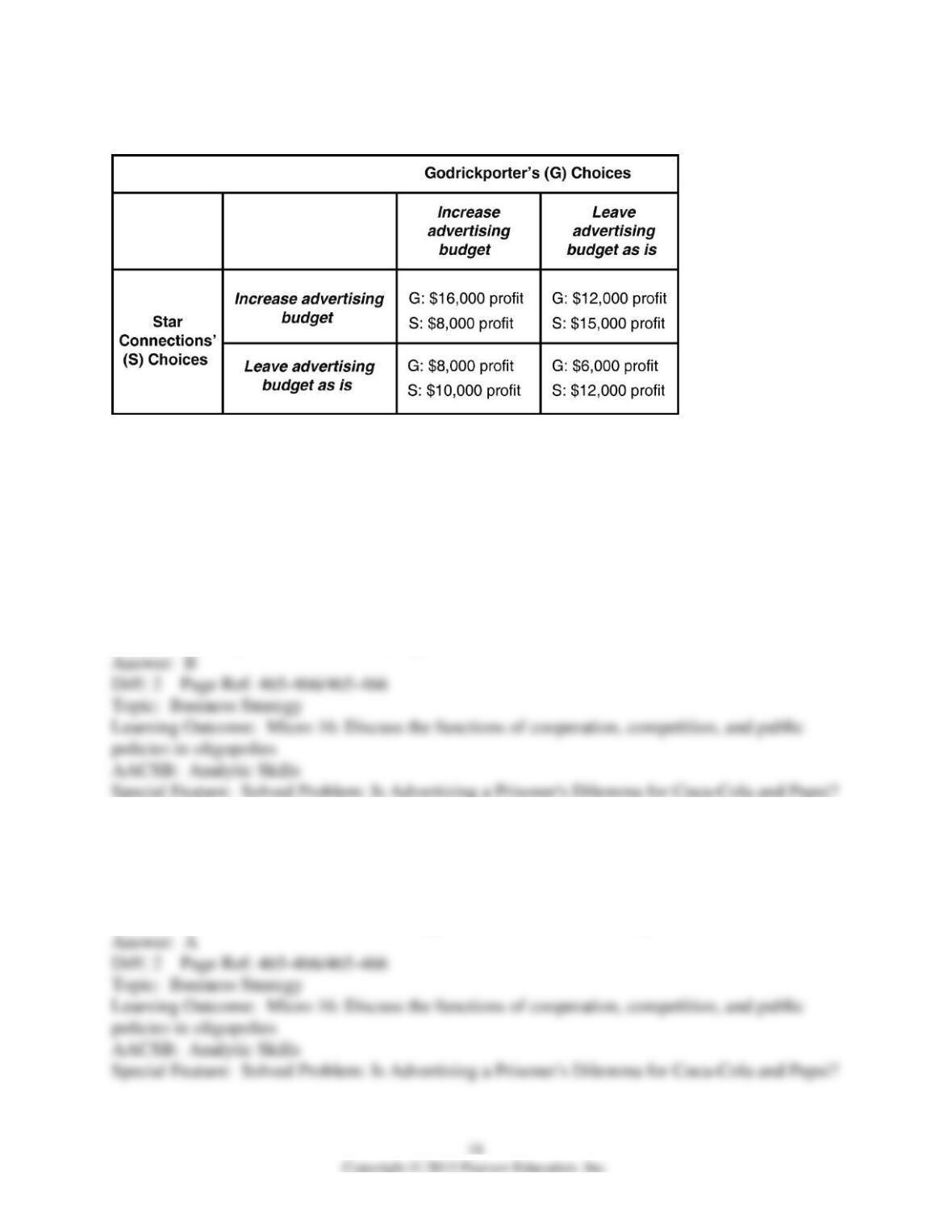
Table 14-1
Godrickporter and Star Connections are the only two airport shuttle and limousine rental service
companies in the mid-sized town of Godrick Hollow. Each firm must decide on whether to
increase its advertising spending to compete for customers. Table 14-1 shows the payoff matrix
for this advertising game.
13) Refer to Table 14-1. Is there a dominant strategy for Godrickporter and if so, what is it?
A) No, its outcome depends on what Star Connections does.
B) Yes, Godrickporter should increase its advertising spending.
C) Yes, Godrickporter should reduce its advertising spending.
D) Yes, Godrickporter’s dominant strategy is to collude with Star Connections.
14) Refer to Table 14-1. Is there a dominant strategy for Star Connections and if so, what is it?
A) No, its outcome depends on what Godrickporter does.
B) Yes, Star Connections should increase its advertising spending.
C) Yes, Star Connections should reduce its advertising spending.
D) Yes, Star Connections’ dominant strategy is to collude with Godrickporter.
15) Refer to Table 14-1. Let’s suppose the game starts with each firm adhering to its original
budget so that Godrickporter earns a profit of $6,000 and Star Connections earns a profit of
$12,000. Is there an incentive for any one firm to increase its advertising budget?
A) No, neither firm has an incentive to raise its advertising spending.
B) Yes, both firms have an incentive to raise their advertising budgets.
C) Yes, Star Connections has an incentive to increase its advertising budget, but Godrickporter
does not.
D) Yes, Godrickporter has an incentive to increase its advertising budget, but Star Connections
does not.
16) Refer to Table 14-1. What is the Nash equilibrium in this game?
A) There is no Nash equilibrium.
B) Godrickporter increases its advertising budget, but Star Connections does not.
C) Star Connections increases its advertising budget, but Godrickporter does not.
D) Both Godrickporter and Star Connections increase their advertising budgets.
17) Which of the following statements about the prisoner’s dilemma is false?
A) The prisoner’s dilemma in a one-shot game leads to a noncooperative, equilibrium outcome.
B) The prisoner’s dilemma in repeated games could lead to cooperation especially if there is
some enforcement mechanism that punishes a player who does not cooperate.
C) Players caught in a prisoner’s dilemma act in selfish ways that lead to an equilibrium that is
sub-optimal.
D) The prisoner’s dilemma game can never reach a Nash equilibrium as long as players do not
cooperate.
18) Which of the following is an example of a way in which a firm in oligopoly can escape the
prisoner’s dilemma?
A) producing more of its product
B) advertising that it will match its rival’s price
C) reneging on a previous tacit agreement with rival firms to charge identical high prices
D) ignoring the pricing decisions of the other firms
19) Consider two oligopolistic industries selling the same product in different locations. In the
first industry, firms always match price changes by any other firm in the industry. In the second
industry, firms always ignore price changes by any other firm. which of the following statements
is true about these two industries, holding everything else constant?
A) Market prices are likely to be higher in the first industry in which firms always match price
changes by rival firms than in the second where firms ignore their rivals’ price changes.
B) Market prices are likely to be lower in the first industry where firms always match price
changes by rival firms than in the second where firms ignore their rivals’ price changes.
C) Market prices are likely to be the same in both markets because they are both oligopolistic
markets.
D) No conclusions can be drawn about the pricing behavior under these very different firm
behaviors.