4) Which of the following is true of trademarks?
A) A successful trademark is one that becomes a generic name for a product, for example,
“Xerox” has become a generic term for making photocopies.
B) A successful trademark is one that allows consumers to immediately identify the source or
producer of the product.
C) If a firm is granted a trademark, then no other firms can legally produce similar products for a
given period of time.
D) If a firm is granted a trademark, then no other firms can legally sell in the same geographic
area for a given period of time.
5) ________ describes the actions a firm takes to maintain the differentiation of its product over
time.
A) Product differentiation.
B) Brand management
C) Aggressive marketing.
D) Advertising
6) Which of the following can a firm use to defend a successful product’s brand name?
A) The firm can obtain a patent on the brand name.
B) The firm can apply for a trademark to ban other firm’s from using the product’s name.
C) The firm can increase the amount it spends on advertising for the product.
D) The firm can attempt to copyright the brand name.
7) Firms use two marketing tools to differentiate their products. What are these two tools?
A) lobbying and word of mouth
B) market research and demand estimation
C) brand management and advertising
D) consumer surveys and market experiments
8) When a firm has been granted a trademark, which grants legal protection against other firms
using the name of the product that has been granted the trademark, the firm
A) still faces the possibility that the name will become widely used and no longer associated with
a specific company.
B) does not have to worry about legally enforcing the trademark; this is the responsibility of the
legal system.
C) still must apply for a copyright and a patent to ensure that no other firm will use the product’s
name.
D) must spend an annual amount on advertising the product each year; the amount it must spend
is negotiated by the firm and the government agency that grants the trademark.
9) One goal a firm tries to achieve when it advertises a product is to
A) make the demand curve for the product more elastic.
B) shift the demand curve for the product to the left.
C) make the demand curve for the product unitary elastic.
D) make the demand curve for the product more inelastic.
10) Advertising is the action of a firm that is intended to maintain the differentiation of its
product over time.
11) Marketing refers to all the activities necessary for a firm to sell a product to a consumer.
12) Discuss the role of product differentiation and advertising in monopolistic competition.
13) Why are many companies concerned about brand management?
14) Why would an organization as large as the National Football League (NFL) incur large legal
expenses to try to prevent bars and restaurants from using their trademarked term “Super Bowl”
in their advertising?
13.6 What Makes a Firm Successful?
1) The most important of the factors that make a firm successful and that can be controlled by the
firm’s owners and managers are
A) the establishment of trademarks for its products and the aggressive defense of those
trademarks.
B) lobbying government to erect or enforce entry barriers in its markets and the marketing of its
products as widely as possible.
C) the differentiation of its products and the production of products at a lower average cost than
competing firms.
D) the selection of the prices of its products and the selection of the most productive and loyal
employees.
2) A firm cannot control all of the factors that allow it to make economic profits. Which of the
following is an example of an uncontrollable factor?
A) product differentiation
B) input prices
C) producing at a lower average total cost than competing firms
D) hiring competent managers
3) Some factors that allow firms to make economic profits are beyond its control. All but one of
the following is an uncontrollable factor. Which factor is controllable?
A) input prices
B) consumer tastes
C) chance events
D) product differentiation
4) Being the first to sell a particular good can give a firm advantages over other firms that sell
similar products. What is the name given to these advantages?
A) first-mover
B) first come, first served
C) follow the leader
D) first to market
5) The marketing of the first ballpoint by Milton Reynolds showed
A) that first-mover advantages can make it more difficult for new firms to enter a market and
compete against the first mover.
B) that being the first firm to market a new product can result in a natural monopoly.
C) that being the first firm to market a product may not lead to a long-lived advantage over later
entrants into the market.
D) how important it is to receive patent protection for a new product.
6) In a monopolistically competitive market, a successful new restaurant
A) can earn economic profits in the long run if it uses barriers to restrict entry by new
restaurants.
B) will earn zero economic profit in the long run because of free entry, but competition will lead
restaurants to offer different versions of the same product.
C) will face high entry barriers because of health and safety regulations to which all restaurants
are subject.
D) must obtain a trademark to ensure that it will break even in the long run.
7) Which of the following statements is true?
A) Input prices are one of the success factors that firms can control.
B) Consumers will buy a product only if its price is below that of its competitors.
C) Consumers will buy a product only if it meets a need not met by competing products.
D) Sheer chance can play a significant role in the success or failure of a business.
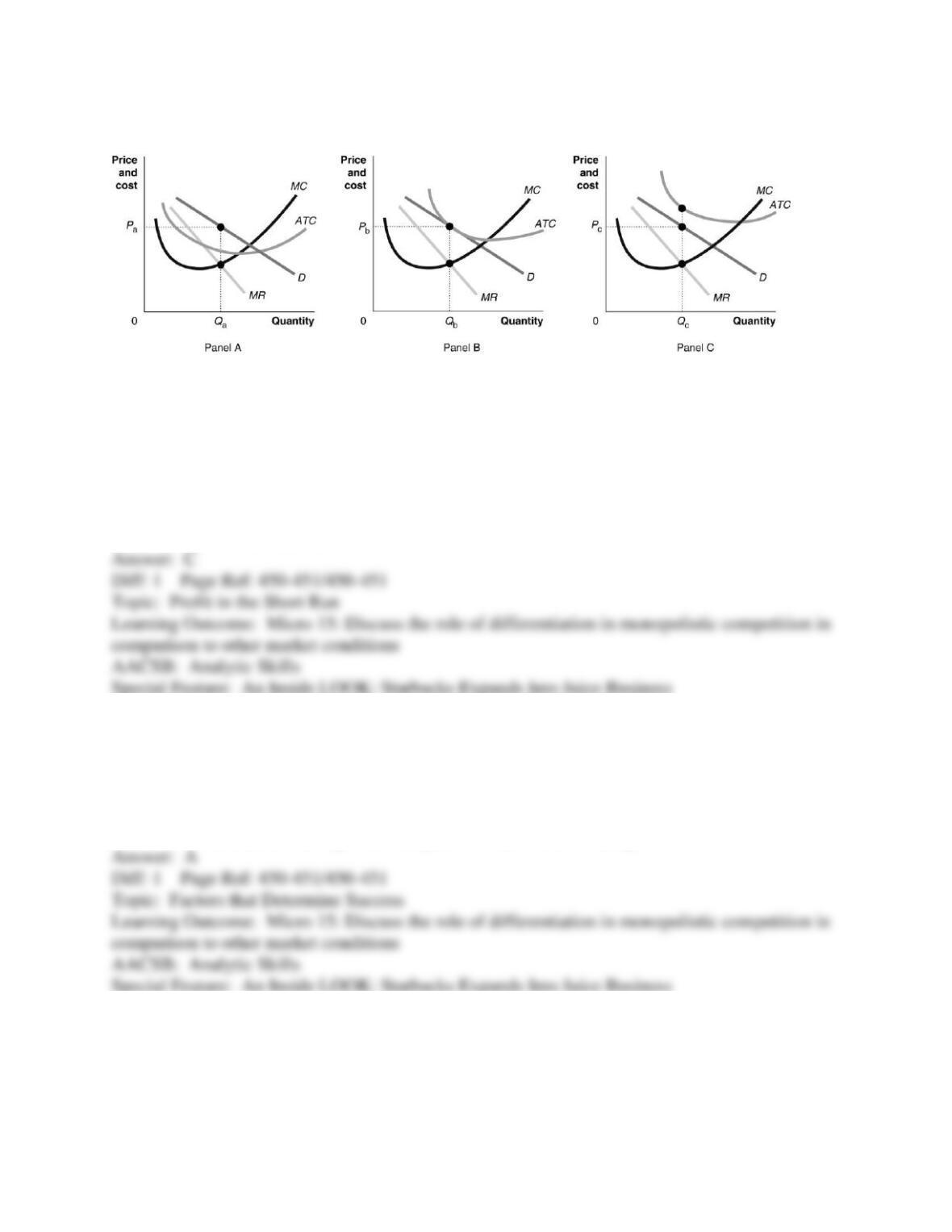
Figure 13-9
8) Refer to Figure 13-9. Which of the graphs in the figure above reflects the decline in sales that
Starbucks experienced as a result of increased competition from companies like McDonald’s and
Dunkin’ Donuts. Assume that as a result of the competition, Starbucks began to experience an
economic loss.
A) Panel A
B) Panel B
C) Panel C
D) either Panel A or Panel C
9) If Starbucks is successful at luring away competitors’ customers with its chain of health and
wellness stores, what will be the effect on Starbucks’ demand and marginal revenue curves?
A) They will both shift to the right.
B) They will both shift to the left.
C) Demand will shift to the left and marginal revenue will not change.
D) Demand will shift to the right and marginal revenue will not change.
10) The ability to engage in product differentiation is one of the factors a manager or owner of a
firm can control in order to create value for consumers.
11) If a firm can produce a product at a lower average cost than its competitors, it stands a better
chance of earning economic profit.
12) What are the key factors that determine the profitability of a firm in a monopolistically
competitive market?
13) Explain the significance of brand management to a firm that has differentiated its product.
Comment specifically on the importance of obtaining a trademark.