4) Which of the following statements is true about monopolistically competitive firms?
A) Unlike perfectly competitive firms, monopolistically competitive firms are able to raise their
prices without losing all of their customers.
B) Like perfectly competitive firms, monopolistically competitive firms are not able to raise
prices without losing all of their customers because they face competition from firms selling
similar products.
C) Like perfectly competitive firms, monopolistically competitive firms maximize their profits
by settling price equal to marginal cost.
D) Unlike perfectly competitive firms, monopolistically competitive face perfectly inelastic
demand curves.
5) Which of the following is not a characteristic of a monopolistically competitive firm in long-
run equilibrium?
A) Marginal revenue is equal to marginal cost.
B) Price is equal to average revenue.
C) The firm has excess capacity.
D) Price is equal to marginal cost.
6) In contrast with perfect competition, excess capacity characterizes monopolistic competition.
Excess capacity is due to which of the following?
A) Monopolistically competitive firms produce at the minimum point on their average total cost
curves.
B) Monopolistically competitive firms face downward-sloping demand curves. In the long run,
firms produce where their demand curves are tangent to their long-run average total cost curves.
C) Monopolistically competitive firms produce where marginal revenue is equal to marginal
cost.
D) Monopolistically competitive markets have low barriers to entry.
7) Excess capacity is a characteristic of monopolistically competitive firms. What does excess
capacity mean?
A) It means that firms do not produce the output level that corresponds to the minimum point on
their average total cost curves.
B) It means that firms hire more than the minimum number of workers needed to produce the
profit-maximizing level of output.
C) It means that firms produce with inefficient combinations of resources.
D) It means that firms build plants that are not large enough to achieve minimum efficient scale.
8) Monopolistically competitive firms have downward-sloping demand curves. In the long run,
monopolistically competitive firms earn zero economic profits. These two characteristics imply
that in the long run,
A) monopolistically competitive markets achieve productive efficiency.
B) monopolistically competitive markets achieve allocative efficiency.
C) monopolistically competitive firms earn economic profits.
D) monopolistically competitive firms have excess capacity.
9) Only one of the following statements is correct. The statements compare perfectly competitive
(PC) markets and monopolistically competitive (MC) markets. Which statement is correct?
A) Productive efficiency is achieved in both PC and MC markets. Allocative efficiency is
achieved only in MC markets.
B) Allocative efficiency is achieved in both PC and MC markets. Productive efficiency is
achieved only in PC markets.
C) Productive efficiency and allocative efficiency are both achieved in PC markets. Neither is
achieved in MC markets.
D) Allocative efficiency is achieved only in PC markets. Productive efficiency is achieved only
in MC markets.
10) Economists have long debated whether there is a significant loss of well-being to society in
markets that are monopolistically competitive rather than perfectly competitive. Which of the
following offers the best reason why some economists believe that monopolistically competitive
markets are less efficient than perfectly competitive markets?
A) In contrast to perfectly competitive markets, neither allocative efficiency nor productive
efficiency are achieved in monopolistically competitive markets.
B) In contrast to perfectly competitive markets, firms in monopolistically competitive markets
earn economic profits in long-run equilibrium.
C) In contrast to perfectly competitive markets, firms in monopolistically competitive markets do
not produce where price equals average total cost in long-run equilibrium.
D) In contrast to perfectly competitive markets, firms in monopolistically competitive markets
can charge a price greater than average total cost in the short run.
11) Economists have long debated whether there is a significant loss of well-being to society in
markets that are monopolistically competitive rather than perfectly competitive. Which of the
following offers the best reason why some economists believe that monopolistically competitive
markets benefit consumers despite any loss of well-being?
A) Although consumers may pay a price greater than marginal cost for a product, the product is
produced at the minimum average total cost.
B) Although consumers may pay a price greater than marginal cost and the product is not
produced at minimum average total cost, they benefit from being able to buy a differentiated
product more closely suited to their tastes.
C) Consumers pay a price equal to the marginal cost of producing a product, even though it is
not produced at the minimum average total cost.
D) Consumers are better off choosing from a variety of differentiated products, even though
product differentiation causes barriers that restrict entry into monopolistically competitive
markets.
12) As customers switch from renting DVDs to downloading or streaming movies from the
Internet, Netflix will likely find it
A) harder to remain profitable as they face more competition with streaming movies than with
mail order DVD rental.
B) harder to remain profitable as they face less competition with streaming movies than with
mail order DVD rental.
C) easier to remain profitable as they face more competition with streaming movies than with
mail order DVD rental.
D) easier to remain profitable as they face less competition with streaming movies than with mail
order DVD rental.
13) In long-run equilibrium, compared to a perfectly competitive market, a monopolistically
competitive industry produces a ________ level of output and charges a ________ price.
A) higher; lower
B) lower; lower
C) lower; higher
D) higher; higher
14) Long-run equilibrium in a monopolistically competitive market is similar to long-run
equilibrium in a
perfectly competitive market in that in both markets, firms
A) produce at the minimum point of their average total cost curves.
B) produce where price equals marginal cost.
C) break even.
D) produce where price equals marginal revenue.
15) If a monopolistically competitive firm has excess capacity
A) it has exhausted all economies of scale.
B) it is producing beyond the minimum efficient scale.
C) it is experiences diseconomies of scale.
D) it produces an output rate that places it on the negatively sloped portion of its average total
cost curve.
16) In what way does long-run equilibrium under monopolistic competition differ from long-run
equilibrium under perfect competition?
A) Firms in perfect competition achieve productive and allocative efficiency while firms in
monopolistic competition achieve neither allocative nor productive efficiency.
B) The only difference is that in a monopolistically competitive market there are many brands to
choose from while in a perfectly competitive market there is one standard product.
C) Firms in perfect competition achieve productive efficiency while firms in monopolistic
competition achieve allocative efficiency.
D) Firms in perfect competition achieve allocative efficiency while firms in monopolistic
competition achieve brand efficiency.
17) What is the trade-off that consumers face when buying the product of a monopolistically
competitive firm?
A) Consumers pay higher prices but receive better quality goods compared to the output of
perfectly competitive firms.
B) Consumers pay a price greater than marginal cost, but have the luxury of choices more suited
to their tastes.
C) Consumers pay higher prices but the products are produced by highly efficient firms.
D) Consumers pay lower prices but have fewer choices.
18) Monopolistically competitive firms achieve allocative efficiency but not productive
efficiency.
19) A monopolistic competitor does not earn profits in the long run unless it can successfully
differentiate its product in the minds of its consumers.
20) In the long-run equilibrium, both the perfectly competitive firm and the monopolistically
competitive firm produce the output at which MR=MC and charge a price equal to the average
total cost of production.
21) Economists believe that consumers would be better off if markets were perfectly competitive
rather than monopolistically competitive.
22) What is meant by “excess capacity”? How does it relate to consumer utility?
23) Both the perfectly competitive firm and the monopolistically competitive firm produce at the
output where marginal revenue equals marginal cost (MR = MC) but only the perfectly
competitive firm achieves allocative efficiency. Explain why this is the case.
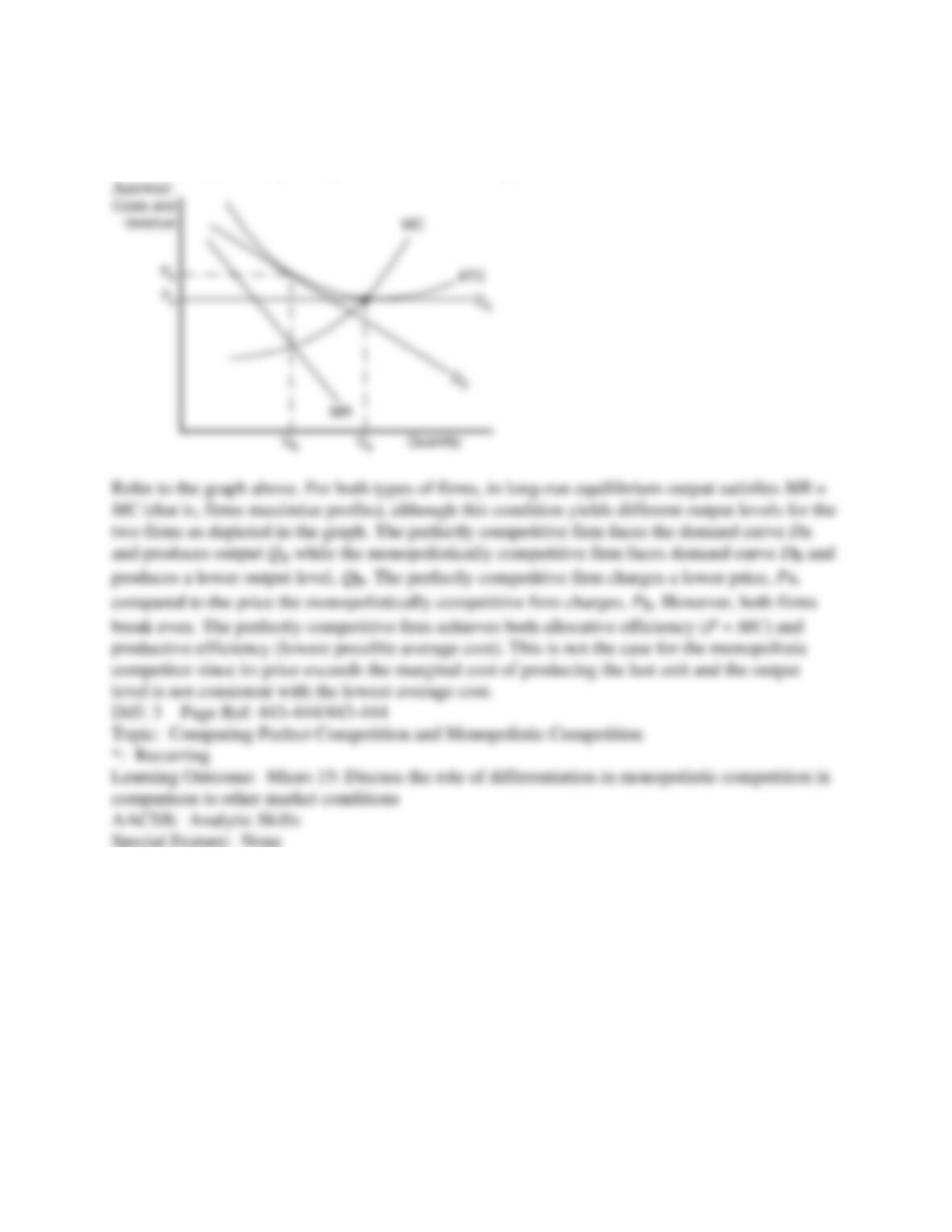
24) Explain the similarities and differences between the long-run equilibrium for a perfectly
competitive firm and a monopolistically competitive firm. Illustrate your answer with a graph
demonstrating the long run equilibrium for the two types of firms.
13.5 How Marketing Differentiates Products
1) Monopolistically competitive firms can differentiate their products
A) by producing at minimum efficient scale.
B) by producing where marginal revenue equals marginal cost.
C) by equating price and average total cost.
D) through marketing.
2) To maximize their profits and defend those profits from competitors, monopolistically
competitive firms must
A) lobby government to erect barriers to entry in their industries.
B) limit foreign competition in their markets by encouraging the government to impose tariffs
and other trade restrictions.
C) differentiate their products.
D) achieve economies of scale.
3) A franchise is
A) a firm that buys and operates a brand name business in a new market.
B) a firm with the legal right to sell a good or service in a particular area.
C) a firm with no competitors.
D) a branch of a national company.