Microeconomics, 4e – Testbank 2 (Hubbard)
Chapter 13 Monopolistic Competition: The Competitive Model in a More Realistic Setting
13.1 Demand and Marginal Revenue for a Firm in a Monopolistically Competitive Market
1) Which of the following characterizes the market that Starbucks competes in?
A) All coffeehouses face horizontal demand curves.
B) Coffeehouses sell identical products.
C) Barriers to entry are low.
D) There are a small number of firms.
2) Starbucks started out small in 1971, but by 1993 Starbucks was a national chain and had
coffeehouses in 38 countries. A key to the company’s success was the realization by executives
that
A) there was a demand for coffeehouses where consumers could sit and drink high-quality
coffee.
B) coffee prices would have to be cut in order for Starbucks to compete with other stores that
sold coffee.
C) they had to keep their stores open longer hours to attract a large number of customers.
D) their stores should be located close to other stores that sold similar products.
3) A monopolistically competitive market is described as one in which there are
A) a few firms producing an identical product.
B) a large number of firms selling similar, but not identical, products.
C) a few firms producing differentiated products.
D) one large firm and many small firms producing identical products.
4) Because the monopolistically competitive firm faces a ________ demand curve for its
product, it ________ the price of its output.
A) downward-sloping; cannot influence
B) horizontal; can influence
C) horizontal; cannot influence
D) downward-sloping; can influence
5) Monopolistic competition is a market structure in which
A) firms produce and sell products for which there are no close substitutes.
B) the demand curve for a typical firm is horizontal.
C) firms cannot influence the market price.
D) barriers to entry are low.
6) Which of the following is not a characteristic of monopolistic competition?
A) Firms are price takers.
B) There are many buyers and sellers.
C) Barriers to entry are low.
D) Firms sell similar, but not identical, products.
7) Which of the following is not a characteristic of monopolistic competition?
A) There are many buyers and sellers.
B) There are low barriers to entry.
C) Average revenue is equal to price.
D) The products sold by all firms are identical.
8) In the United States, the average person mostly patronizes firms that operate in
A) perfectly competitive markets.
B) monopolistically competitive markets.
C) oligopoly markets.
D) monopoly markets.
9) Which of the following is the best example of a firm that competes in a monopolistically
competitive market?
A) the U.S. Postal Service
B) Microsoft
C) a movie theater
D) an automobile manufacturer
10) In San Francisco there are many restaurants that specialize in a wide variety of cuisines.
Patronage at these restaurants is influenced by factors such as tastes, price and location. This
market is
A) perfectly competitive.
B) monopolistically competitive.
C) oligopolistic.
D) monopolistic.
11) When a monopolistically competitive firm lowers its price, one good thing happens to the
firm. What is this “one good thing” called?
A) the output effect
B) the price effect
C) the income effect
D) the substitution effect
12) When a monopolistically competitive firm lowers it price one bad thing happens to the firm.
What is this “one bad thing” called?
A) the output effect
B) the income effect
C) the substitution effect
D) the price effect
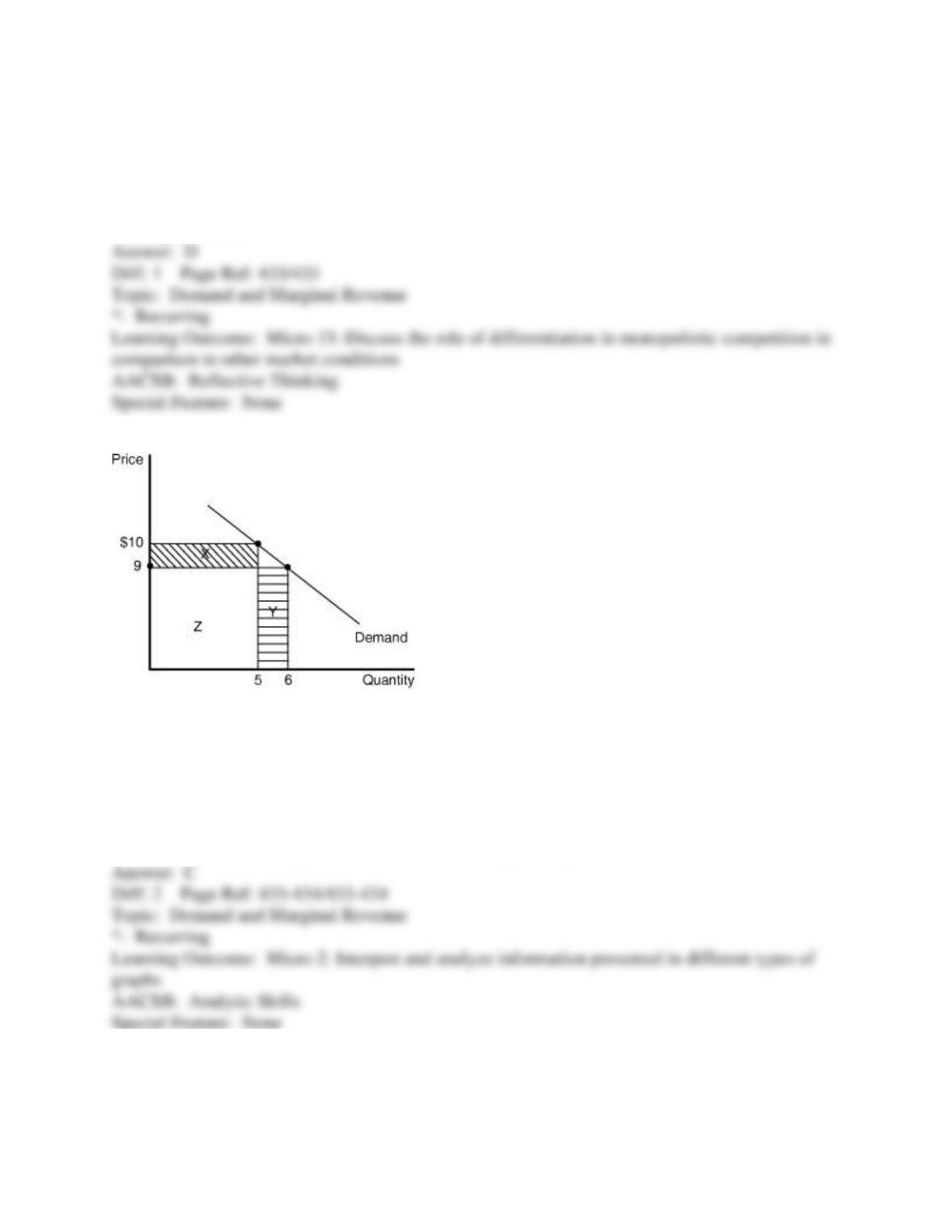
Figure 13-1
13) Refer to Figure 13-1. The marginal revenue from one additional unit sold is the sum of the
gain in revenue from selling the additional unit and the loss in revenue from having to charge a
lower price to sell the additional unit. Based on the diagram in the figure,
A) X represents the gain (price effect) and Y the loss (output effect).
B) X + Z represents the loss (output effect) and Y the gain (price effect).
C) Y represents the gain (output effect) and X the loss (price effect).
D) X represents the loss (price effect) and Y + Z the gain (output effect).
14) Refer to Figure 13-1. What is the marginal revenue of the sixth unit of output?
A) $4
B) $5
C) $9
D) $54
15) For the monopolistically competitive firm,
A) Price (P) = Marginal Revenue (MR) = Average Revenue (AR).
B) P = MR > AR.
C) P = AR > MR.
D) P > MR = AR.
16) The Jeans Store sells 7 pairs of jeans per day when it charges $100 per pair. It sells 8 pairs
of jeans per day at a price of $90 per pair. The marginal revenue of the eighth pair of jeans is
A) $20.
B) $90.
C) $100.
D) $700.
17) Which of the following describes a difference between the marginal revenue and demand
curves of a perfectly competitive firm and a monopolistically competitive firm?
A) The perfectly competitive firm’s marginal revenue and demand curves are the same; the
marginal revenue curve of a monopolistically competitive firm lies above its demand curve.
B) The perfectly competitive firm’s marginal revenue and demand curves are the same; the
marginal revenue curve of a monopolistically competitive firm lies below its demand curve.
C) The monopolistically competitive firm’s marginal revenue and demand curves are the same;
the marginal revenue curve of a perfectly competitive firm lies below its demand curve.
D) The marginal revenue curve of a monopolistically competitive firm lies below its demand
curve; the marginal revenue curve of a perfectly competitive firm lies above its demand curve.
18) When a firm faces a downward-sloping demand curve, marginal revenue
A) must exceed price because the price effect outweighs the output effect.
B) is less than price because a firm must lower its price to sell more.
C) equals price because the firm sells a standardized product.
D) must exceed price because the output effect outweighs the price effect.
19) The marginal revenue of a monopolistically competitive firm
A) cannot be negative because the price the firm charges will always be greater than zero.
B) can be negative if the firm charges a high price.
C) can be negative if the firm charges a low price.
D) will equal average revenue.
20) If a monopolistically competitive firm lowers its price and, as a result, its total revenue
decreases then
A) the output effect of the price change was less than the price effect.
B) the output effect of the price change was greater than the price effect.
C) the firm’s demand curve must have decreased.
D) the substitution effect of the price change was greater than the income effect.
21) The demand curve of a monopolistically competitive firm
A) is horizontal because the firm must cut its price to sell more.
B) is perfectly elastic.
C) is downward-sloping because it sells an identical product.
D) is downward-sloping because it must cut its price to sell more.
22) Every firm that has the ability to affect the price of the good or service it sells will
A) have a perfectly elastic demand curve.
B) have a marginal revenue curve that lies below its demand curve.
C) earn a short-run profit but break even in the long run.
D) shut down in the short run.
23) Suppose a monopolistically competitive firm sells 25 units at a price of $10. Calculate its
marginal revenue per unit of output if it sells 5 more units of output when it reduced its price to
$9.
A) $270.
B) $20
C) $4
D) $2.50
24) Which of the following statements is true?
A) The marginal revenue of a monopolistically competitive firm will be positive at high prices
and negative at low prices.
B) Because the demand curve for a monopolistically competitive firm is downward-sloping its
marginal revenue will be negative.
C) The marginal revenue of a monopolistically competitive firm will be always be positive.
D) The marginal revenue of a monopolistically competitive firm will be positive at low prices
and negative at high prices.
25) Monopolistically competitive firms face a perfectly elastic demand curve.
26) New firms are able to enter monopolistically competitive markets because there are low
barriers to entry.
27) Firms in monopolistic competition compete by selling similar, but not identical products.
28) For a downward-sloping demand curve, marginal revenue decreases as quantity sold
increases.
29) One of the assumptions of monopolistic competition is that firms produce differentiated
products. What does this assumption imply about the demand curve facing a representative firm?
30) Why are demand and marginal revenue represented by the same curve for a firm in a
perfectly competitive market, but by separate curves for a firm in a monopolistically competitive
market?
31) There are many cattle ranchers in the world, and there are also many McDonald’s restaurants
in the world. Why, then, does a McDonald’s restaurant face a downward sloping demand curve
while a cattle rancher faces a horizontal demand curve?
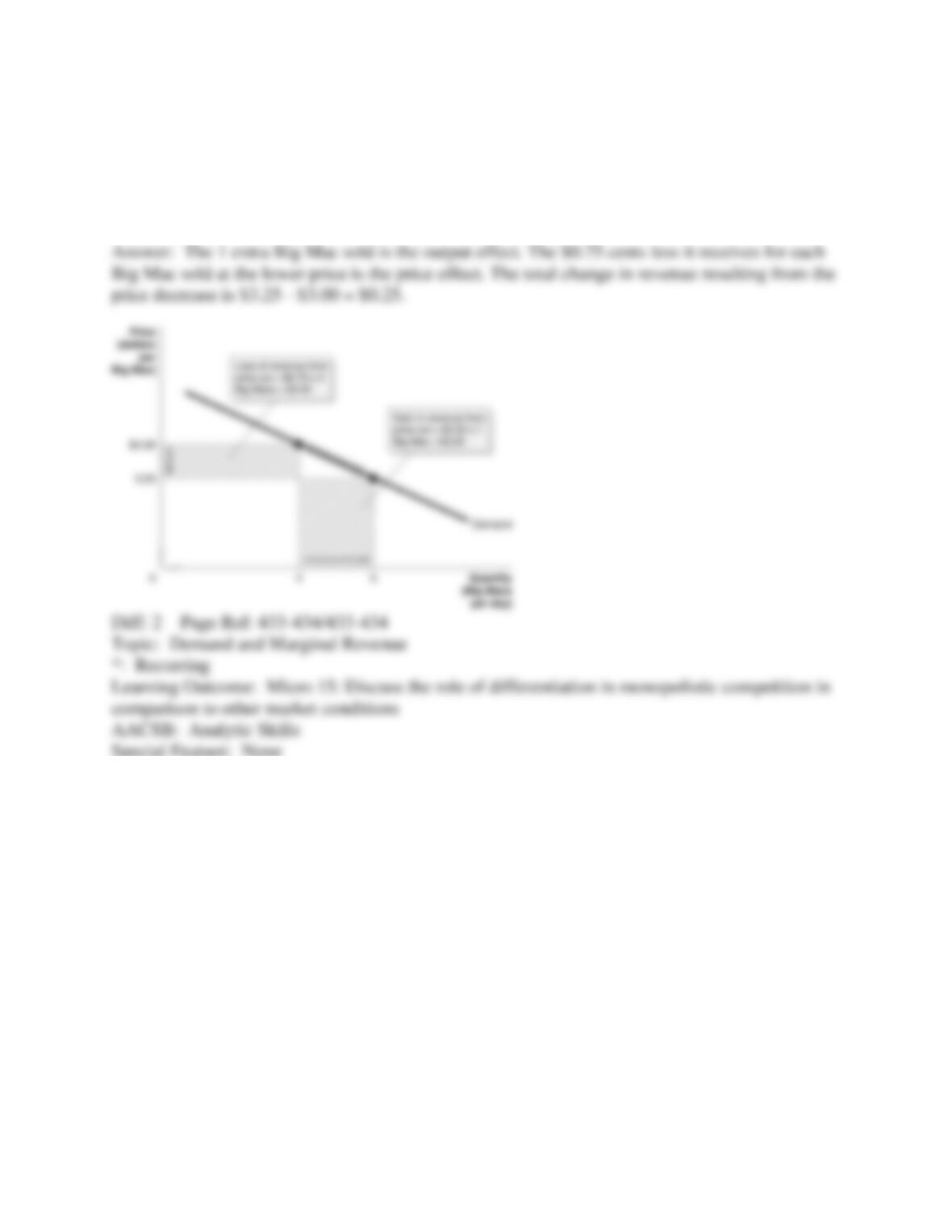
32) Suppose that if a local McDonald’s restaurant reduces the price of a Big Mac from $4.00 to
$3.25, the number of Big Macs it sells per day will increase from 4 to 5. Explain the output effect
and the price effect resulting from this change. Using a graph, illustrate both the loss in revenue
from selling each of the first 4 Big Macs for $0.75 less and the additional revenue from selling 1
more Big Mac. What is the total change in revenue received which results from this price
decrease?
13.2 How a Monopolistically Competitive Firm Maximizes Profit in the Short Run
1) Both monopolistically competitive firms and perfectly competitive firms maximize profits
A) by producing where price equals average total cost.
B) by producing where marginal revenue equals average revenue.
C) by producing where marginal revenue is equal to marginal cost.
D) by producing where price equals average variable cost.
2) A monopolistically competitive firm maximizes profit in the short run by producing where
A) price is less than marginal cost.
B) price is less than marginal revenue.
C) price is less than average revenue.
D) price is greater than marginal cost.
3) A monopolistically competitive firm chooses
A) both the quantity of output to produce and the price at which it will sell its output.
B) the price of the product it sells but market forces determine the quantity it will be able to sell.
C) the quantity of output to produce but the price of the product it sells is determined collectively
by all firms in the industry.
D) the price of the product it sells but the quantity of output to produce is agreed upon by all
firms in the industry.
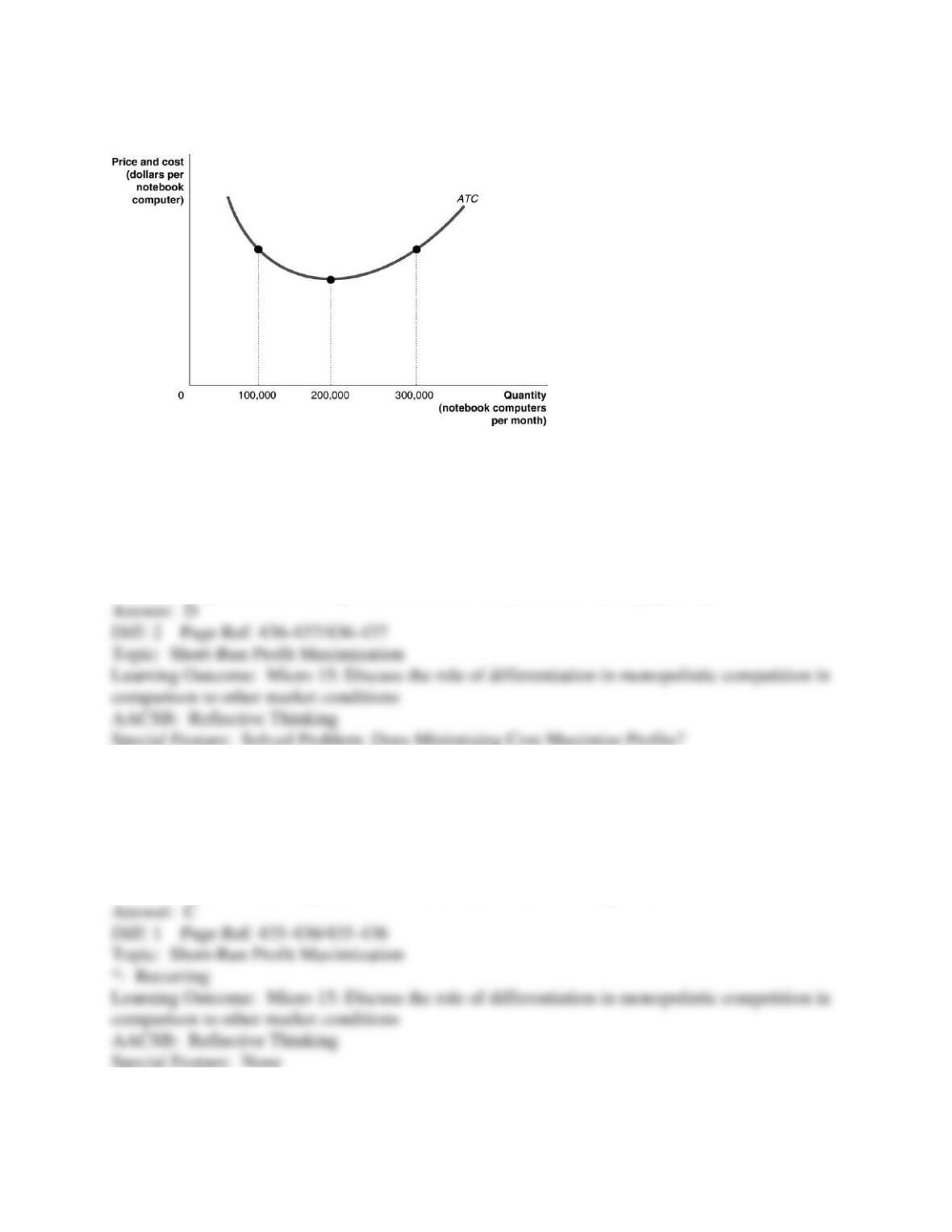
Figure 13-2
4) Refer to Figure 13-2. Suppose Dell finds the relationship between the average total cost of
producing notebook computers and the quantity of notebook computers produced is as shown by
Figure 13-2. Dell will maximize profits if it produces ________ notebook computers per month.
A) 100,000
B) 200,000
C) 300,000
D) Not enough information is given to determine the profit-maximizing quantity.
5) After selling 1,000 three-ring binders Tony DiFulvio realizes that the marginal revenue from
selling the last binder was less than the marginal cost. From this we can conclude that
A) Tony’s business earns a short-run economic profit.
B) Tony should shut down his business temporarily.
C) Tony’s profit fell after selling his 1,000th three-ring binder.
D) Tony’s profit would be greater if he sold an additional three-ring binder.
Table 13-1
Quantity
Sold
Price
Total
Revenue
Marginal
Revenue
Total
Cost
Marginal
Cost
Profit
0
$10
$0
—–
$2
—–
-$2
1
9
9
8
2
8
16
13
3
7
21
17
4
6
24
20
5
5
25
22
6
4
24
26
Table 13-1 lists estimated revenues and costs (per week) for plastic vials (100 vials per box) for
the Victoria Biological Supplies Company. Victoria sells plastic vials to university and private
research laboratories.
6) Refer to Table 13-1. Based on the data in the table, which of the following statements is true?
A) The table summarizes Victoria’s short-run, rather than long-run, market for plastic vials.
B) Victoria could be either a monopolistically competitive or a perfectly competitive firm.
C) Victoria should shut down temporarily.
D) Victoria should advertise more in order to increase the demand for plastic vials.
7) Refer to Table 13-1. Victoria’s profit-maximizing quantity sold (Q) and price (P) are:
A) Q = 3; P = $7.
B) Q = 4; P = $6.
C) Q = 5; P = $5.
D) Q = 6; P = $4.
8) Refer to Table 13-1. Victoria’s profit-maximizing output is where
A) total profit equals $3.
B) marginal revenue and marginal cost both equal $4.
C) marginal revenue and marginal cost both equal $3.
D) marginal cost is at its minimum value.
9) Refer to Table 13-1. At Victoria’s profit-maximizing output
A) profit equals $2.
B) total revenue equals $24 and total cost equals $20.
C) total revenue equals $25 and total cost equals $22.
D) total revenue equals $21 and total cost equals $17.
10) The profit-maximizing rule for a monopolistically competitive firm is to select the quantity at
which
A) marginal revenue equals marginal cost.
B) average revenue exceeds marginal cost by the greatest amount.
C) price equals marginal cost.
D) average revenue equals average total cost.
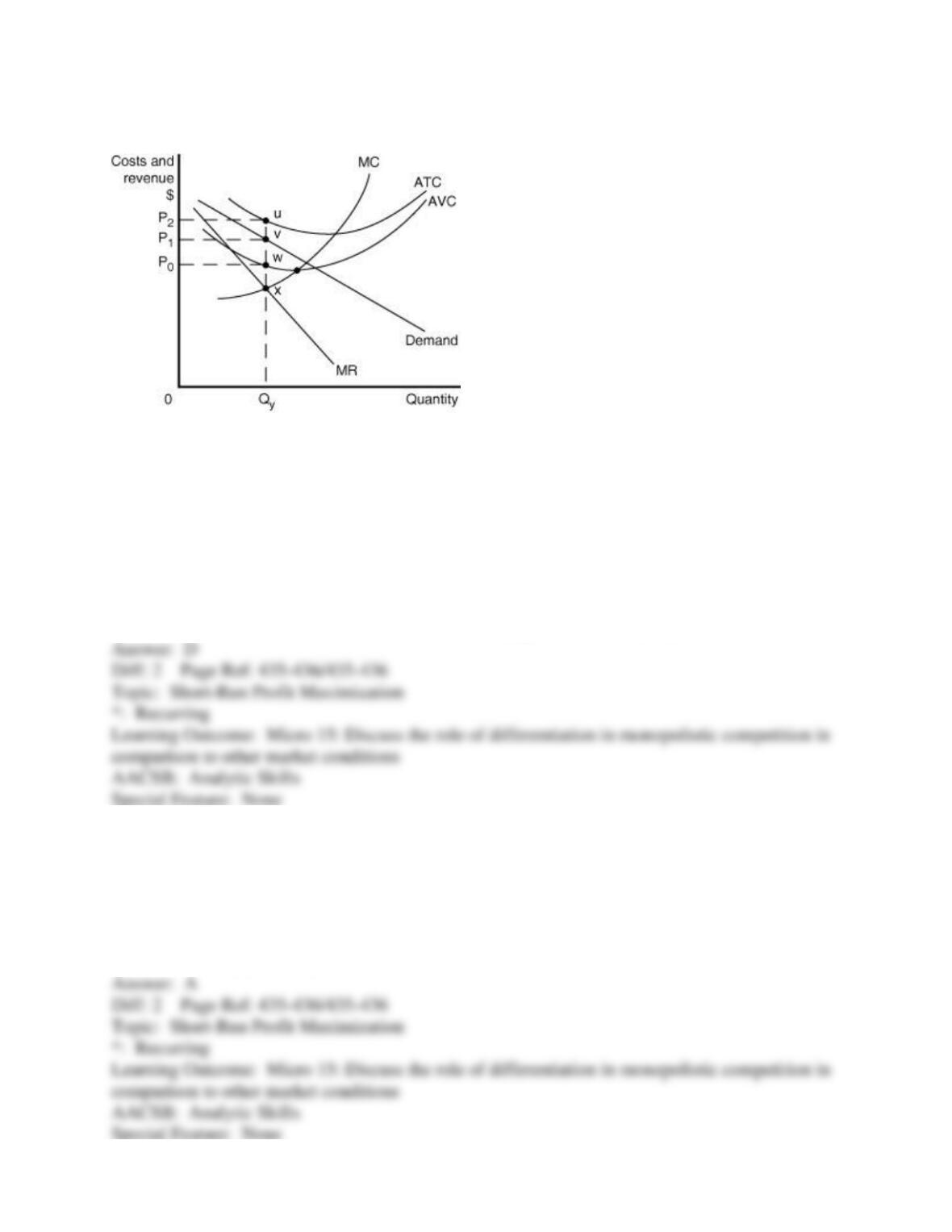
Figure 13-3
Figure 13-3 shows short-run cost and demand curves for a monopolistically competitive firm in
the footwear market.
11) Refer to Figure 13-3. Which of the following statements describes the best course of action
for the firm depicted in the diagram?
A) The firm should exit the industry because its price is less than its average total cost.
B) The firm should minimize its losses by producing Qy units and charging a price of P0.
C) The firm should minimize its losses by producing Qy units and charging a price of P2.
D) The firm should minimize its losses by producing Qy units and charging a price of P1.
12) Refer to Figure 13-3. Which of the following is the area that represents the profit or loss
experienced by the firm?
A) A loss represented by the rectangle P2uvP1.
B) A loss represented by the rectangle P2uwP0.
C) A loss represented by the rectangle P1vwP0.
D) An accounting profit equal to P1vwP0.
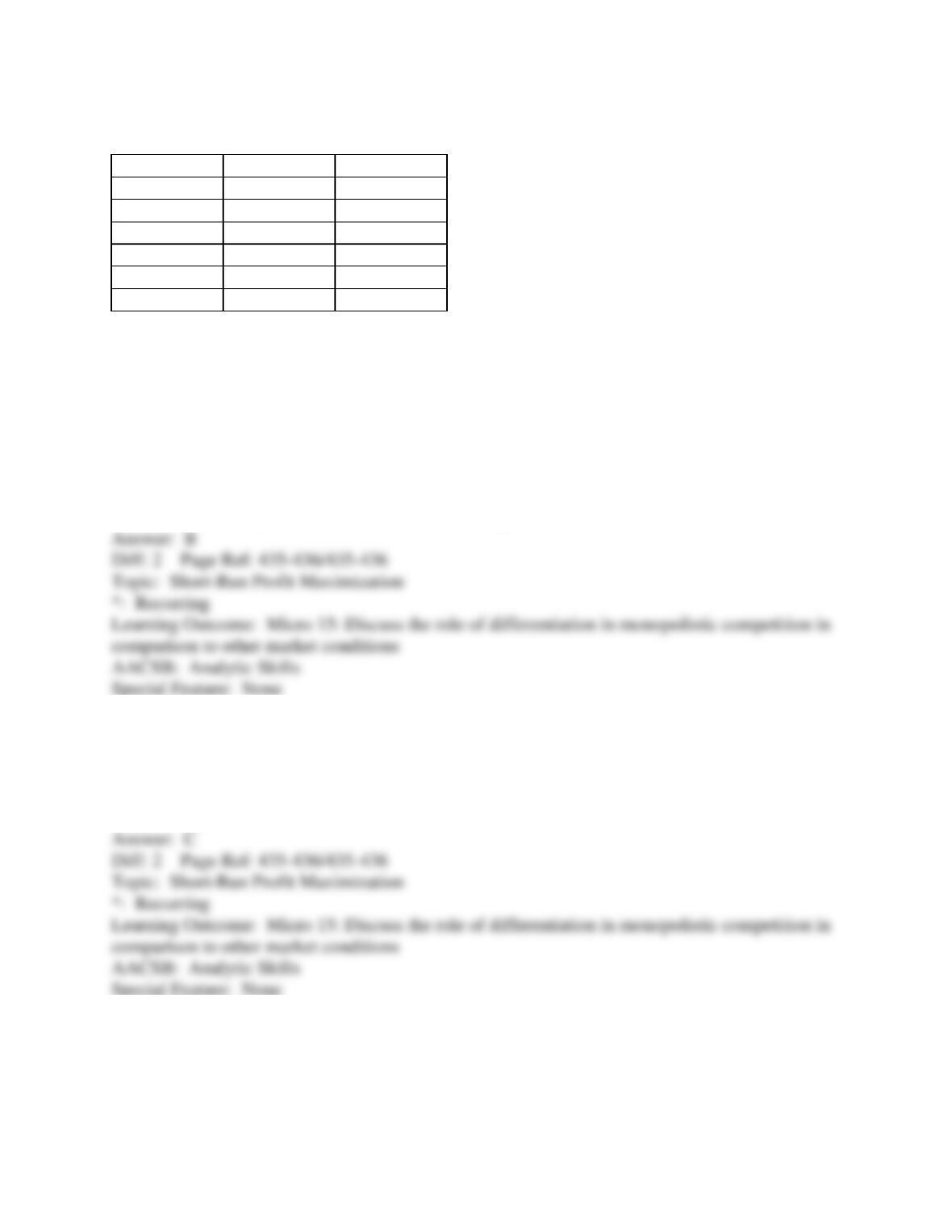
Table 13-2
Quantity
Price
Total Cost
1
$18
$14
2
16
20
3
14
26
4
12
32
5
10
38
6
8
44
Table 13-2 shows the demand and cost data facing a monopolistically competitive producer of
canvas bags.
13) Refer to Table 13-2. What are the firm’s profit-maximizing or loss-minimizing price and
quantity?
A) price = $10; quantity = 5.
B) price = $12; quantity = 4.
C) The firm should shut down temporarily.
D) This cannot be determined from the information given.
14) Refer to Table 13-2. At the profit-maximizing or loss-minimizing output level
A) the firm makes a profit of $12.
B) the firm incurs a loss equal to its fixed cost.
C) the firm makes a profit of $16.
D) the firm incurs a loss of $14.
15) A monopolistically competitive firm is producing an output level where marginal revenue is
greater than marginal cost. What should this firm do to increase its profit or reduce its losses?
A) The firm should raise its price.
B) The firm should decrease its fixed costs.
C) The firm should increase its implicit costs.
D) The firm should lower its price.
16) Suppose a monopolistically competitive firm’s output where marginal revenue equals
marginal cost is 66 units and the price corresponding to this quantity is $18. If the average total
cost at this output is $16.55, then its total profit is
A) $1,188.
B) $1,092.30.
C) $95.70.
D) $1.45.
17) If a monopolistically competitive firm is producing 50 units of output where marginal cost
equals marginal revenue, total cost is $1,674 and total revenue is $2,000, its average profit is
A) $326.
B) $40.
C) $6.52.
D) impossible to determine without additional information.
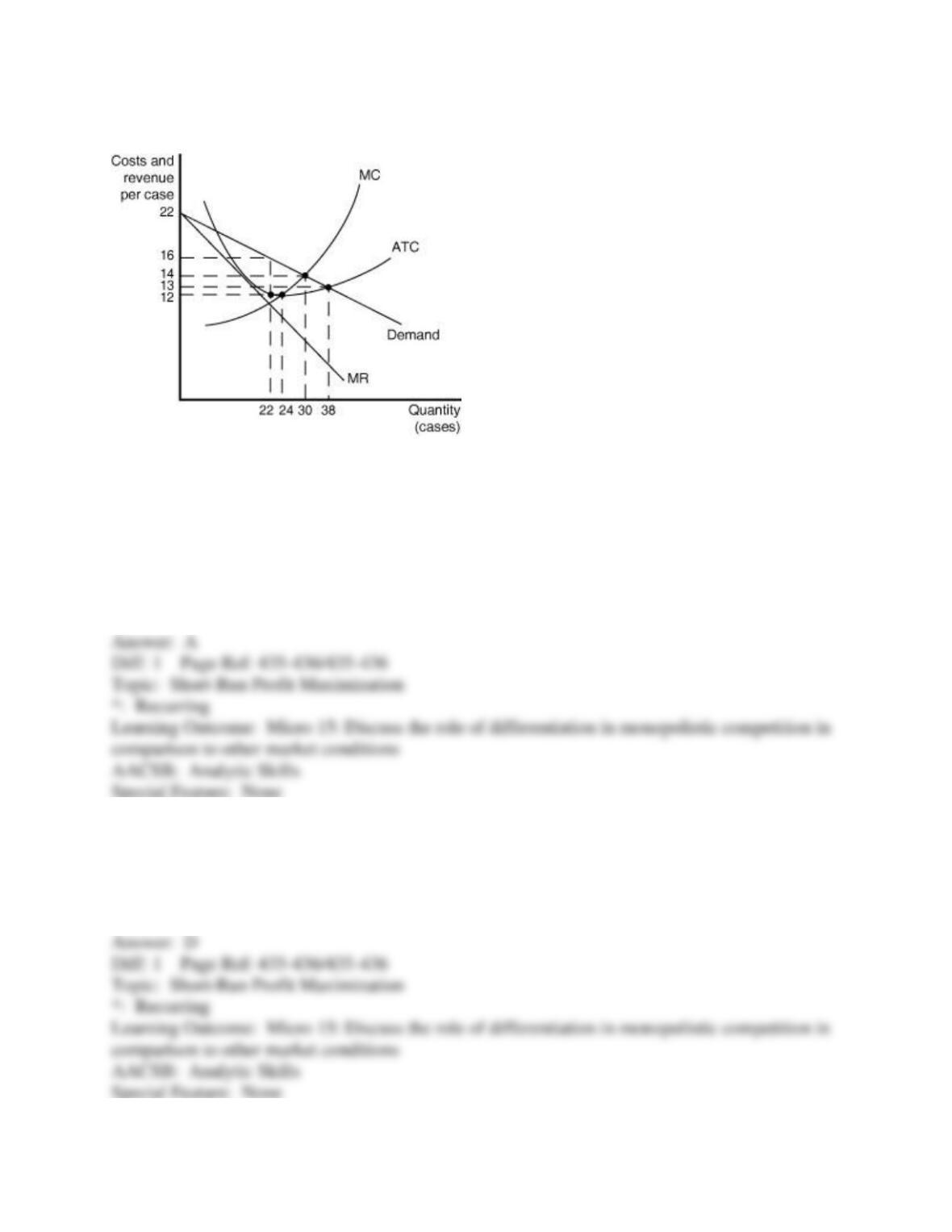
Figure 13-4
Figure 13-4 shows cost and demand curves for a monopolistically competitive producer of iced–
tea.
18) Refer to Figure 13-4. What is the profit-maximizing output level?
A) 22 cases
B) 24 cases
C) 30 cases
D) 38 cases
19) Refer to Figure 13-4. What is the firm’s profit-maximizing price?
A) $12
B) $13
C) $14
D) $16