Cost Accounting: A Managerial Emphasis, 6e
Chapter 13 – Strategy, Balanced Scorecard, and Profitability Analysis
Chapter 13 Strategy, Balanced Scorecard, and Profitability Analysis
13.1 Explain how the relative strength of five competitive forces help managers
identify two types of strategy.
1) Strategies have been classified in many different ways, but what is common is to set the business
within its external environment.
2) Cost leadership is an organization’s ability to offer products or services that are perceived by its own
customers as being superior and unique relative to those of its competitors.
3) ________ has/have been classified in many ways, but what is common is to set the business within its
external environment.
A) Strategies
B) Planning
C) Competitors
D) Bargaining power of input suppliers
E) Cost Leadership
4) Which of the following is not a force that shapes an organization’s competitive environment?
A) competitors
B) equivalent products
C) bargaining power of customers
D) government regulation
E) potential entrants into the market

Cost Accounting: A Managerial Emphasis, 6e
Chapter 13 – Strategy, Balanced Scorecard, and Profitability Analysis
5) Which of the following is a force that shapes an organization’s profit potential?
A) Investors
B) Potential entrants into the market
C) Lenders
D) Research and development
E) Bankers
6) ________ is an organization’s ability to offer products or services that are perceived by its customers as
being superior and unique relative to those of its competitors.
A) Strategy
B) Product differentiation
C) Cost leadership
D) The balanced scorecard
E) Cost differentiation
7) ________ is an organization’s ability to achieve low costs relative to competitors through productivity
and efficiency improvements, elimination of waste, and tight cost control.
A) Strategy
B) Product differentiation
C) Cost leadership
D) The balanced scorecard
E) Product leadership
8) An organization that is using the product differentiation approach would
A) focus on tight cost control.
B) carefully cultivate its brands.
C) provide products that are similar to competitors.
D) offer products at a lower cost than competitors.
E) focus on low prices
Cost Accounting: A Managerial Emphasis, 6e
Chapter 13 – Strategy, Balanced Scorecard, and Profitability Analysis
9) An organization that is using the cost leadership approach would
A) incur costs for innovative R&D.
B) provide products at a higher cost than competitors.
C) focus on productivity through efficiency improvements.
D) bring products to market rapidly.
E) use a skimming pricing policy.
10) Identify and explain Porter’s Five Forces model.
13.2 Identify Porter’s five factors and apply the decision framework to a strategic
choice.
1) Strategy requires integration of product and process development.
2) To achieve a cost leadership strategy companies may need to improve their internal production
processes to increase yield.
Cost Accounting: A Managerial Emphasis, 6e
Chapter 13 – Strategy, Balanced Scorecard, and Profitability Analysis
3) Reengineering is the fundamental rethinking and redesign of business processes to achieve
improvements in critical measures of performance such as cost, quality, service, speed, and customer
satisfaction.
4) Reengineering benefits are most significant when they focus on one business function rather than
crossing functional lines of the business process.
5) Successful reengineering efforts generally involve changing the roles and responsibilities of employees.
6) In general, profit potential increases with greater competition, stronger potential entrants, products
that are similar, and tougher customers and suppliers.
7) ________ is the fundamental rethinking and redesign of business processes to achieve improvements in
critical measures of performance such as cost, quality, service, speed, and customer satisfaction.
A) Strategy
B) Customer perspective
C) Learning and growth perspective
D) Reengineering
E) Product differentiation
Cost Accounting: A Managerial Emphasis, 6e
Chapter 13 – Strategy, Balanced Scorecard, and Profitability Analysis
8) Successful reengineering involves all of the following EXCEPT
A) cutting across functional lines to focus on the entire business process.
B) redefining the roles and responsibilities of employees.
C) using information technology.
D) entering new geographic markets.
E) improving customer satisfaction.
9) Bosely Corporation is reviewing its business strategy. The first step for Bosely is to perform an industry
analysis. You have been hired to help the company go through the strategy formulation process.
Required:
To perform the industry analysis, what areas should Bosely focus on and give at least one example of
how Bosely can effectively deal with each area.
10) What is reengineering? Can you contrast a reengineering approach to change with a kaizen approach
to change?
Cost Accounting: A Managerial Emphasis, 6e
Chapter 13 – Strategy, Balanced Scorecard, and Profitability Analysis
13.3 Identify balanced scorecard measures appropriate to a cost leadership strategy.
1) The accounting scorecard translates an organization’s mission and strategy into a comprehensive set of
performance measures that provides the framework for implementing its strategy.
2) External business process perspective focuses on internal operations that further both the customer
perspective by creating value for customers and the financial perspective by increasing shareholder
wealth.
3) Learning and growth perspective identifies the capabilities in which the organization must excel to
achieve superior internal processes that create value for customers and shareholders.
4) When implementing a balanced scorecard, one should assume the cause-and-effect linkage to be
precise.

Cost Accounting: A Managerial Emphasis, 6e
Chapter 13 – Strategy, Balanced Scorecard, and Profitability Analysis
5) ________ translates an organization’s mission and strategy into a comprehensive set of performance
measures that provides the framework for implementing its strategy.
A) Strategy
B) Product differentiation
C) Cost leadership
D) The balanced scorecard
E) Planning
6) The return-on–investment ratio is an example of a scorecard measure under the
A) internal business process.
B) customer perspective.
C) financial perspective.
D) learning and growth perspective.
E) manufacturing perspective.
7) The number of complaints about the company’s product is a potential measure of the
A) financial perspective.
B) shareholder value.
C) internal business process.
D) learning and growth perspective.
E) customer perspective.
8) Manufacturing cycle efficiency is a potential measure of the
A) financial perspective.
B) customer perspective.
C) internal business process perspective.
D) learning and growth perspective.
E) real-time feedback capacity.
Cost Accounting: A Managerial Emphasis, 6e
Chapter 13 – Strategy, Balanced Scorecard, and Profitability Analysis
9) Surveys of employee satisfaction is a potential measure of the
A) financial perspective.
B) customer perspective.
C) internal business process perspective.
D) learning and growth perspective.
E) shareholder value.
Use the information below to answer the following question(s).
Following a strategy of product differentiation, Luke Company makes a high-end Appliance, AP15. Luke
Company presents the following data for the years 1 and 2.
Year 1
Year 2
Units of AP15 produced and sold
20,000
21,000
Selling price
$200
$220
Direct materials (square metres)
60,000
61,500
Direct materials costs per square metre
$20
$22
Manufacturing capacity for AP15 (units)
25,000
25,000
Total manufacturing conversion costs
$1,000,000
$1,100,000
Manufacturing conversion costs (per unit of capacity)
$40
$44
Selling and customer– service capacity (customers)
60
58
Total selling and customer-service costs
$360,000
$362,500
Cost per customer of selling and customer-service
capacity
$6,000
$6,250
Luke Company produces no defective units but it wants to reduce direct materials usage per unit of AP15
in year 2. Manufacturing conversion costs in each year depend on production capacity defined in terms of
AP15 units that can be produced. Selling and customer-service costs depend on the number of customers
that the customer and service functions are designed to support. Neither conversion costs or customer–
service costs are affected by changes in actual volume. Luke Company has 46 customers in year 1 and 50
customers in year 2. The industry market size for high–end appliances increased 5% from year 1 to year 2.
10) Which of the following is a measure of the financial perspective?
A) reengineering process
B) market share in the high-end appliance market
C) order delivery time
D) production cycle time
E) operating income growth from changing higher margins for AP15
Cost Accounting: A Managerial Emphasis, 6e
Chapter 13 – Strategy, Balanced Scorecard, and Profitability Analysis
11) Which of the following is a measure of the customer perspective?
A) return on investment
B) market share in the high-end appliance market
C) development of new products or services
D) production cycle time
E) revenue growth
12) Which of the following is a measure of the internal business perspective?
A) return on investment
B) market share in the high-end appliance market
C) timely delivery
D) production cycle time
E) number of employees trained in quality management
13) Which of the following is an objective of the learning and growth perspective?
A) increase return on investment
B) increase market share in the high-end appliance market
C) improve order delivery time
D) development of new products or services
E) increase customer satisfaction
Cost Accounting: A Managerial Emphasis, 6e
Chapter 13 – Strategy, Balanced Scorecard, and Profitability Analysis
Use the information below to answer the following question(s).
Following a strategy of product differentiation, Barry Company makes an XX 300. Barry Company
presents the following data for the years 1 and 2.
Year 1
Year 2
Units of XX 300 produced and sold
10,000
10,800
Selling price
$100
$115
Direct materials (litres)
30,000
31,900
Direct materials costs per litre
$15
$16
Manufacturing capacity for XX 300 (units)
12,500
12,500
Total manufacturing conversion costs
$250,000
$275,000
Manufacturing conversion costs (per unit of capacity)
$20
$22
Selling and customer-service capacity (customers)
30
29
Total selling and customer-service costs
$90,000
$90,625
Cost per customer of selling and customer-service
capacity
$3,000
$3,120
Barry Company produces no defective units but it wants to reduce direct materials usage per unit of XX
300 in year 2. Manufacturing conversion costs in each year depend on production capacity defined in
terms of XX 300 units that can be produced. Selling and customer–service costs depend on the number of
customers that the customer and service functions are designed to support. Neither conversion costs or
customer-service costs are affected by changes in actual volume. Barry Company has 23 customers in year
1 and 25 customers in year 2. The industry market size for high-end appliances increased 5% from year 1
to year 2.
14) Which of the following is a measure of the financial perspective?
A) order delivery time
B) reengineering
C) operating income growth from charging higher margins for XX 300
D) improving manufacturing processes
E) market share in the high-end appliance market
15) Which of the following is a measure of the customer perspective?
A) operating income growth from charging higher margins for XX 300
B) yield
C) production cycle time
D) improving manufacturing processes
E) customer satisfaction rating

Cost Accounting: A Managerial Emphasis, 6e
Chapter 13 – Strategy, Balanced Scorecard, and Profitability Analysis
16) Which of the following is a measure of the internal business perspective?
A) operating income growth from charging higher margins for XX 300
B) market share in the high-end appliance market
C) production cycle time
D) number of employees trained in quality management
E) real-time feedback capacity
17) Which of the following is an objective of the learning and growth perspective?
A) operating income growth from charging higher margins for XX 300
B) market share in the high-end appliance market
C) order delivery time
D) number of employees trained in quality management
E) increase customer satisfaction
18) The purpose of the balanced scorecard is BEST described as helping an organization
A) develop customer relations.
B) mobilize employee skills for continuous improvements in processing capabilities, quality, and
response times.
C) introduce innovative products and services desired by target customers.
D) translate an organization’s mission and strategy into a set of performance measures that help to
implement the strategy.
E) develop supplier relations.
19) Measures of the balanced scorecard‘s financial perspective include all of the following EXCEPT
A) operating income.
B) customer satisfaction.
C) gross profit percentage.
D) cost reductions.
E) return on investment.

Cost Accounting: A Managerial Emphasis, 6e
Chapter 13 – Strategy, Balanced Scorecard, and Profitability Analysis
20) Measures of the balanced scorecard’s customer perspective include all of the following EXCEPT
A) market share.
B) customer satisfaction.
C) number of new customers.
D) customer training on new products.
E) number of repeat customers.
21) Measures of the balanced scorecard‘s internal-business-process perspective include all of the
following EXCEPT
A) operating capabilities.
B) number of new products.
C) employee turnover rates.
D) defect rates.
E) production cycle time.
22) Which of the following is NOT true of a good balanced scorecard?
A) It tells the story of a company’s strategy by articulating a sequence of cause–and-effect relationships.
B) It helps to communicate corporate strategy to all members of the organization.
C) It identifies all measures, whether significant or small, that help to implement strategy.
D) It uses nonfinancial measures to serve as leading indicators of future financial performance.
E) It incorporates both financial and nonfinancial measures.
23) Which of the following is a feature of a good balanced scorecard?
A) It tells the story of a company’s strategy by articulating costs along the value chain.
B) It helps to communicate the strategy to all members of the organization by translating the strategy into
a coherent and linked set of understandable and measurable operational targets.
C) The scorecard measures match those of other companies.
D) It provides cause-and-effect linkages that are precise.
E) The scorecard contains dozens of different measures across many different categories.
Cost Accounting: A Managerial Emphasis, 6e
Chapter 13 – Strategy, Balanced Scorecard, and Profitability Analysis
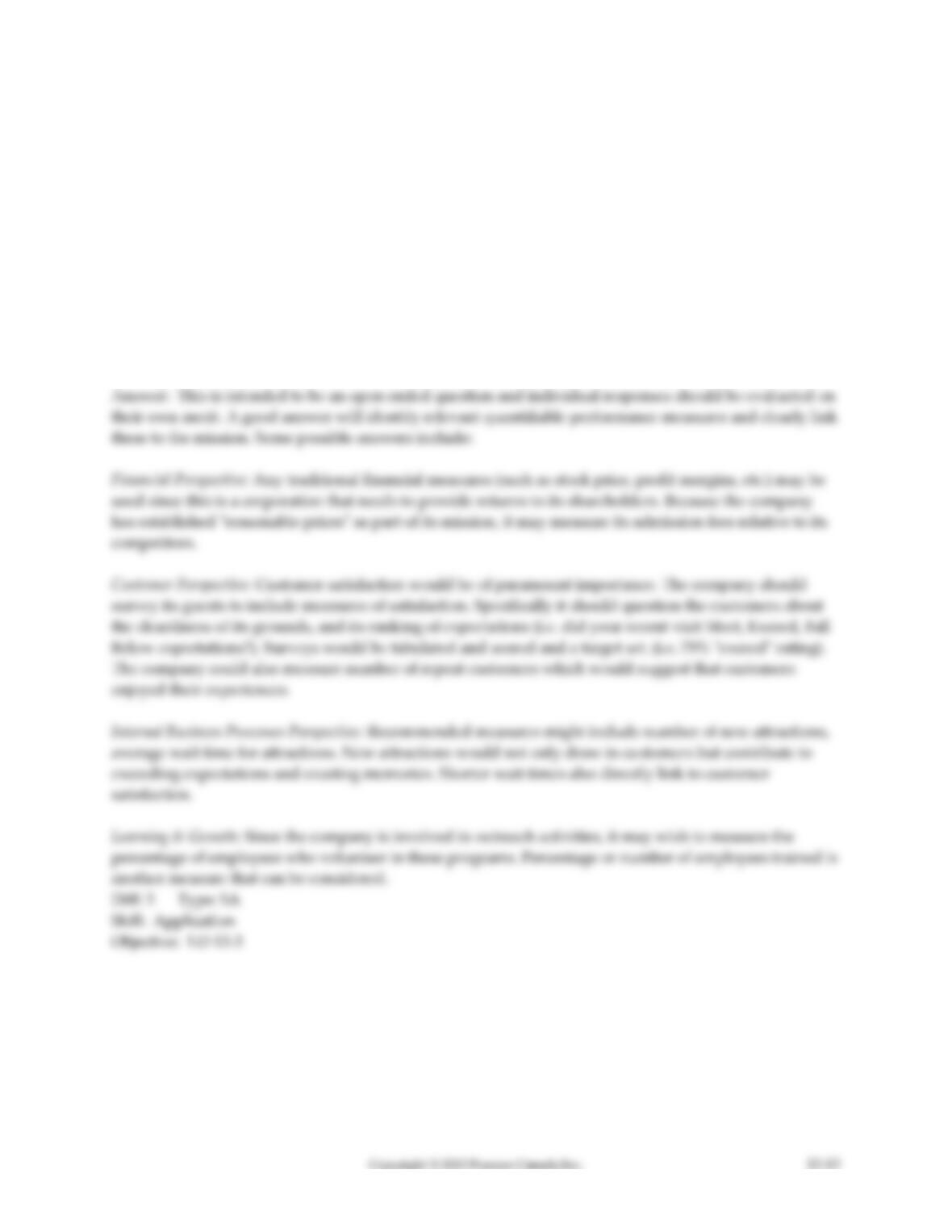
24) Wondergardens Ltd. operates amusement parks similar to those such as Six Flags, Universal Studios,
Disneyland etc. Wondergardens’ mission is to provide high quality family entertainment that exceed
guests’ expectations and will create lifelong memories. To achieve this goal, Wondergardens strives to
provide safe, clean, friendly family environments at reasonable prices. In addition to the amusement
parks, the company operates a community outreach program. Through volunteerism, it offers
educational and recreational programs (e.g. after school programs for children and teenagers,
employment related training for adults) and special events at its facilities.
Wondergardens’ president, Roland Coaster, has asked you to lead a team of employees in developing a
balanced scorecard for its parks.
Required:
Develop the balanced scorecard for Roland Coaster.
Cost Accounting: A Managerial Emphasis, 6e
Chapter 13 – Strategy, Balanced Scorecard, and Profitability Analysis
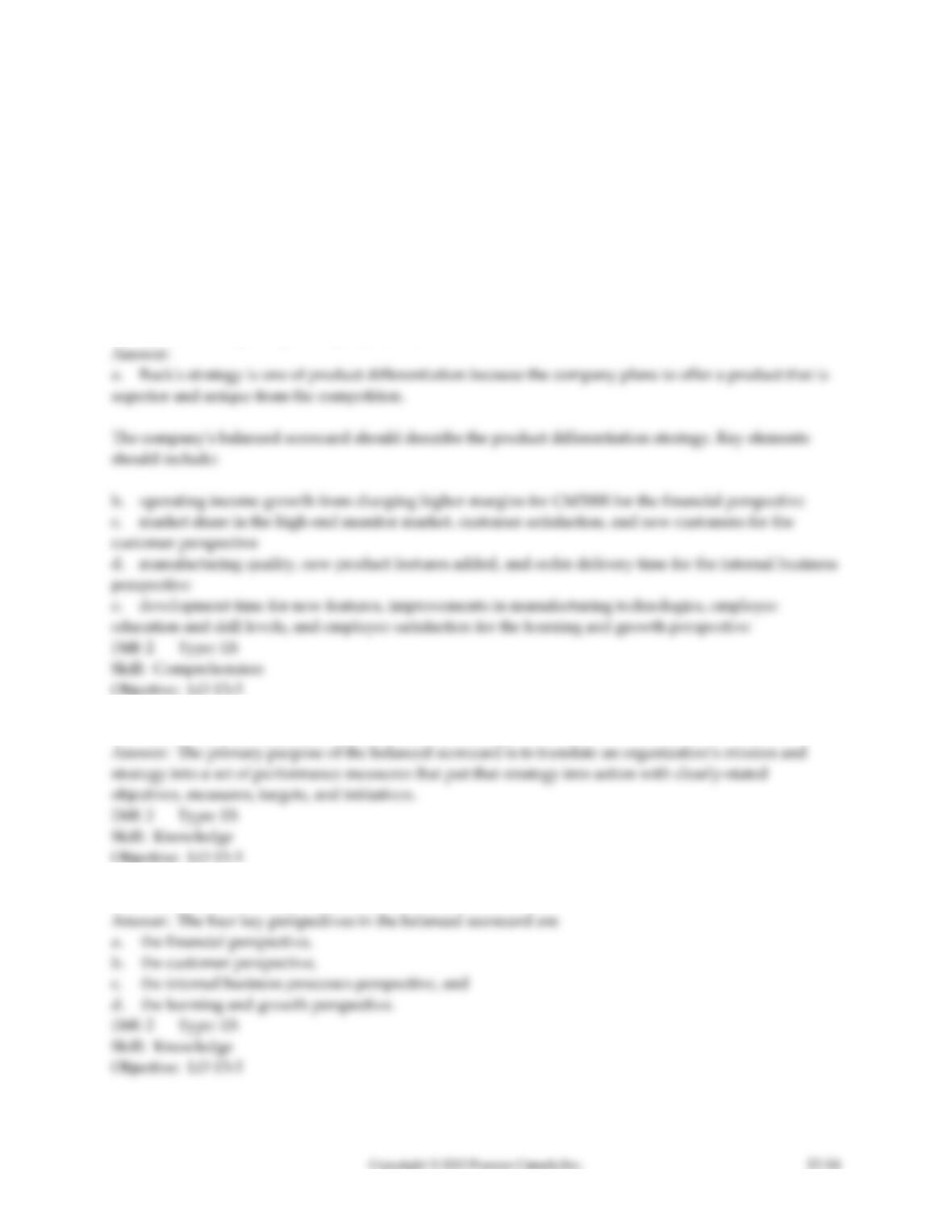
25) Buck Corporation plans to grow by offering a computer monitor, the CM3000 that is superior and
unique from the competition. Buck believes that putting additional resources into R&D and staying
ahead of the competition with technological innovations are critical to implementing its strategy.
Required:
a. Is Buck’s strategy one of product differentiation or cost leadership? Explain briefly. Identify at least
one key element that you would expect to see included in the balanced scorecard
b. for the financial perspective.
c. for the customer perspective.
d. for the internal business process perspective.
e. for the learning and growth perspective.
26) What is the primary purpose of the balanced scorecard?
27) What are the four key perspectives in the balanced scorecard?
Cost Accounting: A Managerial Emphasis, 6e
Chapter 13 – Strategy, Balanced Scorecard, and Profitability Analysis
13.4 Evaluate strategic success at implementing a cost leadership strategy using
balanced scorecard measures.
1) The growth component measures the increase in revenues minus the increase in costs from selling
more units of a product.
2) The productivity component measures the reduction in costs attributable to a reduction in the quantity
of inputs used in year 2 relative to the quantity of inputs that would have been used in year 1 to produce
the year 2 output.
3) To evaluate the success of its strategy, a company can subdivide the change in costs into growth, price–
recovery and productivity components.
4) The productivity component of operating income focuses exclusively on revenues.
5) The price-recovery component measures the increase in operating income from selling more units of a
product.
Cost Accounting: A Managerial Emphasis, 6e
Chapter 13 – Strategy, Balanced Scorecard, and Profitability Analysis
6) Companies that have been successful at cost leadership will show large favorable price–recovery and
growth components when analyzing profitability.
7) The price-recovery component of a change in operating income from one year to the next measures the
increase in operating income from selling more units of the product.
8) The price-recovery component of a change in operating income measures the effect of price changes on
revenues and costs.
9) Unused capacity is the amount of productive capacity available over and above the productive
capacity employed to meet customer demand in the current period.
Cost Accounting: A Managerial Emphasis, 6e
Chapter 13 – Strategy, Balanced Scorecard, and Profitability Analysis
Use the information below to answer the following question(s).
Following a strategy of product differentiation, Luke Company makes a high-end Appliance, AP15. Luke
Company presents the following data for the years 1 and 2.
Year 1
Year 2
Units of AP15 produced and sold
20,000
21,000
Selling price
$200
$220
Direct materials (square metres)
60,000
61,500
Direct materials costs per square metre
$20
$22
Manufacturing capacity for AP15 (units)
25,000
25,000
Total manufacturing conversion costs
$1,000,000
$1,100,000
Manufacturing conversion costs (per unit of capacity)
$40
$44
Selling and customer– service capacity (customers)
60
58
Total selling and customer-service costs
$360,000
$362,500
Cost per customer of selling and customer-service
capacity
$6,000
$6,250
Luke Company produces no defective units but it wants to reduce direct materials usage per unit of AP15
in year 2. Manufacturing conversion costs in each year depend on production capacity defined in terms of
AP15 units that can be produced. Selling and customer-service costs depend on the number of customers
that the customer and service functions are designed to support. Neither conversion costs or customer–
service costs are affected by changes in actual volume. Luke Company has 46 customers in year 1 and 50
customers in year 2. The industry market size for high–end appliances increased 5% from year 1 to year 2.
10) What is the operating income for year 1?
A) $4,000,000
B) $804,500
C) $1,240,000
D) $1,240,500
E) $1,440,000
Cost Accounting: A Managerial Emphasis, 6e
Chapter 13 – Strategy, Balanced Scorecard, and Profitability Analysis
11) What is the operating income in Year 2?
A) $1,804,500
B) $1,440,000
C) $4,620,000
D) $200,000
E) $188,000
12) What is the change in operating income from year 1 to year 2?
A) $620,000 favourable
B) $364,500 unfavourable
C) $364,500 favourable
D) $200,000 favourable
E) $200,000 unfavourable
13) What is the revenue effect of growth component?
A) $440,000 favourable
B) $400,000 unfavourable
C) $400,000 favourable
D) $200,000 favourable
E) $220,000 favourable
14) What is the cost effect of growth component?
A) $60,000 unfavourable
B) $30,000 favourable
C) $60,000 favourable
D) $200,000 favourable
E) $30,000 unfavourable
Cost Accounting: A Managerial Emphasis, 6e
Chapter 13 – Strategy, Balanced Scorecard, and Profitability Analysis
15) What is the net increase in operating income as a result of the growth component?
A) $340,000 unfavourable
B) $140,000 favourable
C) $160,000 favourable
D) $190,000 favourable
E) $250,000 unfavourable
16) What is the revenue effect of price-recovery component?
A) $400,000 favourable
B) $220,000 unfavourable
C) $400,000 unfavourable
D) $420,000 unfavourable
E) $420,000 favourable
17) What is the cost effect of price-recovery component?
A) $126,000 favourable
B) $126,000 unfavourable
C) $241,000 unfavourable
D) $420,000 favourable
E) $238,000 unfavourable
Cost Accounting: A Managerial Emphasis, 6e
Chapter 13 – Strategy, Balanced Scorecard, and Profitability Analysis
18) What is the net increase in operating income as a result of the price-recovery component?
A) $179,000 favourable
B) $179,000 unfavourable
C) $182,000 unfavourable
D) $20,000 favourable
E) $20,000 unfavourable
19) What is the productivity component of change in operating income?
A) $33,000 favourable
B) $45,500 favourable
C) $33,000 unfavourable
D) $45,500 unfavourable
E) $20,500 unfavourable