49. Which of the following is a disadvantage of hydropower?
a.
It creates high levels of carbon dioxide emissions.
b.
There is a high environmental impact from flooding land to form a reservoir.
c.
The cost of electricity produced from hydropower is lower than electricity produced from
other sources.
d.
It has a moderate to high net energy.
e.
It is largely unavailable in the United States
50. In order, the largest wind power producers are:
a.
China, India, Spain, United States, Germany
b.
Germany, China, United States, Spain, India
c.
United States, India, Spain, Germany, China
d.
China, United States, Spain, Germany, India
e.
Denmark, United States, China, Germany, India
51. Which number and cause of bird death are incorrectly matched (for the U.S.)?
a.
cars/trucks — 80 million
b.
pesticide poisoning – 500,000
c.
wind turbines — 7,000 up to 440,000
d.
domestic and feral cats — 250 million
e.
glass windows, buildings, and electrical transmission towers — 10 million
52. Which three states in the USA have the potential to provide enough usable wind power to supply the
entire country’s electricity needs?
a.
Maine, Washington State and California
b.
North Dakota, Kansas, and Texas
c.
Maine, Washington State Nevada
d.
Coastal Florida, Mississippi and Louisiana
e.
North Carolina, Texas and Oregon
53. All of the following statements about solid biomass are correct except
a.
plantations can help restore degraded areas
b.
costs are moderate
c.
they are widely available in some areas
d.
they are possible to produce with no net carbon dioxide increase
e.
it can lead to deforestation
54. Which of the following statements about geothermal power is false?
a.
It provides a moderate net energy gain.
b.
It can be highly efficient at accessible sites.
c.
It releases more carbon dioxide than fossil fuels.
d.
It has a low cost at accessible sites.
e.
There is a scarcity of suitable sites.
55. The use of hydrogen gas would eliminate most of the air pollution problems we have today because:
a.
When it burns it combines with carbon dioxide and removes it from the air.
b.
When it burns it combines with water to produce heavy rainwater.
c.
When it burns it combines with oxygen gas in the air to produce water vapor.
d.
When it burns it combines with carbon to produce methane gas.
e.
More than one of the answers is correct.
56. The lesson we can learn from disasters such as the disruption of oil production by Hurricane Katrina
and loss of nuclear power from the tsunamis in Japan is that
a.
we need to build better structures to protect ourselves against terrorists
b.
we need to have more than one type of energy producing plants available in case natural
disasters affect the main plant
c.
each household has to have its own generator for emergency situations
d.
a shift to a more decentralized energy system would improve national and economic
security
e.
we cannot protect ourselves from power outages and must accept this reality
57. A soft energy path is one that
a.
relies on improving energy efficiency and increasing the use of a variety of renewable
energy resources
b.
relies completely on the use of biofuels
c.
relies on the use of liquid fossil fuels
d.
relies on the use of soft money for research and development
e.
relies on soft coal
TRUE/FALSE
1. There are three major forms of fossil fuels: coal, oil, and natural gas.
2. The estimated oil reserves in the Arctic National Wildlife Refuge would meet current world oil
demand for at least another 50 years.
3. The world’s dependence on fossil fuels has been increased through subsidies and tax breaks that
support fossil fuel processors (oil companies).
4. It has been estimated that using nuclear power will require more energy than it will ever produce.
5. Nuclear power is now the world’s fastest-growing energy source.
6. The United States wastes almost none of its energy.
7. Photovoltaic cells do not produce any of the greenhouse or acid gas emissions associated with
electricity generated by the combustion of fossil fuels.

8. A spent fuel rod that has been removed from a nuclear power plant reactor core is essentially safe from
radioactivity after a period of about 10 years.
9. None of the three worst nuclear power plant accidents occurred in the United States.
10. The most efficient and long-lasting light bulb available today is the LED (light-emitting diode).
11. Microwave ovens use about the same amount of energy as conventional ovens.
12. China plans to lead the world in relying on renewable energy resources.
13. Reducing energy waste is a commendable activity, but would not impact our energy supplies in any
meaningful way.
14. Sunlight reflected onto a “power tower” is a great idea for collecting solar energy, but there is no way
to store the collected energy.
15. It has been estimated that capturing the wind’s energy at the world’s best sites would only produce
about 50% of the electricity currently being used worldwide.
16. One of the disadvantages of liquid biofuels is that the area where the crops are grown has to compete
with areas where food crops can be grown.

17. Brazil, the second largest ethanol producer, makes its ethanol from the residue of sugar cane.
18. Geothermal fuels have lower carbon dioxide emissions than fossil fuels.
COMPLETION
1. The quickest, cleanest, and cheapest way to provide more energy is to ____________________.
2. ____________________ produces fewer pollutants than burning coal, but is significantly more
expensive and produces radioactive wastes.
3. Large reserves of ____________________ are located in Canada and are now considered to be
conventional oil reserves, second only in size to those in Saudi Arabia.
4. _______________energy is the only energy that really counts.
5. Although coal is a very plentiful fuel, when burned it produces very high ____________________
emissions.

6. Wind is actually an indirect form of ____________________ energy.
7. Producing steel from recycled scrap iron uses _______________% less energy than producing steel
from virgin iron ore.
8. Using wind to produce electricity is an important step toward ____________________.
9. The estimated proven reserves under Alaska’s North slope would meet current world demand for oil
for about ____________months or U.S. demand for less than ____________years.
10. ____________________ is the point in time when we reach the maximum overall rate of crude oil
production for the whole world.
11. About ____________________% of the world’s proven crude oil reserves are in the hands of
government-owned companies.
12. About ____________________ % of the electricity used in the United States is produced by burning
coal.
13. The cleanest burning alternative among the fossil fuels is ______________ __________.
14. The element _______________is said to be a safer radioactive element that could be used in newer
nuclear power plant reactors.
15. Ultra-high voltage, digitally controlled _________ ___________ would be more responsive to local
and regional changes in supply and demand of energy.
16. An example of an energy efficient window is a ______________ ______________ window.
17. A proposed program whereby owners of fuel-inefficient vehicles pay higher fees and the revenue from
those fees is given to owners of fuel-efficient vehicles is called the ____________________ program.
18. ____________________ loading washers are more efficient than ____________________ loading
washers.
289
19. Food riots in Mexico were caused by the decrease in corn production in the United States when food
crop land was converted to producing corn for ______________.
MATCHING
Match the items listed below with the appropriate choice
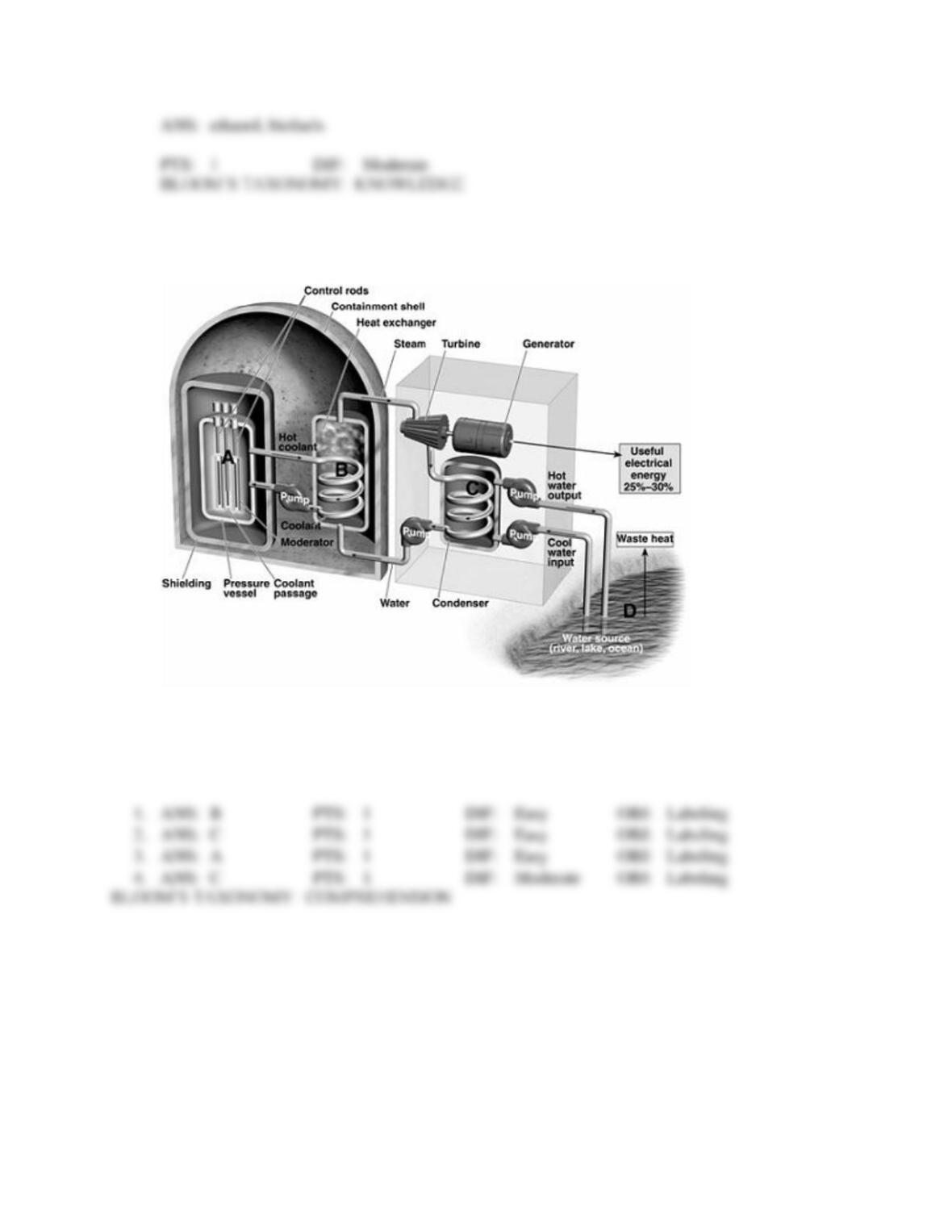
1. Steam is generated to produce electricity in which compartment?
2. Water from the external cooling area penetrates inside the plant to which compartment?
3. Which area of the plant is susceptible to a meltdown?
4. Electricity is generated in which area of the plant?
Match the appropriate energy source with the advantage or disadvantage in the list below.
a.
wind power
b.
nuclear power
c.
natural gas
d.
hydro-electric
e.
passive solar
5. radioactive wastes are an ongoing problem
6. requires access to sunlight for 60% of daylight hours
7. disrupts aquatic ecosystems
8. difficult and costly to transport between countries
9. easy to build and expand
10. low level noise pollution
11. emits less carbon dioxide than other fossil fuels when burned
12. needs a back-up system for cloudy days
13. displacement of people
14. low risk of incidents in newer, modern plants
SHORT ANSWER
1. Explain this statement: The highest priority in fighting the war on terror must be to reduce America’s
dependence on foreign oil.
2. Using information from this chapter about consumption of products of crude oil, and combining it with
information from chapter 10 on food production, explain something you can do in your day–to-day life
that can significantly help reduce energy consumption.
3. This chapter presents a list of a dozen actions that individuals can take to make the shift to more
sustainable energy use. Using this list as a source or reference, name four actions you are willing to
take and four actions you are unwilling to take. For each action you are willing to take, state why. For
each action you are not willing to take, state why you are not. Also state what would have to change in
order for you to take the steps you are now unwilling to take?
4. A survey in August 2011 on the world wide web was conducted by the news agency CNN, and asked
participants to rate the more serious problem with the United States economy, given the choices 1) the
debt crisis or 2) unemployment.
The majority of respondents voted unemployment as the more serious problem. Give at least one
example from this chapter of how using renewable energy can help solve this problem in the United
States.
292
ESSAY
1. Briefly explain why it is so expensive to close down a nuclear power plant.
2. List and briefly describe four widely used forms of technology in our society that waste large amounts
of energy.
ANS:
3. Scientists and energy experts who have evaluated energy alternatives have come to three general
conclusions. What are these conclusions? State each one and provide a single sentence as explanation
for each.
ANS:
4. What five criteria must be met by new generation nuclear reactors in order to be considered acceptable
by the experts?
5. Briefly describe how a cogeneration or combined heat and power (CHP) functions.