Chapter 13 – The Respiratory System
b.
False
True
51. Because the amount of atmospheric air that reaches the alveoli and is actually available for exchange with blood is
more important than the total amount breathed in and out, alveolar ventilation is more important than pulmonary
ventilation.
a.
True
b.
False
True
52. An increase in alveolar O2 concentration caused by a mismatched large airflow and small blood flow brings about
pulmonary vasodilation.
a.
True
b.
False
True
53. A difference in partial pressure between the venous blood and the surrounding structures is known as a partial pressure
gradient.
a.
True
b.
False
False
54. The amount of O2 picked up in the lungs exceeds the amount extracted and used by the tissues.
a.
True
b.
False
False
55. The rate of gas exchange is directly proportional to the surface area across which exchange takes place.
Chapter 13 – The Respiratory System
a.
True
b.
False
True
56. Inadequate gas exchange can occur when the thickness of the barrier separating the air and blood is pathologically
decreased.
a.
True
b.
False
False
57. The more actively a tissue is metabolizing, the higher the cellular PO2 rises and the lower the cellular PCO2 falls.
a.
True
b.
False
False
58. When not combined with O2, hemoglobin is referred to as reduced hemoglobin, or deoxyhemoglobin.
a.
True
b.
False
True
59. Hemoglobin’s affinity for CO is 2 times that of its affinity for O2.
a.
True
b.
False
False
60. Hypercapnia is characterized by excess CO2 in the arterial blood.
Chapter 13 – The Respiratory System
a.
True
b.
False
True
61. Anemic hypoxia is a reduced O2-carrying capacity of the blood.
a.
True
b.
False
True
62. When the tidal volume is large, as during exercise, the Bohr reflex is triggered to prevent over-inflation of the lungs.
a.
True
b.
False
False
63. Arterial PCO2 is monitored by peripheral chemoreceptors known as the carotid bodies and arterial bodies.
a.
True
b.
False
False
64. Apnea is the transient interruption of ventilation, with breathing resuming spontaneously.
a.
True
b.
False
True
65. Dyspnea is directly related to chronic elevation of arterial PCO2 or reduction of PO2.
a.
True
b.
False
Chapter 13 – The Respiratory System
66. The mechanical act of breathing is called __________.
67. Prostaglandins can spill into the blood, but they are __________ during passage through the lungs so that they cannot
exert systemic effects.
68. Clustered at the ends of the terminal bronchioles are the __________, the tiny air sacs where gases are exchanged
between air and __________.
69. __________ is an inflammation of the pleural sac and leads to by painful breathing because each inflation and each
deflation of the lungs cause a “friction rub.”
70. The major inspiratory muscles—the muscles that contract to accomplish an inspiration during quiet breathing—
include the __________ and __________ intercostal muscles.
71. Altering the volume of the lungs can change intra-alveolar pressure, in accordance with __________ law.
72. During inspiration, intra-alveolar pressure is __________ than atmospheric pressure.
73. __________ stimulation promotes bronchiolar smooth muscle contraction, which increases airway resistance by
producing bronchoconstriction.
74. Emphysema is characterized by __________ of the smaller airways and breakdown of __________ walls.
75. The term __________ refers to how much effort is required to stretch or distend the lungs and is analogous to how
easy or hard it is to blow up a balloon.
76. When pulmonary compliance is __________, such as with pulmonary fibrosis, more work is required to expand the
lungs.
77. Two general categories of respiratory dysfunction yield abnormal results during spirometry: __________ lung disease
and __________ lung disease.
78. Any ventilated alveoli that do not participate in gas exchange with blood because they are inadequately perfused are
considered alveolar __________.
79. Gas exchange at both the pulmonary capillary and the tissue capillary levels involves simple __________ diffusion of
O2 and CO2 down __________ pressure gradients.
80. The greater the partial pressure of a gas in a liquid, the __________ of that gas is dissolved.
81. As blood passes through the lungs, it picks up __________ and gives up CO2 by diffusion down partial pressure
gradients between blood and __________.
82. The diffusion constant for CO2 is ______ times that of O2 because CO2 is much more soluble in body tissues than O2
is.
83. Oxygen is present in the blood in two forms: __________ dissolved and __________ bound to hemoglobin.
84. According to the law of __________, if the concentration of one substance involved in a reversible reaction is
increased, the reaction is driven toward the opposite side.
85. Factors that affect the affinity between hemoglobin and oxygen include CO2, __________, __________, and 2,3-
bisphosphoglycerate.
86. About 30% of the CO2 combines with hemoglobin to form __________.
87. The __________ respiratory group consists mostly of inspiratory neurons whose descending fibers terminate on the
motor neurons that supply the inspiratory muscles.
88. The __________ center prevents the inspiratory neurons from being switched off, thus providing an extra boost to the
inspiratory drive.
89. Changes in arterial hydrogen ion concentration cannot influence the __________ chemoreceptors because it does not
readily cross the __________ barrier.
90. If breathing does not resume following apnea, the condition is called __________.
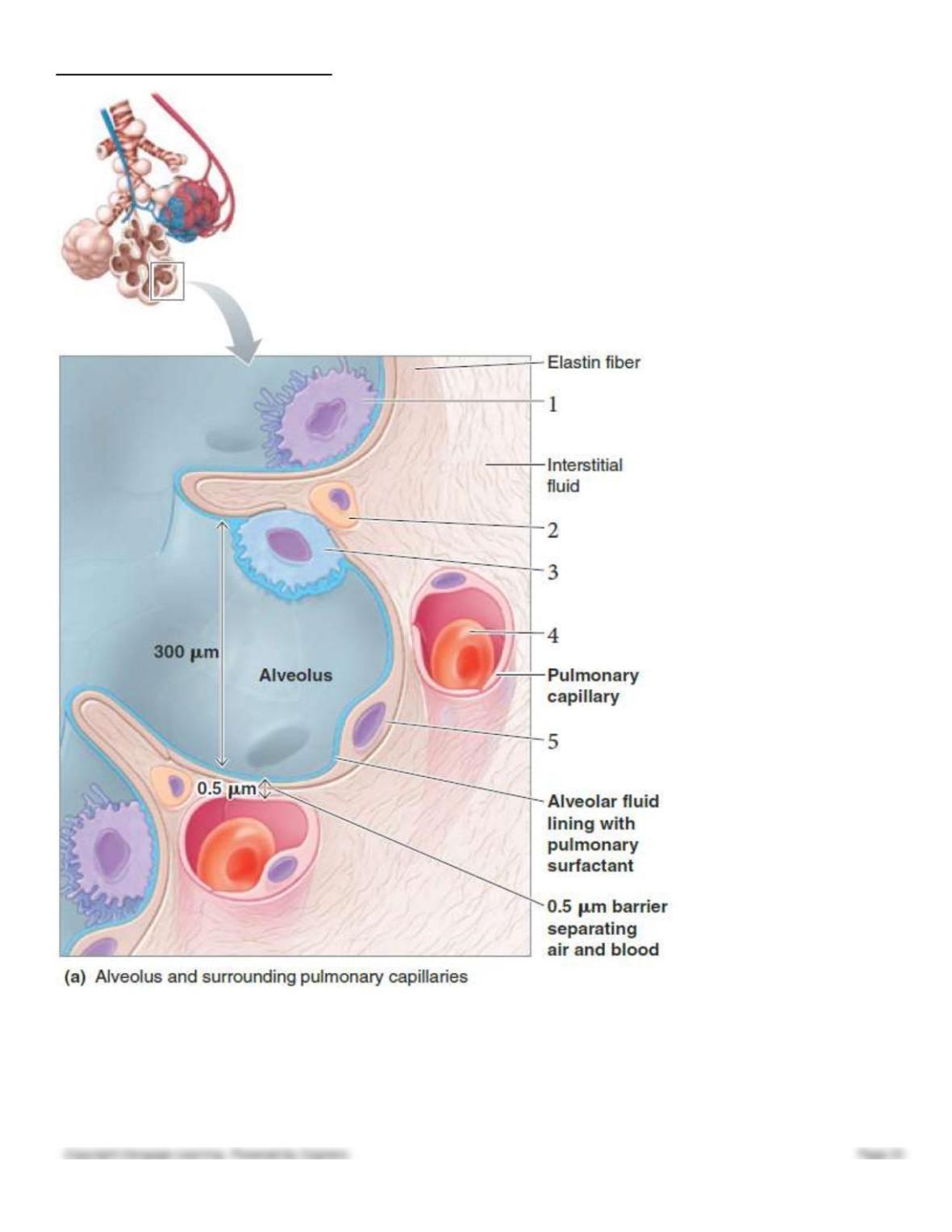
Chapter 13 – The Respiratory System
Use the figure above (Figure 13–4) to answer the corresponding questions.
91. Which number in the figure represents an erythrocyte?
a.
1
b.
2
c.
3
d.
4
Chapter 13 – The Respiratory System
e.
5
d
92. Which number in the figure represents a type I alveolar cell?
a.
1
b.
2
c.
3
d.
4
e.
5
93. Which number in the figure represents an alveolar macrophage?
a.
1
b.
2
c.
3
d.
4
e.
5
94. Which number in the figure represents a type II alveolar cell?
a.
1
b.
2
c.
3
d.
4
e.
5
95. Which number in the figure represents a monocyte?
Chapter 13 – The Respiratory System
a.
1
b.
2
c.
3
d.
4
e.
5
b
96. Describe the structure and function of the alveoli.
97. Discuss Boyle’s law and respiratory muscle activity.
98. Discuss the net diffusion of O2 and CO2 between the alveoli and tissues.
99. Explain the Bohr effect on the release of O2.
100. Describe the dorsal respiratory group (DRG).