Chapter 13: Corporations: Organization, Stock Transactions, and Dividends
174.
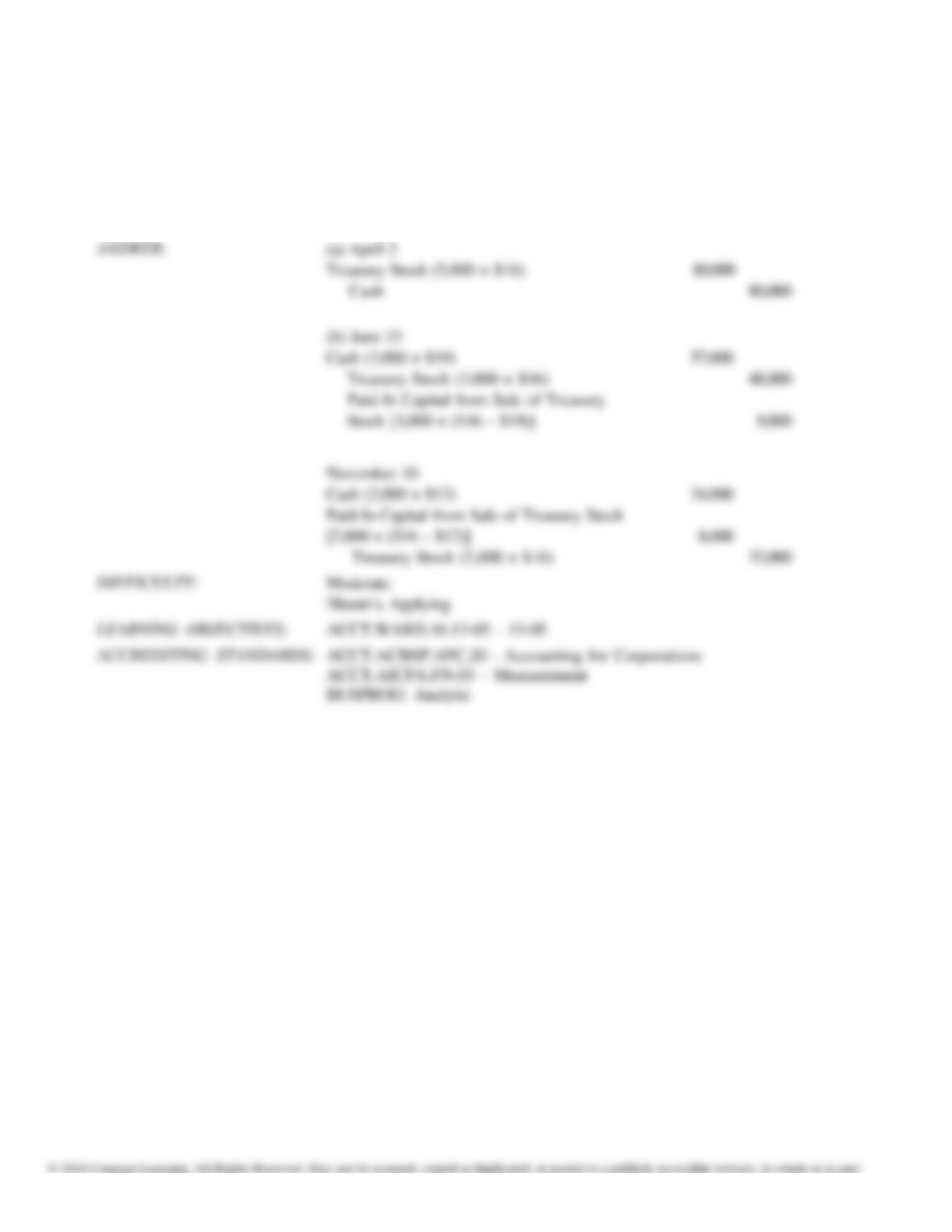
On April 2 a corporation purchased for cash 5,000 shares of its own $10 par common stock at $16 a share. It sold
3,000 of the treasury shares at $19 a share on June 10. The remaining 2,000 shares were sold on November 10 for
$12 a share.
(a)
Journalize the entries to record the purchase (treasury stock is recorded at cost).
(b)
Journalize the entries to record the sale of the stock.
Chapter 13: Corporations: Organization, Stock Transactions, and Dividends
175.
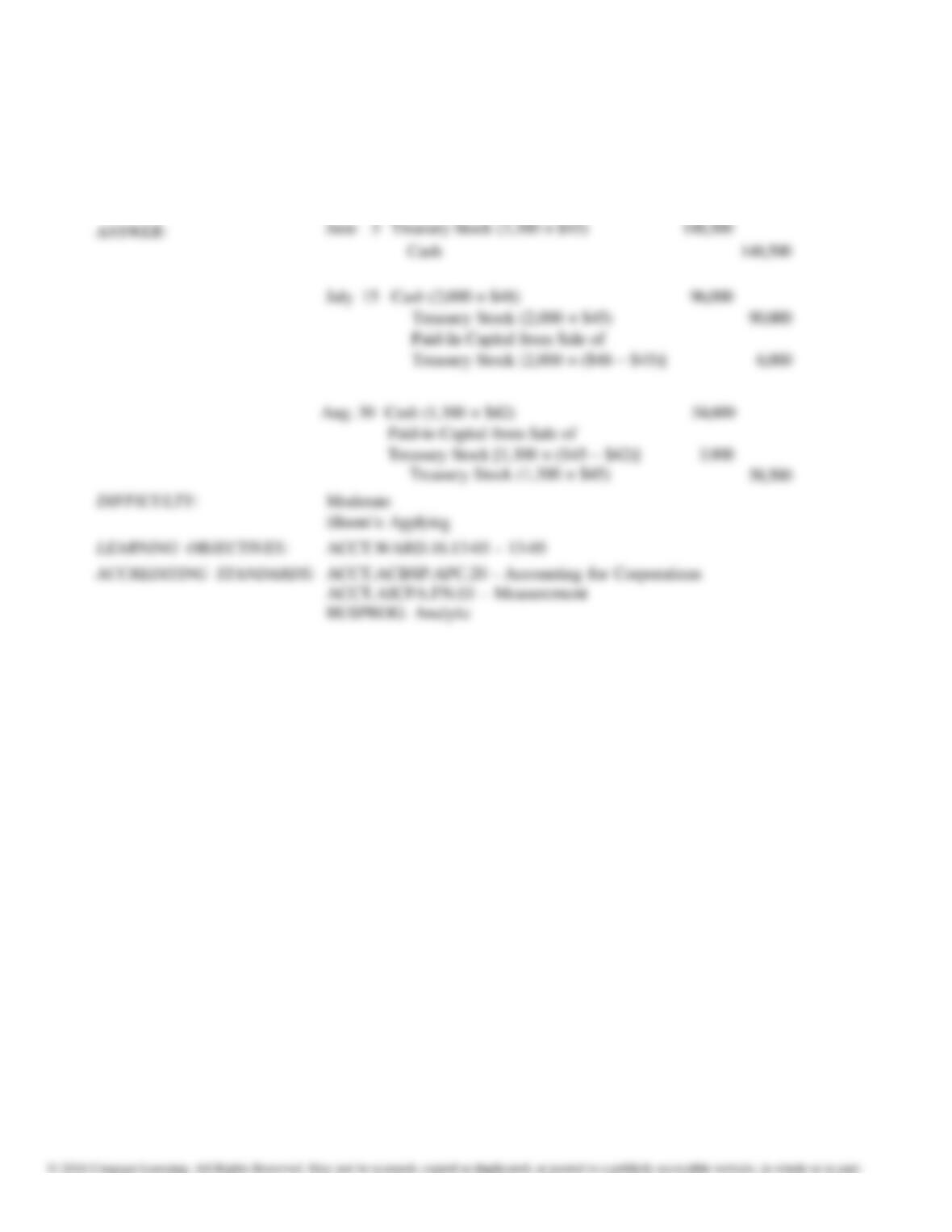
On June 5, Belen Corporation reacquired 3,300 shares of its own common stock at $45 per share. On July 15,
Belen sold 2,000 of the reacquired shares at $48 per share. On August 30, Belen sold the remaining shares at $42
per share.
Journalize the transactions of June 5, July 15, and August 30.
Chapter 13: Corporations: Organization, Stock Transactions, and Dividends
176.
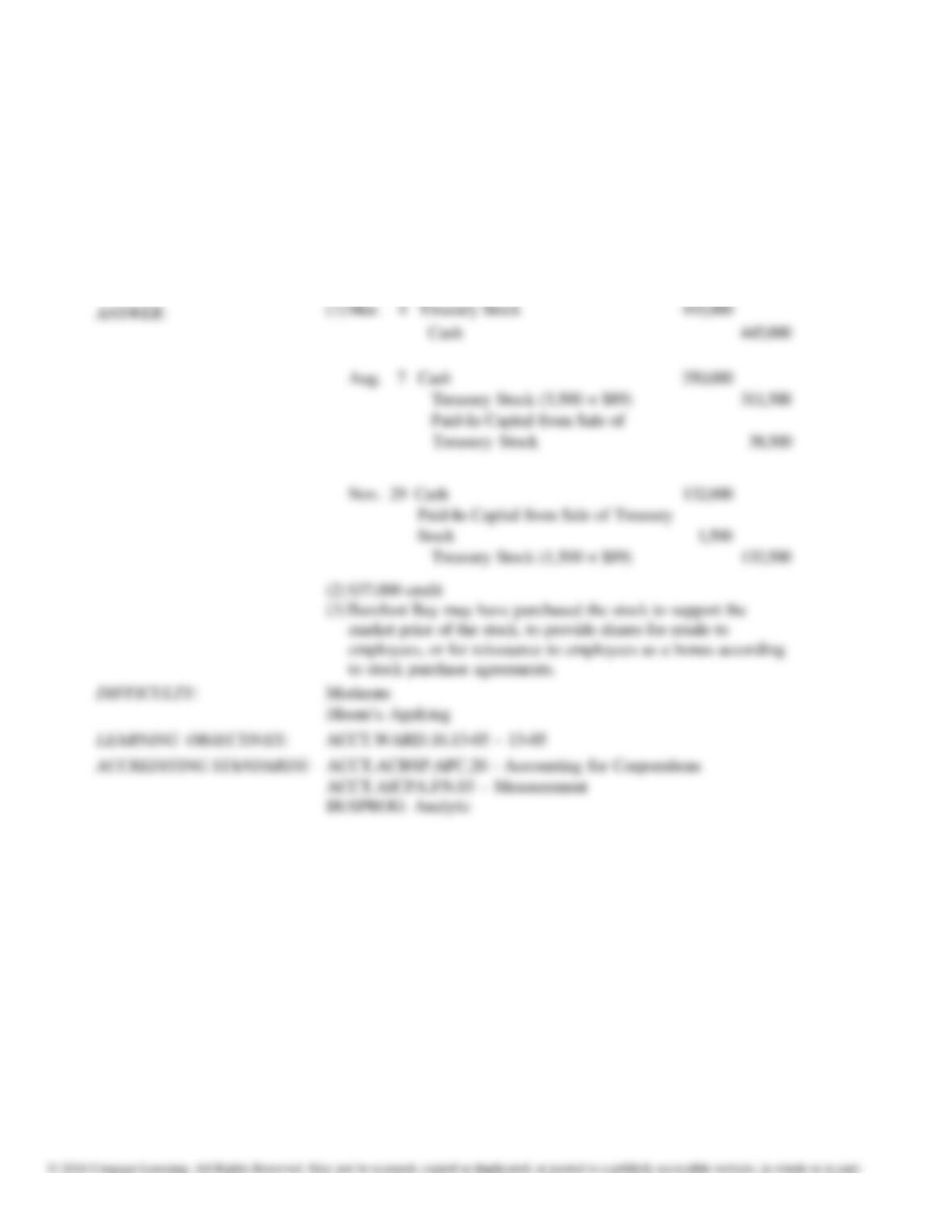
On March 4 of the current year, Barefoot Bay, Inc. reacquired 5,000 shares of its common stock at $89 per
share. On August 7, Barefoot Bay sold 3,500 of the reacquired shares at $100 per share. The remaining 1,500
shares were sold at $88 per share on November 29.
Required:
(1)
Journalize the transaction of March 4, August 7, and November 29.
(2)
What is the balance in Paid-in Capital from Sale of Treasury Stock on December
31 of the current year?
(3)
Why might Barefoot Bay Inc. have purchased the treasury stock?
Chapter 13: Corporations: Organization, Stock Transactions, and Dividends
177.
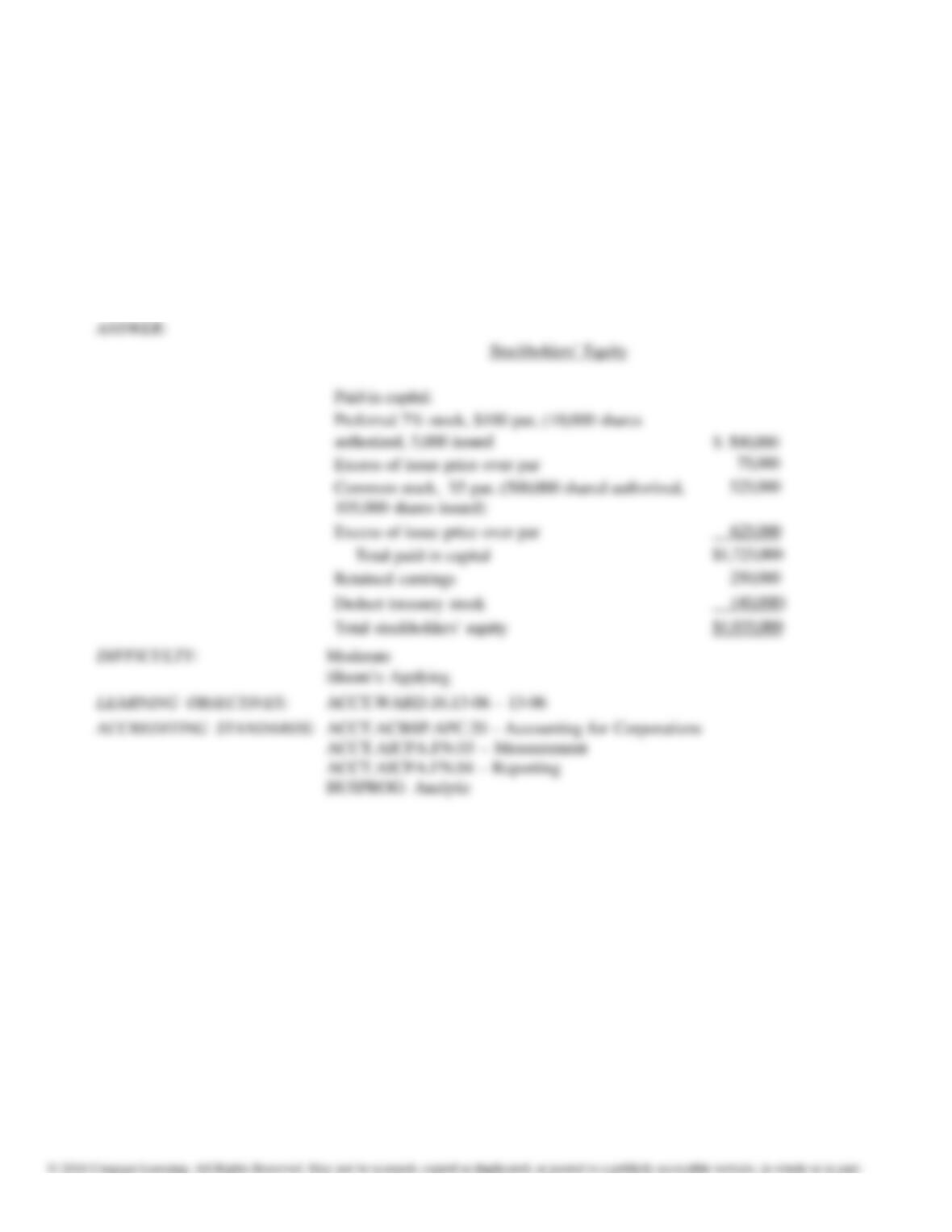
At December 31, Idaho Company had the following ending account balances:
Retained Earnings: $250,000
Preferred Stock ($100 par, 7% cumulative, 10,000 authorized, 5,000 issued and outstanding): $500,000
Treasury Stock: $40,000
Paid-In Capital in Excess of Par—Common Stock: $625,000
Paid-In Capital in Excess of Par—Preferred Stock: $50,000
Common Stock ($5 par value, 500,000 shares authorized, 105,000 issued): $525,000
Prepare the stockholders’ equity section of the balance sheet in good form with all of the required disclosures.
Chapter 13: Corporations: Organization, Stock Transactions, and Dividends
178.
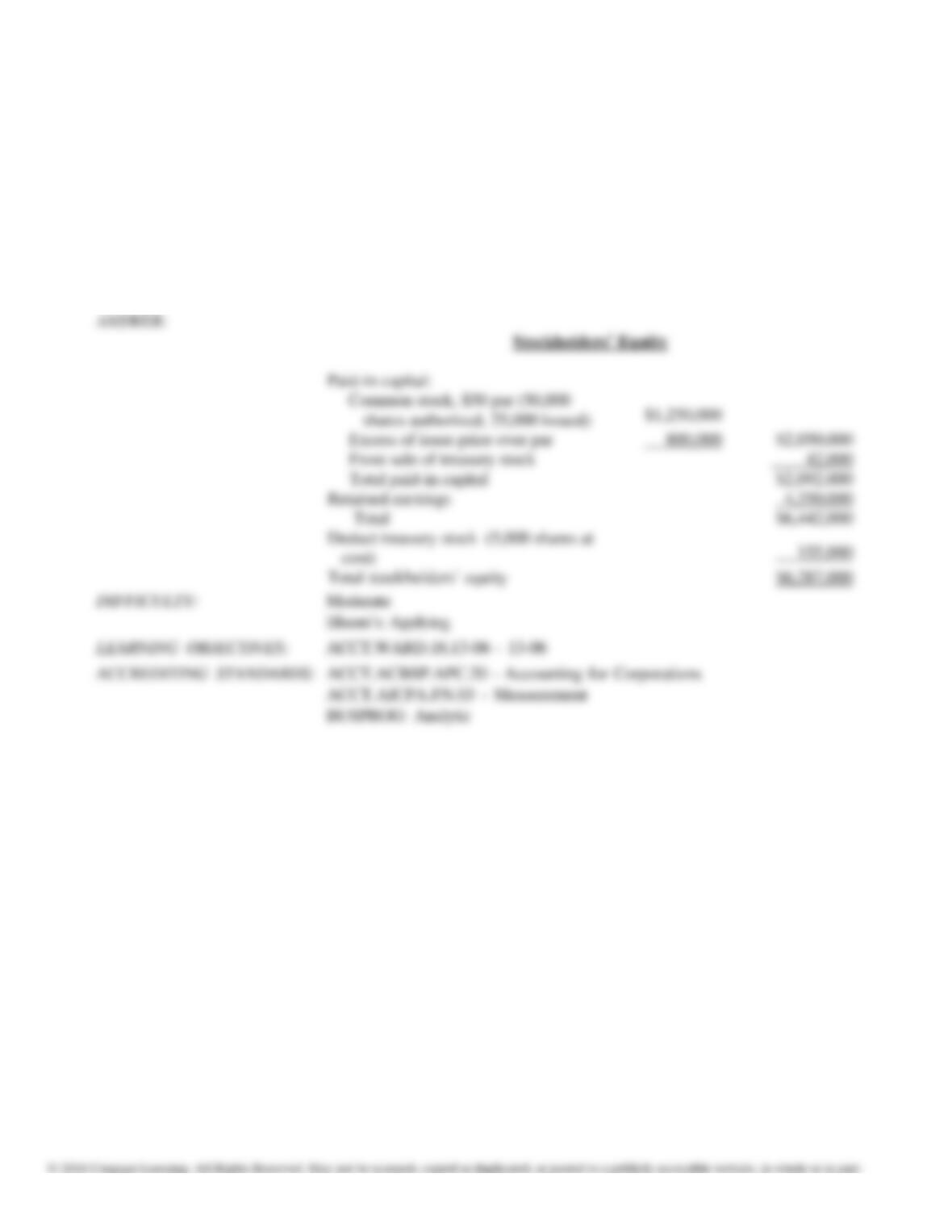
Using the following accounts and balances, prepare the stockholders’ equity section of the balance sheet. Fifty
thousand shares of common stock are authorized, and 5,000 shares have been reacquired.
Common Stock, $50 par Common Stock, $50 par $1,250,000
Paid-In Capital in Excess of Par 800,000
Paid–In Capital from Sale of Treasury Stock 42,000
Retained Earnings 4,350,000
Treasury Stock 155,000
Chapter 13: Corporations: Organization, Stock Transactions, and Dividends
179.
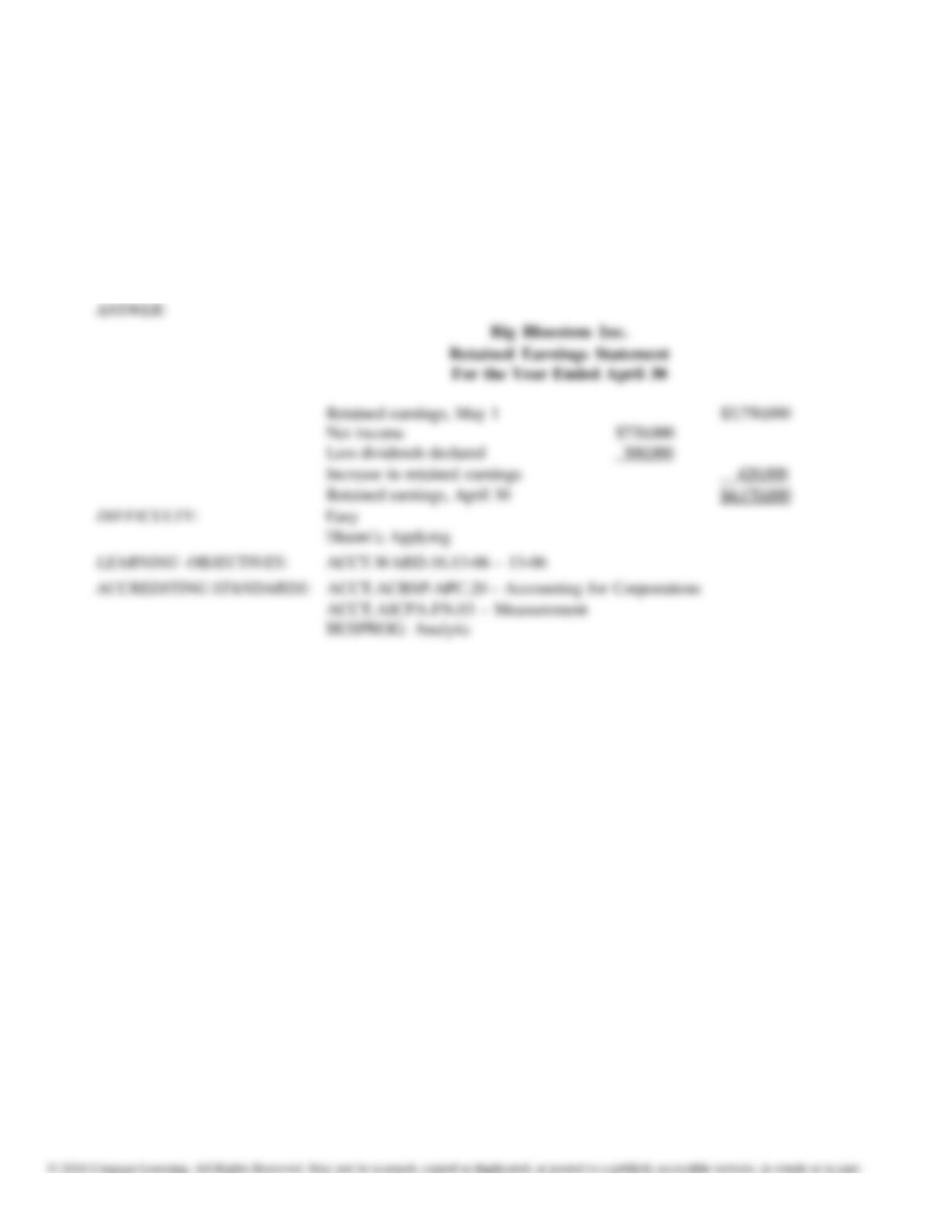
Big Bluestem Inc. reported the following results for the year ending April 30:
Retained earnings, May 1
$3,750,000
Net income
720,000
Cash dividends declared
80,000
Stock dividends declared
220,000
Prepare a retained earnings statement for the fiscal year ended April 30.
Chapter 13: Corporations: Organization, Stock Transactions, and Dividends
180.
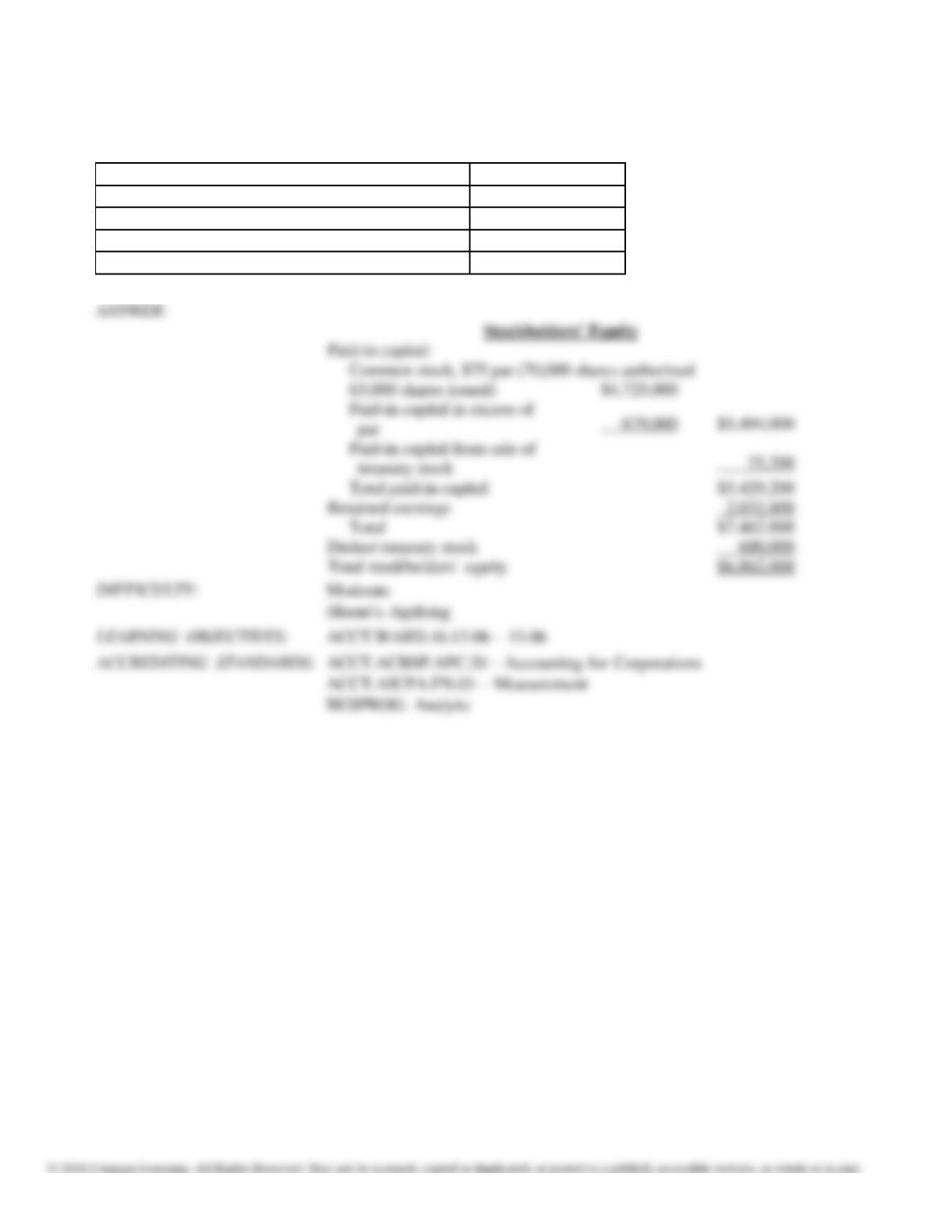
Using the following information, prepare the stockholders’ equity section of the balance sheet. Seventy thousand
shares of common stock are authorized and 7,000 shares have been reacquired.
Common Stock, $75 par
$4,725,000
Paid-In Capital in Excess of Par
679,000
Paid–In Capital from Sale of Treasury Stock
25,200
Retained Earnings
2,032,800
Treasury Stock
600,000
Chapter 13: Corporations: Organization, Stock Transactions, and Dividends
181.
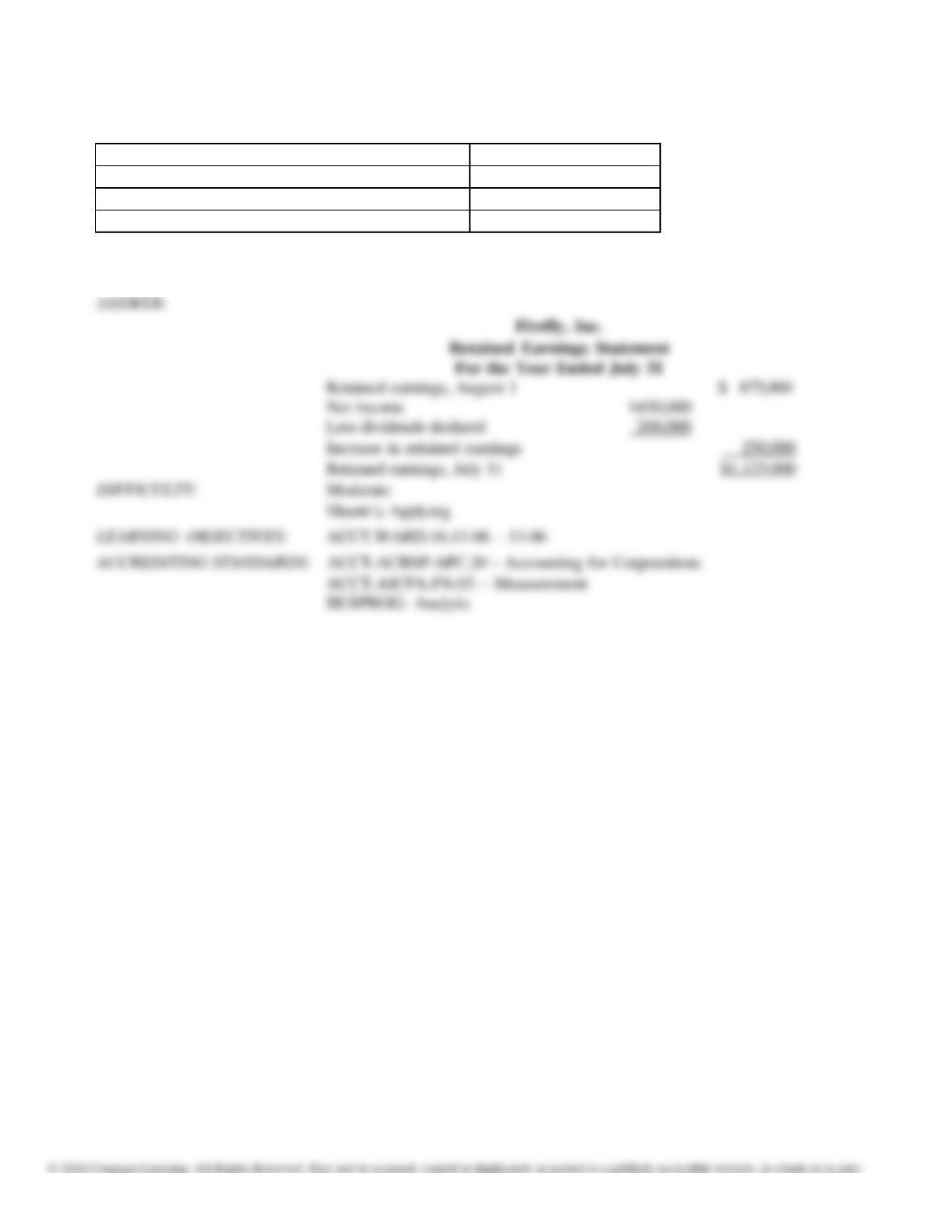
Firefly, Inc. reported the following results for the year ending July 31:
Retained earnings, August 1
$875,000
Net income
450,000
Cash dividends declared
140,000
Stock dividends declared
60,000
Prepare a retained earnings statement for the fiscal year ended July 31.
Chapter 13: Corporations: Organization, Stock Transactions, and Dividends
182.
The Torre Company has the following stockholders’ equity account balances in stockholders equity on December
31.
Common Stock – $5 par, 60,000 shared issued
$300,000
Paid-In Capital in Excess of Par—Common Stock
600,000
Preferred stock – $100 par, 5,000 shares issued
500,000
Paid-In Capital in Excess of Par—Preferred
100,000
Retained Earnings
200,000
Treasury Stock (cost – $12 per share)
60,000
Answer the following questions:
1. How many shares of treasury stock are owned?
2.
What was the average market price per share at which common stock was issued?
3.
What was the average market price per share at which preferred stock was issued?
4.
What is the total value of the paid-in capital portion of stockholders’ equity?
5.
What is the total value of stockholders’ equity?
6.
How many shares of common stock are outstanding?
7.
If net income for the year was $75,000 and a preferred stock dividend of $20,000 was paid,
what was the beginning value of retained earnings? How much is earnings per share for
the year?
Chapter 13: Corporations: Organization, Stock Transactions, and Dividends
183.
Marcos Company, which had 35,000 shares of common stock outstanding, declared a 4-for–1 stock split.
Required:
(1)
What will be the number of shares outstanding after the split?
(2)
If the common stock had a market price of $280 per share before the stock
split, what would be an approximate market price per share after the split?
184.
A corporation, which had 18,000 shares of common stock outstanding, declared a 3-for-1 stock split.
(a)
What will be the number of shares outstanding after the split?
(b)
If the common stock had a market price of $240 per share before the stock split, what
would be an approximate market price per share after the split?
(c)
Journalize the entry to record the stock split.
185.
A company had the following stockholders‘ equity information available at year-end.
–
Issued 11,000 shares of $2.00 par value common stock for $12.00 per share.
–
Issued 5,000 shares of $50 par value 6% preferred stock for $70 per share.
–
Purchased 1,000 shares of previously issued common stock for $15.00 per share.
–
Reported net income of $200,000.
–
Declared and paid the preferred stock dividend.
Calculate the earnings per share for the current year.

Chapter 13: Corporations: Organization, Stock Transactions, and Dividends
Match each of the following stockholders’ equity concepts to the appropriate term (a – h)...
a.
articles of incorporation
b.
limited liability
c.
bylaws
d.
corporation
e.
public corporation
f.
board of directors
g.
private corporation
h.
dividends
DIFFICULTY: Moderate
Bloom’s: Remembering
LEARNING OBJECTIVES: ACCT.WARD.16.13-01 – 13–01
ACCREDITING STANDARDS: ACCT.ACBSP.APC.20 – Accounting for Corporations
ACCT.AICPA.FN.03 – Measurement
ACCT.AICPA.FN.04 – Reporting
BUSPROG: Analytic
186.
A legal entity, separate from the people who create and operate it
187.
A company whose shares can be bought and sold in public markets
188.
The rules and procedures for conducting a corporation’s affairs
189.
A company whose shares are not bought or sold in public markets
190.
Document which formally creates a corporation
191.
Creditors cannot pursue stockholders’ personal assets to satisfy claims

Chapter 13: Corporations: Organization, Stock Transactions, and Dividends
192.
Group which meets periodically to establish corporate policies
193.
Corporate income distributed to stockholders
Match each of the following stockholders’ equity concepts to the most appropriate term (a – h)..
a.
authorized shares
b.
issued shares
c.
outstanding shares
d.
par value
e.
common stock
f.
preferred stock
g.
Paid-In Capital in Excess of Par
h.
transfer agent
DIFFICULTY: Moderate
Bloom’s: Remembering
LEARNING OBJECTIVES: ACCT.WARD.16.13-03 – 13–03
ACCREDITING STANDARDS: ACCT.ACBSP.APC.20 – Accounting for Corporations
ACCT.AICPA.FN.03 – Measurement
BUSPROG: Analytic
194.
The account used to record the difference when issue price exceeds par value of stock
195.
The dollar amount assigned to each share of stock
196.
The number of shares currently held by stockholders
197.
A class of stock having first rights to dividends of a corporation
198.
The maximum number of shares a company can issue to shareholders

Chapter 13: Corporations: Organization, Stock Transactions, and Dividends
199.
The number of shares sold to stockholders
200.
A class of stock that provides no preference rights to shareholders
201.
A financial institution that records and maintains records of another company‘s stockholders.
Match the following stockholders’ equity concepts to the appropriate term (a – h).
a.
cash dividend
b.
date of record
c.
Stock Dividends Distributable
d.
date of declaration
e.
treasury stock
f.
preferred stock
g.
date of payment
h.
Paid-In Capital in Excess of Par
DIFFICULTY: Moderate
Bloom’s: Remembering
LEARNING OBJECTIVES: ACCT.WARD.16.13-03 – 13–03
ACCT.WARD.16.13-04 – 13–04
ACCT.WARD.16.13-05 – 13–05
ACCREDITING STANDARDS: ACCT.ACBSP.APC.20 – Accounting for Corporations
ACCT.AICPA.FN.03 – Measurement
ACCT.AICPA.FN.04 – Reporting
BUSPROG: Analytic
202.
Equity account reflecting shares “owed” to stockholders
203.
Shares of common stock that were issued and then reacquired by a company
204.
Owners of this class of stock are entitled to receive dividends first

Chapter 13: Corporations: Organization, Stock Transactions, and Dividends
205.
Cash distribution of a company’s earnings to stockholders
206.
Account used when shares are issued for an amount greater than par value
207.
The day of the event that creates a liability to company
208.
The date that is used to determine the owners of stock who will receive the current dividend
209.
The date when dividends are actually distributed to stockholders

Chapter 13: Corporations: Organization, Stock Transactions, and Dividends
For the current year ended, ABC had the following transactions:
–
Issued 10,000 shares of $2.00 par value common stock for $12.00 per share.
–
Issued 3,000 shares of $50 par value 6% preferred stock for $70 per share.
–
Purchased 1,000 shares of previously issued common stock for $15.00 per share.
–
Reported net income of $200,000.
–
Declared and paid a total dividend of $40,000.
Assume that retained earnings had a beginning balance of $75,000.
a.
Treasury stock
b.
Retained earnings
c.
Preferred stock
d.
Excess of issue price over par (preferred)
e.
Common stock
f.
Total paid–in capital
g.
Excess of issue price over par (common)
h.
Total stockholders’ equity
DIFFICULTY: Challenging
Bloom’s: Remembering
LEARNING OBJECTIVES: ACCT.WARD.16.13-06 – 13–06
ACCREDITING STANDARDS: ACCT.ACBSP.APC.20 – Accounting for Corporations
ACCT.AICPA.FN.03 – Measurement
ACCT.AICPA.FN.04 – Reporting
BUSPROG: Analytic
210. $150,000
211. $100,000
212. $60,000
213. $20,000

Chapter 13: Corporations: Organization, Stock Transactions, and Dividends
214. $235,000
215. $330,000
216. $550,000
217. $15,000