Cost Accounting: A Managerial Emphasis, 6e
Chapter 13 – Strategy, Balanced Scorecard, and Profitability Analysis
Use the information below to answer the following question(s).
Following a strategy of product differentiation, Barry Company makes an XX 300. Barry Company
presents the following data for the years 1 and 2.
Year 1
Year 2
Units of XX 300 produced and sold
10,000
10,800
Selling price
$100
$115
Direct materials (litres)
30,000
31,900
Direct materials costs per litre
$15
$16
Manufacturing capacity for XX 300 (units)
12,500
12,500
Total manufacturing conversion costs
$250,000
$275,000
Manufacturing conversion costs (per unit of capacity)
$20
$22
Selling and customer-service capacity (customers)
30
29
Total selling and customer-service costs
$90,000
$90,625
Cost per customer of selling and customer-service
capacity
$3,000
$3,120
Barry Company produces no defective units but it wants to reduce direct materials usage per unit of XX
300 in year 2. Manufacturing conversion costs in each year depend on production capacity defined in
terms of XX 300 units that can be produced. Selling and customer-service costs depend on the number of
customers that the customer and service functions are designed to support. Neither conversion costs or
customer-service costs are affected by changes in actual volume. Barry Company has 23 customers in year
1 and 25 customers in year 2. The industry market size for high-end appliances increased 5% from year 1
to year 2.
20) What is the operating income for year 1?
A) $210,000
B) $366,120
C) $1,000,000
D) $260,000
E) $231,000
Cost Accounting: A Managerial Emphasis, 6e
Chapter 13 – Strategy, Balanced Scorecard, and Profitability Analysis
21) What is the operating income in year 2?
A) $378,600
B) $366,120
C) $1,242,000
D) $403,520
E) $210,000
22) What is the change in operating income from year 1 to year 2?
A) $147,600 favourable
B) $143,520 favourable
C) $156,120 favourable
D) $156,120 unfavourable
E) $242,000 favourable
23) What is the revenue effect of growth component?
A) $92,000 favourable
B) $92,000 unfavourable
C) $80,000 unfavourable
D) $162,000 favourable
E) $80,000 favourable
24) What is the cost effect of growth component?
A) $7,500 favourable
B) $28,500 favourable
C) $7,500 unfavourable
D) $28,500 unfavourable
E) $30,000 favourable
Cost Accounting: A Managerial Emphasis, 6e
Chapter 13 – Strategy, Balanced Scorecard, and Profitability Analysis
25) What is the net increase in operating income as a result of the growth component?
A) $72,500 unfavourable
B) $72,500 favourable
C) $51,500 favourable
D) $99,500 unfavourable
E) $99,500 favourable
26) What is the revenue effect of price-recovery component?
A) $54,000 favourable
B) $162,000 favourable
C) $54,000 unfavourable
D) $92,000 favourable
E) $50,000 unfavourable
27) What is the cost effect of price-recovery component?
A) $61,000 favourable
B) $60,850 unfavourable
C) $60,100 favourable
D) $60,100 unfavourable
E) $61,000 unfavourable
28) What is the net increase in operating income as a result of the price-recovery component?
A) $101,000 unfavourable
B) $101,000 favourable
C) $6,100 favourable
D) $2,700 unfavourable
E) $6,100 unfavourable
Cost Accounting: A Managerial Emphasis, 6e
Chapter 13 – Strategy, Balanced Scorecard, and Profitability Analysis
29) What is the productivity component of change in operating income?
A) $31,620 favourable
B) $11,120 favourable
C) $11,120 unfavourable
D) $33,520 favourable
E) $33,520 unfavourable
30) ________ measures the reduction in costs attributable to a reduction in the quantity of inputs used in
year two relative to the quantity of inputs that would have been used in year one to produce the year two
output.
A) The growth component
B) The price-recovery component
C) The productivity component
D) The cost leadership component
E) The strategy component
31) ________ measures the changes in operating income attributed solely to an increase in the quantity of
output between years one and two.
A) The growth component
B) The price-recovery component
C) The productivity component
D) The cost leadership component
E) The strategy component
Cost Accounting: A Managerial Emphasis, 6e
Chapter 13 – Strategy, Balanced Scorecard, and Profitability Analysis
32) ________ measures the change in operating income attributable solely to changes in a company’s
profit margins between years one and two.
A) The growth component
B) The price-recovery component
C) The productivity component
D) The cost leadership component
E) The strategy component
33) Maloney Corporation manufactures plastic water bottles. It plans to grow by producing high-quality
water bottles at a low cost that are delivered in a timely manner. There are a number of other
manufacturers who produce similar water bottles. Maloney believes that continuously improving its
manufacturing processes and having satisfied employees are critical to implementing its strategy.
Required:
a. Is Maloney’s strategy one of product differentiation or cost leadership? Explain briefly.
Identify at least one key element that you would expect to see included in the balanced scorecard
b. for the financial perspective.
c. for the customer perspective.
d. for the internal business process perspective.
e. for the learning and growth perspective.
Cost Accounting: A Managerial Emphasis, 6e
Chapter 13 – Strategy, Balanced Scorecard, and Profitability Analysis
34) An analysis of Louis Brown Corporation’s operating income changes between year 1 and year 2 show
the following:
Operating income for Year 1 $1,000,000
Add growth component 30,000
Add price-recovery component 200,000
Deduct productivity component (10,000)
Operating income for Year 2 $1,220,000
Required:
Is Louis Brown’s operating income gain consistent with the product differentiation or cost leadership
strategy? Explain briefly.
35) An analysis of Gardner Corporation’s operating income changes between Year 1 and Year 2 show the
following:
Operating income for Year 1 $1,000,000
Add growth component 50,000
Deduct price-recovery component (30,000)
Add productivity component 120,000
Operating income for Year 2 $1,140,000
Required:
Is Gardner’s operating income gain consistent with the product differentiation or cost leadership
strategy? Explain briefly.
Cost Accounting: A Managerial Emphasis, 6e
Chapter 13 – Strategy, Balanced Scorecard, and Profitability Analysis
Use the information below to answer the following question(s).
Following a strategy of product differentiation, Despotovich Corporation makes a high-end Computer
Monitor, CM12. Despotovich Corporation presents the following data for the years 1 and 2:
Year 1 Year 2
Units of CM12 produced and sold 5,000 5,500
Selling price $400 $440
Direct materials (pounds) 15,000 15,375
Direct materials costs per kilogram $40 $44
Manufacturing capacity for CM12 (units) 10,000 10,000
Total manufacturing conversion costs $500,000 $550,000
Manufacturing conversion costs per unit of capacity $50 $55
Selling and customer-service capacity (customers) 60 58
Total selling and customer-service costs $180,000 $181,250
Cost per customer of selling & customer-service capacity $3,000 $3,125
Despotovich Corporation produces no defective units but it wants to reduce direct materials usage per
unit of CM12 in Year 2. Manufacturing conversion costs in each year depend on production capacity
defined in terms of CM12 units that can be produced. Selling and customer-service costs depend on the
number of customers that the customer and service functions are designed to support. Neither conversion
costs nor customer-service costs are affected by changes in actual volume. Despotovich Corporation has
46 customers in Year 1 and 50 customers in Year 2 . The industry market size for high-end computer
monitors increased 5% from Year 1 to Year 2. Of the $40 increase in unit selling price, $10 was attributable
to a general increase in prices.
36) Required:
a. What is the operating income for Year 1?
b. What is the operating income in Year 2?
c. What is the change in operating income from Year 1 to Year 2?
Cost Accounting: A Managerial Emphasis, 6e
Chapter 13 – Strategy, Balanced Scorecard, and Profitability Analysis
37) Required:
a. What amount is the revenue effect of growth component?
b. What amount is the cost effect of growth component?
c. What is the change in operating income as a result of the growth component?
38) Required:
a. What amount is the revenue effect of price recovery component?
b. What amount is the cost effect of price recovery component?
c. What is the change in income as a result of the price recovery component?
39) Required:
What is the amount of the productivity component?
Cost Accounting: A Managerial Emphasis, 6e
Chapter 13 – Strategy, Balanced Scorecard, and Profitability Analysis
40) Required:
Present the following,
a. The change in operating income from cost leadership.
b. The change in operating income due to industry wide effects.
c. The effect of product differentiation on operating income and a summarization of the change in
operating income between Year 1 and Year 2.
Cost Accounting: A Managerial Emphasis, 6e
Chapter 13 – Strategy, Balanced Scorecard, and Profitability Analysis
Use the information below to answer the following question(s).
Following a strategy of product differentiation, Ernsting Ltd. makes high quality electronic components.
Ernsting Ltd. presents the following data for the past two years relating to its XJ649 product.
Year 1 Year 2
Units of XJ649 produced and sold 4,000 4,320
Selling price $800 $850
Direct materials (kilograms) 10,400 12,360
Direct materials costs per kilogram $60 $64
Manufacturing capacity for XJ649 (units) 15,000 15,000
Conversion costs $1,350,000 $1,440,000
Conversion costs per unit of capacity $90 $96
Selling and customer-service capacity (customers) 80 78
Total selling and customer-service costs $760,000 $780,000
Selling and customer-service capacity cost per customer $9,500 $10,000
Ernsting produces no defective units but it wants to reduce direct materials usage per unit in Year 2
Manufacturing conversion costs in each year depend on production capacity defined in terms of units
that can be produced. Selling and customer-service costs depend on the number of customers that the
customer and service functions are designed to support. Neither conversion costs or customer-service
costs are affected by changes in actual volume. Ernsting has 60 customers in Year 1 and 66 customers in
Year 2. The industry market size for the product increased 6% from Year 1 to Year 2. Of the $50 increase
in unit selling price, $30 is attributable to a general price increase.
41) Required:
a. What is the operating income for Year 1?
b. What is the operating income in Year 2?
c. What is the change in operating income from Year 1 to Year 2?
Cost Accounting: A Managerial Emphasis, 6e
Chapter 13 – Strategy, Balanced Scorecard, and Profitability Analysis
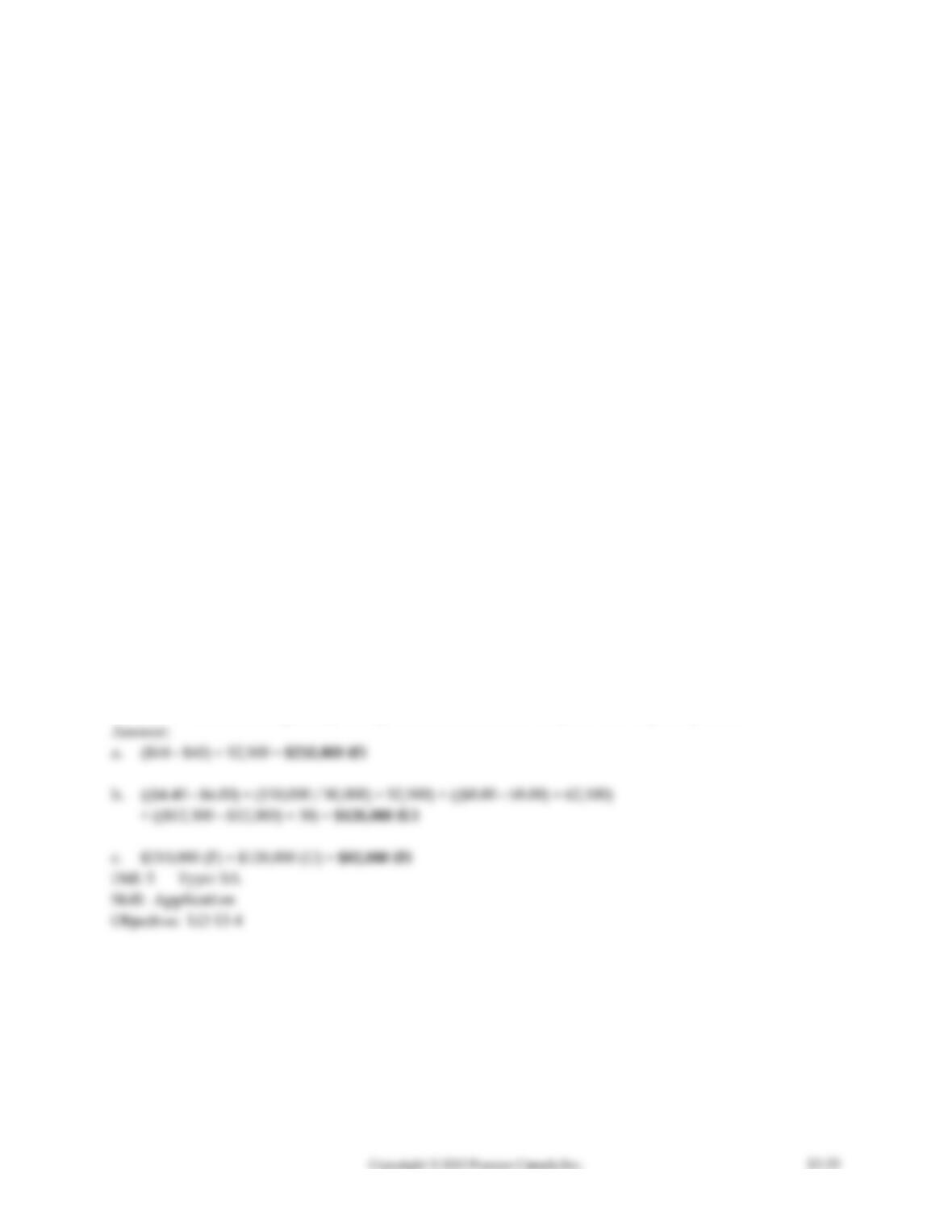
42) Required:
a. What amount is the revenue effect of the growth component?
b. What amount is the cost effect of the growth component?
c. What is the net effect on operating income as a result of the growth component?
43) Required:
a. What amount is the revenue effect of the price-recovery component?
b. What amount is the cost effect of the price-recovery component?
c. What is the net effect on operating income as a result of the price-recovery component?
d. What is the net effect on operating income as a result of the productivity component?
Cost Accounting: A Managerial Emphasis, 6e
Chapter 13 – Strategy, Balanced Scorecard, and Profitability Analysis
44) Required:
Present the following,
a. The change in operating income from cost leadership.
b. The change in operating income due to industry wide effects.
c. The effect of product differentiation on operating income and a summarization of the change in
operating income between Year 1 to Year 2.
Cost Accounting: A Managerial Emphasis, 6e
Chapter 13 – Strategy, Balanced Scorecard, and Profitability Analysis
Use the information below to answer the following question(s).
Following a strategy of product differentiation, Instruments Inc. makes a hand held calculator, II400.
Instruments Inc. presents the following data for the years 1 and 2
Year 1 Year 2
Units of II400 produced and sold 50,000 52,500
Selling price $40 $44
Direct materials (kilograms) 150,000 153,375
Direct materials costs per kilogram $4.00 $4.40
Manufacturing capacity for II400 (units) 62,500 62,500
Total manufacturing conversion costs $500,000 $550,000
Manufacturing conversion costs per unit of capacity $8.00 $8.80
Selling and customer-service capacity (customers) 30 29
Total selling and customer-service costs $360,000 $362,500
Cost per customer of selling & customer-service capacity $12,000 $12,500
Instruments Inc. produces no defective units but it wants to reduce direct materials usage per unit of
II400 in year 2. Manufacturing conversion costs in each year depend on production capacity defined in
terms of II400 units that can be produced. Selling and customer-service costs depend on the number of
customers that the customer and service functions are designed to support. Neither conversion costs or
customer-service costs are affected by changes in actual volume. Instruments Inc. has 23 customers in
year 1 and 25 customers in year 2. The industry market size for hand held calculators increased 5% from
year 1 to year 2.
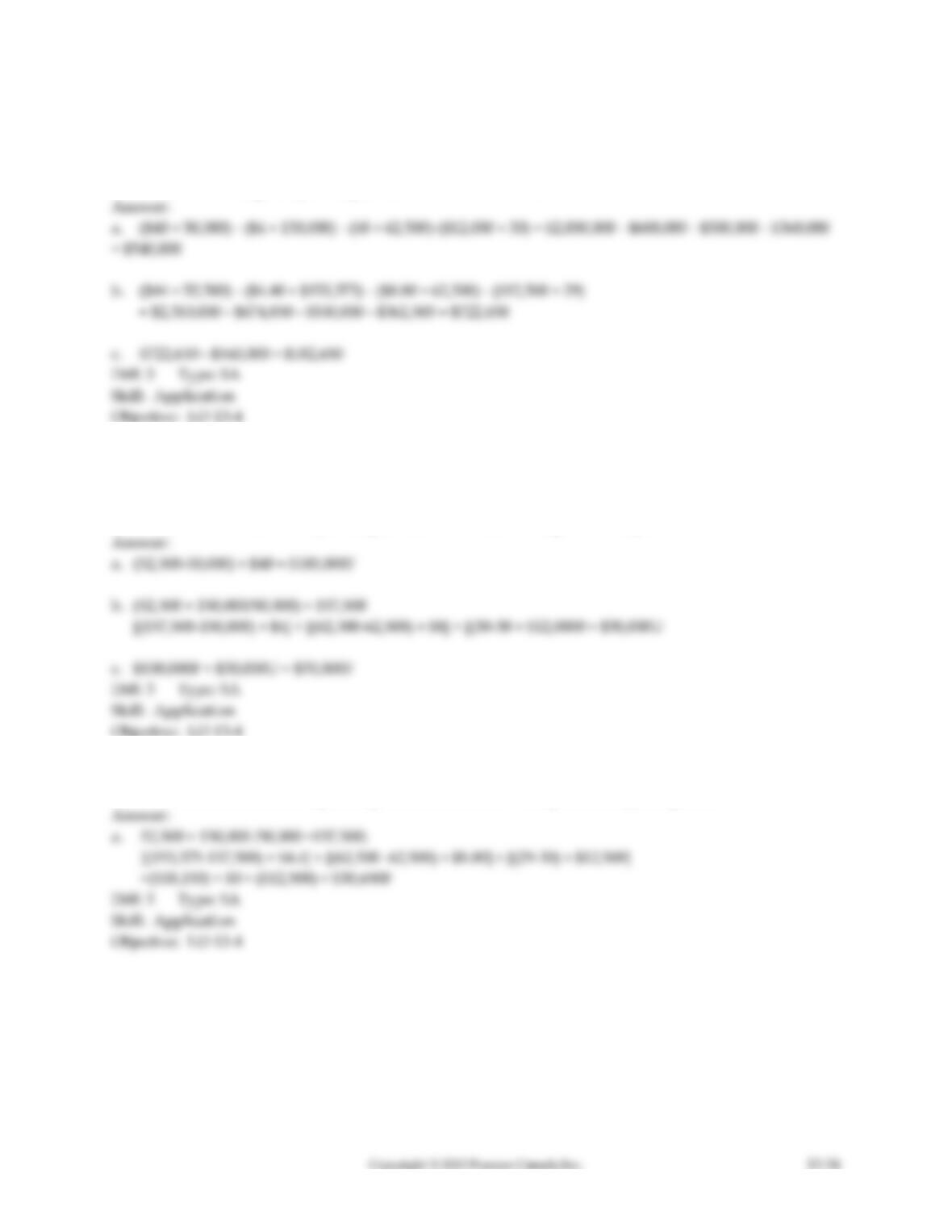
45) Required:
a. What amount is the revenue effect of the price-recovery component?
b. What amount is the cost effect of the price-recovery component?
c. What is the net change in operating income as a result of the price-recovery component?
Cost Accounting: A Managerial Emphasis, 6e
Chapter 13 – Strategy, Balanced Scorecard, and Profitability Analysis
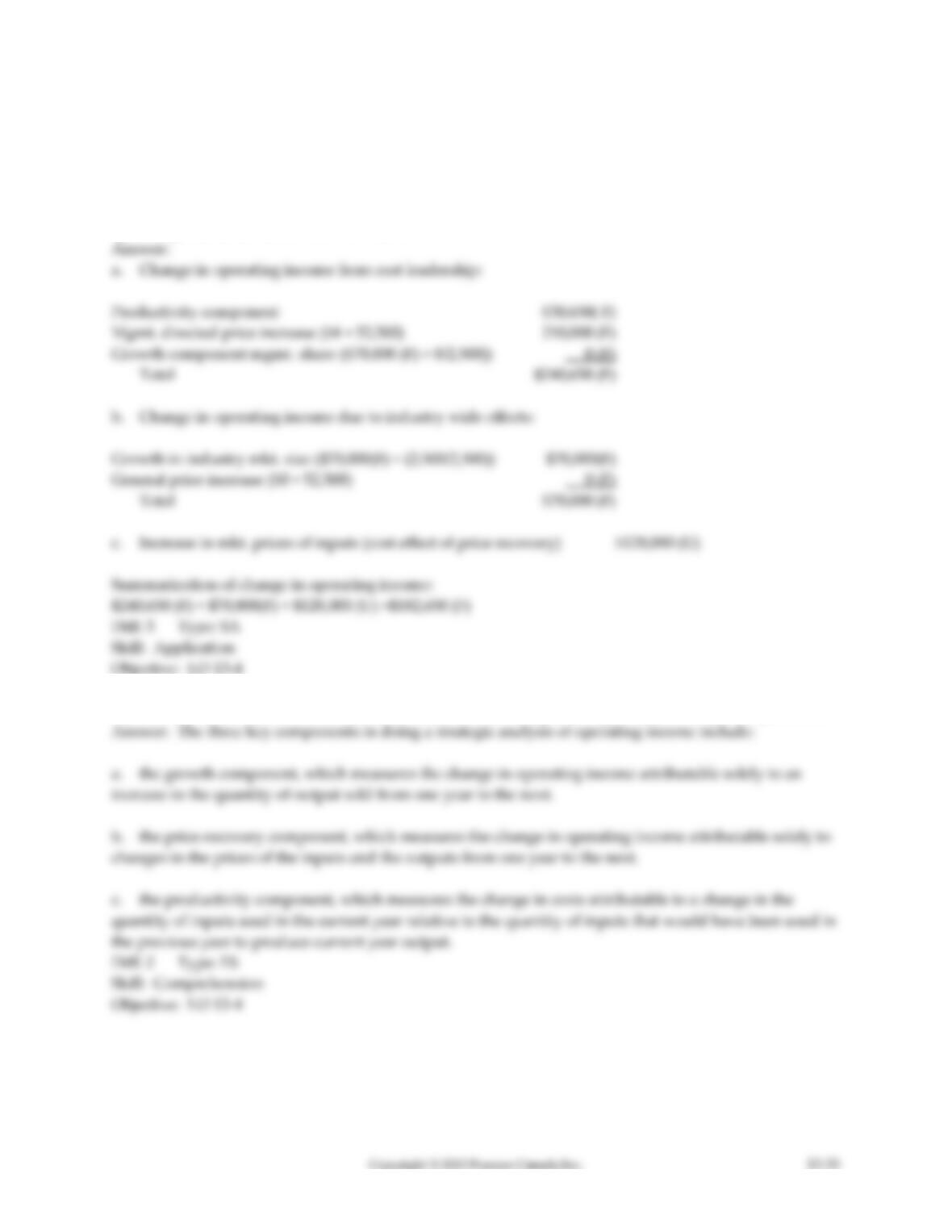
46) Required:
a. What is the operating income for Year 1?
b. What is the operating income in Year 2?
c. What is the change in operating income from Year 1 to Year 2?
47) Required:
a. What amount is the revenue effect of the growth component?
b. What amount is the cost effect of the growth component?
c. What is the net effect on operating income as a result of the growth component?
48) Required:
a. What is the net effect on operating income as a result of the productivity component?
Cost Accounting: A Managerial Emphasis, 6e
Chapter 13 – Strategy, Balanced Scorecard, and Profitability Analysis
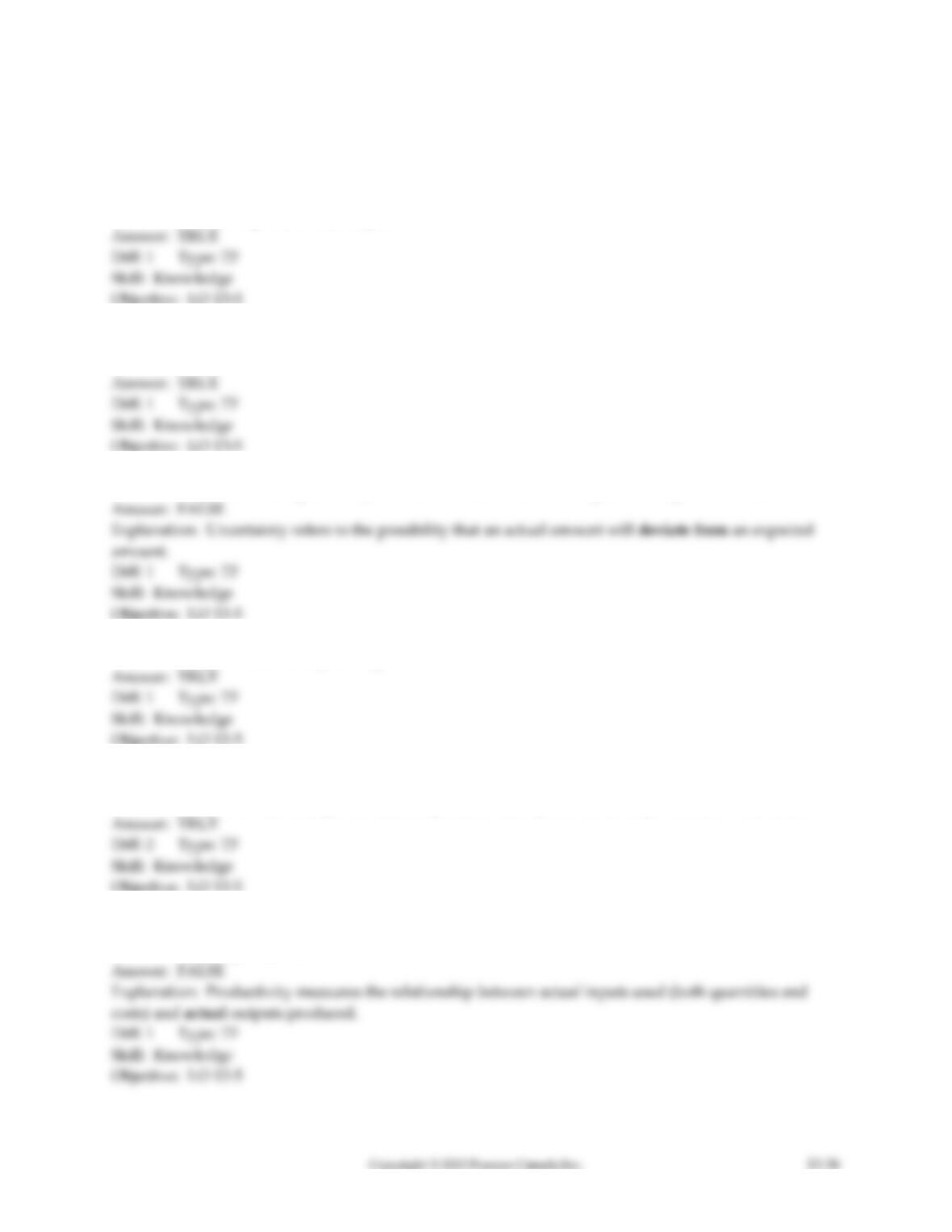
49) Required:
Present the following,
a. The change in operating income from cost leadership.
b. The change in operating income due to industry wide effects.
c. The effect of product differentiation on operating income and a summarization of the change in
operating income between Year 1 to Year 2.
50) Describe three key balanced scorecard components in doing a strategic analysis of operating income.
Cost Accounting: A Managerial Emphasis, 6e
Chapter 13 – Strategy, Balanced Scorecard, and Profitability Analysis
13.5 Analyze the results from specific productivity and capacity control strategies to
achieve BSC expectations.
1) Engineered costs result specifically from a clear cause-and-effect relationship between output and the
resources needed to produce that output.
2) Discretionary costs arise from periodic (usually yearly) decisions regarding the maximum amount to
be incurred.
3) Uncertainty refers to the possibility that an actual amount will be equal to an expected amount.
4) Downsizing is also called rightsizing.
5) Downsizing is an integrated approach to configure processes, products, and people to by match costs
to the activities that need to be performed, to operate efficiently and effectively, now and in the future.
6) Productivity measures the relationship between actual inputs used (both quantities and costs) and
standard outputs produced.
Cost Accounting: A Managerial Emphasis, 6e
Chapter 13 – Strategy, Balanced Scorecard, and Profitability Analysis
7) Partial productivity equals quantity of output produced divided by quantity of individual input used.
8) Total factor productivity (TFP) is the ratio of the quantity of output produced to the costs of all inputs
used, where the inputs are combined on the basis of current period prices.
9) Although total factor productivity (TFP) measures are comprehensive, operations personnel find
financial TFP measures more difficult to understand and less useful than physical partial productivity
measures in performing their tasks.
10) Research and development cost is an example of an engineered cost.
11) One way to eliminate unused capacity is to downsize.
12) Downsizing often means eliminating jobs, which can have an adverse effect on employee morale.