
The Essential Cosmic Perspective, 8e (Bennett et al.)
Chapter 13 Star Stuff
13.1 Multiple Choice Questions
1) What did Carl Sagan mean when he said that we are all “star stuff“?
A) that life would be impossible without energy from the Sun
B) that the Earth formed at the same time as the Sun
C) that the carbon, oxygen, and other elements essential to life were created by nucleosynthesis
in stellar cores
D) that the Sun formed from the interstellar medium: the “stuff” between the stars
E) that the universe contains billions of stars
2) Which two energy sources can help a star maintain its internal thermal pressure?
A) nuclear fusion and gravitational contraction
B) nuclear fission and gravitational contraction
C) nuclear fusion and nuclear fission
D) chemical reactions and gravitational contraction
E) nuclear fusion and chemical reactions
3) What condition is necessary in an interstellar gas cloud for it to begin collapsing?
A) a low density
B) a low temperature
C) a high temperature
D) a high heavy element content
E) a low heavy element content
4) What eventually halts the gravitational collapse of an interstellar gas cloud if it is massive
enough to become a star?
A) the central object becoming hot enough to sustain nuclear fusion in its core
B) the crowding of electrons in the core
C) nothing; all collapsing gas clouds become black holes
D) a critical fraction of the gas has been driven further into space
5) What is the source of luminosity for protostars that have not yet become hot enough for fusion
in their cores?
A) fission from concentrated radioactive elements
B) light absorbed from nearby stars
C) gravitational energy released by infalling matter
D) fusion in their low-density outer layers
6) Why do disks form around young stars?
A) They don’t; the stars form from the disks.
B) Collisions between rotating gas particles flatten the gas cloud along its axis of rotation.
C) Centrifugal force pushes gas outward from the spinning gas cloud.
D) Intense winds from nearby massive stars flatten the gas cloud.
7) In what way do the jets emanating from a protostar help with the formation of the star?
A) They bring in surrounding gas to the protostar, allowing it to become massive enough to
collapse.
B) They help cool the core of the protostar, allowing it to continue collapsing.
C) They help slow the rotation rate of the protostar by carrying away some of its angular
momentum.
D) They heat up the core of the protostar, allowing hydrogen fusion to begin.
8)
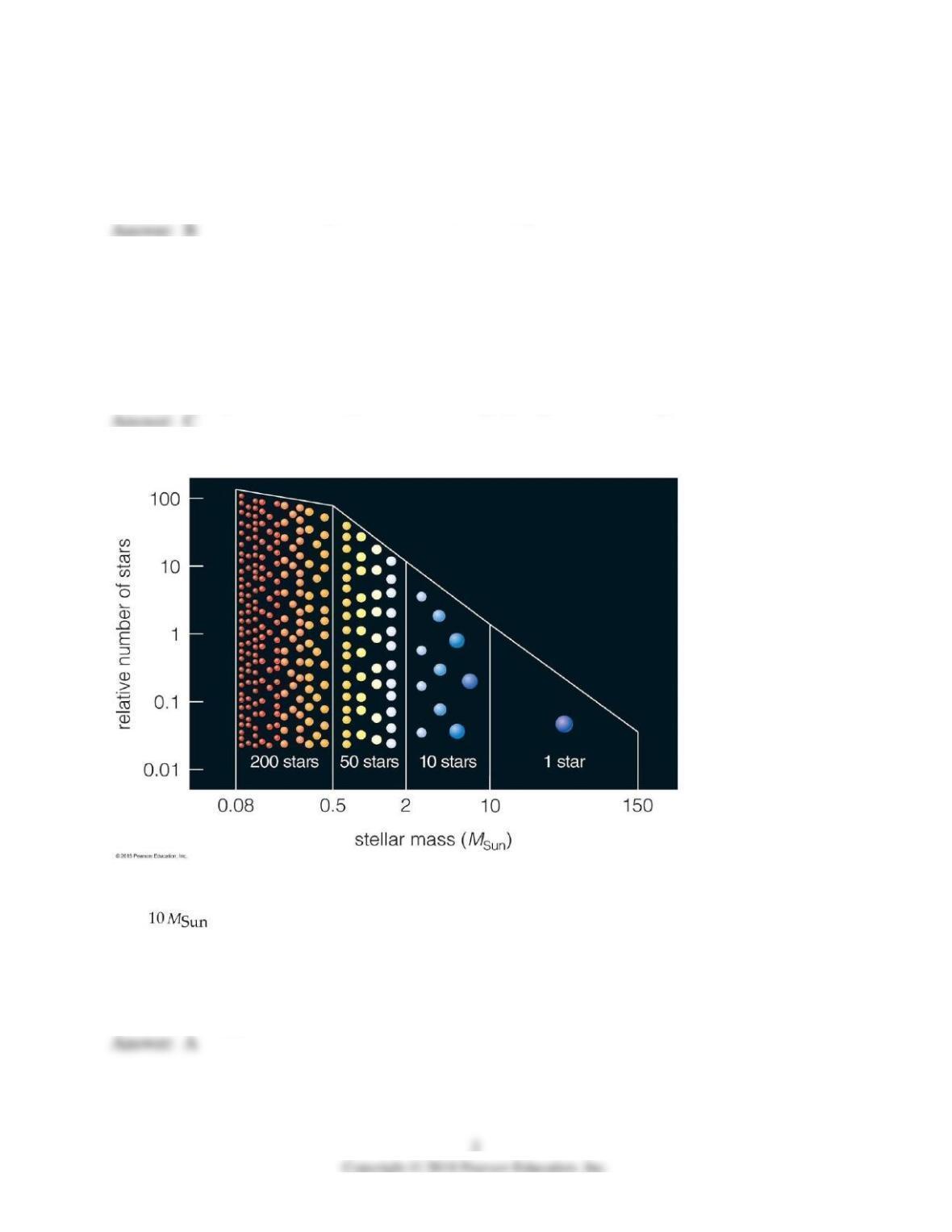
This schematic shows the number of stars formed in each mass range for each star more massive
than . What is the mass range of the most common stars?
A) 0.08 – 0.5 MSun
B) 0.5 – 2 MSun
C) 2 – 10 MSun
D) 10 – 150 MSun

9) Which of the following masses separates low mass stars from intermediate mass stars?
A) about 150 solar masses
B) about 50 solar masses
C) about 2 solar masses
D) about 1 solar mass
E) about 0.08 solar masses
10) Stars with masses greater than 150 times our Sun probably cannot form because
A) molecular clouds do not have enough material to form such massive stars.
B) they would fragment into binary stars because of their rapid rotation.
C) they would generate so much energy that they would blow off their outer layers.
D) they would shine exclusively at X-ray wavelengths and would be difficult to detect.
E) they would be too massive for hydrogen fusion to occur in their cores.
11) What eventually halts the gravitational collapse of an interstellar gas cloud that forms an
object that is not massive enough to become a star?
A) the central object becoming hot enough to sustain nuclear fusion in its core
B) the crowding of electrons in the core
C) Nothing; all collapsing gas clouds become black holes.
D) A critical fraction of the gas has been driven further into space.
12) What can we learn about a star from its life track on an H-R diagram?
A) how long ago it was born
B) when it will die
C) where it is located
D) what surface temperature and luminosity it will have at each stage of its life
E) all of the above
13) As a one solar mass protostar moves on to the main sequence,
A) its surface temperature and luminosity increase.
B) its surface temperature increases and its luminosity decreases.
C) its surface temperature and luminosity decrease.
D) its surface temperature decreases and its luminosity increases.
E) its surface temperature and luminosity remain the same.

14) When does a star become a main-sequence star?
A) when the protostar assembles from its parent molecular cloud
B) the instant when hydrogen fusion first begins in the star’s core
C) when the rate of hydrogen fusion in the star’s core is high enough to sustain gravitational
equilibrium
D) when a star becomes luminous enough to emit thermal radiation
E) when hydrogen fusion is occurring throughout the star’s interior
15) Which of the following statements about degeneracy pressure is not true?
A) Degeneracy pressure varies with the temperature of the star.
B) Degeneracy pressure can halt gravitational contraction of a star even when no fusion is
occurring in the core.
C) Degeneracy pressure keeps any protostar less than 0.08 solar mass from becoming a true,
hydrogen-fusing star.
D) Degeneracy pressure is a consequence of the laws of quantum mechanics.
16) What is the fate of an isolated brown dwarf?
A) It will become a white dwarf.
B) It will become a neutron star.
C) It will become a black hole.
D) It will slowly evaporate to nothing.
E) It will remain a brown dwarf forever.
17) What percentage of a star’s total lifetime is spent on the main sequence?
A) 10%
B) 20%
C) 50%
D) 90%
E) 100%
18) What change slowly occurs during the main-sequence lifetime of a star?
A) As the solar wind blows material into space, the decreasing mass reduces pressure in the core,
which in turn reduces the fusion rate and the luminosity.
B) As hydrogen is used up in the core, the fusion rate decreases and reduces the luminosity.
C) It gathers more gas from interstellar space, increasing its mass and hence the luminosity.
D) Its core temperature slowly increases, increasing the fusion rate and hence the luminosity.

19) What happens when a star like the sun exhausts its core hydrogen supply?
A) Its core contracts, but its outer layers expand and the star becomes bigger and brighter.
B) It contracts, becoming smaller and dimmer.
C) It contracts, becoming hotter and brighter.
D) It expands, becoming bigger but dimmer.
E) Its core contracts, but its outer layers expand and the star becomes bigger but cooler and
therefore remains at the same brightness.
20) Compared to the star it evolved from, a red giant is
A) hotter and brighter.
B) hotter and dimmer.
C) cooler and brighter.
D) cooler and dimmer.
E) the same temperature and brightness.
21) At approximately what temperature can helium fusion occur?
A) 100,000 K
B) 1 million K
C) 10 million K
D) 100 million K
E) 100 billion K
22) Why does a star grow larger immediately after it exhausts its core hydrogen?
A) The outer layers of the star are no longer gravitationally attracted to the core.
B) Hydrogen fusion in a shell outside the core generates enough thermal pressure to push the
upper layers outward.
C) Helium fusion in the core generates enough thermal pressure to push the upper layers
outward.
D) Helium fusion in a shell outside the core generates enough thermal pressure to push the upper
layers outward.
E) The internal radiation generated by the hydrogen fusion in the core has heated the outer layers
enough that they can expand after the star is no longer fusing hydrogen.
23) How many helium nuclei fuse together to make a carbon nucleus?
A) 2
B) 3
C) 4
D) It varies depending on the reaction.
E) Helium cannot fuse into carbon.

24) Helium fusion directly results in the formation of
A) hydrogen.
B) oxygen.
C) carbon.
D) nitrogen.
E) iron.
25) What happens after the helium flash in the core of a star?
A) The core quickly heats up and expands as helium fusion begins all at once throughout the
core.
B) The star breaks apart in a violent explosion.
C) The core suddenly contracts.
D) The core stops fusing helium.
E) The star starts to fuse helium in a shell outside the core.
26) What is a planetary nebula?
A) a disk of gas surrounding a protostar that may form into planets
B) what is left of its planets after a low-mass star has ended its life
C) the expanding shell of gas that is no longer gravitationally bound to the core of a star
D) the molecular cloud from which planets form
E) the expanding shell of gas that is left when a white dwarf explodes as a supernova
27) What happens to the core of a star after the planetary nebula stage?
A) It contracts from a protostar to a main-sequence star.
B) It breaks apart in a violent explosion.
C) It becomes a white dwarf.
D) It becomes a neutron star.
E) none of the above
28) Which of the following sequences correctly describes the stages of life for a one solar mass
star?
A) red giant, protostar, main-sequence, white dwarf
B) white dwarf, main-sequence, red giant, protostar
C) protostar, red giant, main-sequence, white dwarf
D) protostar, main-sequence, white dwarf, red giant
E) protostar, main-sequence, red giant, white dwarf
29) Compared to the star it evolved from, a white dwarf is
A) hotter and brighter.
B) hotter and dimmer.
C) cooler and brighter.
D) cooler and dimmer.
E) the same temperature and brightness.
30) Most interstellar dust grains
A) were produced in the Big Bang.
B) are produced in the interstellar medium.
C) are produced in the atmospheres of red giant stars.
D) are produced in supernova explosions.
E) are produced in the cores of low-mass stars
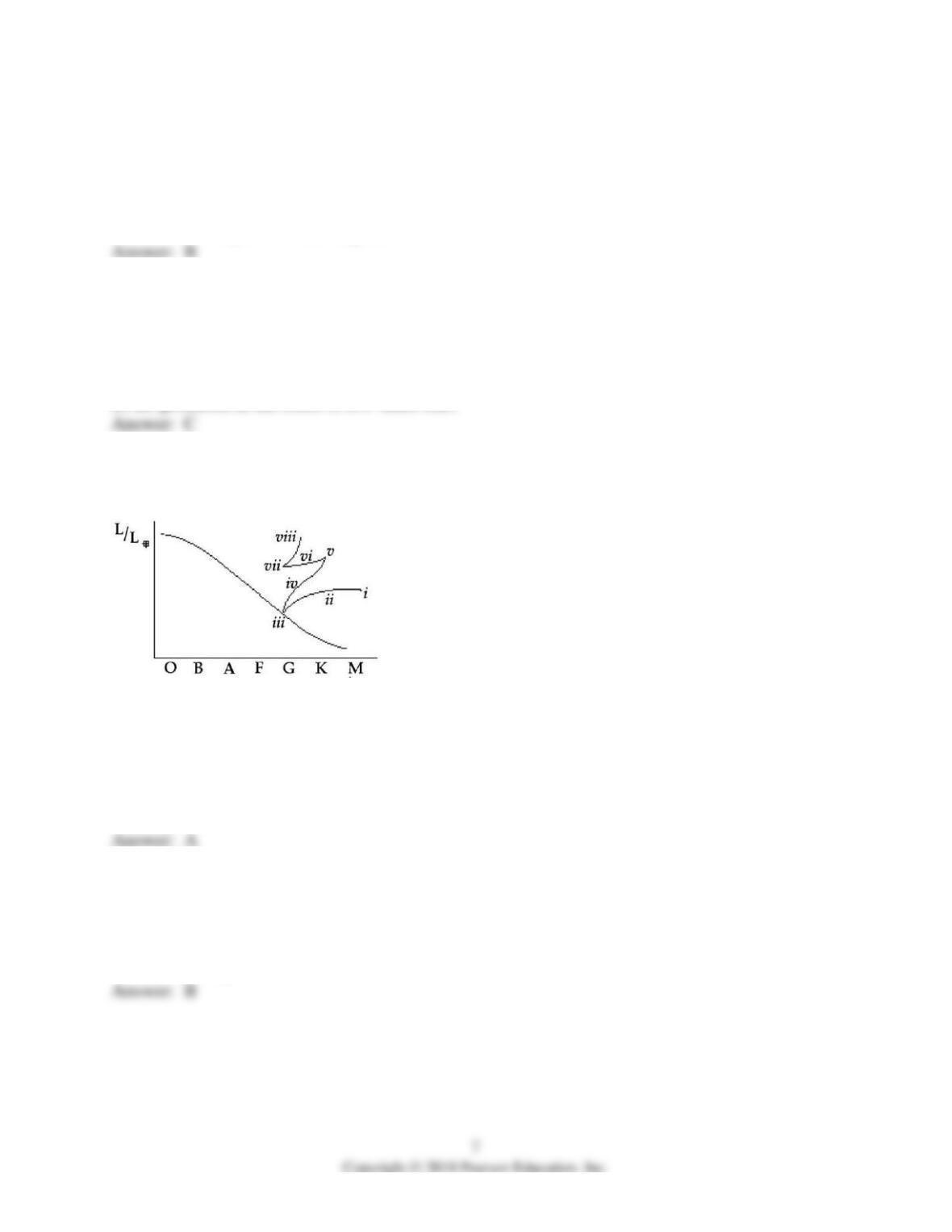
The following questions refer to the H-R diagram below that shows the life track of a 1-solar-
mass star, with various stages labeled with Roman numerals.
31) At the end of its life, the remaining core of this star will be left behind as
A) a white dwarf made primarily of carbon and oxygen.
B) a white dwarf made primarily of silicon and iron.
C) a neutron star.
D) a black hole.
E) a supernova.
32) A star at the point labelled iii is
A) a protostar.
B) on the main sequence.
C) a red giant.
D) experiencing shell fusion.
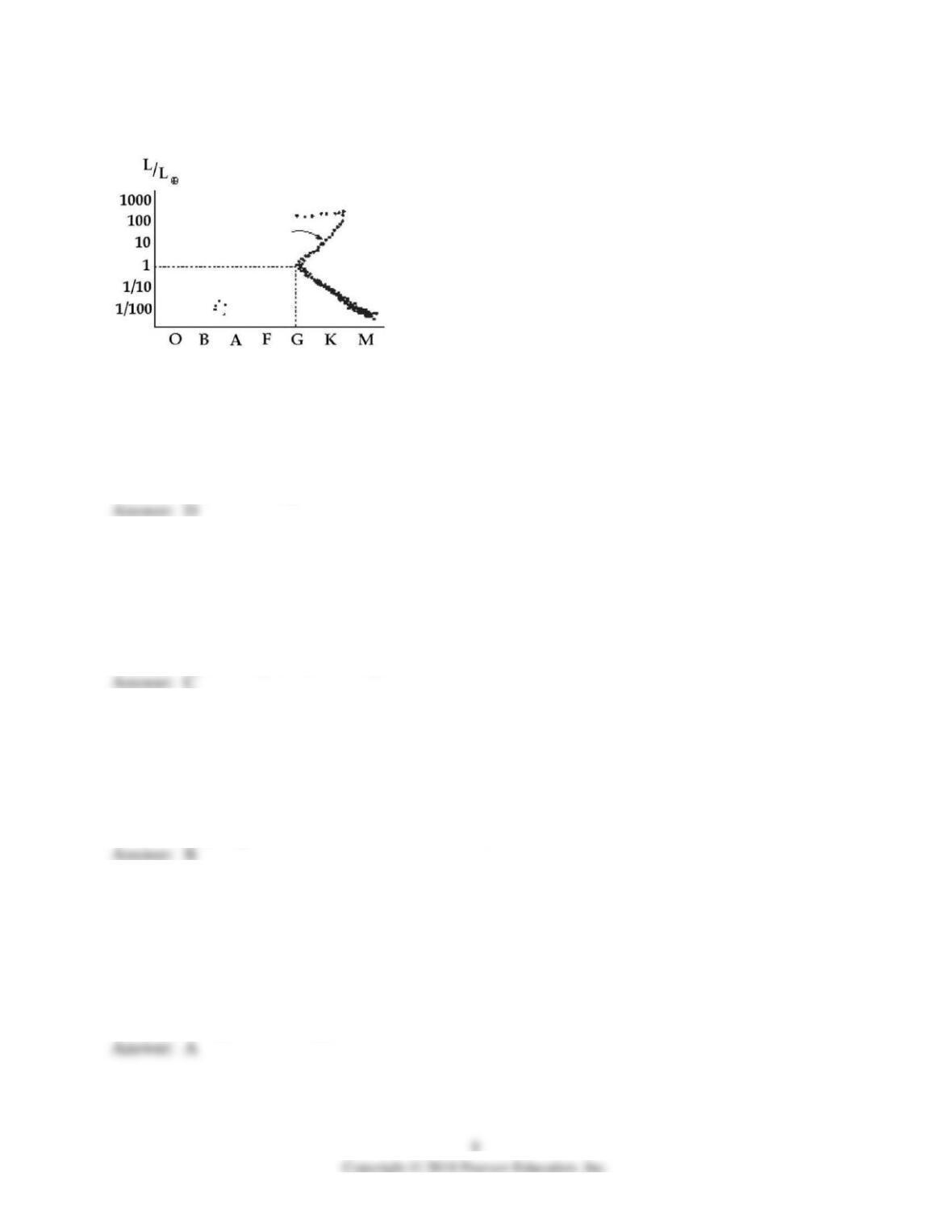
The following questions refer to the sketch below of an H-R diagram for a star cluster.
33) Based on its main-sequence turnoff point, the age of this cluster is
A) less than 1 billion years.
B) about 1 billion years.
C) about 4.5 billion years.
D) about 10 billion years.
E) more than 15 billion years.
34) Which statement about this cluster is not true?
A) It is likely to be located in the halo of the galaxy.
B) It contains some stars that are fusing helium in their cores.
C) It is the type of cluster known as an open cluster.
D) It contains no young stars.
E) It is likely to be spherical in shape.
35) Consider the star to which the arrow points. How is it currently generating energy?
A) by gravitational contraction
B) by hydrogen shell fusion around an inert helium core
C) by core hydrogen fusion
D) by core helium fusion combined with hydrogen shell fusion
E) by both hydrogen and helium shell fusion around an inert carbon core
36) Consider the star to which the arrow points. Which of the following statements about this
star is not true?
A) It is significantly less massive than the Sun.
B) It is larger in radius than the Sun.
C) It is brighter than the Sun.
D) Its surface temperature is lower than the Sun’s.
E) Its core temperature is higher than the Sun’s.

37) What is the CNO cycle?
A) the process by which helium is fused into carbon, nitrogen, and oxygen
B) the process by which carbon is fused into nitrogen and oxygen
C) a type of hydrogen fusion that uses carbon, nitrogen, and oxygen atoms as catalysts
D) the period of a massive star’s life when carbon, nitrogen, and oxygen are fusing in different
shells outside the core
E) the period of a low-mass star’s life when it can no longer fuse carbon, nitrogen, and oxygen in
its core
38) Why does stellar main-sequence lifetime decrease with increasing stellar mass?
A) It doesn’t; higher mass stars have more hydrogen available for fusion, and thus have longer
lifetimes.
B) Strong stellar winds cause higher mass stars to lose mass quickly.
C) Higher core temperatures cause fusion to proceed much more rapidly.
D) Higher outward pressure prevents the core hydrogen from being replenished by the star’s
outer layers.
39) Which element has the lowest mass per nuclear particle and therefore cannot release energy
by either fusion or fission?
A) hydrogen
B) oxygen
C) silicon
D) iron
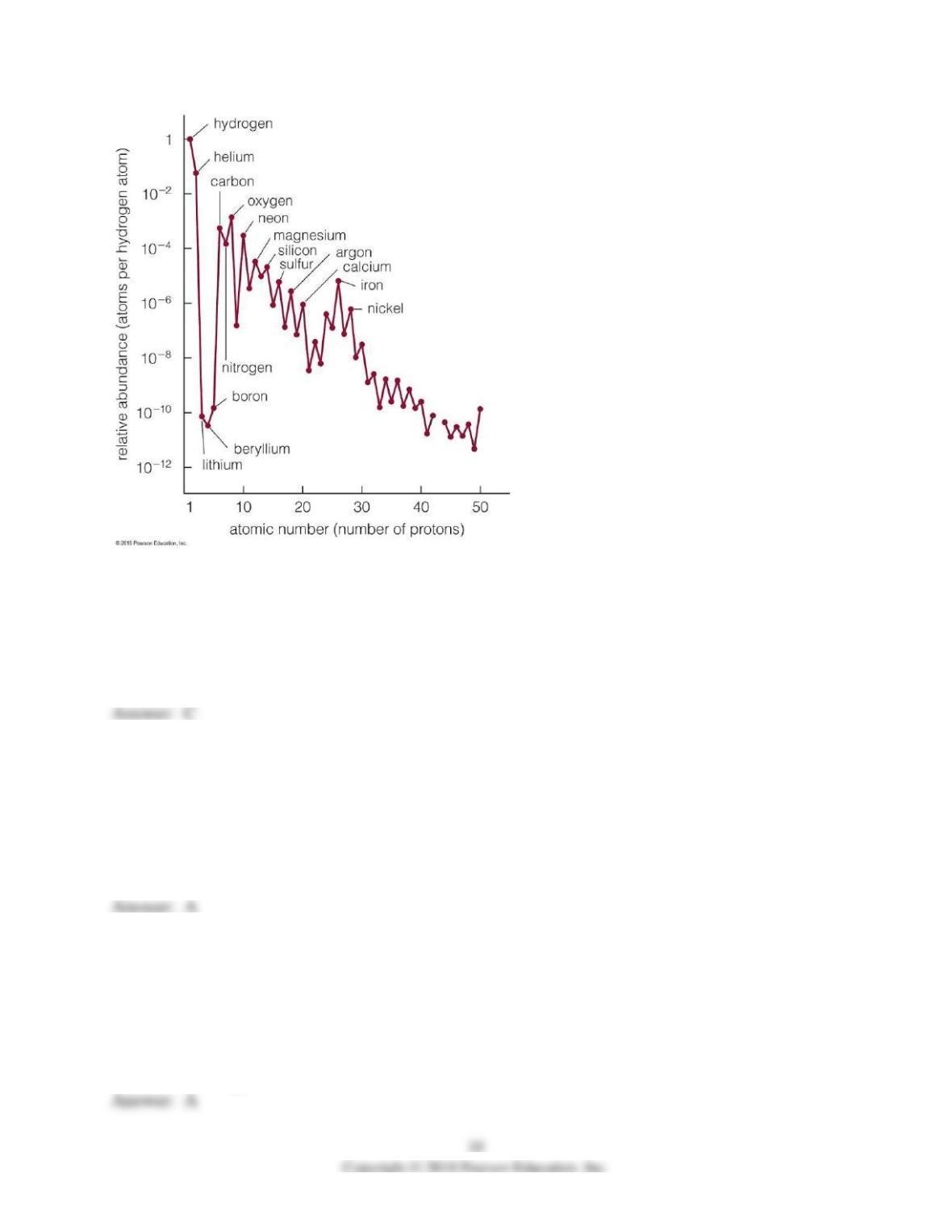
40) The figure above shows the abundance of elements in the galaxy relative to hydrogen. What
is the least abundant of the elements with an atomic number less than iron’s?
A) hydrogen
B) lithium
C) beryllium
D) nitrogen
41) The figure above shows the abundance of elements in the galaxy relative to hydrogen. Why
does iron have a higher abundance than elements similar in atomic number?
A) It is the end product of core fusion in massive stars, and can only be destroyed in rare
supernova fusion reactions.
B) It has a higher density than other elements, and thus becomes locked away in dust.
C) It does not; this apparent higher abundance is due to iron’s many spectral lines making it
easier to find.
42) The figure above shows the abundance of elements in the galaxy relative to hydrogen. What
is the general trend in elemental abundance?
A) Elements with more protons are less abundant.
B) Elements with more protons are more abundant.
C) Elements heavier than iron do not exist.
D) Elements heavier than iron are relatively abundant.
E) There is no apparent trend in the abundance of elements.

43) What happens when the gravity of a massive star’s collapsing core is able to overcome
neutron degeneracy pressure?
A) The core contracts and becomes a white dwarf.
B) The core contracts and becomes a ball of neutrons.
C) The core contracts and becomes a black hole.
D) The star explodes violently, leaving nothing behind.
E) Gravity is not able to overcome neutron degeneracy pressure.
44) What types of stars end their lives with supernovae?
A) all stars that are red in color
B) all stars that are yellow in color
C) stars that are more massive than eight times the mass of the Sun
D) stars that are similar in mass to the Sun
E) stars that have reached an age of 10 billion years
45) Which of the following statements about the stages of nuclear burning in a massive star is
not true?
A) Each successive stage of fusion requires higher temperatures than the previous stages.
B) As each stage ends, the core shrinks further.
C) Each successive stage creates an element with a higher atomic mass.
D) Each successive stage lasts for approximately as long as the first, hydrogen fusion stage.
46) Suppose the star Betelgeuse (the upper left shoulder of Orion) were to go supernova
tomorrow (as seen here on Earth). What would it look like to the naked eye?
A) Because the supernova event destroys the star, Betelgeuse would suddenly disappear from
view.
B) We’d see a cloud of gas expanding away from the position where Betelgeuse used to be. Over
a period of a few weeks, this cloud would fill our entire sky.
C) Betelgeuse would remain a dot of light but would suddenly become so bright that, for a few
weeks, we’d be able to see this dot in the daytime.
D) Betelgeuse would suddenly appear to grow larger in size, soon reaching the size of the full
moon. It would also be about as bright as the full moon.
47) Which event marks the beginning of a supernova?
A) the onset of helium burning after a helium flash in a star with mass comparable to that of the
Sun
B) the sudden outpouring of X-rays from a newly formed accretion disk
C) the sudden collapse of an iron core into a compact ball of neutrons
D) the beginning of neon burning in an extremely massive star
E) the expansion of a low-mass star into a red giant

48) After a supernova event occurring in a high-mass star, what is left behind?
A) always a white dwarf
B) always a neutron star
C) always a black hole
D) either a white dwarf or a neutron star
E) either a neutron star or a black hole
49) How are elements beyond iron formed in massive-star supernovae?
A) Neutrons produced during the core collapse are slammed into atomic nuclei.
B) The high temperature and pressure allow iron nuclei to fuse.
C) Elements thrown out at high speeds fuse with hydrogen atoms in the interstellar medium.
50) Why is Supernova 1987A particularly important to astronomers?
A) It occurred only a few dozen light-years from Earth.
B) It provided the first observational evidence that supernovae actually occur.
C) It provided the first evidence that neutron stars exist.
D) It was the first supernova detected in nearly 400 years.
E) It was the nearest supernova detected in nearly 400 years.
51) You discover a binary star system in which one member is a 15 solar mass main-sequence
star and the other star is a 10 solar mass giant star. Why should you be surprised, at least at first?
A) It doesn’t make sense to find a giant in a binary star system.
B) The odds of ever finding two such massive stars in the same binary system are so small as to
make it inconceivable.
C) The two stars in a binary system should both be at the same point in stellar evolution; that is,
they should either both be main-sequence stars or both be giants.
D) The two stars should be the same age, so the more massive one should have become a giant
first.
E) A star with a mass of 15 solar masses is too big to be a main-sequence star.

52) You discover a binary star system in which one member is a 15 solar mass main-sequence
star and the other star is a 10 solar mass giant star. How do we believe that a star system such as
this might have come to exist?
A) The giant must once have been the more massive star but transferred some of its mass to its
companion.
B) Other than the very low odds of finding a system with two such massive stars, there is nothing
surprising about the fact that such systems exist.
C) The two stars probably were once separate but became a binary when a close encounter
allowed their mutual gravity to pull them together.
D) The main-sequence star probably is a pulsating variable star and therefore appears to be less
massive than it really is.
E) Although both stars probably formed from the same clump of gas, the more massive one must
have had its birth slowed so that it became a main-sequence star millions of years later than its
less massive companion.
13.2 True/False Questions
1) Photographs of many young stars show long jets of material apparently being ejected from
their poles.
2) Although some photographs show what looks like jets of material near many young stars, we
now know that these “jets” actually represent gas from the surrounding nebula that is falling onto
the stars.
3) In any star cluster, stars with lower masses greatly outnumber those with higher masses.
4) There is no limit to the mass with which a star can be born.
5) Stars with high masses live longer than stars with lower masses.
6) Stars spend about 90% of their lifetime on the main sequence.
7) The helium fusion process works by fusing two helium nuclei into one beryllium nucleus.
8) Our Sun will end its life in a planetary nebula and become a white dwarf.
9) The most massive stars generate energy at the end of their lives by fusing iron in their cores.