Elements of Ecology, 9e (Smith)
Chapter 13 Interspecific Competition
13.1 Short Answer Questions
1) A relationship that affects the populations of two or more species adversely is referred to as
________ competition.
2) ________ competition results when individuals of one species inhibit individuals of another
by using up a shared resource.
3) Chemical interaction competition in plants is called ________.
4) ________ competition results when nonterritorial behavioral interactions between two species
result in negative effects on both species.
5) The Lotka-Volterra equations predict the outcomes of ________ competition under different
conditions.
6) In a competitive interaction in which species 1 has a higher carrying capacity (K1) than
species 2 (K2), it is expected that species ________ will go extinct.
7) The Russian biologist G. F. Gause was one of the first to support the Lotka-Volterra equations
by studying the competitive interactions of ________ species.
8) According to the competitive ________ principle, two “complete competitors” cannot coexist.
9) Interspecific competition involves individuals of two or more species vying for the same
limited ________.
10) Periods of drought or extreme environmental conditions may depress the ________ of a
species below its carrying capacity (K).
11) Interspecific ________ occurs when the competition for space between two species
influences access to food and nesting sites.
12) The portion of the fundamental niche that an organism actually exploits in the presence of
competitors is called its ________ niche.
13) When a species expands its niche in response to the removal of a competitor, the species has
experienced competitive ________.
14) The coexistence of competitors due to differences in the range of resources used or
environmental tolerances is referred to as niche ________.
15) A shift in the morphology, behavior, or physiology of a species in response to resource
competition is referred to as ________ displacement.
13.2 Multiple-Choice Questions
1) The occupation of space by a sessile organism, such as a barnacle, that precludes the
establishment or occupation by another species is referred to as
A) preemptive competition.
B) consumption competition.
C) overgrowth competition.
D) encounter competition.
2) A taller plant shading those individuals below, and reducing available light, is referred to as
A) preemptive competition.
B) consumption competition.
C) overgrowth competition.
D) territorial competition.
3) Various species of scavengers fighting over the carcass of a dead animal is referred to as
A) consumption competition.
B) preemptive competition.
C) encounter competition.
D) overgrowth competition.
4) Chemicals released by plants to inhibit germination and establishment of other species is
known as
A) consumption.
B) allelopathy.
C) toxicopathy.
D) competitive exclusion.
5) In the following formula, what is β? dN2/dt = r2N2(1 – (N2 + βN1)/K2)
A) competition coefficient
B) growth rate
C) carrying capacity
D) population size
6) What is a zero-growth isocline?
A) when the population size of species 1 exceeds species 2
B) the set of values where α = β
C) the set of values of two population sizes where the growth rate is 0
D) the set of values where the carrying capacity is reached for one of the two species
7) According to the Lotka-Volterra equations, which of the following is not an expected outcome
of competitive interactions between two species?
A) Species 1 drives species 2 to extinction.
B) Species 2 drives species 1 to extinction.
C) Both species coexist.
D) The populations of both species increase to infinity.
8) The diagonal line that represents dN/dt = 0 in the graphical depiction of the Lotka-Volterra
competitions equations is called
A) a competition coefficient.
B) the carrying capacity.
C) a zero-growth isocline.
D) a competitive exclusion parameter.
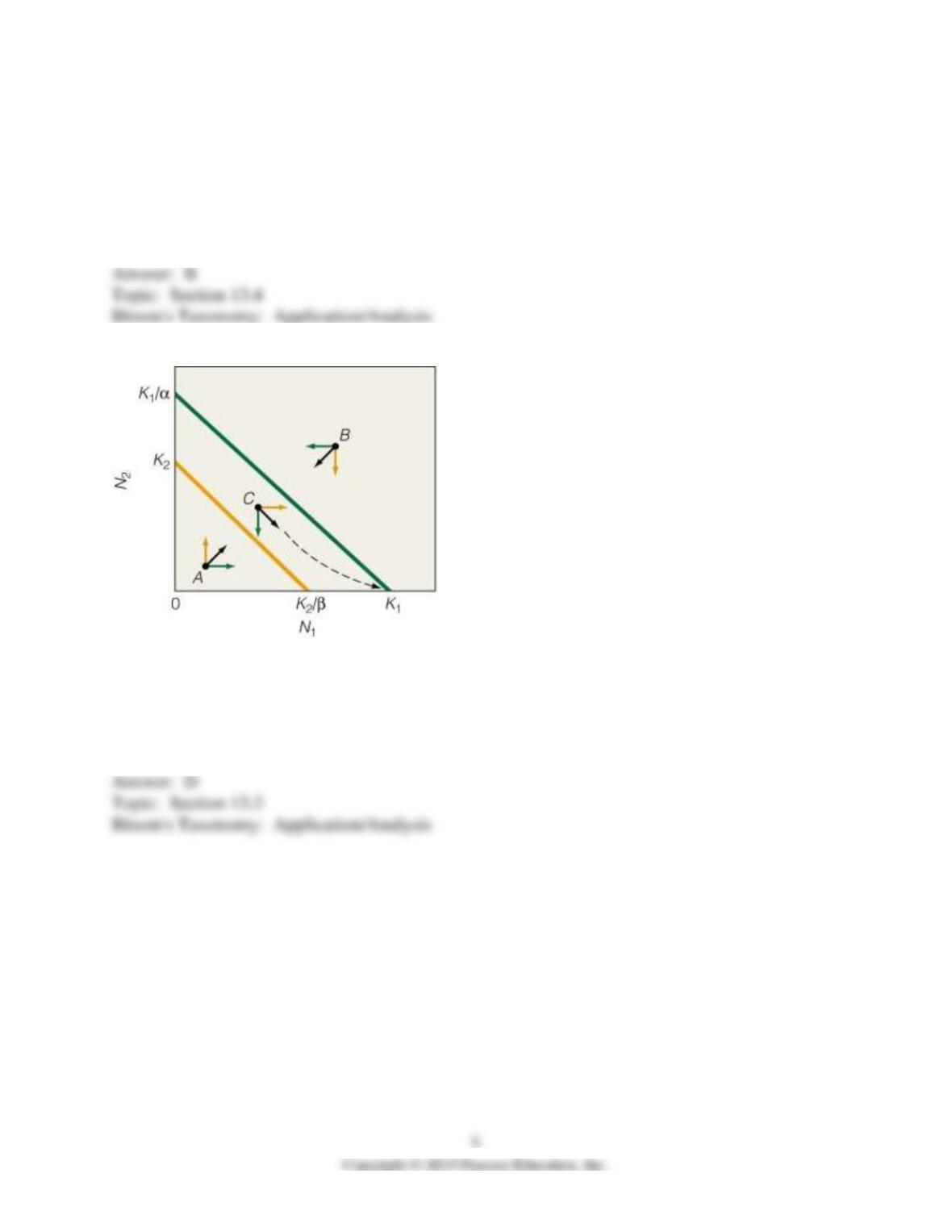
9) Paramecium aurelia has a higher rate of population growth and can tolerate a higher
population density than P. caudatum. When both species were introduced into a tube containing
a fixed amount of bacterial food, the populations of both species
A) thrived, even though they shared the same food supply.
B) initially increased, after which P. aurelia thrived and P. caudatum died out.
C) initially increased, after which P. caudatum thrived and P. aurelia died out.
D) died out.
10)
What is the outcome of these isoclines?
A) Species 2 wins.
B) If species 1 begins with a higher abundance, it wins.
C) If species 2 begins with a higher abundance, it wins.
D) Species 1 wins.
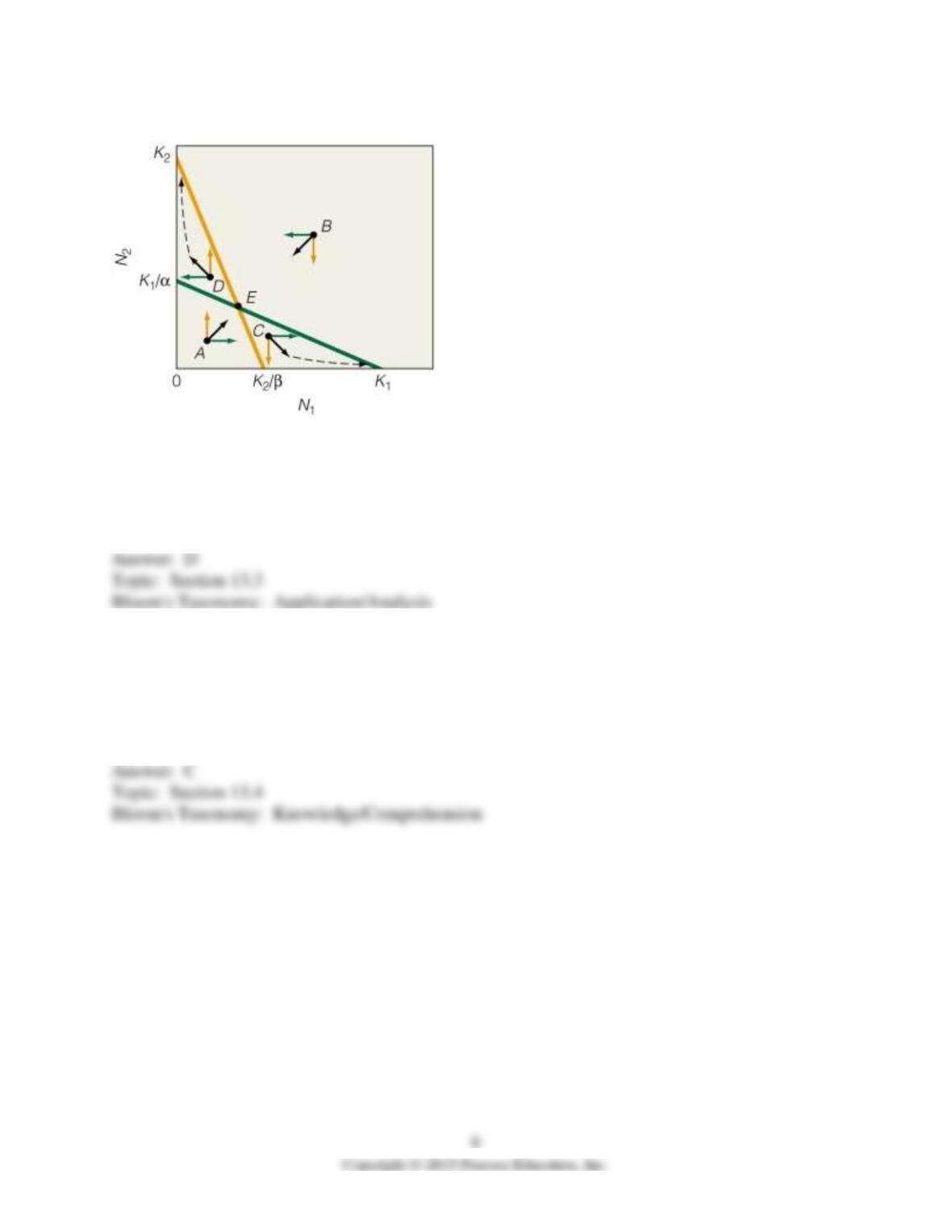
11)
What is the outcome of these isoclines?
A) Species 1 wins.
B) If species 1 begins with a higher abundance, it wins.
C) Species 2 wins.
D) Both species coexist.
12) In Tilman’s experiments with diatoms, what was the outcome when the two species
competed for silica?
A) Both coexisted.
B) Both survived several years but one eventually won out.
C) One outcompeted the other to extinction.
D) Both died.
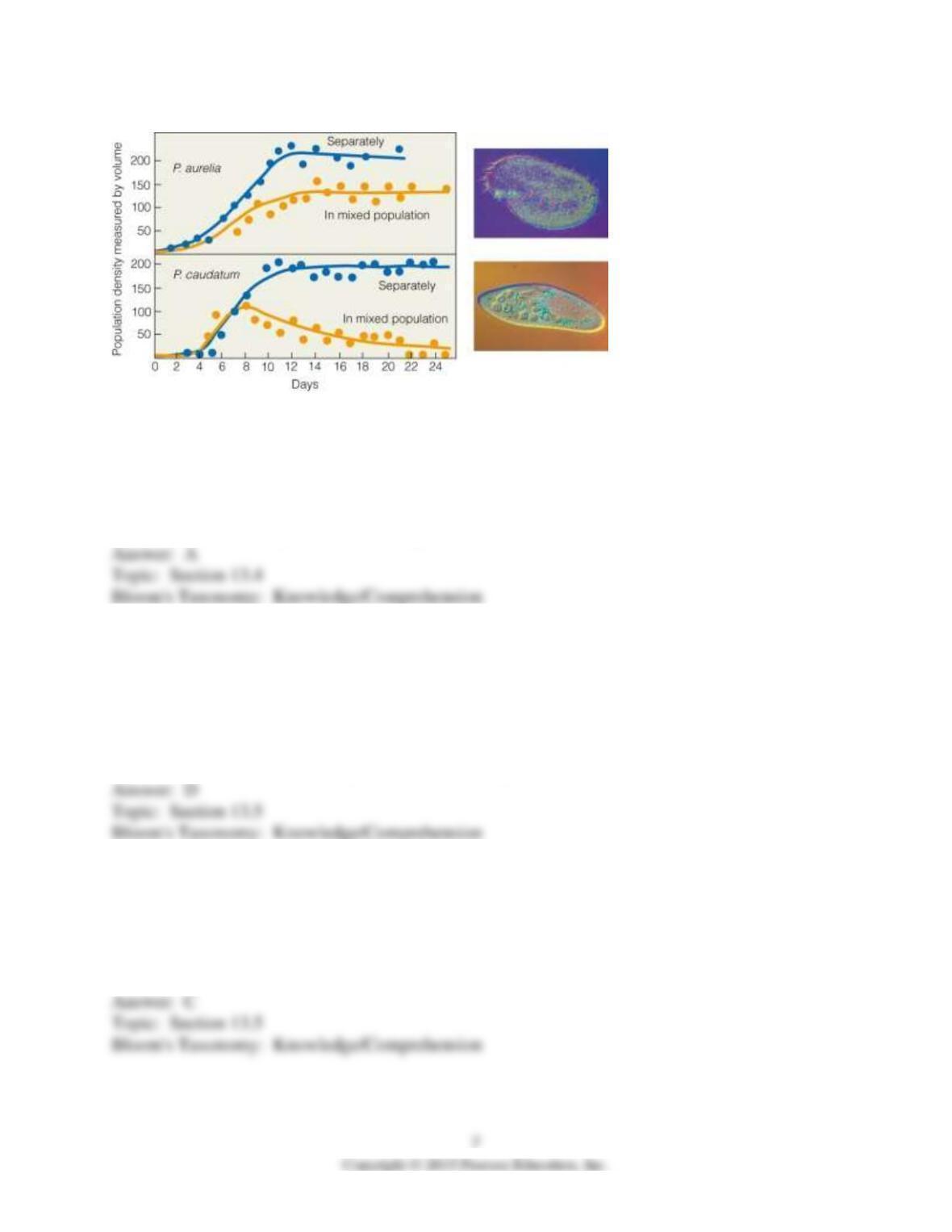
13)
According to the figure, when these two species are combined in a culture, what will the
outcome be?
A) P. aurelia wins.
B) P. caudatum wins.
C) Both species coexist.
D) P. aurelia wins only if it starts at a higher abundance.
14) According to the competitive exclusion principle, the populations of two species that live in
the same place and have exactly the same ecological requirements
A) can coexist at the same carrying capacity (K) as when each population is separate.
B) can coexist but with the population of each species at half of the carrying capacity (K) as
when each population is separate.
C) can coexist but with the population of one species much higher than that of the other species.
D) cannot coexist because one species will eventually drive the other to extinction.
15) The competitive exclusion principle assumes that the
A) competing species have different resource requirements.
B) competing species have the same carrying capacity (K).
C) environmental conditions remain constant.
D) superior competing species will have a lower population growth rate than the inferior
competitor.

16) The competitive exclusion principle states that
A) one species will always win out.
B) two species cannot coexist unless they cooperate.
C) two close competitors cannot coexist.
D) one species will feed on another until it is extinct.
17) Which of the following is TRUE regarding competition?
A) One species will always drive the other to extinction.
B) Competition is always focused on food.
C) The species larger in size typically outcompetes the smaller.
D) Water temperature can influence the outcome of competitive interactions.
18) Which of the following is a nonresource (or nonconsumable resource) that can influence the
outcome of competition among plant species?
A) temperature
B) light
C) water
D) nitrogen
19) How can one grass species be dominant one year, while another is dominant a few years later
and then the first becomes dominant again?
A) changes in precipitation across years
B) Lotka-Volterra models predicting cycling
C) competitive exclusion principle
D) growth rate differences among the species
20) Typically species compete for
A) food.
B) space.
C) essential nutrients.
D) multiple resources simultaneously.
21) Hiking up an elevational gradient, you notice different species of birds becoming more
dominant the higher you go. This could be because
A) older birds prefer lower elevations.
B) competitive abilities change along environmental gradients.
C) of population cycling.
D) there are more predators at higher elevation.
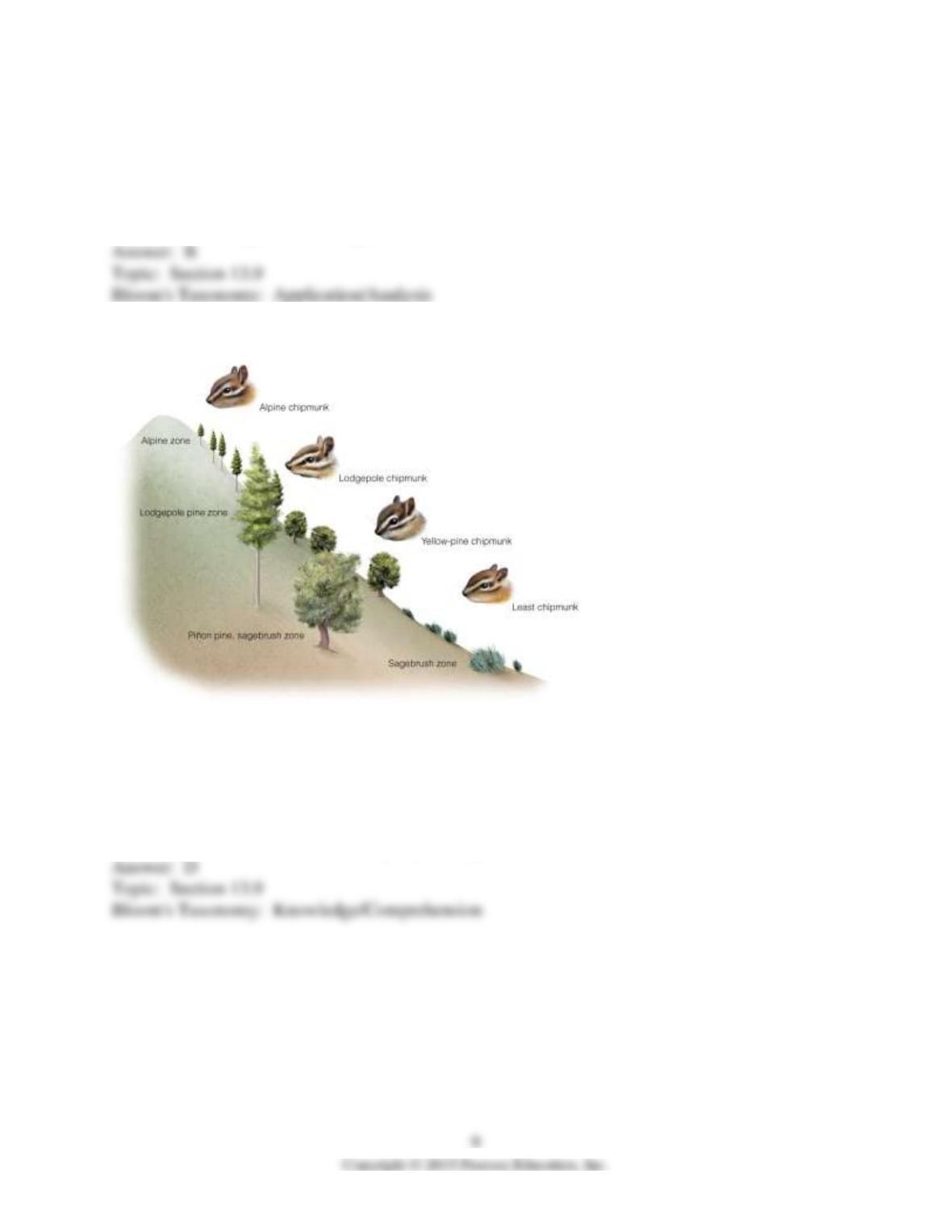
22)
The different chipmunk species correspond to the different tree species along an elevational
gradient. This is likely because
A) each chipmunk species depends on the specific tree species for habitat.
B) lodgepole trees and lodgepole chipmunks prefer warmer temperatures.
C) the fundamental niche of yellow-pine chipmunks is limited to middle elevation.
D) several resource factors for both groups change with elevation.
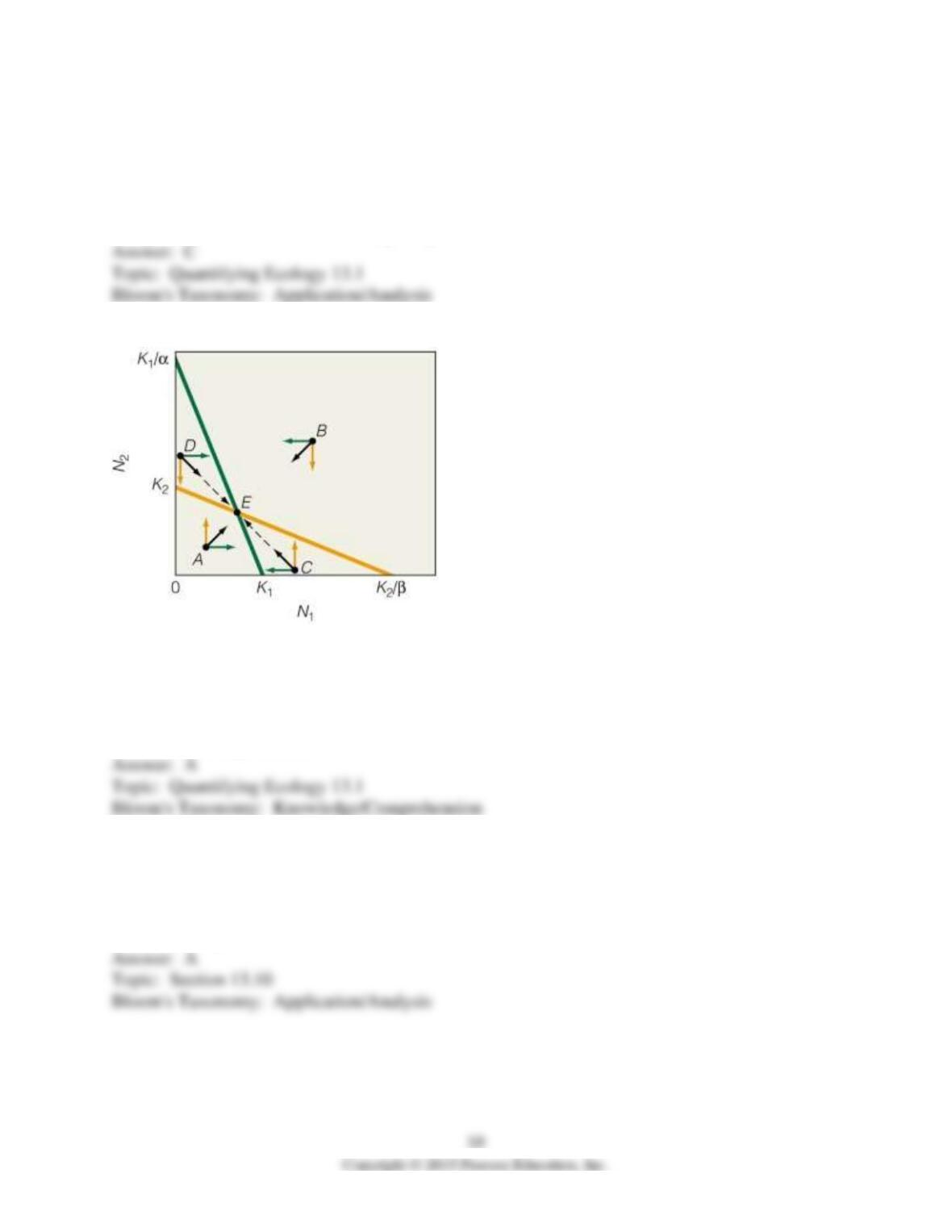
23) Two bird species compete in the forest for the same seeds. If α = 0.75 and β = 0.25, then
(assuming the same carrying capacity for both)
A) the rate of seed consumption is the same for both species.
B) the environment can supply both species since the sum of competition coefficients equals 1.
C) species 1 “wins” and will outcompete species 2.
D) species 2 “wins” and will outcompete species 1.
24)
If the carrying capacity of species 2 was actually 50, what would the competitive outcome be?
A) Both species coexist.
B) Species 1 wins.
C) Species 2 wins.
D) Both species go extinct.
25) Species A prefers a more dry habitat but grows in a wet habitat. Why might this be?
A) Species B outcompetes A in the dry habitat.
B) Species A’s fundamental niche is restricted to a wet habitat.
C) Species A requires large amounts of moisture to grow.
D) Species B prefers a wet habitat.

26) Two organisms using a portion of the same resource simultaneously is referred to as
A) niche overlap.
B) competitive release.
C) intraspecific competition.
D) territoriality.
27) The portion of potential resources and conditions that an organism actually exploits as a
result of interactions with other species is its
A) home range.
B) territory.
C) realized niche.
D) fundamental niche.
28) Competitive release is most likely to occur when a
A) species colonizes an island that already has potential competitors.
B) species moves into new habitats that it never occupied on a mainland.
C) species decreases in abundance.
D) competing species is added to a community.
29) Coexisting species of wild cats differ in the size of their canine teeth, which corresponds to
differences in their preferred species of prey. This outcome is most likely the result of
A) resource partitioning.
B) ecological release.
C) competitive exclusion.
D) preemptive competition.
30) One way two competing species can coexist in the same area is via
A) having the same competition coefficient.
B) zero-growth isoclines.
C) competitive exclusion.
D) niche differentiation.
31) Change in beak size over time in Darwin’s finches is an example of
A) environmental gradient.
B) fundamental niche.
C) competitive exclusion.
D) character displacement.
32) Competition typically
A) only involves two closely related species.
B) involves a predator and prey.
C) is a complex interaction of biotic and abiotic factors.
D) is random.
33) Demonstrating the occurrence of interspecific competition during a field study is problematic
for all of the following reasons, except
A) it is difficult to know whether a population is at carrying capacity.
B) competition is impossible to measure in a natural setting.
C) scientists cannot control the environment.
D) scientists lack full knowledge of the life history requirements of natural populations.
34) One effect of decreasing wolf populations in North America is
A) decreased deer populations.
B) range expansion for coyotes.
C) range retraction for elk.
D) increased bear populations.
35) Coyote populations are lower where wolf populations are increasing because
A) wolves directly compete with coyotes.
B) wolves are a primary predator on coyotes.
C) wolves can withstand colder temperatures than coyotes.
D) wolves facilitate coyote populations by leaving scavenged meat.

13.3 True/False Questions
1) Competition has been regarded as a major force behind species divergence and specialization.
2) Encounter competition results from the behavioral exclusion of some individuals by others
from a specific space that is defended.
3) Preemptive competition occurs primarily among mobile organisms, such as small mammals.
4) According to the Lotka-Volterra equations, when two species compete for the same resource,
one or the other species eventually wins, driving the other to extinction.
5) Laboratory studies have confirmed that two different species can coexist while using the same
resource.
6) The competitive exclusion principle assumes that the competing species have exactly the same
resource requirements.
7) The outcome of competitive interactions is determined solely by resource availability.
8) Environmental variation can allow competitors to coexist where under constant conditions one
would exclude the other.

9) Climatic variation can function as a density-independent limitation on population density.
10) Competition for one resource often influences the ability of an organism to access other
resources.
11) Changes in the outcome of competition over an environmental gradient are mediated by
multiple environmental variables.
12) Because of interspecific competition, species do not always occupy the part of their
fundamental niche where conditions yield the highest growth rate, reproduction, or fitness.
13) Two or more organisms using a portion of the same resource simultaneously is referred to as
resource partitioning.
14) Differences among species may relate to adaptation for the ability to exploit a certain
environment or range of resources independent of competition.
15) Studying competition in the laboratory is more complex than studying competition in the
field.
16) Removing individuals during a competition experiment may have direct and indirect effects
on the environment that are not intended or understood by the investigators and that can
influence the response of the remaining species.
13.4 Essay Questions
1) Discuss six types of competitive interactions among species and provide an example for each.
2) Use a graph of the Lotka-Volterra equations to show how the outcome of competition between
two species depends on the population carrying capacity.
3) Describe the competitive exclusion principle and outline its major assumptions. Provide an
example of a scientific study that supports the competitive exclusion principle.
4) Explain how a variety of nonresource factors can influence the outcome of competition.
5) Define ecological release, and discuss under what conditions it is likely to occur.
6) Explain how it is possible for diverse potential competitors to coexist in the same community,
despite the competitive exclusion principle.
7) Explain the idea of “ghosts of competition past” coined by ecologist J. Connell. What does
this concept refer to and why is it important to our understanding of evolution and diversity?
8) Discuss the relative difficulties of studying interspecific competition in a laboratory and in the
field.