Fundamentals of Corporate Finance 3e Test Bank
53.
PackMan Corporation has semiannual bonds outstanding with nine years to maturity and the
bonds are currently priced at $754.08. If the bonds have a coupon rate of 7.25 percent, then
what is the after-tax cost of debt for Beckham if its marginal tax rate is 30 percent? Round
your intermediate calculation to two decimal places & final percentage answer to three
decimal places.
A)
7.050%
B)
8.225%
C)
11.750%
D)
12.095%
Ans:
A
Feedback:
AICPA: Industry/Sector Perspective
Fundamentals of Corporate Finance 3e Test Bank
54.
A recent leveraged buyout was financed with $50M. This amount comprised of partner’s
equity capital of $12M, $20M unsecured debt borrowed at 7% from one bank, and the
remainder from another bank at 8.5%. What is the overall after-tax cost of the debt financing
if you expect the firm’s marginal tax rate to be 33%?
A)
2.55%
B)
3.34%
C)
5.17%
D)
7.71%
Ans:
C
Feedback:
55.
The appropriate risk-free rate to use when calculating the cost of equity for a firm is
A)
a long-term Treasury rate.
B)
a short-term Treasury rate.
C)
an equal mix of short-term and long-term Treasury rates.
D)
None of the above
Ans:
56.
The average risk-premium for the market from 1926 to 2012 was
A)
8.00%.
B)
7.50%.
C)
5.71% .
D)
6.51% + the Treasury rate.
Ans:
C
AICPA: Industry/Sector Perspective
Fundamentals of Corporate Finance 3e Test Bank
57.
The recommended model to estimate the cost of common equity for a firm is
A)
the one-stage constant growth dividend model.
B)
the multistage –growth dividend model.
C)
the capital asset pricing model(CAPM).
D)
None of the above
Ans:
C
58.
Jacque Ewing Drilling, Inc. has a beta of 1.3 and is trying to calculate its cost of equity
capital. If the risk-free rate of return is 8 percent and the expected return on the market is 12
percent, then what is the firm’s after-tax cost of equity capital if the firm’s marginal tax rate
is 40 percent?
A)
7.92%
B)
13.20%
C)
15.57%
D)
23.60%
Ans:
Feedback:
59.
TeleNyckel, Inc. has a beta of 1.4 and is trying to calculate its cost of equity capital. If the
risk-free rate of return is 9 percent and the market risk premium is 5 percent, then what is
the firm’s after-tax cost of equity capital if the firm’s marginal tax rate is 30 percent?
A)
11.20%
B)
10.60%
C)
15.14%
D)
16.00%
Fundamentals of Corporate Finance 3e Test Bank
60.
Radical VenOil, Inc. has a cost of equity capital equal to 22.8 percent. If the risk-free rate of
return is 10 percent and the expected return on the market is 18 percent, then what is the firm’
beta if the marginal tax rate is 35 percent?
A)
1.0
B)
1.28
C)
1.60
D)
4.10
61.
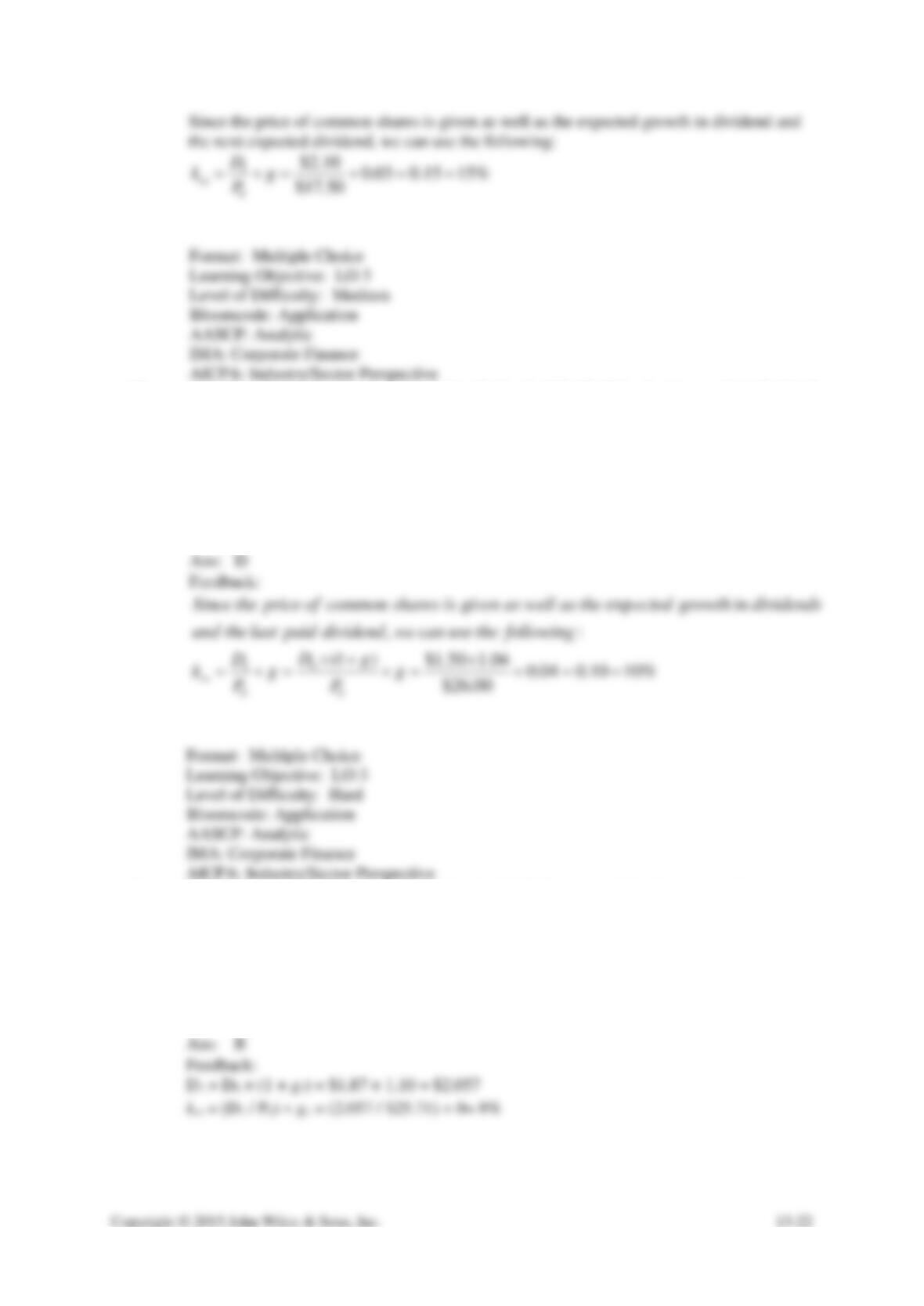
Gangland Water Guns, Inc. is expected to pay a dividend of $2.10 one year from today. If
the firm’s growth in dividends is expected to remain at a flat 3 percent forever, then what is
the cost of equity capital for Gangland if the price of its common shares is currently $17.50?
A)
12.00%
B)
14.65%
C)
15.00%
D)
15.36%
Fundamentals of Corporate Finance 3e Test Bank
62.
UltraFlex Diving Boards, Inc. just paid a dividend of $1.50. If the firm’s growth in dividends
is expected to remain at a flat 4 percent forever, then what is the cost of equity capital for
Ultra Flex Diving Boards if the price of its common shares is currently $26.00?
A)
5.77%
B)
6.00%
C)
9.77%
D)
10.00%
D
63.
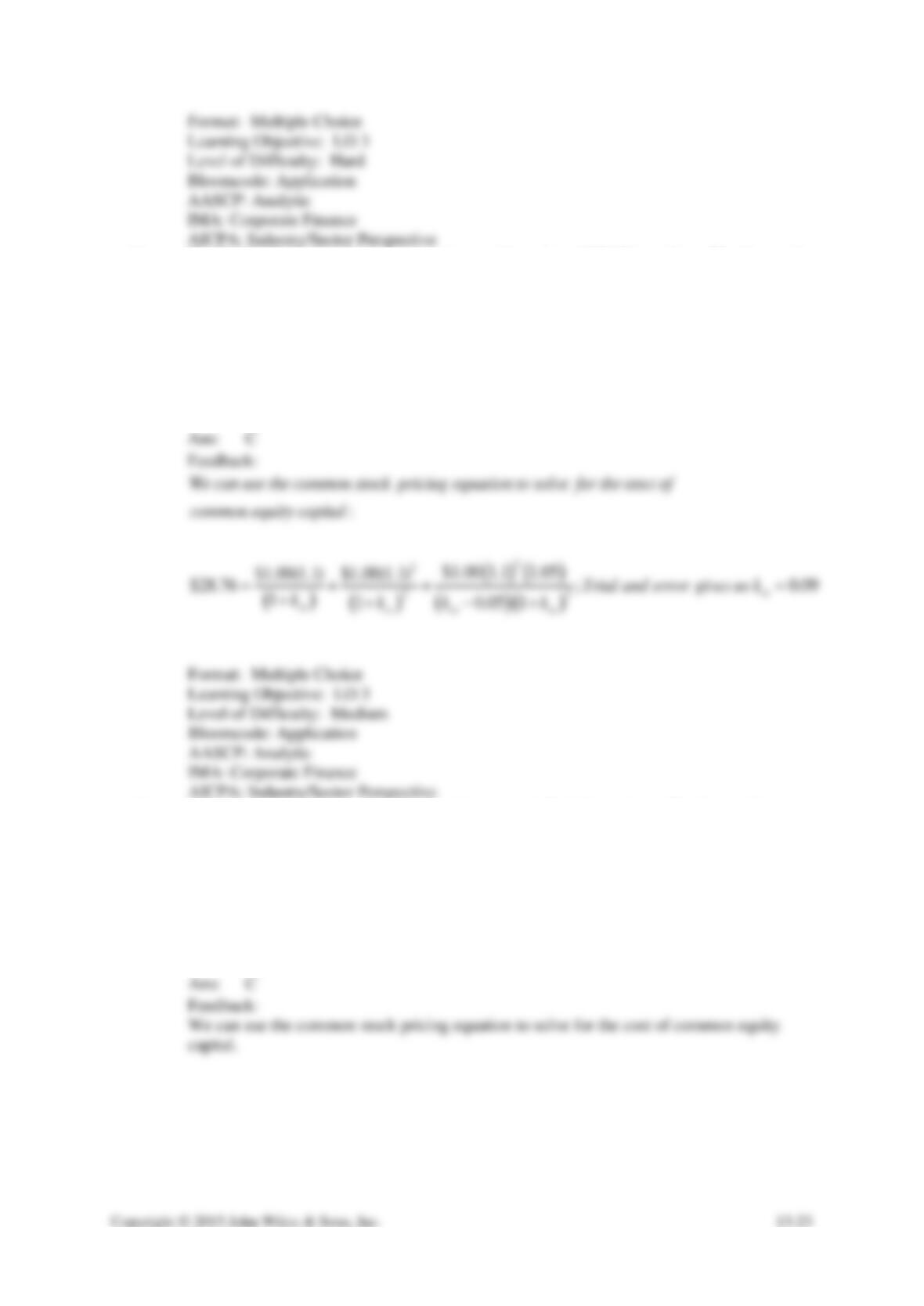
Turquoise Electronics, Inc. paid a dividend of $1.87 last year. If the firm’s growth in
dividends is expected to be 10 percent next year and then zero thereafter, then what is its
cost of equity capital if the price of its common shares is currently $25.71?
A)
7.27%
B)
8.00%
C)
18.00%
D)
The problem is not solvable with the information that is given.
Ans:
B
Fundamentals of Corporate Finance 3e Test Bank
64.
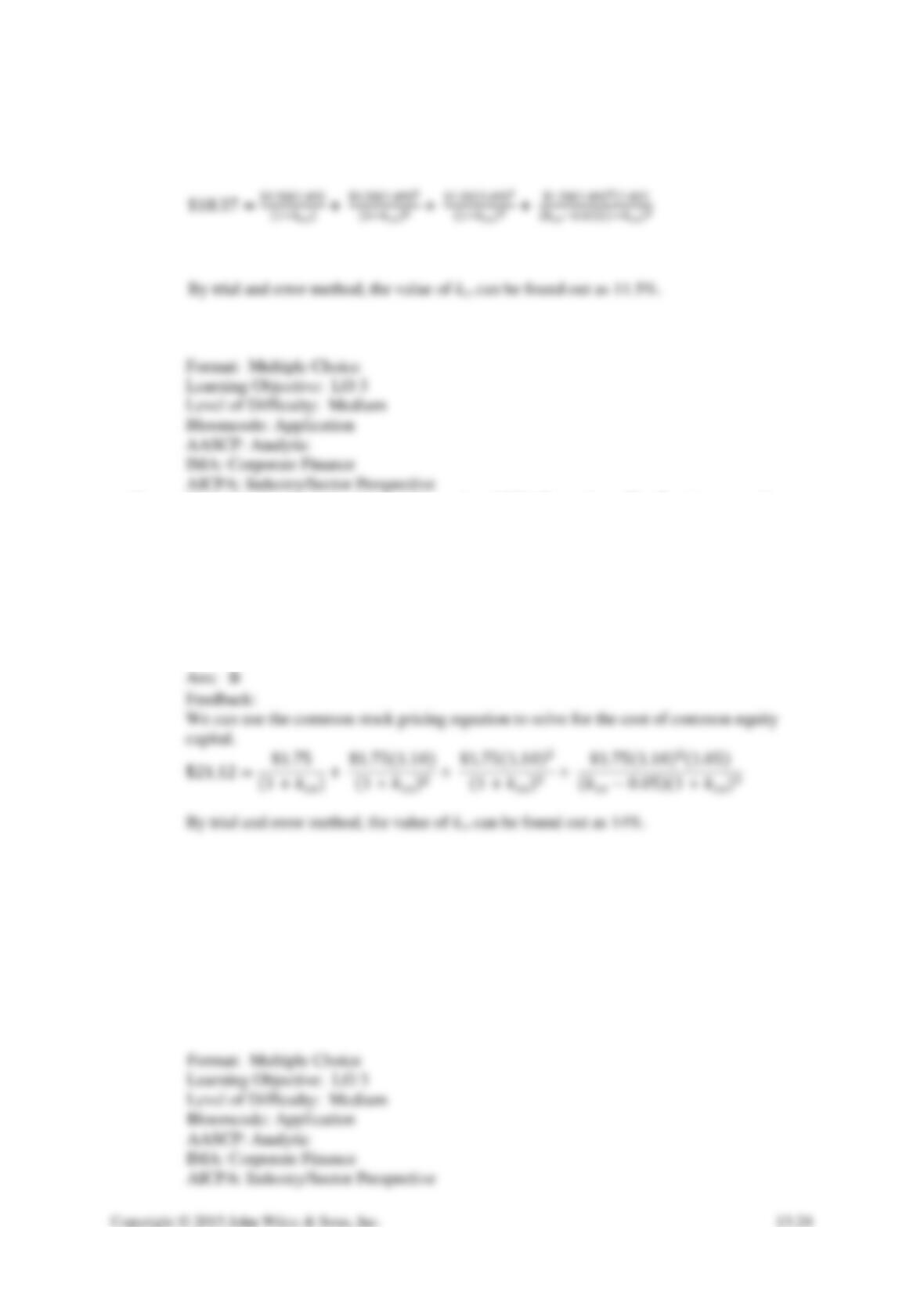
The Dedus Shoes, Inc. has common shares with a price of $28.76 per share. The firm paid a
dividend of $1.00 yesterday, and dividends are expected to grow at 10 percent for two years
and then at 5 percent, thereafter. What is the implied cost of common equity capital for
Dedus? Round your final percentage answer to 1 decimal place.
A)
7.00%
B)
8.00%
C)
9.00%
D)
10.00%
Ans:
C
Feedback:
65.
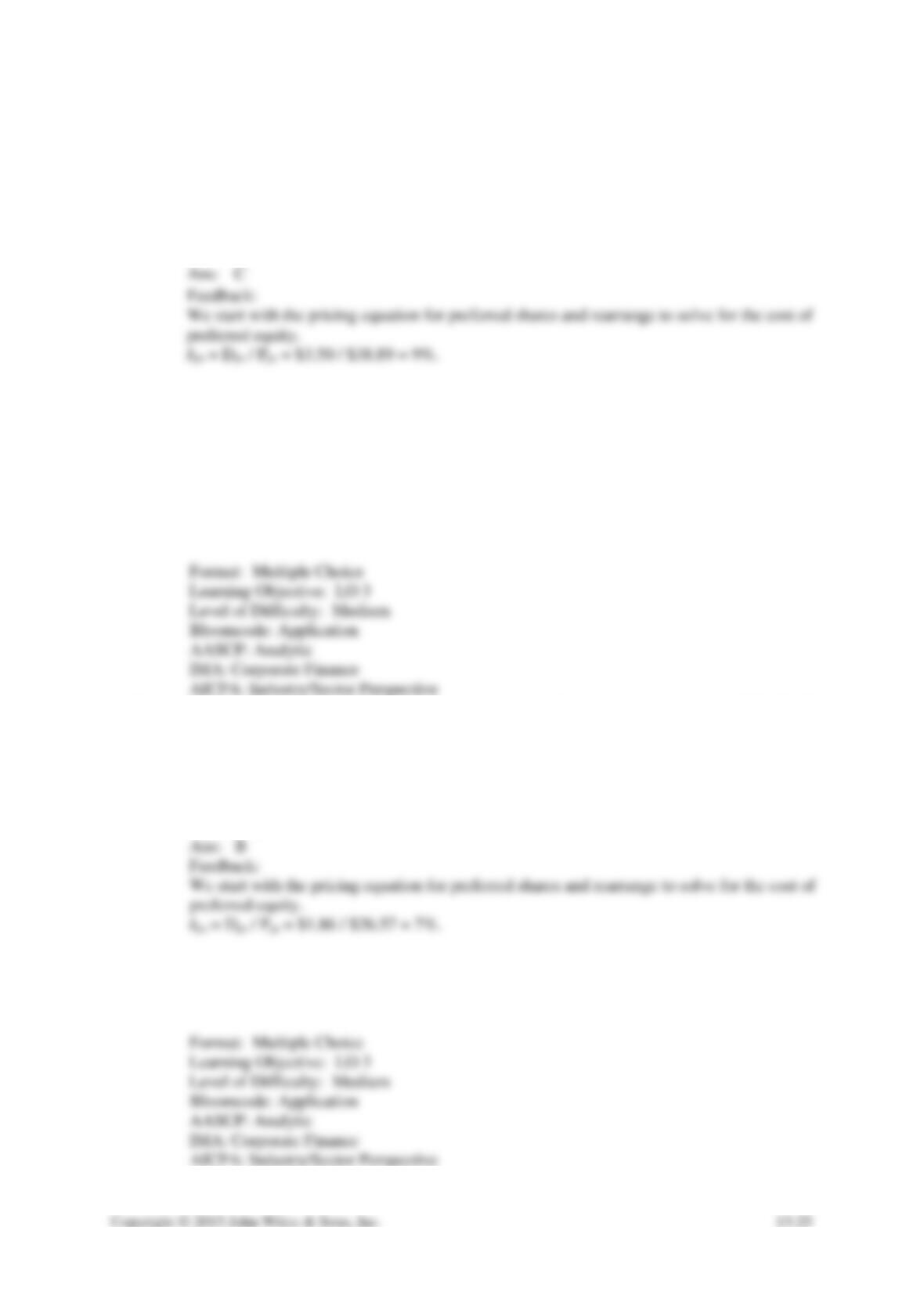
Tranquility, Inc. has common shares with a price of $18.37 per share. The firm paid a
dividend of $1.50 yesterday, and dividends are expected to grow at 9 percent for three years
and then at 2 percent thereafter. What is the implied cost of common equity capital for
Tranquility? Round your final percentage answer to 1 decimal place.
A)
9.5%
B)
10.5%
C)
11.5%
D)
12.5%
Ans:
C
Fundamentals of Corporate Finance 3e Test Bank
66.
Oasis, Inc. has common shares with a price of $21.12 per share. The firm is expected to
pay a dividend of $1.75 one year from today, and dividends are expected to grow at 10
percent for two years after that and then at 5 percent thereafter. What is the implied cost
of common equity capital for Oasis? Round your final answer to nearest percentage.
A)
13%
B)
14%
C)
15%
D)
16%
Ans:
B
Fundamentals of Corporate Finance 3e Test Bank
67.
Billy’s Goat Coats has a preferred share issue outstanding with a current price of $38.89.
The firm last paid a dividend on the issue of $3.50 per share. What is the firm’s cost of
preferred equity? Round your final answer to nearest percentage.
A)
7%
B)
8%
C)
9%
D)
10%
Ans:
C
68.
Wally’s War Duds has a preferred share issue outstanding with a current price of $26.57. The
firm is expected to pay a dividend of $1.86 per share a year from today. What is the firm’s
cost of preferred equity? Round your final answer to nearest percentage.
A)
6.50%
B)
7.00%
C)
7.50%
D)
8.00%
Ans:
69.
Melba’s Toast has a preferred share issue outstanding with a current price of $19.50. The
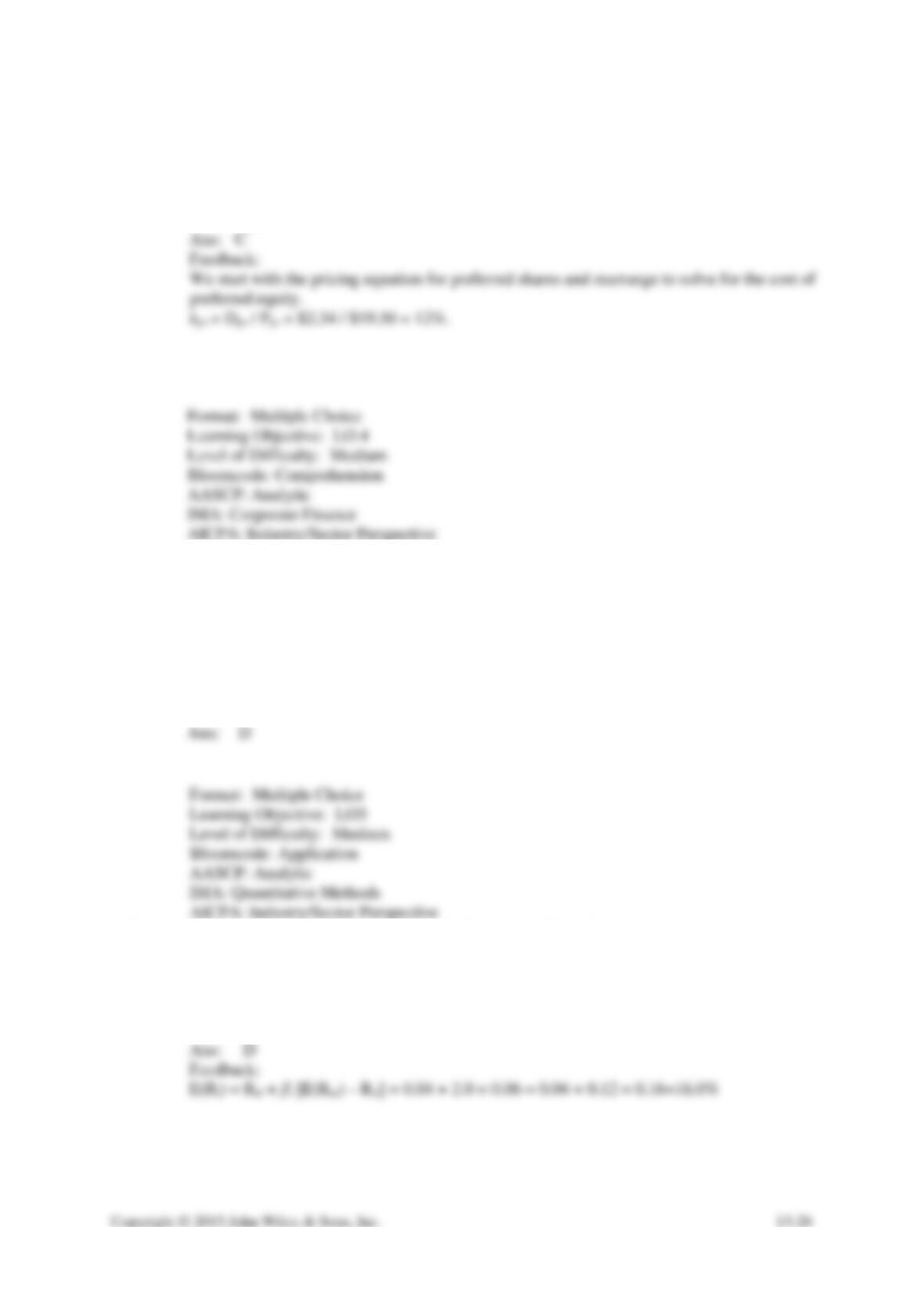
Fundamentals of Corporate Finance 3e Test Bank
firm is expected to pay a dividend of $2.34 per share a year from today. What is the firm’s
cost of preferred equity?
A)
11.50%
B)
11.75%
C)
12.00%
D)
12.25%
Ans:
C
70.
In order to use a firm’s WACC to evaluate its future project’s flows, which of the following
must hold?
A)
The project will be financed with the same proportion of debt and equity as the firm.
B)
The systematic risk of the project is the same as the overall systematic risk of the
firm.
C)
The project should have conventional cash flows.
D)
Both A and B above
Ans:
D
71.
If the market risk premium is currently 6 percent and the risk-free rate of return is 4 percent, t
what is the expected return on a common share with a beta equal to 2?
A)
8.0%
B)
10.0%
C)
12.0%
D)
16.0%
Ans:
Fundamentals of Corporate Finance 3e Test Bank
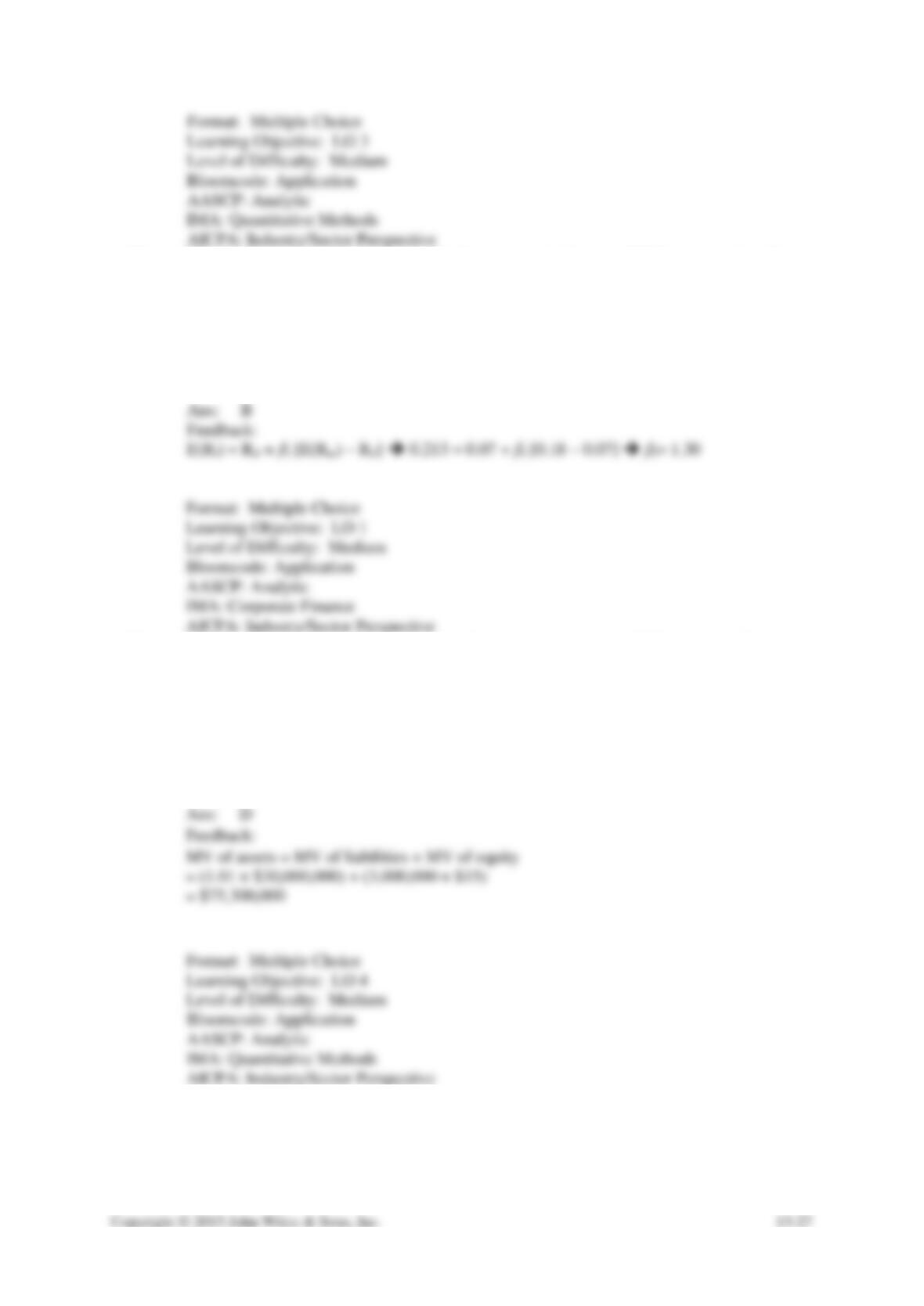
72.
What is the beta of a firm whose equity has an expected return of 21.3 percent when the
risk-free rate of return is 7.0 percent and the expected return on the market is 18.0 percent?
A)
0.79
B)
1.30
C)
1.57
D)
None of the above
73.
Stryder, Inc. has 3 million shares outstanding at a current price of $15 per share. The book
value of the shares is $10 per share. The firm also has $30 million in par value of bonds
outstanding. The bonds are selling at a price equal to 101 percent of par. What is the
market value of the firm?
A)
$30.0 million
B)
$45.0 million
C)
$75.0 million
D)
$75.3 million
Ans:
D
Feedback:
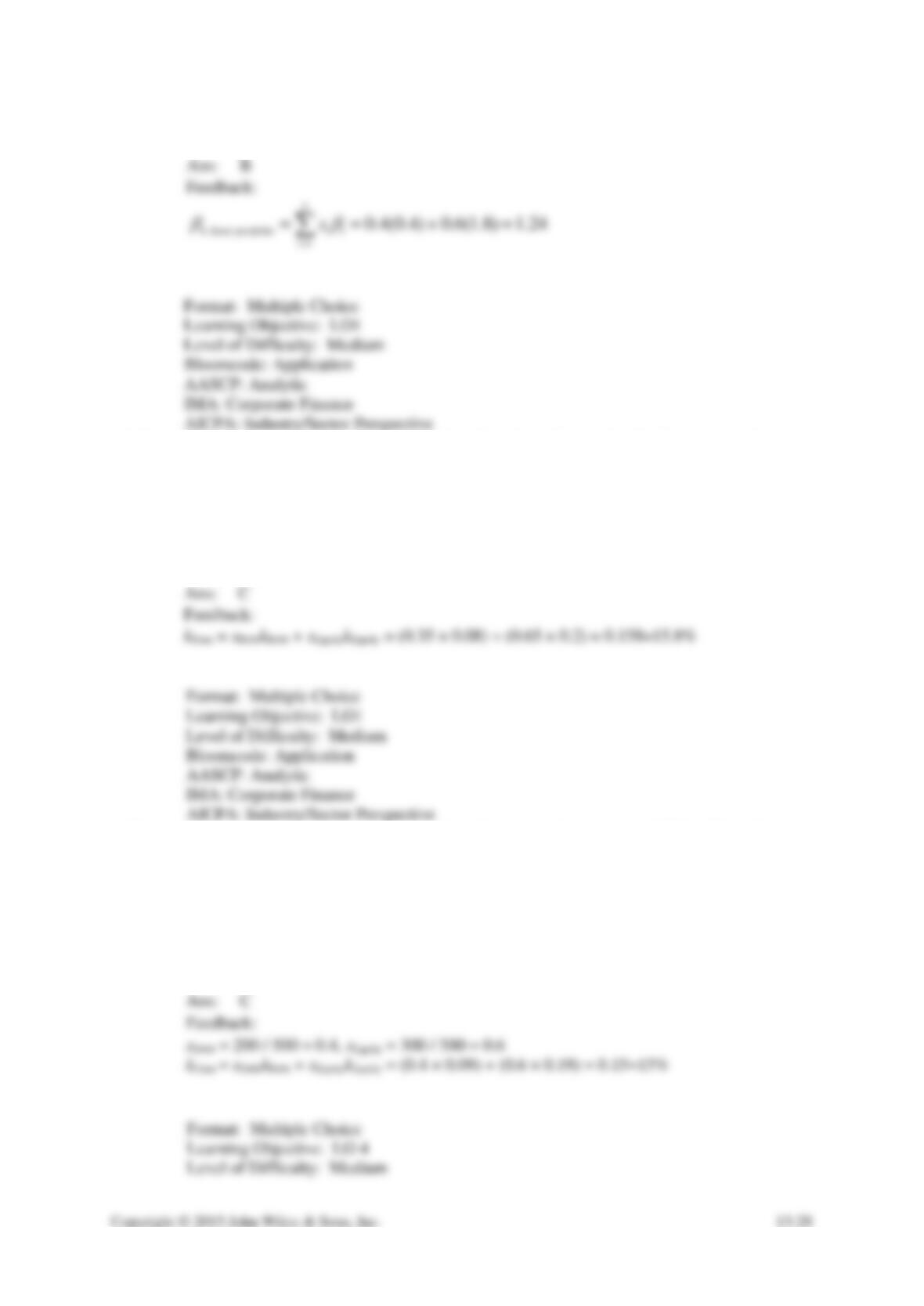
74.
The Diverse Co. has invested 40 percent of the firm’s assets in a project with a beta of 0.4
and the remaining assets in a project with a beta of 1.8. What is the beta of the firm?
A)
0.96
B)
1.24
Fundamentals of Corporate Finance 3e Test Bank
C)
1.28
D)
None of the above
Ans:
B
Feedback:
75.
You are analyzing the cost of capital for a firm that is financed with 65 percent equity
and 35 percent debt. The cost of debt capital is 8 percent, while the cost of equity capital
is 20 percent for the firm. What is the overall cost of capital for the firm?
A)
12.2%
B)
14.0%
C)
15.8%
D)
20.0%
Ans:
C
Feedback:
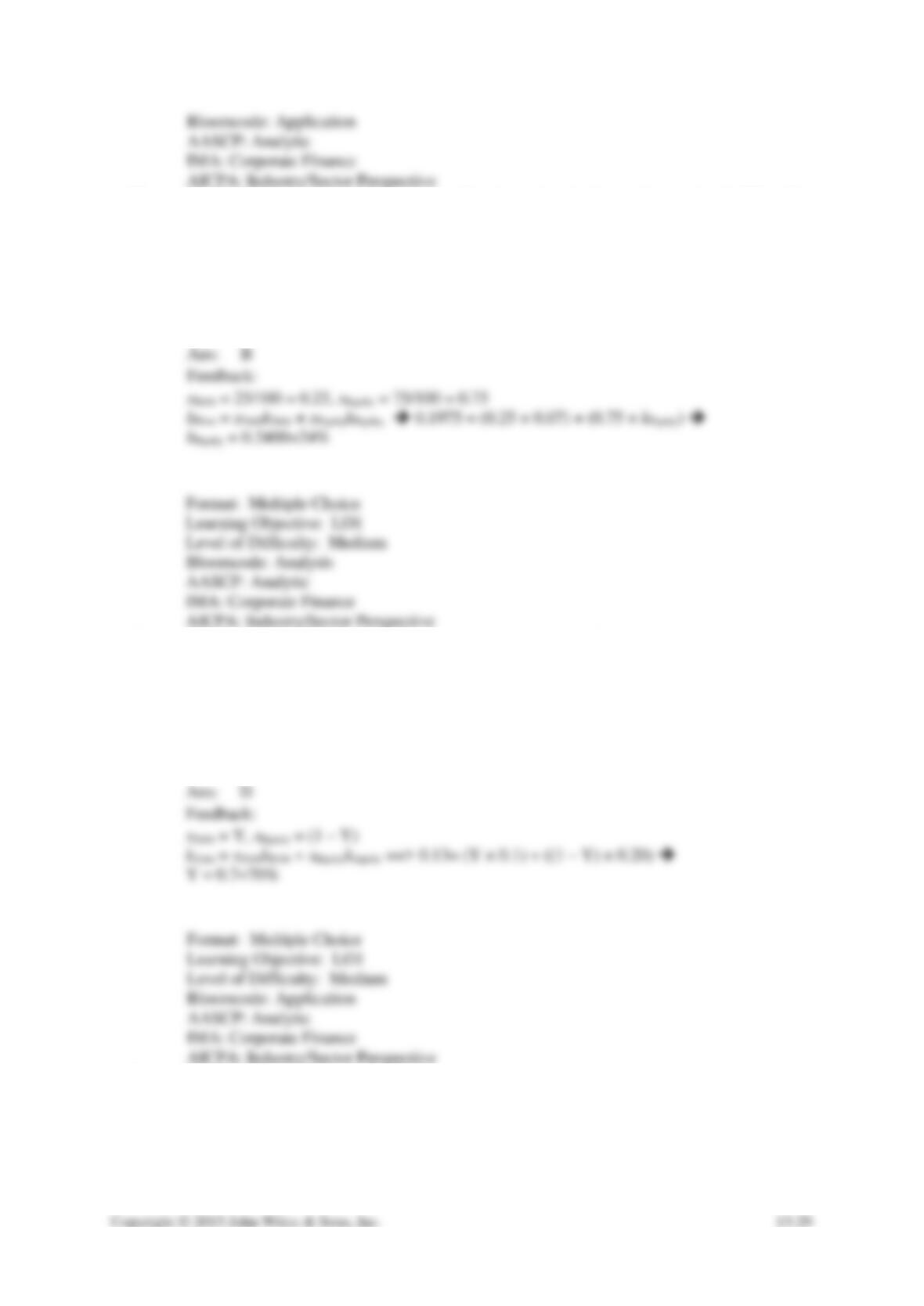
76.
You are analyzing the cost of capital for a firm that is financed with $300 million of equity
and $200 million of debt. The cost of debt capital for the firm is 9 percent, while the cost of
equity capital is 19 percent. What is the overall cost of capital for the firm? Assume there
are no taxes.
A)
13.0%
B)
14.0%
C)
15.0%
D)
16.0%
Ans:
C
Feedback:
Fundamentals of Corporate Finance 3e Test Bank
77.
The WACC for a firm is 19.75 percent. You know that the firm is financed with $75 million
of equity and $25 million of debt. The cost of debt capital is 7 percent. What is the cost of
equity for the firm? Assume there are no taxes.
A)
19.75%
B)
24.00%
C)
32.50%
D)
58.00%
Ans:
B
Feedback:
78.
The WACC for a firm is 13.00 percent. You know that the firm’s cost of debt capital is 10
percent and the cost of equity capital is 20%. What proportion of the firm is financed with
debt? Assume there are no taxes.
A)
30%
B)
33%
C)
50%
D)
70%
Ans:
D
Feedback:
79.
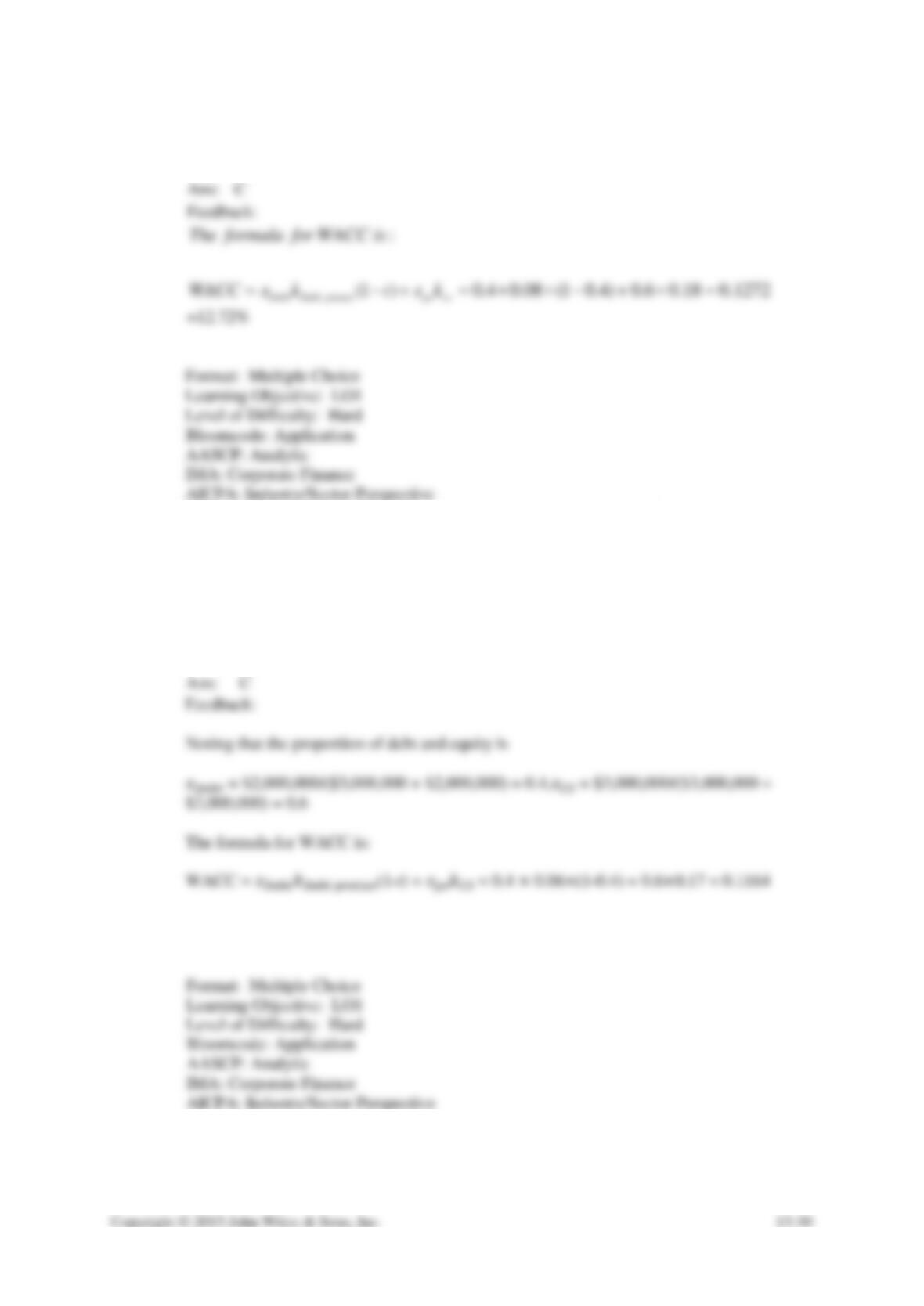
Swirlpool, Inc. has found that its cost of common equity capital is 18 percent, and its cost of
debt capital is 8 percent. The firm is financed with 60 percent common shares and 40
percent debt. What is the after-tax weighted average cost of capital for Swirlpool, if it is
subject to a 40 percent marginal tax rate?
A)
10.37%
Fundamentals of Corporate Finance 3e Test Bank
B)
12.00%
C)
12.72%
D)
14.00%
Ans:
C
Feedback:
80.
Maloney’s, Inc. has found that its cost of common equity capital is 17 percent and its cost
of debt capital is 6 percent. The firm is financed with $3,000,000 of common shares
(market value) and $2,000,000 of debt. What is the after-tax weighted average cost of
capital for Maloney’s, if it is subject to a 40 percent marginal tax rate?
A)
8.96%
B)
11.16%
C)
11.64%
D)
12.60%
81.
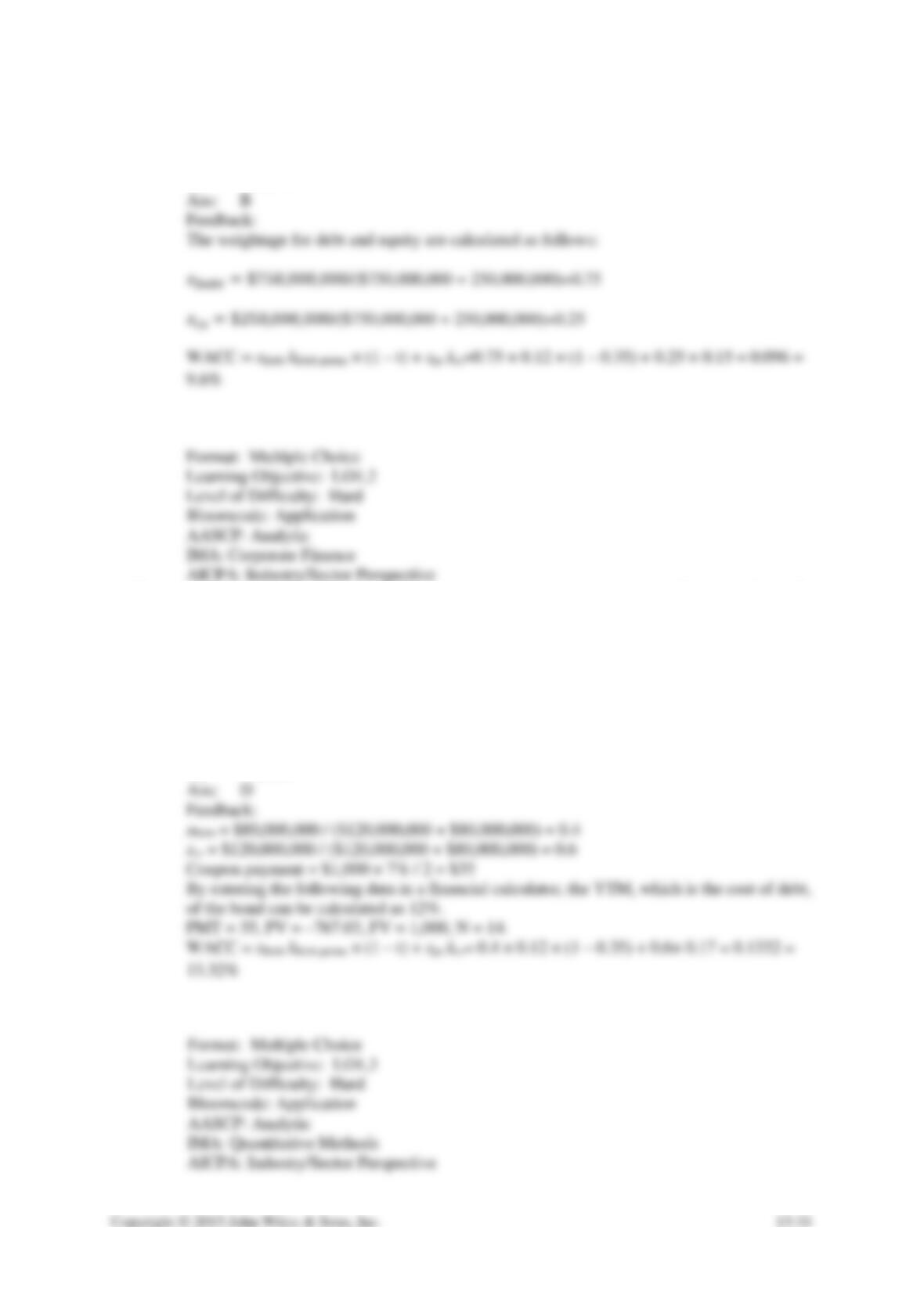
Ronnie’s Comics has found that its cost of common equity capital is 15 percent and its cost
of debt capital is 12 percent. The firm is financed with $250,000,000 of common shares
(market value) and $750,000,000 of debt. What is the after-tax weighted average cost of
capital for Ronnie’s, if it is subject to a 35 percent marginal tax rate?
Fundamentals of Corporate Finance 3e Test Bank
A)
6.05%
B)
9.6%
C)
8.75%
D)
13.65%
Ans:
B
AICPA: Industry/Sector Perspective
82.
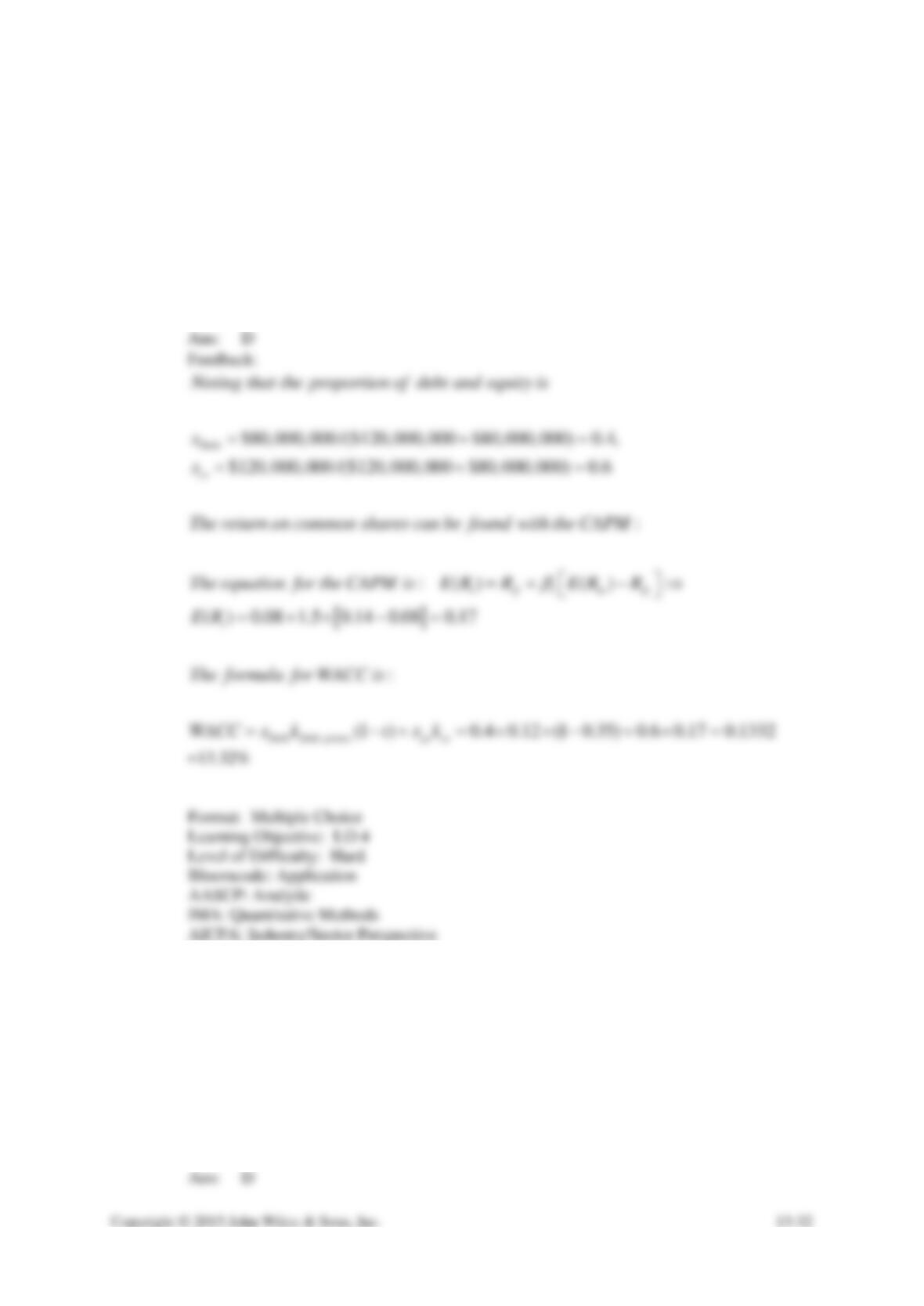
Poly’s Parrot Shops has found that its cost of common equity capital is 17 percent. It has 7–
year maturity semiannual bonds outstanding with a price of $767.03 that have a coupon rate
of 7 percent. The firm is financed with $120,000,000 of common shares (market value) and
$80,000,000 of debt. What is the after-tax weighted average cost of capital for Poly’s, if it is
subject to a 35 percent marginal tax rate? Round your final percentage answer to two
decimal places.
A)
10.20%
B)
11.76%
C)
11.88%
D)
13.32%
Ans:
D
Fundamentals of Corporate Finance 3e Test Bank
83.
Marley’s Pipe Shops has found that its common equity capital shares have a beta equal to 1.5
while the risk-free return is 8 percent and the expected return on the market is 14 percent. Its
cost of debt financing is 12 percent. The firm is financed with $120,000,000 of common
shares (market value) and $80,000,000 of debt. What is the after-tax weighted average cost
of capital for Marley’s, if it is subject to a 35 percent marginal tax rate?
A)
10.20%
B)
11.76%
C)
11.88%
D)
13.32%
Ans:
D
Feedback:
84.
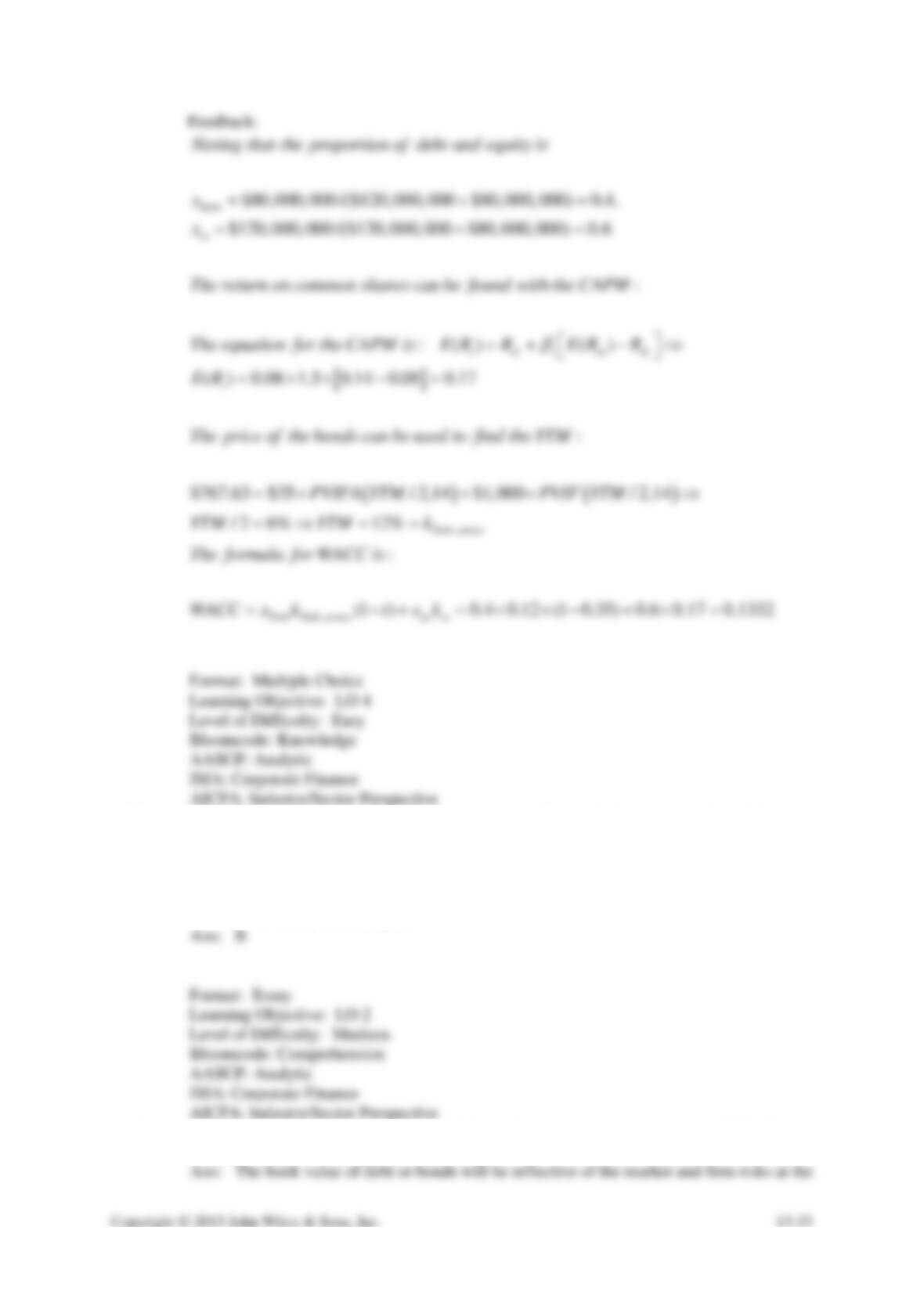
Droz’s Hiking Gear, Inc. has found that its common equity capital shares have a beta equal to
1.5 while the risk-free return is 8 percent and the expected return on the market is 14 percent.
It has 7-year semiannual maturity bonds outstanding with a price of $767.03 that have a
coupon rate of 7 percent. The firm is financed with $120,000,000 of common shares (market
value) and $80,000,000 of debt. What is the after-tax weighted average cost of capital for
Droz’s, if it is subject to a 35 percent marginal tax rate? Round your final percentage answer
to two decimal places.
A)
10.20%
B)
11.76%
C)
11.88%
D)
13.32%
Ans:
Fundamentals of Corporate Finance 3e Test Bank
85.
Which type of project do financial managers typically use the highest cost of capital when
evaluating?
A)
Extension projects
B)
New product projects
C)
Efficiency projects
D)
Market expansion projects
86.
Briefly explain why the book value of debt might not reflect the current cost of debt for a
firm, with respect to a single issuance of debt?
Fundamentals of Corporate Finance 3e Test Bank
87.
Explain the conditions under which the constant-growth dividend formula for the cost of
common stock can be used to find the cost of common equity capital for a firm.
88.
Discuss the two major conditions for when a firm may use its current weighted average
cost of capital to evaluate a new project’s cash flows.