Page 1
1. A simple regression model contains:
A) two independent variables
B) two dependent variables
C) one independent and one dependent variable
D) more than one independent variable
2. A linear regression:
A) gives a relationship between two variables that can be described by a line
B) gives a relationship between two variables that cannot be described by a line
C) gives a relationship between three variables that can be described by a line
D) contains only two variables
3. In a regression model, the y-intercept is the:
A) point where the y-axis intersects the x-axis
B) point where the regression line intersects the y-axis
C) point where the x-axis intersects the y–axis
D) value of y when x is equal to 1
4. In a regression model, the slope represents the:
A) point where the y-axis intersects the x-axis
B) change in y due to a one unit change in x
C) point where the x-axis intersects the y-axis
D) change in the independent variable due to a one unit change in the dependent
variable
model and its equation.
5. In the equation
12 6yx=+
, y is the:
A) independent variable C) dependent variable
B) slope of the line D) y-intercept
6. In the equation
12 6yx=+
, x is the:
A) independent variable C) dependent variable
B) slope of the line D) y-intercept
Chapter 13
Page 2
7. In the equation
23yx=+
, 2 is the:
A) independent variable C) dependent variable
B) slope of the line D) y-intercept
8. In the equation
36yx=+
, 6 is the:
A) independent variable C) dependent variable
B) slope of the line D) y–intercept
9. In the equation
120 14yx=−
, 120 is the:
A) value of y when x is equal to 1
B) point where the line intersects the x-axis
C) change in y due to a one-unit change in x
D) point where the line intersects the y-axis
10. In the equation
85 17yx=−
, −17 is the:
A) value of y when x is equal to 1
B) point where the line intersects the x-axis
C) change in y due to a one-unit change in x
D) change in x due to a one-unit change in y
11. The model
y A Bx=+
is a:
A) probabilistic model C) stochastic model
B) nonlinear model D) deterministic model
12. The regression model
y A Bx e= + +
is:
A) a probabilistic model C) an exact relationship
B) a nonlinear model D) a deterministic model
Chapter 13
Page 3
13. In the regression model
y A Bx e= + +
, A and B are the:
A) sample statistics C) population parameters
B) random variables D) omitted variables
14. In the regression model
y A Bx e= + +
,
e
is the:
A) slope of the regression line C) y-intercept
B) random error term D) missing variable
15. In the regression model
y A Bx e= + +
, x is the:
A) dependent variable C) error term
B) independent variable D) missing variable
16. In the regression model
y A Bx e= + +
, y is the:
A) dependent variable C) error term
B) independent variable D) missing variable
17. In a regression model, the random error term is included to capture the effects of the:
A) independent variable
B) dependent variable
C) missing variables and random variation
D) deterministic relationship
18. In the regression model
ˆ
y a bx=+
, a and b are the:
A) estimates of the population parameters A and B
B) random variables
C) population parameters
D) omitted variables
Chapter 13
19. In the regression model
ˆ
y a bx=+
, a and b are the:
A) sample statistics C) population parameters
B) random variables D) omitted variables
20. In the regression model
ˆ
y a bx=+
,
ˆ
y
is the:
A) actual value of y C) value of y when a and b are zero
B) predicted value of y D) missing value of y
21. We construct a scatter diagram by:
A) scattering the values of x over the values of y
B) scattering the values of y over the values of x
C) plotting the paired values of x and y
D) plotting the values of the population parameters A and B
22. The value of y obtained for an element from a survey is the:
A) predicted value of y C) actual value of y
B) estimated value of y D) residual
23. The random error for the sample regression model, denoted by e, is equal to the:
A) predicted value of y minus the estimated value of y
B) estimated value of y minus the predicted value of y
C) actual value of y minus the predicted value of y
D) actual value of y minus the actual value of x
24. For a regression model, the error sum of squares, denoted by SSE, is equal to the sum of
the:
A) errors
B) squares of errors
C) squares of y values
D) squares of the difference between x and y values
Chapter 13
25. The least squares method minimizes the:
A) difference between the y and x values C) sum of the squares of errors
B) sum of the errors D) sum of the y values
26. The value of
xx
SS
:
A) is always negative C) is always positive
B) is always non-negative D) can be negative, zero, or positive
27. The value of
xy
SS
:
A) is always negative C) is always positive
B) is always non-negative D) can be negative, zero, or positive
28. Given that
xx
SS =
875 and
xy
SS =
275, the value of b in the regression of y on x, rounded
to two decimal places, is:
29. Given that
xx
SS =
968 and
xy
SS =
–915, the value of b in the regression of y on x,
rounded to two decimal places, is:
30. For a data set on x and y, the value of
xx
SS
is 979,
xy
SS
is –1,538, the mean of the x
values is 88 , and the mean of the y values is 55. The value of a in the regression of y on
x, rounded to two decimal places, is:
31. For a data set on x and y, the value of
xx
SS
is 831,
xy
SS
is 386, the mean of the x values
is 9 , and the mean of the y values is 48. The value of a in the regression of y on x,
rounded to two decimal places, is:
Chapter 13
Page 6
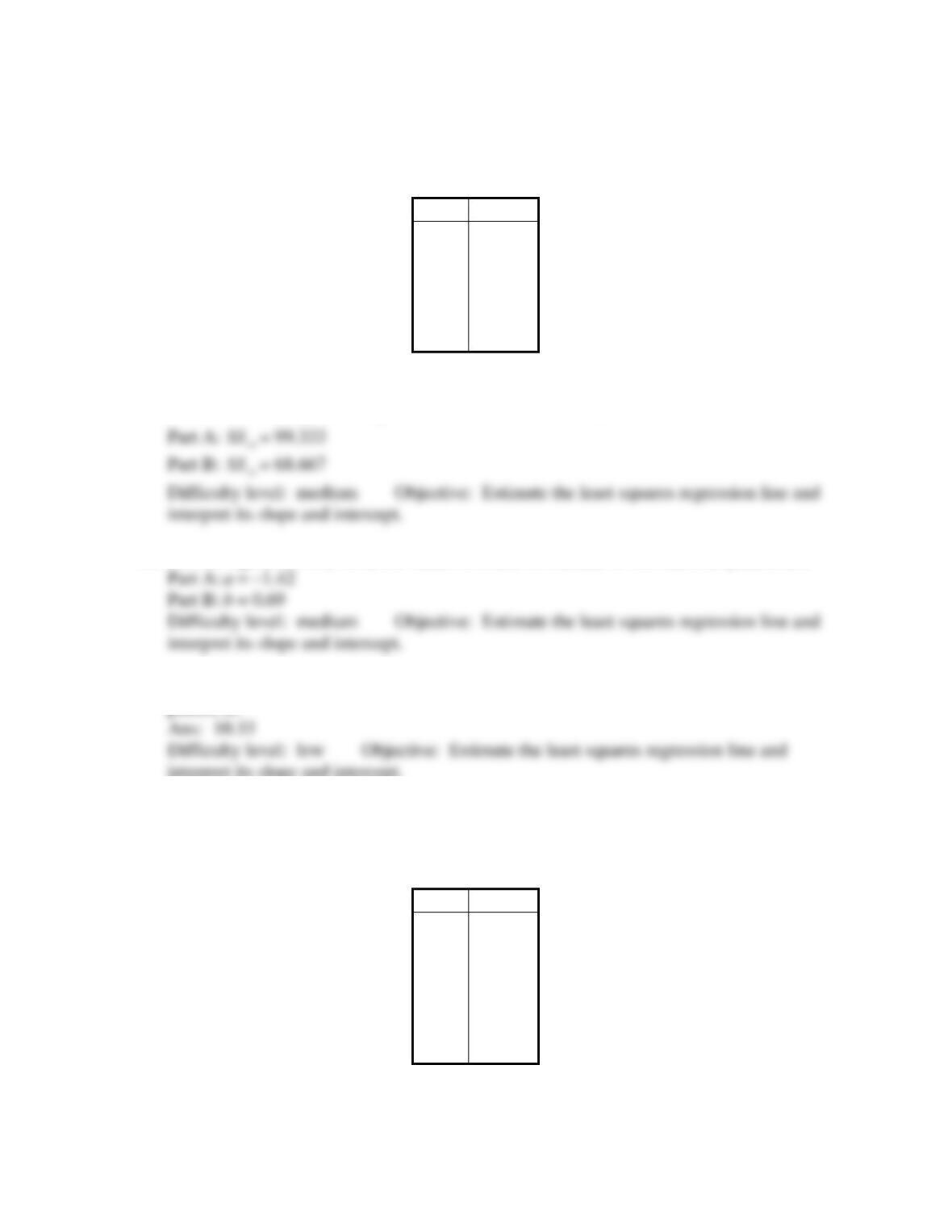
Use the following to answer questions 32-34:
The table shown below gives six pairs of x and y values.
x
y
16
8
20
13
12
9
10
4
9
6
9
4
32. The values of
xx
SS
and
xy
SS
, rounded to three decimal places, are:
33. For the regression of y on x, the values of a and b, rounded to two decimal places, are:
34. Using the regression of y on x, the predicted value of y for x = 17, rounded to two decimal
places, is:
interpret its slope and intercept.
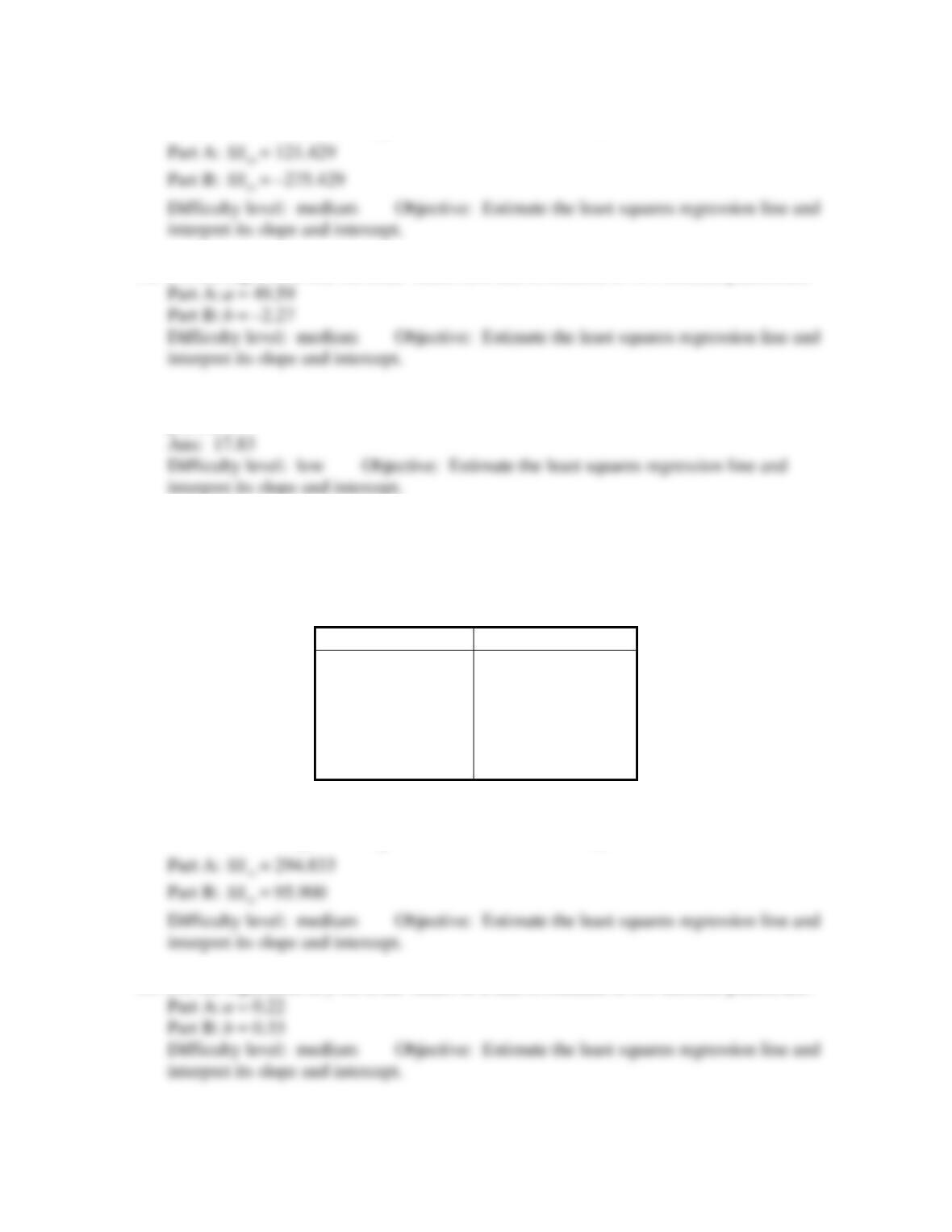
Use the following to answer questions 35-37:
The table shown below gives seven pairs of x and y values.
x
y
12
18
9
35
14
12
8
40
10
29
4
33
18
10
xy
SS
Chapter 13
Page 7
35. The values of
xx
SS
and
xy
SS
, rounded to three decimal places, are:
36. For the regression of y on x, the values of a and b, rounded to two decimal places, are:
37. Using the regression of y on x, the predicted value of y for x = 14, rounded to two decimal
places, is:
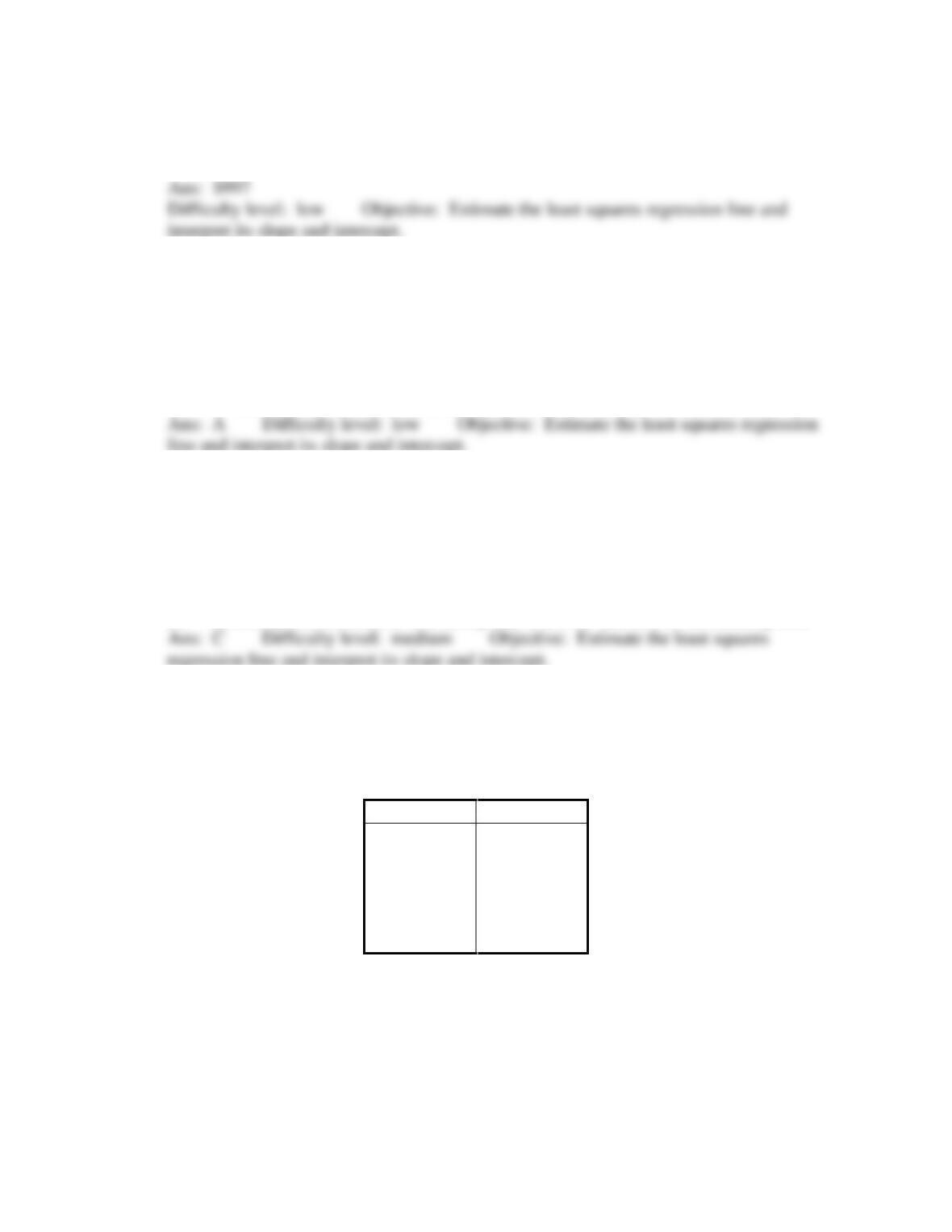
Use the following to answer questions 38-42:
The following table lists the monthly incomes (in hundreds of dollars) and the monthly rents paid
(in hundreds of dollars) by a sample of six families.
Monthly Income
Monthly Rent
24
7.0
16
4.5
19
6.5
31
11.6
10
4.5
27
8.5
38. The values of
xx
SS
and
xy
SS
, rounded to three decimal places, are:
39. For the regression of y on x, the values of a and b, rounded to two decimal places, are:
xy
SS
Chapter 13
Page 8
40. Using the regression of monthly rent paid on monthly income, the predicted value of
monthly rent paid by a family with a monthly income of $3,000, rounded to the nearest
dollar, is:
41. Suppose we have information on the monthly incomes and the monthly rents paid by a
sample of families. In the regression of monthly rent paid on the monthly income for
these data, the value of a will represent:
A) the point where this regression line will intersect the y-axis
B) the point where this regression line will intersect the x-axis
C) an increase in the monthly rent paid by a family due to a $100 increase in income
D) an increase in the income of a family due to a $100 increase in the monthly rent
42. Suppose we have information on the monthly incomes and the monthly rents paid by a
sample of families. In the regression of monthly rent paid on the monthly income for
these data, the value of b will represent:
A) the point where this regression line will intersect the y-axis
B) the point where this regression line will intersect the x-axis
C) an increase in the monthly rent paid by a family due to a $100 increase in income
D) an increase in the income of a family due to a $100 increase in the monthly rent
regression line and interpret its slope and intercept.
Use the following to answer questions 43-47:
The following table lists the ages (in years) and the prices (in thousands of dollars) by a sample
of six houses.
Age
Price
27
165
15
182
3
205
35
161
7
180
18
161
Chapter 13
43. The values of
xx
SS
and
xy
SS
, rounded to three decimal places, are:
xy
SS
44. For the regression of price on age, the estimated values of A and B, rounded to two
decimal places, are:
45. Using the regression of house value on age, the predicted value of a house that 16 years
old, rounded to the nearest dollar, is:
46. Suppose we have information on the ages (in years) and the prices of a sample of houses.
In the regression of price on age for these data, the value of a will represent:
A) the point where this regression line will intersect the y-axis
B) the point where this regression line will intersect the x-axis
C) an decrease in the age of a house due to a $1,000 increase in its price
D) an decrease in the price of a house due to a one year increase in its age
47. Suppose we have information on the ages (in years) and the prices of a sample of houses.
In the regression of price on age for these data, the value of b will represent:
A) the point where this regression line will intersect the y-axis
B) the point where this regression line will intersect the x-axis
C) an decrease in the age of a house due to a $1,000 increase in its price
D) an decrease in the price of a house due to a one year increase in its age
48. An assumption of the regression model is that the random error term has a mean equal to:
A) zero for each x C) the value of each x
B) one for each x D) zero for each y
Chapter 13
49. An assumption of the regression model is that the distribution of errors is
A) binomial B) rectangular C) normal D) bimodal
50. The regression model assumes that the spread of points around the regression line is:
A) different for all values of x C) similar for all values of y
B) different for all values of y D) similar for all values of x
51. The degrees of freedom for a simple linear regression of sample size n are:
A) n – 1 B) n – 2 C) n – 3 D) 2n – 1
52. The coefficient of determination represents the proportion of:
A) SSE (error sum of squares) that the regression model explains
B) SSR (regression sum of squares) that the regression model explains
C) SST (total sum of squares) that the regression model explains
D) SSR (regression sum of squares) that the regression model does not explain
53. The value of
yy
SS
:
A) is always negative C) is always positive
B) is always nonnegative D) can be negative, positive, or zero
54. The value of the coefficient of determination is always:
A) less than 1 C) in the range zero to 1
B) greater than 1 D) between -1 and 1
55. The total sum of squares (SST) is always equal to the:
A) regression sum of squares plus the error sum of squares
B) regression sum of squares minus the error sum of squares
C) error sum of squares minus the regression sum of squares
D) regression sum of squares divided by the error sum of squares
Chapter 13
56. The coefficient of determination is equal to the:
A) total sum of squares divided by the regression sum of squares
B) error sum of squares divided by the regression sum of squares
C) regression sum of squares divided by the total sum of squares
D) error sum of squares divided by the total sum of squares
57. One way to measure the quality of the regression model is to inspect the value of the:
A) constant term C) coefficient of determination
B) coefficient on x D) mean of x
Use the following to answer questions 58-59:
For a sample of 22 values of x and y,
yy
SS =
746,
xy
SS =
254, and b = 1.36.
58. The standard deviation of errors for the regression of y on x, rounded to three decimal
places, is:
59. The coefficient of determination for the regression of y on x, rounded to three decimal
places, is:
Use the following to answer questions 60-61:
For a sample of 19 values of x and y,
yy
SS =
294,
xy
SS =
502, and b = 0.27.
60. The standard deviation of errors for the regression of y on x, rounded to three decimal
places, is:
61. The coefficient of determination for the regression of y on x, rounded to three decimal
places, is: