Chapter 13—Reviewing Statistical Theory and Determining Sample Size
TRUE/FALSE
1. The primary purpose of inferential statistics is to make a judgment about a population.
2. Population parameters are measured characteristics of a specific population.
3. Percentage frequency is the long-run relative frequency with which an event will occur.
4. A top-box score refers to the top quartile of responses.
5. The mean is simply the arithmetic average.
6. The midpoint of a distribution, above which and below which half of the scores fall, is called the
mode.
7. The mode is the measure of central tendency that identifies the value that occurs most often.
8. If between 125 and 150 units of a product have been produced each day during the past month, the
range of this production is 150 units.
9. The average deviation score is frequently used in marketing research studies.
10. The standard deviation eliminates the drawback of having the measure of dispersion in squared units
rather than the original measurement units.
11. The normal distribution is represented by the normal curve.
12. One hundred percent of the scores in a normal distribution fall within plus or minus two standard
deviations of the mean.
13. The standardized normal distribution has a mean of 1.0 and a standard deviation of zero.
14. The standardized normal distribution is a purely theoretical probability distribution and is of little use
in inferential statistics.
15. The standardized value of Z is computed by the formula: Z = (X –
)/
.
16. A frequency distribution of a sample is called a probability distribution.
17. “As sample size increases, the distribution of sample means of samples of size n (when randomly
selected) approaches a normal distribution” is a fundamental assumption of the central-limit theorem.
18. A point estimate is an estimate of the population mean in the form of a single value.
19. A confidence range is a specified range of numbers within which a population mean is expected to lie.
20. A common practice in marketing research is to use the 75 percent confidence interval about the mean
in research studies.
21. A researcher must calculate the population mean to calculate the confidence intervals.
22. The confidence interval increases as the sample size, n, increases.
23. Three factors are required to specify sample size: (1) the variance of the population; (2) the population
mean; and (3) the confidence level.
24. The variance, or heterogeneity, of the population refers to the standard deviation of the population.
25. In most cases, the size of the population does not have a major effect on the sample size.
MULTIPLE CHOICE
1. When a researcher wants to estimate national market share based on the results of the test market for a
new product in St. Louis and Kansas City, this is an example of _____.
a.
descriptive statistics
b.
the central limit theorem
c.
inferential statistics
d.
the standardized normal distribution
2. Measures computed from sample data are called _____.
a.
sample statistics
b.
population parameters
c.
sample frequencies
d.
normalized scores
3. A set of data organized by summarizing the number of times a particular value of a variable occurs is
referred to as a(n) _____.
a.
inference table
b.
frequency distribution
c.
probability sample
d.
sample summary
4. Hank has developed a set of data organized by summarizing the values resulting from rolling a pair of
die. He constructed a table of his data and found that five was the most common result. This is an
example of a _____.
a.
population parameter
b.
mean
c.
frequency distribution
d.
median
5. _____ is the long-run relative frequency with which an event will occur.
a.
Probability
b.
Central tendency
c.
Estimation
d.
Deviation
6. The percentage of elements that meet some criterion is called a(n) _____.
a.
top-box score
b.
distribution
c.
proportion
d.
range
7. If 206 people in a sample of 560 people say that they “liked a product” that they purchased during a
test market study in Cincinnati, the proportion of people in this study who said that they liked this
product was about _____.
a.
0.40
b.
0.37
c.
0.56
d.
2.71
8. Which of the following refers to the proportion of respondents who choose the most positive choice in
a multiple choice question?
a.
heteroskedasticity
b.
mode
c.
median
d.
top-box score
9. Which of the following is a measure of the central tendency of a set of scores?
a.
mode
b.
median
c.
mean
d.
all of these choices
10. The arithmetic average of a set of numbers is referred to as the _____.
a.
proportion
b.
mode
c.
mean
d.
median
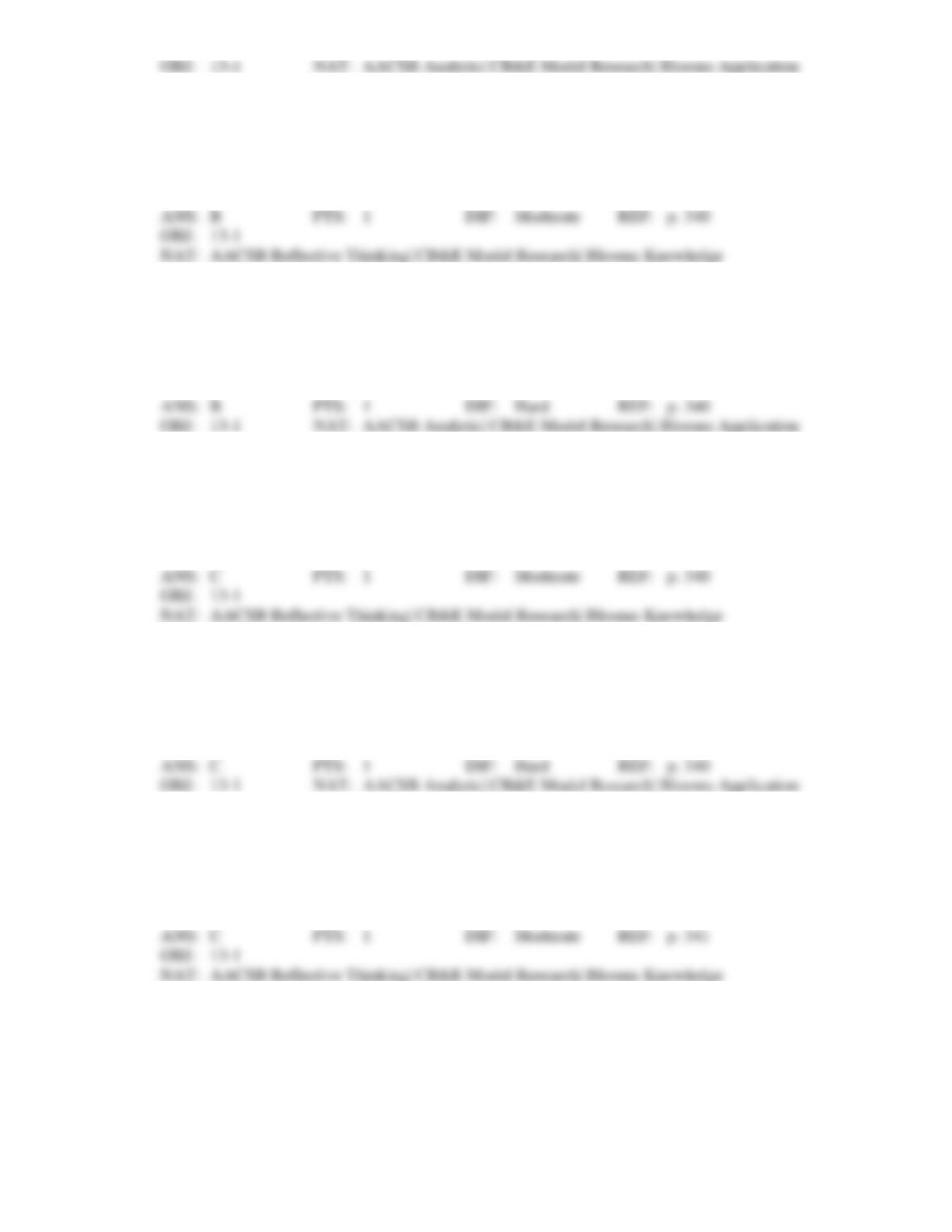
11. The formula below is used to calculate the _______ .
a.
mode of a sample
b.
median of a sample
c.
sample mean
d.
range of a sample
12. Find the mean score of the following set of scores: 2, 5, 7, 4, 8 .
a.
4.8
b.
5.2
c.
7
d.
26
13. The value below which half the values in a distribution fall is the _____.
a.
mean
b.
median
c.
mode
d.
range
14. Find the median of the following scores: 1, 2, 3, 4, 5, 5, 7
a.
3.86
b.
4
c.
6
d.
27
15. The measure of central tendency that identifies the value that occurs most often is called the _____.
a.
mean
b.
median
c.
mode
d.
range
16. Find the mode of the following scores: 1, 2, 3, 4, 5, 5, 7
a.
3.86
b.
4
c.
5
d.
6
17. Which of the following is a measure of dispersion?
a.
mean
b.
proportion
c.
range
d.
all of these choices
18. If the price of a product ranges from $59 to $179, the range of these prices is _____
a.
$238
b.
$60
c.
$120
d.
$179
19. If the average units produced in a month by a Ford Motor Co. plant for Ford Explorers is 22, but only
18 Explorers are produced on a given day in that same month, the deviation score for this one day is
_____.
a.
+4
b.
-4
c.
40
d.
2
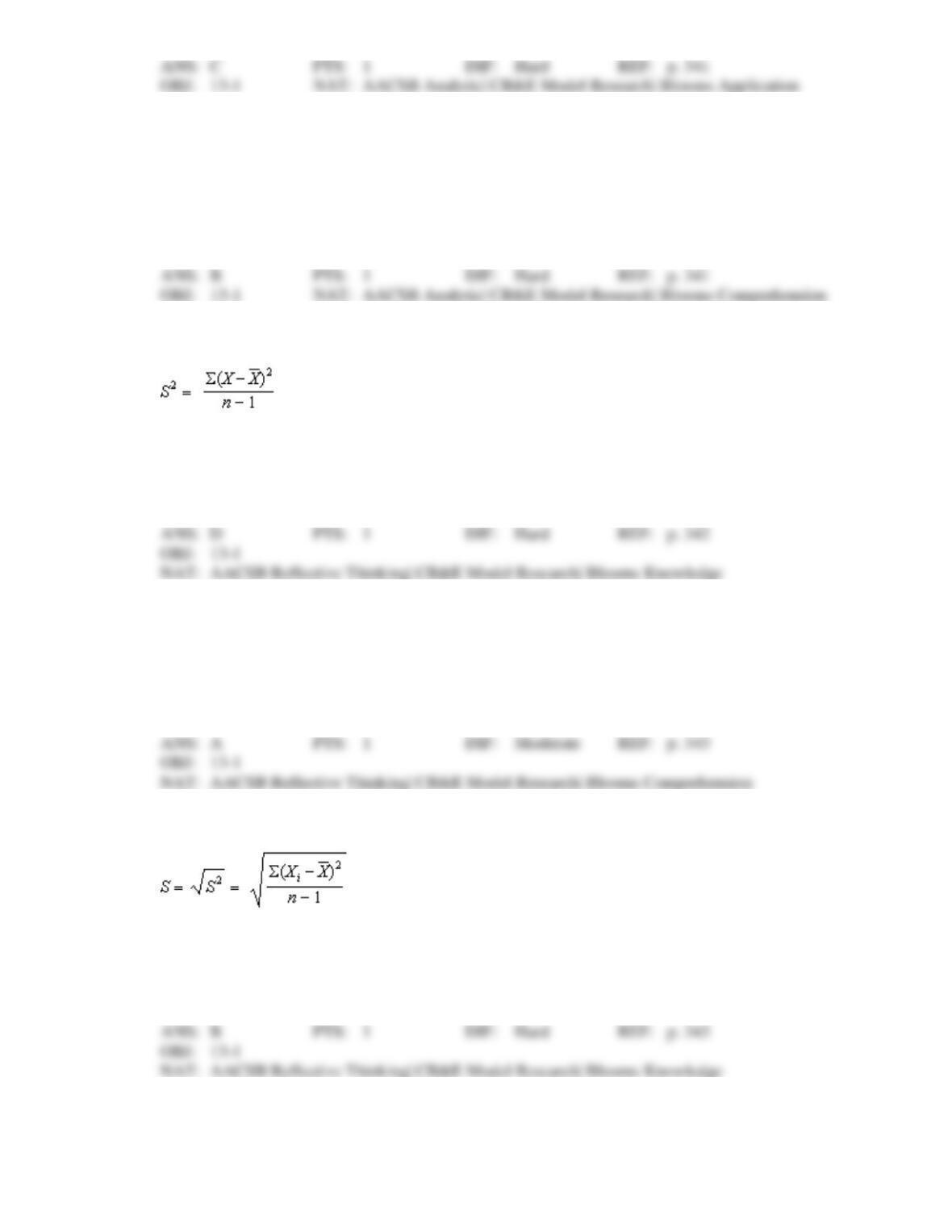
20. The formula below is the formula for the ______ .
a.
standard deviation
b.
standard error of the mean
c.
standard error of the proportion
d.
variance
21. Which of the following eliminates the drawback of having the measure of dispersion in squared units
rather than in the original measurement units?
a.
standard deviation
b.
variance
c.
deviation
d.
mean
22. The following formula is the formula for calculating the ______ .
a.
standard error of the mean
b.
standard deviation
c.
standard normal distribution
d.
variance
23. Find the approximate standard deviation of the following set of scores: 3, 6, 2, 7, 8 .
a.
2.24
b.
2.59
c.
3.32
d.
6.70
24. Which of the following is the symbol for the sample standard deviation?
a.
S
b.
2
c.
d.
2
25. Which of the following is the symbol for the population standard deviation?
a.
S
b.
c.
d.
S2
26. The _____ distribution is a symmetrical, bell-shaped distribution that describes the expected
probability distribution of many chance occurrences.
a.
bell-weather
b.
common
c.
normal
d.
unique
27. One of the most common probability distributions in statistics is the _____ distribution.
a.
normal
b.
bell
c.
central
d.
confidence interval
28. All of the following are characteristics of the standardized normal distribution EXCEPT _____.
a.
symmetrical about its mean
b.
has an infinite number of cases
c.
mean identifies the normal curve’s highest point (the mode)
d.
has a mean of 1 and a standard deviation of 0
29. If the population mean is assumed to be 20 and the sample standard deviation is 5, a score of 15 would
have a Z-value of _____.
a.
+1.00
b.
-7.00
c.
-1.00
d.
+5.00
30. A frequency distribution of the population elements is called a _____.
a.
normal distribution
b.
sample statistic
c.
population distribution
d.
standard error
31. A frequency distribution of a sample is called a(n) _____.
a.
sample distribution
b.
inferred distribution
c.
secondary distribution
d.
standard distribution
32. Which of the following represents the standard deviation of the sampling distribution?
a.
range
b.
standard median
c.
dispersion
d.
standard error of the mean
33. Which theory states that as sample size increases, the distribution of sample means of size n, randomly
selected, approaches a normal distribution?
a.
prospect theory
b.
central-limit theorem
c.
dispersion theory
d.
entropy
34. An estimate of the population mean in the form of a single value, usually the sample mean, is called a
_____.
a.
confidence interval estimate
b.
standard deviation
c.
point estimate
d.
variant
35. If the sample standard deviation is 10.5 and the sample mean is 48 based on a study with a sample size
of 120, the 95 percent confidence interval about the mean is between approximately _____.
a.
44.37 and 51.63
b.
46.12 and 49.88
c.
47.88 and 48.12
d.
40.0 and 50.0
36. In statistical terms, ______ the sample size ______ the width of the confidence interval about the mean
at a given confidence level.
a.
increasing; decreases
b.
increasing; increases
c.
decreasing; decreases
d.
none of these choices
37. Which of the following is a step in determining sample size?
a.
estimate the standard deviation of the population
b.
make a judgment about the allowable magnitude of error
c.
determine a confidence level
d.
all of these choices
38. The formula below is used to calculate the ______ .
(ZS/E)2
a.
sample standard deviation
b.
population standard deviation
c.
sample size
d.
sample variance
39. The confidence interval for a proportion uses which of the following formulas?
a.
p ±ZSp
b.
Sp ±ZP
c.
±ZSs
d.
none of these choices
40. If 35 percent of TV viewers recalled seeing an ad for a Toyota Prius on a particular television program
based on a sample of 800 viewers, the 95 percent confidence interval for this study would be between
approximately _____.
a.
30 percent and 40 percent
b.
32 percent and 38 percent
c.
28 percent and 42 percent
d.
20 percent and 30 percent
COMPLETION
1. Variables in a sample or measures computed from sample data are called _____.
2. When a data set is summarized by counting the number of times each value for a variable occurs in the
sample, this is known as a(n) ______.
3. A frequency distribution organized into a table or graph that summarizes percentage values associated
with particular values of a variable is called a(n) _____.
4. The percentage of elements that meet some criterion is referred to as the _____.
5. When you add up a set of scores and divide the result by the number of scores, you have determined
the ______ of the distribution, which is a measure of central tendency.
6. The middle score in the rank order of scores is called the ______ score.
7. The simplest measure of the dispersion of a set of scores is the ______ .
8. The _____ distribution is bell shaped.
9. A frequency distribution of the population elements is called a(n) _____ distribution.
10. The standard deviation of the sampling distribution is called the ______ of the mean.
11. The idea that as sample size increases, the distribution of sample means of samples of size n, when
randomly selected, approaches a normal distribution is known as the ______.
12. An estimate of the population mean in the form of a single value is called a(n) _____.
13. A specified range of numbers within which a population mean is expected to lie is known as the
______ estimate.
14. Traditionally, market researchers have used the ______ percent confidence level in research studies.
15. Three factors in determining sample size for questions involving means are: (1) the variance, or
heterogeneity, of the population; (2) the magnitude of acceptable error; and (3) the _____.
ESSAY
1. Compare and contrast describe statistics and inferential statistics. Which one is most appropriate for
causal research?
2. Describe the measures of central tendency and calculate each for the following salary data: $25,000,
$35,000, $35,000, $40,000, $50,000, $70,000, and $350,000. Which is the best measure of central
tendency for this data?
3. Describe the measures of dispersion and explain why standard deviation is used most often.
4. List the characteristics of the standardized normal distribution and explain why it is a useful
distribution in inferential statistics.
5. Explain the central-limit theorem and discuss why it is useful to marketing researchers.
6. Discuss the three factors required to specify sample size.