
Name:
Class:
Date:
Chapter 13: Capital, Interest, Entrepreneurship, and Corporate Finance
b. It has no impact on a firm’s investment decision if the firm uses borrowed funds.
c. It is indirectly related to the supply of loanable funds.
d. It has no impact on a firm’s investment decision if the firm uses savings.
e. It represents the opportunity cost of investing with either borrowed funds or savings.
85. If the interest rate increases, _____.
a. the cost of saving will increase
b. the cost of borrowing will increase
c. a firm should decrease the amount of capital it owns
d. a firm should acquire more capital
e. the supply of loanable funds will increase
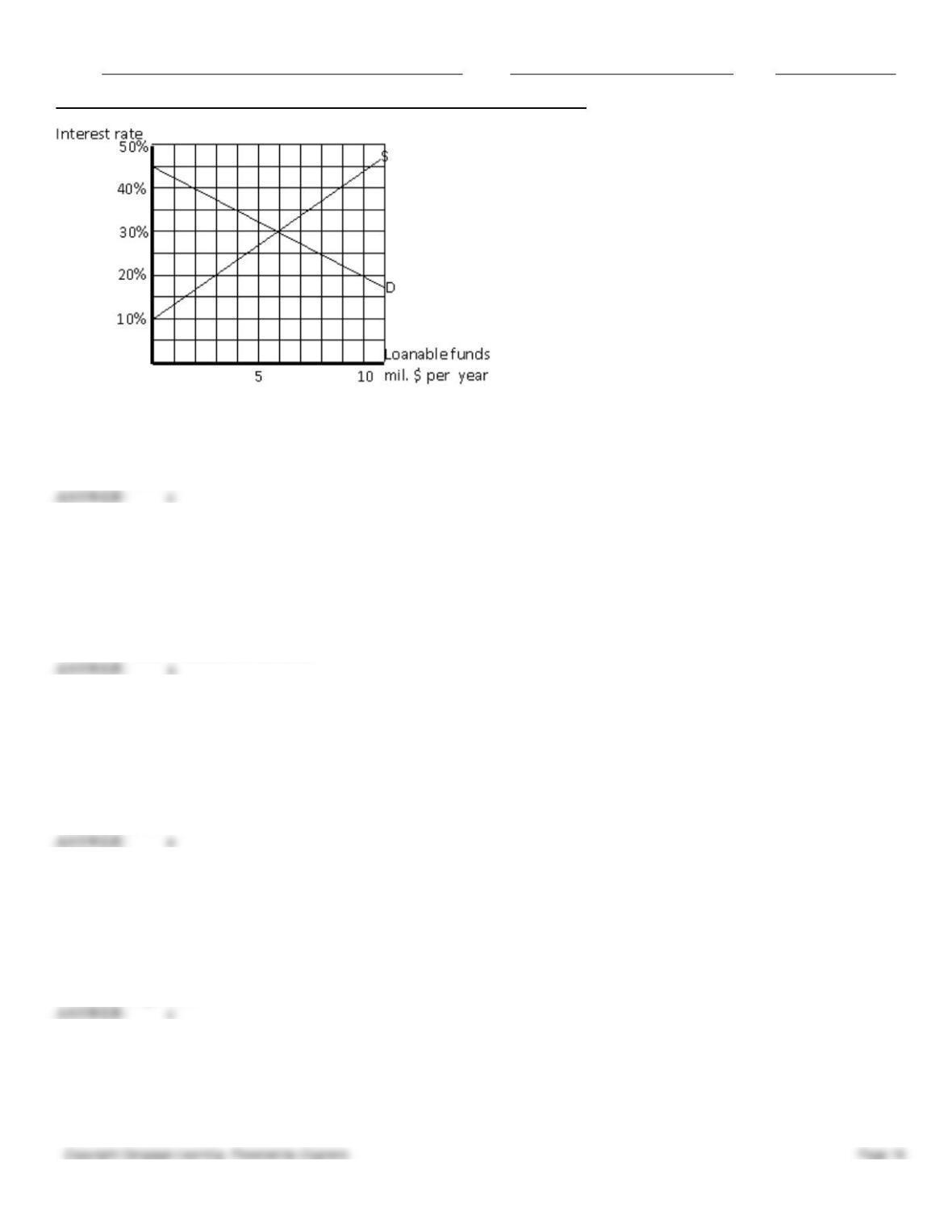
86. In the market for loanable funds depicted in the figure given below, the equilibrium interest rate is _____.
Figure 13.2
a. 50 percent
b. 40 percent
c. 30 percent
d. 20 percent
e. 10 percent
87. In the market for loanable funds depicted in the figure below, the equilibrium amount of loanable funds exchanged is
_____.
Figure 13.2
Name:
Class:
Date:
Chapter 13: Capital, Interest, Entrepreneurship, and Corporate Finance
a. $4 million
b. $5 million
c. $6 million
d. $7 million
e. $8 million
88. Which of the following does not affect the interest rate on a loan?
a. The retirement plans of a borrower
b. The duration of the loan
c. The tax treatment of the loan
d. The administrative cost of the loan
e. The risk of default on the loan
89. The interest rate lenders charge their most trustworthy business borrowers is called the_____.
a. discount rate
b. repo rate
c. mortgage rate
d. reverse repo rate
e. prime rate
90. _____ is an asset pledged by a borrower to a bank when he or she takes a loan.
a. A bond
b. Owner’s equity
c. Collateral
d. A mutual fund
e. A hedge fund
91. Which of the following is true of lending by banks?
a. Banks charge a higher rate of interest on a car loan than a home loan.
b. Banks increase their prime rate of lending to protect their loans.
c. Banks require borrowers to put up collateral to reduce the risk of lending.

Name:
Class:
Date:
Chapter 13: Capital, Interest, Entrepreneurship, and Corporate Finance
d. Banks discount the present value of loans to reduce the risk of lending.
e. Banks charge lower rates of interest to people with poor credit ratings.
92. The interest rate charged on a car loan is usually higher than the interest rate charged on a home loan because:
a. the market price of a car is less than the market price of a home.
b. a car is a worse collateral than a home.
c. the rate of default on car loans is lower than the rate of default on home loans.
d. people with poor credit ratings take car loans.
e. people with poor credit ratings are willing to pay higher rates of interest.
93. Which of the following statements is true?
a. Interest rates charged to well-known corporations are higher than rates charged to individuals because
corporations can afford it.
b. If people expect higher rates of inflation, the market interest rate will decrease because fewer people will borrow.
c. Interest rates in politically and economically unstable countries are lower than rates in stable countries.
d. The risk of doing business in a high-crime area is greater than that in a safe area, and the cost of borrowing is also
greater.
e. The lower the tax rate, the greater the cost of borrowing.
94. The term structure of interest rates describes the relationship between the interest rate charged and the _____.
a. duration of a loan
b. amount of a loan
c. riskiness of a borrower
d. credit history of a borrower
e. age of a borrower
95. As the duration of a loan increases, _____.
a. lenders require a lower interest rate because of lower risk
b. lenders require a higher interest rate to compensate for the greater risk
c. the administration costs, as a proportion of the loan size, increase
d. the administration costs, as a proportion of the loan size, decrease
e. the federal income tax rate decreases
96. The costs of executing a loan agreement, monitoring the loan, and collecting payments are called _____.
a. administration costs
b. sunk costs
c. variable costs
d. opportunity costs
e. transactions cost
97. The administration costs of a loan, as a proportion of the total cost of the loan, typically:

Name:
Class:
Date:
Chapter 13: Capital, Interest, Entrepreneurship, and Corporate Finance
a. decrease as the size of the loan increases, lowering the interest rate.
b. decrease as the size of the loan increases, increasing the interest rate.
c. increase as the size of the loan increases, lowering the interest rate.
d. increase as the size of the loan increases, increasing the interest rate.
e. increase as the size of the loan increases, leaving the interest rate unchanged.
98. _____ affect the interest rate charged on loans.
a. Differences in the rate of time preference
b. Differences in the tax treatment of loans
c. Differences in the expected rate of return on capital
d. Differences in the present value of loans
e. Differences in the present value of annuities
99. Identify the correct statement about the interest rate charged on loans.
a. Borrowers considered credit risks are charged low rates of interest on personal loans.
b. Interest rates are low for personal loans and credit cards as these are backed by collaterals.
c. Financial institutions pay a higher rate of interest than governments.
d. The interest rate decreases with the duration of a loan.
e. Borrowers considered credit risks are given personal loans at zero rates of interest.
100. State and local governments pay a low rate of interest because:
a. the risk of default is high.
b. the risk of default is low.
c. lenders are always willing to lend money to governments rather than financial institutions.
d. lenders focus on their after-tax rate of interest.
e. the administration costs of their loans are very low.
101. If the market interest rate is 5 percent, the opportunity cost of $100 spend on the purchase of goods:
a. is $105 today.
b. is $105 next year.
c. is $5 today.
d. is $5 next year.
e. cannot be determined unless the consumer’s rate of time preference is known.
102. If the interest rate is 8 percent, $54 next year is worth _____today.
a. $62
b. $50.68
c. $50
d. $62
e. $4.32

Name:
Class:
Date:
Chapter 13: Capital, Interest, Entrepreneurship, and Corporate Finance
103. The procedure of determining the present value of payments to be received in the future is known as:
a. compounding.
b. amortizing.
c. perpetuating.
d. nominalizing.
e. discounting.
104. Discounting involves:
a. converting future dollar amounts into present value.
b. converting current dollar amounts into future value.
c. computing the present value of an investment, given the current rate of inflation.
d. computing the present value of an investment for an expected rate of inflation.
e. computing the future value of an investment, given the current rate of inflation.
105. The present value of $200 received one year from now when the prevailing interest rate is 8 percent is _____.
a. $192
b. $185.19
c. $200
d. $208
e. $160
106. If the market interest rate is 5 percent, the present value of $200 to be paid to you at the end of two years is _____.
a. $181.41
b. $190.00
c. $210.00
d. $225.78
e. $95.23
107. The present value of receiving M dollars in year t when the prevailing interest rate is i is given by the formula _____.
a. M − it
b. M × (1 − i)t
c. M/(1 + i)t
d. M ×it
e. M/it
108. The present value of a given payment will be lower _____.
a. if the payment comes sooner than expected
b. the lower the prevailing interest rate
c. the further in the future the payment is to be received
d. the sooner the payment is to be received
e. if the payment is made in cash

Name:
Class:
Date:
Chapter 13: Capital, Interest, Entrepreneurship, and Corporate Finance
109. Suppose Peter expects to receive $5,000 three years from today. If the interest rate is 4 percent, the present value of
$5,000 is approximately _____.
a. $5,025
b. $4,500
c. $3,429
d. $4,444
e. $4,762
110. If you are to receive a payment of $200 at the end of the first year and a payment of $250 at the end of the second
year at a market interest rate of 5 percent, the present value of this income stream is:
a. $400.37.
b. $417.23.
c. $450.00.
d. $475.37.
e. $490.13.
111. Suppose an investment will yield $1,000 after one year and $2,000 after two years. The present value of this
investment at a discount rate of 8 percent is:
a. $2,479.34.
b. $2,640.60.
c. $2,727.27.
d. $3,000.
e. $3,520.
112. A given sum of money received each year for a specific number of years is called a(n):
a. bond.
b. perpetuity.
c. debt.
d. dividend.
e. annuity.
113. A $100 annuity means _____.
a. $100 is received in a single year
b. $100 is received each year forever
c. a person receives more than or less than $100, depending on the interest rate, for a certain number of years
d. $100 is received each year for a certain number of years
e. a person receives more than or less than $100, depending on the interest rate, until an upper limit is reached
114. The payment of a given sum of money each year that continues indefinitely into the future is known as a(n):
a. perpetuity.

Name:
Class:
Date:
Chapter 13: Capital, Interest, Entrepreneurship, and Corporate Finance
b. lottery.
c. term payment.
d. permanent annuity.
e. indefinite annuity.
115. If you own a perpetuity of $500 and if the interest rate is 4 percent, then its present value:
a. cannot be determined unless the number of years is known.
b. is $2,000.
c. is $504.
d. is $12,500.
e. is infinite.
116. If the interest rate is 10 percent, the present value of an annual payment of $100,000 to be received indefinitely is:
a. $1,000,000.
b. $1,246,296.
c. $2,000,000.
d. $976,463.
e. infinite.
117. Suppose Penny will receive $2,000 per year forever from her local bank when the prevailing interest rate is 7 percent.
The present value of that income stream is approximately _____.
a. $20,000
b. $62,472
c. $100,087
d. $27,000
e. $28,571
118. The present value of an education can be computed by:
a. summing the total expense on education and dividing it by the number of years spent in education.
b. discounting earnings based on the level of education and then summing total earnings over work life.
c. discounting the cost of education at the prevailing market rate of interest.
d. summing the total earnings of an individual and dividing it by the number of years spent in education.
e. dividing the total expense on education by the total earnings from a typical work life.
119. When David Palmisano won the Powerball lottery, he could choose between getting annual installments and taking a
lump-sum amount. An economist suggested that David should think about _____.
a. the marginal revenue from the lottery
b. the present value of his income stream
c. the marginal disutility from the lottery
d. the present value of a payment only one year later
e. the marginal revenue product of the lottery

Name:
Class:
Date:
Chapter 13: Capital, Interest, Entrepreneurship, and Corporate Finance
120. Andre runs a company that yields a profit of $40,000 per year, and this profit stream is expected to continue
indefinitely. If the interest rate equals 8 percent, he will be willing to sell the company at a price of:
a. $40,000.
b. $60,000.
c. $100,000.
d. $250,000.
e. $500,000.
121. The present value of a promise to pay $5,000 every year forever when the prevailing interest rate is 10 percent
equals:
a. $5,000.
b. $50,000.
c. $100,000.
d. $250,000.
e. $500,000.
122. Winners of the Jackson City Lottery prize of $10 million are paid $1 million per year over a period of ten years. Paid
out in this form, this prize is:
a. worth less than $10 million because the payment is deferred over time.
b. worth more than $10 million because the payments remain constant for the next ten years.
c. worth more than $10 million because the tax burden on the smaller payments is less.
d. worth exactly $10 million.
e. not worth $10 million if the interest rate is positive.
123. In most state-run lotteries, _____.
a. the winner receives a single lump-sum payment
b. the present value of the winning amount is less than the amount of dollars won
c. the present value of the winning amount exceeds the amount of dollars won
d. winners are paid the present value of the total amount won
e. winners are paid only in the distant future
124. If you win $1 million in a lottery and are paid in installments, _____.
a. the future value of these payments is $1 million
b. the present value of these payments equals $1 million if the interest rate is zero
c. the present value of these payments equals $1 million if the interest rate is 10 percent
d. the present value of the payments exceeds $1 million if the interest rate is positive
e. the future value of the payments is less than $1 million if the interest rate is negative
125. Entrepreneurship:
a. is costly to create and cannot be protected by copyrights and patents.
b. confers property rights to an original creation of an author, artist, or producer.
c. confers property rights over products that are innovations of entrepreneurs.

Name:
Class:
Date:
Chapter 13: Capital, Interest, Entrepreneurship, and Corporate Finance
d. is necessary for the success of any business venture.
e. is not as necessary for production as other factors.
126. Which of the following is true of entrepreneurs?
a. They usually supply all the financial capital required by a firm to start its operation.
b. They accept the risk of success or failure of a business venture.
c. They supply all the natural resources required to continue production.
d. They get yearly dividends as they are the owners of a company.
e. They provide loans to financial companies at high rates of interest.
127. An entrepreneur is the residual claimant, which implies that:
a. he gets a dividend from a company only when it earns a profit.
b. he is the last person to get paid.
c. he gets as profit the amount that is left after paying all the resources.
d. he can sell the unsold stock of goods of a company and earn a profit.
e. he can claim a part of the total revenue of a company.
128. Which of the following is not a role of an entrepreneur?
a. Creating new products
b. Improving existing products
c. Introducing new production methods
d. Introducing new ways of doing business
e. Selling the stocks of a company
129. Inventors are considered entrepreneurs if:
a. they own stocks of a company.
b. they bear the risk of success or failure of a company.
c. they invest their own money in a company.
d. they have the right to vote on the corporate decisions of a company.
e. they receive a part of the profits earned by a company.
130. As large-scale production became more profitable during the Industrial Revolution, the easiest way to finance the
required factories and heavy machinery was through:
a. sole proprietorships.
b. limited liability partnerships.
c. purchase of government securities.
d. the corporate structure.
e. family businesses.
131. Corporations can obtain investment funds by:
a. buying government securities.

Name:
Class:
Date:
Chapter 13: Capital, Interest, Entrepreneurship, and Corporate Finance
b. selling stock.
c. increasing dividends.
d. purchasing more capital.
e. buying back stock.
132. An initial public offering is:
a. the first sale of stock of a newly formed company to the public.
b. the initial dividend which is paid to the shareholders of a company when the company makes a profit.
c. a lump-sum payment given to the bondholders of a company after the first year of purchasing the bond.
d. the initial sale of stocks of a company to a few favored enterprises at a low price.
e. an initial investment made by the public in a company that is in financial trouble.
133. A(n) _____ is a claim on the net income and assets of a corporation.
a. bond
b. annuity
c. perpetuity
d. share
e. dividend
134. The reinvested profits of a corporation are known as:
a. retained earnings, and these help a firm to grow.
b. dividends, and these are paid to the shareholders of the corporation.
c. dividends, and these are paid to the bondholders of the corporation.
d. retained earnings, and these are retained by the entrepreneur.
e. retained earnings, and these are retained by shareholders.
135. If Neofuture Corp. is a new, profitable company, _____.
a. it must pay dividends to its stockholders
b. its entrepreneurs will not get any “sweat equity”
c. after-tax profits are either paid as dividends or reinvested in the corporation
d. it is contractually obligated to retain a portion of its earnings
e. it typically uses the profits to buy back its own stock from the underwriter
136. If Neofuture Corp. sells its shares to the public, the share price tends to:
a. fluctuate inversely with the profit prospects of the company.
b. fluctuate inversely with the dividend payout of the company.
c. fluctuate directly with the dividend payout of the company.
d. fluctuate directly with the profit prospects of the company.
e. fluctuate inversely with the number of years it has been in the stock exchange.
137. Which of the following is true if Sandra owns a share of stock in Secure Funds Bank?

Name:
Class:
Date:
Chapter 13: Capital, Interest, Entrepreneurship, and Corporate Finance
a. She does not have the right to vote on important corporate decisions.
b. She can sue the company if I do not receive annual dividends.
c. She cannot sell the share to any other person without the approval of the board of directors of the company.
d. She only has the right to demand annual dividend payments.
e. She has a claim to a share of the company’s assets and earnings as well as the right to vote in elections of
corporate directors.
138. An IOU reflecting a corporation’s promise to pay the holder a fixed sum of money at a designated maturity date plus
annual interest payments until maturity is:
a. a bond.
b. a stock certificate.
c. an annuity.
d. a golden parachute.
e. a credit note.
139. One reason investors may prefer bonds over stocks is that:
a. potential profits are larger for bondholders.
b. bond prices never vary in the long run.
c. bondholders get paid before stockholders.
d. owning bonds implies owning a part of the company.
e. interest rates do not affect the value of bonds.
140. The market value of a bond is _____.
a. directly related to the rate of interest on the bond
b. inversely related to the rate of interest on the bond
c. not related to the rate of interest on the bond
d. directly related to the maturity date of the bond
e. inversely related to the maturity date of the bond
141. Other things constant, the more profitable a corporation, _____.
a. the lower the value of its shares on the stock market and the lower the interest rate that would have to be paid on
new bond issues
b. the higher the value of its shares on the stock market and the higher the interest rate it would have to pay on new
bond issues
c. the higher the value of its shares on the stock market and the lower the interest rate that would have to be paid on
new bond issues
d. the lower the value of its shares on the stock market and the higher the interest rate that would have to be paid on
new bond issues
e. the lower the interest rate that would have to be paid on new bond issues; the value of its shares on the stock
market does not vary
142. Which of the following is the best description of the risks of corporate bonds?
a. Low level of profits of corporations

Name:
Class:
Date:
Chapter 13: Capital, Interest, Entrepreneurship, and Corporate Finance
b. Bankruptcy and higher market interest rates
c. Fluctuations in bond prices
d. Fluctuations in the interest rate
e. Unreliable payment of dividends
143. You buy a bond for $1,000 from the federal government at an interest rate of 7 percent. Suppose immediately after
you buy the bond, the market rate of interest increases to 10 percent. The market value of your bond:
a. will be $1,100.
b. will be less than $1,000.
c. will be more than $1,700.
d. will remain unchanged at $1,000.
e. will first increase to $1,070 and then decrease to $1,007.
144. If you hold a bond at a time when the market interest rate is increasing, you will find that the bond’s value will:
a. remain the same because the interest payment remains constant.
b. increase only if the market interest rate is lower than the interest rate payable on the bond.
c. increase only if the market interest rate exceeds the interest rate payable on the bond.
d. decrease because you will receive a lower price when you sell the bond.
e. decrease only if the interest payable on the bond exceeds the market interest rate.
145. The market value of Pharmashot Inc., whose securities are publicly traded, can be found by:
a. multiplying the price of its stock by the number of shares issued in the market.
b. dividing the number of shares issued in the market by the price of the stock.
c. adding the total value of its outstanding stock to the total value of its outstanding bonds.
d. subtracting the total value of its outstanding bonds from the total value of its outstanding stock.
e. subtracting the total value of its outstanding stock from the total value of its outstanding bonds.
146. Secondhand securities are those securities that:
a. are available in the stock exchange at very low prices.
b. do not guarantee any dividends to their holders.
c. give low dividends to their shareholders.
d. are issued by new companies without any brand value.
e. have already been issued by a corporation.
147. Identify the correct statement about the securities market.
a. Secondary markets make shares readily convertible into cash and increase the liquidity of securities.
b. Secondary markets make bonds readily convertible into cash and increase the funds available with a corporation.
c. The securities market decides the value of a corporation on the basis of its profits.
d. The securities market decides the value of a corporation on the basis of the number of years it has registered
profits.
e. The securities market decides the value of a corporation on the basis of the number of its employees.

Name:
Class:
Date:
Chapter 13: Capital, Interest, Entrepreneurship, and Corporate Finance
148. Most securities traded in the United States are:
a. secondhand securities bought by individuals.
b. secondhand securities bought by institutional investors.
c. new securities bought by banks.
d. new securities bought by insurance companies.
e. new securities bought by individuals.
149. The exchange of secondhand securities _____.
a. takes place in an oligopolistic market
b. does not provide funds to the firm that issued those securities
c. includes the initial sale when securities are issued by a firm
d. involves very few institutional investors
e. lowers the liquidity of the securities
150. The share prices of a corporation:
a. are inversely proportional to the profits earned by the corporation.
b. are decided by its board of directors.
c. are decided at the start of every trading day by the Securities and Exchange Commission in the United States.
d. reflect the present value of the discounted stream of expected profit.
e. reflect the present value of the corporation’s rate of investment.