
Chapter 13—Capital Structure: Balancing the Benefits and Costs of Debt
MULTIPLE CHOICE
1. Firms with sufficient __________ will not have to issue equity securities to finance investment
projects and are thus able to finesse information problems between managers and investors.
a.
agency costs
b.
financial slack
c.
asset substitutions
d.
debt overhang
2. The __________ problem prevents the financing of new positive-NPV projects because the benefits
would accrue to existing creditors rather than to the shareholders who finance the new project.
a.
agency cost
b.
financial slack
c.
asset substitutions
d.
debt overhang
3. __________ significantly influence(s) a firm’s capital structure choices.
a.
Corporate and personal taxes
b.
The operating environment
c.
Investment opportunities
d.
The firm’s ownership structure
e.
All of the above
4. The pecking order model provides a rationale for the development of __________, based on the
pervasiveness of the information asymmetry between corporate managers and shareholders.
a.
underinvestment
b.
the business judgment rule
c.
absolute priority rule
d.
financial intermediaries
5. The corporate form of organization:
a.
provides limited liability to shareholders, thus decreasing the incentives of a company to
issue new equity and decreasing corporate leverage
b.
provides limited liability to shareholders and creates a costless bankruptcy process
c.
provides limited liability, thereby allowing shareholders to exercise their option to default
on company debt
d.
increases the likelihood that a business will experience greater direct costs than indirect
costs of bankruptcy
e.
increases the likelihood that sales in the years after filing for bankruptcy will be higher
than pre-bankruptcy sales growth forecasts would project
6. Direct costs of bankruptcy include all of the following except:

a.
document printing
b.
lost sales
c.
filing expenses
d.
lawyer’s fees
e.
accountant’s fees
7. Hare-Brained-Toys (HBT) and Tortoise-Toys (TT) provide returns to their bondholders of 7% and 4%,
respectively. Returns to their stockholders are 12% and 9%, respectively. If the cost of capital for both
firms is 8%:
a.
HBT bondholders are requiring a return which is “too low”
b.
TT stockholders are requiring a return which is “too high”
c.
HBT’s capital structure consists of 60% debt and 40% equity
d.
TT employs a lower level of leverage than HBT
e.
the market is inefficient
8. Rocky’s Rent-to-Own is in financial distress. In order to meet upcoming debt obligations, management
is attempting to increase income. Which of the following actions is an example of the asset substitution
problem?
a.
advertising a 3-month payment plan instead of a 6-month payment plan for costly items
b.
investing in a new line of expensive technology-based luxury items (e.g., 60″ plasma
screen TV’s)
c.
eliminating consumer credit requirements for first-time renters
d.
a and b
e.
b and c
9. Bullwinkle’s Burger Barn, Inc. is on the verge of bankruptcy. The paint is beginning to peel, curtains
are fading, and the grill has been turning off and on for no apparent reason. Bullwinkle’s management
has recognized for months that insolvency is imminent and has chosen not to invest in maintenance
and repairs. This decision is an example of:
a.
the resource-consumption aspect of bankruptcy
b.
shareholders exercising their option to default on company debt
c.
an asset substitution problem
d.
an underinvestment problem
e.
the deadweight costs associated with bankruptcy
10. Using debt as a source of external funding can help overcome the agency costs of outside equity by:
a.
burdening management with regular, legally enforceable debt-service payments which
serve as an effective discipline tool
b.
reducing the scope for excessive managerial perquisite consumption
c.
reducing the amount of external equity required, thus reducing the deadweight agency
costs of the manager/stockholder relationship
d.
a and b
e.
all of the above
11. Which of the following would lead to an increase in leverage in a firm’s optimal capital structure
according to the agency cost/tax shield trade-off model?
a.
A decline in the corporate tax rate
b.
An increase in the agency costs of outside equity
c.
An increase in indirect bankruptcy costs
d.
An increase in the agency costs of outside debt
e.
All of the above
12. Macrohard holds cash and marketable securities worth over $20 billion. It is a highly profitable firm,
yet maintains a low leverage level and pays out very little profit in the form of dividends. Macrohard’s
industry is characterized by numerous positive-NPV opportunities, but management is reluctant to
issue equity in order to finance investments. Which of the following best accounts for Macrohard’s
leverage decisions?
a.
the pecking order theory
b.
the signaling theory
c.
the tax-benefit theory
d.
the agency cost theory
e.
the agency cost / tax shield trade-off theory
13. According to the signaling theory of capital structure, a firm concerned about increasing its stock price
should:
a.
make public its inside information that a particular investment will generate tremendous
future cash flows
b.
issue equity to signal the undertaking of positive-NPV projects
c.
issue debt in order to finance positive-NPV projects
d.
decrease the amount of leverage employed as it becomes more profitable
e.
decrease the amount of leverage employed as the firm’s growth potential increases
14. __________ companies use far more debt than do growth companies.
a.
Low quality
b.
Underinvested
c.
Asset-rich
d.
Reorganized
e.
Chapter 7
15. Which of the following presents a problem for the signaling theory of capital structure?
a.
The theory predicts that low-quality firms should issue the most debt.
b.
Empirically, both high-quality and low-quality firms use very similar levels of debt.
c.
The theory is too complex for managers to understand.
d.
Signaling models suggest that firms with high growth opportunities and intangible assets
should issue very little debt.
e.
Stock returns are almost always positive around events that increase leverage.
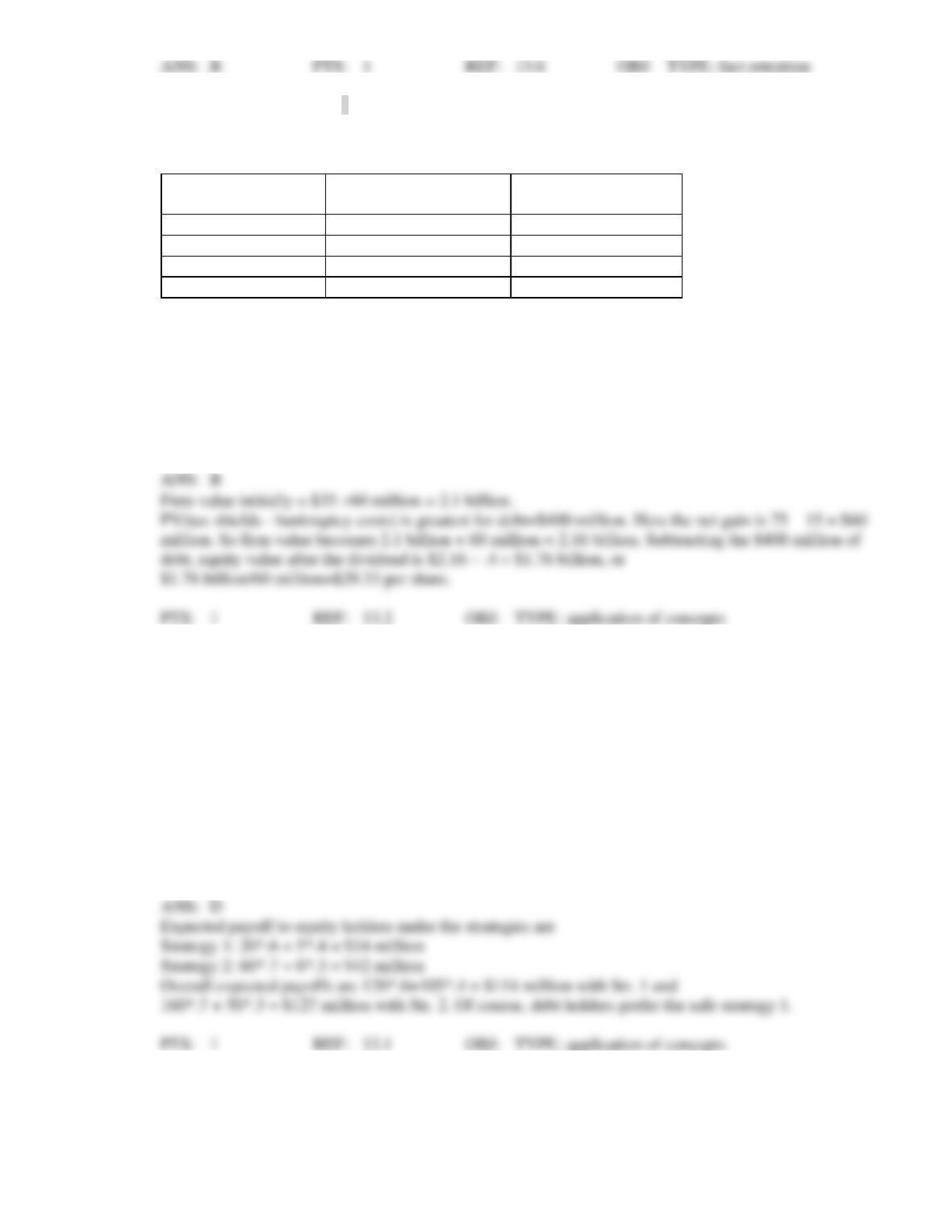
16. Mizer Corp. currently has s million shares worth $35 each and no debt. Mizer is considering issuing
some debt and using the proceeds to pay a dividend, such that the scale of firm operations would not
change. Debt would be sold at a fair price. Following are the possible debt amounts with
corresponding effects on the firm:
Value of Debt
Present Value of Tax
Shields
Present Value of
Bankruptcy Costs
$400 million
$75 million
$15 million
$800 million
$130 million
$75 million
$1.2 billion
$175 million
$175 million
$1.6
$190 million
$350 million
No change is also a possibility. There are no other avenues through which capital structure impacts
firm value. What should be the stock price per share after the dividend (there are no personal taxes)?
a.
$22.58
b.
$29.33
c.
$35.00
d.
$36.00
e.
none of the above
17. A firm has debt maturing two years from now with face value $100 million. The firm can choose one
of two strategies, the first offering a 60% chance of total payoff $120 million and a 40% chance of
$105 million, either to come in two years. The second strategy offers a payoff in two years that is $160
million with 70% probability and $50 million with 30% probability. Neither of these strategies
involves market risk, and the firm will have no going-concern value beyond year 2. Equity holders
would choose Strategy __________, while if managers acted in the interest of the firm as a whole, they
would select __________.
a.
1, Strategy 1
b.
1, Strategy 2
c.
2, Strategy 1
d.
2, Strategy 2
e.
2, either strategy
18. Investors sue management for poor performance and apparent excess perquisite consumption. It will
likely be relatively __________ for them to prevail, due to __________.

a.
easy; infighting amongst managerial defendants
b.
difficult; the fact that excess perquisite consumption is only a theoretical construct
c.
difficult; application of the business judgment rule
d.
easy; application of the constrained discretion rule
e.
difficult; the likely corporate takeover of such a defendant, which will nullify any pending
suits.
19. Which of the following is not an assumption of the pecking-order hypothesis?
a.
Dividends are “sticky”
b.
Firms prefer internal financing to external financing
c.
Firms prefer issuing safer securities to less safe securities
d.
Financial markets are largely efficient
20. Why would profitable firms borrow more?
a.
They would not as they can rely on internally generated financing
b.
They are more likely to benefit from tax shields
c.
They are more likely to negotiate lower interest rates
d.
They are more likely to actively manage their WACC
21. A firm that is in financial distress
a.
Its managers may behave rationally investing in high risk projects
b.
Its managers may behave irrationally investing in high risk projects
c.
Its managers may conserve capital to protect the firm’s stakeholders
d.
Its manager may liquidate the firm
22. Investors recognize that outside equity creates agency costs such as managers granting themselves
excessive perquisites, a practical method of reducing this is
a.
Vote against management at the annual shareholders meeting
b.
Sue management for malfeasance
c.
Invest in firms that have significant debt
d.
Accumulate enough shares to take over the firm
23. The agency cost of debt refers to
a.
The bond rating companies’ fees for rating the firm’s debt
b.
The incentive managers have to transfer wealth from the bondholders to the shareholders
or management
c.
The costs associated with increasing outside ownership equity
d.
The costs associated with issuing debt
24. While the __________ model provides a convincing explanation for observed changes in capital
structure, the __________ model explains observed corporate debt levels.
a.
signaling; pecking order
b.
trade-off; managerial opportunism
c.
signaling; trade-off
d.
pecking order; trade-off
e.
pecking order; trade-off
25. Jason is suggesting that his company issue debt in order to finance an upcoming project, even though
the firm has large cash reserves. He believes the market is currently underpricing his firm’s stock, and
would like investors to be convinced that the firm’s true value is much higher. Which of the following
capital structure theories provide the best explanation for Jason’s suggestion?
a.
trade-off model
b.
pecking-order hypothesis
c.
signaling model
d.
managerial opportunism hypothesis
e.
M & M capital structure model
26. The __________ argues that firms attempt to time the market by issuing equity when share values are
high and by issuing debt when share prices are low.
a.
managerial opportunism hypothesis
b.
signaling model
c.
pecking order hypothesis
d.
the trade-off model
MATCHING
Match each of the following variables with its relationship to leverage:
a.
negative
b.
positive
c.
ambiguous
1. profitability
2. earnings volatility
3. effective tax rate
4. size
5. growth rate
6. managerial entrenchment
7. regulation
8. state ownership
Match the following examples with their best descriptions:
a.
direct costs of bankruptcy
b.
indirect costs of bankruptcy
9. lawyer fees
10. diversion of management’s time
11. lost sales
12. constrained capital investment
13. accounting fees
14. investment banker fees
15. loss of key employees
SHORT ANSWER
1. TVs-R-Us, a brand-name TV manufacturer, has fallen on hard times. The firm is expected to have
difficulty meeting its near-term obligations to all counter-parties. Provide at least three examples of the
indirect costs of financial distress that TVs-R-Us will face. You may wish to consider the company’s
relationship with its suppliers, employees, customers, lenders, and even stockholders.
2. It is early fall and your Internet company is struggling. It seems as though the only way you might be
able to make promised payments to employees and lenders is if, perhaps miraculously, customers
recognize your products as valuable and lenders decide you are worth the risk of allowing a few
promised debt payments to be missed. To give yourself a chance of success, you decide to spend all
available cash that you can muster in one great Super-Bowl advertisement. Explain this behavior in
terms of the asset substitution problem.
3. You run a large manufacturing facility that produces standard components for industrial assembly
lines. Your production operation is one of many such large producers in the global market. Is your firm
likely to make extensive or very limited use of debt? Fully explain your answer.
4. A standard example of underinvestment occurs when a borrower fails to maintain an automobile after
he or she recognizes, that making promised payments will be difficult.
a.
Carefully describe how this problem arises.
b.
Provide two examples of how we attempt to mitigate this problem in lending practices.
in general, not provide good care for his or her car.
market support contracts will be of very low value).
Lenders will seek assurances of promised future payments.
underinvest may arise.
5. You are considering an investment in a firm that makes a great product and has excellent long-term
potential. Unfortunately, the manager of the firm, Shaky-Joe, is a little troublesome. He is well known
for throwing large parties and traveling to golf tournaments. The firm is currently financed with 90
percent equity and 10 percent debt. Explain how you might wish to change the company’s capital
structure to handle Shaky-Joe.
6. Equation 13.2 provides an intuitively powerful explanation of trade-offs inherent in the capital
structure decision. Explain why this theory is difficult for managers to put into practice.
7. Consider the costs and benefits of financial slack in terms of both the agency costs of outside debt and
the pecking order theory. Provide one situation that supports each interpretation.
8. Your firm Dier-Streits is in the plumbing business. Lately things seem to be going down the tubes.
Your firm’s total asset value is estimated to be about $9 million, but debt payments of 10 million are
due at the end of the year. You are considering a job that would require massive overtime but would
create an NPV of −$3 million or $6 million with probabilities of .7 and .3, respectively.
a.
What is the expected NPV of this project?
b.
From a total firm value perspective, should you invest in this project?
c.
From purely a shareholder’s perspective, should you invest in this project?
1.
costly agreements to negotiate
2.
costly agreements to enforce
3.
may prevent managers from making value-increasing investments
9. What is meant by the term bankruptcy costs?
10. What means do bond investors employ to protect themselves from wealth expropriation by
stockholders?
11. What are the disadvantages to strict bond covenants?
1.
the value of the tax shield
2.
estimate the direct and indirect costs of bankruptcy
3.
estimate the probability of the firm going bankrupt given a certain degree of leverage
4.
how much value the firm creates by reducing the agency costs of equity by issuing bonds
12. What do you need to know to determine the optimal capital structure for a firm in the trade-off model?
a.
The expected NPV is .7(–$3,000,000) + .3($6,000,000) = –$300,000.
overall firm value.
value if we take the gamble. This is an example of the asset substitution problem.
5.
what are the agency costs of debt associated with different levels of leverage?
1.
Highly profitable firms can fund most of their investment projects using retained earnings.
All three explanations have some validity.
13. What are the limitations of the pecking order theory?
14. Why do signaling models enjoy less empirical support than either the trade-off or pecking order
theory?
15. What are the explanations for the negative leverage/Profitability relationship?
PTS: 1 REF: 13.5 OBJ: TYPE: critical thinking
16. How has deregulating an industry affected the capital structures of affected firms?
17. What are the two potentially offsetting effects of insider shareholdings on leverage?
18. What does international capital structure research suggest about creditor power in bankruptcy?
19. What is the effect of privatization on leverage levels of formerly state-owned enterprises?
20. If the levered firm has $1,000,000 in debt and a tax rate of 35%, what is the value of the levered firm if
its value on an unlevered basis is $$2,000,000 and the PV of bankruptcy costs is $180,000?
21. If the unlevered firm has net income of $250,000 and a capitalization rate of 10%, what is the value of
an identical firm with $300,000 in outstanding debt if it has a tax rate of 40% and the PV of
bankruptcy costs is $80,000?
22. In their survey of corporate financial practices, Graham and Harvey (2001) find clear links between
finance theory and practice regarding capital budgeting, but the linkages between theory and practice
on the subject of capital structure were much weaker. Why do you think this is true?
23. List the characteristics of firms and industries that have a positive relationship with the use of debt.
24. What capital structure might a management team choose to avoid a takeover attempt?
25. Explain the differences in the use of leverage for a pipeline company and a cutting-edge technology
company like Cisco Systems.
ESSAY
1. Given the following information.
Equity Corporation
Debt Corporation
Cost of equity
12%
18%
Debt
——–
$2,000,000
Pretax cost of debt
——–
8%
EBIT
$500,000
$ 500,000
Calculate the market value of Equity Corporation, Debt Corporation, and the present value of the tax
shield to Debt Corporation if both companies have a tax rate of 40%. Assume there are no financial
distress or agency costs and that expected growth of EBIT is zero.
2. Debt Corporation has a value of $3,500,000, computed as the total of its $2,500,000 all-equity
(unlevered) value and the present value of interest tax shields, which is equal to $1,000,000. How will
the value of Debt Corporation be affected if bankruptcy and agency costs are considered?
EBIT =
Int.
EBT
Tax @ 40%
EAT
EBIT =
Int.
EBT
Tax @ 40%
3. Students often discuss bankruptcy as an event rather than a process. Provide a clear discussion of both
the direct and indirect costs of bankruptcy as a part of the process of financial distress. Your discussion
should clearly differentiate why financial distress is best viewed as a process.
4. Eastern Airlines received protection from its creditors in 1991 after filing for bankruptcy protection. At
that time, the estimated liquidation value of the firm was approximately 90 cents per dollar owed. At
the time of the ultimate liquidation, two years later, debtholders received approximately 10 cents per
dollar owed. In general, discuss the trade-offs between affording protection to a failing company and
protecting the rights and interests of bondholders.