
Chapter 13: The Balanced Scorecard: Strategic-Based Control
91. At the beginning of 2016, Haroldson Company installed a JIT purchasing and manufacturing system. The
following information has been gathered about one of the company’s products.
Theoretical annual capacity
9,000
Actual production
3,600
Production hours available
3,000
Actual cost per unit
$33
What is the ideal conversion cost per unit?
a. $39.60 per unit.
b. $16.50 per unit.
c. $99 per unit
d. $11 per unit.
92. Mobility, Inc., manufactures a product that experiences the following activities:
Processing (three departments) 18 hours
Moving (four moves) 2 hours
Waiting time 14 hours
Storage time (before delivery) 26 hours
The MCE for the product is
a. 0.48.
b. 0.30.
c. 0.42.
d. 0.45.
93. The perspective that defines the capabilities needed by the organization to create long-term improvement is the
a. financial perspective.
b. customer perspective.
c. process perspective.
d. learning and growth perspective.

Chapter 13: The Balanced Scorecard: Strategic-Based Control
94. Which of the following would NOT be a core outcome measure for employee capabilities?
a. employee satisfaction ratings
b. number of employees
c. employee turnover
d. employee productivity
95. Which of the following would be considered a lead measure for employee capabilities?
a. employee satisfaction
b. employee turnover
c. employee productivity
d. number of training hours
96. The learning and growth perspective has three major objectives. Which of the following is an objective of the
learning and growth process?
a. increase the number of new products
b. increase customer acquisition
c. increase motivation and alignment
d. improve asset utilization
97. Double-loop feedback occurs under what conditions?
a. When managers receive information about both the effectiveness of strategy implementation as well as the
validity of assumptions.
b. When managers receive feedback information from two information sources.
c. When managers validate the feedback information by double checking it.
d. When managers receive information about the effectiveness of the controls and the effectiveness of the
implementation.
98. Which of the following would not be an outcome measure?
a. net income
b. market share
c. return on investment
d. training hours

Chapter 13: The Balanced Scorecard: Strategic-Based Control
99. The critical performance measures of the Balanced Scorecard have some special properties. Which of the
following is NOT one of those properties?
a. scorecard measures are linked by cause-and-effect relationships
b. performance measures are derived from strategy
c. benchmarking plays a critical role
d. performance measures should be balanced between outcome and lead measures
100. Failure of a strategy might be due to
a. incorrect calculations.
b. incorrect feedback.
c. implementation problems.
d. invalid controls.
101. A testable strategy is defined as
a. a strategy that can be implemented.
b. a set of profit goals.
c. a set of linked objectives aimed at an overall goal.
d. a strategy that is verifiable.
102. A testable strategy can be constructed
a. by prioritizing objectives.
b. by sequencing if-then statements.
c. by creating alternative scenarios.
d. by creating lead measures.
103. A strategy map
a. links the cause-and-effect relationships in the proposed strategy, creating a testable strategy.
b. maps the organization’s strategies over time.
c. documents the performance results of an organization.
d. strategizes about the organization’s competitors.
104. Double-loop feedback can be defined as
a. feedback that deals with both the effectiveness of strategy implementation and the validity of the
assumptions underlying the strategy.
b. feedback that emphasizes the effectiveness of strategy implementation and the costs of implementation.
c. feedback that emphasizes the validity and assumptions underlying the strategy and the costs of the strategy.
d. feedback on lead indicators and lag indicators.

Chapter 13: The Balanced Scorecard: Strategic-Based Control
105. If only the return on investment were used to measure performance, it would be considered
a. double-loop feedback.
b. triple-loop feedback.
c. a testable strategy.
d. single-loop feedback.
106. A balanced scorecard is designed to bring about organizational change. Which of the following is a means of
alignment?
a. Employees must share ownership of objectives, measures, targets, and initiatives.
b. Incentives must be structured to support strategy.
c. Resources must be allocated to support strategy.
d. all of the above.
107. The balanced scorecard becomes a means of communicating the strategy of the organization to its employees and
managers. What might be a downside of communicating this information?
a. Employees will need direction about what is to be done.
b. Employees will need to understand where the organization is headed.
c. Sensitive information may end up in the hands of competitors.
d. all of the above.
108. Which of the following is NOT a condition that must be present for a strategy to become attainable?
a. budgetary process must provide the resources necessary to carry out the initiatives
b. resources must be allocated to strategic initiatives
c. the organization must decide how much of the strategic targets will be achieved for the coming year
d. all are conditions that must be met for strategy to become actionable
109. Performance expectations are communicated by setting
a. new initiatives.
b. targets.
c. a strategic vision.
d. activity measures.
110. For purposes of strategic alignment, incentive compensation should be based upon
a. expected performance of weighted targets for a given period.
b. expected financial performance of the company.
c. actual performance compared to weighted target values for a given period.
d. actual financial performance of the company.
Chapter 13: The Balanced Scorecard: Strategic-Based Control
111. Compare and contrast activity-based measures and strategic-based measures.
112. Activity-based responsibility and strategic-based responsibility incorporate some of the same elements. However,
strategic-based responsibility adds some new elements to the common dimensions. What are the elements in
common and what new elements are included?
113. Activity-based evaluation and strategic-based evaluation incorporate some of the same elements. However,
strategic-based responsibility adds some new elements to the common dimensions. What are the elements in
common and what new elements are included?
114. Strategic-based performance measures are balanced measures. Give examples of four types of balanced
measures.
Chapter 13: The Balanced Scorecard: Strategic-Based Control
115. The following measures belong to one of four perspectives on the balanced scorecard:
1. Return on investment
2. Time to market
3. Number of new customers
4. Percentage of revenues from new sources
5. Quality costs
6. Employee productivity
Required:
a. Identify the perspective appropriate for each measure listed above.
b. Suggest a possible strategic objective that might be associated with each measure.
116. Mendocino Company would like to increase its operational efficiency. For the first quarter of operations during the
current year, the following data were reported:
Days
Inspection time
0.4
Process time
3.9
Move time
1.1
Wait time
Required:
4.9
a. Compute the manufacturing cycle efficiency (MCE) for the quarter.
b. If by use of JIT all wait time during production is eliminated, what will be the new MCE? (round to two
decimal places if necessary)
Chapter 13: The Balanced Scorecard: Strategic-Based Control
117. The following measures belong to one of four perspectives on the balanced scorecard:
1. Satisfaction of customer
2. Satisfaction of employees
3. Cycle time
4. Product cost per unit
Required:
a. Identify the perspective appropriate for each measure listed above.
b. Suggest a possible strategic objective that might be associated with each measure.
118. Montepulciano Industries is planning to change its manufacturing plant by automating and installing a flexible
manufacturing system. The company is also changing its performance measures as well as its operating
procedures. In an effort to evaluate performance and determine where improvements can be made, management
has gathered the following data relating to activities over the last four months:
Month
1
2
3
4
Quality Control Measures:
Number of defects
191
161
122
93
Number of warranty claims
56
33
33
29
Number of customer complaints
107
93
71
57
Material Control Measures:
Purchase order lead time
9 days
87 days
6 days
4 days
Scrap as a percentage of total cost
1%
2%
3%
4%
Machine Performance Measures:
Percentage of machine downtime
2%
4%
4%
7%
Use as a percentage of availability
96%
91%
89%
87%
Setup time (hours)
6
9
10
13
Delivery Performance Measures:
Throughput time (days)
6.0
7.5
9.0
10.0
Delivery cycle time (days)
15.0
19.0
21.0
24.0
Manufacturing cycle efficiency
35.0%
26.7%
21.1%
18.0%
Percentage on-time deliveries
97%
95%
92%
84%
Total units
4,221
4,089
3,818
3,705
Chapter 13: The Balanced Scorecard: Strategic-Based Control
Many of these measures are new and the president has asked you to interpret the results. Throughput is the time it
takes to turn materials into a completed product. Delivery cycle time is the time between receiving an order and
shipping the goods.
Required:
Using the performance measures given, do the following:
a. Identify the areas where the company seems to be improving.
b. Identify the areas where the company seems to be deteriorating.
119. How does the Balanced Scorecard communicate strategy to the organization? How is strategy translated into
performance measures?
120. Why does the Balanced Scorecard differ from company to company? Whose responsibility is the implementation?
Chapter 13: The Balanced Scorecard: Strategic-Based Control
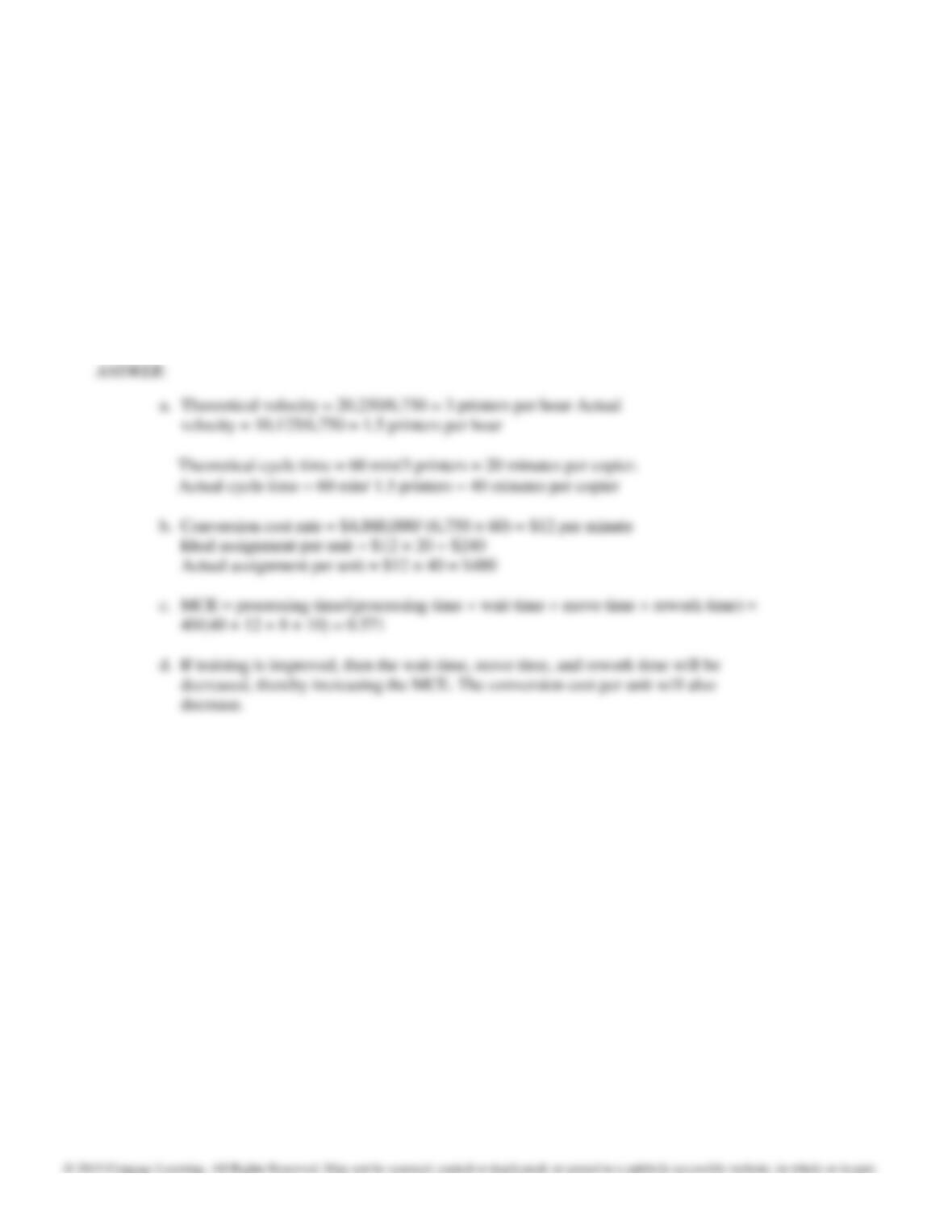
121. Lionheart Manufacturing has a theoretical capability to produce 20,250 printers per quarter but currently produces
10,125 printers. The conversion cost per quarter is $4,860,000. There are 6,750 production hours available within
the plant per quarter. In addition to the processing minutes per unit used, the production of printers uses 12 minutes
of move time, 8 minutes of wait time, and 10 minutes of rework time. (All work is done by cell workers.)
Required:
a. Compute the theoretical and actual velocities per hour and the theoretical and actual cycle times (minutes per
unit produced).
b. Compute the ideal and actual amounts of conversion cost assigned to each printer.
c. Calculate the current MCE.
d. If poor employee training is the root cause of wait time and move time, develop an improvement strategy as a
series of if-then statements that will reduce the conversion cost per printer.
Chapter 13: The Balanced Scorecard: Strategic-Based Control
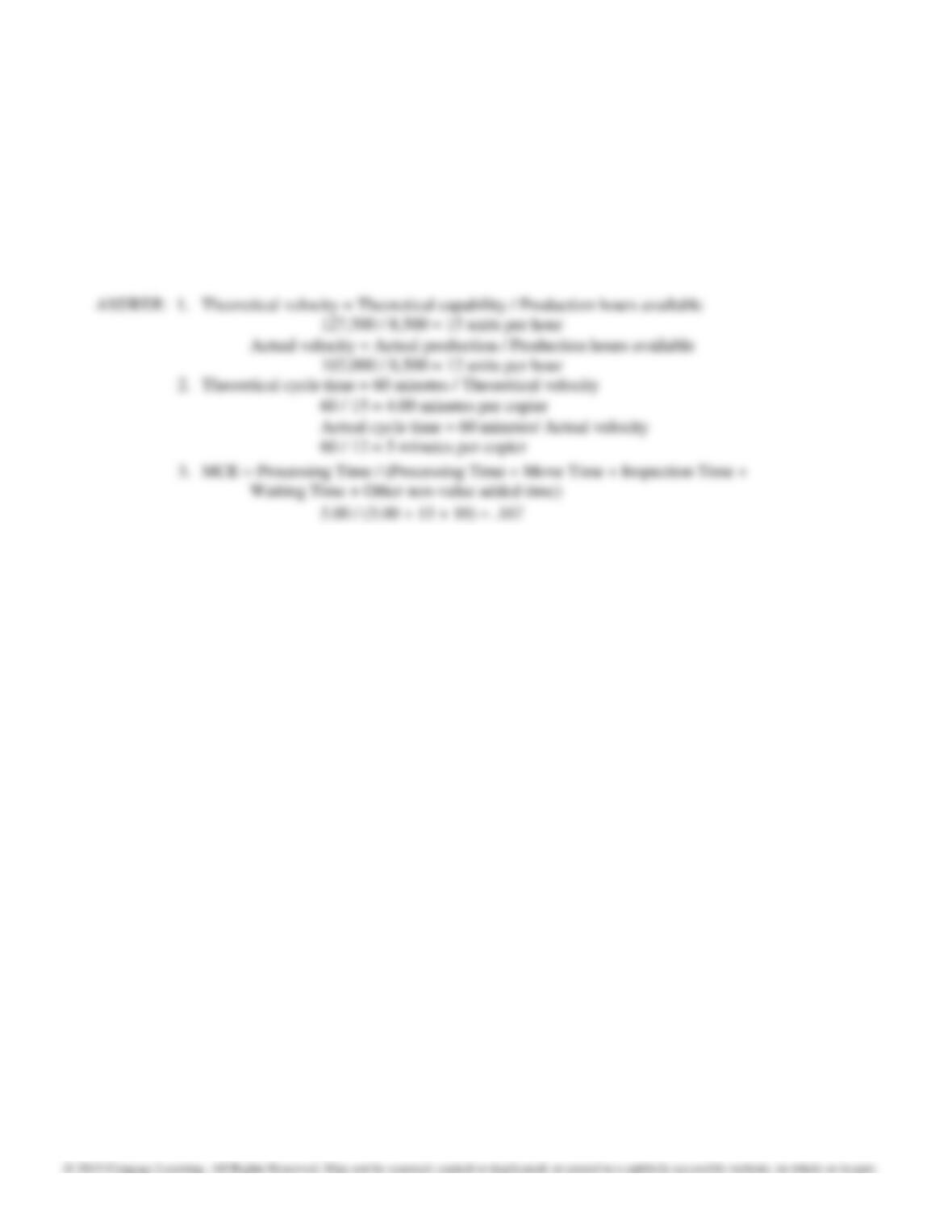
122. Tavarek Industries has the theoretical capability to produce 127,500 units per month but currently produces
102,000 units. The conversion cost for the month is $3,750,000. There are 8,500 production hours available within
the plant per month. In addition to processing time, to produce a unit takes 15 minutes of move time and 10
minutes of wait time.
Required:
1. Compute the theoretical and actual velocities per hour
2. Compute the theoretical and actual cycle times (minutes per unit produced)
3. Compute the current MCE
123. Barney’s Town is a local clothing store in New York. Barney’s Town has been experiencing increased competition
from the national clothing chains. In an effort to improve performance, management intends to create a Balanced
Scorecard. In a meeting, several measures were suggested by various managers.
Management has identified a key problem. Customers are taking too long to pay their department store’s charge
card bills, and the company has an abnormal amount of bad debts. If this problem were solved, the company
would have far more cash to invest in store improvements. Investigation has revealed that much of the problem
with late payments and unpaid bills is apparently due to disputes about incorrect charges on the customer bills.
Incorrect charges usually occur because sales clerks enter data incorrectly on the charge account slip.
The performance measures suggested by the managers are given below:
• Total sales revenue
• Sales per square foot of floor space
• Sales to inventory ratio
• Sales per employee
• Sales to total assets
• Customer satisfaction with accuracy of charge account bills from monthly customer survey
• Customer wait time for service
• Travel expenses for buyers’ trips
• Average age of accounts receivable
• Courtesy shown by junior staff members based on surveys of senior staff
• Unsold inventory at the end of the season as a percentage of total cost of sales
• Percentage of suppliers making just-in-time deliveries
• Quality of food in the staff cafeteria based on staff surveys
• Written-off accounts receivable as a percentage of sales
• Percentage of charge account bills containing errors
• Percentage of employees who have attended the city’s cultural diversity workshop
• Total profit
• Profit per employee
• Percentage of salesclerks trained to correctly enter data on charge account slips
Chapter 13: The Balanced Scorecard: Strategic-Based Control
Required:
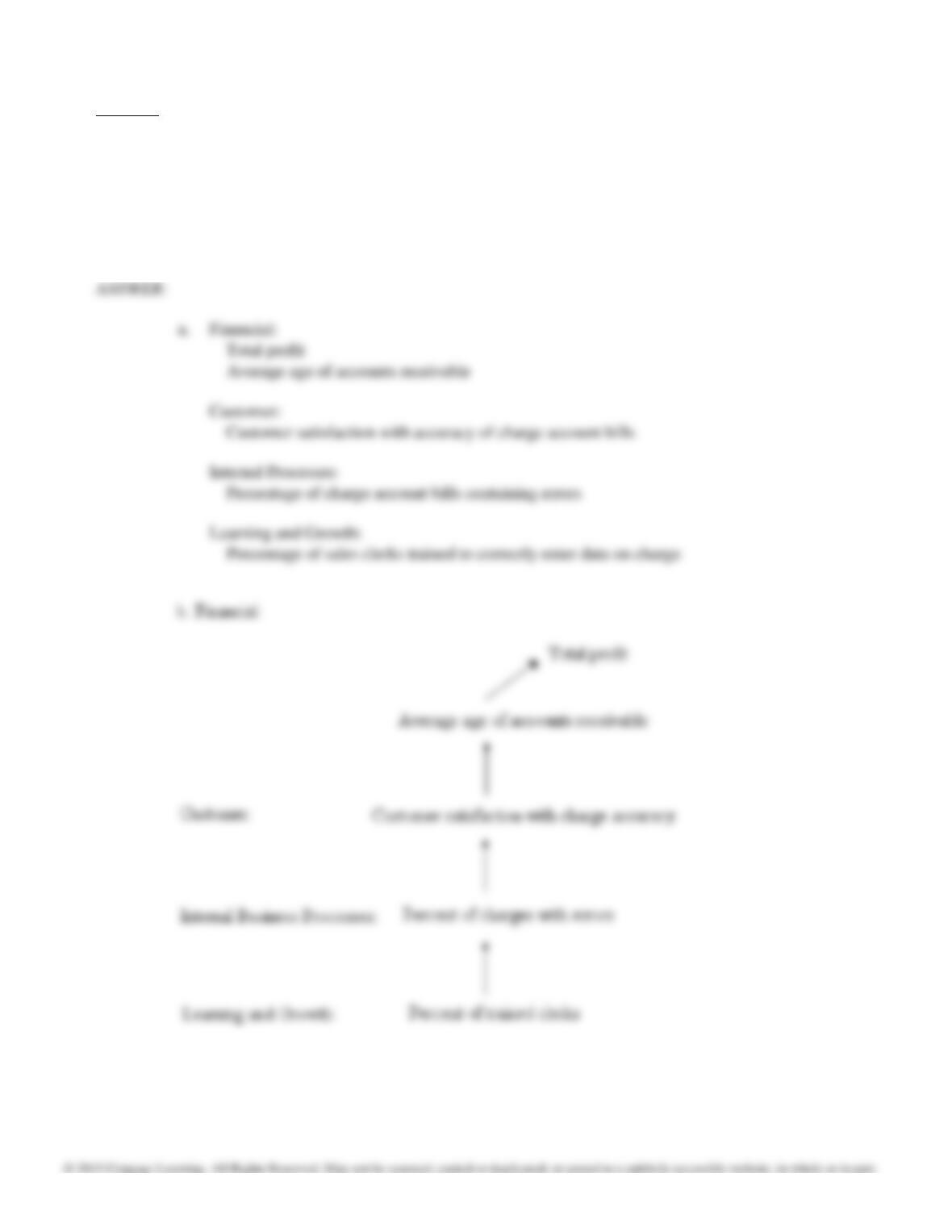
a. Build an integrated Balanced Scorecard using only performance measures suggested by the managers. You
do not have to use all the measures, but build a Balanced Scorecard that reveals a strategy for dealing with
the problems with accounts receivable and unsold merchandise.
b. Construct a testable strategy by showing the causal links (with arrows) between measures in the different
perspectives, and show whether the performance measure should show an increase or decrease.
c. Assume that the company adopts the Balanced Scorecard. After operating for a year, there are
improvements in some performance measures but not in others. What should management do next?

Chapter 13: The Balanced Scorecard: Strategic-Based Control
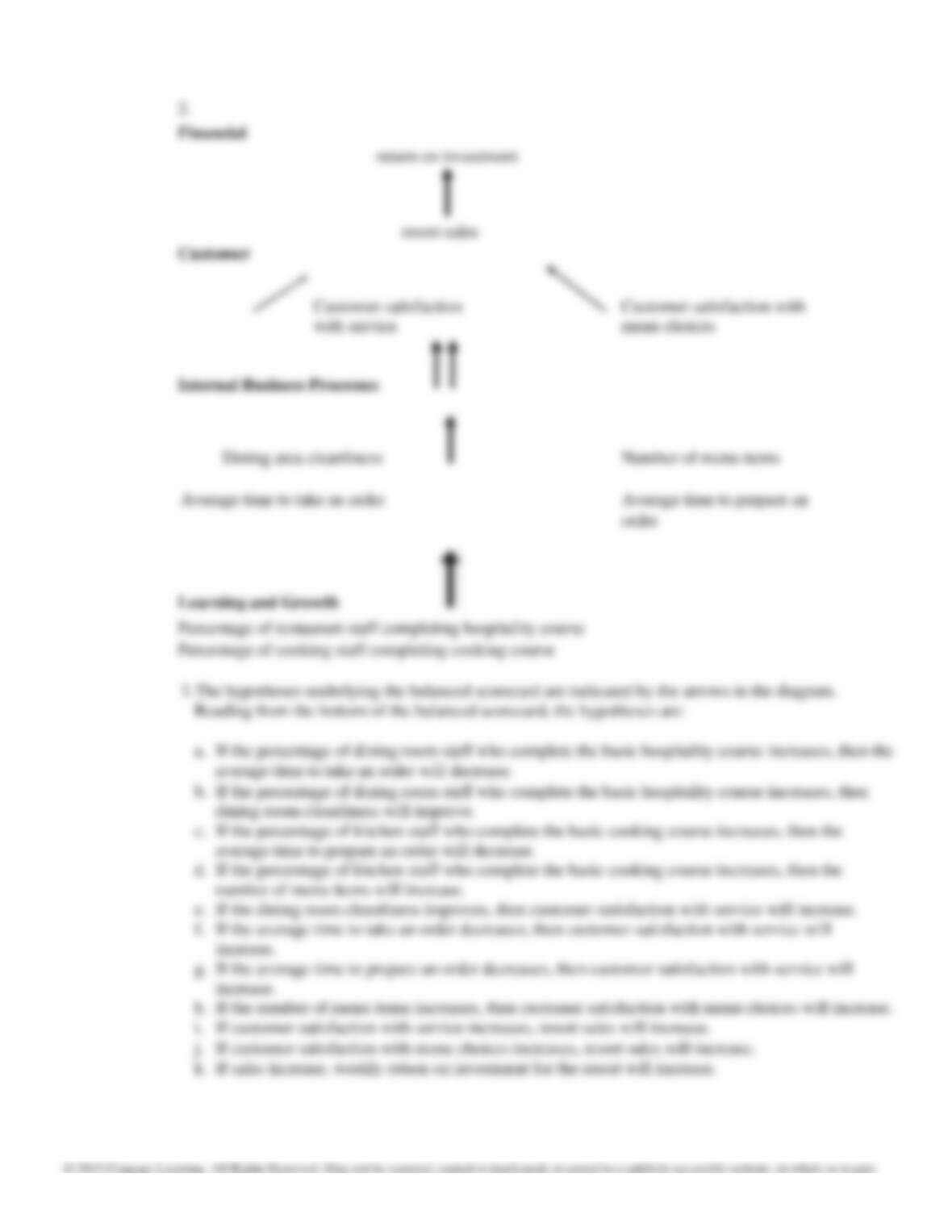
124. The Sand and Sun scuba resort recently changed owners. The new owners planned to upgrade the resort into to a
destination vacation resort by improving the lodging and the restaurant. Currently, the restaurant has a limited
menu of sandwiches and little competition because of its location. The current staff has been retained and the new
management held a meeting with the employees to develop a balanced scorecard that would guide operations. All
were enthusiastic about creating the scorecard and the new management’s plans for the resort.
The following measures were developed for an initiative that would improve the restaurant:
a. Resort sales
b. Resort return on investment
c. Number of menu items
d. Dining area cleanliness
e. Customer satisfaction with menu choices through satisfaction surveys
f. Customer satisfaction with service through satisfaction surveys
g. Average time to take an order
h. Average time to prepare an order
i. Percentage of the cooking staff completing a basic cooking course at the community college
j. Percentage of restaurant staff completing a hospitality course at the community college
Required:
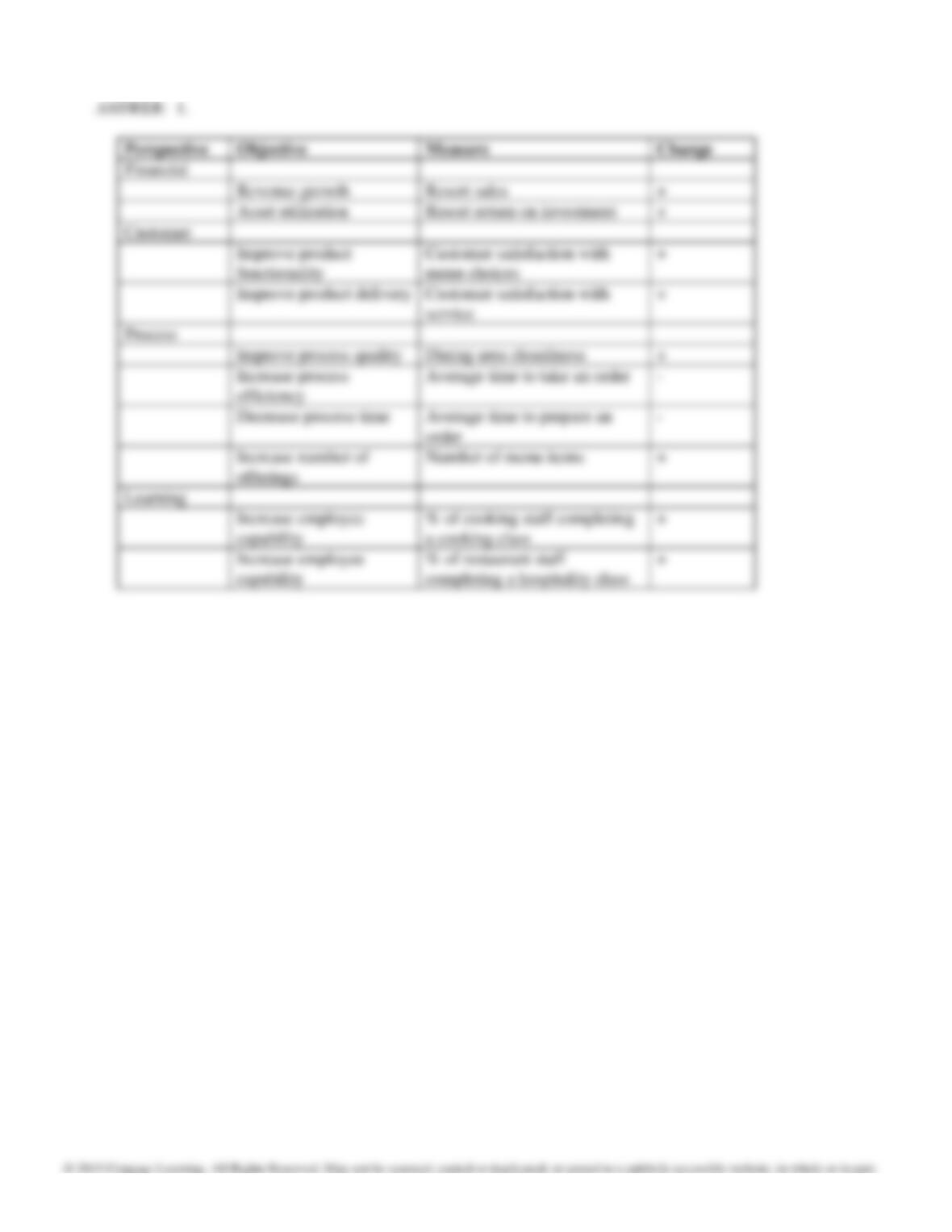
1. For each measure, create a balanced scorecard (show the perspective, measure and measure) indicate whether
the performance measure should increase ( +) or decrease (-).
2. Create a strategy map that links the performance measures.
3. What are the hypotheses built into the scorecard? Through if/then statements show how performance will be
improved.
4. How will management know if one of the hypotheses is false?
Chapter 13: The Balanced Scorecard: Strategic-Based Control
Chapter 13: The Balanced Scorecard: Strategic-Based Control
Chapter 13: The Balanced Scorecard: Strategic-Based Control
125. How can management communicate strategy? What are three methods for achieving strategic alignment? What
management failure can keep strategy from being actionable?