Exam
Name___________________________________
MULTIPLE CHOICE. Choose the one alternative that best completes the statement or answers the question.
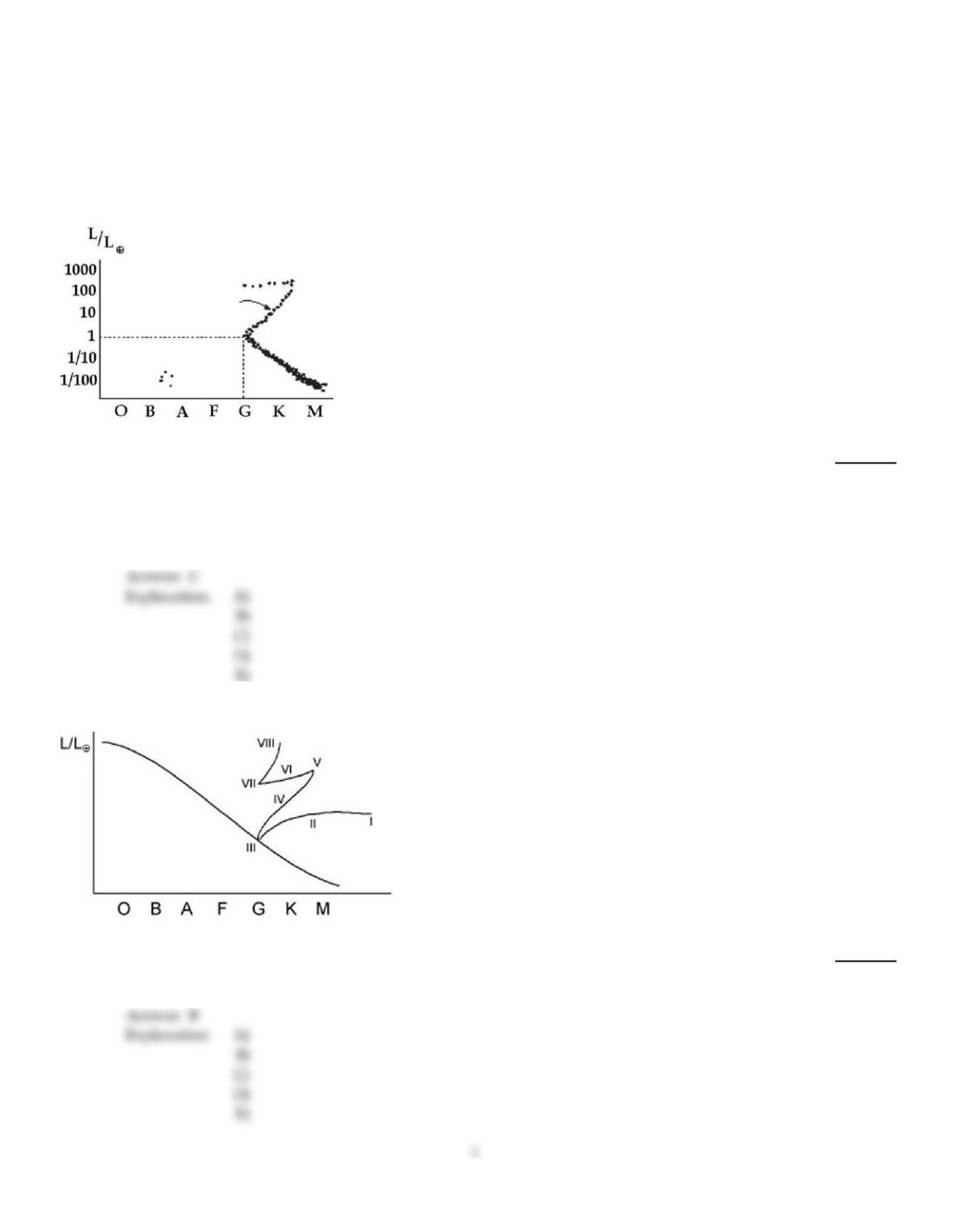
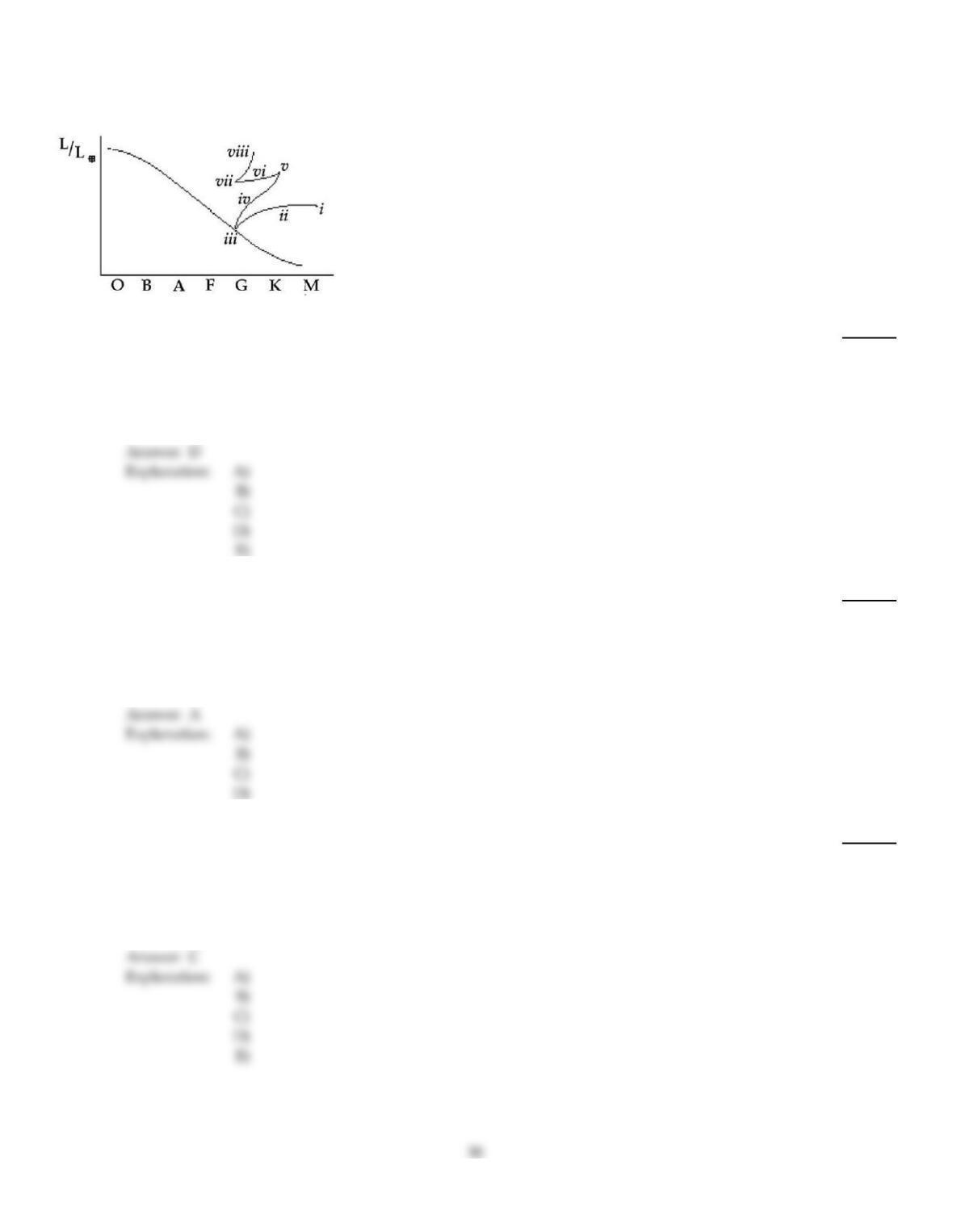
The following questions refer to the sketch below of an H–R diagram for a star cluster.
1)
Which statement about this cluster is not true?
1)
A)
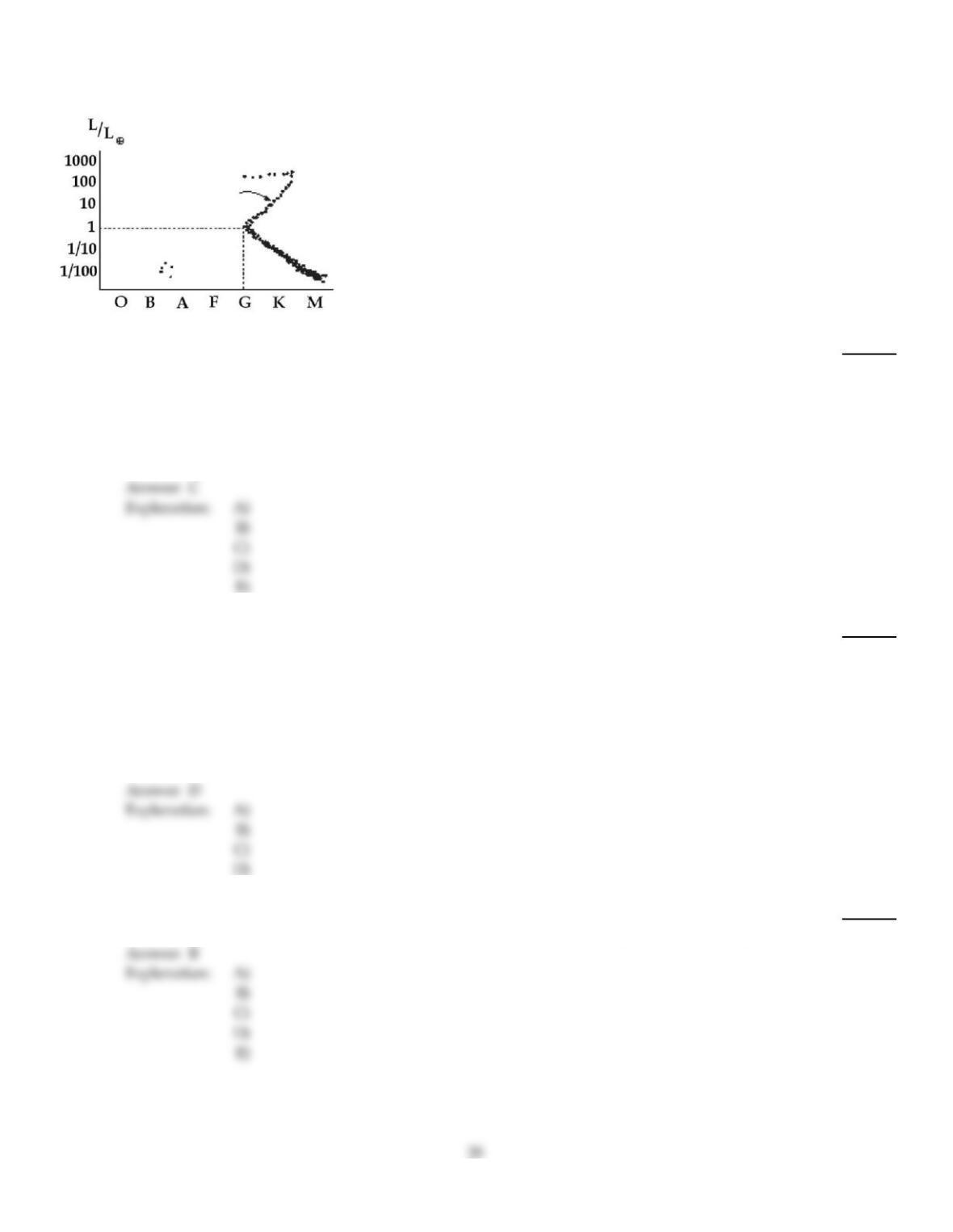
It is likely to be located in the halo of the galaxy.
B)
It is likely to be spherical in shape.
C)
It is the type of cluster known as an open cluster of stars.
D)
It probably contains no young stars at all.
E)
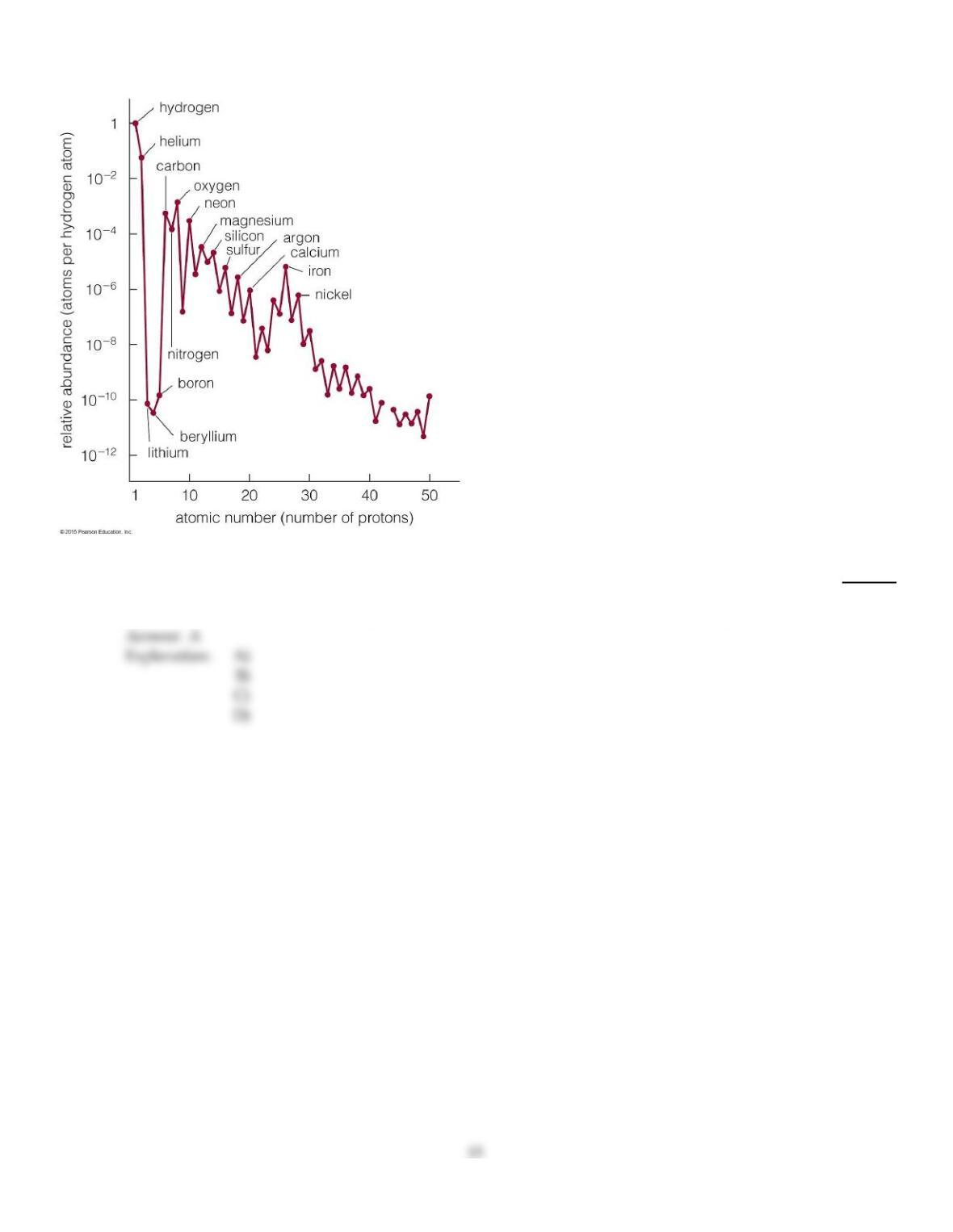
It contains some stars that are burning helium in their cores.
2)
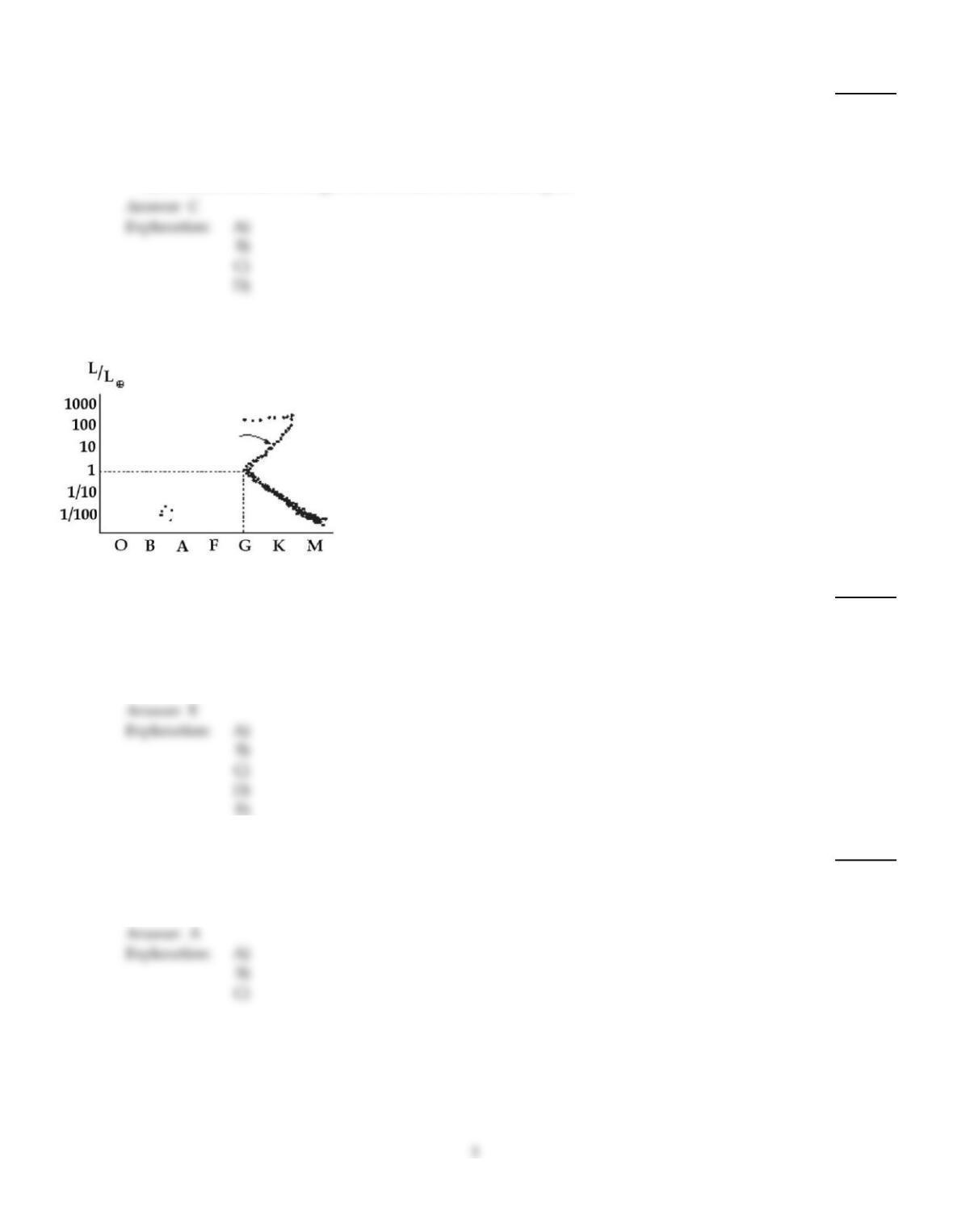
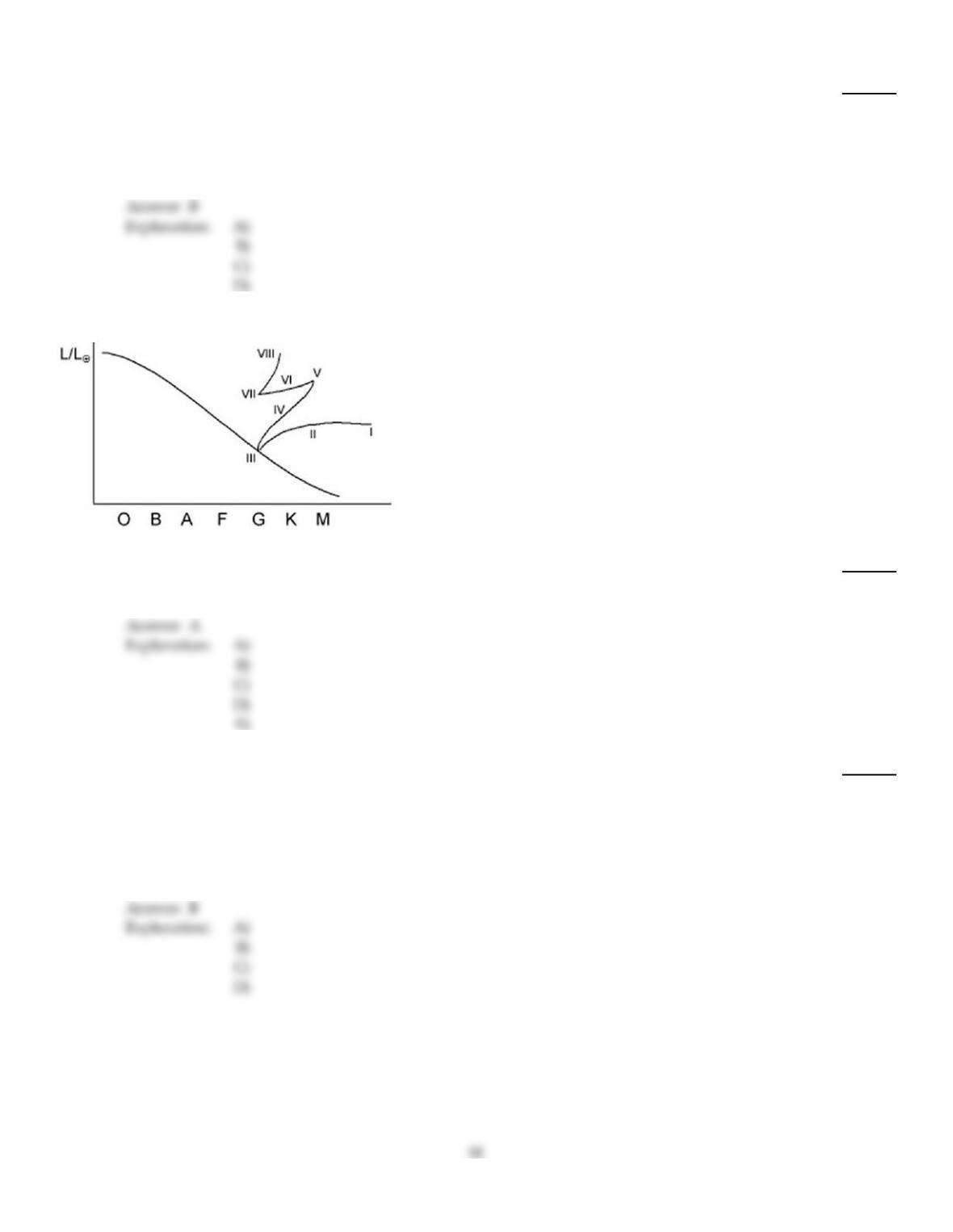
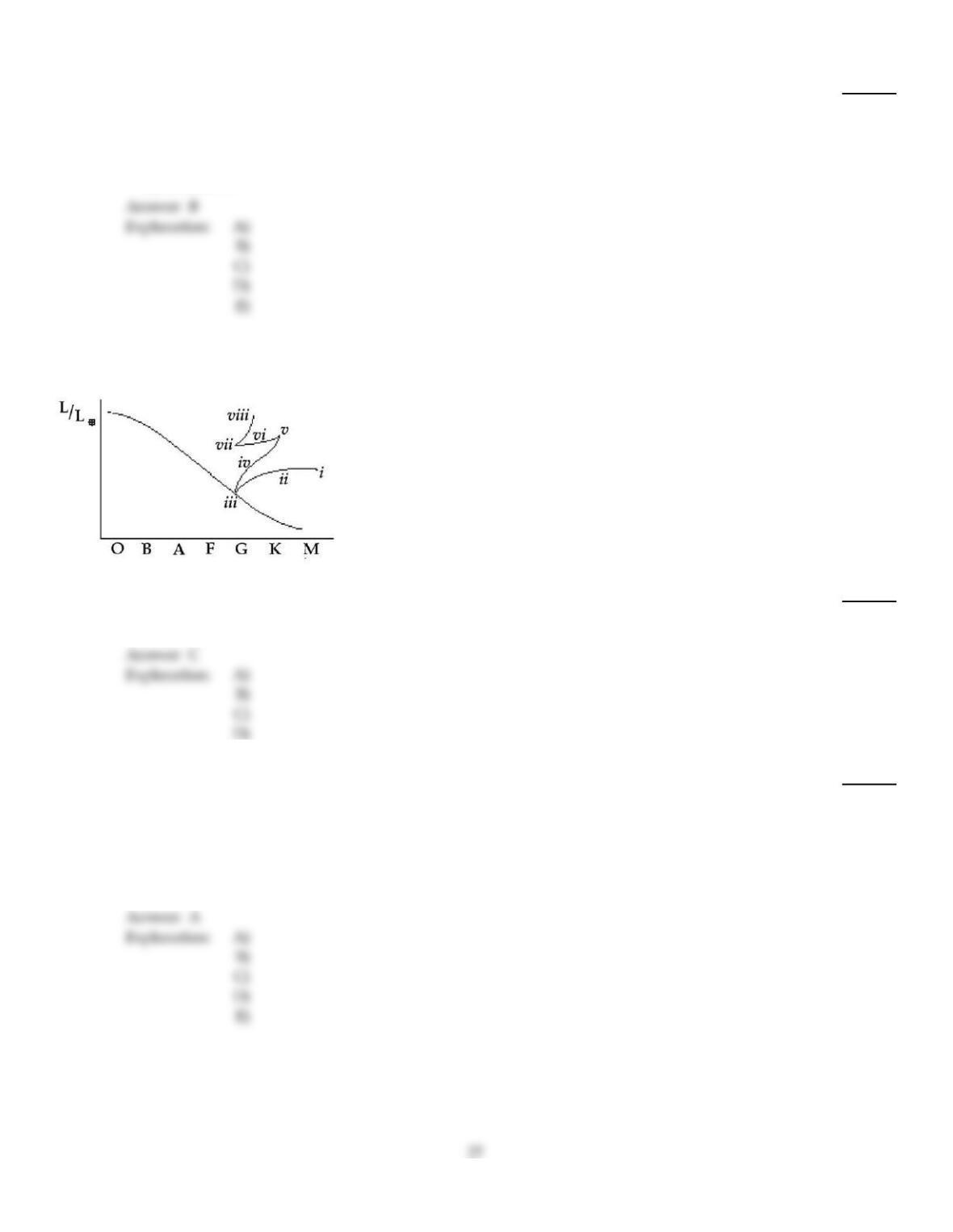
This diagram represents the life track of a 1 solar mass star. Refer to the life stages labeled with
roman numerals. During which stage does the star have an inert (non–burning) helium core?
2)
A)
iii
B)
iv
C)
vii
D)
viii
E)
vi

3)
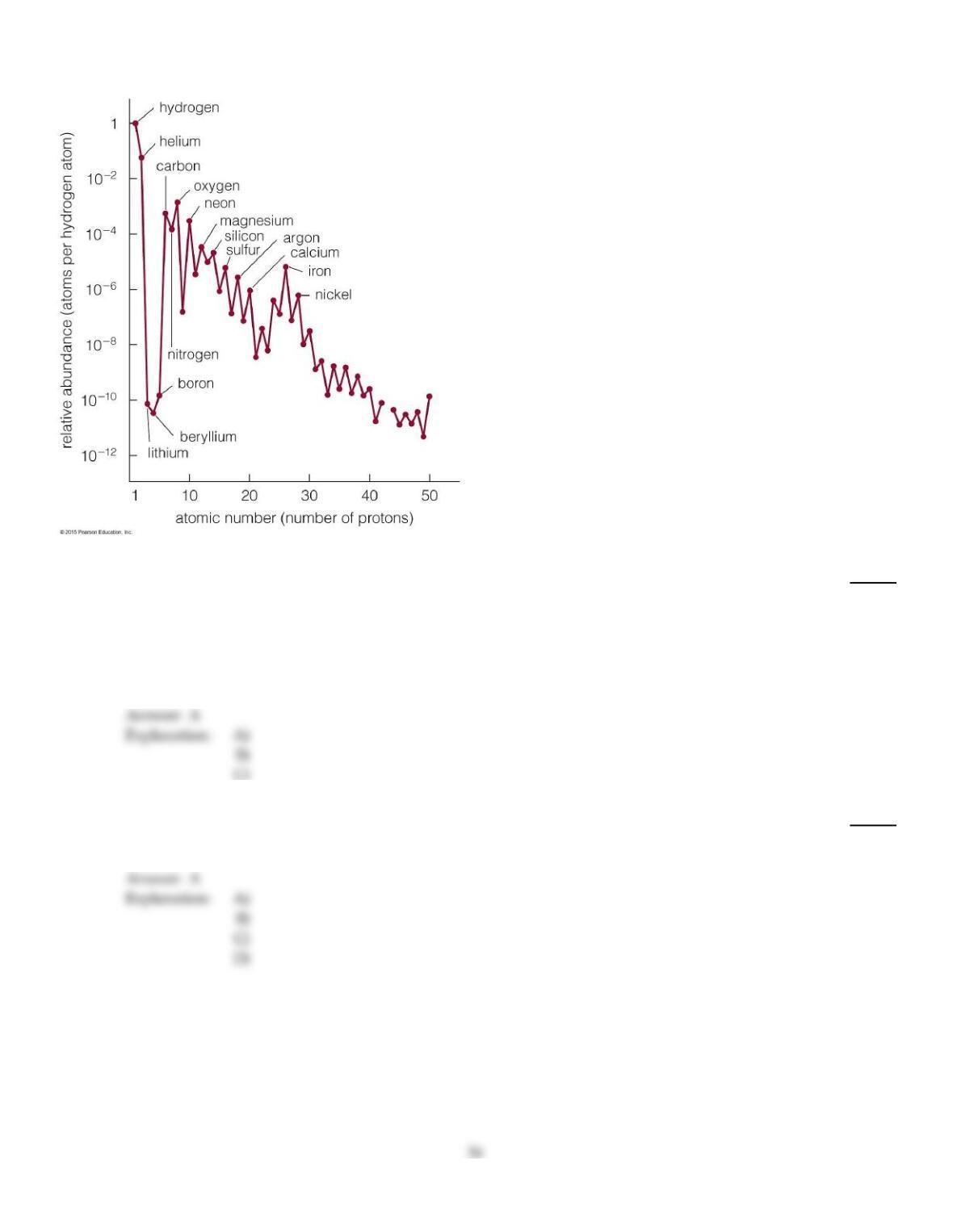
Why are elements with even numbers of protons more abundant, on average, than elements with
odd numbers of protons?
3)
A)
because elements are mainly made in fusion reactions with helium nuclei
B)
because elements are mainly made in fusion reactions with hydrogen nuclei
C)
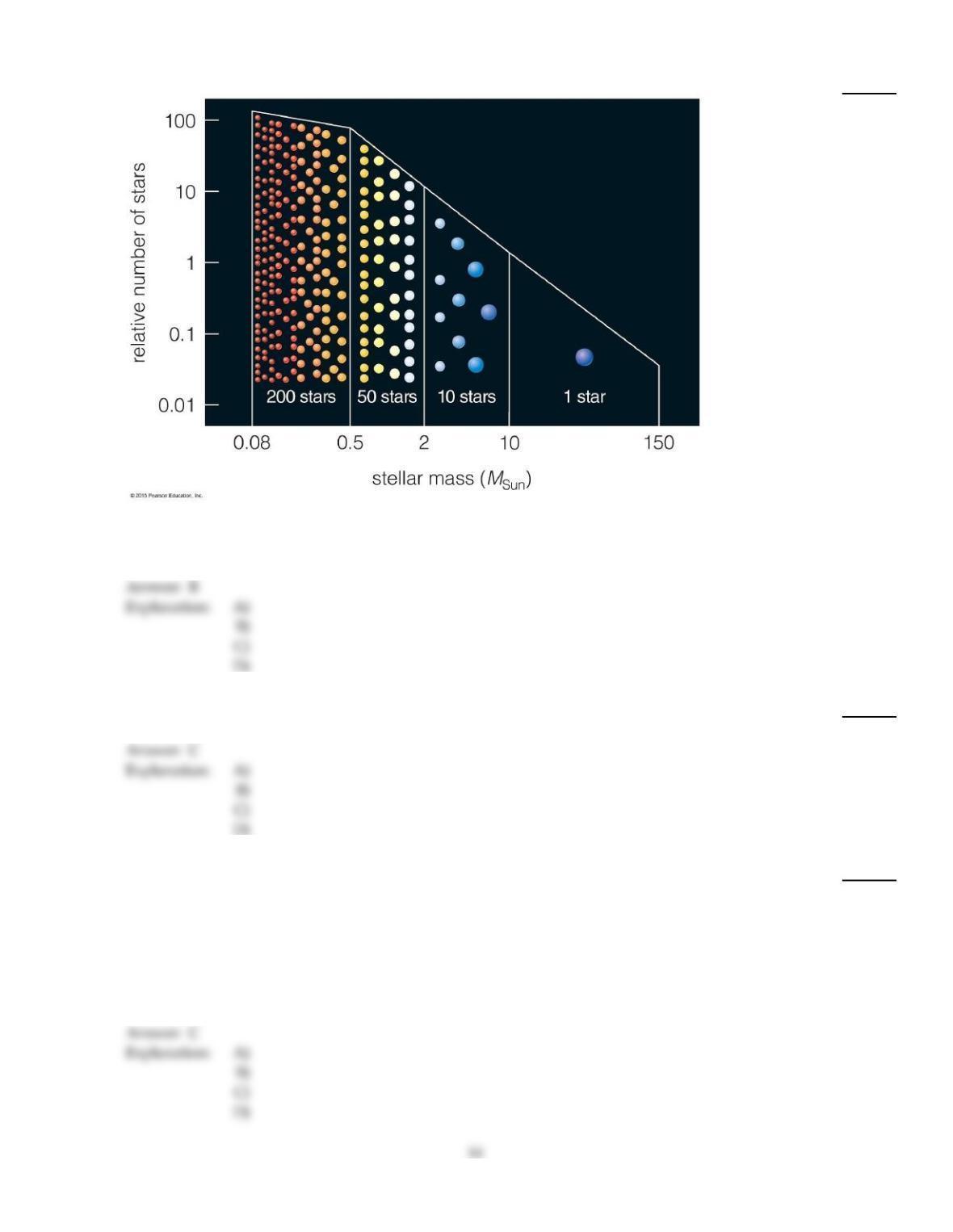
because when elements split in a fission reaction, they prefer to split with all the protons
paired
D)
There’s no explanation; it’s something of a mystery to be explained or it may be a coincidence.
4)
Compared to the star it evolved from, a red giant is
4)
A)
the same temperature and brightness.
B)
cooler and dimmer.
C)
cooler and brighter.
D)
hotter and brighter.
E)
hotter and dimmer.
5)
Where would a brown dwarf be located on an H–R diagram?
5)
A)
in the lower left corner of the H–R diagram
B)
in the upper right corner of the H–R diagram
C)
above and to the left of the highest part of the main sequence
D)
below and to the right of the lowest part of the main sequence
6)
Consider the “dead end” element for cores of massive stars. Why is that element the “dead end“?
6)
A)
It can only release energy by fission.
B)
It can only release energy by fusion.
C)
It has the highest mass per nuclear particle.
D)
It has the lowest nuclear mass.
E)
It has the highest nuclear mass.
F)
It has the lowest mass per nuclear particle.
7)
What eventually halts the gravitational collapse of an interstellar gas cloud that forms an object that
is massive enough to become a star?
7)
A)
nothing; all collapsing gas clouds become black holes
B)
the crowding of electrons in the core
C)
the central object becoming hot enough to sustain nuclear fusion in its core
D)
a critical fraction of the gas has been driven further into space
The following questions refer to the sketch below of an H–R diagram for a star cluster.
8)
Based on its main–sequence turnoff point, the age of this cluster is
8)
A)
about 4.5 billion years.
B)
about 1 billion years.
C)
less than 1 billion years.
D)
more than 15 billion years.
E)
about 10 billion years.
9)
How are elements beyond iron formed in massive–star supernovae?
9)
A)
Neutrons produced during the core collapse are slammed into atomic nuclei.
B)
Elements thrown out at high speeds fuse with hydrogen atoms in the interstellar medium.
C)
The high temperature and pressure allow iron nuclei to fuse.

10)
Why is Supernova 1987A particularly important to astronomers?
10)
A)
It occurred only a few light–years from Earth.
B)
It provided the first evidence that supernovae really occur.
C)
It was the first supernova detected in nearly 400 years.
D)
It is the nearest supernova to have occurred at a time when we were capable of studying it
carefully with telescopes.
11)
At approximately what temperature can helium fusion occur?
11)
A)
1 million K
B)
100 million K
C)
100,000 K
D)
100 billion K
E)
10 million K
Explanation:
12)
If someone somehow added a lot more hydrogen and helium to the Sun (say 50% more than it has
now), what would happen to it?
12)
A)
It would explode as a supernova.
B)
It would increase in size and float away.
C)
It would begin to evolve much more quickly than it is now.
D)
It would cease to exist as a star because it would be too diffuse and fluffy.
E)
Its nuclear reactions would slow down because its heavy element abundance would be
relatively less.
Explanation:
13)
What happens when the gravity of a massive star is able to overcome neutron degeneracy pressure?
13)
A)
The core contracts and becomes a black hole.
B)
The core contracts and becomes a ball of neutrons.
C)
The star explodes violently, leaving nothing behind.
D)
The core contracts and becomes a white dwarf.
E)
Gravity is not able to overcome neutron degeneracy pressure.
Explanation:
Explanation:

14)
Which two processes can generate energy to help a star maintain its internal thermal pressure?
14)
A)
nuclear fusion and supernova
B)
nuclear fission and supernova
C)
nuclear fusion and nuclear fission
D)
nuclear fusion and gravitational contraction
15)
Angular momentum plays an important role in star formation. Which of the following
characteristics of a protostellar system is probably not strongly affected by the star’s angular
momentum?
15)
A)
the formation of a protostellar disk
B)
the existence of protostellar jets
C)
the onset of core hydrogen fusion
D)
the strength of protostellar winds
16)
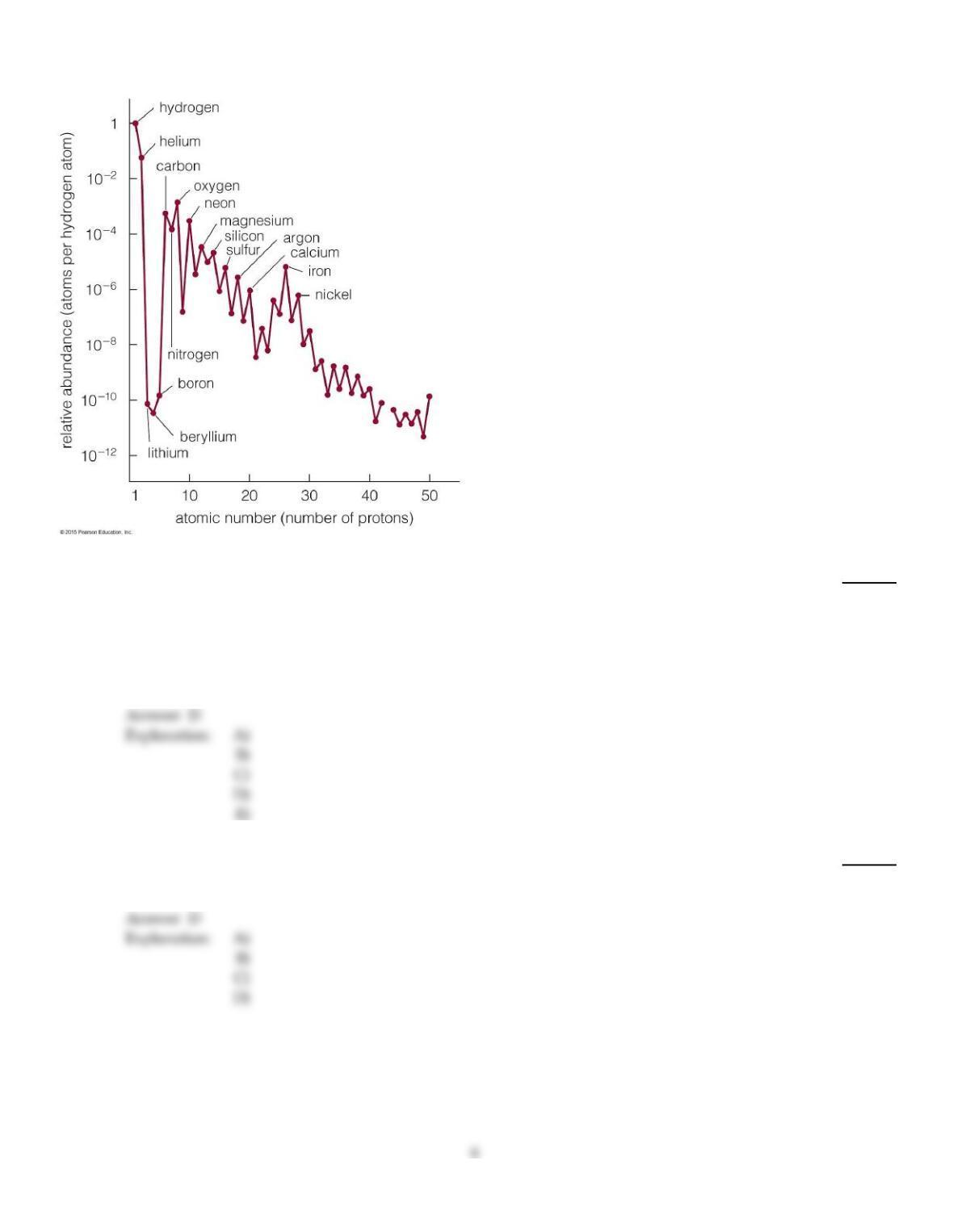
The figure above shows the abundance of elements in the galaxy relative to hydrogen. What is the
general trend in elemental abundance?
16)
A)
Elements with an odd number of protons are less abundant than neighboring elements.
B)
Elements with more protons are less abundant.
C)
Elements with an even number of protons are less abundant than neighboring elements.
D)
both A and B
E)
both A and C
17)
What kind of gas cloud is most likely to give birth to stars?
17)
A)
a hot, dense gas cloud
B)
a hot, low–density gas cloud
C)
a cold, low–density gas cloud
D)
a cold, dense gas cloud

18)
When does a star become a main–sequence star?
18)
A)
when hydrogen fusion is occurring throughout the star’s interior
B)
when the protostar assembles from its parent molecular cloud
C)
when the rate of hydrogen fusion in the star’s core is high enough to sustain gravitational
equilibrium
D)
when a star becomes luminous enough to emit thermal radiation
E)
the instant when hydrogen fusion first begins in the star’s core
19)
The overall helium fusion reaction is ________.
19)
A)
four helium nuclei fuse to form one oxygen nucleus
B)
two hydrogen nuclei fuse to form one helium nucleus
C)
three helium nuclei fuse to form one carbon nucleus
D)
two helium nuclei fuse to form one beryllium nucleus
20)
No stars are expected with masses greater than 150 times our Sun because
20)
A)
molecular clouds do not have enough material to form such massive stars.
B)
they would shine exclusively at X–ray wavelengths and would be difficult to detect.
C)
they would be too massive for hydrogen fusion to occur in their cores.
D)
they would fragment into binary stars because of their rapid rotation.
E)
they would generate so much power that they would blow themselves apart.
21)
Algol consists of a 3.7 MSun main–sequence star and a 0.8 MSun subgiant. Why does this seem
surprising, at least at first?
21)
A)
A star with a mass of 3.7 MSun is too big to be a main sequence star.
B)
The two stars in a binary system should both be at the same stage of life; that is, they should
either both be main sequence stars or both be subgiants.
C)
The two stars should be the same age, so we’d expect the subgiant to be more massive than
the main–sequence star.
D)
It doesn’t make sense to find a subgiant in a binary star system.

22)
Why does stellar main–sequence lifetime decrease with increasing stellar mass?
22)
A)
It doesn’t; higher mass stars have more hydrogen available for fusion, and thus have longer
lifetimes.
B)
Strong stellar winds cause higher mass stars to lose mass quickly.
C)
Higher outward pressure prevents the core hydrogen from being replenished by the star’s
outer layers.
D)
Higher core temperatures cause fusion to proceed much more rapidly.
23)
You discover a binary star system in which one member is a15 solar mass main–sequence star and
the other star is a 10 solar mass giant star. How do we believe that a star system such as this might
have come to exist?
23)
A)
The giant must once have been the more massive star but transferred some of its mass to its
companion.
B)
The main–sequence star probably is a pulsating variable star and therefore appears to be less
massive than it really is.
C)
Other than the very low odds of finding a system with two such massive stars, there is
nothing surprising about the fact that such systems exist.
D)
Although both stars probably formed from the same clump of gas, the more massive one
must have had its birth slowed so that it became a main–sequence star millions of years later
than its less massive companion.
E)
The two stars probably were once separate but became a binary when a close encounter
allowed their mutual gravity to pull them together.
24)
What is the approximate range of masses that newborn main sequence stars can have?
24)
A)
0.1 to 1,000 solar masses
B)
0.001 to 150 solar masses
C)
0.1 to 10 solar masses
D)
0.1 to 150 solar masses
E)
0.001 to 10 solar masses

25)
During which of the following phases of life is a star’s pressure and gravity out of equilibrium?
25)
A)
red giant
B)
helium core fusion
C)
white dwarf
D)
main sequence
E)
A star is never out of equilibrium.
26)
What is a planetary nebula?
26)
A)
interstellar gas from which planets are likely to form in the not–too–distant future
B)
gas ejected from a low–mass star in the final stage of its life
C)
gas created from the remains of planets that once orbited a dead star
D)
the remains of a high–mass star that has exploded
Explanation:
27)
What type of star is our Sun?
27)
A)
a low–mass star
B)
a high–mass star
C)
an intermediate–mass star
Explanation:
28)
Which of the following sequences correctly describes the stages of life for a low–mass star?
28)
A)
protostar, red giant, main–sequence, white dwarf
B)
protostar, main–sequence, red giant, white dwarf
C)
red giant, protostar, main–sequence, white dwarf
D)
protostar, main–sequence, white dwarf, red giant
E)
white dwarf, main–sequence, red giant, protostar
Explanation:
Explanation:

29)
After a supernova explosion, the remains of the stellar core ________.
29)
A)
will always be a neutron star
B)
may be either a neutron star or a black hole
C)
will always be a black hole
D)
may be either a white dwarf, neutron star, or black hole
30)
Most interstellar clouds remain stable in size because the force of gravity is opposed by ________
within the cloud.
30)
A)
stellar winds
B)
degeneracy pressure
C)
radiation pressure
D)
thermal pressure
31)
Which of the following lists the stages of life for a low–mass star in the correct order?
31)
A)
main–sequence star, white dwarf, red giant, planetary nebula, protostar
B)
protostar, main–sequence star, red giant, planetary nebula, white dwarf
C)
protostar, main–sequence star, red giant, supernova, neutron star
D)
protostar, main–sequence star, planetary nebula, red giant
32)
What happens to the core of a star after it ejects a planetary nebula?
32)
A)
It becomes a neutron star.
B)
It breaks apart in a violent explosion.
C)
It becomes a white dwarf.
D)
It contracts from a protostar to a main–sequence star.
E)
None of the above

33)
What is a protostar?
33)
A)
a star that has planets
B)
a star in its final stage of life
C)
an intermediate–mass star
D)
a star that is still in the process of forming
34)
What is the CNO cycle?
34)
A)
the process by which carbon is fused into nitrogen and oxygen
B)
the period of a massive star’s life when carbon, nitrogen, and oxygen are fusing in different
shells outside the core
C)
the process by which helium is fused into carbon, nitrogen, and oxygen
D)
a type of hydrogen fusion that uses carbon, nitrogen, and oxygen atoms as catalysts
E)
the period of a low–mass star’s life when it can no longer fuse carbon, nitrogen, and oxygen in
its core
35)
Which type of star spends the longest time as a protostar?
35)
A)
B star
B)
G star
C)
O star
D)
M star
36)
When does a protostar become a main–sequence star?
36)
A)
at the instant that the first hydrogen fusion reactions occur in the protostar’s core
B)
when it becomes luminous enough to emit thermal radiation
C)
when the rate of hydrogen fusion becomes high enough to balance the rate at which the star
radiates energy into space
D)
when a piece of a molecular cloud first begins to contract into a star
37)
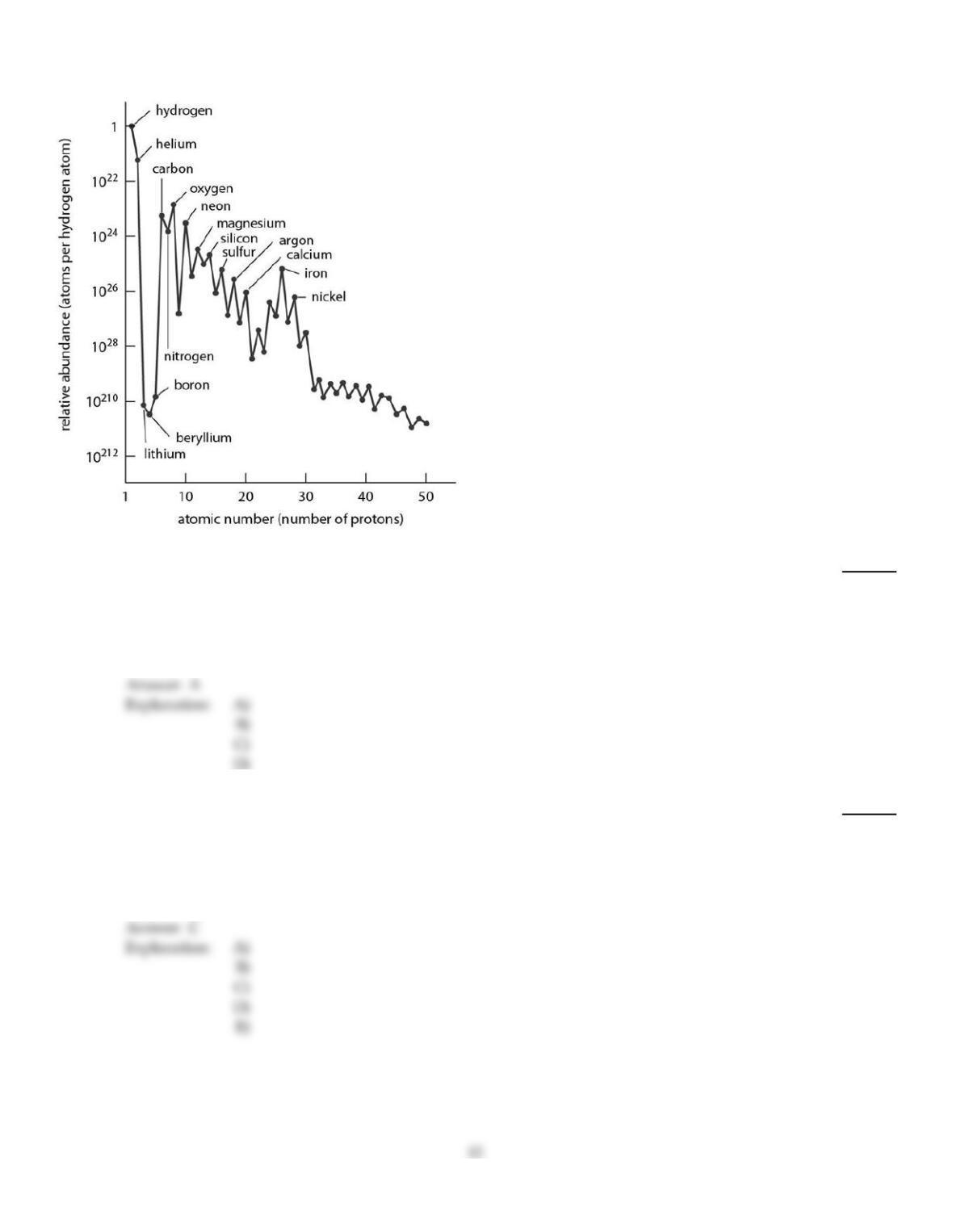
(Use diagram of abundance vs atomic number) What process best explains the observed pattern of
abundances of elements with atomic numbers between 6 and 20?
37)
A)
fusion reactions with helium nuclei
B)
fusion reactions with hydrogen nuclei
C)
radioactive decay of nuclei with odd numbers of protons
D)
fusion reactions with neutrons
38)
Compared to the star it evolved from, a white dwarf is
38)
A)
cooler and brighter.
B)
the same temperature and brightness.
C)
hotter and dimmer.
D)
cooler and dimmer.
E)
hotter and brighter.
39)
The figure above shows the abundance of elements in the galaxy relative to hydrogen. What is the
least abundant of the elements with an atomic number less than iron’s?
39)
A)
beryllium
B)
nitrogen
C)
lithium
D)
hydrogen
40)
This schematic shows the number of stars formed in each mass range for each star more massive
than 10 MSun. What is the mass range of the most common stars?
40)
A)
0.5 – 2 MSun
B)
0.08 – 0.5 MSun
C)
2 – 10 MSun
D)
10 – 150 MSun
41)
Which type of star spends the shortest time as a main sequence star?
41)
A)
B star
B)
G star
C)
O star
D)
M star
42)
Which of the following statements about various stages of core nuclear burning (hydrogen, helium,
carbon, and so on) in a high–mass star is not true?
42)
A)
As each stage ends, the reactions that occurred in previous stages continue in shells around
the core.
B)
Each successive stage creates an element with a higher atomic number and atomic mass
number.
C)
Each successive stage lasts for approximately the same amount of time.
D)
As each stage ends, the core shrinks and heats further.

43)
What is the fate of an isolated brown dwarf?
43)
A)
It will become a neutron star.
B)
It will become a white dwarf.
C)
It will slowly evaporate to nothing.
D)
It will remain a brown dwarf forever.
E)
It will become a black hole.
44)
Why do flat disks form around young stars?
44)
A)
They don’t; the stars form from the disks.
B)
Centrifugal force pushes gas outward from the spinning gas cloud.
C)
Intense winds from nearby massive stars flatten the gas cloud.
D)
Collisions between rotating gas particles flatten the gas cloud along the axis of rotation.
45)
You discover a binary star system in which one member is a 15 solar mass main–sequence star and
the other star is a 10 solar mass giant star. Why should you be surprised, at least at first?
45)
A)
It doesn’t make sense to find a giant in a binary star system.
B)
The two stars in a binary system should both be at the same point in stellar evolution; that is,
they should either both be main–sequence stars or both be giants.
C)
The odds of ever finding two such massive stars in the same binary system are so small as to
make it inconceivable.
D)
The two stars should be the same age, so the more massive one should have become a giant
first.
E)
A star with a mass of 15 solar masses is too big to be a main–sequence star.
46)
Generally speaking, how does the surface temperature and luminosity of a protostar compare to
the surface temperature and luminosity of the main–sequence star it becomes?
46)
A)
A main–sequence star is hotter and dimmer than it was as a protostar.
B)
A main–sequence star is cooler and brighter than it was as a protostar.
C)
A main–sequence star is hotter and brighter than it was as a protostar.
D)
A main–sequence star is cooler and dimmer than it was as a protostar.

47)
Which event marks the beginning of a supernova?
47)
A)
the onset of helium burning after a helium flash
B)
the beginning of neon burning in an extremely massive star
C)
the sudden initiation of the CNO cycle
D)
the sudden collapse of an iron core into a compact ball of neutrons
48)
Why does a star grow larger after it exhausts its core hydrogen?
48)
A)
The internal radiation generated by the hydrogen fusion in the core has heated the outer
layers enough that they can expand after the star is no longer fusing hydrogen.
B)
Helium fusion in a shell outside the core generates enough thermal pressure to push the
upper layers outward.
C)
The outer layers of the star are no longer gravitationally attracted to the core.
D)
Helium fusion in the core generates enough thermal pressure to push the upper layers
outward.
E)
Hydrogen fusion in a shell outside the core generates enough thermal pressure to push the
upper layers outward.
E
49)
Why is a 1 solar–mass red giant more luminous than a 1 solar–mass main sequence star?
49)
A)
The red giant has a hotter core.
B)
The red giant is more massive.
C)
Fusion reactions are producing energy at a greater rate in the red giant.
D)
The red giant’s surface is hotter.
C
50)
The main source of energy for a star as it grows in size to become a red giant is ________.
50)
A)
hydrogen fusion in a shell surrounding the central core
B)
hydrogen fusion in the central core
C)
helium fusion in the central core
D)
gravitational contraction
A
D

51)
Which is more common: a star blows up as a supernova, or a star forms a planetary nebula/white
dwarf system?
51)
A)
Planetary nebula formation is more common.
B)
Supernovae are more common.
C)
They both occur in about equal numbers.
D)
It is impossible to say.
52)
Which of the following statements about brown dwarfs is not true?
52)
A)
Brown dwarfs eventually collapse to become white dwarfs.
B)
Brown dwarfs are supported against gravity by degeneracy pressure, which does not depend
on the object’s temperature.
C)
All brown dwarfs have masses less than about 8% that of our Sun.
D)
Brown dwarfs form like ordinary stars but are too small to sustain nuclear fusion in their
cores.
53)
You discover a binary star system in which one star is a 15 MSun main–sequence star and the other
is a 10 MSun giant. How do we think that a star system such as this might have come to exist?
53)
A)
Although both stars probably formed from the same clump of gas, the more massive one
must have had its birth slowed so that it became a main sequence stars millions of years later
than its less massive companion.
B)
The two stars are simply evolving normally and independently, and one has become a giant
before the other.
C)
The two stars probably were once separate, but became a binary when a close encounter
allowed their mutual gravity to pull them together.
D)
The giant must once have been the more massive star, but is now less massive because it
transferred some of its mass to its companion.
54)
A spinning neutron star has been observed at the center of a ________.
54)
A)
planetary nebula
B)
protostar
C)
supernova remnant
D)
red supergiant
55)
Which of the following types of data provide evidence that helps us understand the life tracks of
low–mass stars?
55)
A)
H–R diagrams of open clusters
B)
H–R diagrams of globular clusters
C)
spacecraft observations of the Sun
D)
observing a low–mass star over many years
56)
This diagram represents the life track of a 1 solar mass star. Refer to the life stages labeled with
roman numerals. Which stage lasts the longest?
56)
A)
iii
B)
viii
C)
vi
D)
iv
E)
i
57)
We do not know for certain whether the general trends we observe in stellar birth masses also
apply to brown dwarfs. But if they do, then which of the following would be true?
57)
A)
Brown dwarfs would be responsible for most of the overall luminosity of our Milky Way
Galaxy.
B)
Brown dwarfs would outnumber all ordinary stars.
C)
Brown dwarfs would be extremely rare.
D)
Most of the brown dwarfs in the Milky Way Galaxy would be quite young in age.

58)
Our Sun is considered to be a(n) ________.
58)
A)
brown dwarf
B)
low–mass star
C)
high–mass star
D)
intermediate–mass star
59)
Which part of the electromagnetic spectrum generally gives us our best views of stars forming in
dusty clouds?
59)
A)
ultraviolet
B)
infrared
C)
blue light
D)
visible light
60)
Which two energy sources can help a star maintain its internal thermal pressure?
60)
A)
nuclear fusion and gravitational contraction
B)
nuclear fusion and chemical reactions
C)
nuclear fission and gravitational contraction
D)
nuclear fusion and nuclear fission
E)
chemical reactions and gravitational contraction
The following questions refer to the sketch below of an H–R diagram for a star cluster.
61)
Consider the star to which the arrow points. Which of the following statements about this star is not
true?
61)
A)
It is larger in radius than the Sun.
B)
Its surface temperature is lower than the Sun’s.
C)
It is significantly less massive than the Sun.
D)
It is brighter than the Sun.
E)
Its core temperature is higher than the Sun’s.
62)
Consider a large molecular cloud that will give birth to a cluster of stars. Which of the following
would you expect to be true?
62)
A)
All the stars in the cluster will have approximately the same luminosity and surface
temperature.
B)
All the stars in the cluster will become main–sequence stars at about the same time.
C)
All the stars in the cluster will be of about the same mass.
D)
A few massive stars will form, live, and die before the majority of the star’s clusters even
complete their protostar stage.
63)
Helium fusion results in the production of
63)
A)
nitrogen.
B)
carbon.
C)
iron.
D)
hydrogen.
E)
oxygen.

64)
The ultimate fate of our Sun is to ________.
64)
A)
become a rapidly spinning neutron star
B)
explode in a supernova
C)
become a black hole
D)
become a white dwarf that will slowly cool with time
65)
Suppose the star Betelgeuse (the upper left shoulder of Orion) were to become a supernova
tomorrow (as seen here on Earth). What would it look like to the naked eye?
65)
A)
We’d see a cloud of gas expanding away from the position where Betelgeuse used to be. Over
a period of a few weeks, this cloud would fill our entire sky.
B)
Because the supernova event destroys the star, Betelgeuse would suddenly disappear from
view.
C)
Betelgeuse would suddenly appear to grow larger in size, soon reaching the size of the full
moon. It would also be about as bright as the full moon.
D)
Betelgeuse would remain a dot of light but would suddenly become so bright that, for a few
weeks, we’d be able to see this dot in the daytime.
66)
Why is Supernova 1987A particularly important to astronomers?
66)
A)
It provided the first evidence that neutron stars exist.
B)
It was the nearest supernova detected in nearly 400 years.
C)
It provided the first observational evidence that supernovae actually occur.
D)
It was the first supernova detected in nearly 400 years.
E)
It occurred only a few dozen light–years from Earth.
67)
Which of the following statements about the stages of nuclear burning in a massive star is not true?
67)
A)
Each successive stage creates an element with a higher atomic weight.
B)
Each successive stage lasts for approximately as long as the first, hydrogen fusion stage.
C)
Each successive stage of fusion requires higher temperatures than the previous stages.
D)
As each stage ends, the core shrinks further.

68)
In order to predict whether a star will eventually fuse oxygen into a heavier element, you mainly
want to know what fact about the star?
68)
A)
its luminosity
B)
its overall abundance of elements heavier than helium
C)
how much oxygen it now has in its core
D)
its mass
69)
After a supernova event occurring in a high–mass star, what is left behind?
69)
A)
always a white dwarf
B)
always a black hole
C)
always a neutron star
D)
either a white dwarf or a neutron star
E)
either a neutron star or a black hole
70)
What can trigger the gravitational collapse of an interstellar gas cloud?
70)
A)
a decrease in temperature
B)
an increase in density
C)
a rise in temperature
D)
A and B
E)
A and C
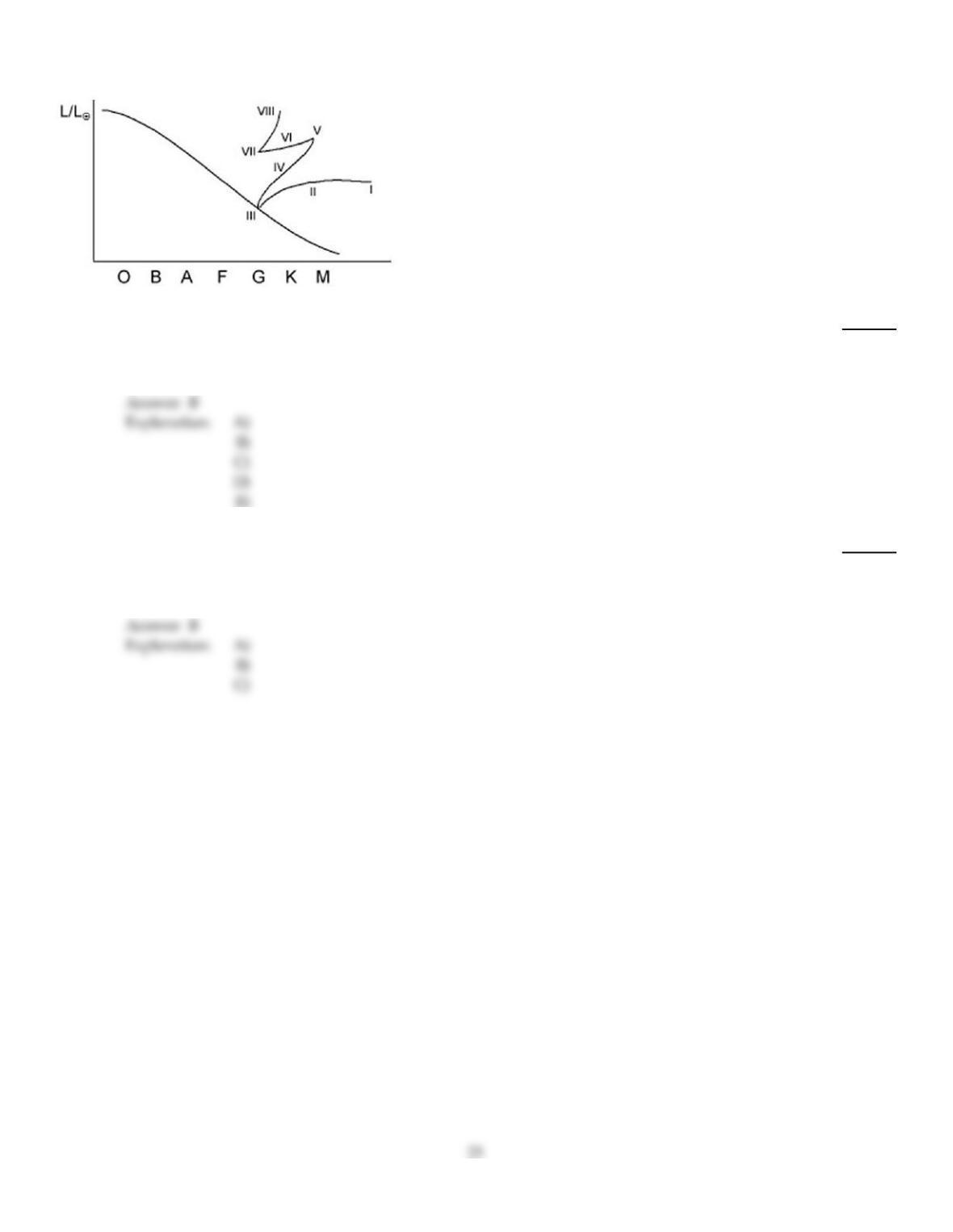
71)
This diagram represents the life track of a 1 solar mass star. Refer to the life stages labeled with
roman numerals. During which stage does the star have an inert (non–burning) carbon core
surrounded by shells of helium and hydrogen burning?
71)
A)
ii
B)
viii
C)
iv
D)
iii
E)
vi
72)
Why don’t low–mass stars have the CNO cycle occurring in their cores?
72)
A)
They don’t have enough carbon, nitrogen, and oxygen.
B)
Their core temperatures are too low.
C)
The CNO cycle makes elements heavier than carbon, nitrogen, and oxygen.
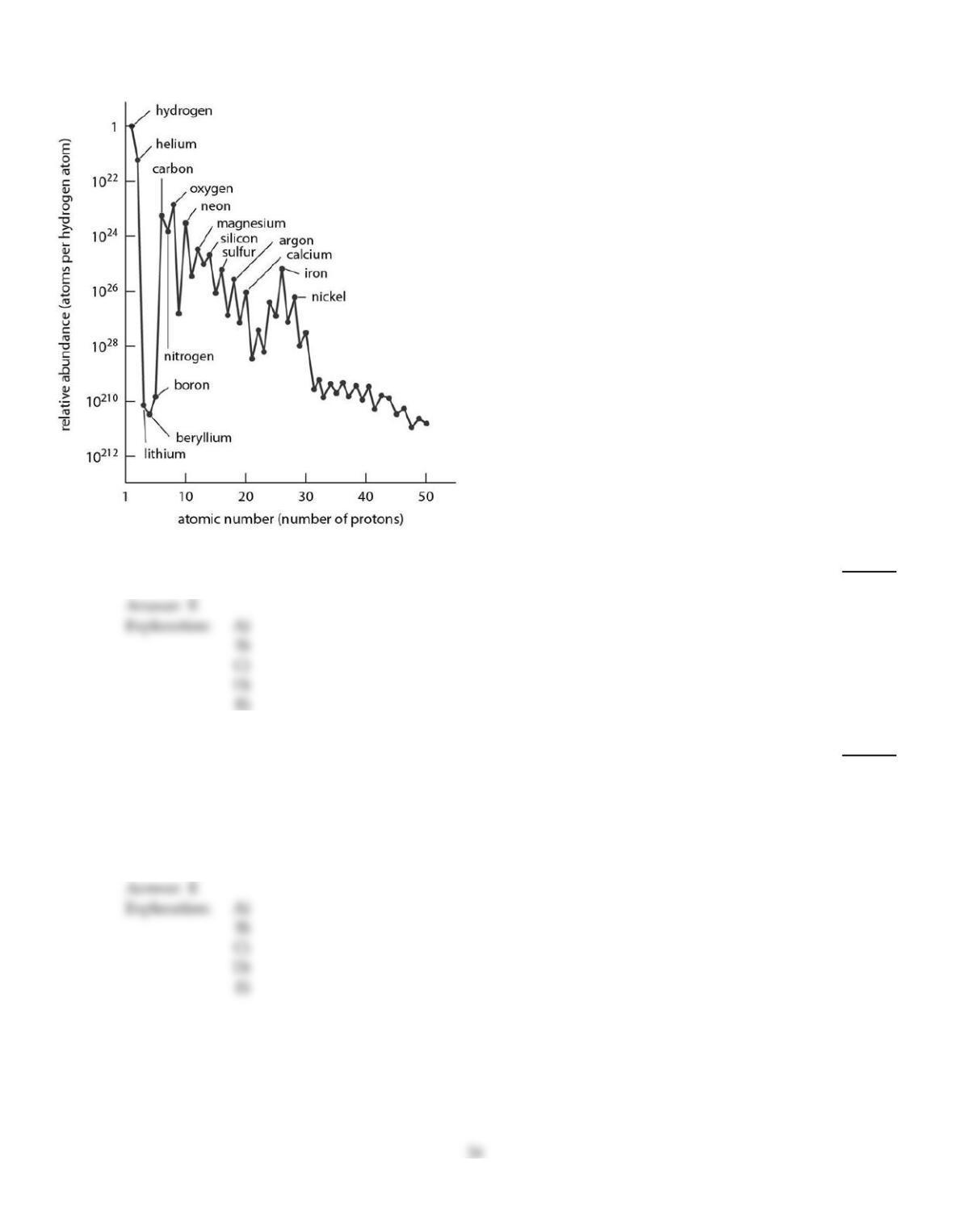
73)
According to this plot, which is the third most abundant element in the universe?
73)
A)
lithium
B)
helium
C)
hydrogen
D)
boron
E)
oxygen
74)
Which event marks the beginning of a supernova?
74)
A)
the onset of helium burning after a helium flash in a star with mass comparable to that of the
Sun
B)
the sudden outpouring of X–rays from a newly formed accretion disk
C)
the beginning of neon burning in an extremely massive star
D)
the expansion of a low–mass star into a red giant
E)
the sudden collapse of an iron core into a compact ball of neutrons

75)
Which of the following properties describes a low–mass star?
75)
A)
late in life, fuses carbon into oxygen
B)
has longer lifetimes than high mass stars
C)
ends its life as a supernova
D)
has higher main–sequence luminosities than high mass stars
76)
What change slowly occurs during the main–sequence lifetime of a star?
76)
A)
It gathers more gas from interstellar space, increasing its mass and hence the luminosity.
B)
Its core temperature slowly increases, increasing the fusion rate and hence the luminosity.
C)
As the solar wind blows material into space, the decreasing mass reduces pressure in the core,
which in turn reduces the fusion rate and the luminosity.
D)
As hydrogen is used up in the core, the fusion rate decreases and reduces the luminosity.
B
77)
Which process is required to allow a gravitationally–collapsing gas cloud to continue to collapse?
77)
A)
New dust particles must continually be made in the cloud.
B)
The cloud must collide with other clouds.
C)
The cloud must radiate much of its thermal energy.
D)
The cloud must trap most of its thermal energy.
C
78)
What eventually halts the gravitational collapse of an interstellar gas cloud that forms an object that
is not massive enough to become a star?
78)
A)
the central object becoming hot enough to sustain nuclear fusion in its core
B)
Nothing; all collapsing gas clouds become black holes.
C)
A critical fraction of the gas has been driven further into space.
D)
the crowding of electrons in the core
D
B

79)
What is a helium flash?
79)
A)
a sudden brightening of a low–mass star, detectable from Earth by observing spectral lines of
helium
B)
another name for the helium fusion reaction
C)
the sudden onset of helium fusion in the core of a low–mass star
D)
the ignition of helium shell burning in a high–mass star with a carbon core
80)
The vast majority of stars in a newly formed star cluster are ________.
80)
A)
about the same mass as our Sun
B)
very high–mass, type O and B stars
C)
less massive than the Sun
D)
red giants
81)
Where does gold (the element) come from?
81)
A)
It was produced during the Big Bang.
B)
It is produced during the late stages of fusion in low–mass stars.
C)
It is produced by mass transfer in close binaries.
D)
It is produced during the supernova explosions of high–mass stars.
82)
Observations show that elements with atomic mass numbers divisible by 4 (such as oxygen–16,
neon–20, and magnesium–24) tend to be more abundant in the universe than elements with atomic
mass numbers in between. Why do we think this is the case?
82)
A)
Elements with atomic mass numbers divisible by 4 tend to be more stable than elements in
between.
B)
The apparent pattern is thought to be a random coincidence.
C)
This pattern in elemental abundances was apparently determined during the first few
minutes after the Big Bang.
D)
At the end of a high–mass star’s life, it produces new elements through a series of helium
capture reactions.
83)
Approximately what core temperature is required before hydrogen fusion can begin in a star?
83)
A)
10 billion K
B)
10 million K
C)
10 trillion K
D)
10,000 K
E)
1 billion K
The following questions refer to the H–R diagram below that shows the life track of a 1–solar–mass star, with various stages labeled with
Roman numerals.
84)
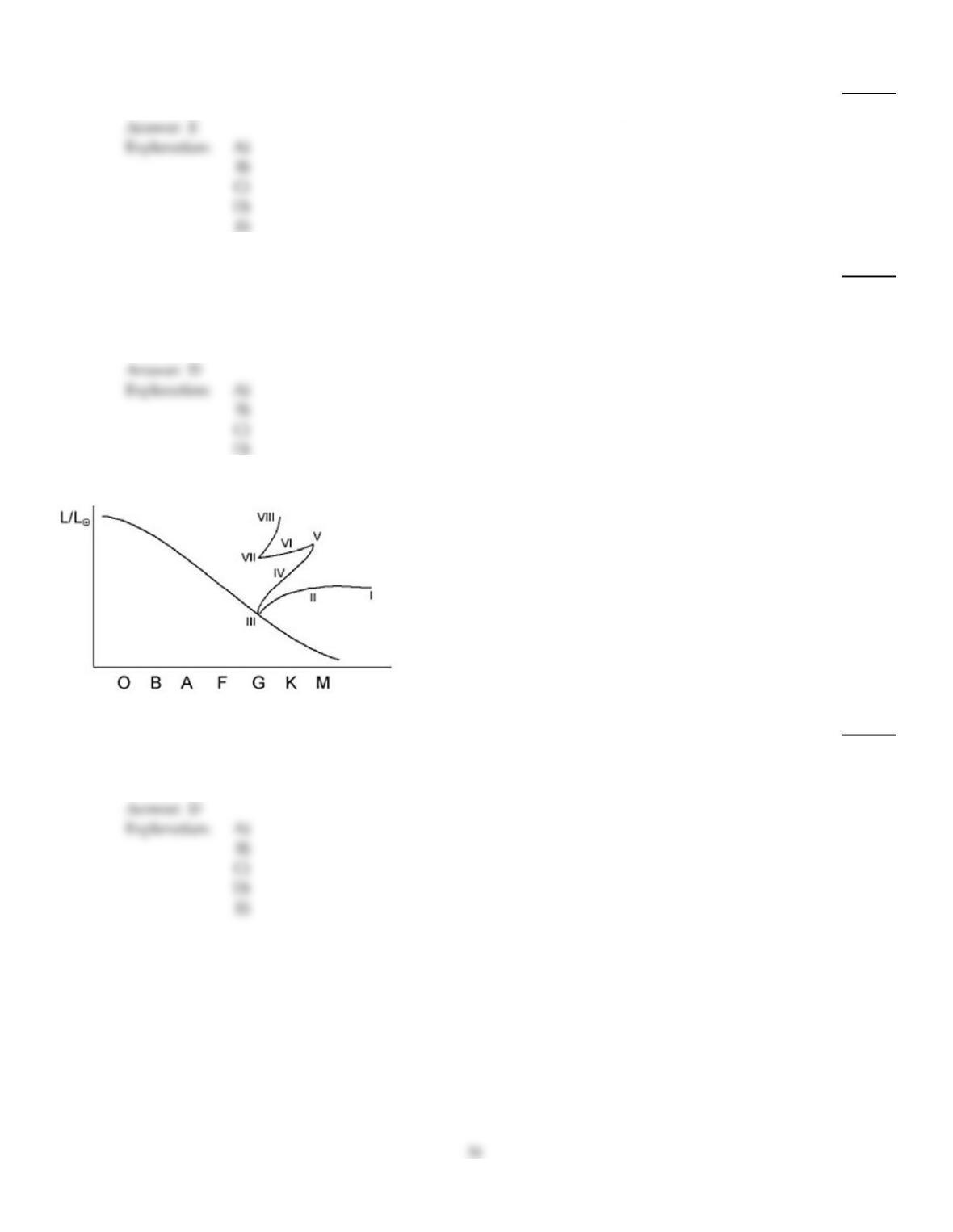
The point labelled iii corresponds to
84)
A)
a red giant
B)
a protostar
C)
on the main sequence
D)
the helium flash
85)
What happens when a star like the sun exhausts its core hydrogen supply?
85)
A)
Its core contracts, but its outer layers expand and the star becomes bigger and brighter.
B)
It contracts, becoming smaller and dimmer.
C)
It expands, becoming bigger but dimmer.
D)
It contracts, becoming hotter and brighter.
E)
Its core contracts, but its outer layers expand and the star becomes bigger but cooler and
therefore remains at the same brightness.

86)
Identify the correct sequence of life events for a high mass star.
86)
A)
main sequence, red supergiant, neutron star, supernova
B)
red supergiant, main sequence, supernova, neutron star
C)
main sequence, red supergiant, supernova, neutron star
D)
red supergiant, main sequence, neutron star, supernova
87)
What will happen in the Sun immediately after it has exhausted its supply of hydrogen in its core?
87)
A)
The Sun will turn into a white dwarf and cool off forever.
B)
The helium core will shrink and heat; a shell of hydrogen will start fusing.
C)
The core will collapse and a supernova will result.
D)
The helium core will shrink, heat, and start fusing helium to carbon.
88)
Carbon fusion occur in high–mass stars but not in low–mass stars because ________.
88)
A)
only high–mass stars do fusion by the CNO cycle
B)
the cores of low–mass stars never contain significant amounts of carbon
C)
carbon fusion can occur only in the stars known as carbon stars
D)
the cores of low–mass stars never get hot enough for carbon fusion
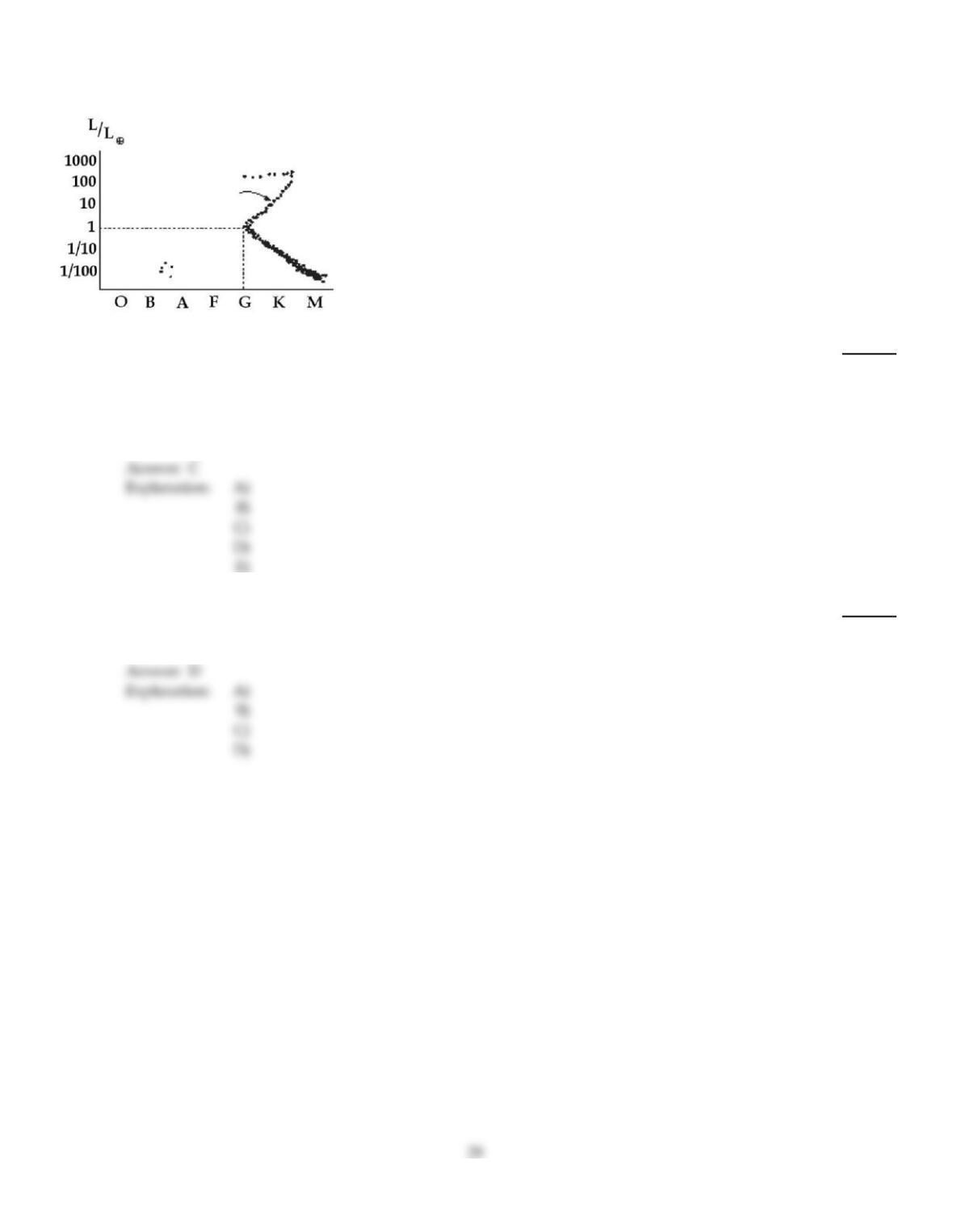
The following questions refer to the sketch below of an H–R diagram for a star cluster.
89)
Consider the star to which the arrow points. How is it currently generating energy?
89)
A)
by gravitational contraction
B)
by core helium fusion combined with hydrogen shell burning
C)
by hydrogen shell burning around an inert helium core
D)
by both hydrogen and helium shell burning around an inert carbon core
E)
by core hydrogen fusion
90)
Which element has the lowest mass per nuclear particle and therefore cannot release energy by
either fusion or fission?
90)
A)
silicon
B)
oxygen
C)
hydrogen
D)
iron
The following questions refer to the H–R diagram below that shows the life track of a 1–solar–mass star, with various stages labeled with
Roman numerals.
91)
At the end of its life, the remaining core of this star will be left behind as
91)
A)
a supernova.
B)
a neutron star.
C)
a black hole.
D)
a white dwarf made primarily of carbon and oxygen.
E)
a white dwarf made primarily of silicon and iron.
92)
What is the CNO cycle?
92)
A)
a set of steps by which four hydrogen nuclei fuse into one helium nucleus
B)
the set of fusion reactions that have produced all the carbon, nitrogen, and oxygen in the
universe
C)
the process by which carbon is fused into nitrogen and oxygen
D)
the process by which helium is fused into carbon, nitrogen, and oxygen
93)
Which of the following masses separates low mass stars from high mass stars?
93)
A)
about 0.08 solar masses
B)
about 1 solar mass
C)
about 2 solar masses
D)
about 50 solar masses
E)
about 150 solar masses
94)
Which element is the dead end for cores of the most massive stars?
94)
A)
oxygen
B)
lead
C)
uranium
D)
hydrogen
E)
iron
95)
The interstellar clouds called molecular clouds are ________.
95)
A)
clouds that are made mostly of complex molecules such as carbon dioxide and sulfur dioxide
B)
the hot clouds of gas expelled by dying stars
C)
the clouds in which elements such as carbon, nitrogen, and oxygen are made
D)
the cool clouds in which stars form
96)
This diagram represents the life track of a 1 solar mass star. Refer to the life stages labeled with
roman numerals. During which stage is the star’s energy supplied by primarily by gravitational
contraction?
96)
A)
vi
B)
viii
C)
v
D)
ii
E)
iii

97)
How many helium nuclei fuse together when making carbon?
97)
A)
4
B)
3
C)
2
D)
It varies depending on the reaction.
E)
Helium cannot fuse into carbon.
98)
Which of the following statements about degeneracy pressure is not true?
98)
A)
Degeneracy pressure keeps any protostar less than 0.08 solar mass from becoming a true,
hydrogen–fusing star.
B)
Degeneracy pressure can halt gravitational contraction of a star even when no fusion is
occurring in the core.
C)
Degeneracy pressure is a consequence of the laws of quantum mechanics.
D)
Degeneracy pressure varies with the temperature of the star.
D
99)
What can we learn about a star from a life track on an H–R diagram?
99)
A)
the star‘s age
B)
the star’s current stage of life
C)
how the star‘s distance from Earth varies at different times in its life
D)
the surface temperature and luminosity the star will have at each stage of its life
D
100)
Which star spends the longest time in the protostellar phase of life?
100)
A)
a 1 solar mass star
B)
a 2 solar mass star
C)
a 3 solar mass star
D)
a 4 solar mass star
E)
a 5 solar mass star
A
B

101)
What happens after the helium flash?
101)
A)
The core quickly heats up and expands.
B)
The core suddenly contracts.
C)
The star breaks apart in a violent explosion.
D)
The star starts to fuse helium in a shell outside the core.
E)
The core stops fusing helium.
102)
What types of stars end their lives with supernovae?
102)
A)
stars that have reached an age of 10 billion years
B)
stars that are at least several times the mass of the Sun
C)
stars that are similar in mass to the Sun
D)
all stars that are red in color
E)
all stars that are yellow in color
103)
Which of the following phenomena is not commonly associated with the star formation process?
103)
A)
powerful “jets” shooting out along the rotation axis of a protostar
B)
strong winds of particles blowing out into space from a protostar
C)
intense ultraviolet radiation coming from a protostar
D)
the formation of a spinning disk of material around a protostar
104)
Why is iron significant to understanding how a supernova occurs?
104)
A)
Supernovae often leave behind neutron stars, which are made mostly of iron.
B)
Iron cannot release energy either by fission or fusion.
C)
The fusion of iron into uranium is the reaction that drives a supernova explosion.
D)
Iron is the heaviest of all atomic nuclei, and thus no heavier elements can be made.
105)
The figure above shows the abundance of elements in the galaxy relative to hydrogen. Why does
iron have a higher abundance than nearby elements?
105)
A)
It is the end product of core fusion in massive stars, and can only be destroyed in rare
supernova fusion reactions.
B)
It has a higher density than other elements, and thus becomes locked away in dust.
C)
It does not; this apparent higher abundance is due to iron’s many spectral lines making it
easier to find.
106)
What star is the most likely to have made the atoms of gold in your jewelry or your electronics?
106)
A)
a high–mass star
B)
the Sun
C)
a white dwarf
D)
a low–mass star

107)
Suppose that the star Betelgeuse (the upper left shoulder of Orion) were to supernova tomorrow (as
seen here on Earth). What would it look like to the naked eye?
107)
A)
Betelgeuse would suddenly appear to grow larger in size, soon reaching the size of the full
Moon. It would also be about as bright as the full Moon.
B)
Betelgeuse would remain a dot of light, but would suddenly become so bright that, for a few
weeks, we’d be able to see this dot in the daytime.
C)
Because the supernova destroys the star, Betelgeuse would suddenly disappear from view.
D)
We’d see a cloud of gas expanding away from the position where Betelgeuse used to be. Over
a period of a few weeks, this cloud would fill our entire sky.
108)
As a solar mass protostar moves on to the main sequence,
108)
A)
its surface temperature and luminosity increase.
B)
its surface temperature increases and its luminosity decreases.
C)
its surface temperature and luminosity remain the same.
D)
its surface temperature decreases and its luminosity increases.
E)
its surface temperature and luminosity decrease.
109)
What is a planetary nebula?
109)
A)
a disk of gas surrounding a protostar that may form into planets
B)
the expanding shell of gas that is no longer gravitationally bound to the remnant of a
low–mass star
C)
what is left of its planets after a low–mass star has ended its life
D)
the molecular cloud from which protostars form
E)
the expanding shell of gas that is left when a white dwarf explodes as a supernova

110)
What does the CNO cycle and the hydrogen proton–proton cycle have in common? Choose the best
answer to the question.
110)
A)
They both are ways to fuse hydrogen nuclei to make helium.
B)
They are both nuclear reactions; the CNO cycle makes carbon, nitrogen, and oxygen, and the
proton cycle makes helium.
C)
They both trigger at the same temperature.
D)
They are both cycles in star lives.
111)
What happens when a main–sequence star exhausts its core hydrogen fuel supply?
111)
A)
The core immediately begins to fuse its helium into carbon.
B)
The entire star shrinks in size.
C)
The core shrinks while the rest of the star expands.
D)
The star becomes a neutron star.
C
112)
What is the lifetime of a star of 0.1 solar masses and a luminosity of 0.01 that of the Sun? Assume
the lifetime of the Sun is 10 billion years.
112)
A)
100 billion years
B)
10 trillion years
C)
10 million years
D)
10 billion years
E)
This star will never start hydrogen fusion reactions because it is not massive enough.
A
113)
What can we learn about a star from a life track on an H–R diagram?
113)
A)
how long ago it was born
B)
where it is located
C)
when it will die
D)
what surface temperature and luminosity it will have at each stage of its life
E)
all of the above
D
A
114)
What percentage of a star’s total lifetime is spent on the main sequence?
114)
A)
20%
B)
50%
C)
10%
D)
90%
E)
100%
115)
What did Carl Sagan mean when he said that we are all “star stuff”?
115)
A)
that the universe contains billions of stars
B)
that the Sun formed from the interstellar medium: the “stuff” between the stars
C)
that the Earth formed at the same time as the Sun
D)
that life would be impossible without energy from the Sun
E)
that the carbon, oxygen, and other elements essential to life were created by nucleosynthesis
in stellar cores
E
116)
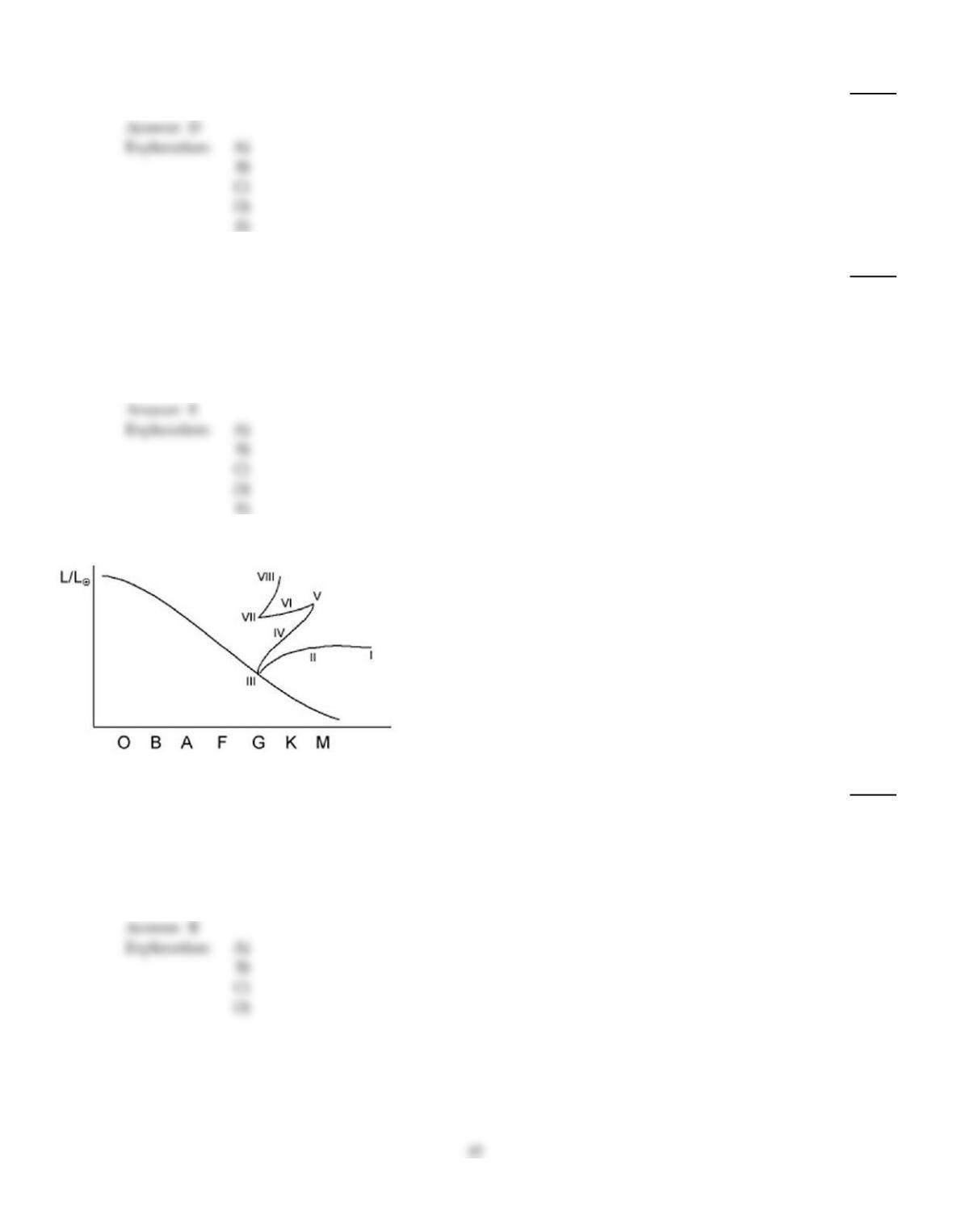
This diagram represents the life track of a 1 solar mass star. Refer to the life stages labeled with
roman numerals. What will happen to the star after stage viii?
116)
A)
It will explode as a supernova and leave a neutron star or black hole behind.
B)
Its outer layers will be ejected as a planetary nebula and its core will become a white dwarf.
C)
It will remain in stage viii for about 10 billion years, after which its outer layers will shrink
back and cool.
D)
It will continue to expand gradually until carbon fusion begins in its core.
B
D

117)
Most interstellar dust grains
117)
A)
are produced in the cores of low–mass stars
B)
are produced in supernova explosions.
C)
are produced in the atmospheres of red giant stars.
D)
were produced in the Big Bang.
E)
are produced in the interstellar medium.
118)
The luminosity of light emerging from the star’s gaseous surface is equal to the
118)
A)
star’s lifetime.
B)
temperature of the star’s core.
C)
rate of energy generated from nuclear reactions in the star’s core.
D)
star’s apparent brightness.
E)
mass of the star.
C
119)
What is the source of luminosity for protostars that have not yet become hot enough for fusion in
their cores?
119)
A)
fission from concentrated radioactive elements
B)
energy released by infalling matter
C)
fusion in their low–density outer layers
D)
light absorbed from nearby stars
B
120)
How will an isolated, one solar–mass star die?
120)
A)
as a white dwarf
B)
as a white dwarf supernova
C)
as a neutron star
D)
as a black hole
E)
uncertain, since stars can die in any number of ways
A
C
SHORT ANSWER. Write the word or phrase that best completes each statement or answers the question.
Choose from the list below for the following questions. You may use a choice more than once.
A. H fusion by the proton–proton chain
B. H fusion by the CNO cycle
C. helium fusion
D. matter–antimatter annihilation
E. gravitational contraction
121)
Which method of energy generation provides the source of energy for a 10 MSun
main–sequence star?
121)
122)
Which process leads to the production of carbon?
122)
123)
Which method of energy generation is used by the Sun today?
123)
124)
Which one is used by a main–sequence star of spectral type B2?
124)
125)
When a 1–solar–mass star stabilizes as a giant for about a billion years, which method of
energy generation occurs in its central core?
125)
126)
Lithium, beryllium, and boron are elements with atomic number 3, 4, and 5, respectively.
Even though they are three of the five simplest elements, why are they rare compared to
many heavier elements?
126)
127)
Do you think it is possible that a 1.5–solar–mass red giant could harbor an advanced
civilization? Explain your reasoning.
127)
Choose from the list below for the following questions. You may use a choice more than once.
A. H fusion by the proton–proton chain
B. H fusion by the CNO cycle
C. helium fusion
D. matter–antimatter annihilation
E. gravitational contraction
128)
Which one provided the energy that made the Sun hot in the first place?
128)
129)
Briefly summarize the stages of life for a low–mass star.
129)
Choose from the list below for the following questions. You may use a choice more than once.
A. H fusion by the proton–proton chain
B. H fusion by the CNO cycle
C. helium fusion
D. matter–antimatter annihilation
E. gravitational contraction
130)
Which method of energy generation provides the source of energy for a protostar?
130)
131)
Briefly describe how a star forms.
131)
132)
Briefly summarize the stages of life for a high–mass star.
132)
133)
Do you think it is possible that a 10–solar–mass main–sequence star could harbor an
advanced civilization? Explain your reasoning.
133)
134)
Explain how some stars form in binary systems.
134)
TRUE/FALSE. Write ‘T’ if the statement is true and ‘F’ if the statement is false.
135)
There is no limit to the mass with which a star can be born.
135)

136)
In any star cluster, stars with lower masses greatly outnumber those with higher masses.
136)
137)
Stars with high masses live longer than stars with lower masses.
137)
138)
All stars that become supernovae will leave behind a neutron star.
138)
139)
The heaviest element produced by stars or in supernovae is silicon.
139)
140)
The helium fusion process works by fusing two helium nuclei into one beryllium nucleus.
140)
141)
Photographs of many young stars show long jets of material apparently being ejected from their
poles.
141)
142)
Our Sun will end its life in a planetary nebula and become a white dwarf.
142)
143)
Stars spend about 90% of their lifetime on the main sequence.
143)
144)
Although some photographs show what looks like jets of material near many young stars, we now
know that these “jets” actually represent gas from the surrounding nebula that is falling onto the
stars.
144)
145)
The most massive stars generate energy at the end of their lives by fusing iron in their cores.
145)

ESSAY. Write your answer in the space provided or on a separate sheet of paper.
146)
Falsifying Scientific Theories: In many simple expositions of the scientific method, it is often stated that if a
scientific theory makes an incorrect prediction, it is falsified and must be discarded. Argue against this simple
view of the scientific method by using the Algol paradox (Section 13.4) as a case study. In particular, why did
astronomers not discard the theory of stellar evolution despite an apparent direct contradiction of a
fundamental prediction of stellar evolution, that more massive stars evolve faster than less massive stars?
147)
Stellar Evolution as a Scientific Theory: Based on the chapter material, list what you feel are the basic founding
assumptions of the theory of stellar evolution. For example, you might list that stars are assumed to be balls of
mostly hydrogen gas held together by their own gravity. After this, make another list of as many of the
successful predictions of this theory as you can. Based on the comparison of these two lists, how successful a
scientific theory would you rate the theory of stellar evolution?
148)
Historical Supernova: You find an ancient Chinese text that speaks of a “new star” briefly visible in the
constellation Sagittarius in the year 1000 B.C. You suspect that the reference is to a supernova explosion. Design
an observing program to provide scientific evidence for this hypothesis. What object or objects would you look
for in the sky today? What wavelengths of electromagnetic radiation would you use? How would you be sure
any object you found exploded (as seen from the Earth) nearly 3000 years ago?
149)
The Faintest White Dwarfs: All low–mass stars end their lives by forming white dwarfs which evolve by cooling
at a constant radius, growing less and less luminous with time. You are about to begin an observing program to
look for the faintest white dwarfs in the Milky Way Galaxy. In the course of your observations, will you
continue to find white dwarfs that are less and less luminous, or will you ultimately find a population of white
dwarfs that are the least luminous ones in the Milky Way? If you answer the latter, what is your interpretation
of this result?
150)
The birth place of stars: Discuss the observational evidence that supports the idea that most stars are formed in
groups from large clouds of interstellar gas and dust.

Answer Key
Testname: C13

Answer Key
Testname: C13
Answer Key
Testname: C13
46
Answer Key
Testname: C13
47