
10) The heaviest element produced by stars or in supernovae is silicon.
11) All stars that become supernovae will leave behind a neutron star.
13.3 Process of Science Questions
1) Historical Supernova: You find an ancient Chinese text that speaks of a “new star” briefly
visible in the constellation Sagittarius in the year 1000 B.C. You suspect that the reference is to a
supernova explosion. Design an observing program to provide scientific evidence for this
hypothesis. What object or objects would you look for in the sky today? What wavelengths of
electromagnetic radiation would you use? How would you be sure any object you found
exploded (as seen from the Earth) nearly 3000 years ago?
2) Stellar Evolution as a Scientific Theory: Based on the chapter material, list what you feel are
the basic founding assumptions of the theory of stellar evolution. For example, you might list
that stars are assumed to be balls of mostly hydrogen gas held together by their own gravity.
After this, make another list of as many of the successful predictions of this theory as you can.
Based on the comparison of these two lists, how successful a scientific theory would you rate the
theory of stellar evolution?
3) Falsifying Scientific Theories: In many simple expositions of the scientific method, it is often
stated that if a scientific theory makes an incorrect prediction, it is falsified and must be
discarded. Argue against this simple view of the scientific method by using the Algol paradox
(Section 13.4) as a case study. In particular, why did astronomers not discard the theory of stellar
evolution despite an apparent direct contradiction of a fundamental prediction of stellar
evolution, that more massive stars evolve faster than less massive stars?
4) The Faintest White Dwarfs: All low-mass stars end their lives by forming white dwarfs which
evolve by cooling at a constant radius, growing less and less luminous with time. You are about
to begin an observing program to look for the faintest white dwarfs in the Milky Way Galaxy. In
the course of your observations, will you continue to find white dwarfs that are less and less
luminous, or will you ultimately find a population of white dwarfs that are the least luminous
ones in the Milky Way? If you answer the latter, what is your interpretation of this result?
5) The Birthplace of Stars: Discuss the observational evidence that supports the idea that most
stars are formed in groups from large clouds of interstellar gas and dust.
13.4 Short Answer Questions
1) Briefly describe how a star forms.
2) Explain how some stars form in binary systems.
end up orbiting each other as a binary.
Choose from the list below for the following questions. You may use a choice more than once.
A. H fusion by the proton-proton chain
B. H fusion by the CNO cycle
C. helium fusion
D. matter-antimatter annihilation
E. gravitational contraction
3) Which method of energy generation is used by the Sun today?
4) Which method of energy generation provided the energy that made the Sun hot in the first
place?
5) Which method of energy generation provides the source of energy for a protostar?
6) Which process leads to the production of carbon?
7) When a 1-solar-mass star stabilizes as a giant for about 100 million years, which method of
energy generation occurs in its central core?
8) Which method of energy generation is used by a main-sequence star of spectral type B2?
9) Which method of energy generation provides the source of energy for a 10 MSun main-
sequence star?
10) Do you think it is possible that a planet orbiting a 10-solar-mass main-sequence star could
harbor an advanced civilization? Explain your reasoning.
11) Do you think it is possible that a planet orbiting a 1.5-solar-mass red giant could harbor an
advanced civilization? Explain your reasoning.
12) Lithium, beryllium, and boron are elements with atomic numbers 3, 4, and 5, respectively.
Even though they are three of the five simplest elements, why are they rare compared to many
heavier elements?
13) Briefly summarize the stages of life for a one solar mass star.
14) Briefly summarize the stages of life for a high-mass star.
13.5 Mastering Astronomy Reading Quiz
1) The interstellar clouds called molecular clouds are ________.
A) the cool clouds in which stars form
B) the clouds in which elements such as carbon, nitrogen, and oxygen are made
C) clouds that are made mostly of complex molecules such as carbon dioxide and sulfur dioxide
D) the hot clouds of gas expelled by dying stars
2) What is a protostar?
A) a star that is still in the process of forming
B) a star that has planets
C) an intermediate-mass star
D) a star in its final stage of life

3) Most interstellar clouds remain stable in size because the force of gravity is opposed by
________ within the cloud.
A) thermal pressure
B) degeneracy pressure
C) radiation pressure
D) stellar winds
4) Which part of the electromagnetic spectrum generally gives us our best views of stars forming
in dusty clouds?
A) infrared
B) visible light
C) ultraviolet
D) blue light
5) What kind of gas cloud is most likely to give birth to stars?
A) a cold, dense gas cloud
B) a hot, dense gas cloud
C) a cold, low-density gas cloud
D) a hot, low-density gas cloud
6) Which of the following phenomena is not commonly associated with the star formation
process?
A) intense ultraviolet radiation coming from a protostar
B) the formation of a spinning disk of material around a protostar
C) powerful “jets” shooting out along the rotation axis of a protostar
D) strong winds of particles blowing out into space from a protostar
7) If the Sun somehow acquired more hydrogen and helium and doubled in mass, what would
happen to it?
A) Its nuclear reactions would slow down because its heavy element abundance would decrease.
B) It would evolve more quickly than it is now.
C) It would explode as a supernova.
D) It would live longer because it would have more hydrogen fuel.
8) Approximately what core temperature is required before hydrogen fusion can begin in a star?
A) 10 million K
B) 10,000 K
C) 10 trillion K
D) 10 billion K
E) 1 billion K

9) Which star spends the longest time in the protostellar phase of life?
A) a 1 solar mass star
B) a 2 solar mass star
C) a 3 solar mass star
D) a 4 solar mass star
E) a 5 solar mass star
10) What is the approximate range of masses that newborn main-sequence stars can have?
A) 0.1 to 150 solar masses
B) 0.001 to 150 solar masses
C) 0.1 to 1,000 solar masses
D) 0.001 to 10 solar masses
E) 0.1 to 10 solar masses
11) The vast majority of stars in an old star cluster are ________.
A) less massive than the Sun
B) very high-mass, type O and B stars
C) red giants
D) about the same mass as our Sun
12) Which of the following statements about brown dwarfs is not true?
A) Brown dwarfs eventually collapse to become white dwarfs.
B) Brown dwarfs are supported against further gravitational collapse by degeneracy pressure.
C) Brown dwarfs form like ordinary stars but are too low mass to sustain nuclear fusion in their
cores.
D) All brown dwarfs have masses less than about 8% that of our Sun.
13) During which of the following phases of life is a star’s pressure and gravity out of
equilibrium?
A) main sequence
B) helium core fusion
C) white dwarf
D) red giant
14) Which of the following types of stars is the most common?
A) G stars
B) O stars
C) A stars
D) M stars

15) What happens when a main-sequence star exhausts its core hydrogen fuel supply?
A) The entire star shrinks in size.
B) The core shrinks while the rest of the star expands.
C) The core immediately begins to fuse its helium into carbon.
D) The star becomes a neutron star.
16) The main source of energy for a star as it grows in size to become a red giant is ________.
A) hydrogen fusion in the central core
B) helium fusion in the central core
C) hydrogen fusion in a shell surrounding the central core
D) gravitational contraction
17) The overall helium fusion reaction is ________.
A) three helium nuclei fuse to form one carbon nucleus
B) two helium nuclei fuse to form one beryllium nucleus
C) two hydrogen nuclei fuse to form one helium nucleus
D) four helium nuclei fuse to form one oxygen nucleus
18) Which of the following reactions would require the highest temperature in order to proceed,
based on the mutual electromagnetic repulsion of the two nuclei?
A) helium and helium
B) helium and hydrogen
C) helium and carbon
D) hydrogen and carbon
19) What is a planetary nebula?
A) gas ejected from a star in the final stage of its life
B) gas created from the remains of planets that once orbited a dead star
C) interstellar gas from which planets are likely to form in the not-too-distant future
D) the remains of a high-mass star that has exploded
20) The ultimate fate of our Sun is to ________.
A) become a white dwarf that will slowly cool with time
B) explode in a supernova
C) become a rapidly spinning neutron star
D) become a black hole

21) What is the CNO cycle?
A) a set of steps by which four hydrogen nuclei fuse into one helium nucleus
B) the process by which helium is fused into carbon, nitrogen, and oxygen
C) the process by which carbon is fused into nitrogen and oxygen
D) the set of fusion reactions that have produced all the carbon, nitrogen, and oxygen in the
universe
22) In order to predict whether a star will eventually fuse oxygen into heavier elements in its
core, you need to know what fact about the star?
A) its mass
B) its luminosity
C) how much oxygen it now has in its core
D) its overall abundance of elements heavier than helium
23) Why is iron significant to understanding how a supernova occurs?
A) Iron cannot release energy either by fission or fusion.
B) Iron is the heaviest of all atomic nuclei, and thus no heavier elements can be made.
C) Supernovae often leave behind neutron stars, which are made mostly of iron.
D) The fusion of iron into uranium is the reaction that drives a supernova explosion.
24) Why can the fusion of carbon occur in high-mass stars but not in low-mass stars?
A) It is because carbon fusion can occur only in stars with very long lives.
B) It is because only high-mass stars do fusion by the CNO cycle.
C) It is because the cores of low-mass stars never contain significant amounts of carbon.
D) It is because the cores of low-mass stars never get hot enough for carbon fusion.
25) Why is Supernova 1987A particularly important to astronomers?
A) It is the nearest supernova to have occurred at a time when we were capable of studying it
carefully with telescopes.
B) It was the first supernova detected in nearly 400 years.
C) It provided the first evidence that supernovae really occur.
D) It occurred only a few light-years from Earth.
26) Algol consists of a 3.7 MSun main-sequence star and a 0.8 MSun subgiant. Why does this
seem surprising, at least at first?
A) The two stars should be the same age, so we’d expect the subgiant to be more massive than
the main-sequence star.
B) The two stars in a binary system should both be at the same stage of life; that is, they should
either both be main-sequence stars or both be subgiants.
C) It doesn’t make sense to find a subgiant in a binary star system.
D) A star with a mass of 3.7 MSun is too big to be a main-sequence star.

27) Where does gold (the element) come from?
A) It is produced during the supernova explosions of high-mass stars.
B) It is produced by mass transfer in close binaries.
C) It is produced during the late stages of fusion in low-mass stars.
D) It was produced during the Big Bang.
13.6 Mastering Astronomy Concept Quiz
1) You observe a red giant star. What is happening to that star?
A) It is increasing in size, and is fusing hydrogen in a shell around its core.
B) It is stable in its size, and is fusing hydrogen in its core.
C) It is decreasing in size, and is fusing hydrogen in a shell around its core.
D) It is increasing in size, and is fusing hydrogen in its core.
2) What would stars be like if hydrogen had the smallest mass per nuclear particle? (Consider
what happens with iron, which actually has the lowest mass per nuclear particle.)
A) Stars would be brighter on average.
B) Nuclear fusion would not occur in stars anywhere.
C) Stars would be fainter on average.
D) All stars would be red giants.
3) Which process is required to allow a gravitationally-collapsing gas cloud to continue to
collapse?
A) The cloud must radiate much of its thermal energy.
B) The cloud must trap most of its thermal energy.
C) The cloud must collide with other clouds.
D) New dust particles must continually be made in the cloud.
4) Angular momentum plays an important role in star formation. Which of the following
characteristics of a protostellar system probably does not strongly affect the star’s angular
momentum?
A) the onset of core hydrogen fusion
B) the existence of protostellar jets
C) the strength of protostellar winds
D) the formation of a protostellar disk

5) Generally speaking, how does the surface temperature and luminosity of a protostar compare
to the surface temperature and luminosity of the main-sequence star it becomes?
A) A main-sequence star is hotter and dimmer than it was as a protostar.
B) A main-sequence star is hotter and brighter than it was as a protostar.
C) A main-sequence star is cooler and dimmer than it was as a protostar.
D) A main-sequence star is cooler and brighter than it was as a protostar.
6) Consider a large molecular cloud that will give birth to a cluster of stars. Which of the
following would you expect to be true?
A) A few massive stars will form, live, and die before the majority of the star’s clusters even
complete their protostar stage.
B) All the stars in the cluster will be of about the same mass.
C) All the stars in the cluster will become main-sequence stars at about the same time.
D) All the stars in the cluster will have approximately the same luminosity and surface
temperature.
7) We do not know for certain whether the general trends we observe in stellar birth masses also
apply to brown dwarfs. But if they do, then which of the following would be true?
A) Brown dwarfs would outnumber all ordinary stars.
B) Brown dwarfs would be responsible for most of the overall luminosity of our Milky Way
Galaxy.
C) Brown dwarfs would be extremely rare.
D) Most of the brown dwarfs in the Milky Way Galaxy would be quite young in age.
8) Where would a brown dwarf be located on an H-R diagram?
A) below and to the right of the lowest part of the main sequence
B) above and to the left of the highest part of the main sequence
C) in the upper right corner of the H-R diagram
D) in the lower left corner of the H-R diagram
9) Which of the following types of data provide evidence that helps us understand the post main-
sequence life tracks of low-mass stars?
A) H-R diagrams of globular clusters
B) H-R diagrams of open clusters
C) observing a low-mass star over many years
D) spacecraft observations of the Sun
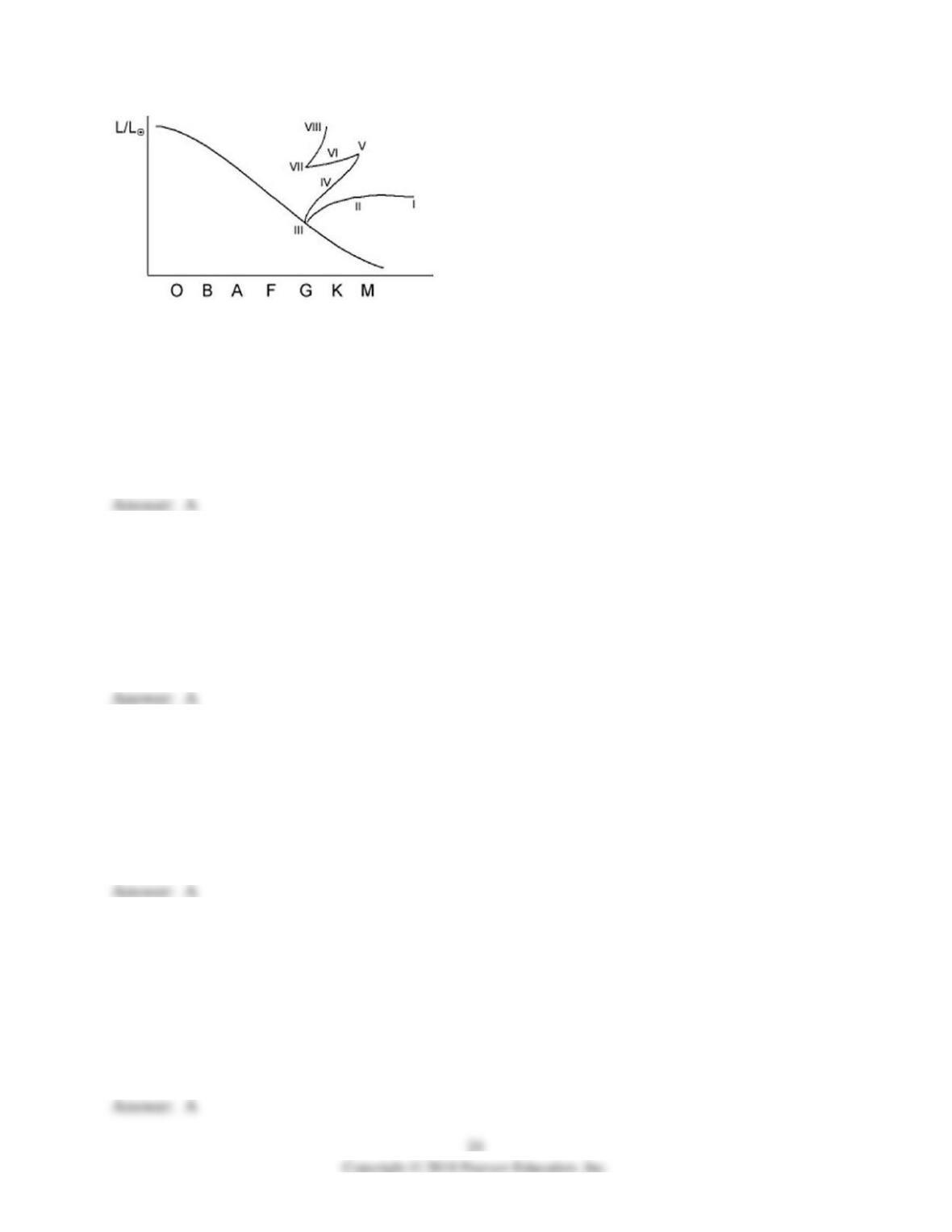
10) This diagram represents the life track of a 1 solar mass star. Refer to the life stages labeled
with roman numerals. During which stage is the star’s energy supplied primarily by gravitational
contraction?
A) ii
B) iii
C) v
D) vi
E) viii
11) This diagram represents the life track of a 1 solar mass star. Refer to the life stages labeled
with roman numerals. During which stage does the star have an inert (non-fusing) helium core?
A) iv
B) iii
C) vii
D) vi
E) viii
12) This diagram represents the life track of a 1 solar mass star. Refer to the life stages labeled
with roman numerals. Which stage lasts the longest?
A) iii
B) i
C) iv
D) vi
E) viii
13) This diagram represents the life track of a 1 solar mass star. Refer to the life stages labeled
with roman numerals. During which stage does the star have an inert (non-burning) carbon core
surrounded by shells of helium and hydrogen burning?
A) viii
B) iv
C) vi
D) iii
E) ii

14) This diagram represents the life track of a 1 solar mass star. Refer to the life stages labeled
with roman numerals. What will happen to the star after stage viii?
A) Its outer layers will be ejected as a planetary nebula and its core will become a white dwarf.
B) It will continue to expand gradually until carbon fusion begins in its core.
C) It will explode as a supernova and leave a neutron star or black hole behind.
D) It will remain in stage viii for about 10 billion years, after which its outer layers will shrink
back and cool.
15) Why is a 1 solar-mass red giant more luminous than a 1 solar-mass main-sequence star?
A) Fusion reactions are producing energy at a greater rate in the red giant.
B) The red giant’s surface is cooler.
C) The red giant’s surface is hotter.
D) The red giant is more massive.
16) Carbon fusion occurs in high-mass stars but not in low-mass stars because ________.
A) the cores of low-mass stars never get hot enough for carbon fusion
B) the cores of low-mass stars never contain significant amounts of carbon
C) only high-mass stars do fusion by the CNO cycle
D) carbon fusion can occur only in the stars known as carbon stars
17) Which of the following statements about various stages of core nuclear fusion (hydrogen,
helium, carbon, and so on) in a high-mass star is not true?
A) Each successive stage lasts for approximately the same amount of time.
B) As each stage ends, the core shrinks and heats further.
C) Each successive stage creates an element with a higher atomic number and atomic mass
number.
D) As each stage ends, the reactions that occurred in previous stages continue in shells around
the core.
18) Why don’t low-mass stars have the CNO cycle occurring in their cores?
A) The CNO cycle makes elements heavier than carbon, nitrogen, and oxygen.
B) They don’t have enough carbon, nitrogen, and oxygen.
C) Their core temperatures are too low.
D) Their core temperatures are too high.
19) Why are stars unable to fuse iron in their cores?
A) Temperatures are never high enough to trigger iron fusion.
B) Pressures are never high enough to trigger iron fusion.
C) The fusion of iron would take more energy than it produces.
D) Iron nuclei are the most massive of any element.

20) Observations show that elements with atomic mass numbers divisible by 4 (such as oxygen-
16, neon-20, and magnesium-24) tend to be more abundant in the universe than elements with
atomic mass numbers in between. Why do we think this is the case?
A) Near the end of a high-mass star’s life, it produces new elements through a series of helium
capture reactions.
B) The apparent pattern is thought to be a random coincidence.
C) Elements with atomic mass numbers divisible by 4 tend to be more stable than elements in
between.
D) This pattern in elemental abundances was apparently determined during the first few minutes
after the Big Bang.
21) A spinning neutron star has been observed at the center of a ________.
A) supernova remnant
B) planetary nebula
C) red supergiant
D) protostar
22) Which is more common: a star blows up as a supernova, or a star forms a planetary
nebula/white dwarf system?
A) Planetary nebula formation is more common.
B) Supernovae are more common.
C) They both occur in about equal numbers.
D) It is impossible to say.
23) Why are the very lowest mass stars unable to fuse helium in their cores?
A) Their cores are supported by the pressure of electrons repelling each other.
B) Their cores will never get hot enough to fuse helium.
C) Their cores are primarily composed of helium when they form.
D) Their cores will bypass helium fusion and use the CNO cycle instead.