Chapter 13 – Auditing Debt Obligations and Stockholders‘ Equity Transactions
74. What type of risk is intentional failure by management to accurately disclose violations of debt covenants?
a.
Inherent risk
b.
Fraud risk
c.
Control risk
d.
Detection risk.
AUDT.JOHN.16.13-03 – LO: 13-03
United States – BUSPORG: Analytic
United States – AK – AICPA BB-Critical thinking
Fraud Risk Associated with Debt and Equity
75. Which of the following statements is true regarding the identification and assessment of the risks of material
misstatements by the auditor?
a.
Auditing standards require the auditor to identify and assess the risks of material misstatement due to
fraud at the financial statement level.
b.
Auditing standards require the auditor to identify and assess the risks of material misstatement due to
fraud at the assertion level.
c.
As part of brainstorming activities, the auditor should identify possible frauds that could occur.
d.
All of these statements are true.
AUDT.JOHN.16.13-03 – LO: 13-03
United States – BUSPORG: Analytic
United States – AK – AICPA BB-Critical thinking
Fraud Risk Associated with Debt and Equity
76. Which of the following would an auditor not typically perform as part of gaining an understanding of the
client’s controls related to debt obligations?
a.
Review policies related to approval required for new debt.
b.
Inquire of management about the process for reviewing compliance with debt covenants.
c.
Review the client’s documentation of controls.
d.
Recalculate interest expense.
AUDT.JOHN.16.13-04 – LO: 13-04
United States – BUSPORG: Analytic
United States – AK – AICPA BB-Critical thinking
Control Risks Associated with Debt and Equity
77. In general, which of the following would an auditor not typically perform as part of gaining an
understanding of the client’s controls?
Chapter 13 – Auditing Debt Obligations and Stockholders‘ Equity Transactions
a.
A walkthrough of the process.
b.
Inquiry.
c.
Observation.
d.
All of these are used to gain an understanding of the controls.
d
1
AUDT.JOHN.16.13-04 – LO: 13-04
United States – BUSPORG: Analytic
United States – AK – AICPA BB-Critical thinking
Control Risks Associated with Debt and Equity
78. Which of the following does an auditor consider when gaining an overall understanding of the client’s
internal controls?
a.
Entity-wide controls at the account level only.
b.
Transaction controls at the account level only.
c.
Entity-wide controls at the assertion level only.
d.
Both entity-wide controls and transaction controls at the account and assertion levels.
d
1
AUDT.JOHN.16.13-04 – LO: 13-04
United States – BUSPORG: Analytic
Control Risks Associated with Debt and Equity
79. Which of the following would the auditor consider as part of the control environment related to debt
obligations?
a.
Inquiry of trustee regarding the registration of current bondholders and distribution of interest
payments.
b.
Recalculation of the underwriter’s commission.
c.
Independence of the board of directors with respect to long-term financing.
d.
Inspection of documentation to confirm refinancing of debt.
1
AUDT.JOHN.16.13-04 – LO: 13-04
United States – BUSPORG: Analytic
United States – AK – AICPA BB-Critical thinking
Control Risks Associated with Debt and Equity
80. Which of the following are entity-wide components of internal control that can mitigate the risk material
misstatement related to debt obligations?
a.
Risk assessment.
b.
Information and communication.
Chapter 13 – Auditing Debt Obligations and Stockholders‘ Equity Transactions
c.
Monitoring controls.
d.
All of these are entity-wide components of internal control.
d
1
AUDT.JOHN.16.13-04 – LO: 13-04
United States – BUSPORG: Analytic
United States – AK – AICPA BB-Critical thinking
Control Risks Associated with Debt and Equity
81. Which of the following is a typical control for debt obligations?
a.
The board of directors approves all new debt.
b.
The stockholders approve all new debt.
c.
The CFO approves all new debt.
d.
Upper managers approve all new debt.
1
AUDT.JOHN.16.13-04 – LO: 13-04
United States – BUSPORG: Analytic
United States – AK – AICPA BB-Critical thinking
Control Risks Associated with Debt and Equity
82. Which of the following statements is typically not true regarding controls related to proper accounting for
stock option grants?
a.
The proper accounting for stock option grants is researched by the organization’s accountant.
b.
The analysis of the accountant regarding stock option grants is reviewed by the CFO.
c.
The analysis of the accountant regarding stock option grants is reviewed by the organization’s legal
counsel.
d.
The analysis of the accountant regarding stock option grants is reviewed by the board of directors.
d
1
AUDT.JOHN.16.13-04 – LO: 13-04
United States – BUSPORG: Analytic
United States – AK – AICPA BB-Critical thinking
Control Risks Associated with Debt and Equity
83. Which of the following statements is true regarding preliminary analytical procedures for debt obligations
and stockholders’ equity transactions?
a.
Trend analysis would not typically be performed for debt obligations.
b.
The long-term debt to equity ratio could be considered by the auditor as part of the preliminary
analytical procedures.
c.
Because there are typically only a few stockholders’ equity transactions, the auditor is not required to
perform preliminary analytical procedures for stockholders’ equity accounts.
Chapter 13 – Auditing Debt Obligations and Stockholders‘ Equity Transactions
d.
If unusual or unexpected relationships are identified by preliminary analytical procedures, the auditor
should stick with the original expectations of misstatements, because this could be an anomaly and
bias the audit overall.
b
1
AUDT.JOHN.16.13-05 – LO: 13-05
United States – BUSPORG: Analytic
United States – AK – AICPA BB-Critical thinking
Preliminary Analytical Procedures for Debt and Equity
84. Which of the following is not an example of typical analytical procedures related to debt obligations?
a.
Perform a trend analysis of the balances in notes payable, interest expense, and accrued interest with
prior periods, considering known client activities related to debt.
b.
Calculate the total debt-to-equity ratio and perform a trend analysis with prior periods.
c.
Calculate the times interest earned ratio and perform a trend analysis with prior periods.
d.
Calculate the current ratio and perform a trend analysis with prior periods.
d
1
AUDT.JOHN.16.13-05 – LO: 13-05
United States – BUSPORG: Analytic
United States – AK – AICPA BB-Critical thinking
Preliminary Analytical Procedures for Debt and Equity
85. Which of the following is not true regarding preliminary analytical procedures performed by the auditor
when planning the audit?
a.
The primary preliminary analytical procedure for stockholders’ equity accounts is a comparison of
current year account balances with prior year account balances.
b.
If there are unusual or unexpected relationships, the planned audit procedures would be adjusted to
address the potential material misstatements.
c.
The auditor should have an expectation as to the nature and magnitude of any account balance
changes.
d.
Auditors show focus on just the numbers when performing analytical procedures.
d
1
AUDT.JOHN.16.13-05 – LO: 13-05
United States – BUSPORG: Analytic
United States – AK – AICPA BB-Critical thinking
Preliminary Analytical Procedures for Debt and Equity
86. Which of the following statements is true regarding the appropriate audit procedures to perform for debt and
stockholder’s equity accounts?
a.
The auditor will usually decide to test debt obligations, including interest, using only substantive
procedures.
Chapter 13 – Auditing Debt Obligations and Stockholders‘ Equity Transactions
b.
Testing debt obligations, including interest, is typically accomplished using only control procedures.
c.
When auditing stockholders’ equity transactions, the auditor commonly uses a control procedure
approach, but uses only substantive procedures to test debt obligation transactions.
d.
None of these statements is true.
AUDT.JOHN.16.13-06 – LO: 13-06
United States – BUSPORG: Analytic
United States – AK – AICPA BB-Critical thinking
Responding to Material Misstatement Risks for Debt and Equity
87. Which of the following is not true about auditing stockholders’ equity transactions?
a.
The auditor usually uses a substantive approach.
b.
The number of equity transactions with outside parties is usually small.
c.
The dollar amount is usually immaterial.
d.
An approach using only tests of details is most commonly used to audit equity accounts.
AUDT.JOHN.16.13-06 – LO: 13-06
United States – BUSPORG: Analytic
United States – AK – AICPA BB-Critical thinking
88. For integrated audits, when does the auditor test the operating effectiveness of important controls?
a.
As of the beginning of the client’s fiscal year.
b.
As of the client’s year end.
c.
As of the end of the second quarter of the client’s fiscal year.
d.
None of these answers is correct.
AUDT.JOHN.16.13-07 – LO: 13-07
United States – BUSPORG: Analytic
United States – AK – AICPA BB-Critical thinking
Tests of Controls for Debt and Equity
89. Which of the following is not true regarding appropriate tests of controls?
a.
The auditor selects controls that are important to the auditor’s conclusion about whether the
organization’s controls adequately address the assessed risk of material misstatement for the relevant
debt and equity accounts.
b.
The client’s audit committee selects controls that are important to the auditor’s conclusion about
whether the organization’s controls adequately address the assessed risk of material misstatement for
the relevant debt and equity accounts.as of the client’s year end.
Chapter 13 – Auditing Debt Obligations and Stockholders‘ Equity Transactions
c.
The auditor will select both entity-wide and transaction controls for testing.
d.
If the auditor wants to rely on controls for the financial statement audit, the auditor would test the
operating effectiveness of those controls throughout the year.
AUDT.JOHN.16.13-07 – LO: 13-07
United States – BUSPORG: Analytic
United States – AK – AICPA BB-Critical thinking
Tests of Controls for Debt and Equity
90. If tests of controls result in identified control deficiencies, how will the auditor assess those deficiencies?
a.
By estimating interest expense based on average interest rates and average debt outstanding.
b.
By comparing current year account balances with prior year account balances.
c.
By determining their severity and the impact on the opinion of internal control effectiveness.
d.
By calculating the long-term debt-to-equity ratio and performing a trend analysis with prior periods.
AUDT.JOHN.16.13-07 – LO: 13-07
United States – BUSPORG: Analytic
United States – AK – AICPA BB-Critical thinking
Tests of Controls for Debt and Equity
91. Which of the following is not a typical test of controls when auditing debt and equity transactions?
a.
Inquiry of personnel performing the control.
b.
Comparing current year account balances with prior year account balances.
c.
Observation of the control being performed.
d.
Reperformance of the control by the auditor testing the control.
AUDT.JOHN.16.13-07 – LO: 13-07
United States – BUSPORG: Analytic
United States – AK – AICPA BB-Critical thinking
Tests of Controls for Debt and Equity
92. Which of the following procedures would be included in the auditor’s audit program for long-term debt?
a.
Investigation of credits to the bond interest income account.
b.
Inspection of the accounts payable master file.
c.
Verification of the existence of the bondholders.
d.
Review debt loan agreements.
93. Which of the following is not true regarding the testing of transactions in the stockholders’ equity accounts?
a.
The transactions are typically tested on a 100% basis.
b.
The transactions are typically tested on a sampling basis.
c.
The number of transactions is typically small.
d.
Most of these transactions are highly material.
AUDT.JOHN.16.13-08 – LO: 13-08
United States – BUSPORG: Analytic
United States – AK – AICPA BB-Critical thinking
Substantive Audit Procedures for Debt and Equity
94. When auditing debt obligations, which of the following is the primary substantive analytical procedure?
a.
Reading loan agreements.
b.
Developing an independent expectation of interest expense.
c.
Tracing bond proceeds to cash receipts.
d.
Confirming transactions with outside parties.
AUDT.JOHN.16.13-08 – LO: 13-08
United States – BUSPORG: Analytic
United States – AK – AICPA BB-Critical thinking
Substantive Audit Procedures for Debt and Equity
95. Which of the following is the least important in helping the auditor develop an independent expectation of
interest expense as a substantive analytical procedure?
a.
Determine average interest rates.
b.
Determine average debt outstanding.
c.
Examine disaggregated data by type of debt.
d.
Examine an interest revenue schedule.
AUDT.JOHN.16.13-08 – LO: 13-08
United States – BUSPORG: Analytic
AUDT.JOHN.16.13-08 – LO: 13-08
United States – BUSPORG: Analytic
United States – AK – AICPA BB-Critical thinking
Substantive Audit Procedures for Debt and Equity
96. Which of the following will an auditor not perform when looking for additions to debt?
a.
Trace the proceeds into the cash receipts records.
b.
Examine canceled notes.
c.
Obtain assurance regarding board approval of the debt through review of board meeting minutes
d.
Trace the proceeds into the bank statement.
AUDT.JOHN.16.13-08 – LO: 13-08
United States – BUSPORG: Analytic
United States – AK – AICPA BB-Critical thinking
Substantive Audit Procedures for Debt and Equity
97. Which of the following will an auditor not perform when looking for debt reductions?
a.
Examine proceeds into the cash receipts records.
b.
Examine canceled checks.
c.
Examine payments through the cash disbursements records.
d.
Examine canceled notes.
AUDT.JOHN.16.13-08 – LO: 13-08
United States – BUSPORG: Analytic
United States – AK – AICPA BB-Critical thinking
Substantive Audit Procedures for Debt and Equity
98. Which of the following procedures is a typical substantive procedure related to the relevant assertion of
completeness for debt obligations?
a.
Recalculating accrued interest.
b.
Reviewing debt agreements for the restrictive covenants.
c.
Using analytical procedures to analyze interest expense.
d.
Confirming debt obligations with relevant outside parties.
AUDT.JOHN.16.13-08 – LO: 13-08
United States – BUSPORG: Analytic
United States – AK – AICPA BB-Critical thinking
Substantive Audit Procedures for Debt and Equity
99. Which of the following procedures is a typical substantive procedure related to the relevant assertion of
valuation and allocation for debt obligations?
a.
Determine the related parties resulting from debt transactions.
b.
Reviewing debt agreements for the restrictive covenants.
c.
Recalculating accrued interest.
Chapter 13 – Auditing Debt Obligations and Stockholders‘ Equity Transactions
d.
Confirming debt obligations with relevant outside parties.
AUDT.JOHN.16.13-08 – LO: 13-08
United States – BUSPORG: Analytic
United States – AK – AICPA BB-Critical thinking
Substantive Audit Procedures for Debt and Equity
100. Which of the following is a typical substantive procedure related to the relevant assertion of presentation
and disclosure for debt obligations?
a.
Vouching additions and deletions to debt obligations.
b.
Reviewing debt agreements for the restrictive covenants.
c.
Recalculating accrued interest.
d.
Confirming debt obligations with relevant outside parties.
AUDT.JOHN.16.13-08 – LO: 13-08
United States – BUSPORG: Analytic
United States – AK – AICPA BB-Critical thinking
Substantive Audit Procedures for Debt and Equity
101. If the auditor determines that the client’s current ratio is below a particular covenant level, which of the
following would the auditor not do?
a.
Assess the effects of the violation.
b.
Assume that the debt will need to be reclassified, if the violation is not waived.
c.
Consider that the debt will be due and payable, if the violation is not waived.
d.
Issue an adverse audit opinion.
AUDT.JOHN.16.13-08 – LO: 13-08
United States – BUSPORG: Analytic
United States – AK – AICPA BB-Critical thinking
Substantive Audit Procedures for Debt and Equity
102. As a starting point for testing capital stock and equity transactions, which of the following should the
auditor perform?
a.
Trace the proceeds of stock sold to the cash receipts journal.
b.
Review the minutes of the board of directors meetings.
c.
Examine documentation maintained by the transfer agent.
d.
Review a copy of the client’s articles of incorporation.
103. For those clients with treasury stock, which of the following would the auditor be least likely to perform?
a.
Obtaining confirmations from the stock transfer agent.
b.
Tracing transactions through the cash receipts journal.
c.
Tracing transactions through the cash disbursements journal.
d.
Reviewing a copy of the client’s articles of incorporation.
AUDT.JOHN.16.13-08 – LO: 13-08
United States – BUSPORG: Analytic
United States – AK – AICPA BB-Critical thinking
Substantive Audit Procedures for Debt and Equity
104. In its 2004 through 2006 inspections, which of the following was not a deficiency the PCAOB noted
related to inadequate testing of stockholders’ equity transactions?
a.
The auditors failed to properly address and evaluate the substance, business purpose, or significant
terms of the equity arrangements.
b.
The auditors failed to consider the accounting principles potentially applicable to the equity
transactions.
c.
The auditors failed to evaluate whether the audit clients had appropriately determined the fair values
assigned to equity-based transactions and to test the reasonableness of such fair values.
d.
The auditors failed to disclose each class of stock issued by the clients.
AUDT.JOHN.16.13-08 – LO: 13-08
United States – BUSPORG: Analytic
United States – AK – AICPA BB-Critical thinking
Substantive Audit Procedures for Debt and Equity
105. Which of the following is not a substantive test of details for dividends?
a.
Calculation of the dividend payout ratio.
b.
Examination of the minutes of the board of directors meetings for authorization of the dividend per
share amount.
c.
Examination of the minutes of the board of directors meetings for the dividend record date.
d.
Agreement of the dividend amount with the payment in the cash disbursements journal.
1
AUDT.JOHN.16.13-08 – LO: 13-08
United States – BUSPORG: Analytic
United States – AK – AICPA BB-Critical thinking
Substantive Audit Procedures for Debt and Equity
106. If the auditor wants to obtain evidence as to whether the dividend payment was made to the stockholders
who owned the stock as of the dividend record date, which of the following would the auditor do?
a.
Recalculate the dividends per share.
b.
Examine the minutes of the board of directors meetings for authorization.
c.
Trace the payee’s name on the canceled check to the dividend records.
d.
Determine that dividend restrictions are adequately disclosed in the financial statements.
1
AUDT.JOHN.16.13-08 – LO: 13-08
United States – BUSPORG: Analytic
United States – AK – AICPA BB-Critical thinking
Substantive Audit Procedures for Debt and Equity
107. Which of the following is not true regarding restrictions on dividend payments?
a.
These restrictions typically arise when loan agreements prohibit the registrant from paying cash
dividends without the consent of the lender.
b.
In certain cases, restrictions at a subsidiary-company level exist such that the registrant’s subsidiary
companies may not transfer amounts to the registrant without the consent of a third party.
c.
Amounts subject to restrictions must be disclosed.
d.
The auditor will typically confirm with shareholders whether there are any side agreements regarding
dividend restrictions.
d
1
AUDT.JOHN.16.13-08 – LO: 13-08
United States – BUSPORG: Analytic
United States – AK – AICPA BB-Critical thinking
Substantive Audit Procedures for Debt and Equity
108. In those audits where there is a heightened risk of fraud related to debt obligations, which of the following
will the auditor not typically perform?
a.
Search public records to identify debt obligations.
b.
Vouch and trace loan proceeds and debt payments.
c.
Send confirmations to lenders and creditors, including confirmation of compliance with any debt
covenants.
d.
Obtain photocopies of supporting documents.
United States – BUSPORG: Analytic
United States – AK – AICPA BB-Critical thinking
Substantive Audit Procedures for Debt and Equity
109. In those audits where there is a heightened risk of fraud related to stockholders’ equity accounts, which of
the following will the auditor typically not perform?
a.
Confirm terms of equity arrangements and shares held directly with shareholders.
b.
Account for and vouch all proceeds from stock issues.
c.
Confirm with shareholders whether there are any side agreements.
d.
Review equity authorizations in the board meeting minutes.
AUDT.JOHN.16.13-08 – LO: 13-08
United States – BUSPORG: Analytic
United States – AK – AICPA BB-Critical thinking
Substantive Audit Procedures for Debt and Equity
110. Which of the following is not important documentation for substantive procedures for debt obligations?
a.
Copies of the debt agreements.
b.
The client’s articles of incorporation.
c.
A summary of the calculations supporting the compliance debt covenance.
d.
Identification of the specific items tested.
AUDT.JOHN.16.13-08 – LO: 13-08
United States – BUSPORG: Analytic
United States – AK – AICPA BB-Critical thinking
Substantive Audit Procedures for Debt and Equity
111. Which of the following is not important documentation for substantive procedures for capital stock and
equity transactions?
a.
Confirmations with transfer agent or shareholders.
b.
The client’s articles of incorporation.
c.
A summary of the changes in equity accounts.
d.
A memo regarding audit ideas generated during the brainstorming session regarding potential frauds
applicable to the capital stock and equity transactions.
AUDT.JOHN.16.13-08 – LO: 13-08
United States – BUSPORG: Analytic
United States – AK – AICPA BB-Critical thinking
Substantive Audit Procedures for Debt and Equity
112. Why are audits of most stock issuance usually considered to be relatively straightforward?
a.
The number of transactions is small.
b.
The transactions are typically material.
c.
Most stock is issued for cash.
d.
There are no disclosure issues to worry about, since stock amounts are reported in the body of the
balance sheet.
d
1
AUDT.JOHN.16.13-08 – LO: 13-08
United States – BUSPORG: Analytic
United States – AK – AICPA BB-Critical thinking
Substantive Audit Procedures for Debt and Equity
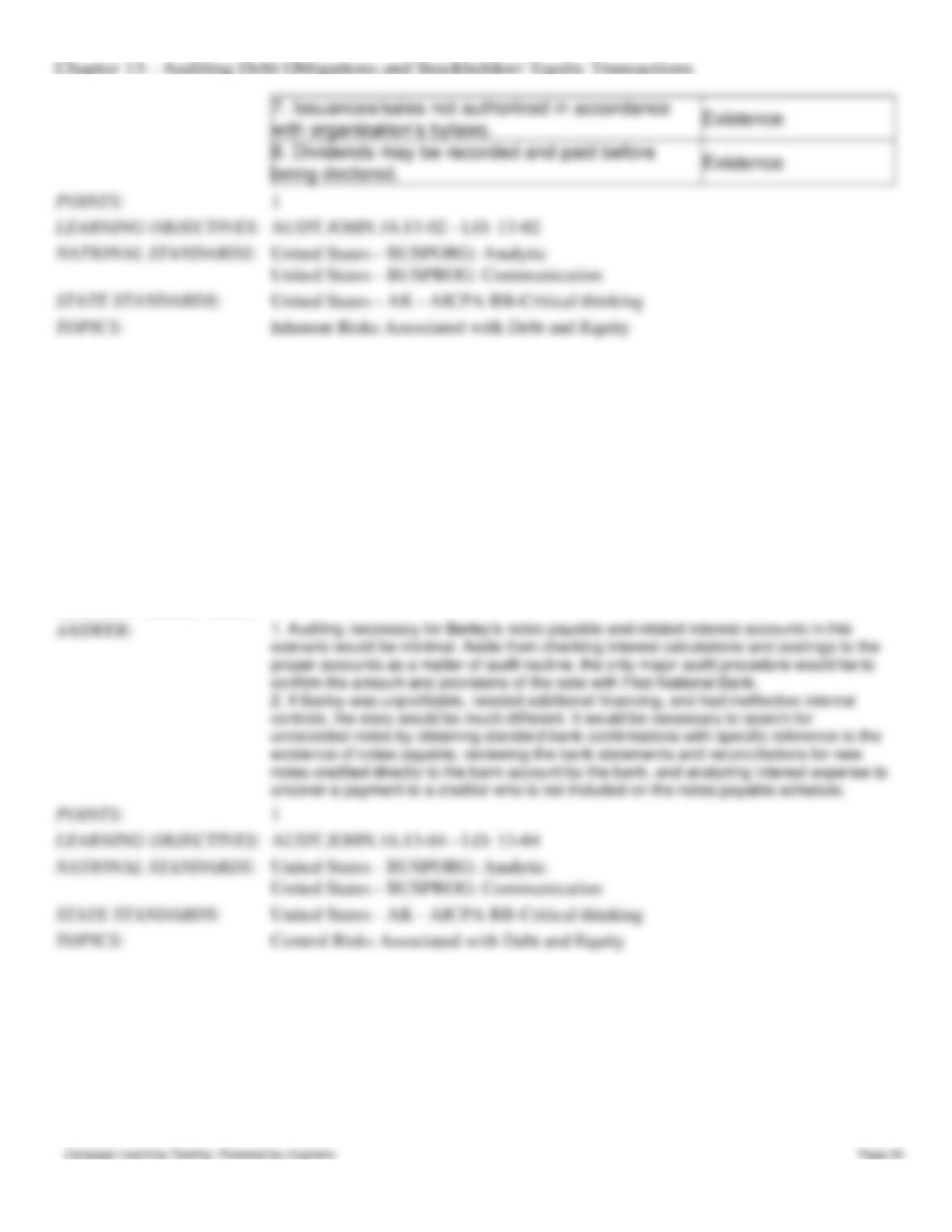
113. Listed below are several inherent risks associated with stockholder’s equity.
REQUIRED:
List the assertion associated with each of these.
Inherent Risk
Related Assertion
1. Proceeds are not received.
2. All stock repurchased is not recorded as treasury stock.
3. The cost of treasury stock that is subsequently retired is
not properly allocated among the appropriate accounts.
4. Dividends are recorded in the wrong period.
5. Stock options exercised or expired remain on the
organization’s books.
6. Stock issued in exchange for goods/services is not properly
valued.
7. Issuances/sales not authorized in accordance with
organization’s bylaws.
8. Dividends may be recorded and paid before being
declared.
114. Barley Company is a medium-sized industrial firm that has been audited by your firm for several years.
The only interest-bearing debt owed by Barley is a $300,000 long-term notes payable held by First National
Bank. The notes were issued 4 years earlier and will mature in 8 more years. Barley is highly profitable, has no
pressing needs for additional financing and has excellent internal controls of the recording of loan and related
interest cost transactions.
REQUIRED:
1. Based on this scenario, describe the auditing procedures that you think will be necessary for notes payable
and related interest accounts.
2. How will you answer differ if instead Barley Company was unprofitable, needed additional financing and had
ineffective internal controls?
115. A CPA firm is engaged in the examination of the financial statements of Garrison Corporation for the year
ended December 31, 2014. Garrison Corporation’s financial statements and records have never been audited by
a CPA. The stockholders’ equity section of Garrison Corporation’s balance sheet at December 31, 2014,
follows:
Stockholders’ Equity:
Capital stock—20,000 shares of $10 par value authorized:
Chapter 13 – Auditing Debt Obligations and Stockholders‘ Equity Transactions
5,500 shares issued and outstanding
$ 55,000
Capital contributed in excess of par value of capital stock
63,800
Retained earnings
110,000
Total stockholders’ equity
$228,800
Founded in 2006, Garrison Corporation has ten stockholders and serves as its own registrar and transfer agent.
It has no capital stock subscription contracts in effect.
REQUIRED:
Prepare the detailed audit program for the examination of the three accounts composing the stockholders’ equity
section of Garrison Corporation’s balance sheet. (Do not include in the audit program the verification of the
results of the current-year operations.)
1
AUDT.JOHN.16.13-06 – LO: 13-06
United States – BUSPROG: Communication
United States – AK – AICPA BB-Critical thinking
Responding to Material Misstatement Risks for Debt and Equity
116. James Carson and Martin Tighe, CPAs have audited all the figures on the balance sheet. James Carson
argues with Martin Tighe that since the retained earnings figure is a balancing figure, it requires no further
verification. Martin Tighe, however, disagrees and argues that they should still choose to verify retained
earnings. Who do you agree with and why?
117. On your first audit for Stark Company, you learn that the company declared a 15% stock dividend during
the last quarter of the year. Identify the evidence you would examine to determine whether the stock dividend
was accounted for properly.
118. The following covenants are extracted from the indenture for McMorris Industries’ 20 year-bond. The
indenture provides that failure to comply with its terms in any respect automatically advances the due date of
the loan to the date of noncompliance.
REQUIRED: Assume that each of these is an independent scenario and identify the audit steps that should be
taken or reporting requirements necessary in connection with (a) through (d).
a. The debtor company shall endeavor to maintain a working capital ratio of 2.5 to 1 at all times, and, in any
fiscal year following a failure to maintain this ratio, the company shall restrict compensation of the CEO and
executive officers to a total of no more than $1,000,000. Executive officers for this purpose shall include the
chairman of the board of directors, the president, all vice presidents, the secretary, and the treasurer.
b. The debtor company shall insure all property that is security for this debt against loss by hurricane to the
extent of 90% of its actual value. Insurance policies securing this protection shall be filed with the trustee.
c. The debtor company shall pay all taxes legally assessed against the property that serves as security for this
debt within the time provided by law for payment without penalty and shall deposit receipted tax bills or equally
acceptable evidence of payment of same with the trustee.
d. A sinking fund shall be established and deposited with the trustee by semiannual payments of $450,000, from
which the trustee shall, at his/her discretion, purchase bonds of this issue.
Chapter 13 – Auditing Debt Obligations and Stockholders‘ Equity Transactions
119. You are engaged in the audit of Bordon Corporation, whose records have not previously been audited by
your firm. The company has an independent transfer agent, as well as a registrar for its capital stock. The
transfer agent maintains the record of stockholders, while the registrar checks that there is no overissue of stock.
Both the transfer agent and registrar are required to validate stock certificates.
One of the seniors on the audit proposes that confirmations be obtained from both the transfer agent and
registrar regarding the outstanding stock balance at the balance sheet date. If the confirmations agree with the
books, then he proposes that no additional work is to be performed on the capital stock account.
REQUIRED:
Do you agree or disagree that this will be sufficient? If yes, give the justification for your position. If no, state
Chapter 13 – Auditing Debt Obligations and Stockholders‘ Equity Transactions
120. The Thomas Corporation took out a 20-year mortgage on a new headquarters building on June 30, 2014 for
$3,000,000 and pledged its only manufacturing facility and the land on which it stands as collateral. The
monthly payment to the mortgagor is $25,000 and was first paid on July 1, 2014. Your firm has audited this
client before, but the client has never had a mortgage in previous years. You are in charge of the current year
audit for Thomas, which has a balance sheet date of December 31, 2014.
REQUIRED:
1. Explain why it is desirable to prepare a schedule for the permanent file regarding the mortgage. What type of
information should this include?
2. Explain why the audit of mortgage payable, interest expense, and interest payable should all be performed
together.
3. List audit procedures that are typically performed to verify the issue of the mortgage, the mortgage and the
interest payable account balances at December 31, 2014, and the balance in interest expense for 2014.
4. What type of information should be disclosed in the footnotes for this mortgage to help the auditor determine
whether the completeness and presentation/disclosure assertions are satisfied?