Chapter 13 – Statement of Cash Flows
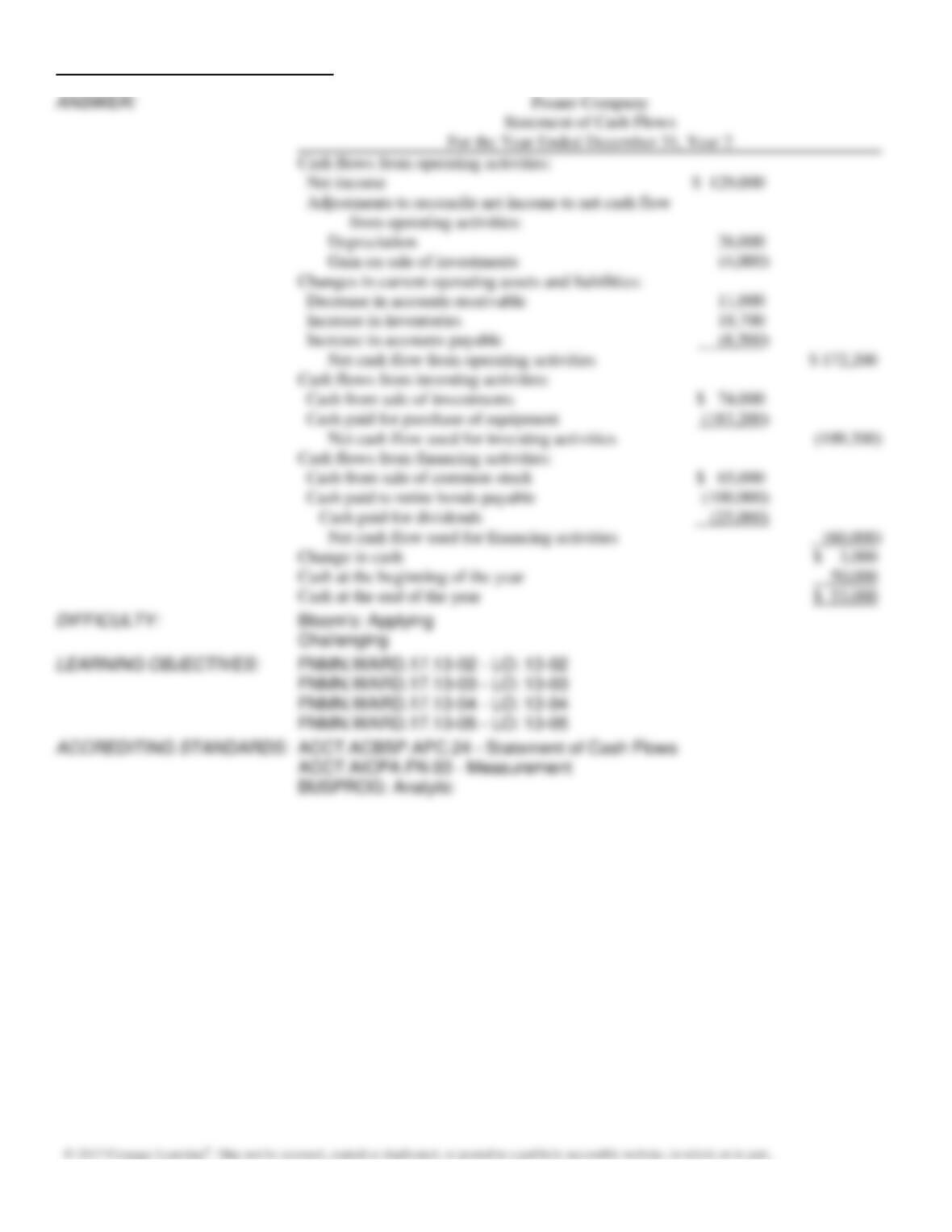
171. The comparative balance sheets of Posner Company, for Years 1 and 2 ended December 31, appear below in
condensed form:
Year 2
Year 1
Cash
$ 53,000
$ 50,000
Accounts receivable (net)
37,000
48,000
Inventories
108,500
100,000
Investments
—
70,000
Equipment
573,200
450,000
Accumulated depreciation—equipment
(142,000)
(176,000)
$629,700
$542,000
Accounts payable
$ 62,500
$ 43,800
Bonds payable, due Year 2
—
100,000
Common stock, $10 par
325,000
285,000
Paid-in capital in excess of par—common stock
80,000
55,000
Retained earnings
162,200
58,200
$629,700
$542,000
The income statement for the current year is as follows:
Sales
$625,700
Cost of goods sold
340,000
Gross profit
$285,700
Operating expenses:
Depreciation expense
$26,000
Other operating expenses
68,000
Total operating expenses
94,000
Income from operations
$191,700
Other income:
Gain on sale of investment
$ 4,000
Other expense:
Interest expense
6,000
(2,000)
Income before income tax
$189,700
Income tax
60,700
Net income
$129,000
Additional data for the current year are as follows:
(a)
Fully depreciated equipment costing $60,000 was scrapped, no salvage, and
new equipment was purchased for $183,200.
(b)
Bonds payable for $100,000 were retired by payment at their face amount.
(c)
5,000 shares of common stock were issued at $13 for cash.
(d)
Cash dividends declared and paid, $25,000.
Prepare a statement of cash flow, using the indirect method of reporting cash flows from operating activities.
Chapter 13 – Statement of Cash Flows
Chapter 13 – Statement of Cash Flows
172. The comparative balance sheet of Barry Company for Years 1 and 2 ended December 31 appears below in condensed
form:
Year 2
Year 1
Cash
$ 72,000
$ 42,500
Accounts receivable (net)
61,000
70,200
Inventories
121,000
105,000
Investments
—
100,000
Equipment
515,000
425,000
Accumulated depreciation—equipment
(153,000)
(175,000)
$616,000
$567,700
Accounts payable
$ 59,750
$ 47,250
Bonds payable
—
75,000
Common stock, $20 par
375,000
325,000
Premium on common stock
50,000
25,000
Retained earnings
131,250
95,450
$616,000
$567,700
Additional data for the current year are as follows:
(a)
Net income, $75,800.
(b)
Depreciation reported on income statement, $38,000.
(c)
Fully depreciated equipment costing $60,000 was scrapped, no salvage, and
equipment was purchased for $150,000.
(d)
Bonds payable for $75,000 were retired by payment at their face amount.
(e)
2,500 shares of common stock were issued at $30 for cash.
(f)
Cash dividends declared and paid, $40,000.
(g)
Investments of $100,000 were sold for $125,000.
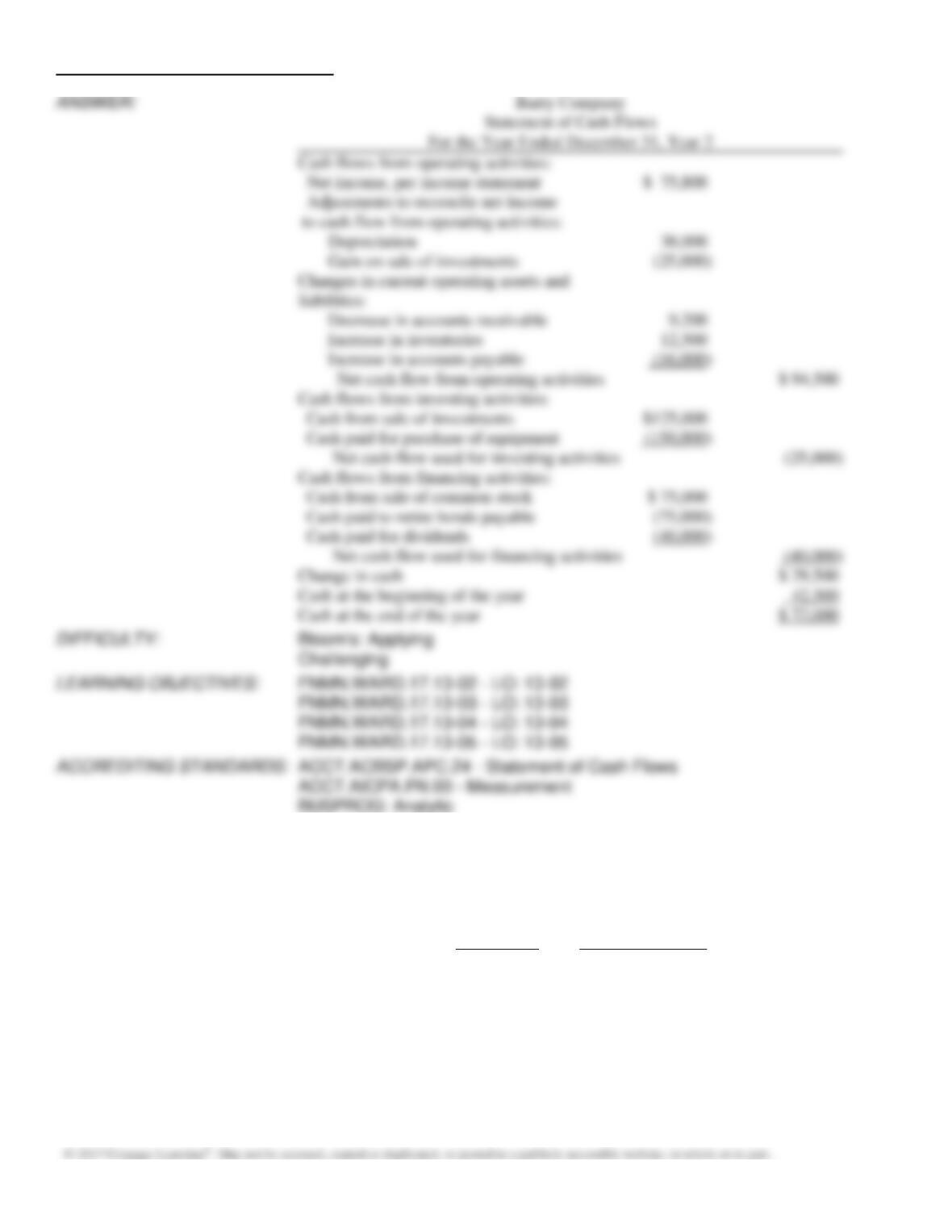
Prepare a statement of cash flows using the indirect method.
Chapter 13 – Statement of Cash Flows
Cash flows from operating activities:
Net income, per income statement
Depreciation
Gain on sale of investments
Decrease in accounts receivable
Increase in inventories
Increase in accounts payable
Net cash flow from operating activities
Cash flows from investing activities:
Cash from sale of investments
Cash paid for purchase of equipment
Net cash flow used for investing activities
Cash flows from financing activities:
Cash from sale of common stock
Cash paid to retire bonds payable
Cash paid for dividends
Net cash flow used for financing activities
Change in cash
Cash at the beginning of the year
Cash at the end of the year
ACCREDITING STANDARDS:
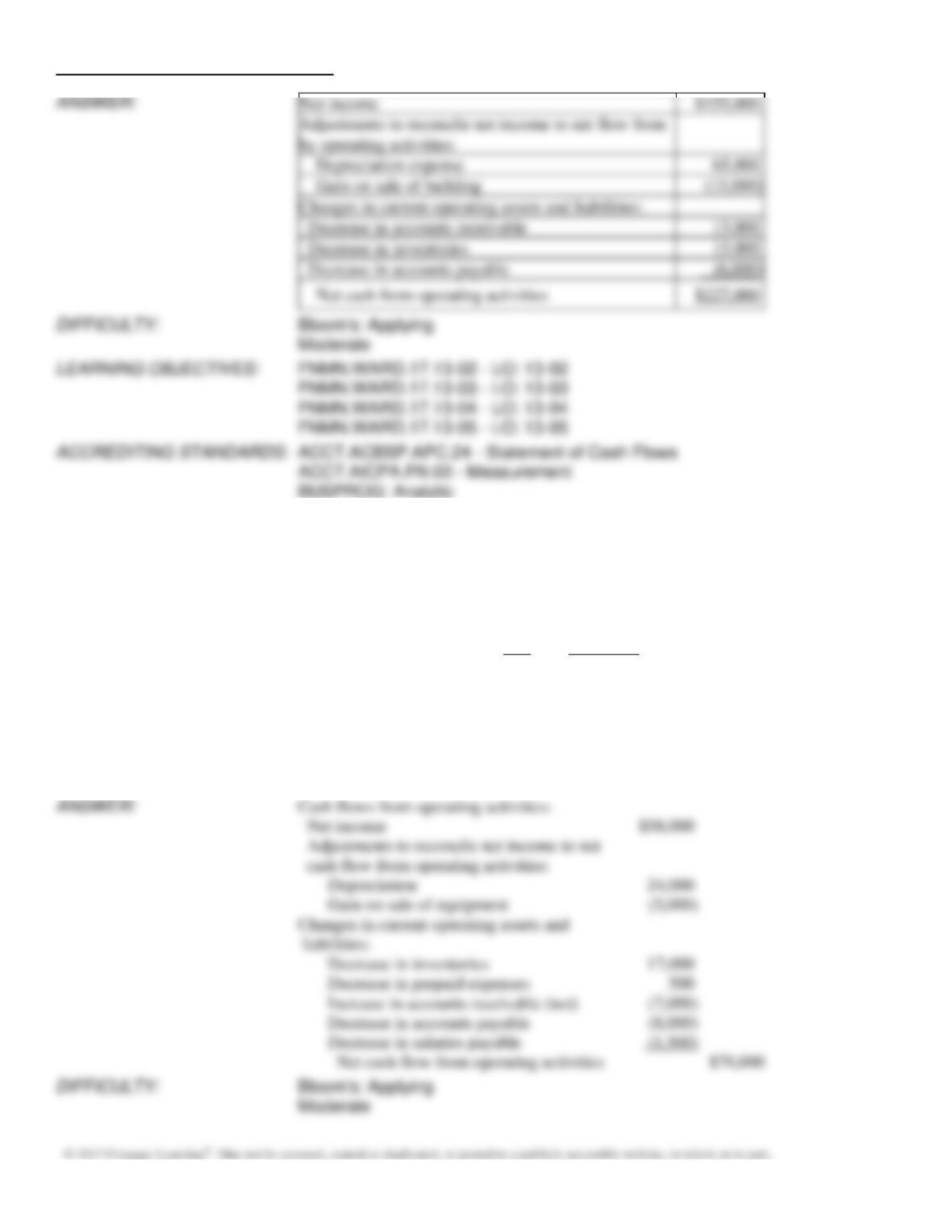
173. The Dickinson Company reported net income of $155,000 for the current year. Depreciation recorded on buildings
and equipment amounted to $65,000 for the year. In addition, a building with an original cost of $250,000 and
accumulated depreciation of $190,000 on the date of the sale, was sold for $75,000. Balances of the current asset and
current liability accounts at the beginning and end of the year are as follows:
End of Year
Beginning of Year
Cash
$20,000
$15,000
Accounts receivable
19,000
32,000
Inventories
50,000
65,000
Accounts payable
12,000
18,000
Prepare the cash flows from the operating activities section of the statement of cash flows using the indirect method.
Chapter 13 – Statement of Cash Flows
Depreciation expense
Gain on sale of building
Changes in current operating assets and liabilities:
Decrease in accounts receivable
Decrease in inventories
Decrease in accounts payable
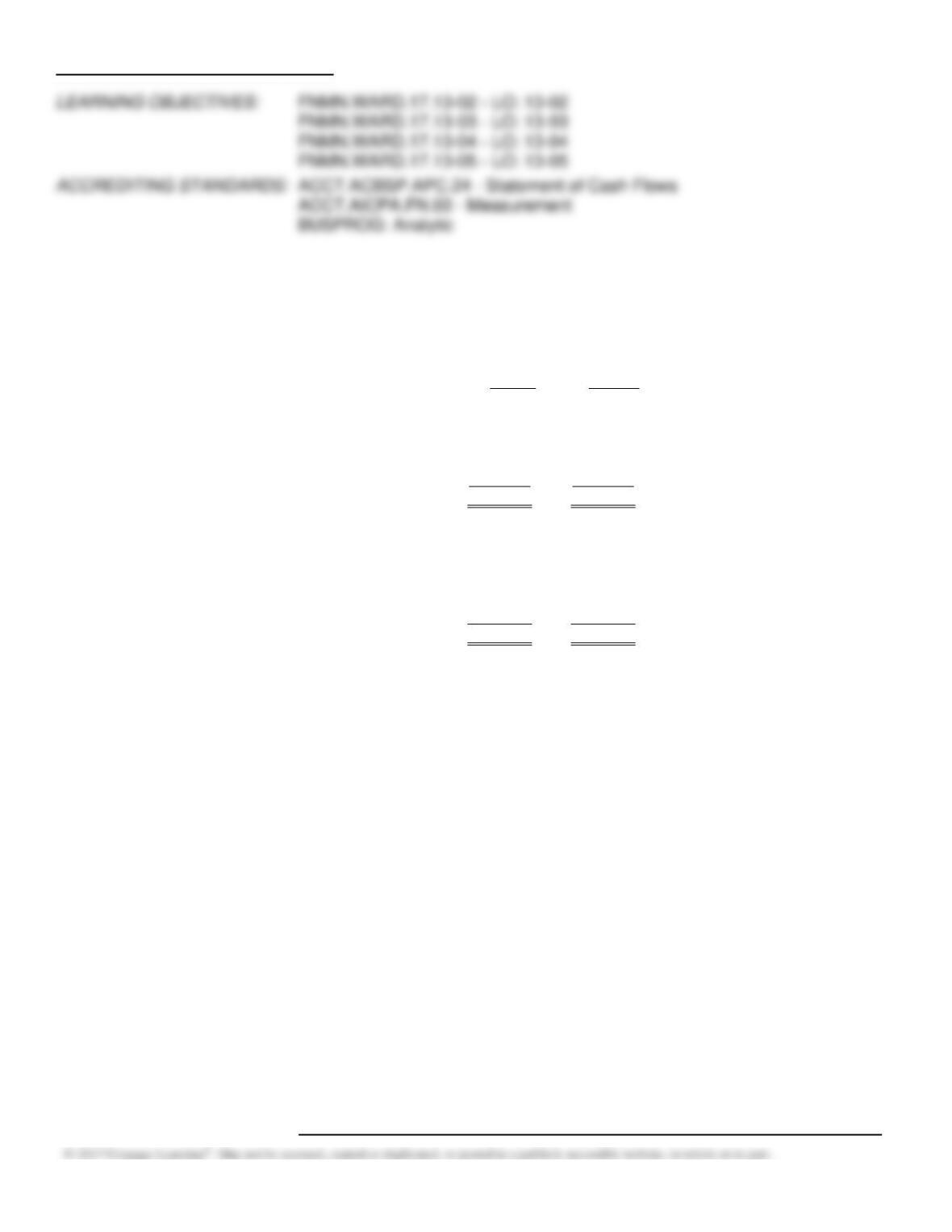
174. The net income reported on the income statement for the current year was $58,000. Depreciation recorded on fixed
assets for the year was $24,000. In addition, equipment with an original cost of $130,000 and accumulated depreciation
of $115,000 on the date of the sale, was sold for $20,000. Balances of the current asset and current liability accounts at
the end and beginning of the year are listed below. Prepare the cash flows from operating activities section of a statement
of cash flows using the indirect method.
End
Beginning
Cash
$65,000
$ 70,000
Accounts receivable (net)
70,000
63,000
Inventories
85,000
102,000
Prepaid expenses
4,000
4,500
Accounts payable (merchandise creditors)
50,000
58,000
Cash dividends payable
4,500
6,500
Salaries payable
6,000
7,500
Cash flows from operating activities:
Net income
cash flow from operating activities:
Depreciation
Gain on sale of equipment
Decrease in inventories
Decrease in prepaid expenses
Increase in accounts receivable (net)
Decrease in accounts payable
Decrease in salaries payable
Net cash flow from operating activities
Chapter 13 – Statement of Cash Flows
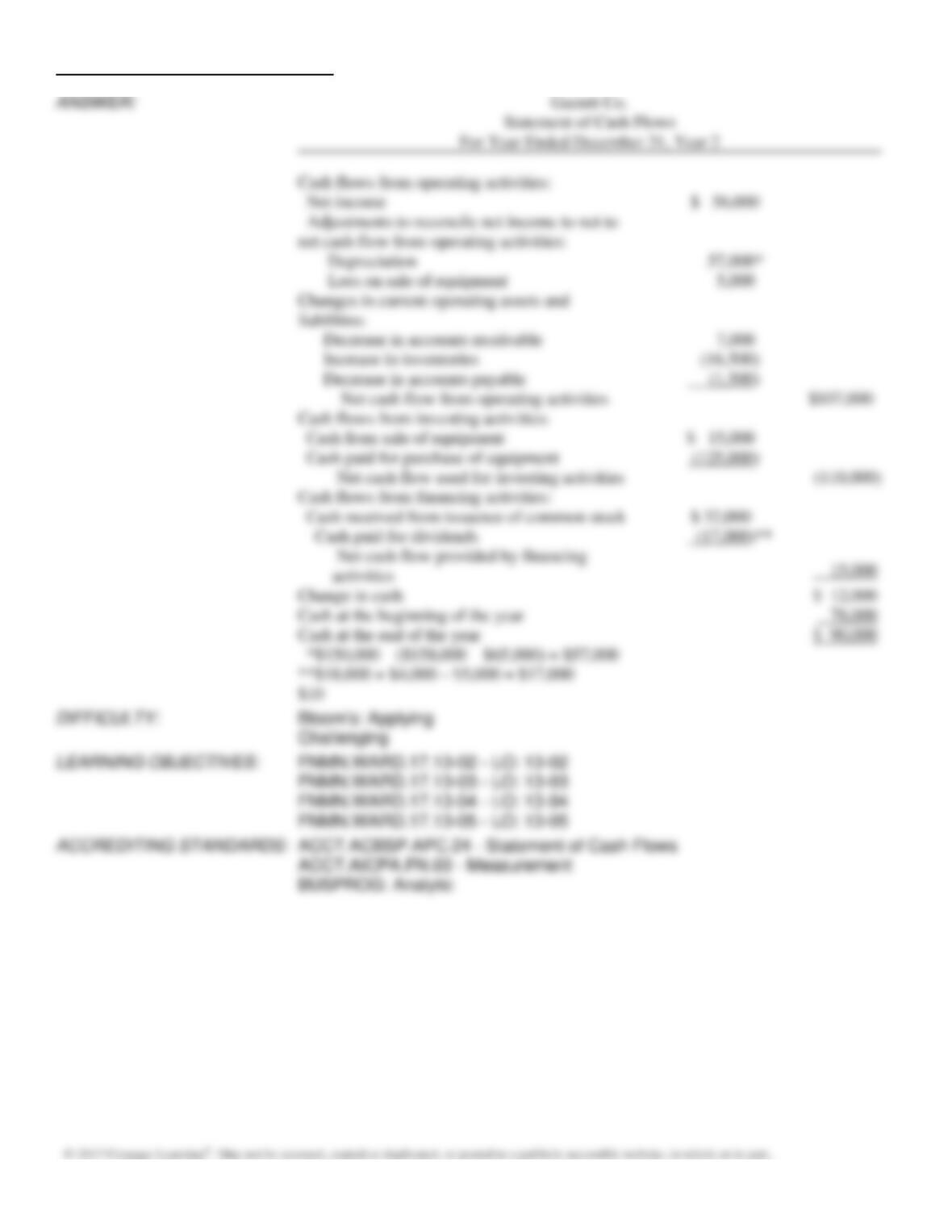
175. On the basis of the following data for Garrett Co. for Years 1 and 2 ended December 31, prepare a statement of cash
flows using the indirect method of reporting cash flows from operating activities. Assume that equipment costing
$125,000 was purchased for cash and equipment costing $85,000 with accumulated depreciation of $65,000 was sold for
$15,000; that the stock was issued for cash; and that the only entries in the retained earnings account were for net income
of $56,000 and cash dividends declared of $18,000.
Year 2
Year 1
Cash
$ 90,000
$ 78,000
Accounts receivable (net)
78,000
85,000
Inventories
106,500
90,000
Equipment
410,000
370,000
Accumulated depreciation
(150,000)
(158,000)
$534,500
$465,000
Accounts payable (merchandise creditors)
$ 53,500
$ 55,000
Cash dividends payable
5,000
4,000
Common stock, $10 par
200,000
170,000
Paid-in capital in excess of par—common stock
62,000
60,000
Retained earnings
214,000
176,000
$534,500
$465,000
Chapter 13 – Statement of Cash Flows
Chapter 13 – Statement of Cash Flows
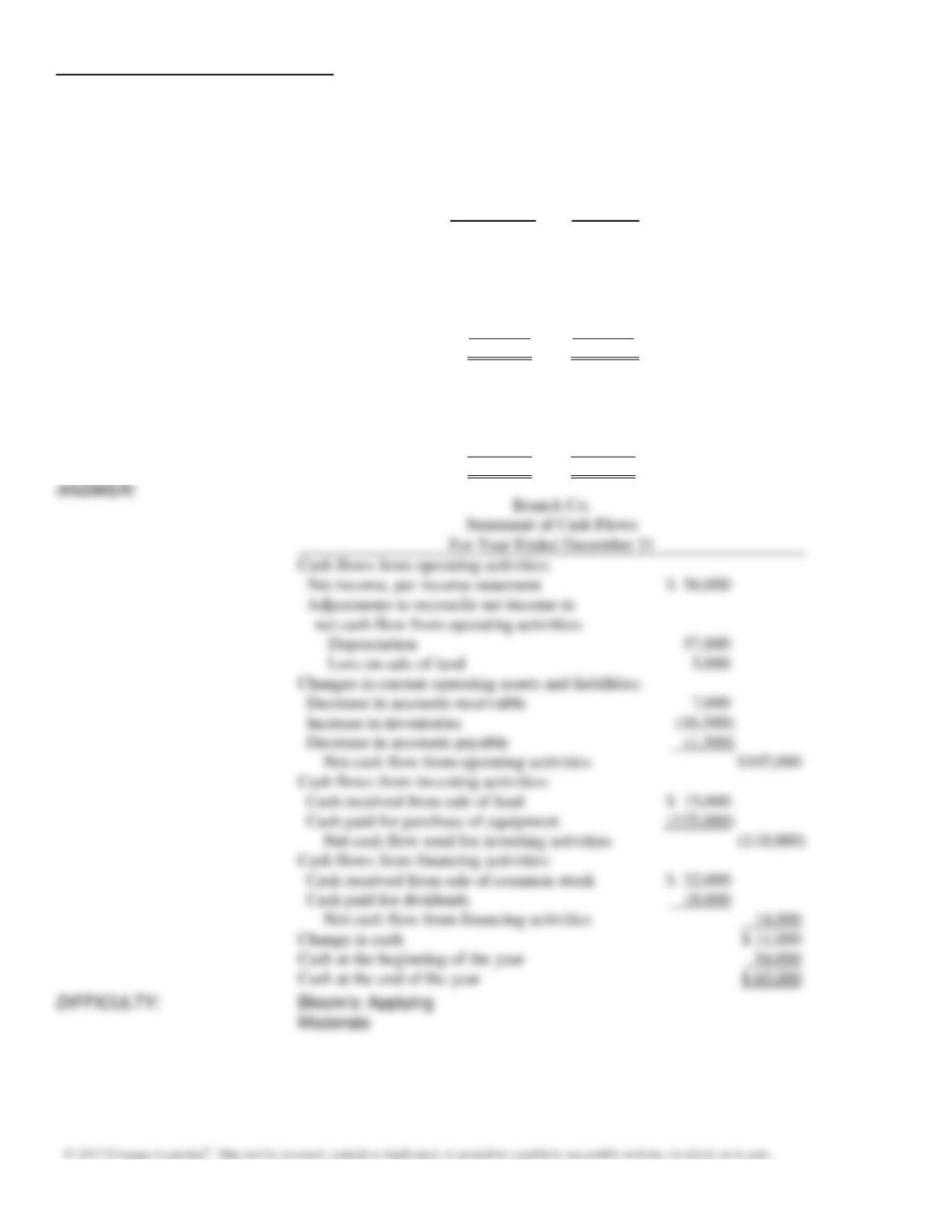
176. On the basis of the following data for Branch Co. for the current and preceding years ended December 31, prepare a
statement of cash flows for the current year using the indirect method.
Assume that equipment costing $125,000 was purchased for cash and the land was sold for $15,000. The stock was issued
for cash and the only entries in the retained earnings account were for net income of $56,000 and cash dividends declared
and paid of $18,000.
Current year
Prior year
Cash
$ 65,000
$ 54,000
Accounts receivable (net)
78,000
85,000
Inventories
106,500
90,000
Land
—
20,000
Equipment
495,000
370,000
Accumulated depreciation
(215,000)
(158,000)
$529,500
$461,000
Accounts payable (merchandise creditors)
$ 53,500
$ 55,000
Common stock, $10 par
200,000
170,000
Paid-in capital in excess of par—common stock
62,000
60,000
Retained earnings
214,000
176,000
$529,500
$461,000
Cash flows from operating activities:
Net income, per income statement
Adjustments to reconcile net income to
net cash flow from operating activities:
Loss on sale of land
Changes in current operating assets and liabilities:
Decrease in accounts receivable
Increase in inventories
Decrease in accounts payable
Net cash flow from operating activities
Cash flows from investing activities:
Cash received from sale of land
Cash paid for purchase of equipment
Net cash flow used for investing activities
Cash flows from financing activities:
Cash received from sale of common stock
Cash paid for dividends
Net cash flow from financing activities
Change in cash
Cash at the beginning of the year
Cash at the end of the year
Chapter 13 – Statement of Cash Flows
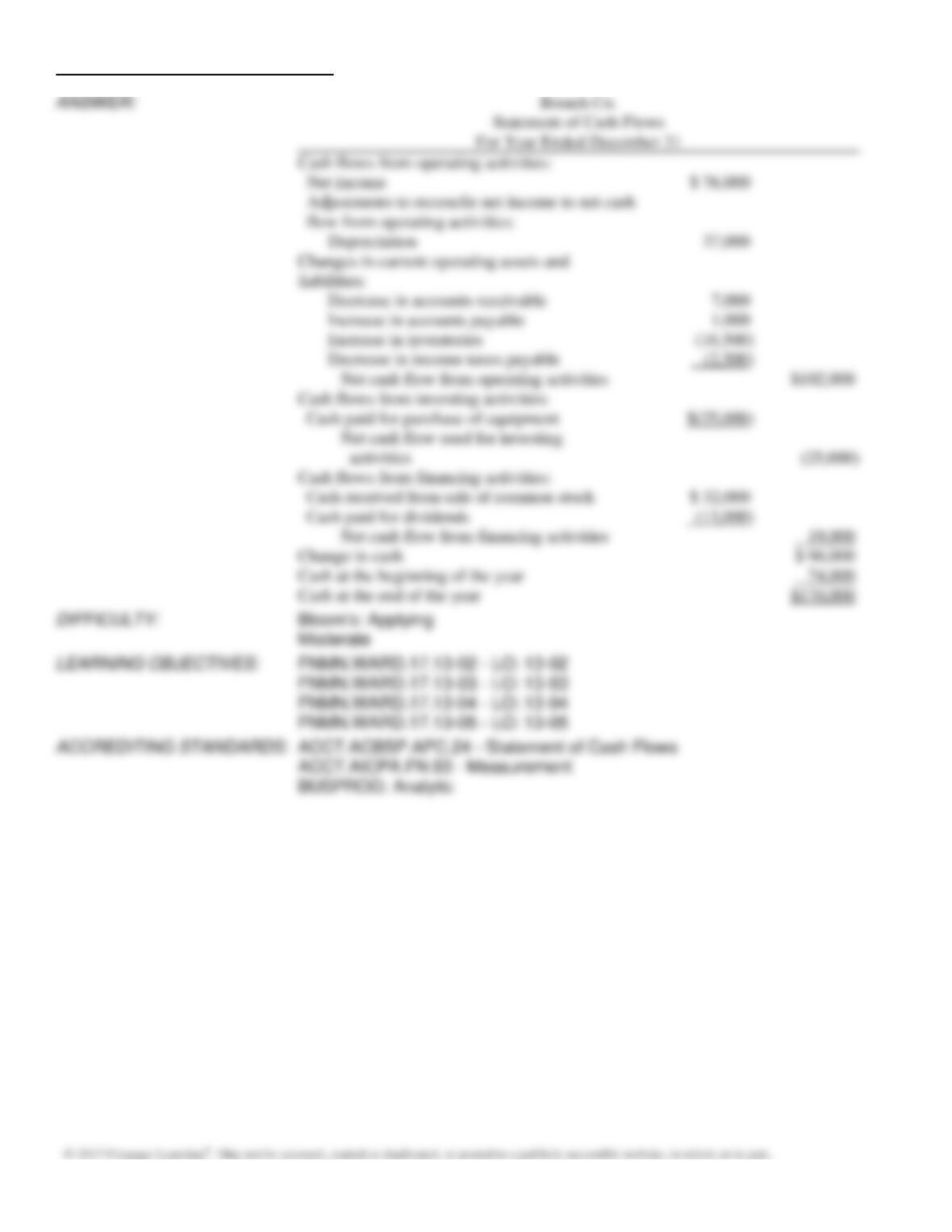
177. On the basis of the following data for Breach Co. for the current and preceding years ended December 31, prepare a
statement of cash flows for the current year using the indirect method.
Assume that equipment costing $25,000 was purchased for cash and no long term assets were sold during the period.
Stock was issued for cash—3,200 shares at par.
Net income for the current year was $76,000.
Cash dividends declared and paid were $13,000.
Current year
Prior year
Cash
$ 170,000
$ 74,000
Accounts receivable (net)
78,000
85,000
Inventories
106,500
90,000
Equipment
395,000
370,000
Accumulated depreciation
(195,000)
(158,000)
$ 554,500
$ 461,000
Accounts payable (merchandise creditors)
$ 51,000
$ 50,000
Taxes payable
2,500
5,000
Common stock, $10 par
262,000
230,000
Retained earnings
239,000
176,000
$554,500
$ 461,000
Chapter 13 – Statement of Cash Flows
Chapter 13 – Statement of Cash Flows
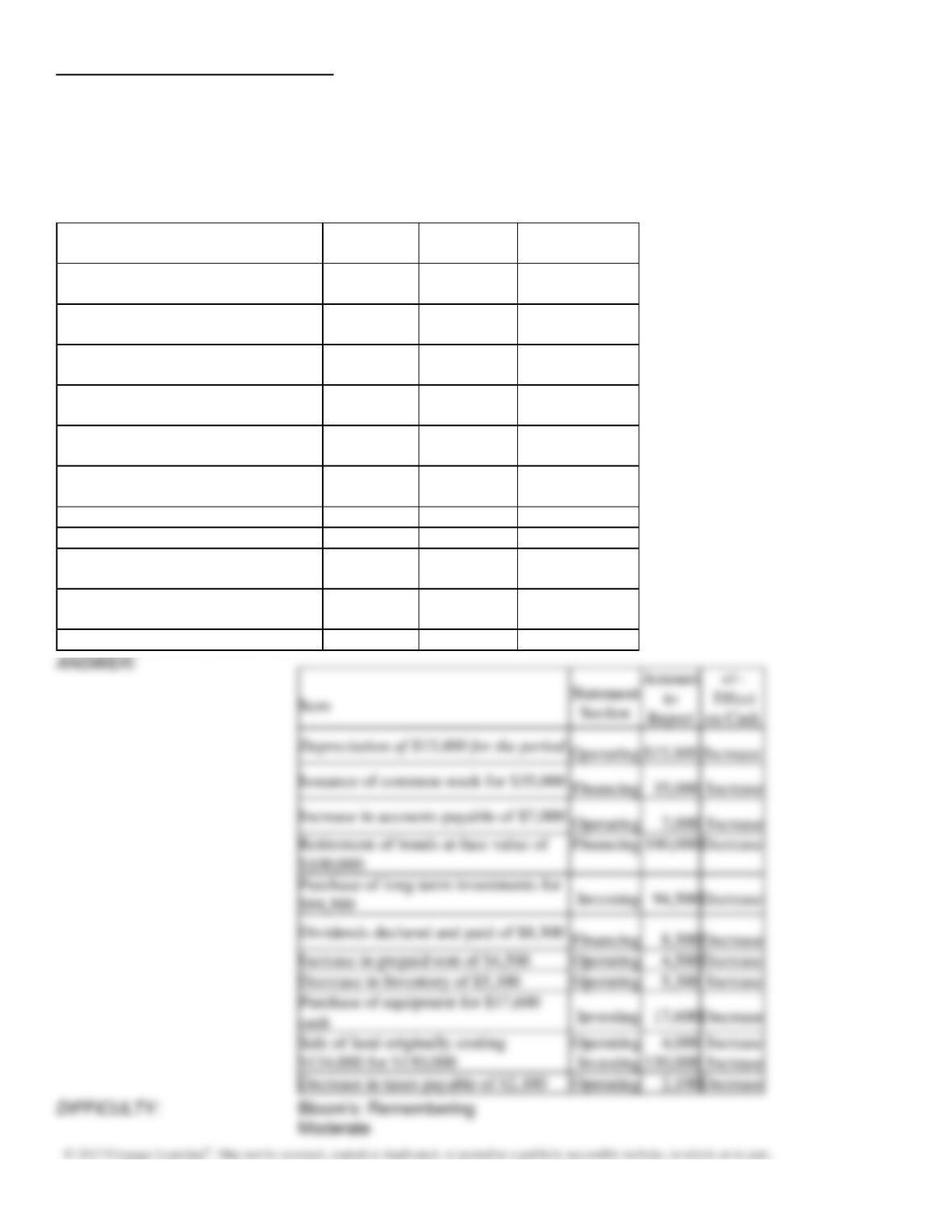
178. Complete each of the columns on the table below, indicating in which section each item would be reported on the
statement of cash flows (operating, investing, or financing), the amount that would be reported, and whether the item
would create an increase or decrease in cash. For item that affect more than one section of the statement, indicate all
affected. Assume the indirect method of reporting cash flows from operating activities.
The first item has been completed as an example.
Item
Statement
Section
Amount
to Report
+/– Effect
on Cash
Depreciation of $15,000 for the
period
Operating
$15,000
Increase
Issuance of common stock for
$35,000
Increase in accounts payable of
$7,000
Retirement of bonds at face value of
$100,000
Purchase of long-term investments for
$94,500
Dividends declared and paid of
$8,300
Increase in prepaid rent of $4,500
Decrease in Inventory of $5,300
Purchase of equipment for $17,600
cash
Sale of land originally costing
$134,000 for $130,000
Decrease in taxes payable of $2,100
Retirement of bonds at face value of
$100,000
Decrease
Increase in prepaid rent of $4,500
Decrease in Inventory of $5,300
Purchase of equipment for $17,600
Sale of land originally costing
Decrease in taxes payable of $2,100
Chapter 13 – Statement of Cash Flows
179. Balances of the current asset and current liability accounts at the end and beginning of the year are as follows:
End
Beginning
Cash
$ 62,000
$73,000
Accounts receivable (net)
75,000
60,000
Inventories
54,000
47,000
Accounts payable
(merchandise creditors)
43,000
37,000
Salaries payable
2,800
3,800
Sales (on account)
210,000
Cost of goods sold
70,000
Operating expenses other than depreciation
67,000
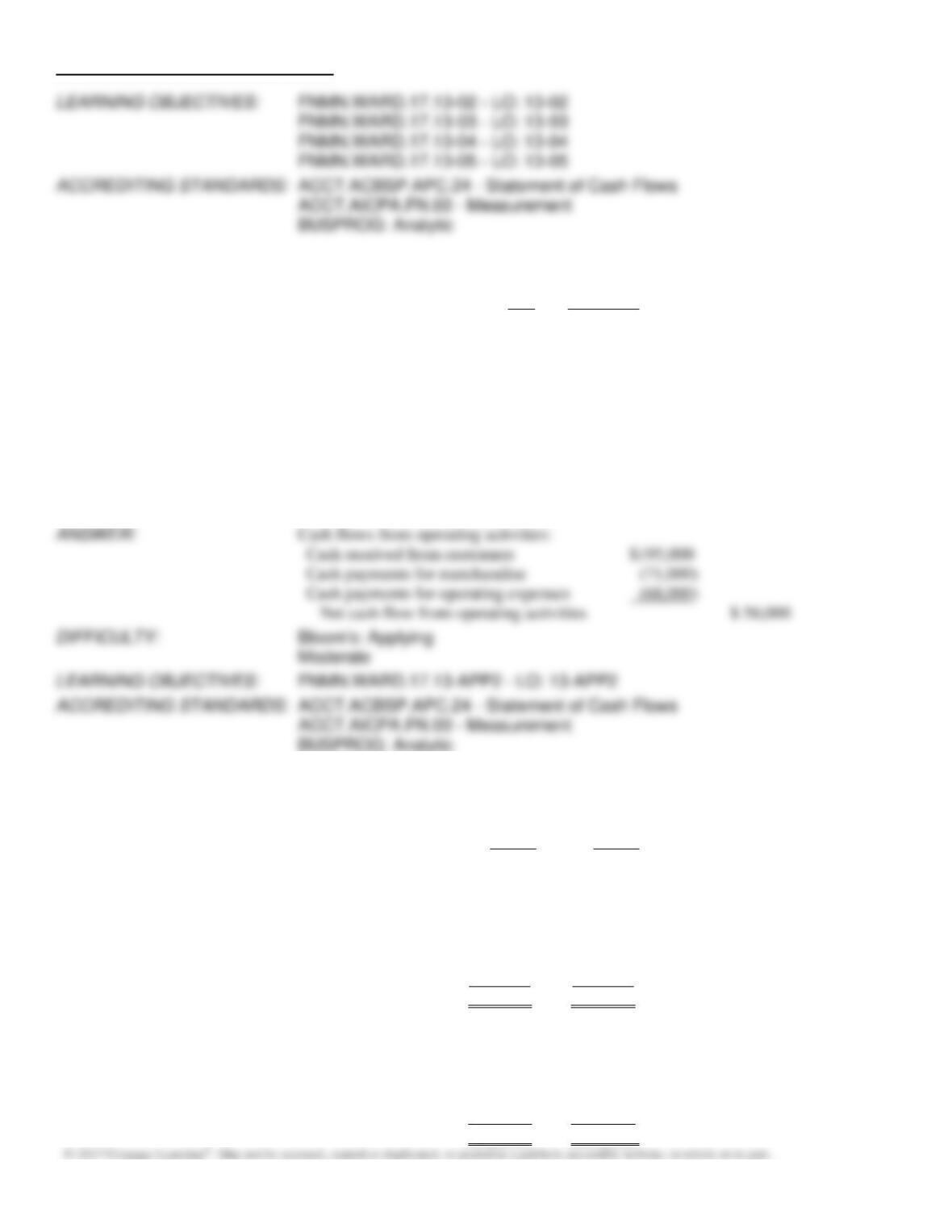
Use the direct method to prepare the cash flows from operating activities section of a statement of cash flows.
Cash flows from operating activities:
Cash received from customers
Cash payments for merchandise
Cash payments for operating expenses
Net cash flow from operating activities
180. The comparative balance sheet of ConnieJo Company, for December 31, Years 1 and 2 ended December 31 appears
below in condensed form:
Year 2
Year 1
Cash
$ 45,000
$ 53,500
Accounts receivable (net)
51,300
58,000
Inventories
147,200
135,000
Investments
0
60,000
Equipment
493,000
375,000
Accumulated depreciation—equipment
(113,700)
(128,000)
$622,800
$553,500
Accounts payable
$61,500
$42,600
Bonds payable, due Year 4
0
100,000
Common stock, $10 par
250,000
200,000
Paid-in capital in excess of par—common stock
75,000
50,000
Retained earnings
236,300
160,900
$622,800
$553,500
Chapter 13 – Statement of Cash Flows
The income statement for the current year is as follows:
Sales
$623,000
Cost of goods sold
348,500
Gross profit
$274,500
Operating expenses:
Depreciation expense
$24,700
Other operating expenses
75,300
Total operating expenses
100,000
Income from operations
$174,500
Other income:
Gain on sale of investment
$ 5,000
Other expense:
Interest expense
12,000
(7,000)
Income before income tax
$167,500
Income tax
64,100
Net income
$103,400
Additional data for the current year are as follows:
(a)
Fully depreciated equipment costing $39,000 was scrapped, no salvage, and
equipment was purchased for $157,000.
(b)
Bonds payable for $100,000 were retired by payment at their face amount.
(c)
5,000 shares of common stock were issued at $15 for cash.
(d)
Cash dividends declared were paid $28,000.
(e)
All sales are on account.
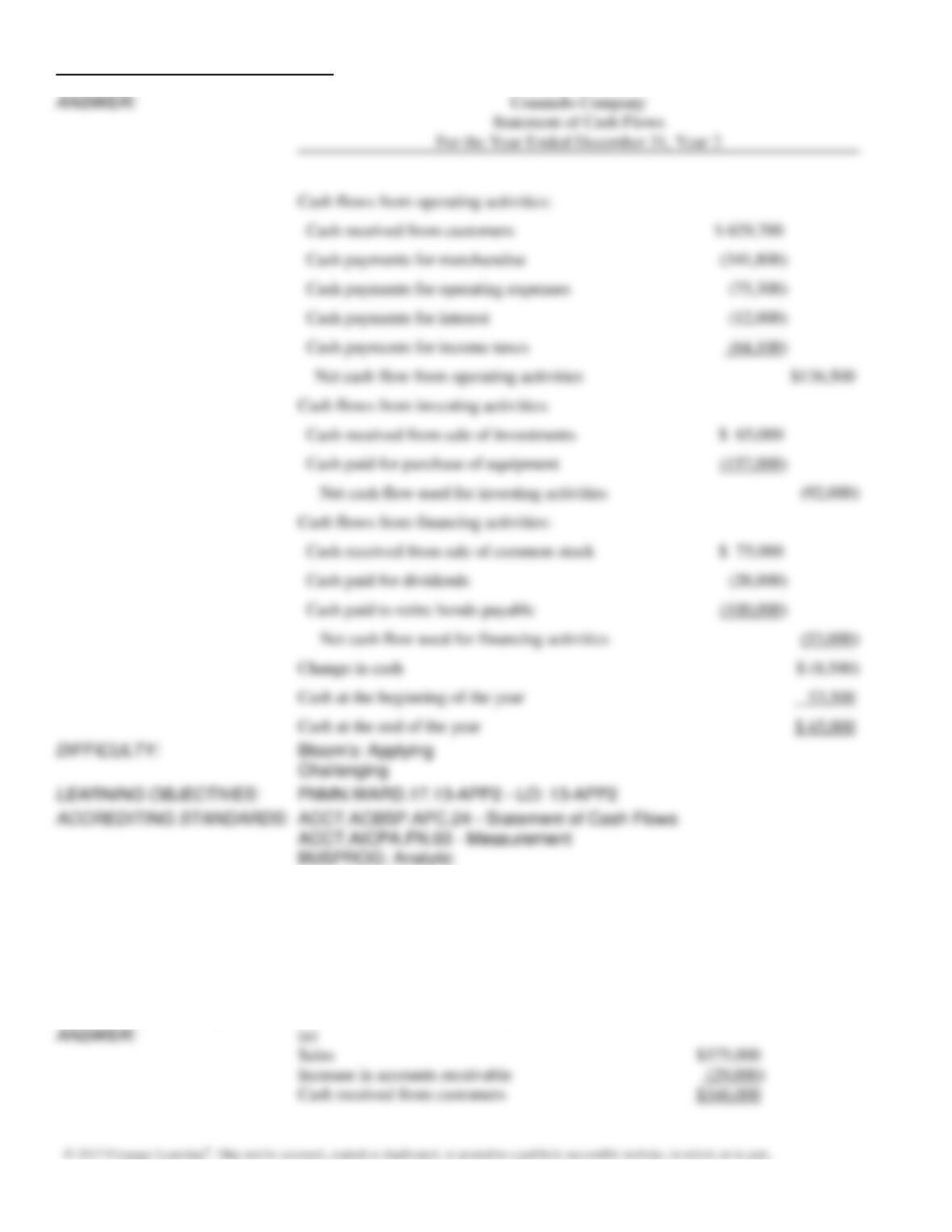
Prepare a statement of cash flows, using the direct method of reporting cash flows from operating activities.
Chapter 13 – Statement of Cash Flows
Cash flows from operating activities:
Cash payments for merchandise
Cash payments for operating expenses
Cash payments for interest
Cash payments for income taxes
Net cash flow from operating activities
Cash flows from investing activities:
Cash received from sale of investments
Cash paid for purchase of equipment
Net cash flow used for investing activities
Cash flows from financing activities:
Cash received from sale of common stock
Cash paid for dividends
Cash paid to retire bonds payable
Net cash flow used for financing activities
Change in cash
Cash at the beginning of the year
Cash at the end of the year
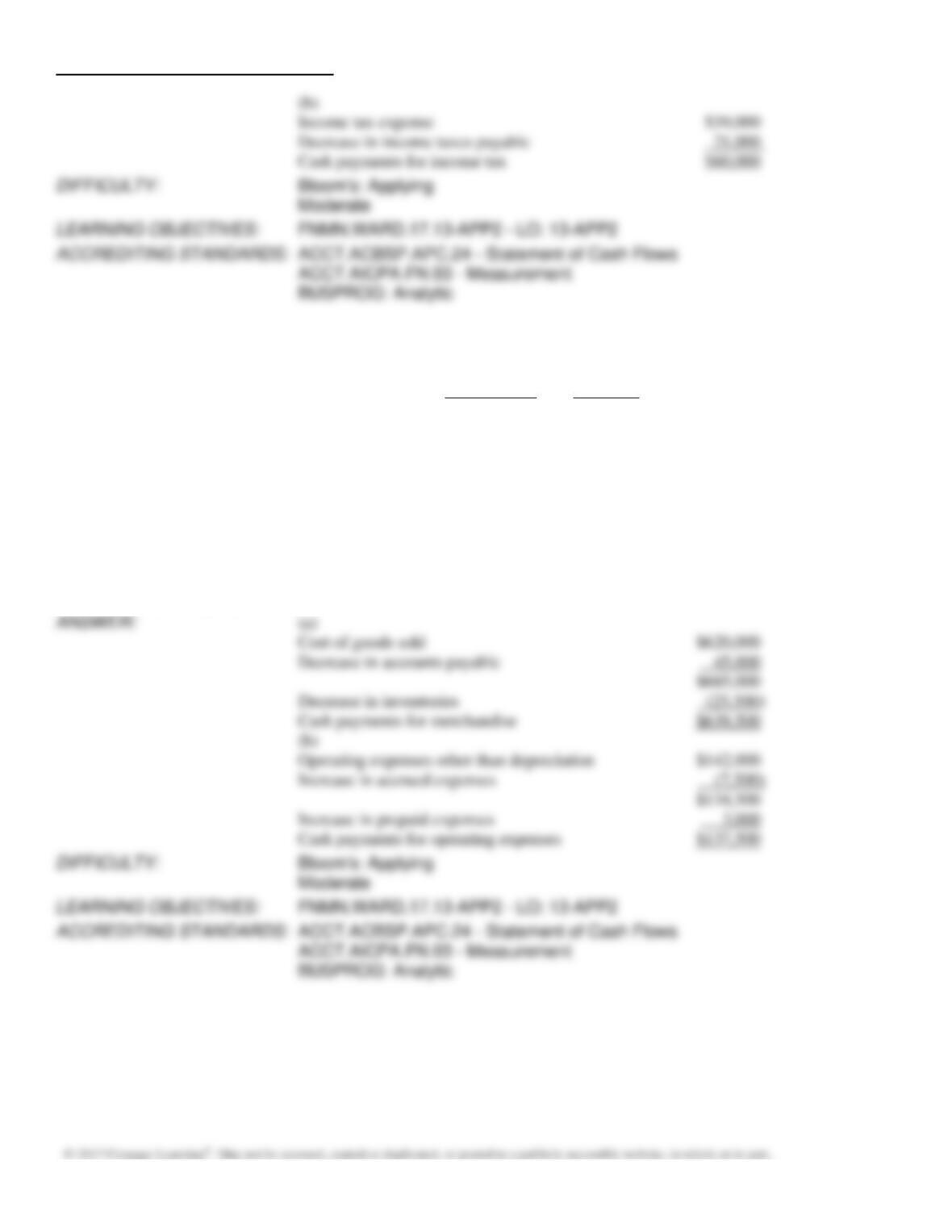
181. The cash flows from operating activities are reported by the direct method on the statement of cash flows. Determine
the following:
(a)
If sales for the current year were $375,000 and accounts receivable increased by $29,000
during the year, what was the amount of cash received from customers?
(b)
If income tax expense for the current year was $39,000 and income tax payable decreased
by $21,000 during the year, what was the amount of cash payments for income tax?
Increase in accounts receivable
Cash received from customers
Chapter 13 – Statement of Cash Flows
182. Selected data for the current year ended December 31 are as follows:
Balance
Balance
December 31
January 1
Accrued expenses (operating expenses)
$29,500
$ 22,000
Accounts payable (merchandise creditors)
90,000
135,000
Inventories
42,500
68,000
Prepaid expenses
23,000
20,000
During the current year, the cost of goods sold was $620,000 and the operating expenses other than depreciation were
$142,000. The direct method is used for presenting the cash flows from operating activities on the statement of cash
flows.
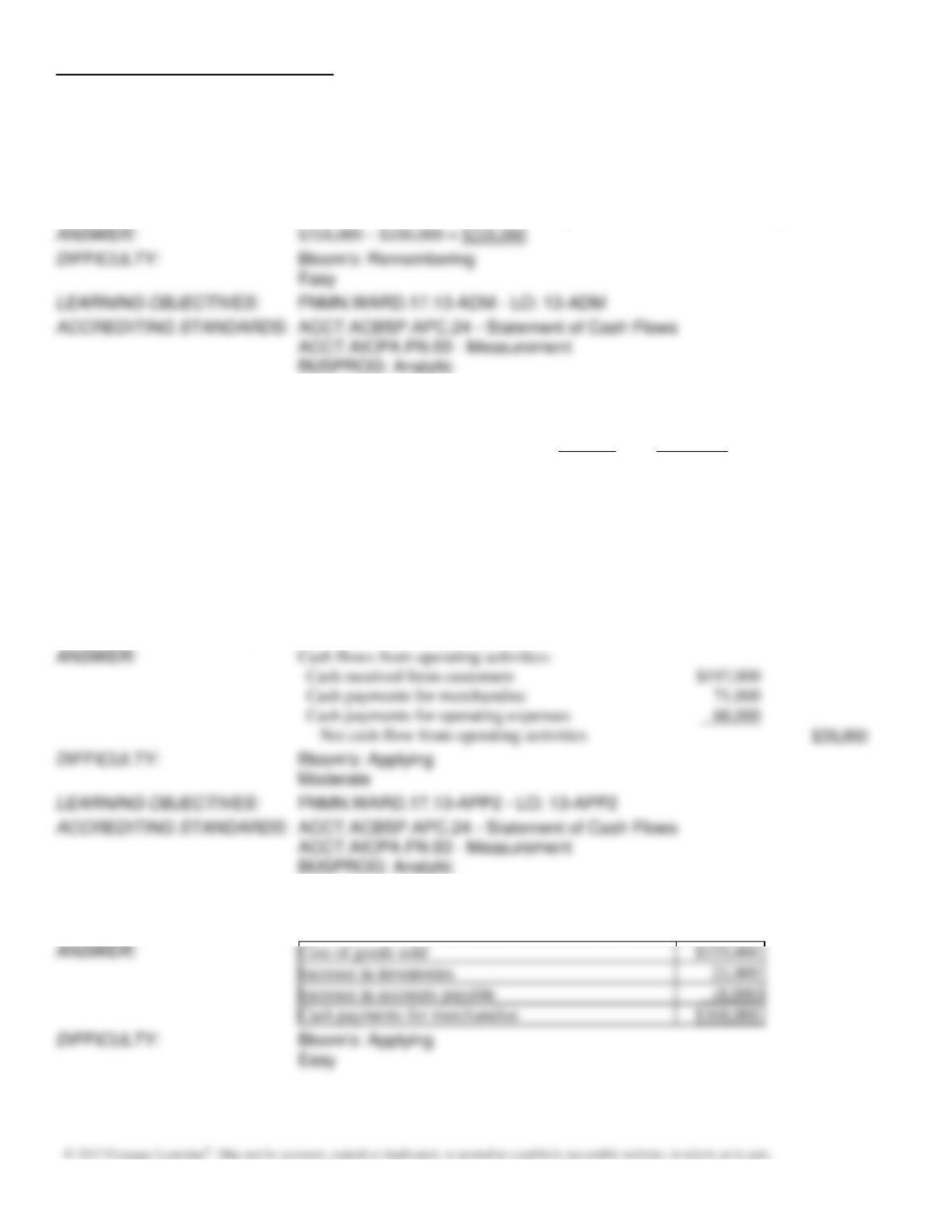
Determine the amount reported on the statement of cash flows for (a) cash payments for merchandise and (b) cash
payments for operating expenses.
Decrease in accounts payable
Decrease in inventories
Cash payments for merchandise
Operating expenses other than depreciation
Increase in accrued expenses
Increase in prepaid expenses
Cash payments for operating expenses
Income tax expense
Decrease in income taxes payable
Cash payments for income tax
Chapter 13 – Statement of Cash Flows
183. Based on the following, what is free cash flow?
Net cash flow from operating activities
$318,000
Net cash flow used for investing activities
(30,000)
Net cash flow from financing activities
30,000
Cash flows from investing include the purchase of a replacement asset for $100,000 and the sale of the one used in
production, which is now obsolete, for $70,000. Cash flows from financing include $70,000 of borrowing.
$318,000 – $100,000 = $218,000
184. Balances of the current asset and current liability accounts at the end and beginning of the year are as follows:
End
Beginning
Cash
$ 67,000
$73,000
Accounts receivable (net)
73,000
60,000
Inventories
54,000
47,000
Accounts payable (merchandise creditors)
43,000
37,000
Salaries payable
2,800
3,800
Sales (on account)
210,000
Cost of goods sold
70,000
Operating expenses other than depreciation
67,000
Use the direct method to prepare the cash flows from operating activities section of a statement of cash flows.
Cash flows from operating activities:
Cash payments for merchandise
Cash payments for operating expenses
Net cash flow from operating activities
185. Cost of goods sold reported on the income statement was $155,000. The accounts payable balance increased $8,000,
and the inventory balance increased by $21,000 over the year. Determine the amount of cash paid for merchandise.
Cost of goods sold
Increase in inventories
Increase in accounts payable
Cash payments for merchandise
Chapter 13 – Statement of Cash Flows
186. Sales reported on the income statement were $690,000. The accounts receivable balance declined $39,000 over the
year. Determine the amount of cash received from customers.
Sales
Decrease in accounts receivable
Cash received from customers
187. Selected data taken from the accounting records of Laser Inc. for the current year ended December 31 are as follows:
Balance,
December 31
Balance,
January 1
Accrued operating expenses
$ 5,590
$ 6,110
Accounts payable (merchandise creditors)
41,730
46,020
Inventories
77,350
84,110
Prepaid expenses
3,250
3,900
During the current year, the cost of goods sold was $448,500, and the operating expenses other than depreciation were
$78,000. The direct method is used for presenting the cash flows from operating activities on the statement of cash flows.
Required:
Determine the amount reported on the statement of cash flows for:
(a) Cash payments for merchandise
(b) Cash payments for operating expenses
(a)
Cost of goods sold
Decrease in accounts payable
Decrease in inventories
Cash payments for merchandise
(b)
Operating expenses other than depreciation
Decrease in accrued expenses payable
Decrease in prepaid expenses
Cash payments for operating expenses
Chapter 13 – Statement of Cash Flows
188. The cash flows from operating activities are reported by the direct method on the statement of cash flows. Determine
the following:
(a)
If sales for the current year were $695,000 and accounts receivable decreased
by $43,500 during the year, what was the amount of cash received from
customers?
(b)
If income tax expense for the current year was $56,000 and income tax payable
decreased by $5,200 during the year, what was the amount of cash payments of
income tax?
189. Connor Designs Company has cash flows for operating activities of $425,000. Cash flows used for investments in
property, plant, and equipment totaled $65,000, of which 70% of this investment was used to replace machinery to
maintain its current operations.
What is the free cash flow for Connor Designs?
equipment