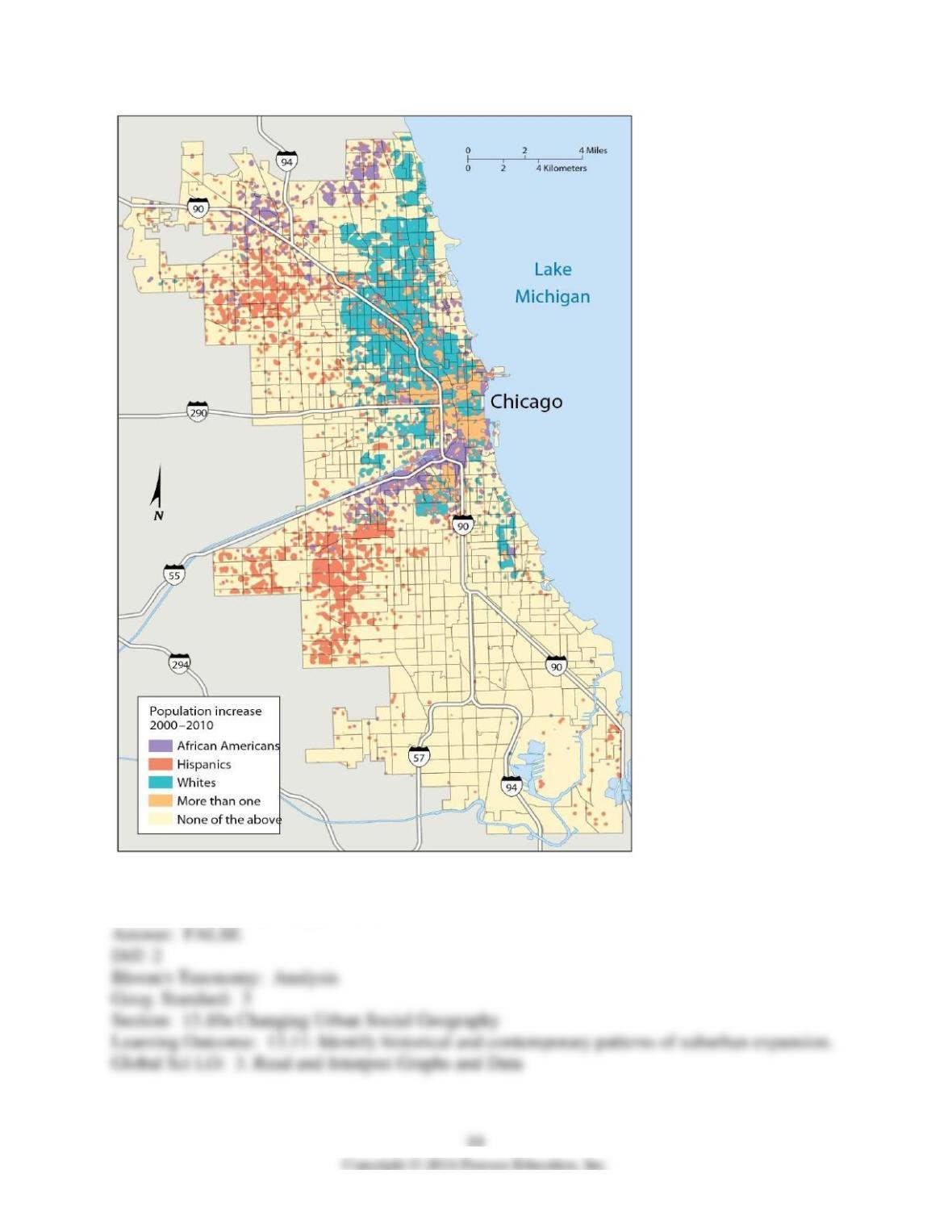
87) This map of Chicago indicates that virtually no whites live in the predominantly Hispanic
and African American neighborhoods.
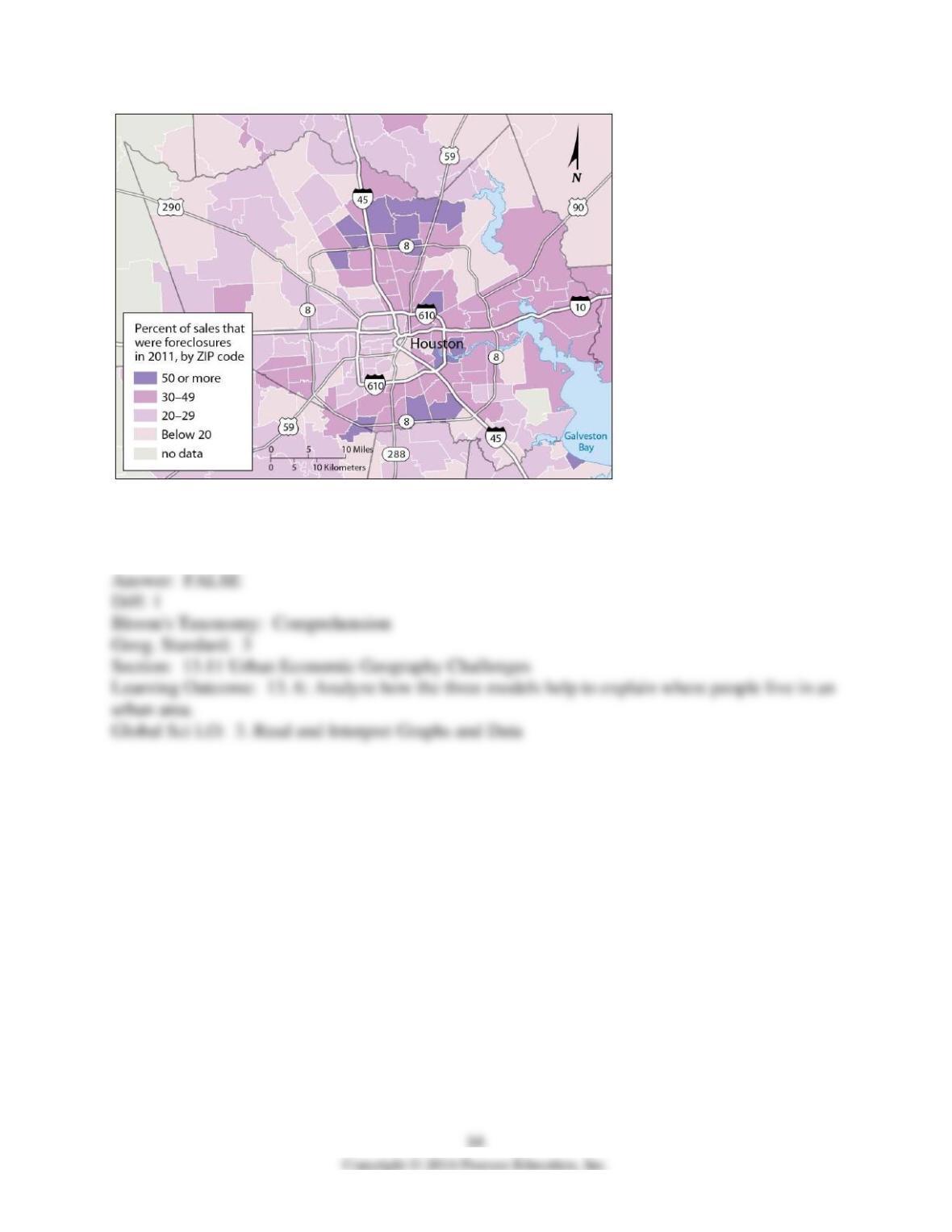
88) According to this map of foreclosures and home sales in Houston, a greater number of homes
were foreclosures in northern and southern areas of Houston than in eastern and western areas of
Houston.
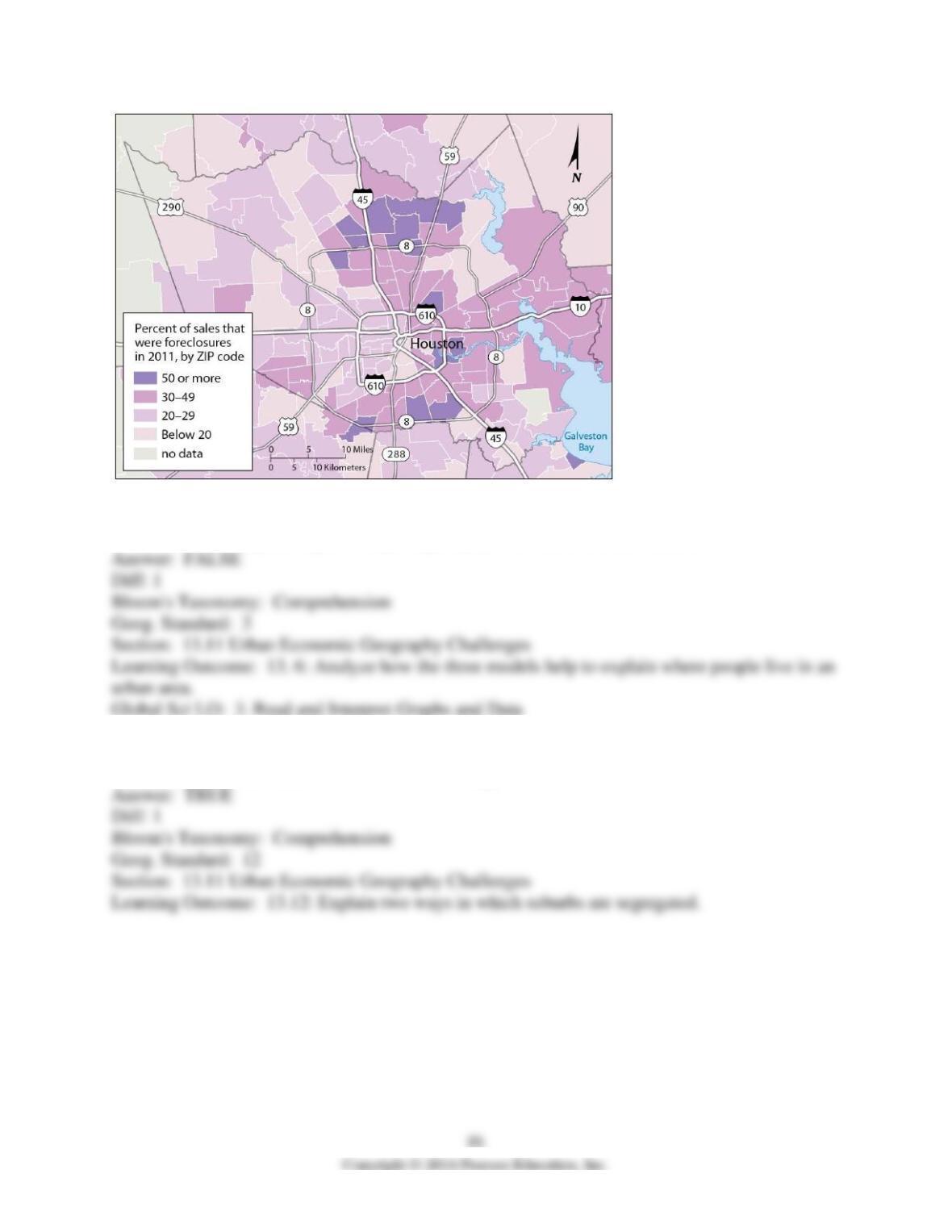
89) According to this map of foreclosures and home sales in Houston, most foreclosure sales
were clustered along the region’s major highways, where land was less valuable.
90) Housing in suburbs is typically built for people in a single social class, often excluding
others through cost, size, or location of the housing.
91) To what extent do the three models explain the internal structure of cities outside of North
America?
92) Describe similarities and differences in the central business districts of cities in the United
States and elsewhere in the world.
93) What kinds of changes would you expect to see in the short term, if the main employers in a
CBD were to relocate to another city? What long-term changes would follow if alternative
employers do not replace those who have departed?
94) What model of urban development does your present city or town most closely resemble? In
what ways do some specific parts of it also resemble the other urban models?
95) What is the zone in transition, and what are some of the social problems found there?
96) In your community, name and describe a neighborhood or area that seems to be a zone in
transition. How does the urban landscape of this zone compare to the typical zone in transition
described in this chapter?
97) In the history of the last 100 years, how has the automobile changed the form of cities?
98) How might advancements in automobile technologies further change the form of cities?
99) Envision a radical new plan of your own for using existing automobile technologies most
effectively, to positively impact human lives, city planning, and other societal concerns. How
would your plan solve or ameliorate some of the problems raised in this chapter?
100) Many scholars argue that U.S. cities are too dependant on automobiles. In your opinion,
assuming you must replace automobiles for a large proportion of the population, what alternative
modes of transportation seem most promising in terms of urban planning and individual lifestyle
choices?
101) What types of retail activities have you seen in your city’s CBD, and how do these compare
with the types predicted by our urban models?
102) Imagine that all of the skyscrapers in Chicago higher than 20 storeys would have to be
demolished for a combination of reasons involving safety, public health, and legal concerns, and
that no additional tall skyscrapers were allowed to be built in Illinois. Assuming that people
would still want to live and work in Chicago, how would the urban landscape and economy of
the city change as a result?
103) We may fool ourselves into thinking that cities serve only their human residents, but in
reality hundreds of millions of pets and other animals also inhabit cities in the United States
alone. Assuming that human concerns will not be forgotten, set those concerns aside for a
moment and consider cities as habitats for pets and wild animals. Now imagine that you are
authoring a plan to vastly improve the quality of life for all animals that currently inhabit your
city or neighborhood—but without lowering the quality of life for humans, of course. What
changes would you propose?
104) Describe the processes of blockbusting, filtering, and gentrification in inner-city
neighborhoods.
105) How should geographic knowledge best be used to reduce violence in urban areas?
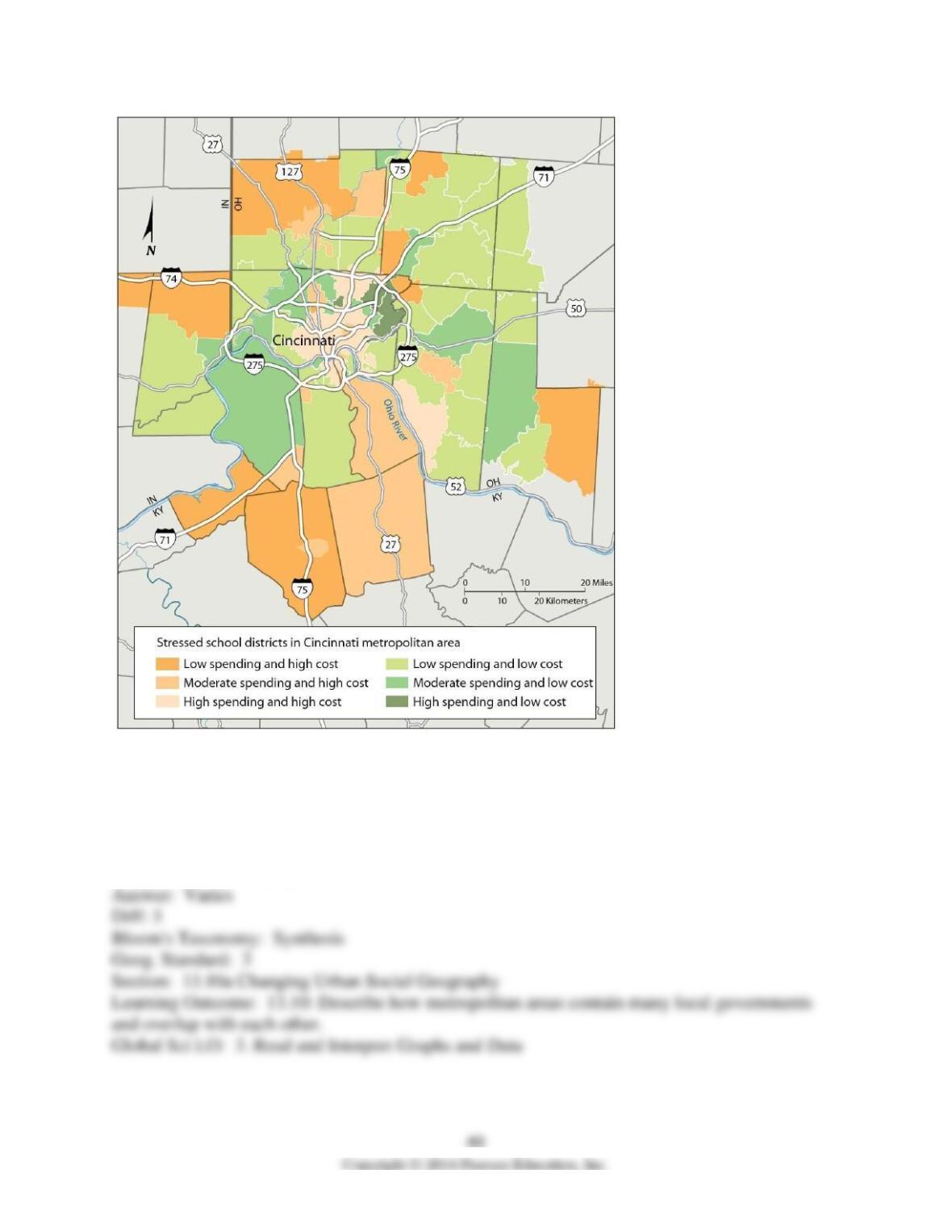
106) Analyze this map of stressed school districts. Imagine that you have been given the power
to redesign the city’s school system, as well as any other urban patterns that correlate to the
school system, specifically to relieve those stressed schools—as if this were a “war on poor
education” for which massive amounts of national, state, and local resources were made
available. What would you do to relieve these school districts? How radical would your plan be,
compared to the status quo?
107) The ethical dimensions of urban geography are sometimes ignored. For the purposes of this
question, imagine that our chief purpose is to increase levels of human fulfillment, justice, and
happiness rather than strengthen markets or increase monetary gains. What changes in the
discipline of geography would you propose to make this new directive come to fruition, at least
in your urban community?
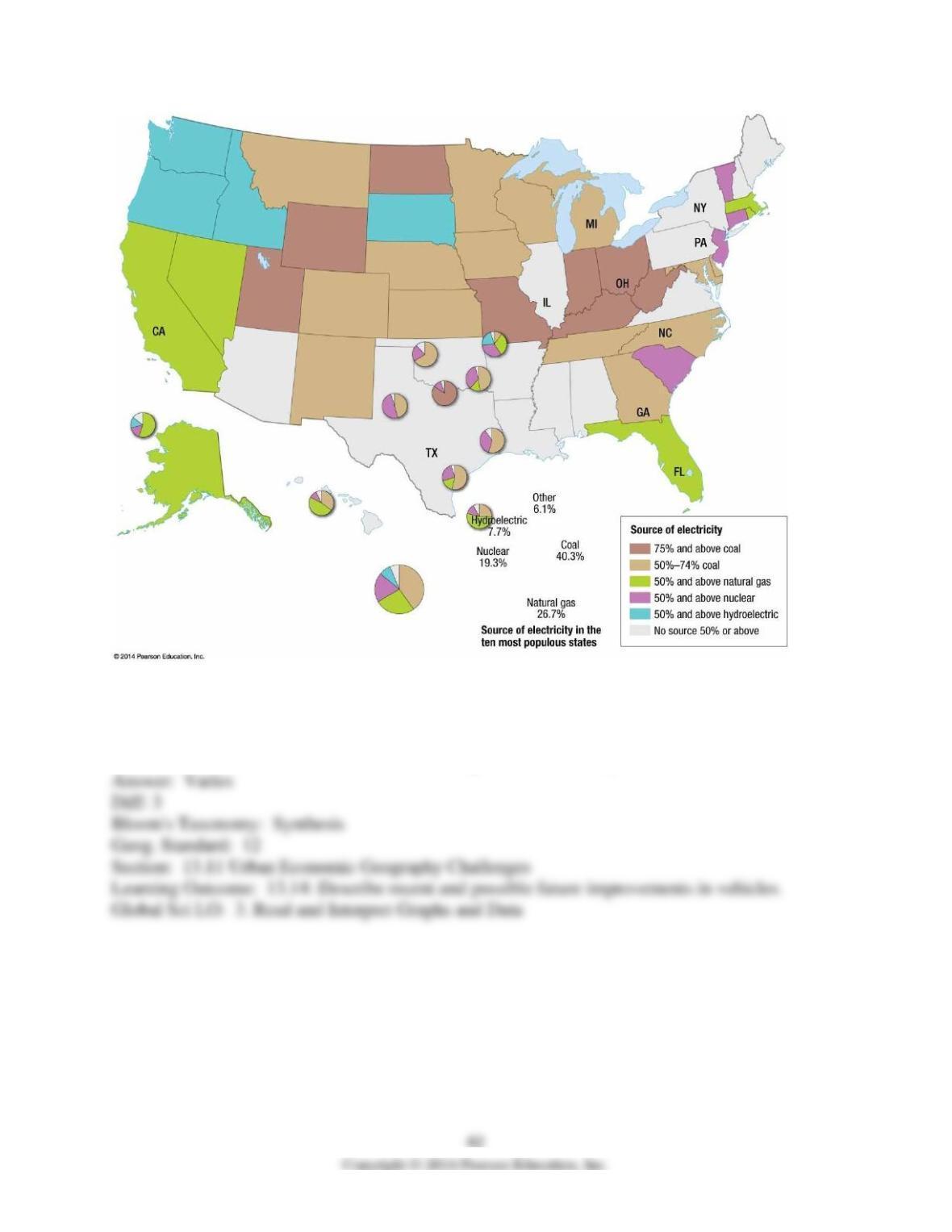
108) Looking at this map of U.S. electrical sources, what are the major sources of energy today
in the U.S. Southwest? What energy alternatives can you propose for the Southwest? Assuming
that your energy alternatives could be fully implemented in the next few years, what energy
options would then become available to other regions of the country as well?
109) Sometimes geographers, public officials, and market analysts are so involved with
questions of “how” to enact changes that we don’t pause enough to ask “why” or “whether we
should” aid specific types of developments in a city or neighborhood. In actuality, controversies
abound over urban transitions, gentrification, and plans involving new construction. Go online to
search for recent media coverage of controversial changes in your city or community, and ask
professors and fellow students about the ethical dimensions of those changes. What changes have
most residents been concerned about? What alternative plans have been proposed?
110) Rather than simply asking “how” to enact changes we should pause to ask “why” or
“whether we should” make specific kinds of changes in our communities. For example,
controversies abound over urban transitions, gentrification, and plans involving the construction
of new Walmart stores. Search for this kind of news coverage concerning a nearby community,
list some of the “pros” in favor of opening a new Walmart, and then discuss several of the “cons”
against the building of these stores. You should also speak with classmates, professors, and
community activists and evaluate their arguments concerning low wages, anti-union policies, and
the closing of smaller stores when a new Walmart arrives.
111) Given our concerns about the underclass, homelessness, ethnic and racial segregation, and
other problems in society today, invent a set of ethical guidelines that you believe that
geographers should follow in their work. Be as specific as possible, and use evidence from the
textbook to reinforce the ethical frameworks that you create.
112) Some environmentalists have recommended urban gardening and the raising of chickens
within urban areas as ways to improve urban living standards and dietary needs in poor areas.
Imagine the types of economic, social, and governmental barriers that these efforts might
encounter in different zones or neighborhoods of a large urban area. In which urban districts
might these efforts meet with more resistance? Less resistance? Why?
113) How do the ways in which food is produced, advertized, and “consumed” in the United
States today add unduly to our costs of transportation, public services, and urban poverty? What
changes could you propose that would have the most immediate beneficial impact on the nexus
between food, health, economics, and U.S. quality of life? Also, how much of a chance does
your plan have of succeeding, given the challenges in U.S. culture and society? In order to form
a more complete answer, synthesize information from previous chapters on agriculture, services,
and transportation with the concerns over urban growth and transition in this chapter.